
Students Labeled with Mental Retardation in Connecticut Analyses
Students Labeled with Mental Retardation in Connecticut Analyses of the ISSIS Database: Patterns of Labeling and Placement Testimony of James W. Conroy, Ph. D. The Center for Outcome Analysis
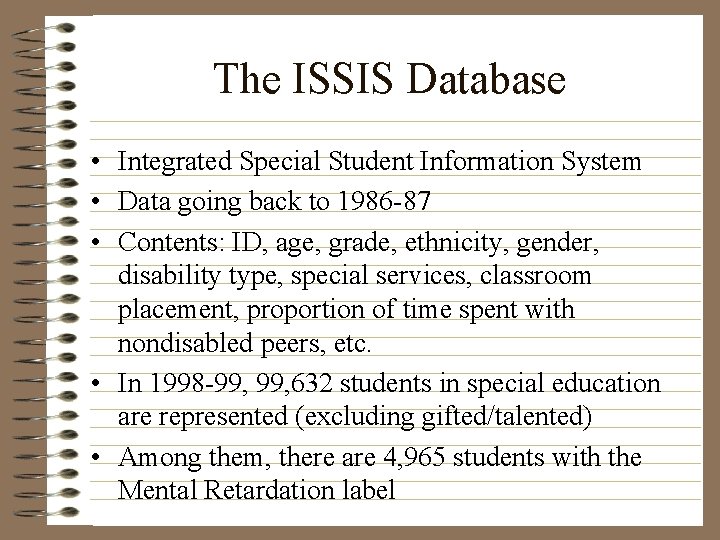
The ISSIS Database • Integrated Special Student Information System • Data going back to 1986 -87 • Contents: ID, age, grade, ethnicity, gender, disability type, special services, classroom placement, proportion of time spent with nondisabled peers, etc. • In 1998 -99, 632 students in special education are represented (excluding gifted/talented) • Among them, there are 4, 965 students with the Mental Retardation label
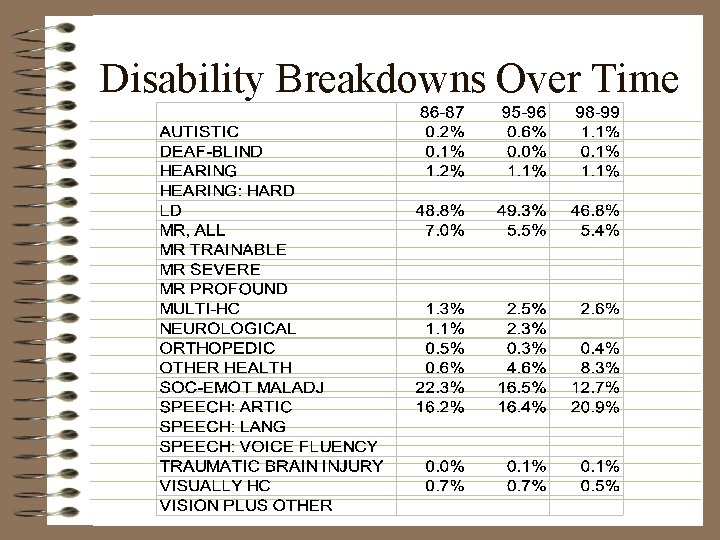
Disability Breakdowns Over Time
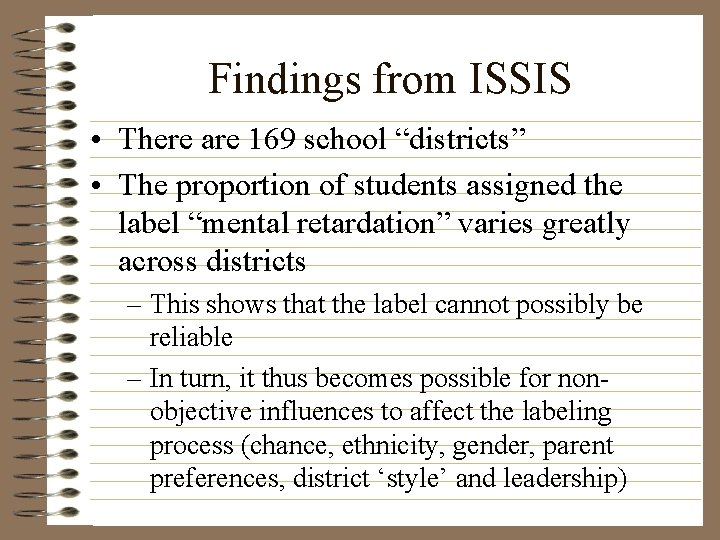
Findings from ISSIS • There are 169 school “districts” • The proportion of students assigned the label “mental retardation” varies greatly across districts – This shows that the label cannot possibly be reliable – In turn, it thus becomes possible for nonobjective influences to affect the labeling process (chance, ethnicity, gender, parent preferences, district ‘style’ and leadership)

View Data in Excel Spreadsheet File Name = CERPT 99 m. xls
Variations in Labeling • These variations cannot be explained by “social class” or ERG (Educational Reference Group) – [View Excel %MR by ERG] • Labels do in fact vary strongly according to ethnicity and gender

Once Students Enter Special Education, Which Labels Do They Receive?
What Can Possibly Explain This Pattern of Selective Labeling? • There is no clear explanation for this pattern of selective labeling and wide variations • We can conclude that it cannot be explained by poverty or social class – By district, %MR is correlated with %Minority, even when “controlling for” ERG via partial correlation r=. 47, then controlled r=. 44; – Data organized by district/ERG show the same conclusion
Labels Influence Placement (Regular Class Experiences) • The facts show that placement is strongly influenced by label (right or wrong, this is simply a fact shown by the data) – Percent of students in “regular class, ” now defined as 80% or more time spent with nondisabled peers, is a consistent measure – (We could also use % time directly, or hours per week, but for consistency, we stick to one measure in this presentation)
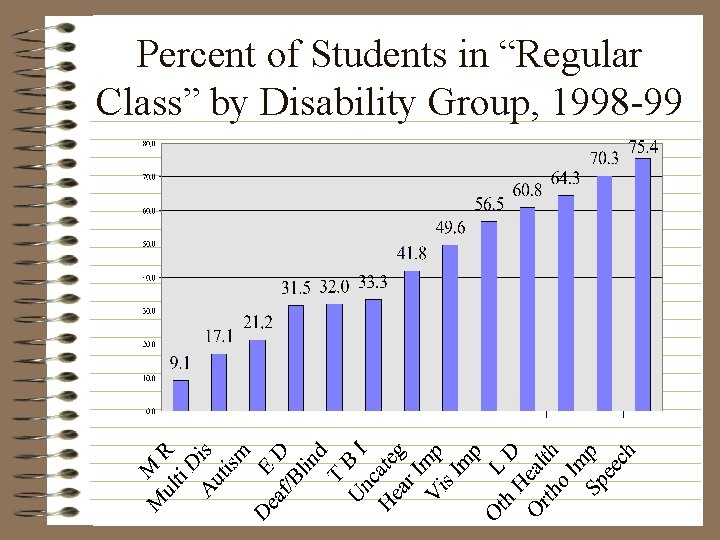
Percent of Students in “Regular Class” by Disability Group, 1998 -99
More Than Just Disability Group Influences Placement • There also direct effects of ethnicity and gender • The percentage of students experiencing segregated settings – (by the Federal definition of less than 40% of time is spent with nondisabled peers) • varies by ethnicity and gender, within the mental retardation group
Variations in Classroom Segregation (Students with the Mental Retardation Label)
Summary To This Point • Hence regular classroom experience is strongly affected by ethnicity and gender, and also by which district the student happens to live in • Students with mental retardation are far less likely to experience regular classrooms than students with other disabilities • Hence the ethnic/gender bias in mental retardation labeling, plus the tendency to exclude students with mental retardation, constitutes “double jeopardy” for minorities and females
Regular Class Experiences for Students with Mental Retardation • Segregation of students with mental retardation varies tremendously across school districts – [See Excel MR Place x LEA] • Even within Education Reference Groups (ERGs), the variations are huge, and therefore ERG cannot “explain” practices of exclusion – [See Excel MR Place x LEA x ERG]
Bias Unchanged Over Time • The pattern of ethnic and gender bias in labeling has not changed much since 1986 -87 • The regular classroom experiences of students with mental retardation has not changed much since 15 years ago – But the regular classroom experiences of other students with disabilities have changed radically for the better – Students with mental retardation have simply been “left behind”
Ethnic and Gender Bias in MR Labeling is Stable Over Time
Have Students with Mental Retardation Become “More Severe”? • The claim by state’s experts is that there have been increases in severity since mid 1970 s • This is trivial; many students with mental retardation, particularly severe, were not in the public education system at all in the mid -1970 s • From 1987 to 1996, the claim is patently untrue
Changes in Severity of Mental Retardation Over Time
How Has Regular Class Participation Changed in CT Over 15 Years? • For students with disabilities in general, considerable progress has been made • (As estimated from “Regular Classroom” in 1987 -87, and 80% or more time with nondisabled in 1999) • But for students with the Mental Retardation Label, …. .
Percent of Students in Regular Class: MR and Other, “Then and Now”
Progress Toward Regular Classes in Special Ed Has Been Made • Overall in CT • For students with most disabilities • But students with the Mental Retardation label have been “left behind”
- Slides: 21