
Studentled whole school mental health initiatives an example






- Slides: 22
Student-led, whole school mental health initiatives: an example from practice Cathy Atkinson, George Thomas, Natasha Goodhall, Laura Barker, Isabella Healey, Lucy Wilkinson & Jenny Ogunmyiwa Division of Educational and Child Psychology Conference, Brighton 11 January 2018 cathy. atkinson@manchester. ac. uk gthomas@bfet. uk
Mental health of young people (Do. H, Df. E, 2017, section 23) • • • The school environment is well suited to a graduated response to children’s mental health, where children at risk can be identified and interventions can by offered to address problems. As the school environment can present triggers for many difficulties (such as social anxiety), it is therefore a good place to find support to manage them. The school environment is non-stigmatising, making interventions offered in this context more acceptable to children and young people, and their parents.
Young people’s views about mental health (Children’s Commissioner, 2017) • • • Mental illness perceived by young people as attracting stigma. Limited awareness and understanding of mental health Conceptualisations of ‘mental illness’ are highly stereotyped, negative and limited. Young people experiencing difficulties are unsure of how to access support. ‘Self-stigma’ is often reinforced by the perception of and treatment by those around them.
Young people’s involvement in whole school strategies • Weare (2015) highlighted the importance of engaging the whole community when developing effective approaches to support mental health, proposing that genuine consultation could potentially promote self-efficacy and control. • However, suggestions for student involvement appeared to focus on decision-making about learning; and classroom and school life, overlooking the potential student contribution that students in helping develop effective mental health support and provision within a system.
Why do we need young people’s involvement in mental health strategy development? • It is debateable to what extent adults working within a school really understand the pressures experienced by students across school, home and community domains. • There are contemporary pressures, such as an increasingly outcome focused curriculum and diminishing opportunities for play and leisure, which many supporting adults may not have experienced. • While there are potential benefits to social media use, there is an association between excessive Internet use and mental health difficulties (Frith, 2017). Young people may be best positioned to understand these risks.
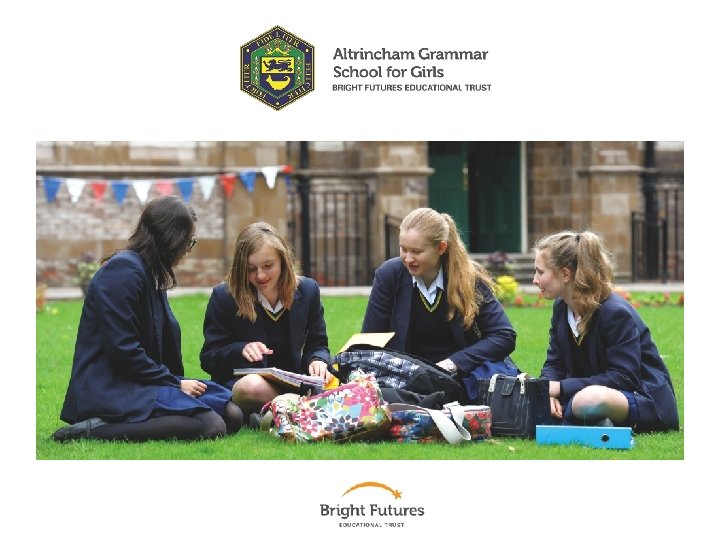
Mental health support within AGGS • Existing provision • Wellbeing ambassadors • Promoting the importance of wellbeing and supporting mental health • Reducing the stigma around mental health • Students from years 8 -13 who had undertaken the role of ‘Wellbeing Ambassador’ worked with EPs to devise a wholeschool, student-friendly mental health strategy
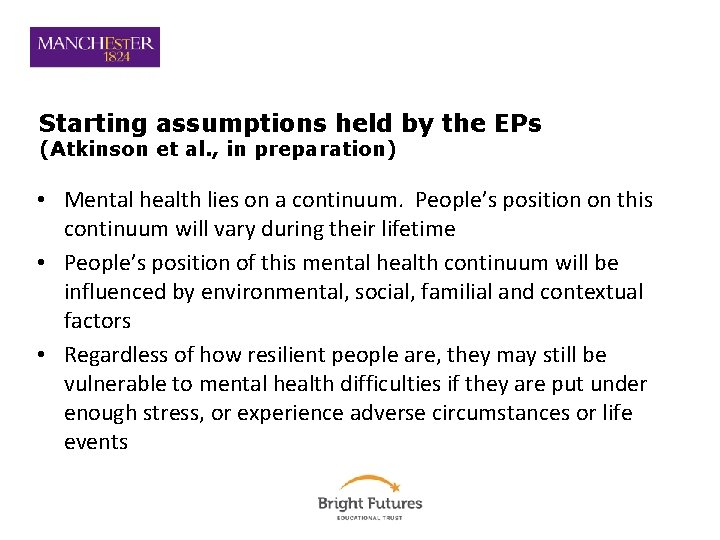
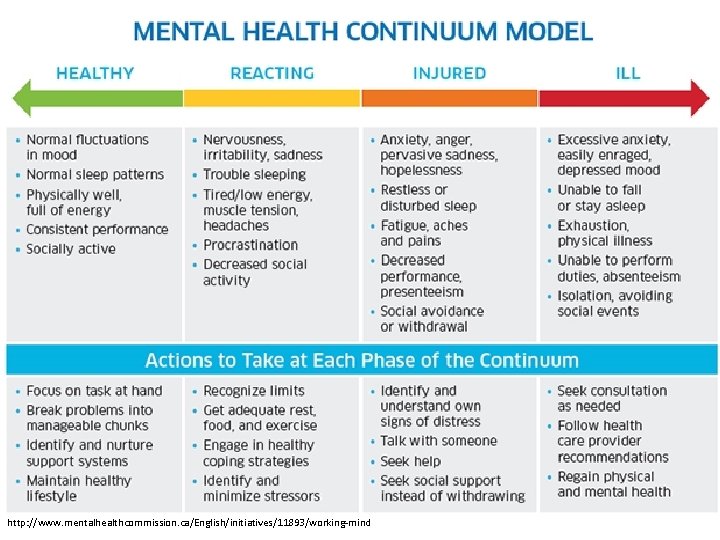
Starting assumptions held by the EPs (Atkinson et al. , in preparation) • Mental health lies on a continuum. People’s position on this continuum will vary during their lifetime • People’s position of this mental health continuum will be influenced by environmental, social, familial and contextual factors • Regardless of how resilient people are, they may still be vulnerable to mental health difficulties if they are put under enough stress, or experience adverse circumstances or life events
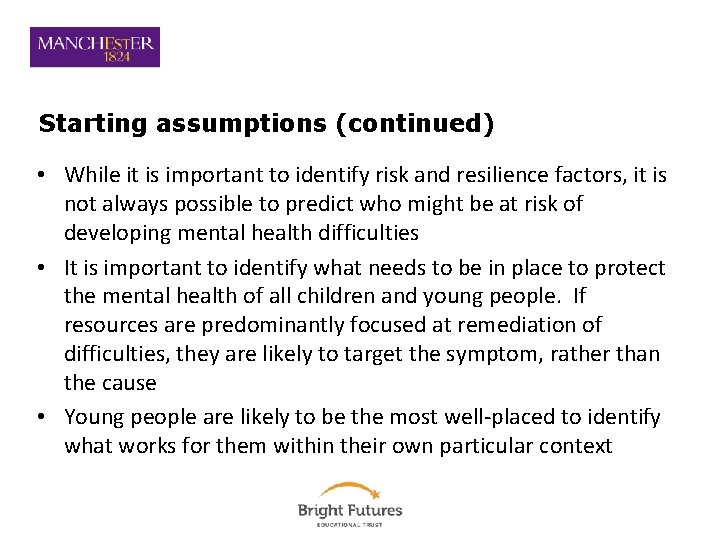
Starting assumptions (continued) • While it is important to identify risk and resilience factors, it is not always possible to predict who might be at risk of developing mental health difficulties • It is important to identify what needs to be in place to protect the mental health of all children and young people. If resources are predominantly focused at remediation of difficulties, they are likely to target the symptom, rather than the cause • Young people are likely to be the most well-placed to identify what works for them within their own particular context
http: //www. mentalhealthcommission. ca/English/initiatives/11893/working-mind
Universal support (available to everyone all of the time) ARE YOU PROMOTING YOUR OWN WELLBEING? (see tips for wellbeing) Anti-bullying ambassadors Anti-bullying blog Circle time Connexions advisor Extra-curricular clubs/exercise Form tutors and teachers Leaflets and information ‘Looking after myself’ page in school diary (p. 289 & 290) Wellbeing page on school website School nurse Sharp system on school website Wellbeing ambassadors Wellbeing page on school website Wellbeing space and wellbeing club Targeted support (when you need a bit of help) ARE YOU PROMOTING YOUR OWN WELLBEING? (see tips for wellbeing) Consultation with form tutor Consultation with senior tutor Pastoral mentoring School nurse Mental Health first aider Intensive support (when it’s really important that you talk to someone) ARE YOU PROMOTING YOUR OWN WELLBEING? (see tips for wellbeing) 42 nd Street counsellor 2 Child and adolescent mental health services (CAMHS)3 Educational psychologist 1 Relate counsellor 2 School nurse 1 (1 Referral via senior tutors; 2 Referral via senior tutors or self-referral; 3 Referral via school nurse) Wellbeing support available in Altrincham Girls Grammar School
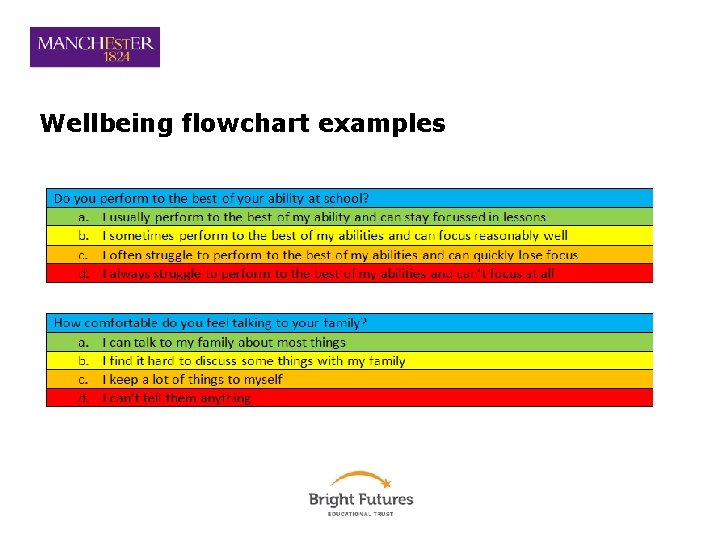
Wellbeing flowchart examples
First person summaries Mostly As Your mental health is good; you feel well in yourself and you’re feeling on top of things at home and in school. Nonetheless, it’s helpful to know that flashpoints can influence how you’re feeling. Strategies for maintaining your own wellbeing are listed below (see tips for wellbeing). Do remember that if your feelings ever change, support is available in school. Mostly Ds On the basis of your responses, it is important that you speak to somebody about how you’re feeling. Please see the range of support available in AGGS.
Flow chart (Barker, Healey & Wilkinson, 2017) • • Flow chart to be created and displayed Large image in central location Accessible to all students Allows independence in assessing own wellbeing and decision -making about support
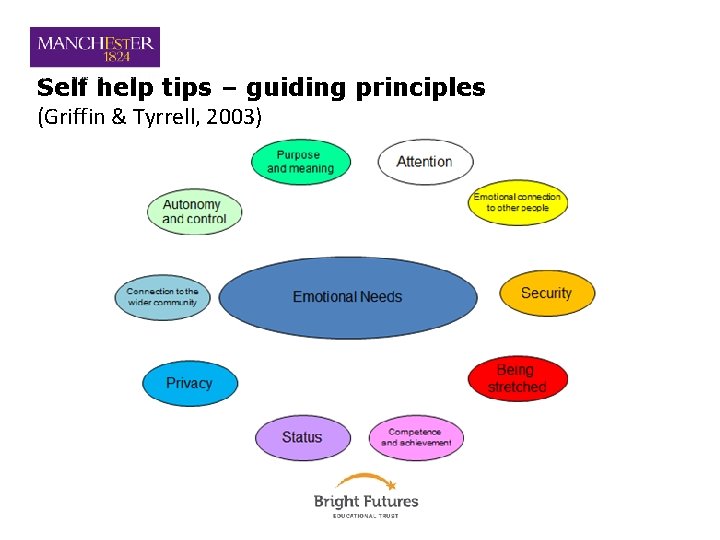
Self help tips – guiding principles (Griffin & Tyrrell, 2003)
Self help tips (example) (Informed by Griffin & Tyrrell, 2003; Stansfield & Gauntlett, 2014) Attention We not only need attention ourselves, but also need to give attention to other people. During times of stress (e. g. exams) it can be harder to spend time with friends and family members, and to give and receive attention as part of this two-way process. It is worth noting that like all emotional needs, our need for attention should be met in balance. Large amounts of attention can affect our self-image, cause us to behave in unhealthy ways and make genuine friendships more difficult.
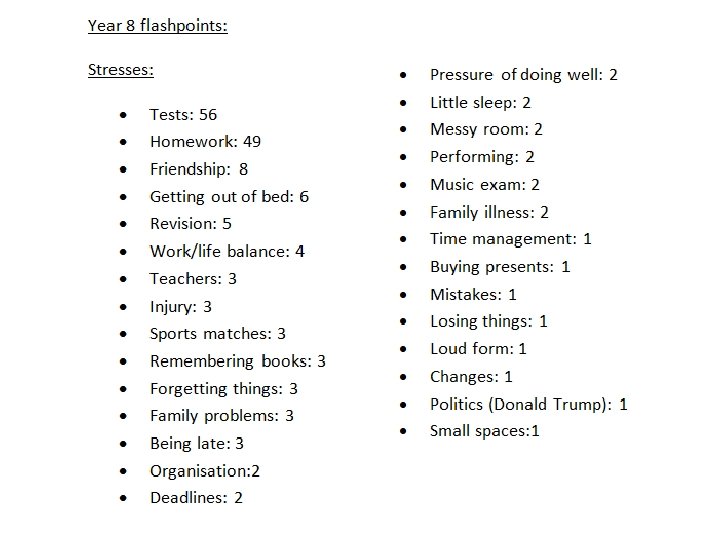
Flashpoints (Barker, Healey & Wilkinson, 2017) • At the wellbeing ambassadors’ meeting, flashpoints were identified, written on post-it notes and typed up • This list was presented to other students at [assemblies and in form time] using Power. Point • Lists have been refined for most year groups.
What we learned (as EPs!) • Applying even carefully-selected adult-mental health models to school contexts might not be appropriate • Students advocated for much more young-person friendly, innovative, contemporary and creative ways of communicating information about mental health • Students were well-placed to identify environmental stressors and to disseminate the agreed strategy • Materials produced by the students were designed to improve access to support; and to encourage dialogue and discussion about mental health, thus reducing stigma
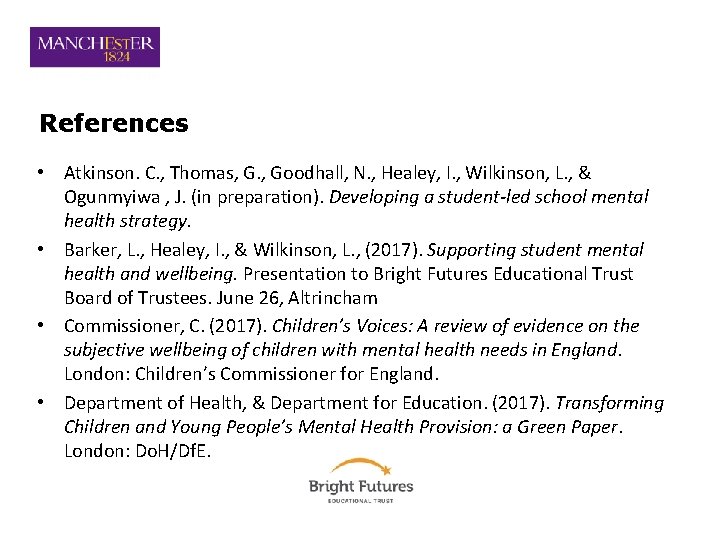
References • Atkinson. C. , Thomas, G. , Goodhall, N. , Healey, I. , Wilkinson, L. , & Ogunmyiwa , J. (in preparation). Developing a student-led school mental health strategy. • Barker, L. , Healey, I. , & Wilkinson, L. , (2017). Supporting student mental health and wellbeing. Presentation to Bright Futures Educational Trust Board of Trustees. June 26, Altrincham • Commissioner, C. (2017). Children’s Voices: A review of evidence on the subjective wellbeing of children with mental health needs in England. London: Children’s Commissioner for England. • Department of Health, & Department for Education. (2017). Transforming Children and Young People’s Mental Health Provision: a Green Paper. London: Do. H/Df. E.
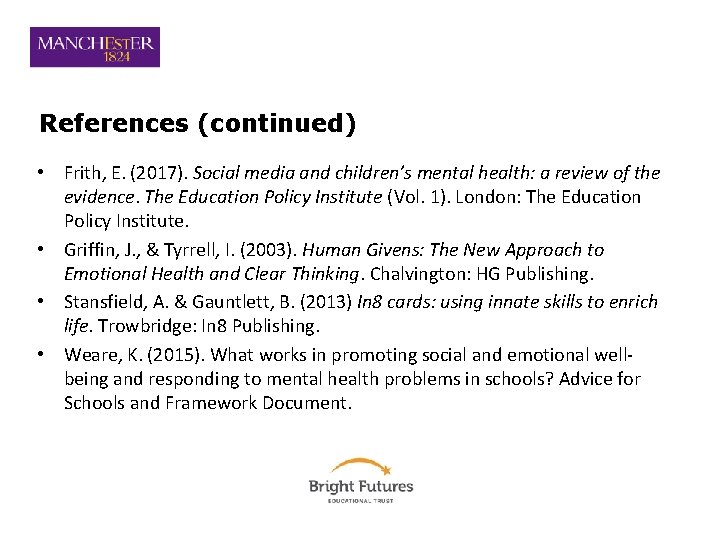
References (continued) • Frith, E. (2017). Social media and children’s mental health: a review of the evidence. The Education Policy Institute (Vol. 1). London: The Education Policy Institute. • Griffin, J. , & Tyrrell, I. (2003). Human Givens: The New Approach to Emotional Health and Clear Thinking. Chalvington: HG Publishing. • Stansfield, A. & Gauntlett, B. (2013) In 8 cards: using innate skills to enrich life. Trowbridge: In 8 Publishing. • Weare, K. (2015). What works in promoting social and emotional wellbeing and responding to mental health problems in schools? Advice for Schools and Framework Document.