
StudentDirected Transition Planning StudentDirected Transition Planning Vision for
- Slides: 53
Student-Directed Transition Planning
Student-Directed Transition Planning Vision for Employment Strengths & Needs Gathering Input 1
Student-Directed Transition Planning Input Circle 2
Student-Directed Transition Planning Transition Journey In the Awareness lesson you talked with your family and identified: • Important values that you share. • Dreams that you share about your future. Image is the copyrighted property of Jupiter. Image and is used with permission under license 3
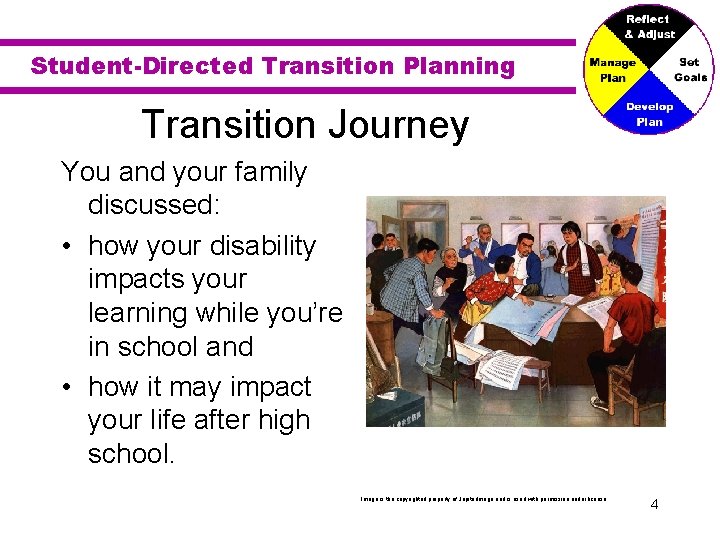
Student-Directed Transition Planning Transition Journey You and your family discussed: • how your disability impacts your learning while you’re in school and • how it may impact your life after high school. Image is the copyrighted property of Jupiter. Image and is used with permission under license 4
Student-Directed Transition Planning Transition Journey…continued In Transition Terms and Concepts you learned: • concepts and terms used to discuss your post-high school plans. • about the transition planning process. Image is the copyrighted property of Jupiter. Image and is used with permission under license 5
Student-Directed Transition Planning Vision for Employment • This lesson will help you to identify, talk with others about, and record your employment preferences, interests, strengths and needs. • Your employment vision will become clearer as you develop plans with your family, teachers, and other people who you respect. 6
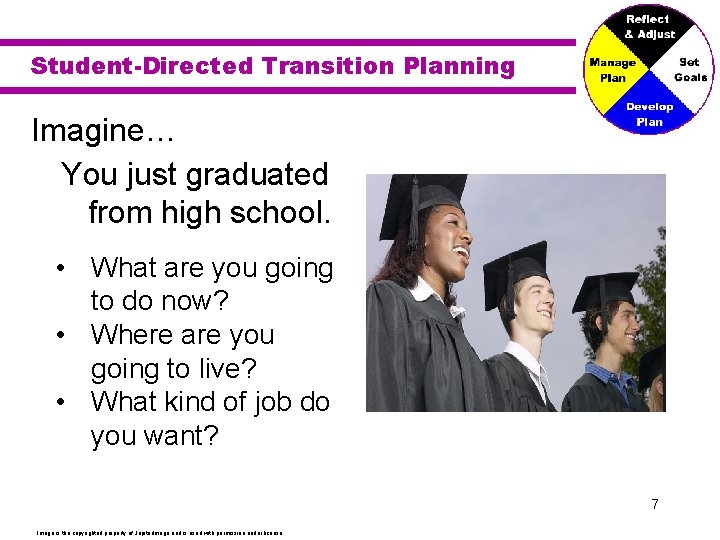
Student-Directed Transition Planning Imagine… You just graduated from high school. • What are you going to do now? • Where are you going to live? • What kind of job do you want? 7 Image is the copyrighted property of Jupiter. Image and is used with permission under license
Student-Directed Transition Planning Vision for Employment Your dream job to earn money so you can help others, feel good about yourself, live where you want, and have fun. • Your family may have a vision for what kind of job you might do. 8
Student-Directed Transition Planning What did you want to be: • In Elementary School? • In Middle School or Junior High? • Now? – How have your ideas changed over the years? Why? 9
Student-Directed Transition Planning Homework Activity • You will take the activity sheet home and have 1 or 2 family members answer questions about what they thought you would be when you grew up. • We’ll discuss your thoughts and those of your family members in class. 10
Student-Directed Transition Planning Vision for Employment • How did you know what kind of job you wanted as you got older? • What made you want to do these jobs? • What ideas did your family members come up with for you? Image is the copyrighted property of Jupiter. Image and is used with permission under license 11
Student-Directed Transition Planning Vision for Employment § § § Your preferences guide you toward what you want to be. Your interests, strengths, and needs also affect your choices. Your parents consider these things, and what is good for your whole family. 12
Student-Directed Transition Planning Vision for Employment • Preferences - A preference is liking one job over another. – You may have a preference for a welding career rather than construction. – You might have a preference to work with animals in a veterinarian’s office rather than in a pet store. What are your preferences for employment after high school? What are your family’s preferences for your employment? 13
Student-Directed Transition Planning Vision for Employment • Interests - Jobs you like and want to learn more about or do. What are your job interests? What are the interests your family has for you? 14
Student-Directed Transition Planning Vision for Employment Strengths - What you do well on a job • What are your strengths? • What does your family think are your strengths? • What are your family’s strengths? • Describe some strengths of your community. 15
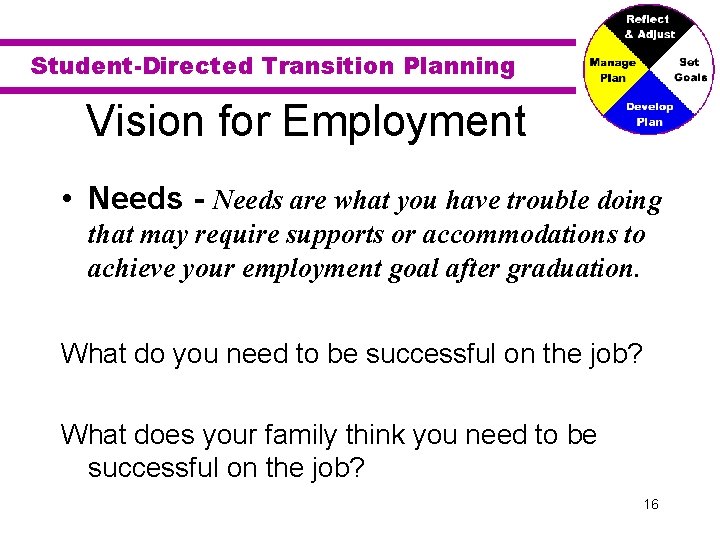
Student-Directed Transition Planning Vision for Employment • Needs - Needs are what you have trouble doing that may require supports or accommodations to achieve your employment goal after graduation. What do you need to be successful on the job? What does your family think you need to be successful on the job? 16
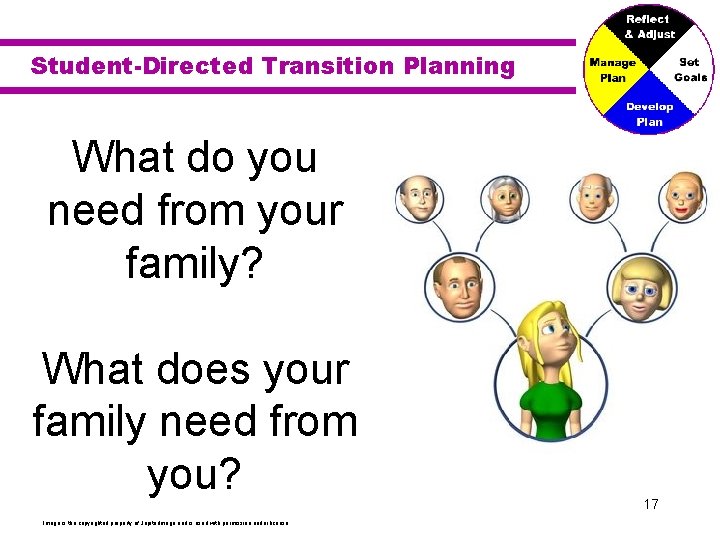
Student-Directed Transition Planning What do you need from your family? What does your family need from you? Image is the copyrighted property of Jupiter. Image and is used with permission under license 17
Student-Directed Transition Planning Transition IEP • In the Terms & Concepts lesson you found where your interests, strengths and needs were located on an IEP. • The transition pages of your IEP specifically address your interests and preferences, strengths, and needs about employment. • Find this section. 18
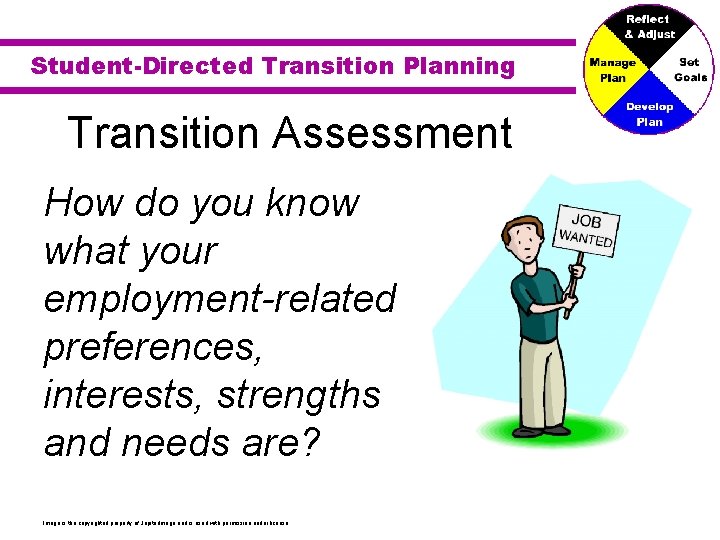
Student-Directed Transition Planning Transition Assessment How do you know what your employment-related preferences, interests, strengths and needs are? Image is the copyrighted property of Jupiter. Image and is used with permission under license
Student-Directed Transition Planning Transition Assessment for Employment • The process of collecting information about your preferences, interests, strengths, and needs for employment. 20
Student-Directed Transition Planning Assessment • Measures of your job interests, strengths, needs, and performance • Job locations could be on school or in your community. • Observations, on-the-job try-outs and internships, interviews, comments from supervisors, or paper/pencil tests. 21
Student-Directed Transition Planning Functional Vocational Evaluation • A transition service that matches your interests and skills to actual jobs, or that matches your needs with those of your family to jobs that you can do. • Can be done at school, or in the community. 22
Student-Directed Transition Planning Present Levels Section May include: • A written statement that combines information gathered from assessments and your thoughts about your employment interests, strengths and needs. 23
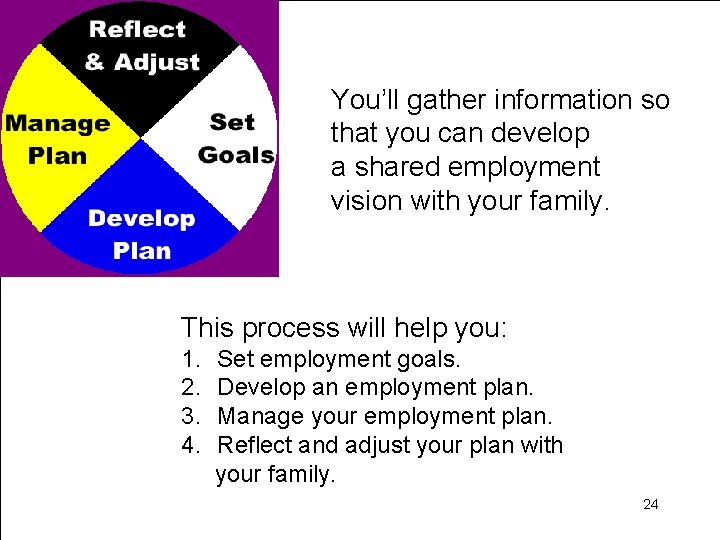
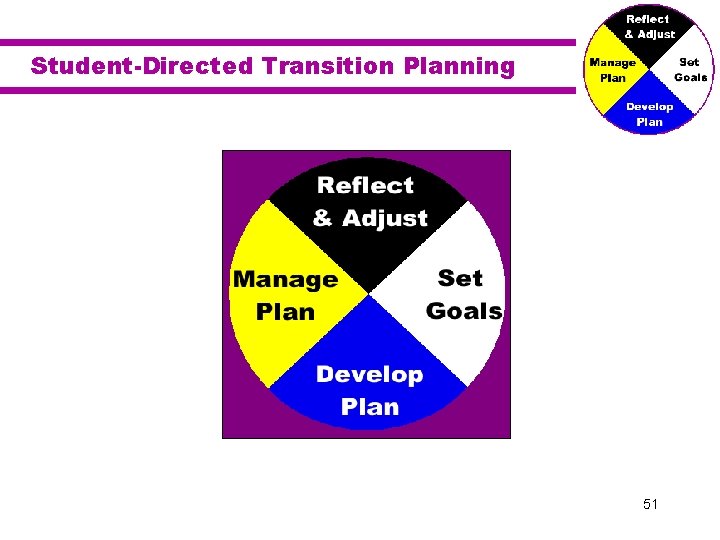
Student-Directed Transition Planning You’ll gather information so that you can develop a shared employment vision with your family. This process will help you: 1. 2. 3. 4. Set employment goals. Develop an employment plan. Manage your employment plan. Reflect and adjust your plan with your family. 24
Student-Directed Transition Planning Activity: Putting it all Together • Let’s review how to use the Input Circle • Then, we’ll see an example of a student using the Input Circle to detail his interests, strengths, and needs regarding his employment vision. 25
Student-Directed Transition Planning Input Circle • The Input Circle helps pull your thoughts together for your transition planning meeting. • It helps clarify your thoughts so you can talk about your employment vision. 26
Student-Directed Transition Planning Input Circles • You gathered information about your disability in the Awareness lesson. • Let’s review what goes in each section. Information from your family. Statement that combines your Ideas and input with family’s & teachers’. Information from your teachers. 27
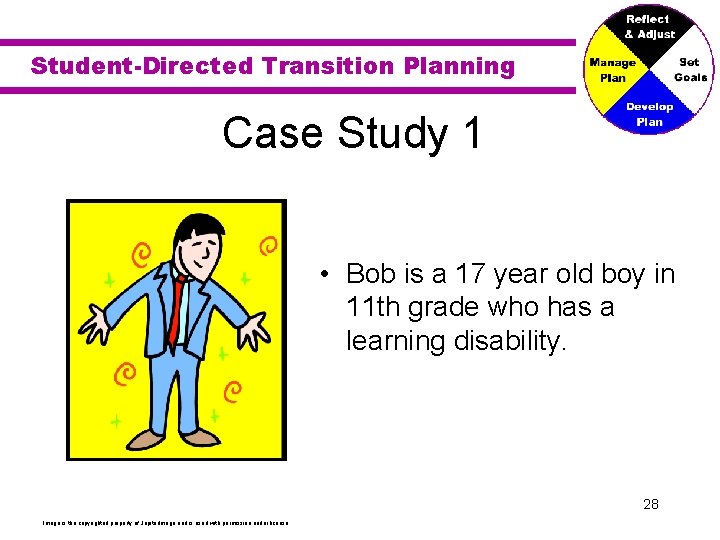
Student-Directed Transition Planning Case Study 1 • Bob is a 17 year old boy in 11 th grade who has a learning disability. 28 Image is the copyrighted property of Jupiter. Image and is used with permission under license
Student-Directed Transition Planning Employment Interests • Bob wrote a statement about the things he was interested in doing. • His answer showed some of the work experience he had with scouting and a summer camp. I’ve always liked being outdoors. I like teaching other kids about things in nature. . 29
Student-Directed Transition Planning Employment Interests • Bob asked his parents what job they think he would like to do after high school. • They gave answers based on things he had done at home and in his community. • They talked about his interests and skills. I’ve always liked being outdoors. I like teaching other kids about things in nature. Bob is very responsible and likes working with people and with kids at his church. . We’d like him to work in a park, and teach nature to kids, hopefully, near home. 30
Student-Directed Transition Planning Employment Interests • • Bob’s teacher talked about the things that seemed to interest him most at school. Natural science and environmental issues are strong areas for Bob. His Vocational Interest Inventory showed his strong preference for environmental work. I’ve always liked being outdoors. I like teaching other kids about things in nature. Bob is very responsible and likes working with people and with kids at his church. . We’d like him to work in a park, and teach nature to kids, hopefully, near home. Bob is interested in natural science and environmental issues. His Vocational Interest Inventory showed a strong preference for environmental jobs. 31
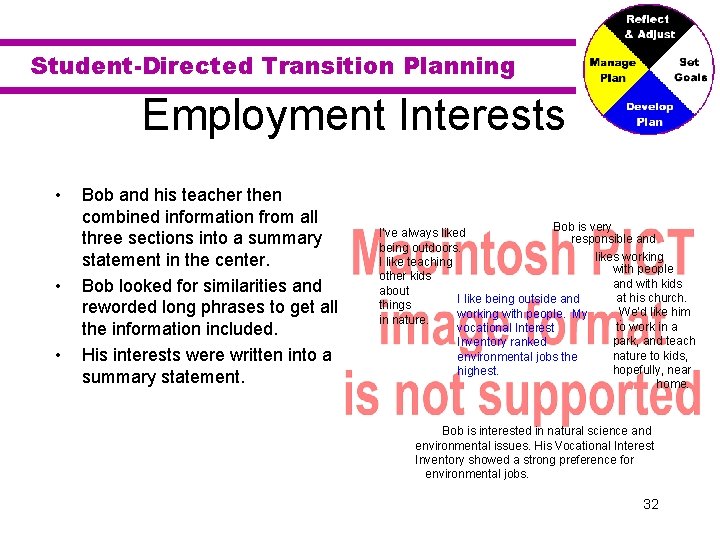
Student-Directed Transition Planning Employment Interests • • • Bob and his teacher then combined information from all three sections into a summary statement in the center. Bob looked for similarities and reworded long phrases to get all the information included. His interests were written into a summary statement. Bob is very I’ve always liked responsible and being outdoors. likes working I like teaching with people other kids and with kids about at his church. I like being outside and things working with people. My. We’d like him in nature. to work in a vocational Interest park, and teach Inventory ranked nature to kids, environmental jobs the hopefully, near highest. home. Bob is interested in natural science and environmental issues. His Vocational Interest Inventory showed a strong preference for environmental jobs. 32
Student-Directed Transition Planning Employment Strengths • • • Bob asked his parents what they thought were his strong job skills. They gave answers based on jobs he had done around the house, as well as how he did with his summer job. They talked about his strengths. Bob is very responsible and respectful. He likes working with people and is good with money. 33
Student-Directed Transition Planning Employment Strengths • Bob wrote down what he thought he was good at and what an employer might like about him. • He thought about his past paid and unpaid work experience. • He talked about his interests and skills. I’m responsible and I always show up on time and ready to work. I did well at my camp job with the park. Bob is very responsible and respectful. He likes working with people and is good with money. 34
Student-Directed Transition Planning Employment Strengths • Bob talked with his teacher about what he was good at and what an employer might like about him. • She talked about his strengths based on formal and informal assessments. I’m responsible and I always show up on time and ready to work. I did well at my camp job with the park. Bob is very responsible and respectful. He likes working with people and is good with money. Bob scored a 77% on the ESTR-J employment readiness scale. Strengths include respect for authority figures punctuality and attendance, and interpersonal skills. 35
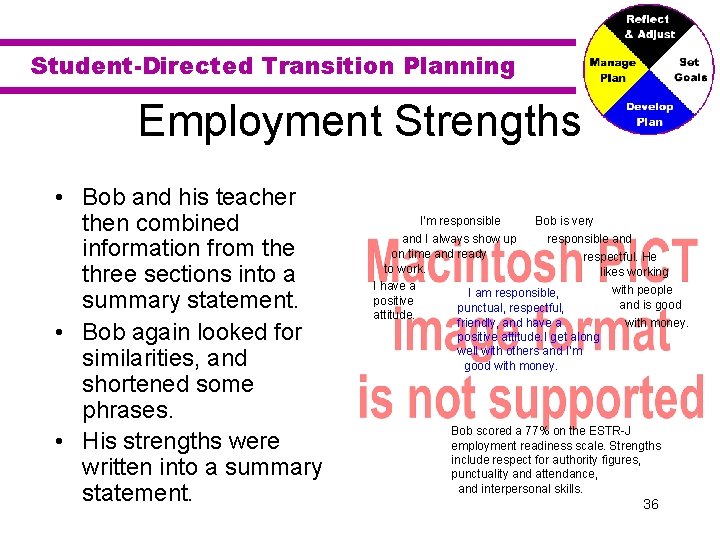
Student-Directed Transition Planning Employment Strengths • Bob and his teacher then combined information from the three sections into a summary statement. • Bob again looked for similarities, and shortened some phrases. • His strengths were written into a summary statement. I’m responsible Bob is very responsible and I always show up on time and ready respectful. He to work. likes working I have a with people I am responsible, positive and is good punctual, respectful, attitude. friendly, and have a with money. positive attitude. I get along well with others and I’m good with money. Bob scored a 77% on the ESTR-J employment readiness scale. Strengths include respect for authority figures, punctuality and attendance, and interpersonal skills. 36
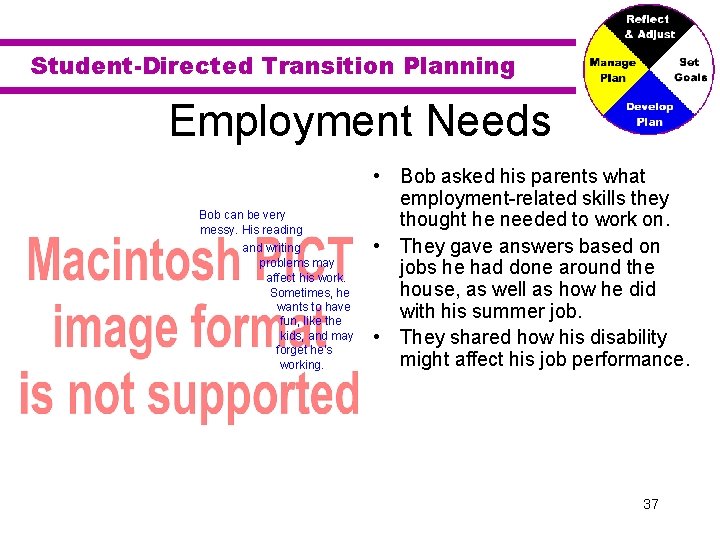
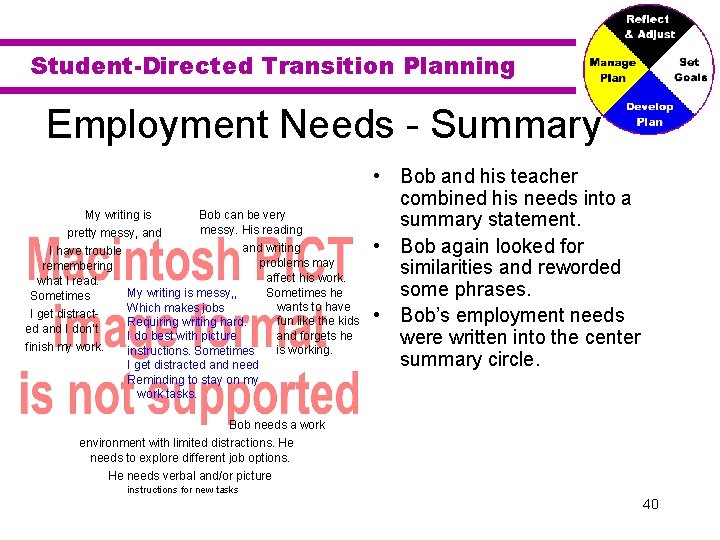
Student-Directed Transition Planning Employment Needs Bob can be very messy. His reading and writing problems may affect his work. Sometimes, he wants to have fun, like the kids, and may forget he’s working. • Bob asked his parents what employment-related skills they thought he needed to work on. • They gave answers based on jobs he had done around the house, as well as how he did with his summer job. • They shared how his disability might affect his job performance. 37
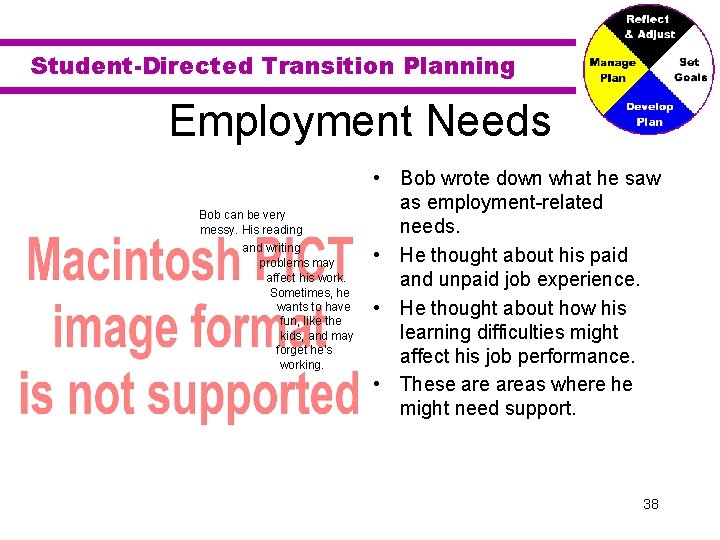
Student-Directed Transition Planning Employment Needs My writing is pretty messy, and I have trouble remembering what I read. Sometimes I get distracted and I don’t finish my work. Bob can be very messy. His reading and writing problems may affect his work. Sometimes, he wants to have fun, like the kids, and may forget he’s working. • Bob wrote down what he saw as employment-related needs. • He thought about his paid and unpaid job experience. • He thought about how his learning difficulties might affect his job performance. • These areas where he might need support. 38
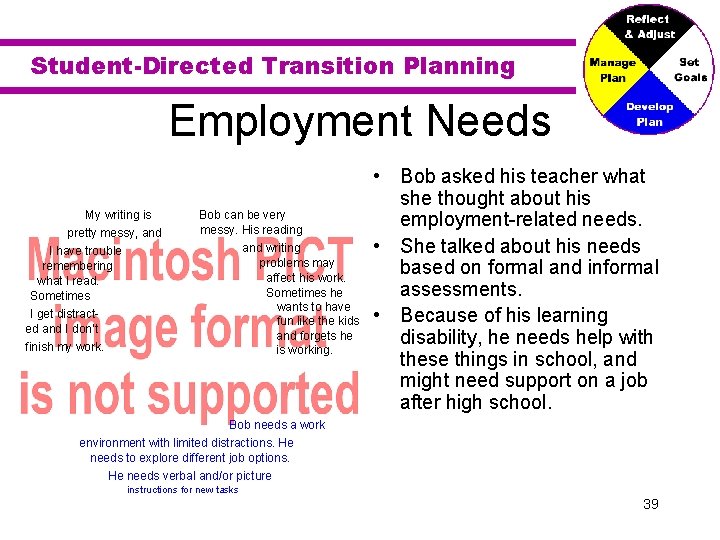
Student-Directed Transition Planning Employment Needs My writing is pretty messy, and I have trouble remembering what I read. Sometimes I get distracted and I don’t finish my work. Bob can be very messy. His reading and writing problems may affect his work. Sometimes he wants to have fun like the kids and forgets he is working. • Bob asked his teacher what she thought about his employment-related needs. • She talked about his needs based on formal and informal assessments. • Because of his learning disability, he needs help with these things in school, and might need support on a job after high school. Bob needs a work environment with limited distractions. He needs to explore different job options. He needs verbal and/or picture instructions for new tasks 39
Student-Directed Transition Planning Employment Needs - Summary My writing is Bob can be very messy. His reading pretty messy, and writing I have trouble problems may remembering affect his work. what I read. Sometimes he My writing is messy, , Sometimes wants to have Which makes jobs I get distractfun like the kids Requiring writing hard. ed and I don’t and forgets he I do best with picture finish my work. is working. instructions. Sometimes I get distracted and need Reminding to stay on my work tasks. • Bob and his teacher combined his needs into a summary statement. • Bob again looked for similarities and reworded some phrases. • Bob’s employment needs were written into the center summary circle. Bob needs a work environment with limited distractions. He needs to explore different job options. He needs verbal and/or picture instructions for new tasks 40
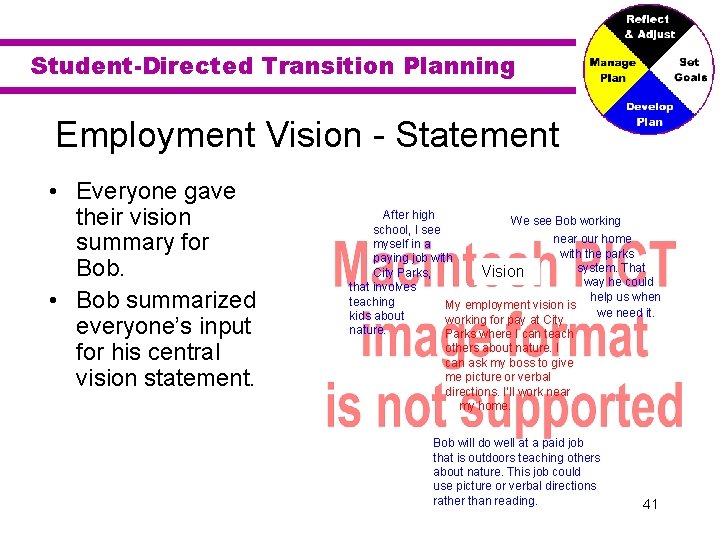
Student-Directed Transition Planning Employment Vision - Statement • Everyone gave their vision summary for Bob. • Bob summarized everyone’s input for his central vision statement. After high We see Bob working school, I see near our home myself in a with the parks paying job with system. That City Parks, Vision way he could that involves help us when teaching My employment vision is we need it. kids about working for pay at City nature. Parks where I can teach others about nature. I can ask my boss to give me picture or verbal directions. I’ll work near my home. Bob will do well at a paid job that is outdoors teaching others about nature. This job could use picture or verbal directions rather than reading. 41
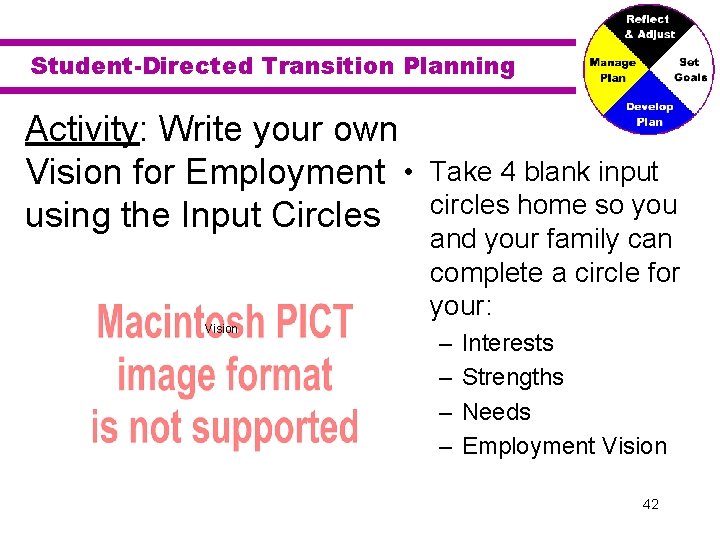
Student-Directed Transition Planning Activity: Write your own Vision for Employment • using the Input Circles Vision Take 4 blank input circles home so you and your family can complete a circle for your: – – Interests Strengths Needs Employment Vision 42
Student-Directed Transition Planning Activity: Teacher Input • Gather information provided by your teacher regarding results of any formal or informal employment assessments that you’ve completed. 43
Student-Directed Transition Planning Activity: Interests, Strengths & Needs Summary Statements Students review all input from their outer circles to make summary statements for 1) strengths input circle 2) interests input circle 3) needs input circle. 44
Student-Directed Transition Planning Interests Summary Statement • Write your “Inner Circle” summary statement about your employment interests that includes your family’s and teachers’ outer circle input. 45
Student-Directed Transition Planning Strengths Summary Statement • Write your “Inner Circle” summary statement about your employment strengths that includes your family‘s and teacher’s outer circle input. 46
Student-Directed Transition Planning Needs Summary Statement • Write your “inner circle” summary statement about your employment needs including your family’s and teacher’s outer circle input. 47
Student-Directed Transition Planning Vision for Employment Statement Vision • After reviewing everyone’s summary statements for your interests, strengths and needs, your Employment Vision is written in the center of the Vision Input Circle. 48
Student-Directed Transition Planning Share Employment Vision • Share your Employment Vision with the class 49
Student-Directed Transition Planning Homework • Share your Employment Vision with your family. • Make changes as needed. • Have a family member sign the homework. 50
Student-Directed Transition Planning 51
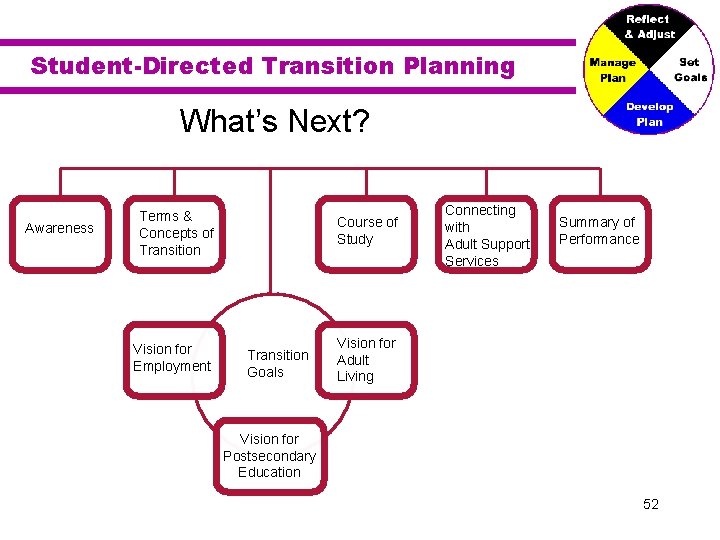
Student-Directed Transition Planning What’s Next? Awareness Terms & Concepts of Transition Vision for Employment Course of Study Transition Goals Connecting with Adult Support Services Summary of Performance Vision for Adult Living Vision for Postsecondary Education 52