
STUDENT REPRESENTATIVE COUNCIL 2020 DOCUMENT PRESENTED BY SRC
STUDENT REPRESENTATIVE COUNCIL 2020 DOCUMENT PRESENTED BY SRC Deputy President –Nyakallo Mokoena SRC GHETTO Officer_- Khethelo

1) STUDENT GOVERNANCE �The Student Representative Council has now been recognized as an important stakeholder in the College. �The new changes/amendments in the Constitution For Student Governance have taken a more direct and just right approach for the requirements of Good Leadership. �Students know feel as though the Student Representative Council will be held to account should they fail to execute their responsibilities. “Dispel the notion that technical and vocational education is for students who cannot get into universities. Our TVET colleges must be institutions that produce the technicians and leaders of the future. ” Deputy Minister of DHET – Buti Manamela
2) ACCOMMODATION �College needs to build or acquire more student residences as the current residences are either full or like currently, one is being renovated for future use. �The main issue raised by students is the exorbitant fees charged by private accommodation owners which can only be afforded by University students, cash-paying students and also those students who are funded by different higher allowance bursaries. �The state of some of these accommodations are so bad that we technically cannot be allowing students to be staying in them. “Dispel the notion that technical and vocational education is for students who cannot get into universities. Our TVET colleges must be institutions that produce t technicians and leaders of the future. ” Deputy Minister of DHET – Buti Manamela
FINANCIAL AID The counter productivity of NSFAS Further Education and Training college attendance policy �Delayed Nsfas payments produce a poor perfomance on class attendance as Nsfas reciepient students use buses and taxis to commute to get to school, this consequently affects the 80% attendance policy �Delayed Nsfas payments also have an adverse effect on student safety, students are forced to rely on other alternative measures to get to school, many of them walk to their respective campuses using unsafe routes and endangering roads on a daily basis. “Dispel the notion that technical and vocational education is for students who cannot get into universities. Our TVET colleges must be institutions that produce the technicians and leaders of the future. ” Deputy Minister of DHET – Buti Manamela
TEACHING AND LEARNING The state of work readiness OUTDATED COURSES AND OUTDATED TEXTBOOKS �Irrelevant curricular disqualifies students from being employable, this also demotivates a great aspect of academic excellence in the TVET sector. �Outdated textbooks discourage the quality of teaching mainly because of the standard of their content. �TVET college lecturers are under skilled and this negatively impacts teaching which furthermore increases the retention rate. “Dispel the notion that technical and vocational education is for students who cannot get into universities. Our TVET colleges must be institutions that produce the technicians and leaders of the future. ” Deputy Minister of DHET – Buti Manamela
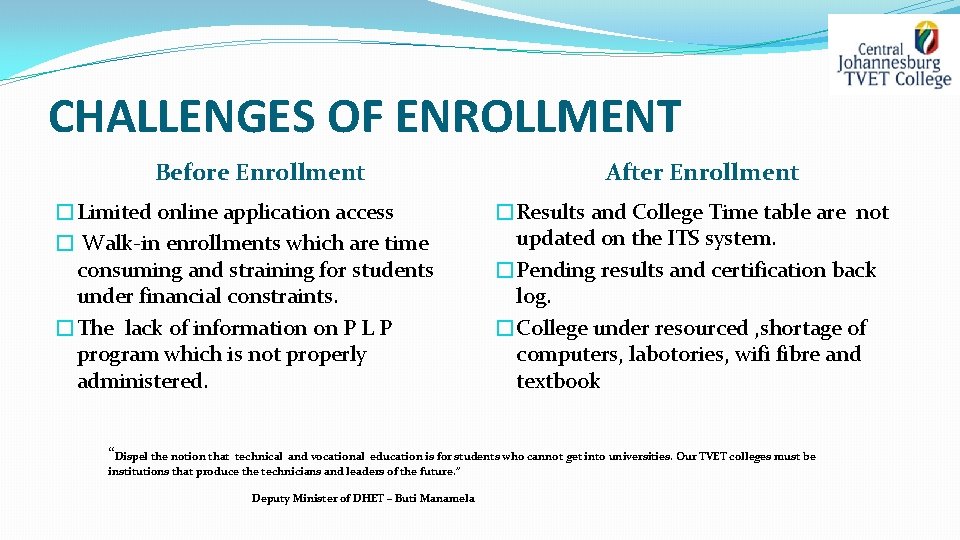
CHALLENGES OF ENROLLMENT Before Enrollment �Limited online application access � Walk-in enrollments which are time consuming and straining for students under financial constraints. �The lack of information on P L P program which is not properly administered. After Enrollment �Results and College Time table are not updated on the ITS system. �Pending results and certification back log. �College under resourced , shortage of computers, labotories, wifi fibre and textbook “Dispel the notion that technical and vocational education is for students who cannot get into universities. Our TVET colleges must be institutions that produce the technicians and leaders of the future. ” Deputy Minister of DHET – Buti Manamela
- Slides: 6