
Student Presentations Fast Facts The presentation is about
Student Presentations

Fast Facts The presentation is about your project. Format: Power. Point, Keynote (Mac Users) or Prezi. 50 points possible.
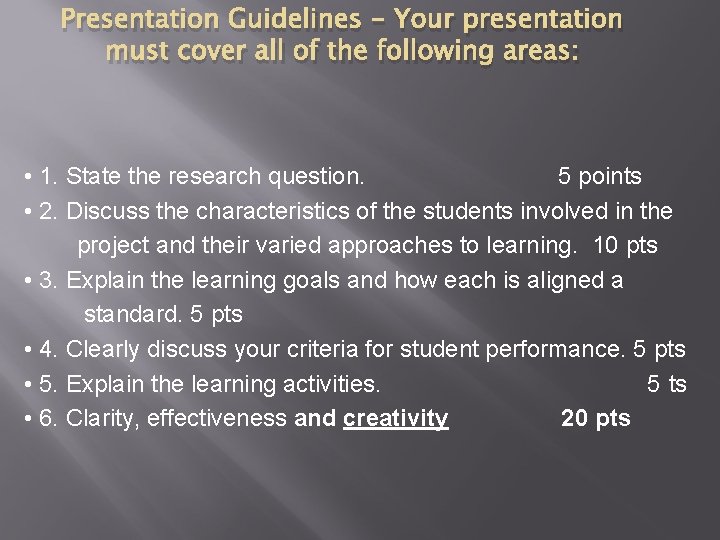
Presentation Guidelines - Your presentation must cover all of the following areas: • 1. State the research question. 5 points • 2. Discuss the characteristics of the students involved in the project and their varied approaches to learning. 10 pts • 3. Explain the learning goals and how each is aligned a standard. 5 pts • 4. Clearly discuss your criteria for student performance. 5 pts • 5. Explain the learning activities. 5 ts • 6. Clarity, effectiveness and creativity 20 pts

Examples Tips & Ideas

THE EFFECT OF COMPUTERBASED COOKING ON Title Page PERFORMANCE By Joe Goodstudent Presented to: Your Instructor Diana Bourisaw, Ph. D. Tom Stephens, Ed. D. UMSL TCH ED 6909 Fall 2012

Research Background • • The research topic for this project was chosen due to the emergence of computer-based testing as an increasingly common method of student assessment, particularly at the research site, Hazelwood East Middle School (EMS), locate in the state of Missouri (USA). Past research has sought to dissect the impact on student scores of shifting the testing medium from PPT delivery to CBT.

Research Question • Will computer-based cooking instruction in the classroom improve student achievement in World History.
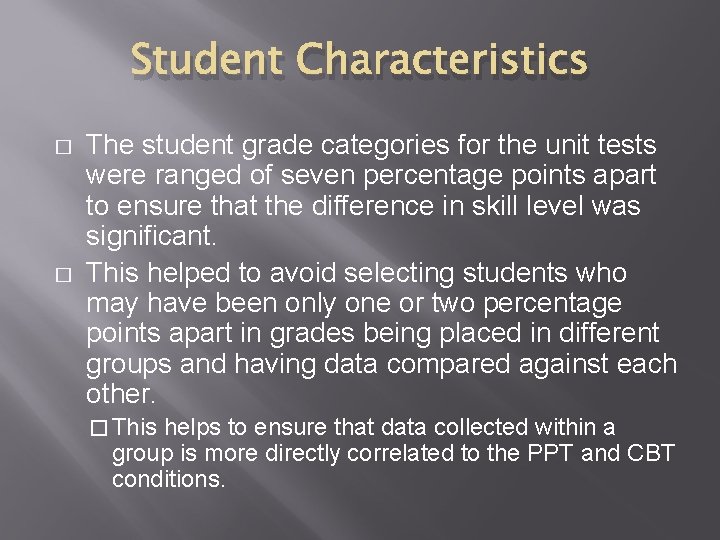
Student Characteristics � � The student grade categories for the unit tests were ranged of seven percentage points apart to ensure that the difference in skill level was significant. This helped to avoid selecting students who may have been only one or two percentage points apart in grades being placed in different groups and having data compared against each other. � This helps to ensure that data collected within a group is more directly correlated to the PPT and CBT conditions.
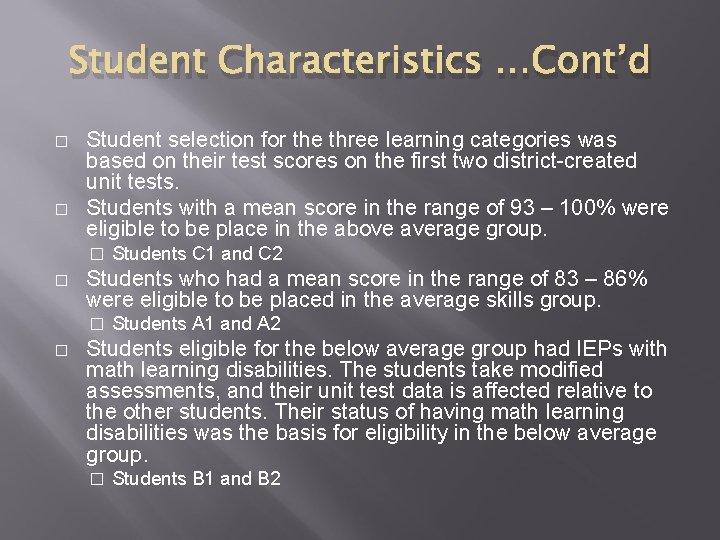
Student Characteristics …Cont’d � � Student selection for the three learning categories was based on their test scores on the first two district-created unit tests. Students with a mean score in the range of 93 – 100% were eligible to be place in the above average group. � � Students who had a mean score in the range of 83 – 86% were eligible to be placed in the average skills group. � � Students C 1 and C 2 Students A 1 and A 2 Students eligible for the below average group had IEPs with math learning disabilities. The students take modified assessments, and their unit test data is affected relative to the other students. Their status of having math learning disabilities was the basis for eligibility in the below average group. � Students B 1 and B 2
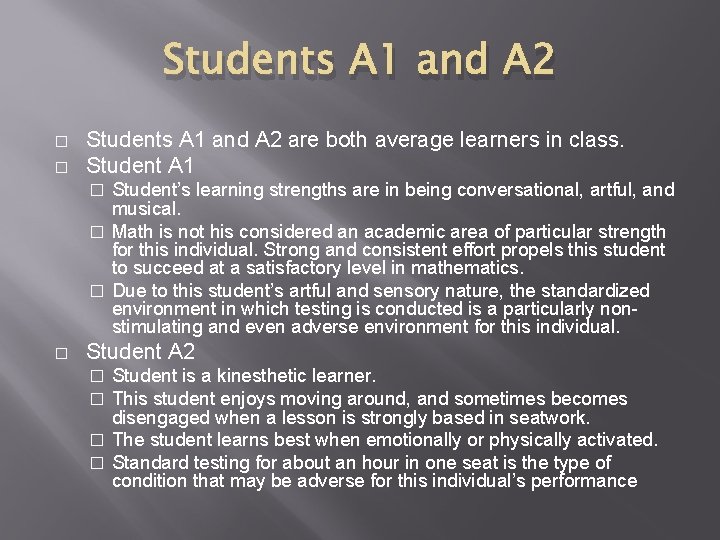
Students A 1 and A 2 � � Students A 1 and A 2 are both average learners in class. Student A 1 Student’s learning strengths are in being conversational, artful, and musical. � Math is not his considered an academic area of particular strength for this individual. Strong and consistent effort propels this student to succeed at a satisfactory level in mathematics. � Due to this student’s artful and sensory nature, the standardized environment in which testing is conducted is a particularly nonstimulating and even adverse environment for this individual. � � Student A 2 Student is a kinesthetic learner. This student enjoys moving around, and sometimes becomes disengaged when a lesson is strongly based in seatwork. � The student learns best when emotionally or physically activated. � Standard testing for about an hour in one seat is the type of condition that may be adverse for this individual’s performance � �
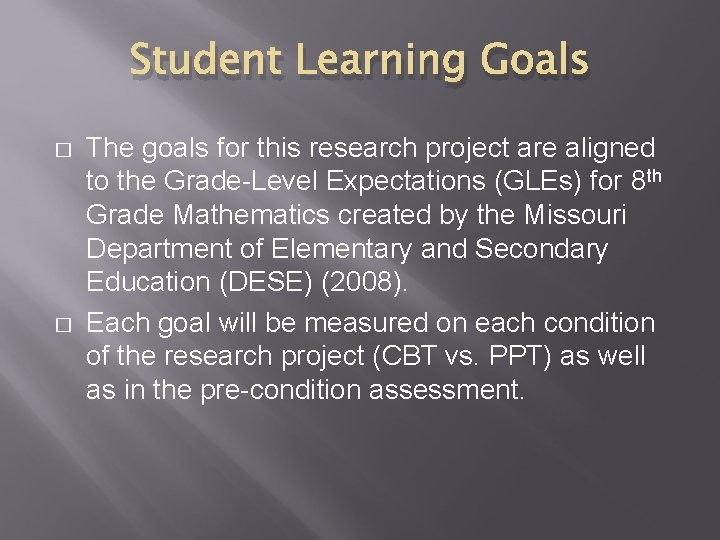
Student Learning Goals � � The goals for this research project are aligned to the Grade-Level Expectations (GLEs) for 8 th Grade Mathematics created by the Missouri Department of Elementary and Secondary Education (DESE) (2008). Each goal will be measured on each condition of the research project (CBT vs. PPT) as well as in the pre-condition assessment.
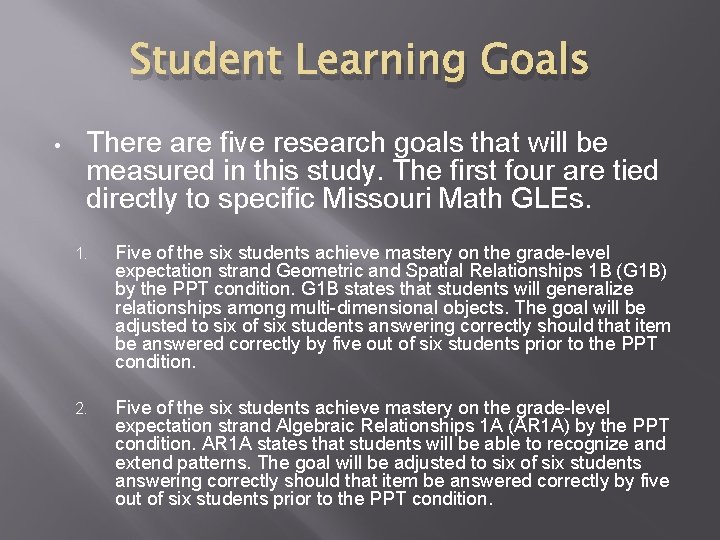
Student Learning Goals • There are five research goals that will be measured in this study. The first four are tied directly to specific Missouri Math GLEs. 1. Five of the six students achieve mastery on the grade-level expectation strand Geometric and Spatial Relationships 1 B (G 1 B) by the PPT condition. G 1 B states that students will generalize relationships among multi-dimensional objects. The goal will be adjusted to six of six students answering correctly should that item be answered correctly by five out of six students prior to the PPT condition. 2. Five of the six students achieve mastery on the grade-level expectation strand Algebraic Relationships 1 A (AR 1 A) by the PPT condition. AR 1 A states that students will be able to recognize and extend patterns. The goal will be adjusted to six of six students answering correctly should that item be answered correctly by five out of six students prior to the PPT condition.
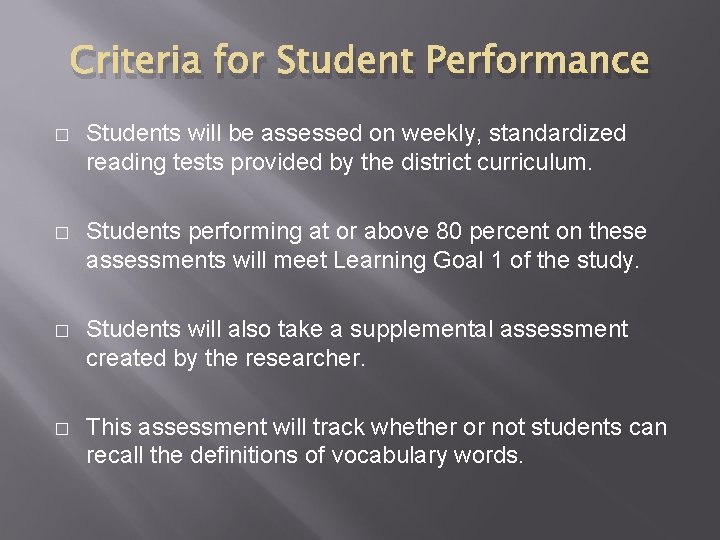
Criteria for Student Performance � Students will be assessed on weekly, standardized reading tests provided by the district curriculum. � Students performing at or above 80 percent on these assessments will meet Learning Goal 1 of the study. � Students will also take a supplemental assessment created by the researcher. � This assessment will track whether or not students can recall the definitions of vocabulary words.
Study Modifications � Student Screening � Prior to the study, each eligible student was screened for his or her educational background. The purpose of the screen was determine if any students had been held back at any point, in which case, they would potentially benefit from another year of exposure to the benchmark testing. � The researcher was also concerned that there may have been differences amongst quality of education in different elementary schools, or for students transferring in from other districts. � The screening was focused to ensure that all study participants had at no point been held back, and that all students had attended one of the two main feeder elementary schools for EMS.
Study Modifications …Cont’d � � Participant Drop-outs and Alternates � In the event of necessary adaptations need to be made to the groups of research participants, the researcher will track data for all students in the class where the research will be conducted. � All students are required to take the benchmark tests each month at the school, and the data and answer sheets are automatically stored for everyone. This leaves open the possibility of bringing in replacement students within the class should any students be forced out of the study due to schedule changes or school transfers during the study. Pre-screening data shows that there should be sufficient replacement students available who meet the group qualification standards either by way of unit test scores, or by way of having a math IEP with math specifications for each group. � Unless the unlikely situation occurs that many students transfer out within the school year, the study should be thoroughly covered for secondary research participants. � Within two of the three subgroups of students there were two other students in the eligibility pool for that particular group. For the above average group, it would require extending the grade percentage cutoff down from a 93% to 91% average for the first two assessments.
Ideas � � � � � Pictures of students or school Tables Animation (including animated gifs) Short video clips Table of Contents & division pages District Map Background of study Hyperlinks (Example: DESE) Questions slide (15 minutes) Format: Power. Point, Keynote (Mac users), Prezi, or i. DVD.
- Slides: 16