
Student Life Assessment Project Module 3 Assessing Learning
- Slides: 13
Student Life Assessment Project Module 3: Assessing Learning Outcomes © 2013 Christie Cruise-Harper, Ph. D All Rights Reserved
Student Life Assessment Project � The purpose of this module is to assist you with choosing the appropriate assessment tools/methods, based on your learning outcomes, for the program/service you plan to assess in the 2013 – 2014 academic year.
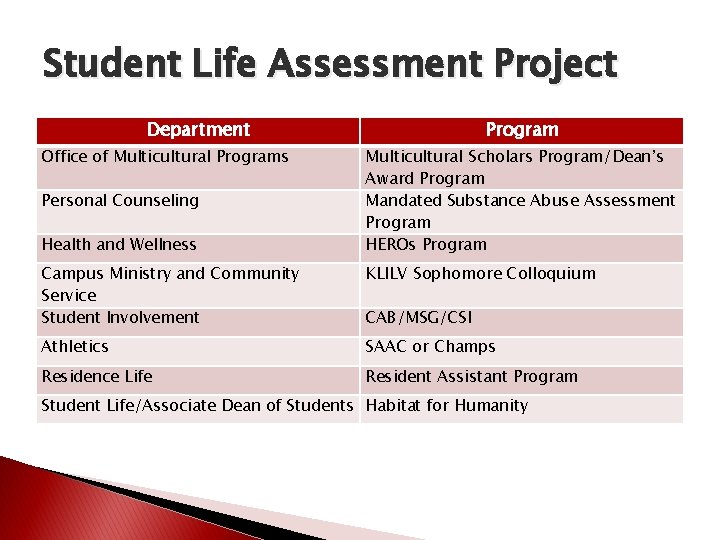
Student Life Assessment Project Department Office of Multicultural Programs Personal Counseling Health and Wellness Program Multicultural Scholars Program/Dean’s Award Program Mandated Substance Abuse Assessment Program HEROs Program Campus Ministry and Community Service Student Involvement KLILV Sophomore Colloquium Athletics SAAC or Champs Residence Life Resident Assistant Program CAB/MSG/CSI Student Life/Associate Dean of Students Habitat for Humanity
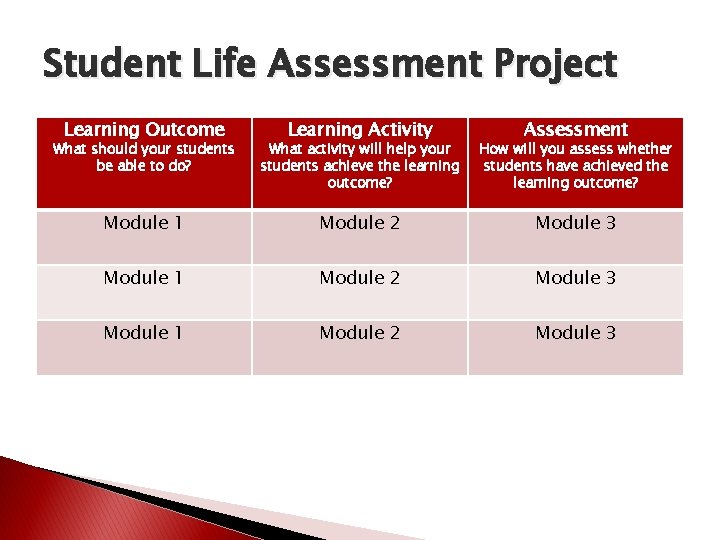
Student Life Assessment Project � In module 1 you developed learning outcomes for your program/service using Bloom’s Taxonomy as a guide. � Module 2 allowed you to strengthen those learning outcomes and guided you through the process of choosing learning activities. � This module will assist you with choosing appropriate assessment tools/methods for the learning outcomes and learning activities you have established.
Student Life Assessment Project Learning Outcome Learning Activity Assessment What should your students be able to do? What activity will help your students achieve the learning outcome? How will you assess whether students have achieved the learning outcome? Module 1 Module 2 Module 3
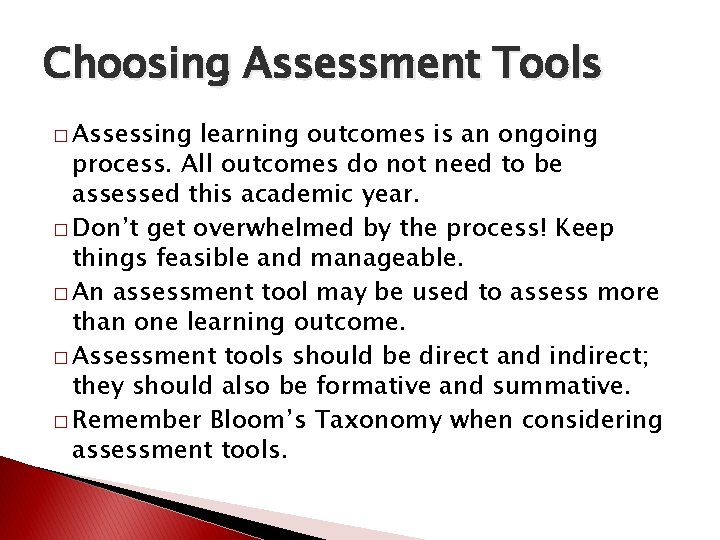
Choosing Assessment Tools � Assessing learning outcomes is an ongoing process. All outcomes do not need to be assessed this academic year. � Don’t get overwhelmed by the process! Keep things feasible and manageable. � An assessment tool may be used to assess more than one learning outcome. � Assessment tools should be direct and indirect; they should also be formative and summative. � Remember Bloom’s Taxonomy when considering assessment tools.
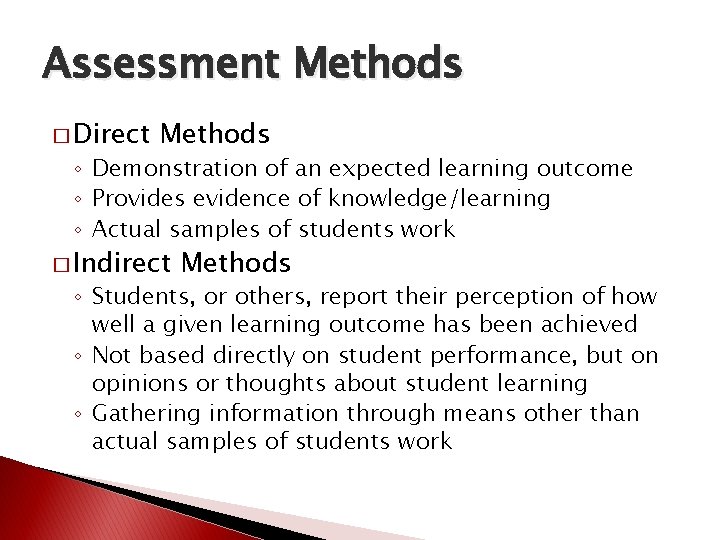
Assessment Methods � Direct Methods ◦ Demonstration of an expected learning outcome ◦ Provides evidence of knowledge/learning ◦ Actual samples of students work � Indirect Methods ◦ Students, or others, report their perception of how well a given learning outcome has been achieved ◦ Not based directly on student performance, but on opinions or thoughts about student learning ◦ Gathering information through means other than actual samples of students work
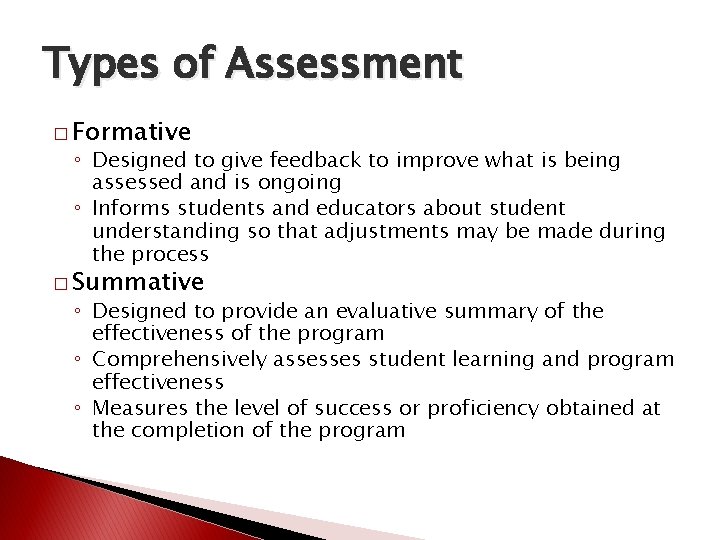
Types of Assessment � Formative ◦ Designed to give feedback to improve what is being assessed and is ongoing ◦ Informs students and educators about student understanding so that adjustments may be made during the process � Summative ◦ Designed to provide an evaluative summary of the effectiveness of the program ◦ Comprehensively assesses student learning and program effectiveness ◦ Measures the level of success or proficiency obtained at the completion of the program
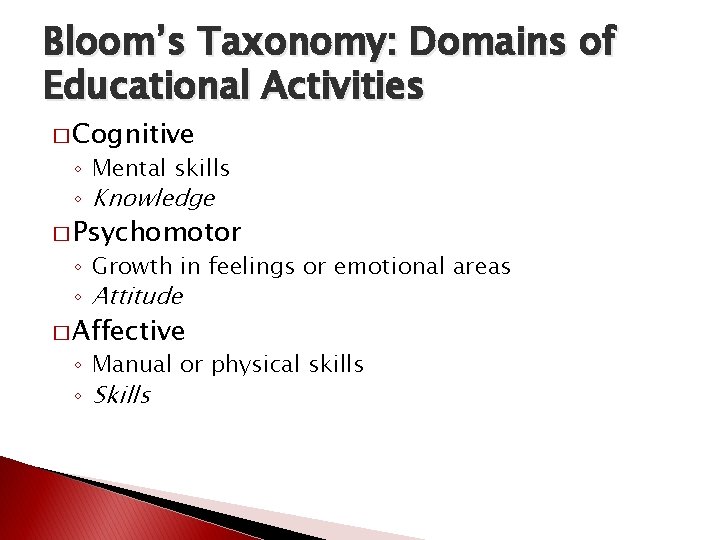
Bloom’s Taxonomy: Domains of Educational Activities � Cognitive ◦ Mental skills ◦ Knowledge � Psychomotor ◦ Growth in feelings or emotional areas ◦ Attitude � Affective ◦ Manual or physical skills ◦ Skills
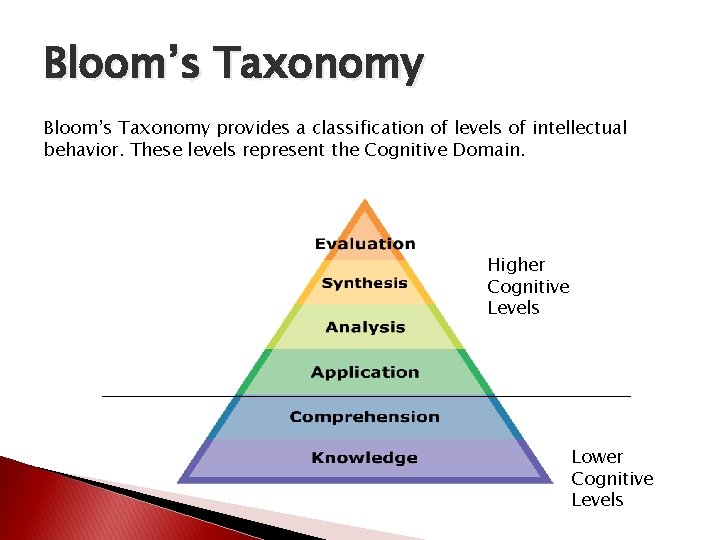
Bloom’s Taxonomy provides a classification of levels of intellectual behavior. These levels represent the Cognitive Domain. Higher Cognitive Levels Lower Cognitive Levels
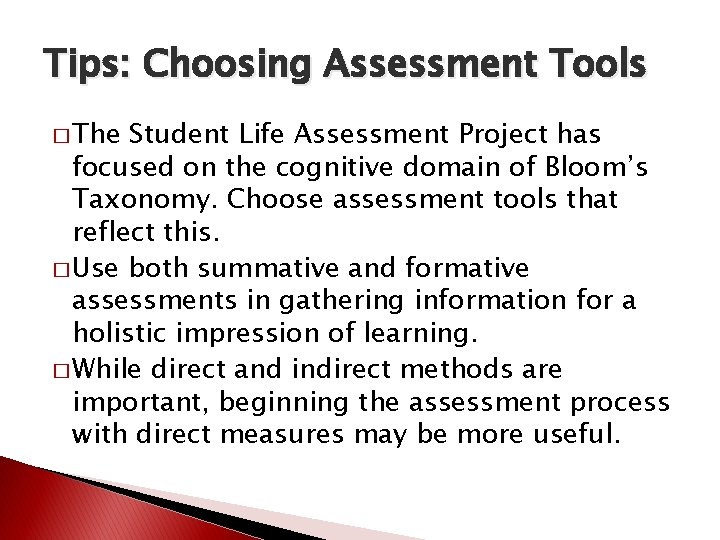
Tips: Choosing Assessment Tools � The Student Life Assessment Project has focused on the cognitive domain of Bloom’s Taxonomy. Choose assessment tools that reflect this. � Use both summative and formative assessments in gathering information for a holistic impression of learning. � While direct and indirect methods are important, beginning the assessment process with direct measures may be more useful.
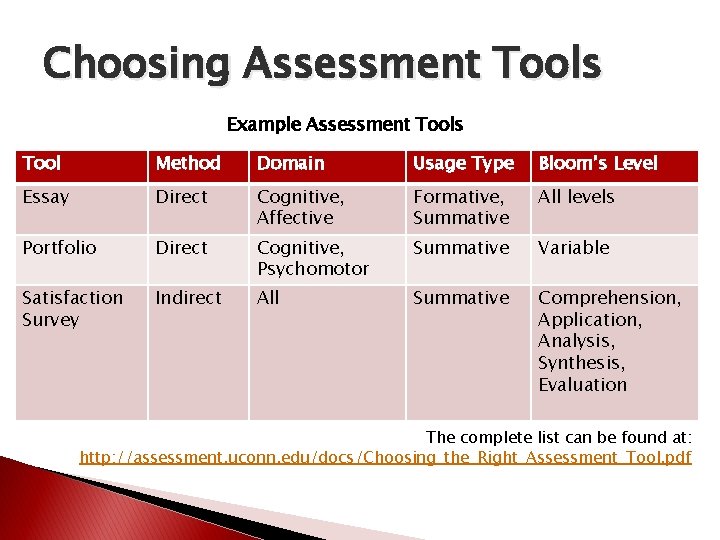
Choosing Assessment Tools Example Assessment Tools Tool Method Domain Usage Type Bloom’s Level Essay Direct Cognitive, Affective Formative, Summative All levels Portfolio Direct Cognitive, Psychomotor Summative Variable Satisfaction Survey Indirect All Summative Comprehension, Application, Analysis, Synthesis, Evaluation The complete list can be found at: http: //assessment. uconn. edu/docs/Choosing_the_Right_Assessment_Tool. pdf
References Allen, M. , Noel, R. C. , Rienzi, B. M. , & Mc. Millin, D. J. (2002). Outcomes assessment handbook. Long Beach: California State University, Institute for Teaching and Learning. � Association for Middle Level Education. (2013). Retrieved from: http: //www. amle. org/Publications/Web. Exclusive/ Assessment/tabid/1120/Default. aspx � Skidmore College. (2013). Retrieved from: http: //cms. skidmore. edu/assessment/Handbook /direct-v-indirect-assessment. cfm � University of Connecticut Assessment. (2013). Choosing the right assessment tool. Retrieved from: http: //assessment. uconn. edu/docs/Choosing_the_Rig ht_Assessment_Tool. pdf �