
Student Learning Objectives Examine what is Floriculture Analyze

Student Learning Objectives • Examine what is Floriculture. • Analyze the principles of floral design. • Examine the concept of proportion.

Student Learning Objectives • Explain how the concept of balance is applied to floral design. • Describe how rhythm is applied in floral work.

Student Learning Objectives • Explain how the principles of dominance and focal point are used in floral design.

What is Floriculture? • Floriculture – Culture of flowers • Grower – Person who Grows the flowers

Business Structure • Grower wholesale florist W. F. Manager Retail floral Manager – Floral arrangers – Floral designers

What are the principles of floral design? • Floral design is the art of organizing the design elements inherent in plant materials and accessories according to principles of design art. • This is sometimes called floral arranging.
What are the principles of floral design? • Principles of design are rules and guidelines used by the floral designer to create a beautiful composition. • The use of these rules promotes beautiful, artistic arrangements. • 1. Proportion is the pleasing relationship between size and shape among objects and parts of objects.

What are the principles of floral design? • 2. Balance in a flower arrangement refers to the arrangement’s equilibrium and equality in weight, both physical and visual. • 3. Rhythm is the orderly organization of design elements to create a visual pathway. • 4. Dominance in a design means that one design element is more prevalent or noticeable, thereby capturing the viewer’s interest.
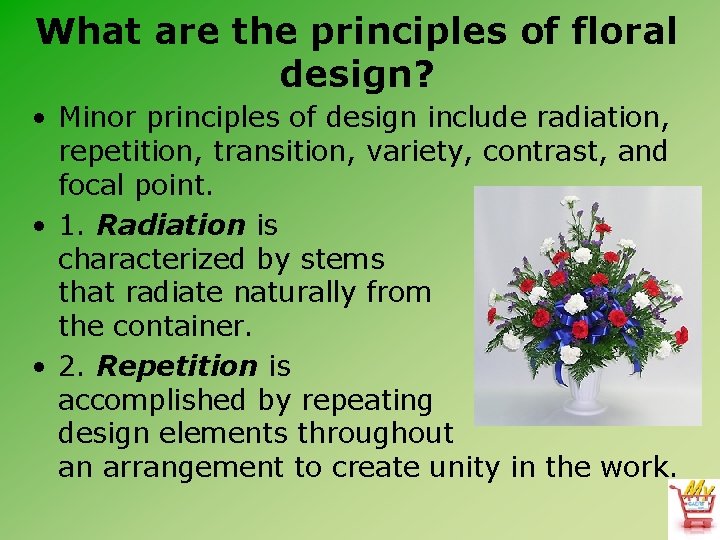
What are the principles of floral design? • Minor principles of design include radiation, repetition, transition, variety, contrast, and focal point. • 1. Radiation is characterized by stems that radiate naturally from the container. • 2. Repetition is accomplished by repeating design elements throughout an arrangement to create unity in the work.

What are the principles of floral design? • 3. Transition is the change from one material to another. • 4. Variety is created by using a diverse assortment and different components in a design.
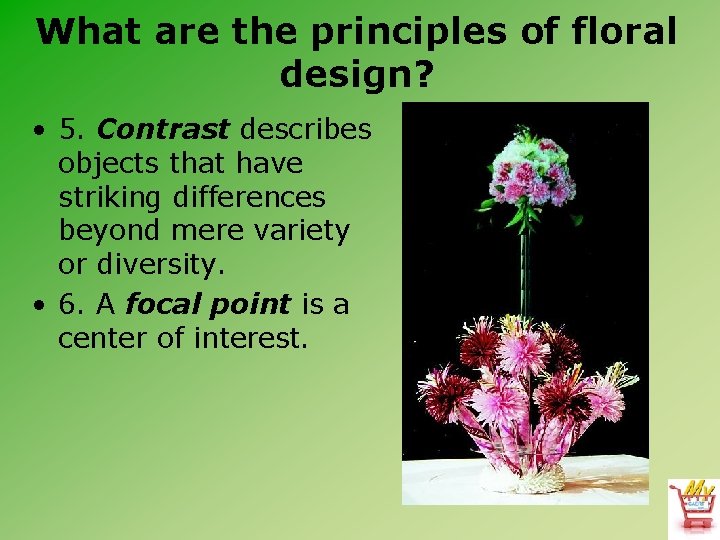
What are the principles of floral design? • 5. Contrast describes objects that have striking differences beyond mere variety or diversity. • 6. A focal point is a center of interest.
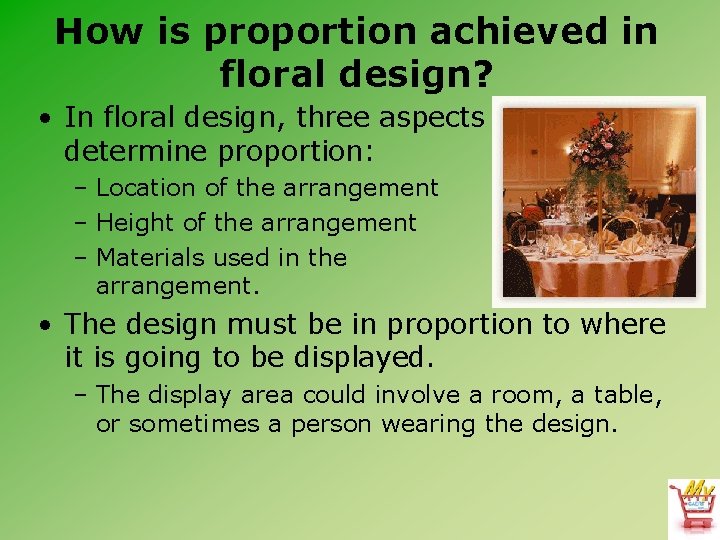
How is proportion achieved in floral design? • In floral design, three aspects determine proportion: – Location of the arrangement – Height of the arrangement – Materials used in the arrangement. • The design must be in proportion to where it is going to be displayed. – The display area could involve a room, a table, or sometimes a person wearing the design.

How is proportion achieved in floral design? • The height of an arrangement should be at least 1½ times the height of its container’s greatest dimension. – There a few exceptions to this rule, including the idea that may be increased proper the room. – Another increase might be because of the materials with which the designer is working. height to create dimension with

How is proportion achieved in floral design? • 1. The container is a primary factor in determining appropriate height. – Four aspects that need to be considered are the container’s: – a. Physical dimensions – b. Color – c. Material and texture – d. Shape
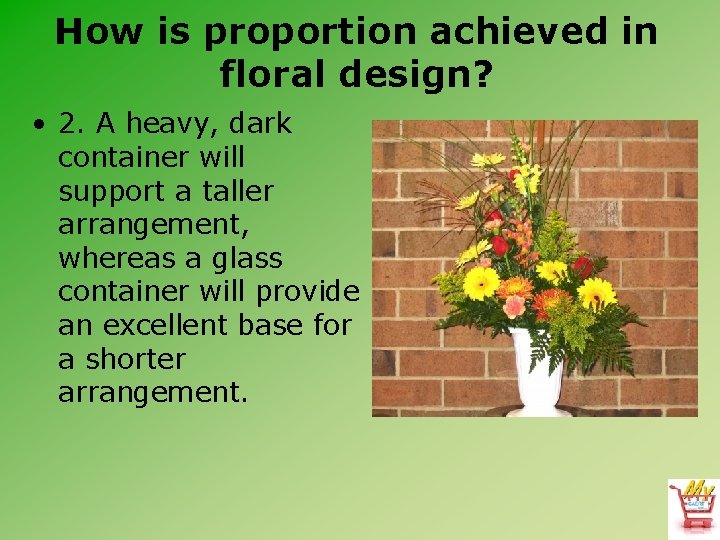
How is proportion achieved in floral design? • 2. A heavy, dark container will support a taller arrangement, whereas a glass container will provide an excellent base for a shorter arrangement.

How is proportion achieved in floral design? • 3. An exception to the height rule applies to centerpieces and horizontal arrangements. – A centerpiece should not obstruct the view of people participating in a dinner conversation; therefore, the arrangement needs to be kept low. – A horizontal arrangement is short, but its linear dimension should be about 1½ times the size of the container.

How is proportion achieved in floral design? • Using flowers and foliage of equal or nearly equal size will help in achieving proper proportion. • Large jumps in flower size within an arrangement should be avoided. • For example, large mums should not be mixed with baby’s breath.
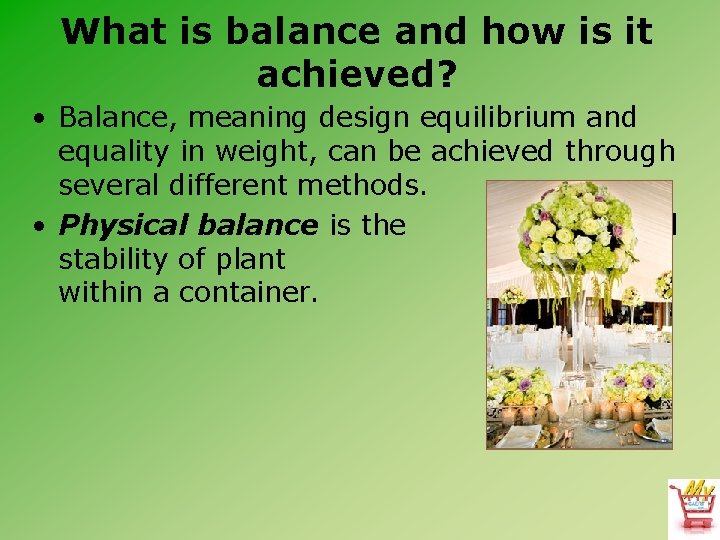
What is balance and how is it achieved? • Balance, meaning design equilibrium and equality in weight, can be achieved through several different methods. • Physical balance is the actual stability of plant materials within a container.
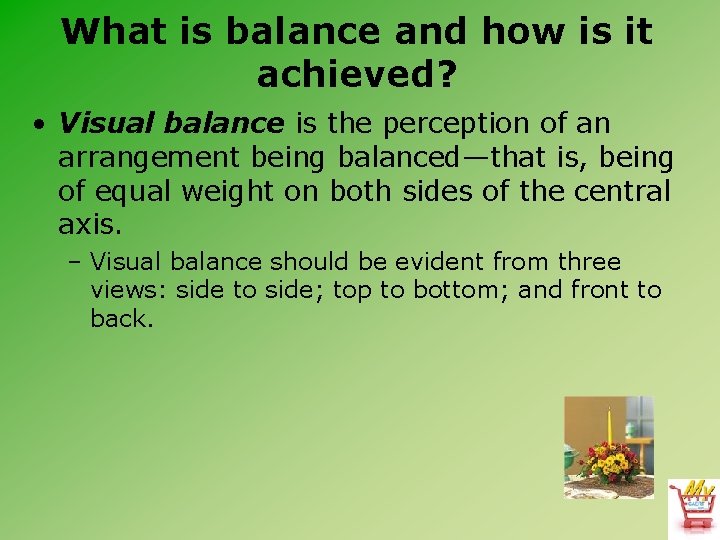
What is balance and how is it achieved? • Visual balance is the perception of an arrangement being balanced—that is, being of equal weight on both sides of the central axis. – Visual balance should be evident from three views: side to side; top to bottom; and front to back.
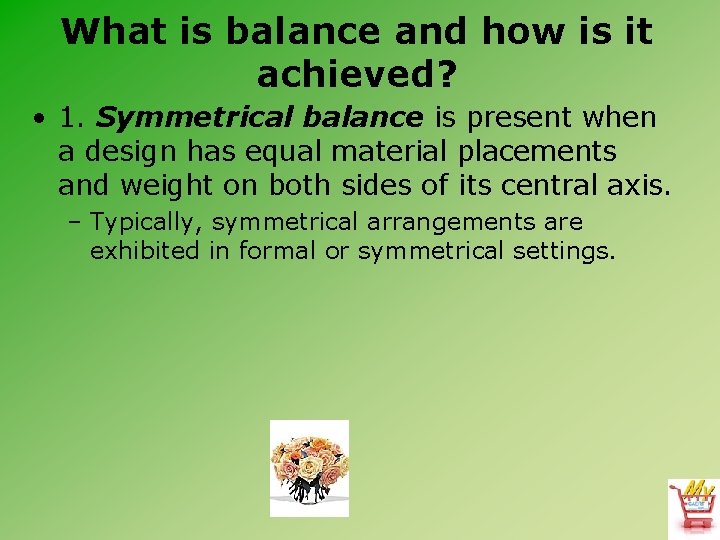
What is balance and how is it achieved? • 1. Symmetrical balance is present when a design has equal material placements and weight on both sides of its central axis. – Typically, symmetrical arrangements are exhibited in formal or symmetrical settings.
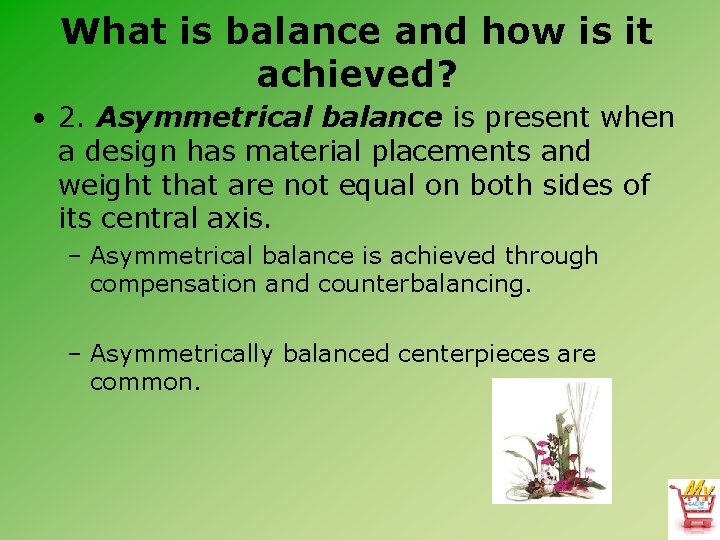
What is balance and how is it achieved? • 2. Asymmetrical balance is present when a design has material placements and weight that are not equal on both sides of its central axis. – Asymmetrical balance is achieved through compensation and counterbalancing. – Asymmetrically balanced centerpieces are common.
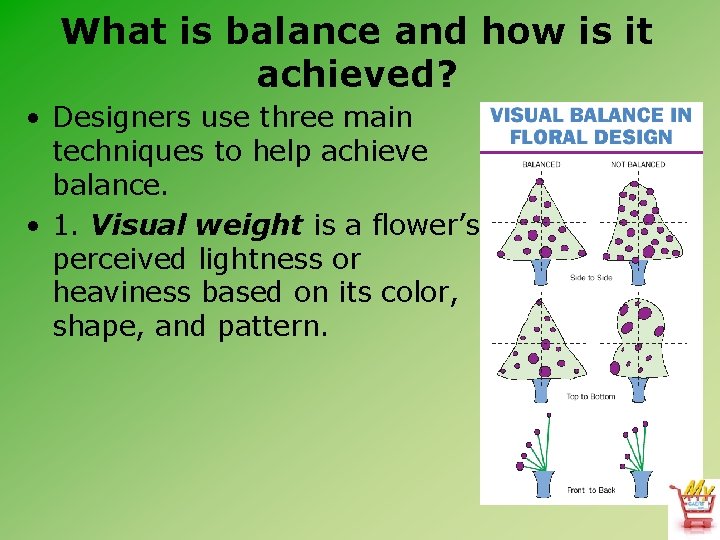
What is balance and how is it achieved? • Designers use three main techniques to help achieve balance. • 1. Visual weight is a flower’s perceived lightness or heaviness based on its color, shape, and pattern.
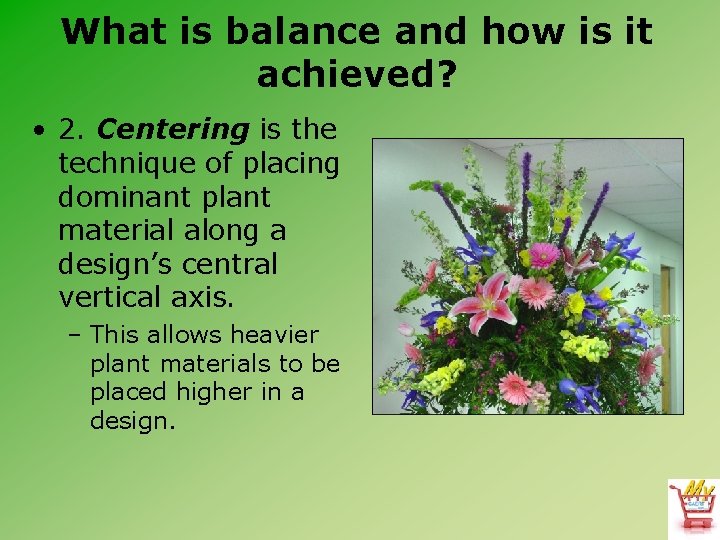
What is balance and how is it achieved? • 2. Centering is the technique of placing dominant plant material along a design’s central vertical axis. – This allows heavier plant materials to be placed higher in a design.
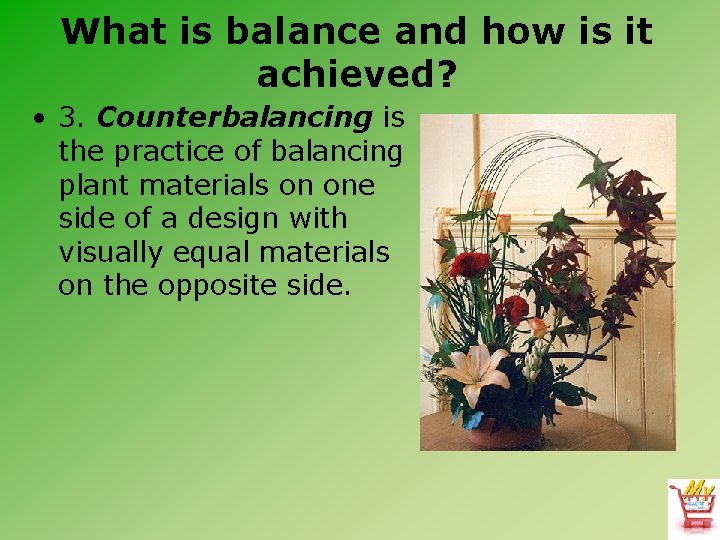
What is balance and how is it achieved? • 3. Counterbalancing is the practice of balancing plant materials on one side of a design with visually equal materials on the opposite side.
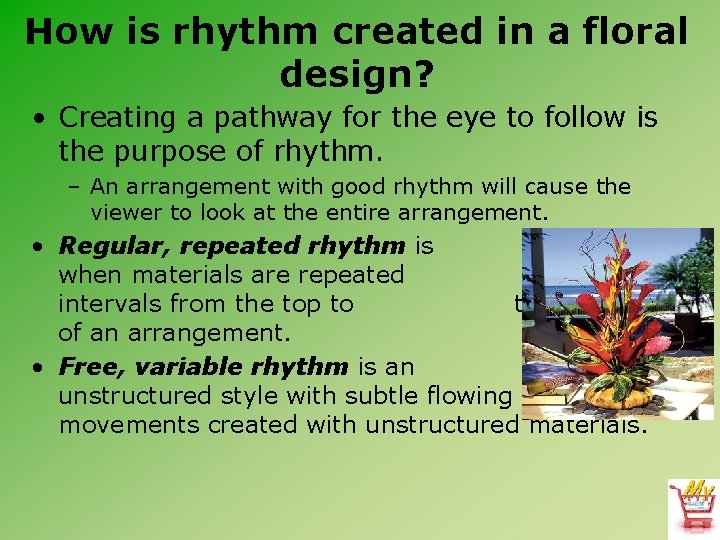
How is rhythm created in a floral design? • Creating a pathway for the eye to follow is the purpose of rhythm. – An arrangement with good rhythm will cause the viewer to look at the entire arrangement. • Regular, repeated rhythm is present when materials are repeated at regular intervals from the top to the bottom of an arrangement. • Free, variable rhythm is an unstructured style with subtle flowing movements created with unstructured materials.
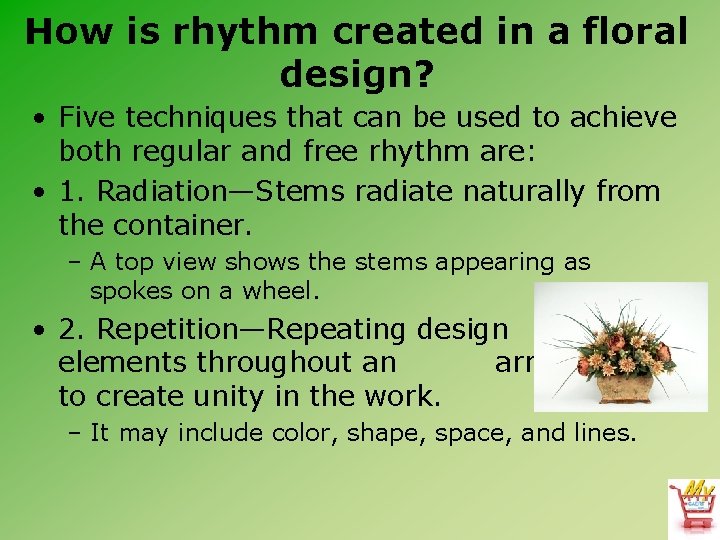
How is rhythm created in a floral design? • Five techniques that can be used to achieve both regular and free rhythm are: • 1. Radiation—Stems radiate naturally from the container. – A top view shows the stems appearing as spokes on a wheel. • 2. Repetition—Repeating design elements throughout an arrangement to create unity in the work. – It may include color, shape, space, and lines.

How is rhythm created in a floral design? • 3. Transition—Change from one material to another. – It should be smooth and gradual. – Lighter flowers near the container edge blend into the heavier ones near the center. • 4. Variety—A diverse assortment and different components in a design. – Variety focuses attention and stimulates interest and imagination. • 5. Contrast—Describes objects that have striking differences beyond mere variety or diversity, taking variety to a higher degree.
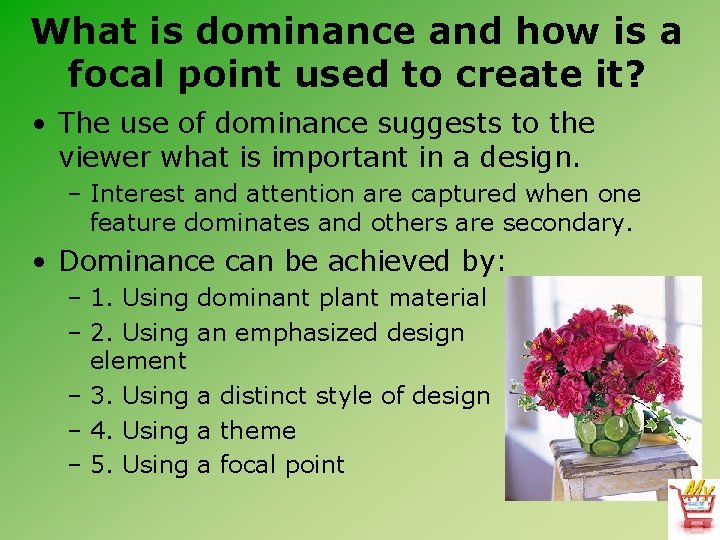
What is dominance and how is a focal point used to create it? • The use of dominance suggests to the viewer what is important in a design. – Interest and attention are captured when one feature dominates and others are secondary. • Dominance can be achieved by: – 1. Using – 2. Using element – 3. Using – 4. Using – 5. Using dominant plant material an emphasized design a distinct style of design a theme a focal point
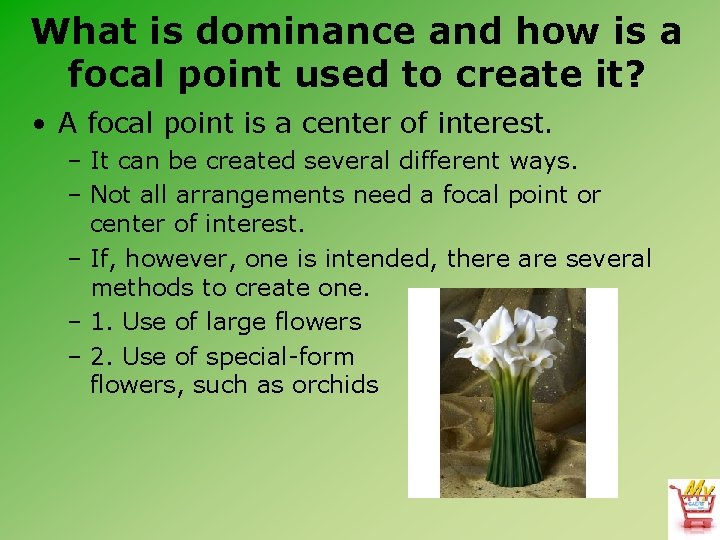
What is dominance and how is a focal point used to create it? • A focal point is a center of interest. – It can be created several different ways. – Not all arrangements need a focal point or center of interest. – If, however, one is intended, there are several methods to create one. – 1. Use of large flowers – 2. Use of special-form flowers, such as orchids
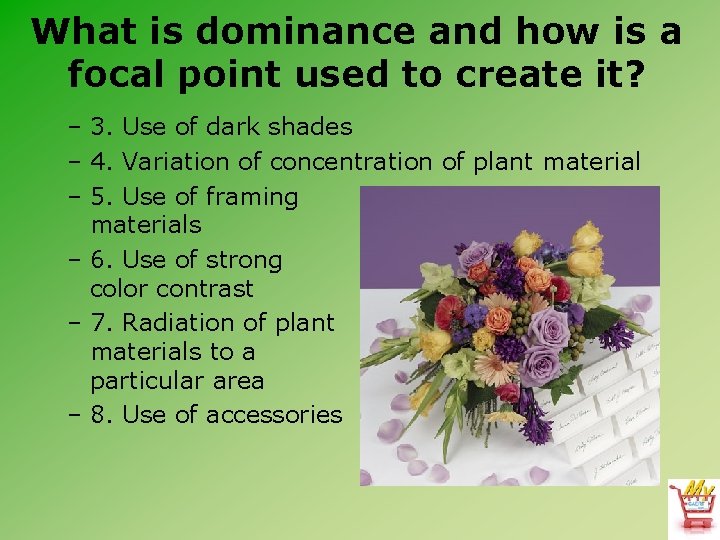
What is dominance and how is a focal point used to create it? – 3. Use of dark shades – 4. Variation of concentration of plant material – 5. Use of framing materials – 6. Use of strong color contrast – 7. Radiation of plant materials to a particular area – 8. Use of accessories
- Slides: 30