
Student Learning Journal Version 2016 Guide for Teachers
- Slides: 32
Student Learning Journal (Version 2016) Guide for Teachers
Things to know before you start… I. The Way 2 Go Bike Ed student learning journal is designed to be used in conjunction with the online teacher resource. The package was developed by the Department of Planning, Transport and Infrastructure for use by schools participating in the Way 2 Go Bike Ed program. II. Tasks may be adapted to better meet student needs. Refer to the lesson instruction guide for ideas. III. Participating schools can order a hardcopy of the student learning journal for each student and class teacher.
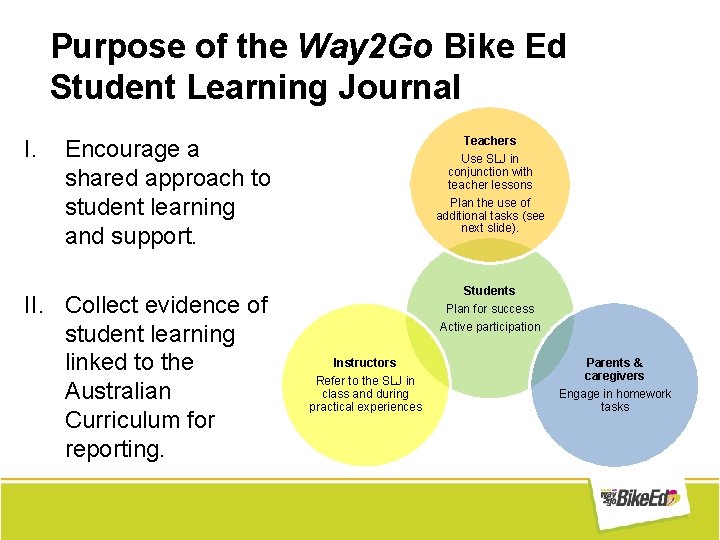
Purpose of the Way 2 Go Bike Ed Student Learning Journal I. Teachers Encourage a shared approach to student learning and support. II. Collect evidence of student learning linked to the Australian Curriculum for reporting. Use SLJ in conjunction with teacher lessons Plan the use of additional tasks (see next slide). Students Plan for success Active participation Instructors Refer to the SLJ in class and during practical experiences Parents & caregivers Engage in homework tasks
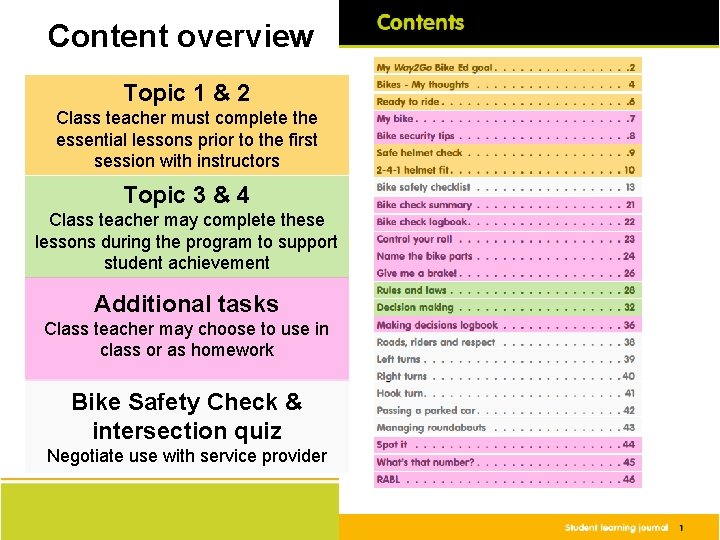
Content overview Topic 1 & 2 Class teacher must complete the essential lessons prior to the first session with instructors Topic 3 & 4 Class teacher may complete these lessons during the program to support student achievement Additional tasks Class teacher may choose to use in class or as homework Bike Safety Check & intersection quiz Negotiate use with service provider
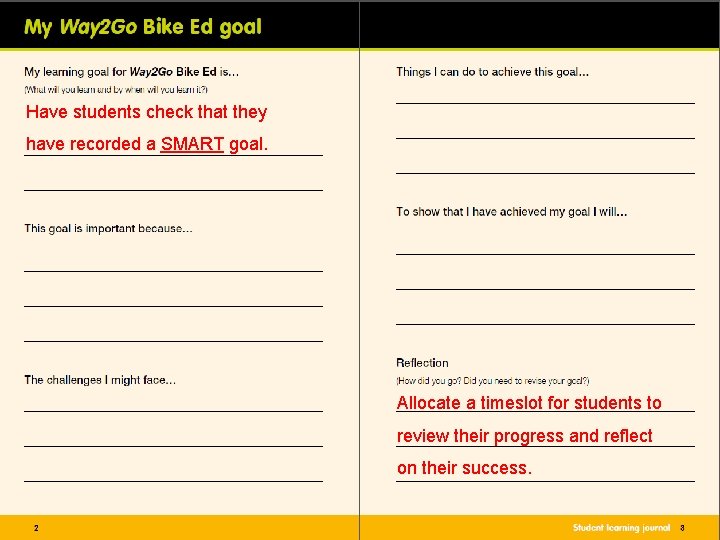
Have students check that they have recorded a SMART goal. Allocate a timeslot for students to review their progress and reflect on their success.
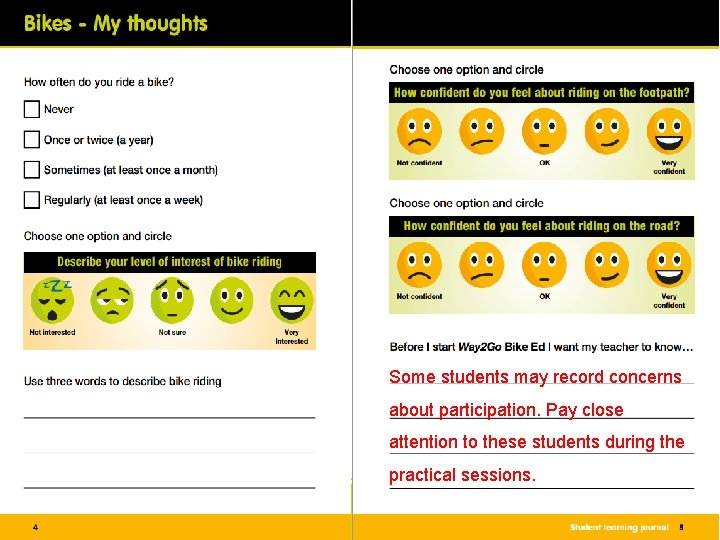
Some students may record concerns about participation. Pay close attention to these students during the practical sessions.
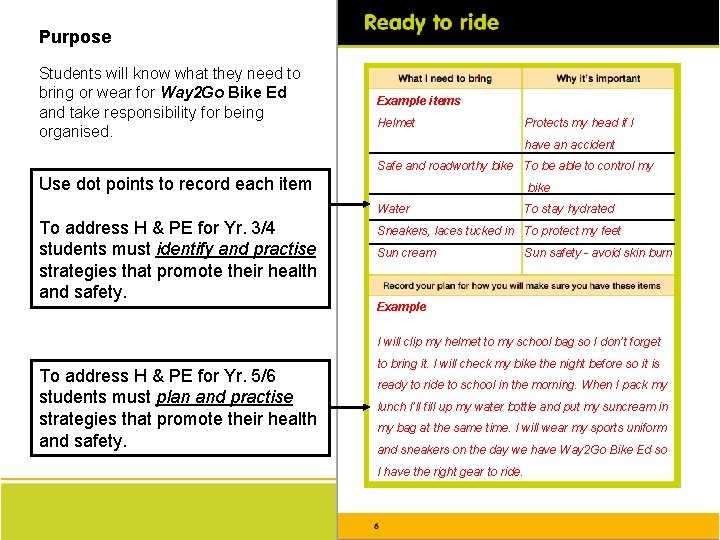
Purpose a Students will know what they need to bring or wear for Way 2 Go Bike Ed and take responsibility for being organised. Example items Helmet Protects my head if I have an accident Safe and roadworthy bike To be able to control my Use dot points to record each item bike Water To address H & PE for Yr. 3/4 students must identify and practise strategies that promote their health and safety. To stay hydrated Sneakers, laces tucked in To protect my feet Sun cream Sun safety - avoid skin burn Example I will clip my helmet to my school bag so I don’t forget To address H & PE for Yr. 5/6 students must plan and practise strategies that promote their health and safety. to bring it. I will check my bike the night before so it is ready to ride to school in the morning. When I pack my lunch I’ll fill up my water bottle and put my suncream in my bag at the same time. I will wear my sports uniform and sneakers on the day we have Way 2 Go Bike Ed so I have the right gear to ride.
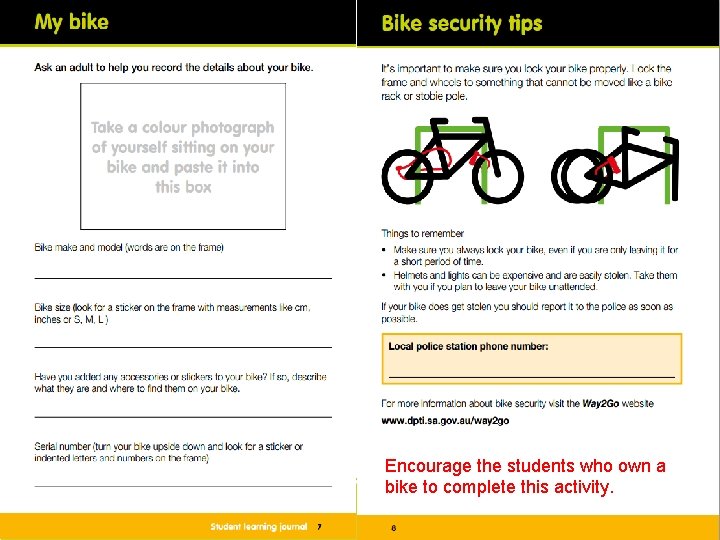
Encourage the students who own a bike to complete this activity.
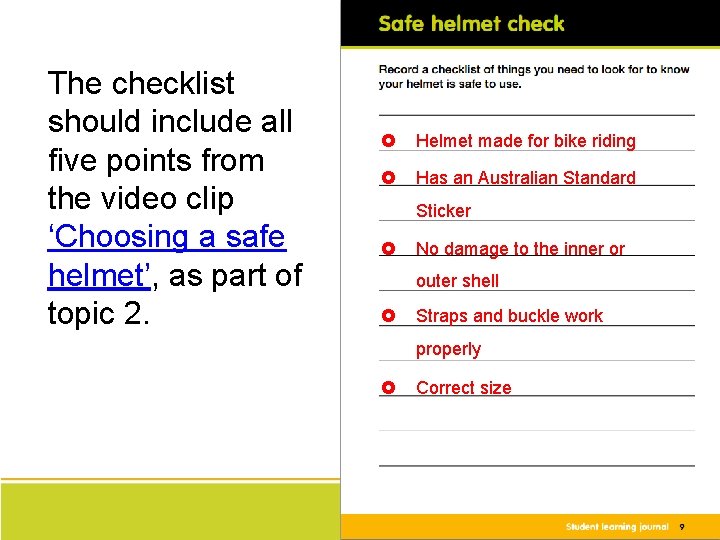
The checklist should include all five points from the video clip ‘Choosing a safe helmet’, as part of topic 2. Helmet made for bike riding Has an Australian Standard Sticker No damage to the inner or outer shell Straps and buckle work properly Correct size
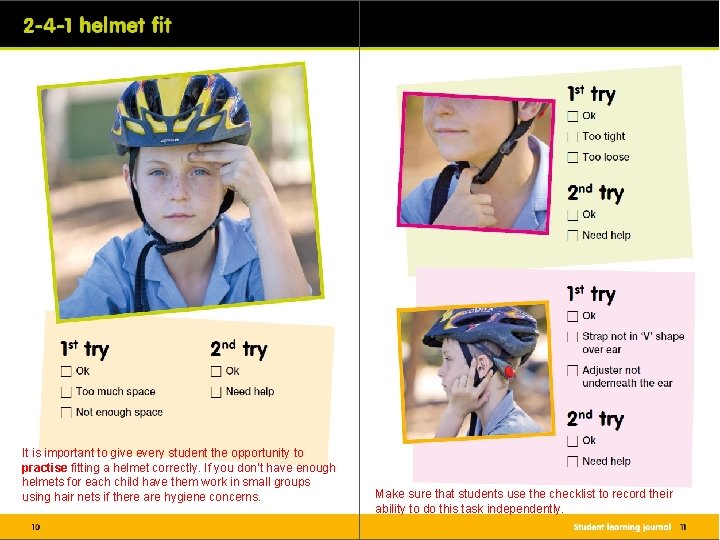
It is important to give every student the opportunity to practise fitting a helmet correctly. If you don’t have enough helmets for each child have them work in small groups using hair nets if there are hygiene concerns. Make sure that students use the checklist to record their ability to do this task independently.
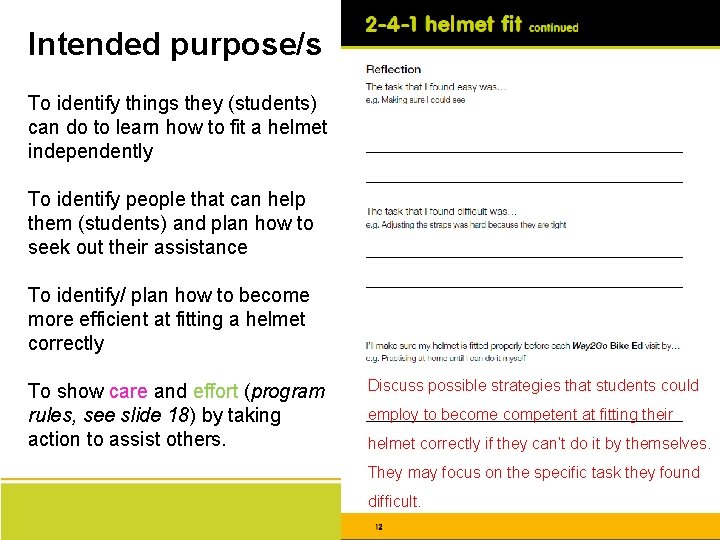
Intended purpose/s To identify things they (students) can do to learn how to fit a helmet independently To identify people that can help them (students) and plan how to seek out their assistance To identify/ plan how to become more efficient at fitting a helmet correctly To show care and effort (program rules, see slide 18) by taking action to assist others. Discuss possible strategies that students could employ to become competent at fitting their helmet correctly if they can’t do it by themselves. They may focus on the specific task they found difficult.
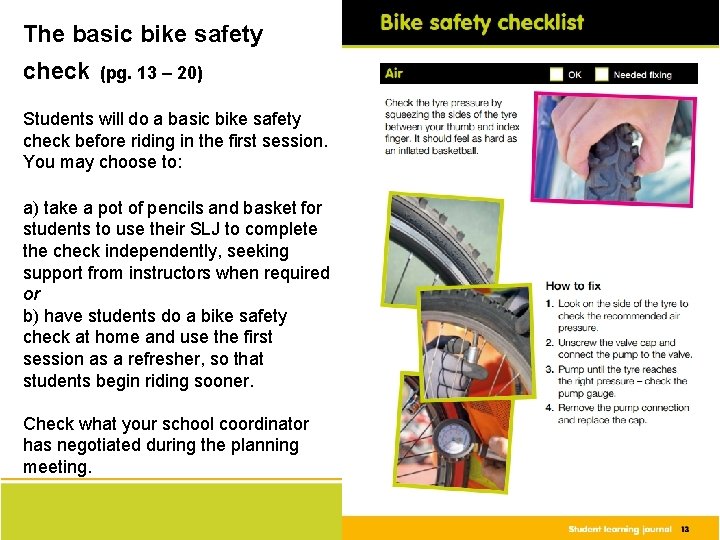
The basic bike safety check (pg. 13 – 20) Students will do a basic bike safety check before riding in the first session. You may choose to: a) take a pot of pencils and basket for students to use their SLJ to complete the check independently, seeking support from instructors when required or b) have students do a bike safety check at home and use the first session as a refresher, so that students begin riding sooner. Check what your school coordinator has negotiated during the planning meeting.
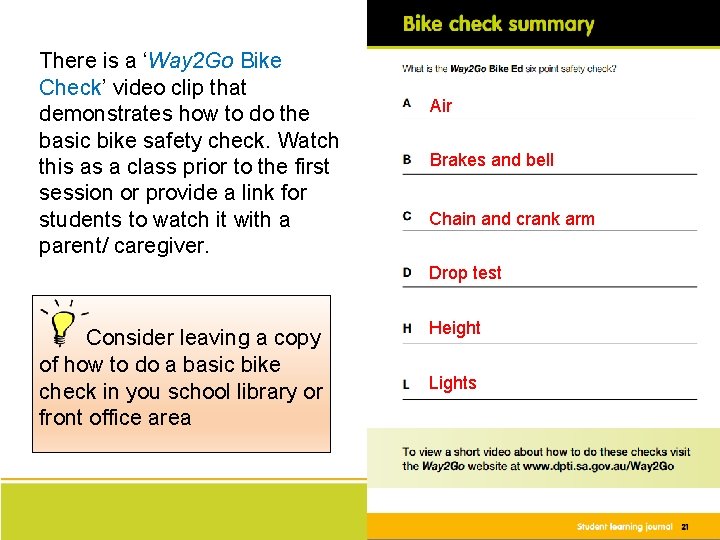
There is a ‘Way 2 Go Bike Check’ video clip that demonstrates how to do the basic bike safety check. Watch this as a class prior to the first session or provide a link for students to watch it with a parent/ caregiver. Air Brakes and bell Chain and crank arm Drop test Consider leaving a copy of how to do a basic bike check in you school library or front office area Height Lights
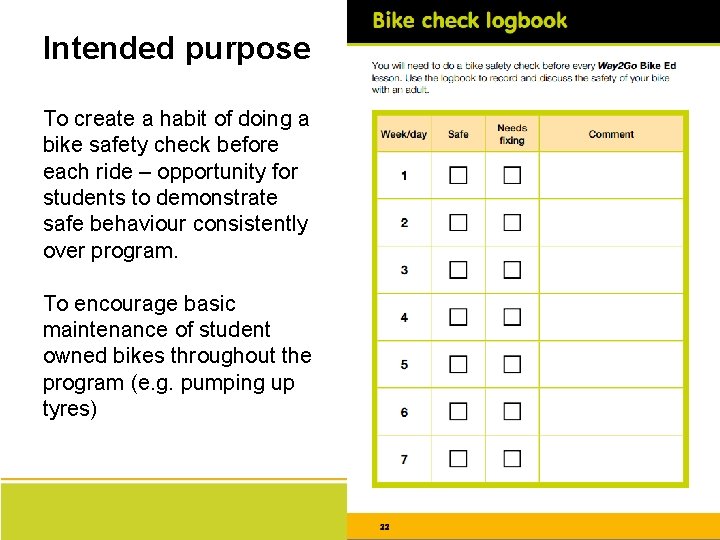
Intended purpose To create a habit of doing a bike safety check before each ride – opportunity for students to demonstrate safe behaviour consistently over program. To encourage basic maintenance of student owned bikes throughout the program (e. g. pumping up tyres)
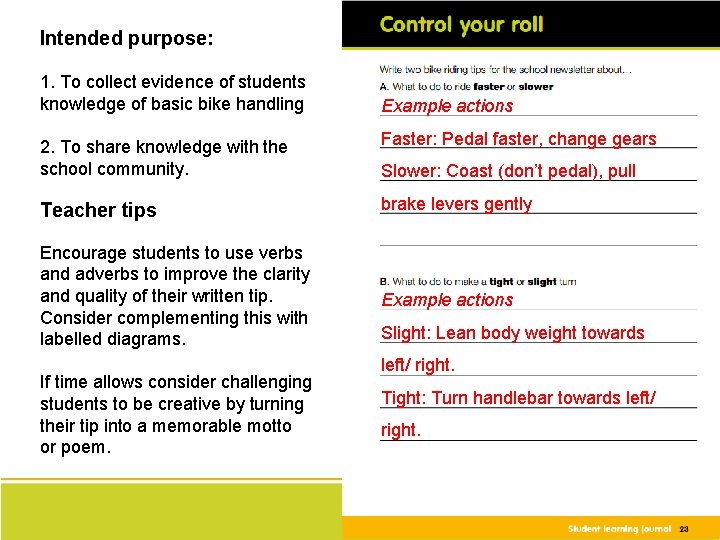
Intended purpose: 1. To collect evidence of students knowledge of basic bike handling Example actions 2. To share knowledge with the school community. Faster: Pedal faster, change gears Teacher tips brake levers gently Encourage students to use verbs and adverbs to improve the clarity and quality of their written tip. Consider complementing this with labelled diagrams. Example actions If time allows consider challenging students to be creative by turning their tip into a memorable motto or poem. Slower: Coast (don’t pedal), pull Slight: Lean body weight towards left/ right. Tight: Turn handlebar towards left/ right.
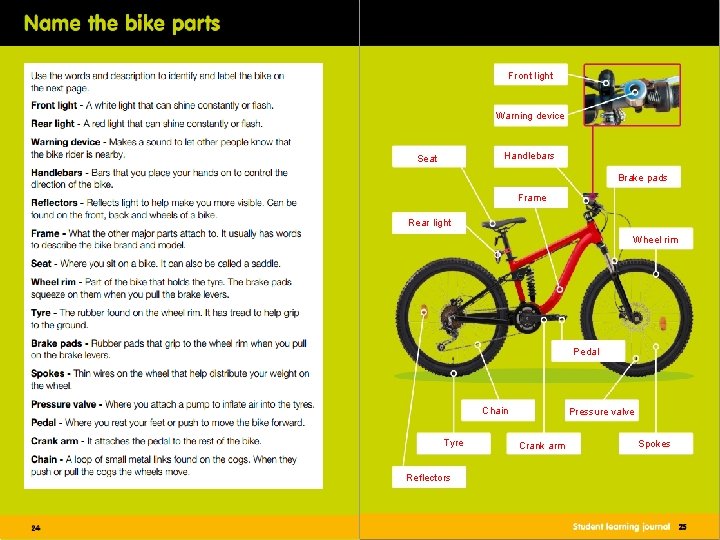
Front light Warning device Handlebars Seat Brake pads Frame Rear light Wheel rim Pedal Chain Tyre Reflectors Pressure valve Crank arm Spokes
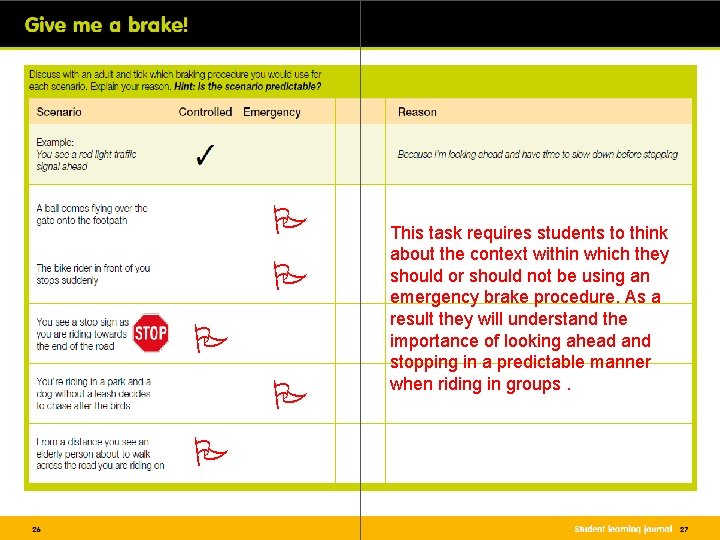
This task requires students to think about the context within which they should or should not be using an emergency brake procedure. As a result they will understand the importance of looking ahead and stopping in a predictable manner when riding in groups.
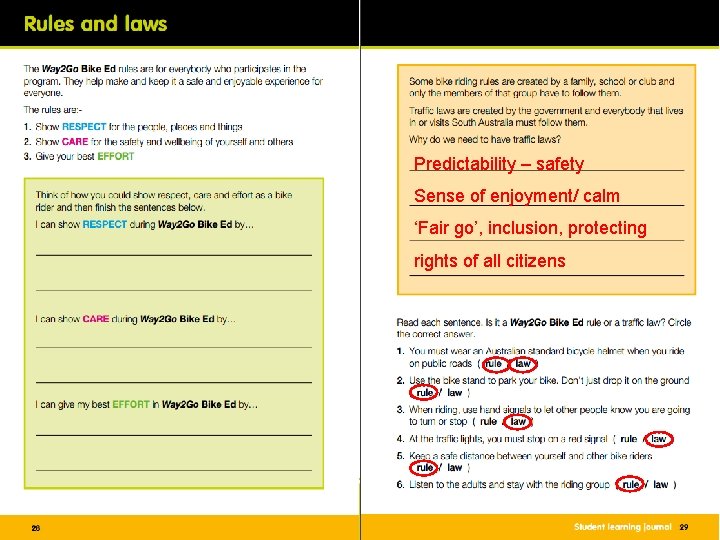
Predictability – safety Sense of enjoyment/ calm ‘Fair go’, inclusion, protecting rights of all citizens
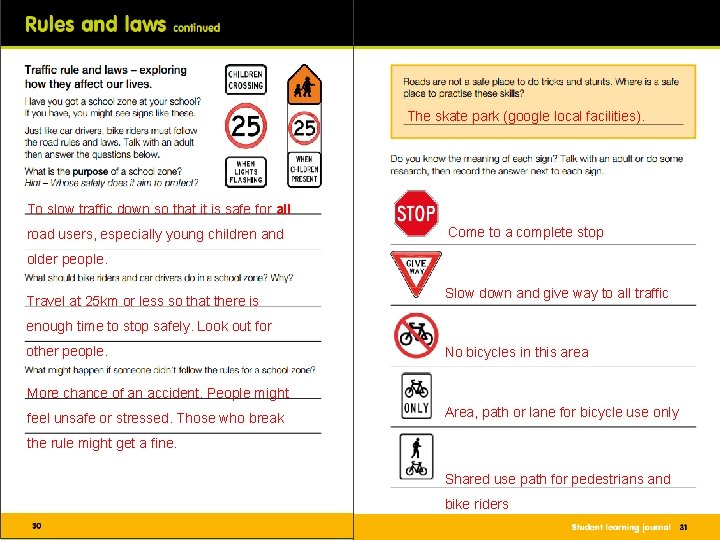
The skate park (google local facilities). To slow traffic down so that it is safe for all road users, especially young children and Come to a complete stop older people. Travel at 25 km or less so that there is Slow down and give way to all traffic enough time to stop safely. Look out for other people. No bicycles in this area More chance of an accident. People might feel unsafe or stressed. Those who break Area, path or lane for bicycle use only the rule might get a fine. Shared use path for pedestrians and bike riders
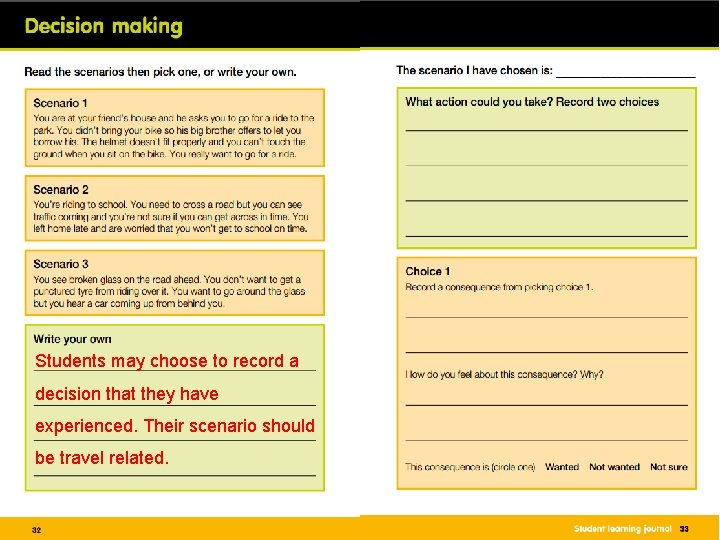
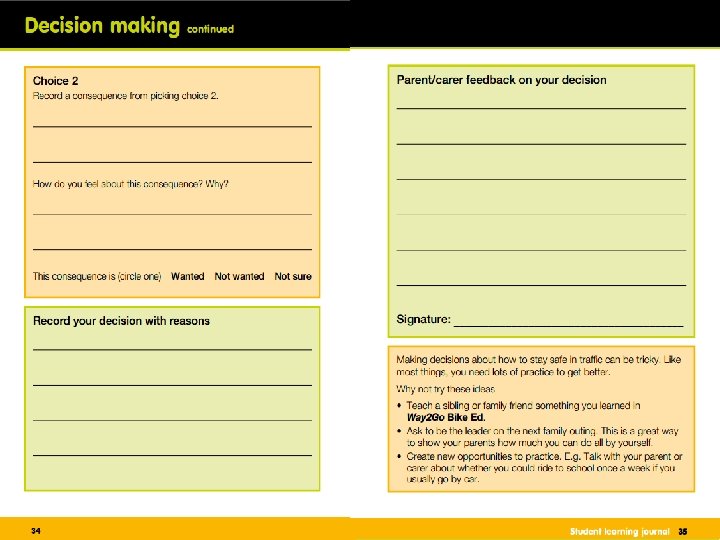
Students may choose to record a decision that they have experienced. Their scenario should be travel related.
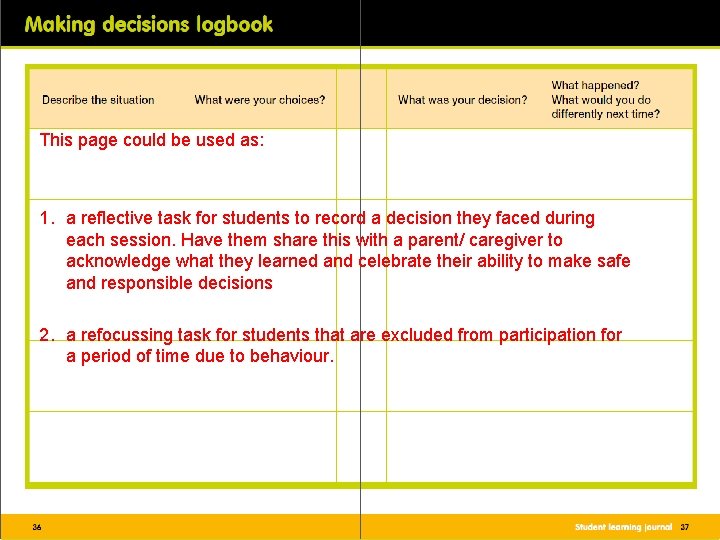
This page could be used as: 1. a reflective task for students to record a decision they faced during each session. Have them share this with a parent/ caregiver to acknowledge what they learned and celebrate their ability to make safe and responsible decisions 2. a refocussing task for students that are excluded from participation for a period of time due to behaviour.
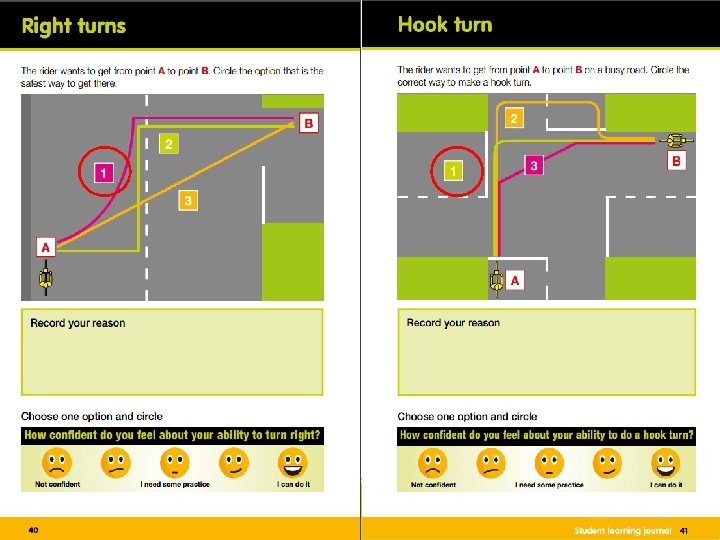
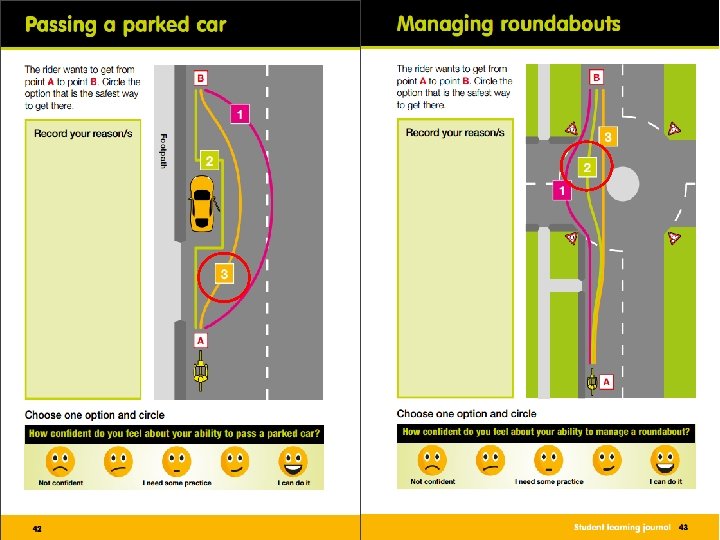
The intersection quiz (pg. 38 -42)
Things to know… • Your school program coordinator may have negotiated with Bike SA for students to do this quiz with the instructors. Ask you school coordinator what has been planned. • When carrying out the quiz instruct students to select the route number not colour. • A detailed explanation of the correct answer to each page can be found by downloading the intersection answer sheet.
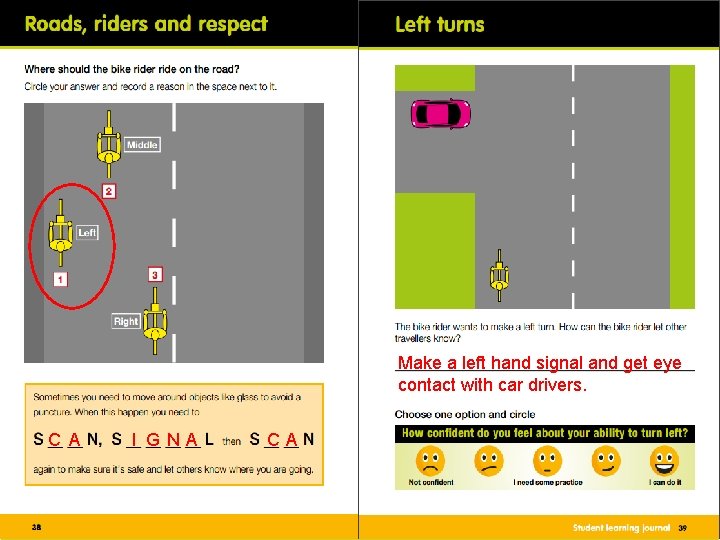
Make a left hand signal and get eye contact with car drivers. C A I GNA CA
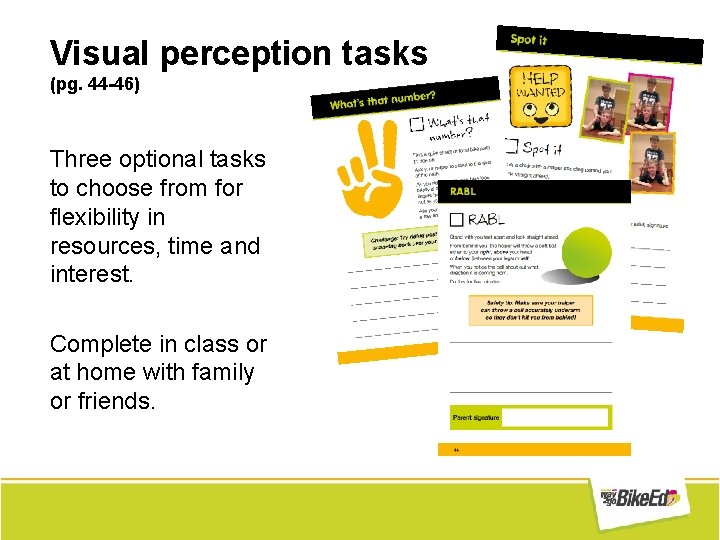
Visual perception tasks (pg. 44 -46) Three optional tasks to choose from for flexibility in resources, time and interest. Complete in class or at home with family or friends.
Visual perception tasks (pg. 44 -46) Makes connections with safe travel behaviours (how to improve in games - focussed attention, ready to respond). Helps to develop students understanding of positional/ directional language for a better understanding of instructions and feedback during practical sessions.
Beyond the Way 2 Go Bike Ed program Want to plan a safe bike riding route? Use the Cycle Instead Journey Planner Looking for more resources, advice or support? Visit the Way 2 Go website.
Food for thought… Sustaining an interest in bike riding beyond the Way 2 Go Bike Ed program is a common challenge faced by schools aiming to create a culture of active travel to and from school. These videos and questions may help you reconceptualise your school approach. Video Reflection questions A thought provoking TED talk about active travel to school. ‘Walk to School: Jennifer Keesmaat at TEDx. Regina’ • How does this apply to my school community? • What could been done to challenge perspectives? Sent out all the information and still not getting the behaviours you want? Watch ‘Three Myths of Behavior Change - What You Think You Know That You Don't: Jeni Cross at TEDx. CSU’ • How effective is my approach in changing behaviour? Why? • What mix of strategies could I apply to get the behaviour I want? Video on making behaviour change manageable and sustainable ‘Forget big change, start with a tiny habit: BJ Fogg at TEDx. Fremont’ • What travel habit would I like to see become common to our school culture? • How could I apply this approach in the classroom?
If you have any questions or would like to provide feedback contact the Way 2 Go team dpti. way 2 go@sa. gov. au