
Student Learning Development Doing a literature review Student


- Slides: 34
Student Learning Development Doing a literature review
Student Learning Development Reasons for reading Why do we read the literature? How many good reasons can you come up with?
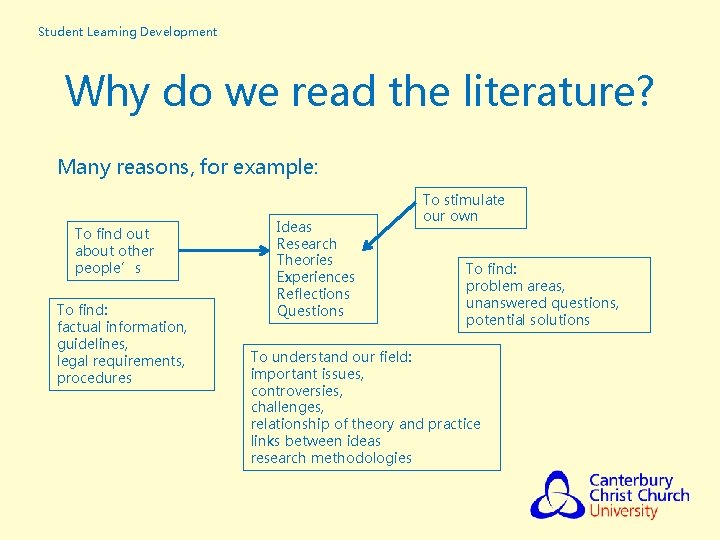
Student Learning Development Why do we read the literature? Many reasons, for example: To find out about other people’s To find: factual information, guidelines, legal requirements, procedures Ideas Research Theories Experiences Reflections Questions To stimulate our own To find: problem areas, unanswered questions, potential solutions To understand our field: important issues, controversies, challenges, relationship of theory and practice links between ideas research methodologies
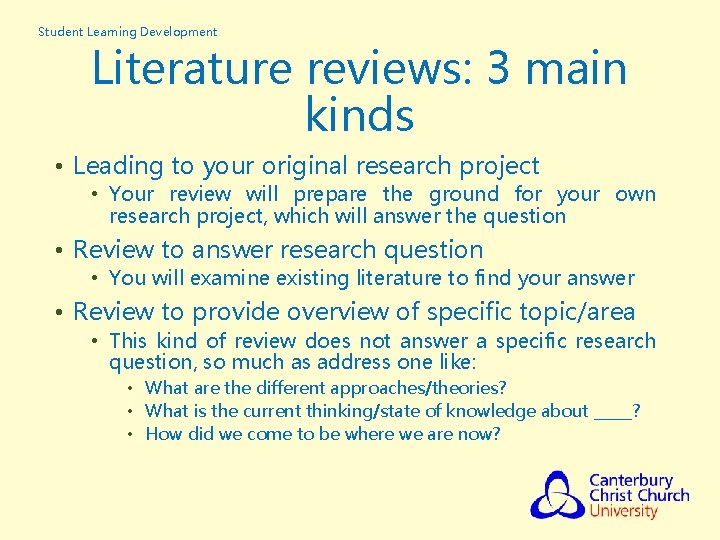
Student Learning Development Literature reviews: 3 main kinds • Leading to your original research project • Your review will prepare the ground for your own research project, which will answer the question • Review to answer research question • You will examine existing literature to find your answer • Review to provide overview of specific topic/area • This kind of review does not answer a specific research question, so much as address one like: • What are the different approaches/theories? • What is the current thinking/state of knowledge about _____? • How did we come to be where we are now?
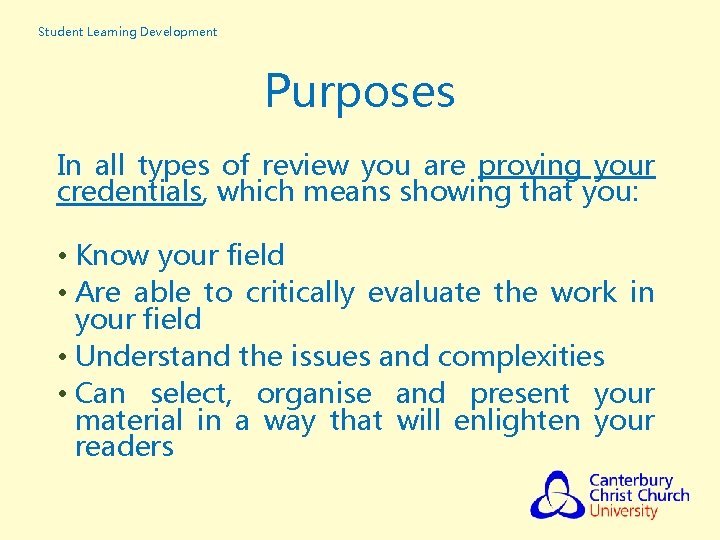
Student Learning Development Purposes In all types of review you are proving your credentials, which means showing that you: • Know your field • Are able to critically evaluate the work in your field • Understand the issues and complexities • Can select, organise and present your material in a way that will enlighten your readers
Student Learning Development Purpose: research project The Literature Review puts your research project in context: • Shows why your research is important • Gives a state-of-the-art analysis to explain why this question needs to be answered • Highlights key issues, themes, debates Positioning your research • Explain the foundations for your research • What theories and previous work are you building on? Why? • What are you rejecting? Why?
Student Learning Development Purpose: research project The Literature Review provides the background: • Make sure that readers know what is necessary to understand appreciate • Your research • Your results • Your conclusions
Student Learning Development Purpose: answering question Show the importance of the research question and the need to answer it. • Pull together what is known/has been found in previous work • Strong emphasis on evidence base • Rigorous criteria for inclusion • Evaluate what is known/has been done • Rigorous criteria for evaluation • Provide an answer based on existing work • Indicate gaps if relevant
Student Learning Development Purpose: ‘overview’ review The literature Review allows your readers to make sense of this particular area. This is more than just reporting, you must shape the field: • Show what is important • Explain, highlight, subordinate, evaluate
Student Learning Development Writing systematic reviews These are often used in health, social care and related areas A lot of useful information can be obtained from the website of the Social Care Institute for Excellence: http: //www. scie. org. uk/index. asp
Student Learning Development Mastering the literature What are your concerns?
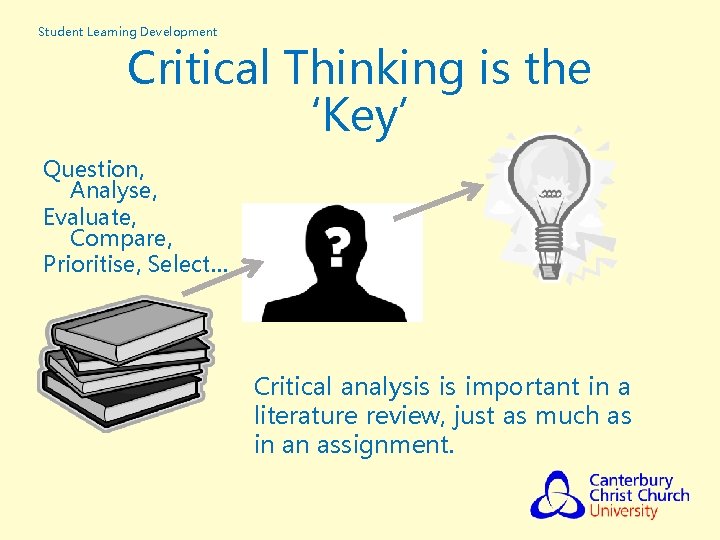
Student Learning Development Critical Thinking is the ‘Key’ Question, Analyse, Evaluate, Compare, Prioritise, Select… Critical analysis is important in a literature review, just as much as in an assignment.
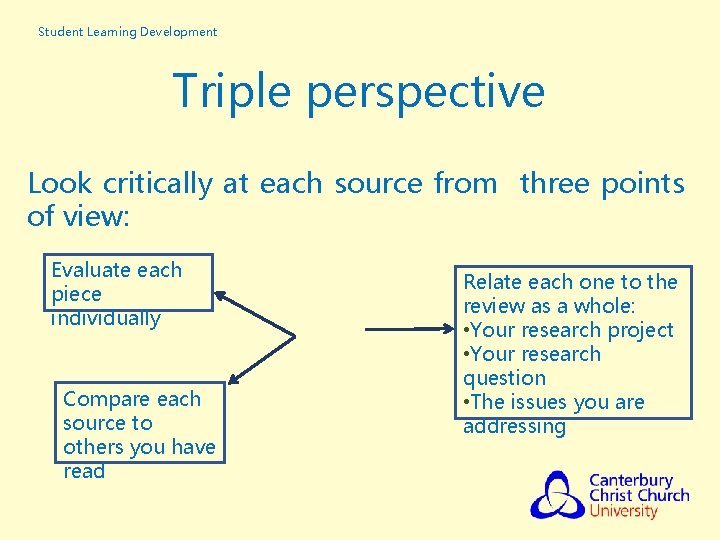
Student Learning Development Triple perspective Look critically at each source from three points of view: Evaluate each piece individually Compare each source to others you have read Relate each one to the review as a whole: • Your research project • Your research question • The issues you are addressing
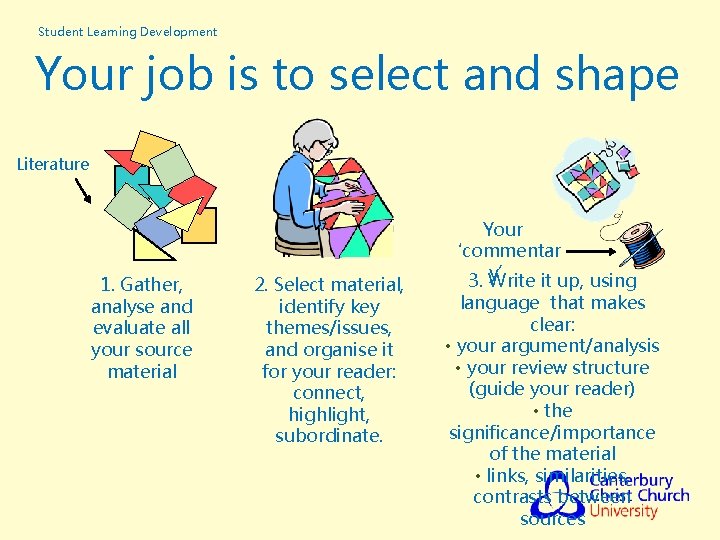
Student Learning Development Your job is to select and shape Literature 1. Gather, analyse and evaluate all your source material 2. Select material, identify key themes/issues, and organise it for your reader: connect, highlight, subordinate. Your ‘commentar y’ it up, using 3. Write language that makes clear: • your argument/analysis • your review structure (guide your reader) • the significance/importance of the material • links, similarities, contrasts between sources
Student Learning Development Finding stuff The trick is to research widely but usefully • Follow up useful leads • Bibliographic search engines – read abstracts • Lists of references from articles you’ve read • Don’t get side-tracked • Keep checking that everything is relevant • Apply inclusion criteria (if appropriate)
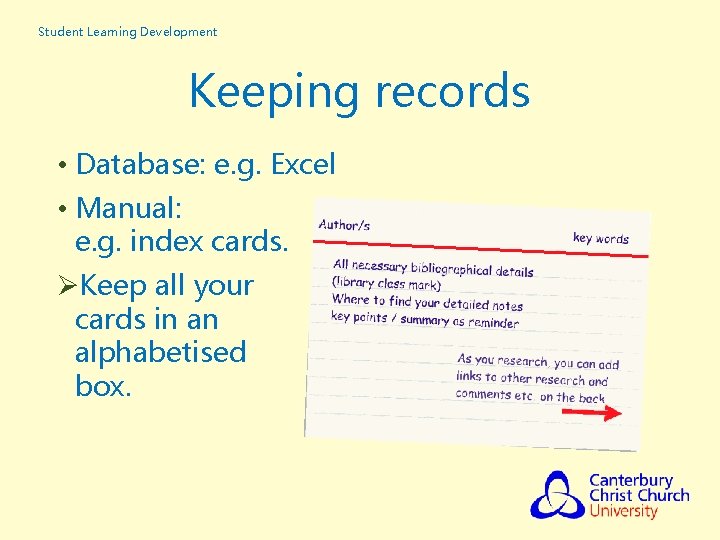
Student Learning Development Keeping records • Database: e. g. Excel • Manual: e. g. index cards. ØKeep all your cards in an alphabetised box.
Student Learning Development Step 1: Focus on the literature • Find out what is out there • Think about it critically. For example: • Explore ideas, find relationships • Identify the strengths of certain (key) studies, and assess the contributions made by researchers • Identify the limitations and weaknesses of particular studies or whole lines of theory/enquiry/practice • Identify key issues/themes/problems/gaps • Use it to refine your thinking
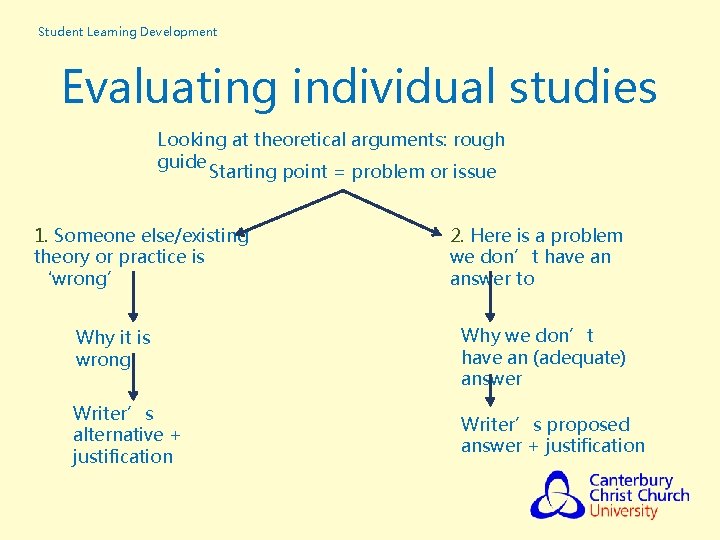
Student Learning Development Evaluating individual studies Looking at theoretical arguments: rough guide Starting point = problem or issue 1. Someone else/existing theory or practice is ‘wrong’ 2. Here is a problem we don’t have an answer to Why it is wrong Why we don’t have an (adequate) answer Writer’s alternative + justification Writer’s proposed answer + justification
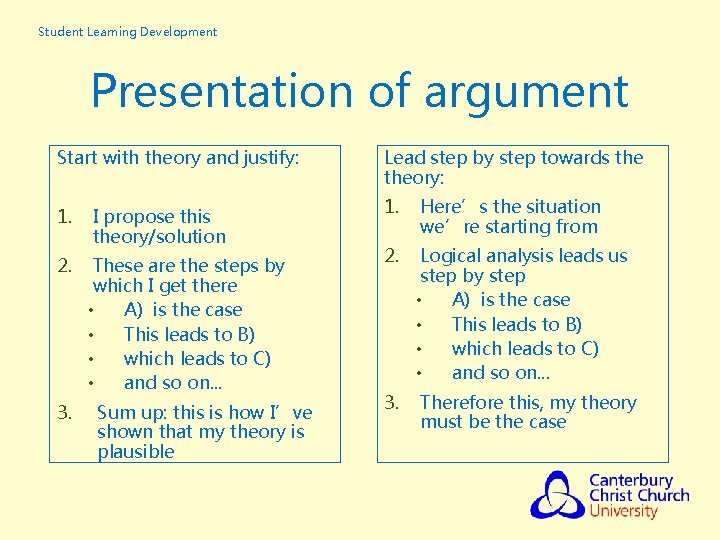
Student Learning Development Presentation of argument Start with theory and justify: 1. I propose this theory/solution 2. These are the steps by which I get there • A) is the case • This leads to B) • which leads to C) • and so on. . . 3. Sum up: this is how I’ve shown that my theory is plausible Lead step by step towards theory: 1. Here’s the situation we’re starting from 2. Logical analysis leads us step by step • A) is the case • This leads to B) • which leads to C) • and so on. . . 3. Therefore this, my theory must be the case
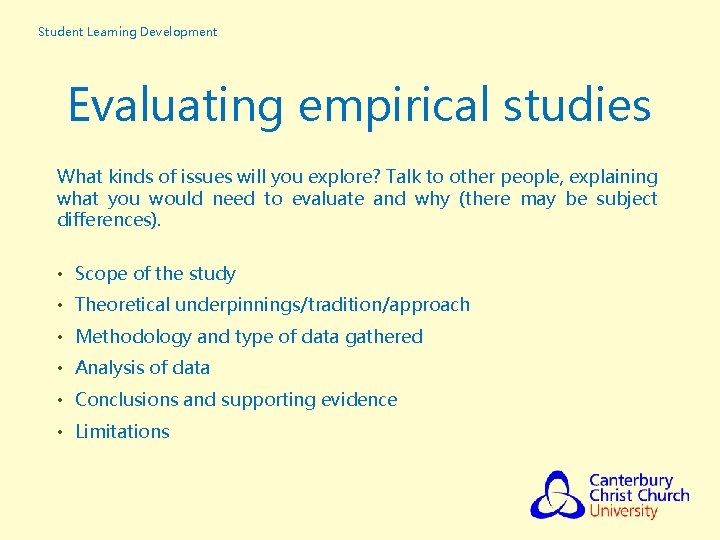
Student Learning Development Evaluating empirical studies What kinds of issues will you explore? Talk to other people, explaining what you would need to evaluate and why (there may be subject differences). • Scope of the study • Theoretical underpinnings/tradition/approach • Methodology and type of data gathered • Analysis of data • Conclusions and supporting evidence • Limitations
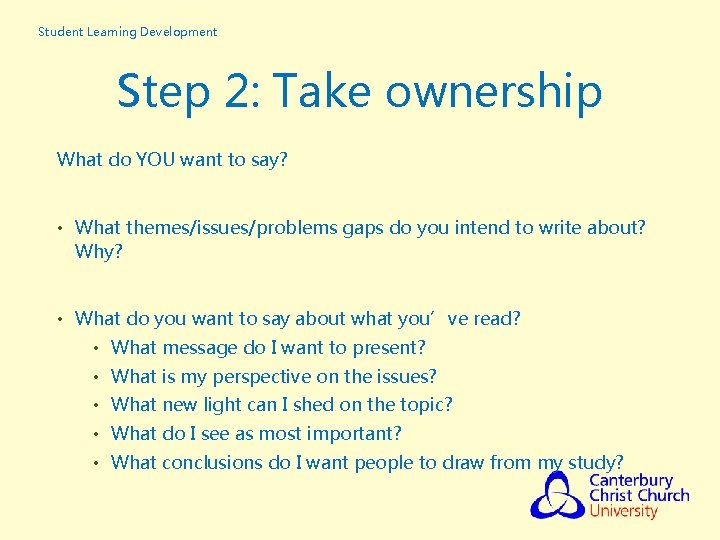
Student Learning Development Step 2: Take ownership What do YOU want to say? • What themes/issues/problems gaps do you intend to write about? Why? • What do you want to say about what you’ve read? • What message do I want to present? • What is my perspective on the issues? • What new light can I shed on the topic? • What do I see as most important? • What conclusions do I want people to draw from my study?
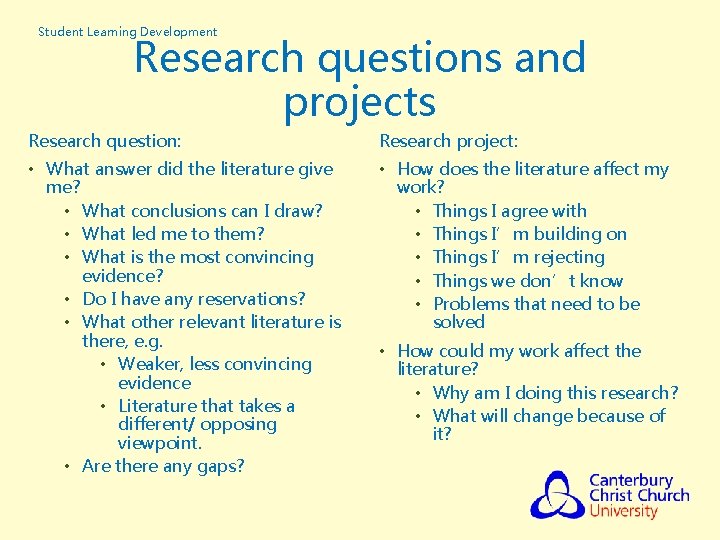
Student Learning Development Research questions and projects Research question: Research project: • What answer did the literature give me? • What conclusions can I draw? • What led me to them? • What is the most convincing evidence? • Do I have any reservations? • What other relevant literature is there, e. g. • Weaker, less convincing evidence • Literature that takes a different/ opposing viewpoint. • Are there any gaps? • How does the literature affect my work? • Things I agree with • Things I’m building on • Things I’m rejecting • Things we don’t know • Problems that need to be solved • How could my work affect the literature? • Why am I doing this research? • What will change because of it?
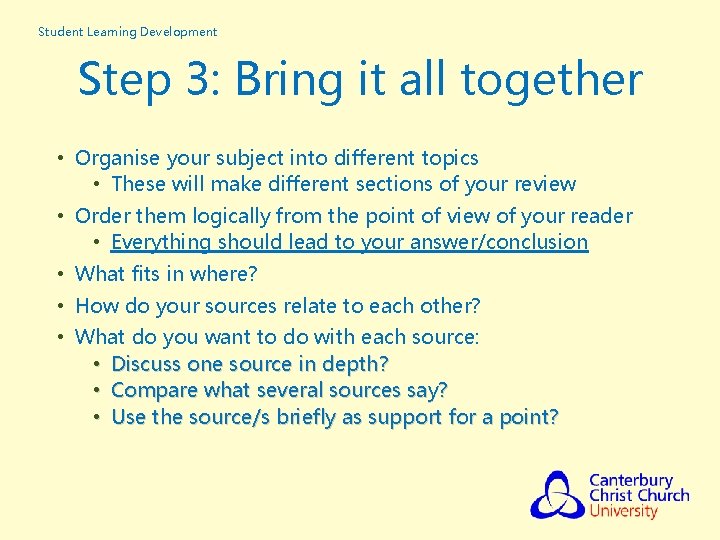
Student Learning Development Step 3: Bring it all together • Organise your subject into different topics • These will make different sections of your review • Order them logically from the point of view of your reader • Everything should lead to your answer/conclusion • What fits in where? • How do your sources relate to each other? • What do you want to do with each source: • Discuss one source in depth? • Compare what several sources say? • Use the source/s briefly as support for a point?
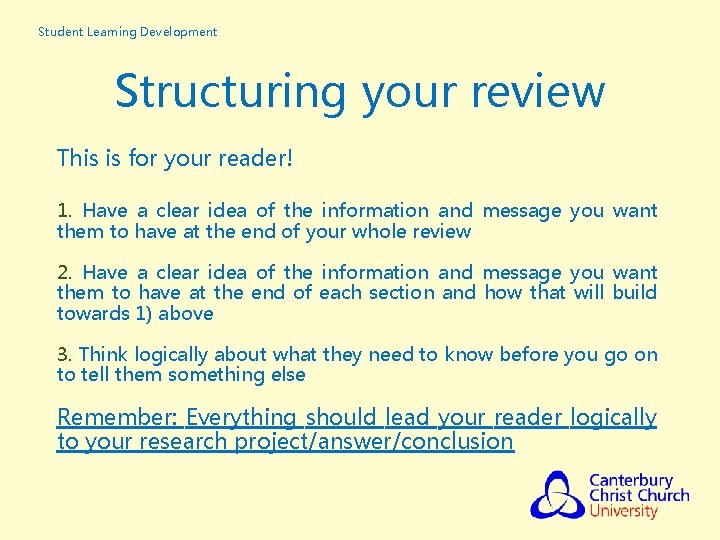
Student Learning Development Structuring your review This is for your reader! 1. Have a clear idea of the information and message you want them to have at the end of your whole review 2. Have a clear idea of the information and message you want them to have at the end of each section and how that will build towards 1) above 3. Think logically about what they need to know before you go on to tell them something else Remember: Everything should lead your reader logically to your research project/answer/conclusion
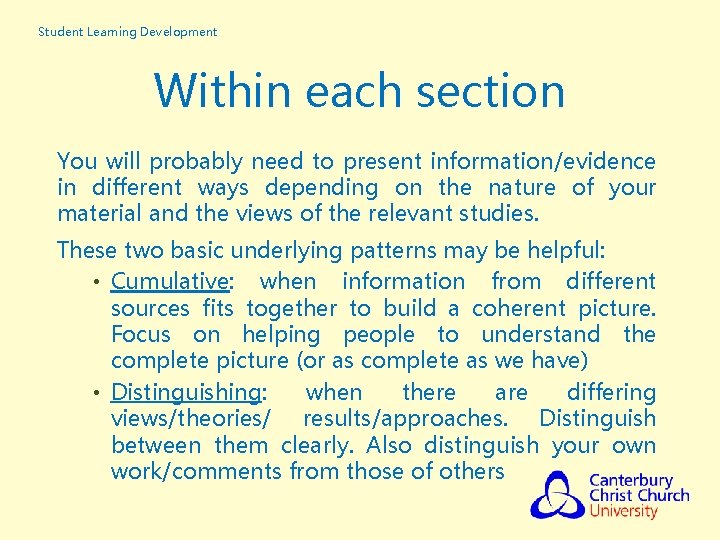
Student Learning Development Within each section You will probably need to present information/evidence in different ways depending on the nature of your material and the views of the relevant studies. These two basic underlying patterns may be helpful: • Cumulative: when information from different sources fits together to build a coherent picture. Focus on helping people to understand the complete picture (or as complete as we have) • Distinguishing: when there are differing views/theories/ results/approaches. Distinguish between them clearly. Also distinguish your own work/comments from those of others
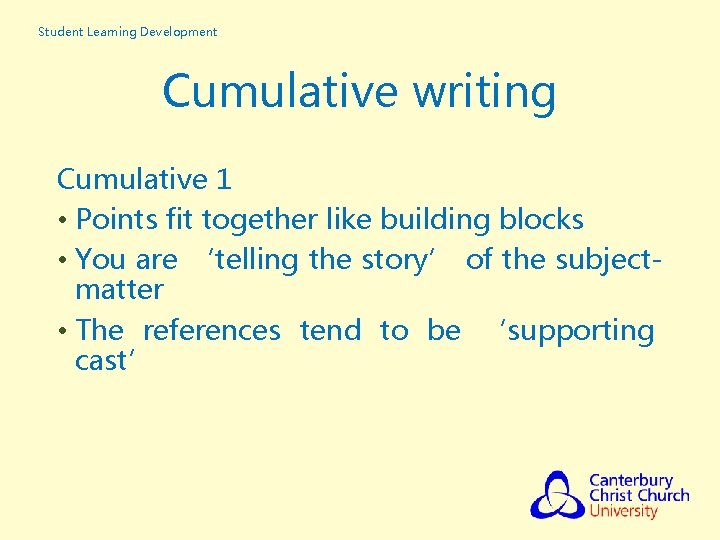
Student Learning Development Cumulative writing Cumulative 1 • Points fit together like building blocks • You are ‘telling the story’ of the subjectmatter • The references tend to be ‘supporting cast’
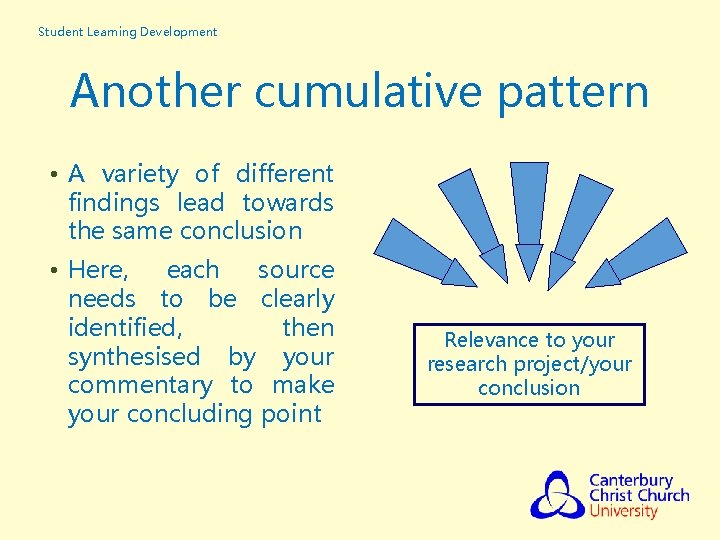
Student Learning Development Another cumulative pattern • A variety of different findings lead towards the same conclusion • Here, each source needs to be clearly identified, then synthesised by your commentary to make your concluding point Relevance to your research project/your conclusion
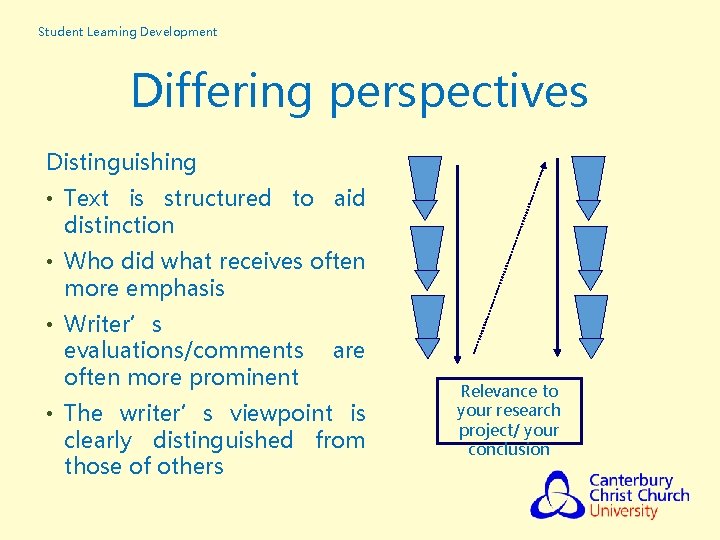
Student Learning Development Differing perspectives Distinguishing • Text is structured to aid distinction • Who did what receives often more emphasis • Writer’s evaluations/comments often more prominent are • The writer’s viewpoint is clearly distinguished from those of others Relevance to your research project/ your conclusion
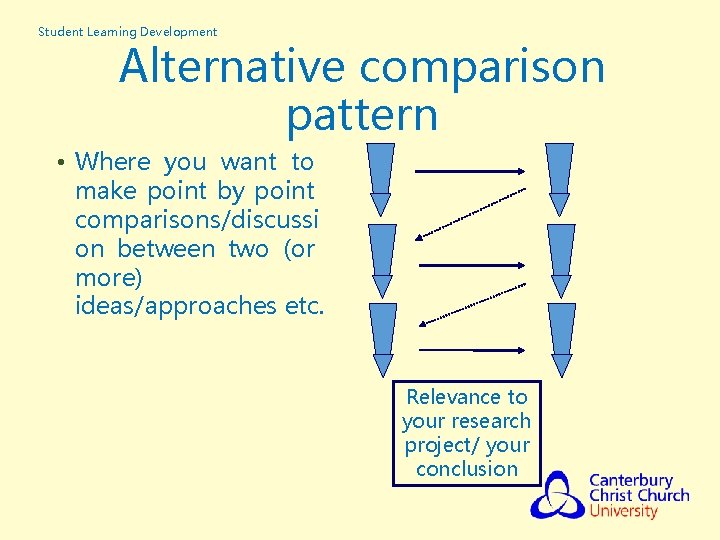
Student Learning Development Alternative comparison pattern • Where you want to make point by point comparisons/discussi on between two (or more) ideas/approaches etc. Relevance to your research project/ your conclusion
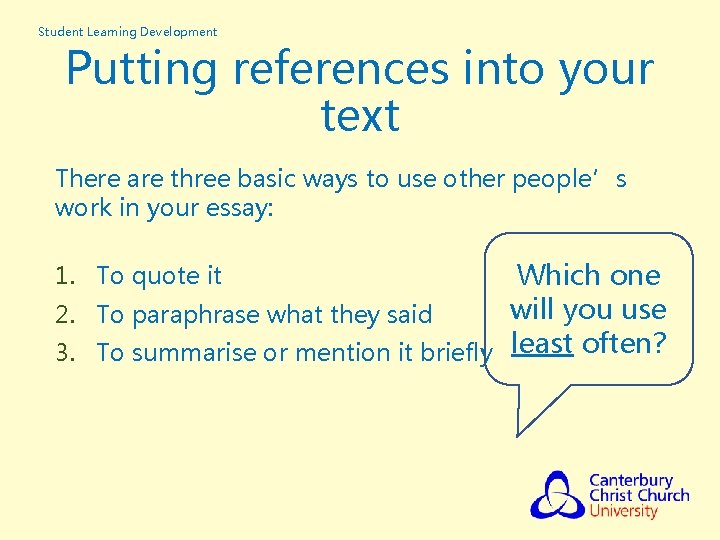
Student Learning Development Putting references into your text There are three basic ways to use other people’s work in your essay: Which one will you use 2. To paraphrase what they said 3. To summarise or mention it briefly least often? 1. To quote it
Student Learning Development Don’t quote too often So when should you quote? • When you are using someone’s definition • When you want to discuss exactly what someone said • When the precise detail of what someone/thing says is important – e. g. a law, policy document etc. • When someone has phrased something effectively and succinctly
Student Learning Development Why paraphrase? • So that we show we understand what the author is saying • Because it is often easier to tailor the information so that it fits into our own writing – for example: • We use only what is relevant to what we want to say • We can highlight a particular aspect of a longer piece • It is easier to pull together data from different people • We can shape the material so that it fits into the flow of our own writing
Student Learning Development Why summarise? • When the amount of detail the author gives is not relevant for your work you can sum up a few paragraphs in one or two sentences that give the central idea or opinion. This allows you to expand the point in your own way and include other viewpoints. • Remember: You don’t want to use up whole chunks of your review just repeating what other people said.