
Student Instructor Orientation Welcome to Aurora Health Care


- Slides: 55
Student / Instructor Orientation Welcome to Aurora Health Care and the Aurora Oshkosh / Fond du Lac Patient Service Market We hope your clinical or internship experience with us will be a rewarding one If you have any questions during your time here, please contact our student coordinator at 920 -456 -7795 or barbara. bloch@aurora. org Updated November 2017
Orientation Checklist: Before you Start • Before you start your clinical or student experience at our sites, print the appropriate orientation checklist from Aurora specific Website, step 3: • Aurora Undergraduate (Hospital) Student Orientation Checklist • Aurora Undergraduate (Clinic) Student Orientation Checklist • Aurora Graduate Student Orientation Checklist 1. Bring to first day of clinical/experience 2. Review with your instructor or preceptor 3. Sign and Return to the Education Department
Orientation Checklist: Before you can Start • Before starting at Aurora, please review: - FVHCA Health Requirements - And Required Background checks • Your school coordinator or instructor must ensure these are met prior to your arrival
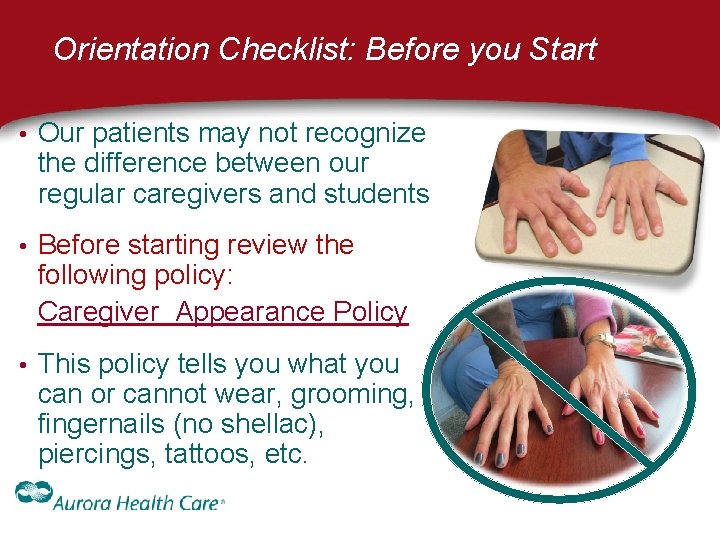
Orientation Checklist: Before you Start • Our patients may not recognize the difference between our regular caregivers and students • Before starting review the following policy: Caregiver Appearance Policy • This policy tells you what you can or cannot wear, grooming, fingernails (no shellac), piercings, tattoos, etc.
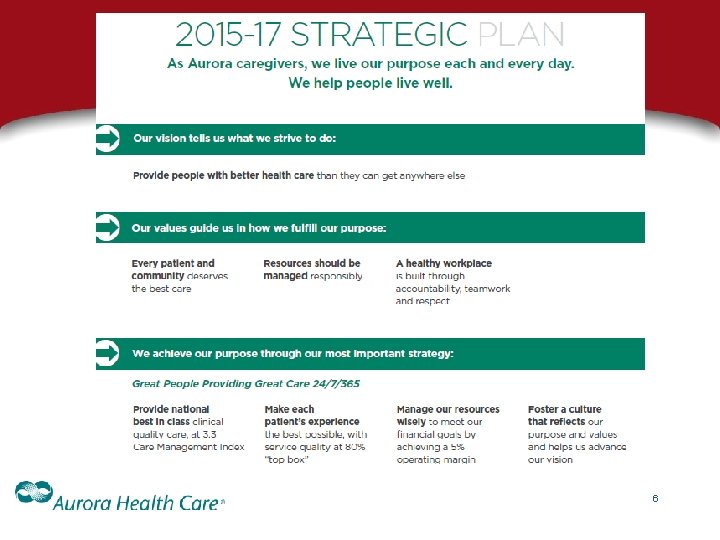
About Aurora, Integrated Health System • Aurora Health Care is an integrated not-for-profit health care provider serving communities throughout eastern Wisconsin and Northern Illinois. • 15 hospitals • 159 clinics • 70 retail pharmacies • 30, 000+ caregivers including 1, 500 employed physicians • Largest home care organization in Wisconsin • Single CEO, Nick Turkal, MD
6
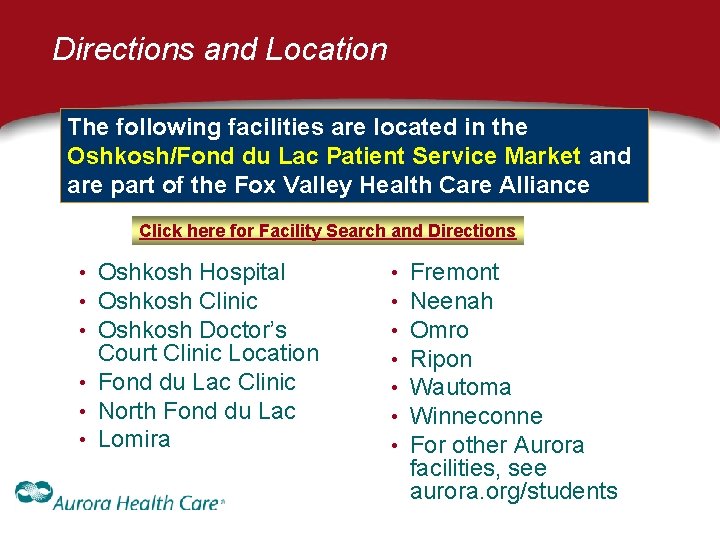
Directions and Location The following facilities are located in the Oshkosh/Fond du Lac Patient Service Market and are part of the Fox Valley Health Care Alliance Click here for Facility Search and Directions • Oshkosh Hospital • Oshkosh Clinic • Oshkosh Doctor’s Court Clinic Location • Fond du Lac Clinic • North Fond du Lac • Lomira • • Fremont Neenah Omro Ripon Wautoma Winneconne For other Aurora facilities, see aurora. org/students
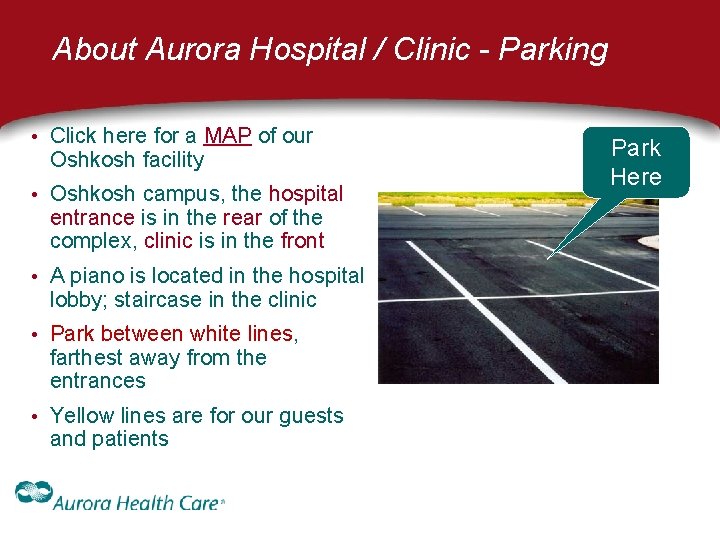
About Aurora Hospital / Clinic - Parking • Click here for a MAP of our Oshkosh facility • Oshkosh campus, the hospital entrance is in the rear of the complex, clinic is in the front • A piano is located in the hospital lobby; staircase in the clinic • Park between white lines, farthest away from the entrances • Yellow lines are for our guests and patients Park Here
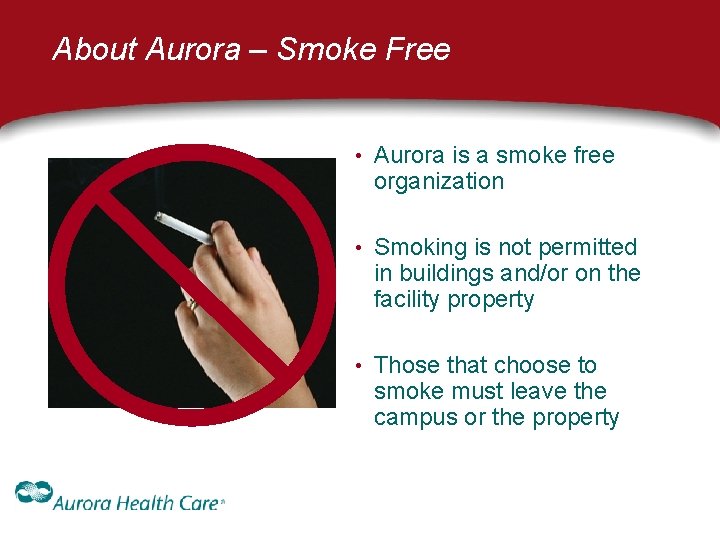
About Aurora – Smoke Free • Aurora is a smoke free organization • Smoking is not permitted in buildings and/or on the facility property • Those that choose to smoke must leave the campus or the property
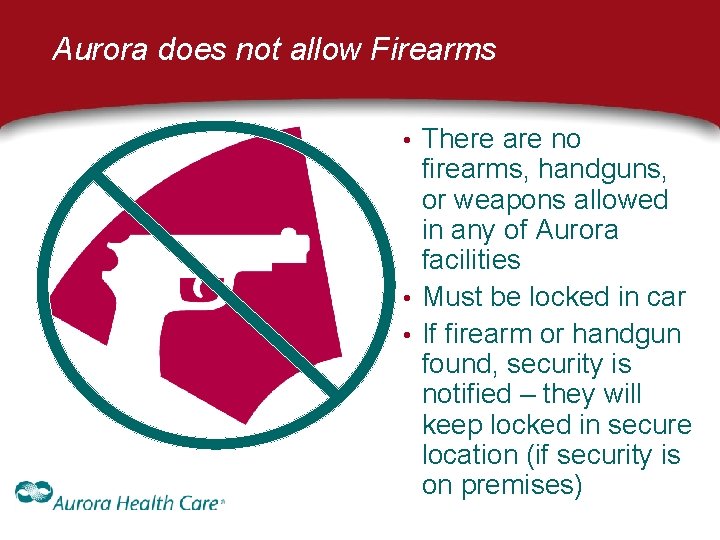
Aurora does not allow Firearms • There are no firearms, handguns, or weapons allowed in any of Aurora facilities • Must be locked in car • If firearm or handgun found, security is notified – they will keep locked in secure location (if security is on premises)
Aurora health Care is a not-for-profit health care provider and a national leader in the efforts to improve the quality of health care.
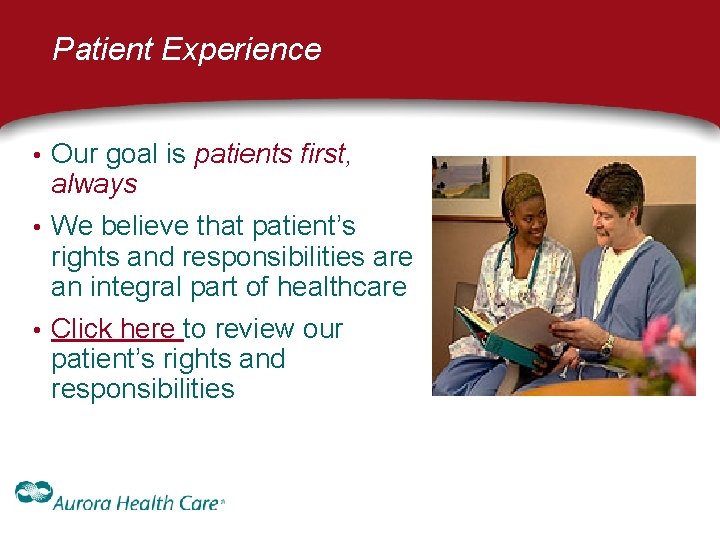
Patient Experience • Our goal is patients first, always • We believe that patient’s rights and responsibilities are an integral part of healthcare • Click here to review our patient’s rights and responsibilities
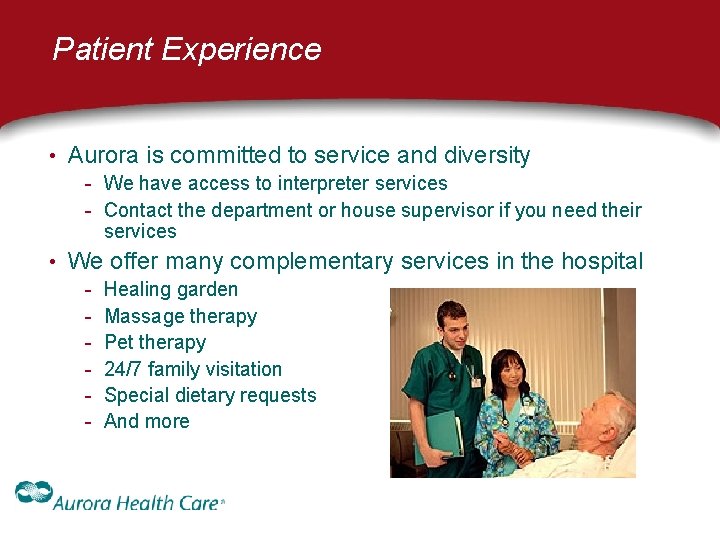
Patient Experience • Aurora is committed to service and diversity - We have access to interpreter services - Contact the department or house supervisor if you need their services • We offer many complementary services in the hospital - Healing garden - Massage therapy - Pet therapy - 24/7 family visitation - Special dietary requests - And more
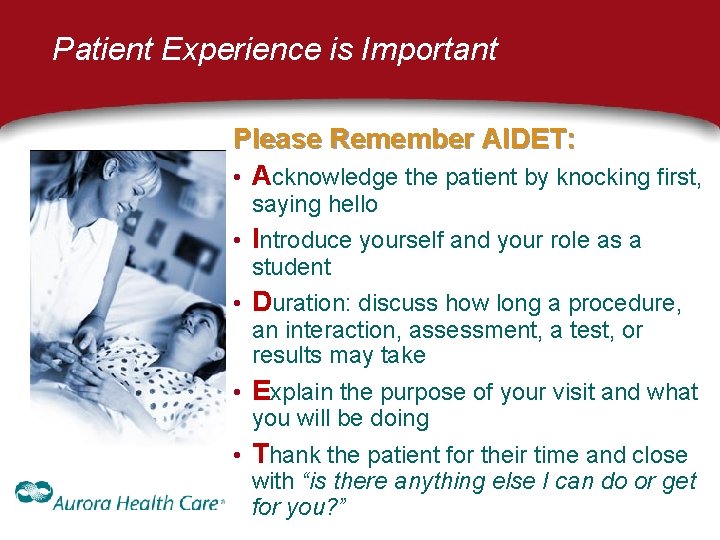
Patient Experience is Important Please Remember AIDET: • Acknowledge the patient by knocking first, saying hello • Introduce yourself and your role as a student • Duration: discuss how long a procedure, an interaction, assessment, a test, or results may take • Explain the purpose of your visit and what you will be doing • Thank the patient for their time and close with “is there anything else I can do or get for you? ”
Patient Experience is Important Other TIPS • Always wear a name badge • Always inform the patient of what you will be doing and why • Show respect, provide dignity and privacy • Think about how you would want to be treated if you were a patient • While you are here, you are part of the team – it is all about the patient
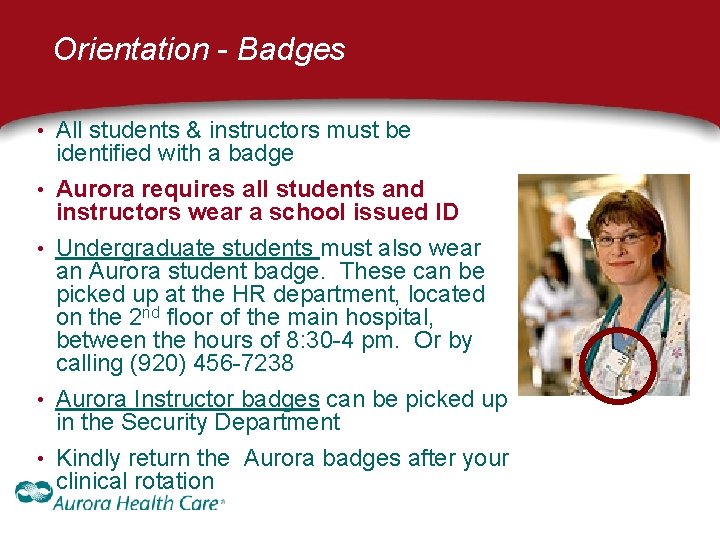
Orientation - Badges • All students & instructors must be • • identified with a badge Aurora requires all students and instructors wear a school issued ID Undergraduate students must also wear an Aurora student badge. These can be picked up at the HR department, located on the 2 nd floor of the main hospital, between the hours of 8: 30 -4 pm. Or by calling (920) 456 -7238 Aurora Instructor badges can be picked up in the Security Department Kindly return the Aurora badges after your clinical rotation
Instructor Badges • Reminder: Badges are tracked by security • All badges need to be returned at the end of your clinical rotation to the Security Department or you will be charged a $25. 00 fee (Please return Undergraduate Aurora badges to HR)
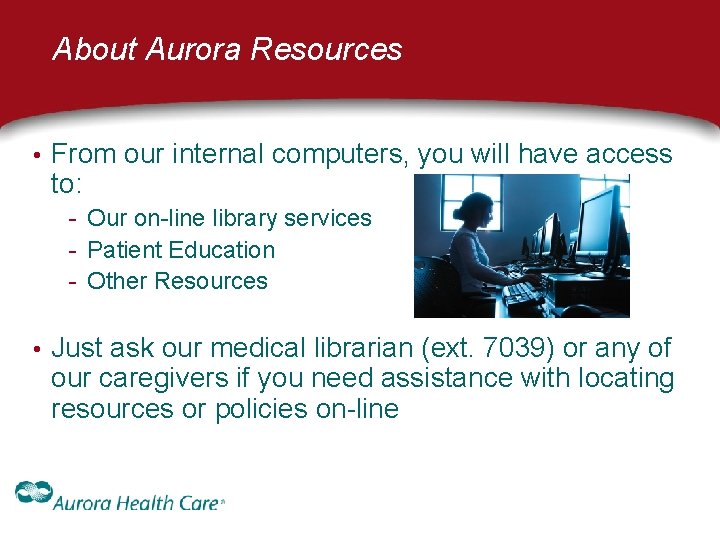
About Aurora Resources • From our internal computers, you will have access to: - Our on-line library services - Patient Education - Other Resources • Just ask our medical librarian (ext. 7039) or any of our caregivers if you need assistance with locating resources or policies on-line
Aurora Resources If you are providing information to patients, please remember the following tips: Ø Keep information simple Ø Use plain language (avoid medical jargon or abbreviations) Ø Have the patient or family member “teach back” or tell you / show you what you just told /showed them Ø Do not say, “do you have any questions”…. . Ø Instead, ask them to… Ø “Tell me what you know about…. ” Ø “Tell me what your doctor told you”, then clarify the information as needed Ø “How will you do this or take this when you get home? ”
Safety • We want you to be prepared in any of our Aurora facilities • We use plain language alerts for situations where we may need to act fast • Know numbers to call: • 5911 at Oshkosh Facility • Other outlying facilities call 9 -911 • Fond du Lac clinic, call 22
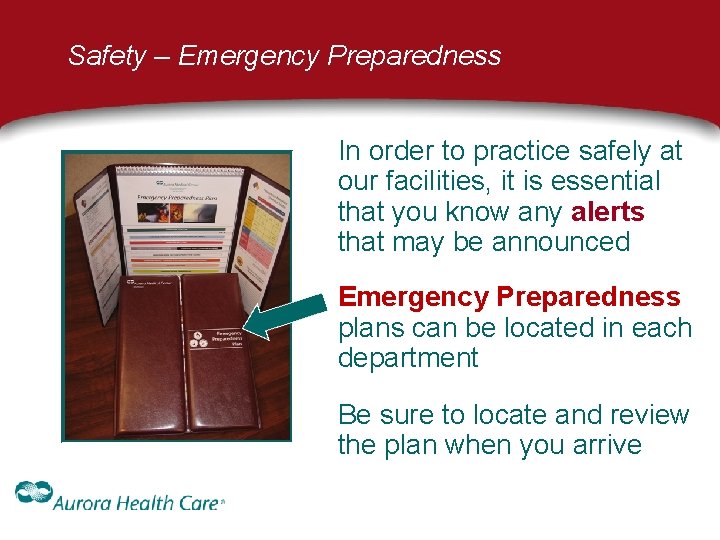
Safety – Emergency Preparedness In order to practice safely at our facilities, it is essential that you know any alerts that may be announced Emergency Preparedness plans can be located in each department Be sure to locate and review the plan when you arrive
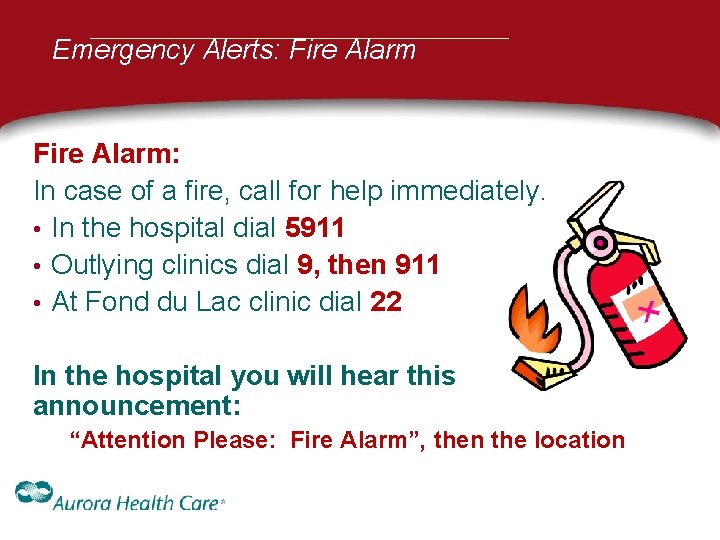
Emergency Alerts: Fire Alarm: In case of a fire, call for help immediately. • In the hospital dial 5911 • Outlying clinics dial 9, then 911 • At Fond du Lac clinic dial 22 In the hospital you will hear this announcement: “Attention Please: Fire Alarm”, then the location
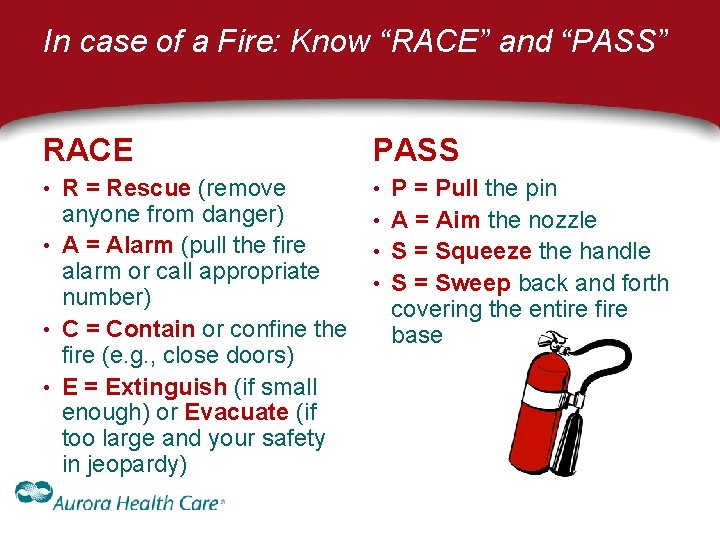
In case of a Fire: Know “RACE” and “PASS” RACE PASS • R = Rescue (remove • P = Pull the pin anyone from danger) • A = Aim the nozzle • A = Alarm (pull the fire • S = Squeeze the handle alarm or call appropriate • S = Sweep back and forth number) covering the entire fire • C = Contain or confine the base fire (e. g. , close doors) • E = Extinguish (if small enough) or Evacuate (if too large and your safety in jeopardy)
Emergency Alerts: Missing Person or Abduction or Missing Person: • What you will hear, - “Attention Please, Missing person, then whether the person is an adult, child or infant, then any description and the location if known - Description may include: • Gender • Age • Clothing • Hair or eye color • Direction last seen or going
Emergency Alerts: Medical Emergency • If there is a medical emergency, perhaps a person or patient you find that has passed out, having a stroke, or is not breathing and you need help quickly • Dial the emergency number - 5911 -Oshkosh; - 9 -911 - Outlying clinics - or 22 – Fond du Lac clinic - 8111 – Neenah Clinic • Give as much information as possible • Always let the operator hang up on you
Emergency Alerts: Medical Emergency • When calling the operator at the Oshkosh campus, give details such as location and the type of help needed. - The location (hospital, room ___; or clinic, suite ___; or whatever department the situation is located - Patient is breathing, not breathing, having a stroke or a heart attack • The announcement overhead will determine which team responds to the medical emergency
Emergency Alerts: Medical Emergency • Rapid Response Team (RRT) is requested if urgent help is needed and the patient is still breathing/has a pulse - RRT Stroke is announced if the patient is having a stroke - RRT OB • RRT Pediatric • Code Blue is announced if the patient is not breathing and has no pulse • External is announced if assistance is needed outside the building
Emergency Alerts: Severe Weather In case of severe weather, you will here this announcement: • “Attention Please, Severe Weather”, then one of the following: - Tornado watch - Tornado warning - Weather advisory • And a timeline
Emergency Alerts: Facility Emergencies • You may also hear other alerts related to facility emergencies that involve: - Communications Flood Evacuation Outages Hazardous Spills • Once these have been resolved, “All Clear” will be announced • A caregiver or a supervisor will direct you if action is needed
Emergency Alerts: Security Alert There may be situations where caregivers, patients and/or visitors might be at risk. Security Alert will be announced followed by one of the following descriptors: • Security Assist (used for disruptive behavior, hostage, gun, knife situations) • Building Threat (used if bomb threat) • Active Shooter (used if there is an active shooter on the premises) • Perimeter Control
Active Shooter: The 5 “Outs” What to do if there is an active shooter 1. RUN 2. HIDE 3. FIGHT Remember to always: • Be aware of your environment and any possible dangers • Take note of two nearest exits in your facility/area • Report any concerns immediately to your preceptor or instructor or Aurora employee or security officer
Safety – Exposures and Spills • If you are exposed to any hazardous chemical, be sure to know how to locate Material Safety Data Sheets (MSDS) • These will provide guidance on how to protect yourself and care following exposure, as well as how to clean a spill • Located on-line, ask any caregiver
Safety – Exposures and Spills If you have a blood spill: 1. Contact Environmental Services immediately 2. If not available, notify the House Supervisor where applicable (Hospital) 3. A blood spill kit is required for clean up 4. Do not pick up broken glass with hands
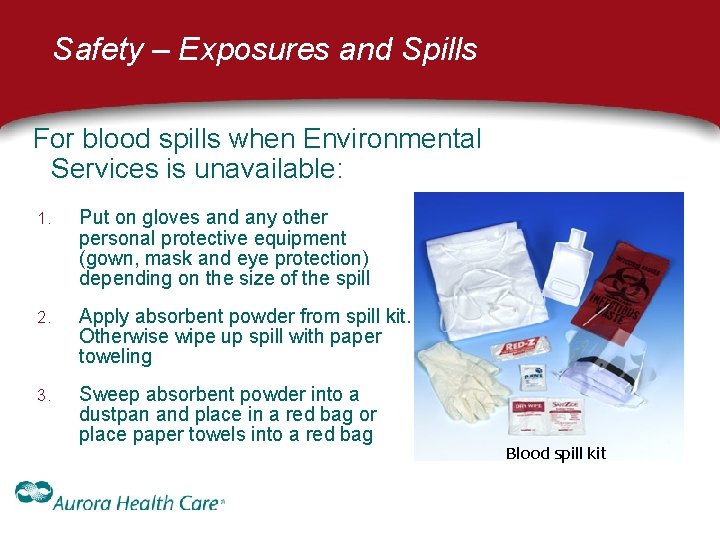
Safety – Exposures and Spills For blood spills when Environmental Services is unavailable: 1. Put on gloves and any other personal protective equipment (gown, mask and eye protection) depending on the size of the spill 2. Apply absorbent powder from spill kit. Otherwise wipe up spill with paper toweling 3. Sweep absorbent powder into a dustpan and place in a red bag or place paper towels into a red bag Blood spill kit
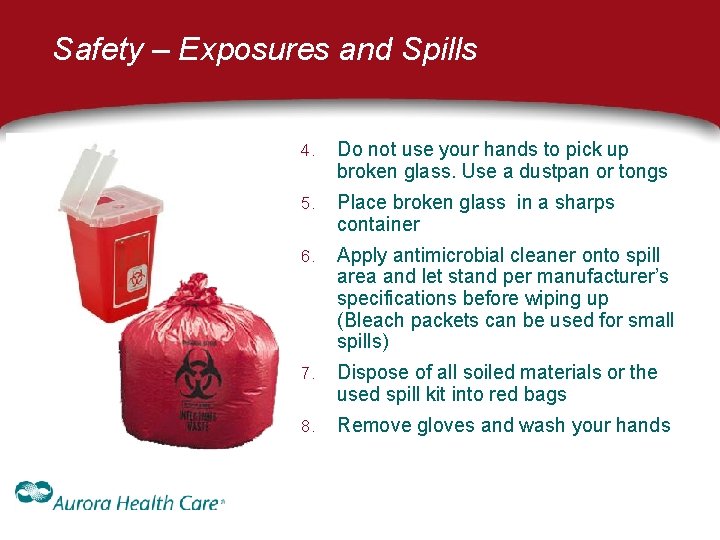
Safety – Exposures and Spills 4. Do not use your hands to pick up broken glass. Use a dustpan or tongs 5. Place broken glass in a sharps container 6. Apply antimicrobial cleaner onto spill area and let stand per manufacturer’s specifications before wiping up (Bleach packets can be used for small spills) 7. Dispose of all soiled materials or the used spill kit into red bags 8. Remove gloves and wash your hands
Safety – Exposures and Spills If you are exposed to a spill, needle stick or any other injury during your student experience: • Notify your instructor or preceptor • Notify the department supervisor or manager and employee health nurse • Report to urgent care or the emergency department (after hours) for evaluation • An incident report will need to be filled out
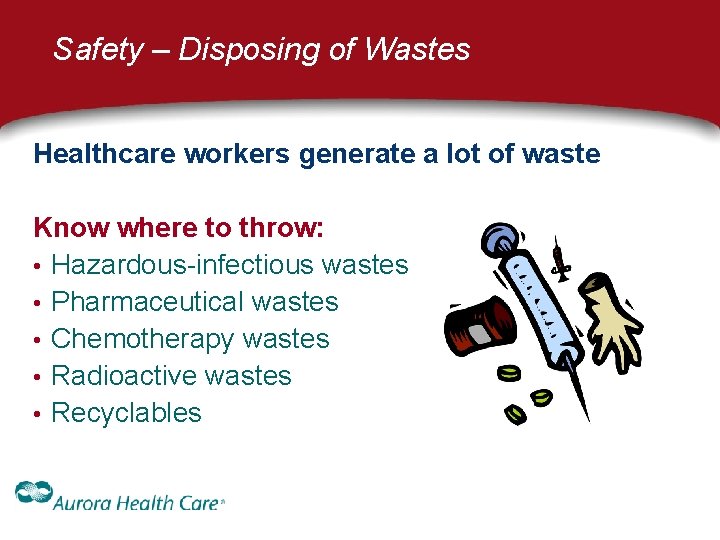
Safety – Disposing of Wastes Healthcare workers generate a lot of waste Know where to throw: • Hazardous-infectious wastes • Pharmaceutical wastes • Chemotherapy wastes • Radioactive wastes • Recyclables
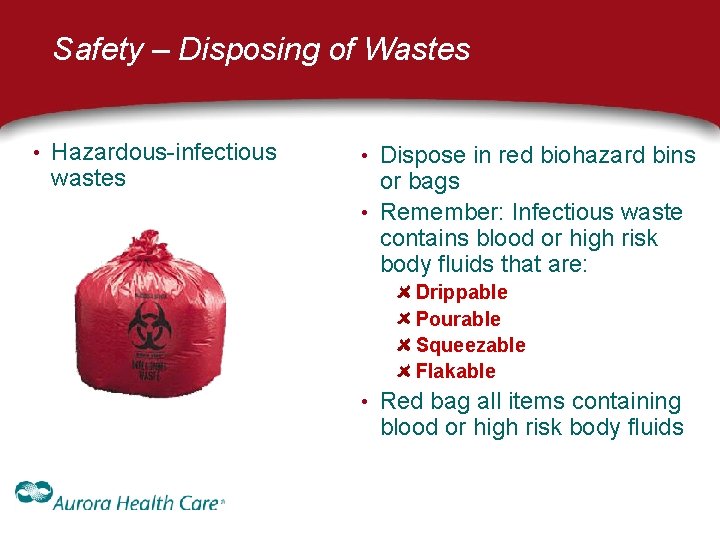
Safety – Disposing of Wastes • Hazardous-infectious wastes • Dispose in red biohazard bins or bags • Remember: Infectious waste contains blood or high risk body fluids that are: Drippable Pourable Squeezable Flakable • Red bag all items containing blood or high risk body fluids
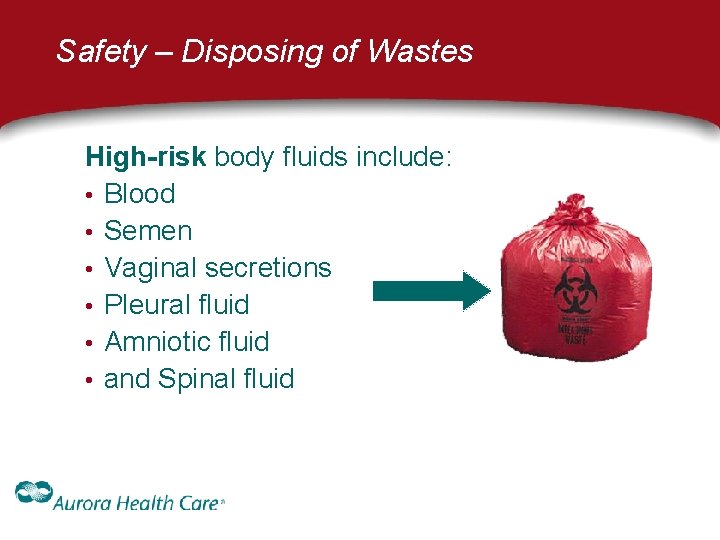
Safety – Disposing of Wastes High-risk body fluids include: • Blood • Semen • Vaginal secretions • Pleural fluid • Amniotic fluid • and Spinal fluid
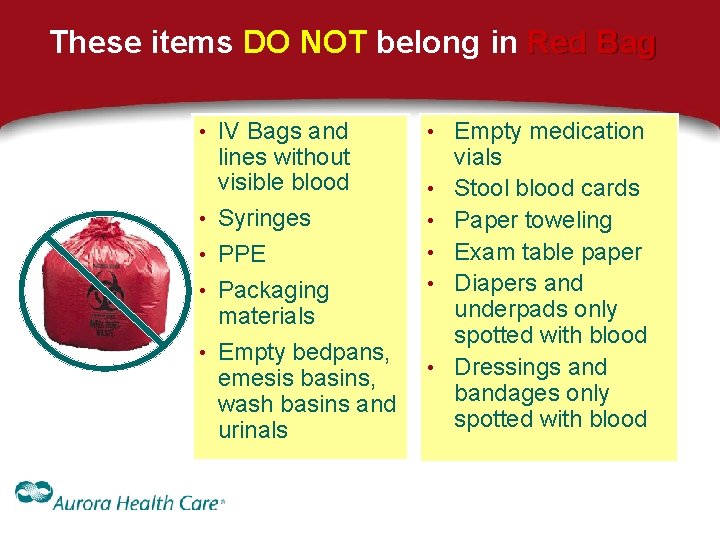
These items DO NOT belong in Red Bag • IV Bags and • • lines without visible blood Syringes PPE Packaging materials Empty bedpans, emesis basins, wash basins and urinals • Empty medication • • • vials Stool blood cards Paper toweling Exam table paper Diapers and underpads only spotted with blood Dressings and bandages only spotted with blood
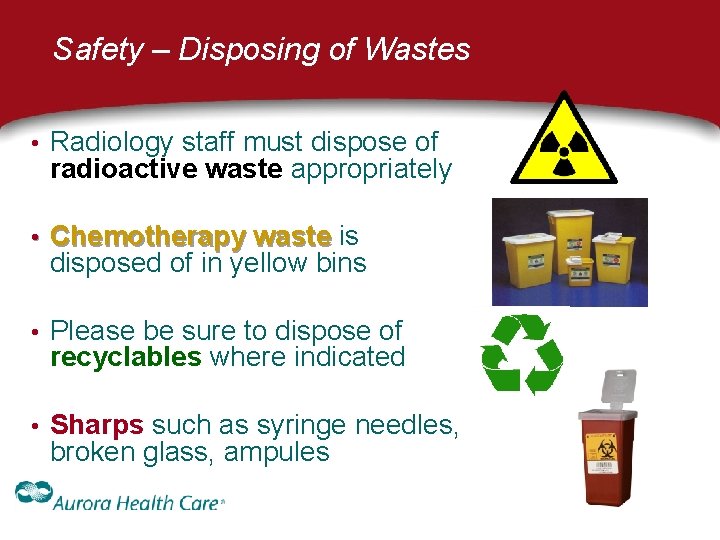
Safety – Disposing of Wastes • Radiology staff must dispose of radioactive waste appropriately • Chemotherapy waste is waste disposed of in yellow bins • Please be sure to dispose of recyclables where indicated • Sharps such as syringe needles, broken glass, ampules
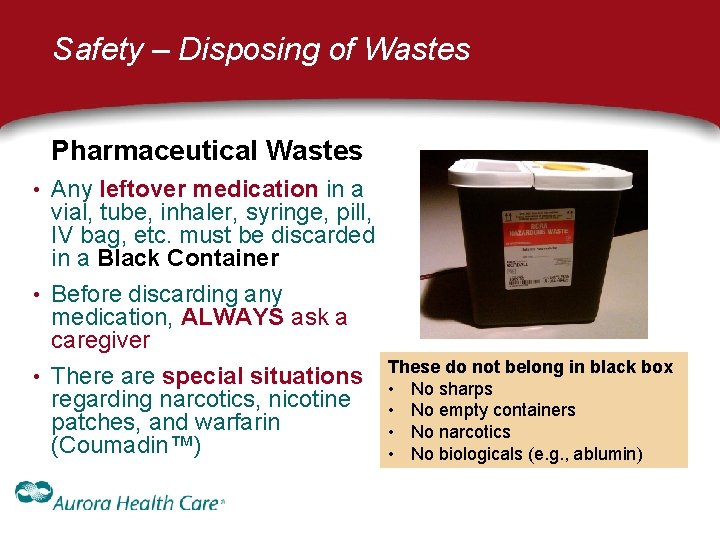
Safety – Disposing of Wastes Pharmaceutical Wastes • Any leftover medication in a vial, tube, inhaler, syringe, pill, IV bag, etc. must be discarded in a Black Container • Before discarding any medication, ALWAYS ask a caregiver These do not belong in black box • There are special situations • No sharps regarding narcotics, nicotine • No empty containers patches, and warfarin • No narcotics (Coumadin™) • No biologicals (e. g. , ablumin)
Patient Safety Is Important! • Prevent infection – wash your hands • • - Follow isolation precautions - Wear appropriate personal protective equipment (PPE) Prevent healthcare associated infections (HAIs) - Surgical Site Infections (SSI) - Central Line Associated Blood Stream Infection (CLABSI) - Catheter Associated Urinary Tract Infection (CA-UTI) Use checklists and take a time out for procedures Identify the correct patient & procedure every time Report critical test results immediately Communicate clearly with other caregivers Communicate clearly with patients Follow interventions to Prevent falls Be alert to signs of abuse, neglect or suicide
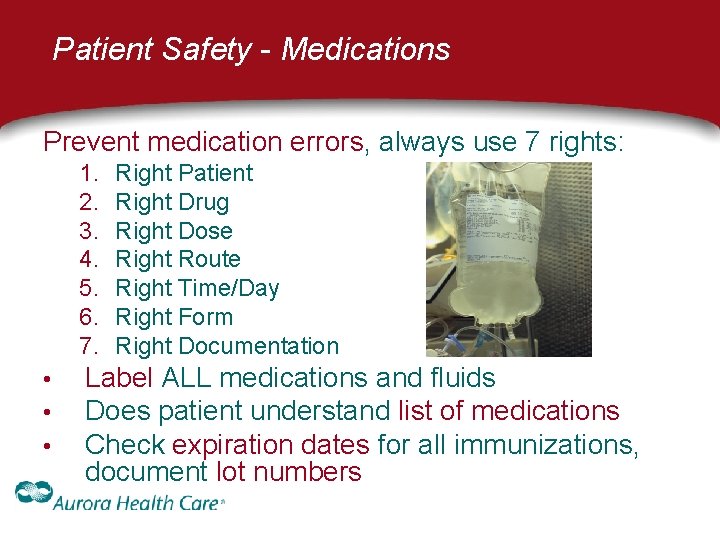
Patient Safety - Medications Prevent medication errors, always use 7 rights: 1. 2. 3. 4. 5. 6. 7. • • • Right Patient Right Drug Right Dose Right Route Right Time/Day Right Form Right Documentation Label ALL medications and fluids Does patient understand list of medications Check expiration dates for all immunizations, document lot numbers
Patient Safety • If your experience will be in the hospital setting, you will need to be aware of our restraint policy • Alternatives to restraints are always used first • Generally we don’t use restraints except for specific situations where the patient could cause harm to self or others • Students and instructors may not apply restraints
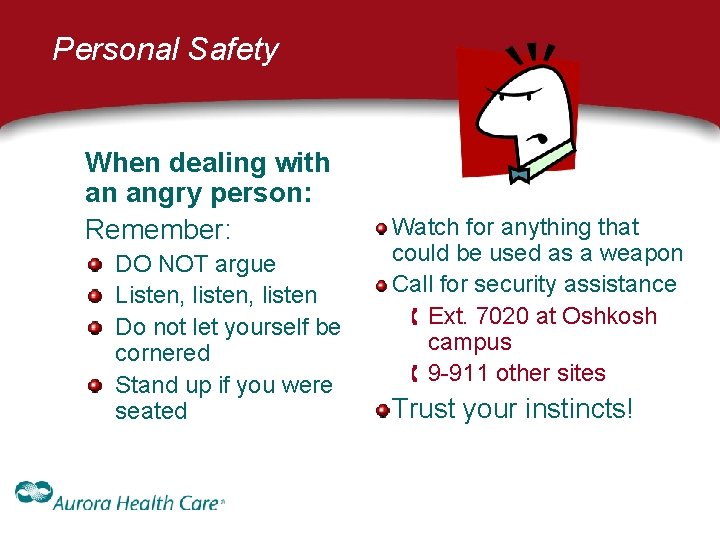
Personal Safety When dealing with an angry person: Remember: DO NOT argue Listen, listen Do not let yourself be cornered Stand up if you were seated Watch for anything that could be used as a weapon Call for security assistance Å Ext. 7020 at Oshkosh campus Å 9 -911 other sites Trust your instincts!
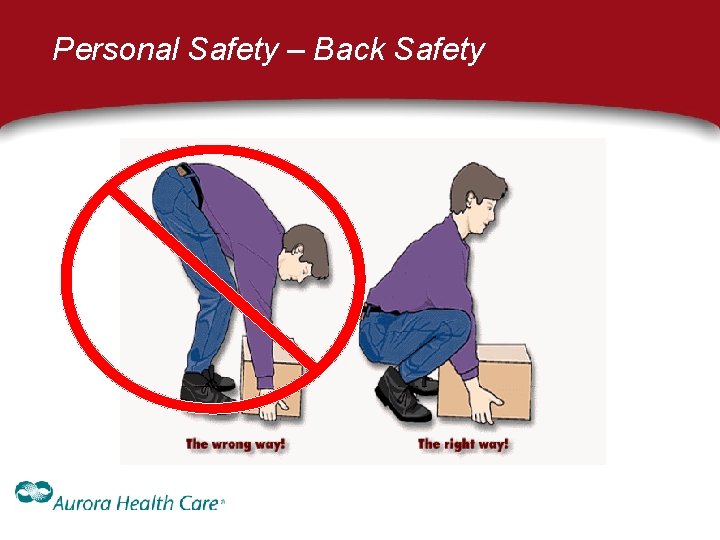
Personal Safety – Back Safety
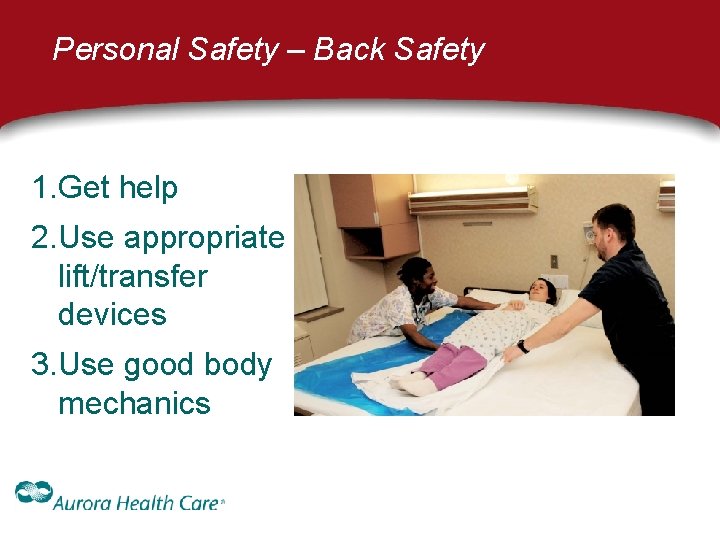
Personal Safety – Back Safety 1. Get help 2. Use appropriate lift/transfer devices 3. Use good body mechanics
Care Management and Quality Initiatives • Aurora is involved in many initiatives that promote quality care • Whether your experience is in a clinic, outpatient setting or hospital, be sure to ask the caregiver you are with about these initiatives and your role See next slide for our Quality Initiatives
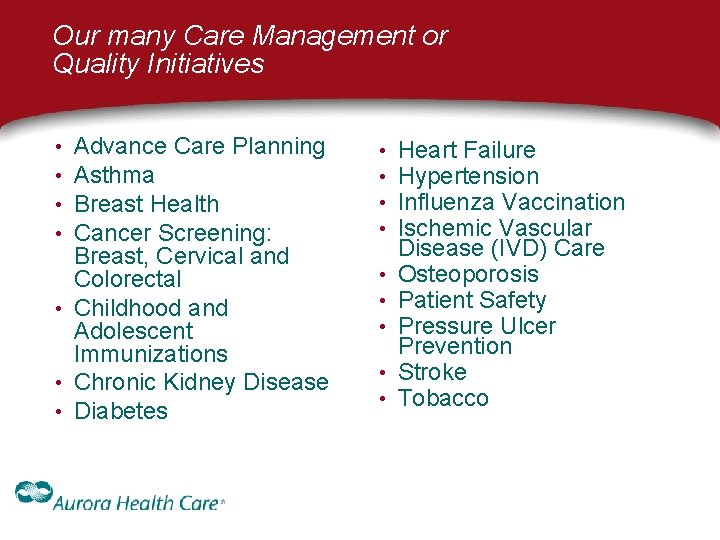
Our many Care Management or Quality Initiatives Advance Care Planning Asthma Breast Health Cancer Screening: Breast, Cervical and Colorectal • Childhood and Adolescent Immunizations • Chronic Kidney Disease • Diabetes • • • • Heart Failure Hypertension Influenza Vaccination Ischemic Vascular Disease (IVD) Care Osteoporosis Patient Safety Pressure Ulcer Prevention Stroke Tobacco
You are almost done! • Be sure to ask our caregivers questions • Don’t do something you have not been trained or are prepared to do • Your instructor or preceptor should guide your experiences • This is your time to learn so be sure to ask for experiences, jump in when you are able • If you are not sure if you can do something, Always ask
Finishing my Student Orientation: Document turned in to your school Back on the FVHCA website, print and sign Form C Indicating completion of this site specific orientation.
Finishing my Student Orientation: Documents that are returned to your school 1. Click on and Print the FVHCA: Clinical Agency Specific Orientation – Form C on the FVHCA website 2. This form confirms you have completed orientation at Aurora – this documentation is a regulatory requirement 3. Sign and Return Form C to your School Coordinator or Instructor “All these forms are confusing…what do I turn in to my school? ”
Finishing my Student Orientation: Documents that are returned to your school By now you should have completed the following: • Module #1: Infection Control / OSHA Bloodborne Pathogens / Safety Orientation (. pdf) • Module #2: HIPAA / Confidentiality / Compliance / Professionalism Orientation (. pdf) And printed off Form A (Confidentiality Agreement) and Form B (Orientation Modules 1 and 2 Completion Form) -------------------------------------------------------------------- You will turn in the following forms to your school or instructor: 1. FVHCA Form A: Confidentiality Agreement 2. FVHCA Form B: Orientation Modules 1 and 2 Completion Form 3. FVHCA Form C: Organization Specific Orientation Confirmation Form
You are done! Welcome to Aurora and we hope you have a wonderful experience in our Oshkosh / Fond du Lac market