
Student Focus Group Data Persistence First Semester to
- Slides: 23
Student Focus Group Data Persistence: First Semester to Second Semester Student Focus Group Data: Persistence
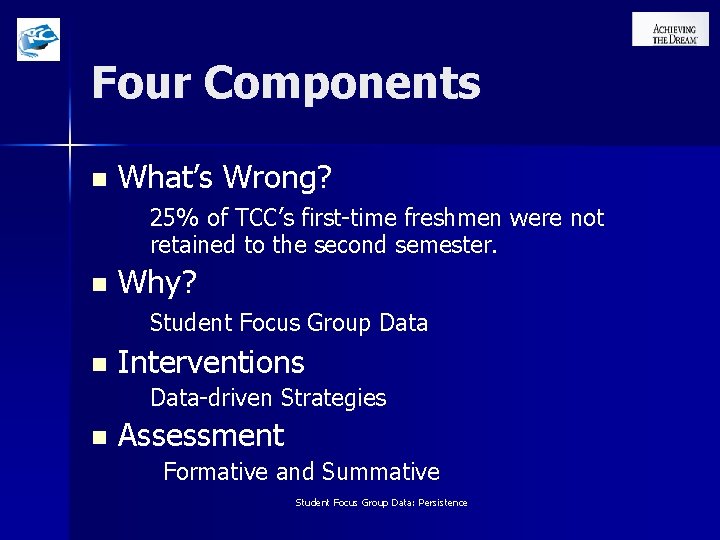
Four Components n What’s Wrong? 25% of TCC’s first-time freshmen were not retained to the second semester. n Why? Student Focus Group Data n Interventions Data-driven Strategies n Assessment Formative and Summative Student Focus Group Data: Persistence
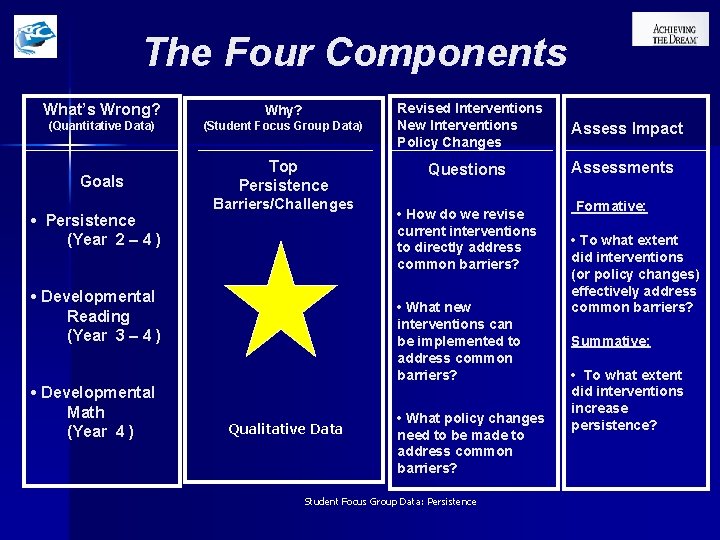
The Four Components What’s Wrong? Why? (Quantitative Data) (Student Focus Group Data) Goals Top Persistence • Persistence (Year 2 – 4 ) Barriers/Challenges • Developmental Reading (Year 3 – 4 ) • Developmental Math (Year 4 ) Revised Interventions New Interventions Policy Changes Questions • How do we revise current interventions to directly address common barriers? • What new interventions can be implemented to address common barriers? Qualitative Data • What policy changes need to be made to address common barriers? Student Focus Group Data: Persistence Assess Impact Assessments Formative: • To what extent did interventions (or policy changes) effectively address common barriers? Summative: • To what extent did interventions increase persistence?
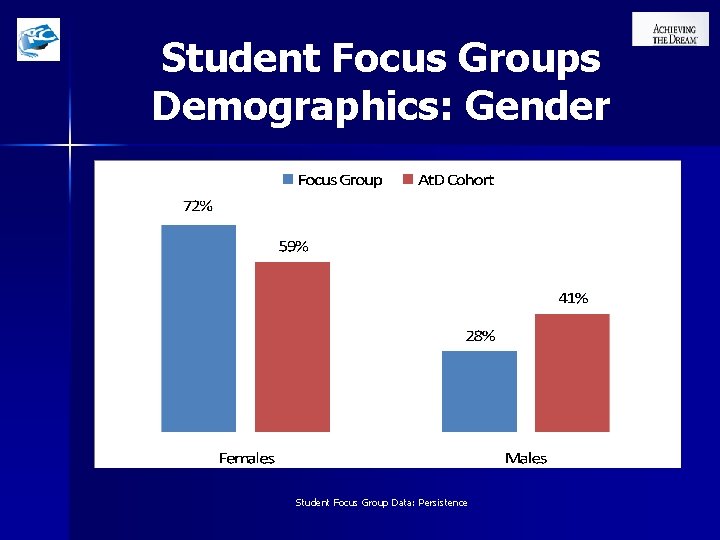
Student Focus Groups Demographics: Gender Student Focus Group Data: Persistence
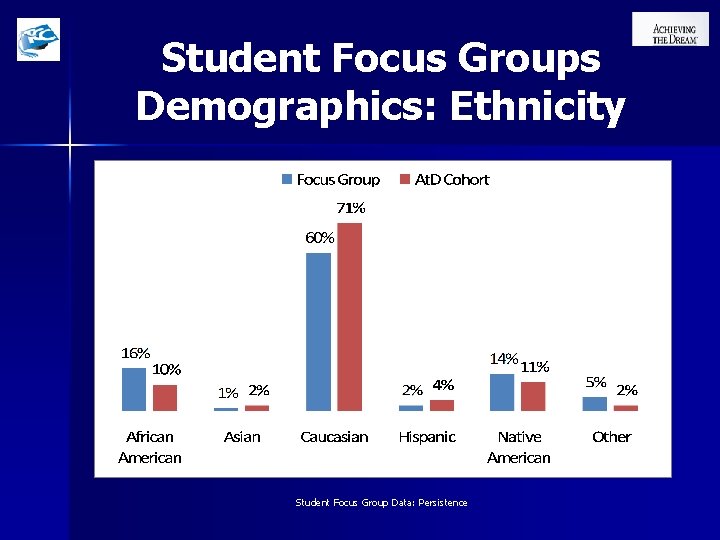
Student Focus Groups Demographics: Ethnicity Student Focus Group Data: Persistence
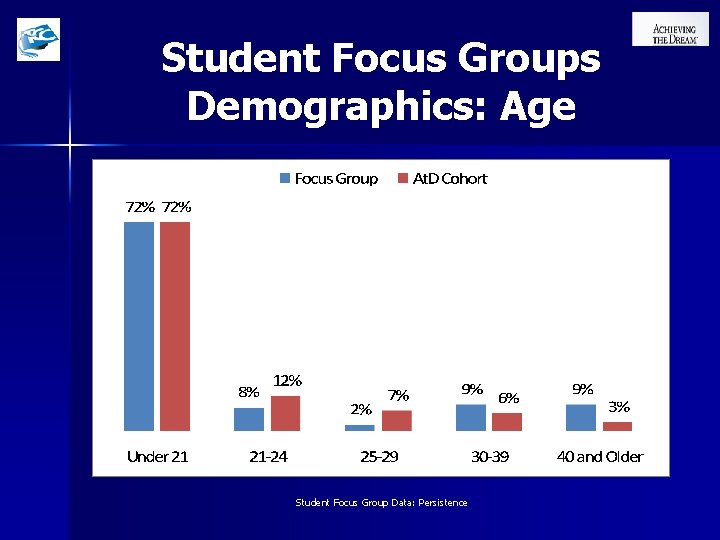
Student Focus Groups Demographics: Age Student Focus Group Data: Persistence
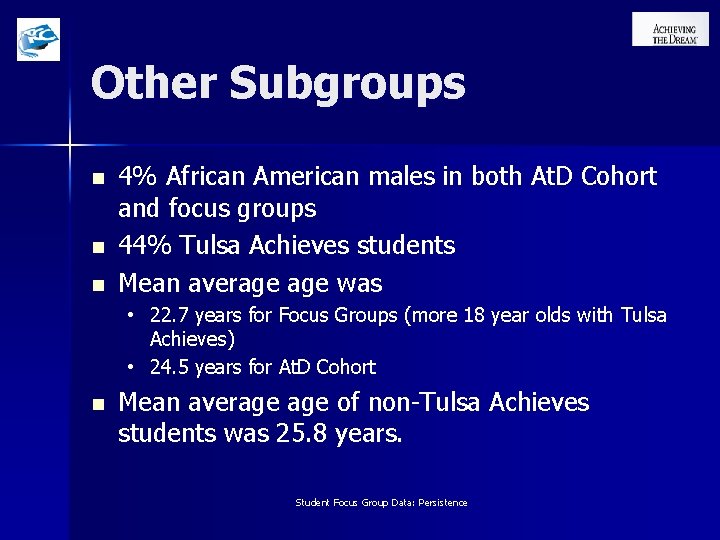
Other Subgroups n n n 4% African American males in both At. D Cohort and focus groups 44% Tulsa Achieves students Mean average was • 22. 7 years for Focus Groups (more 18 year olds with Tulsa Achieves) • 24. 5 years for At. D Cohort n Mean average of non-Tulsa Achieves students was 25. 8 years. Student Focus Group Data: Persistence
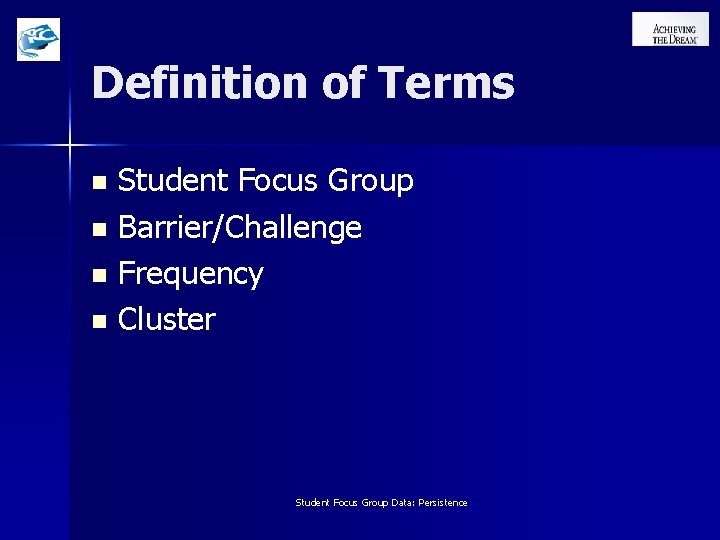
Definition of Terms Student Focus Group n Barrier/Challenge n Frequency n Cluster n Student Focus Group Data: Persistence
Student Focus Groups Three focus groups per campus n 12 total groups n 101 total students n Students volunteered and were accepted if they had completed their first semester in Fall 2007 and had reenrolled in Spring 2008. n Student Focus Group Data: Persistence
Barrier/Challenge n Barrier/Challenge “All students experience barriers or challenges as they make their way toward graduation. ” n Common barriers include those experienced at TCC and those connected to life circumstances. Student Focus Group Data: Persistence
Frequency n Barriers/Challenges - Frequency • • • By Raw Total By Group By Campus Student Focus Group Data: Persistence
Cluster n Barriers seemed related to each other. n Data Team classified barriers into larger clusters or categories to provide the best overall picture of the data. Student Focus Group Data: Persistence
General Findings n No single barrier was mentioned in every focus group on all four campuses. n Many barriers occurred frequently and were identified on all four campuses. n Barriers specific to individual campuses did not occur frequently overall; College-wide barriers were identified far more frequently overall. Student Focus Group Data: Persistence
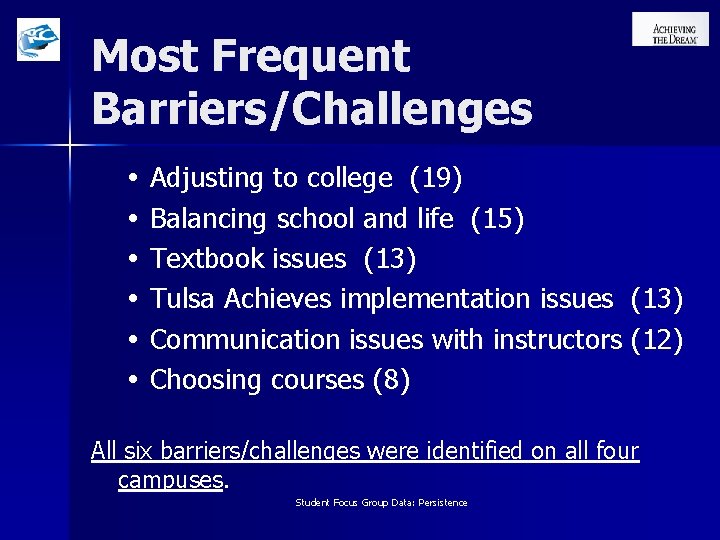
Most Frequent Barriers/Challenges Adjusting to college (19) Balancing school and life (15) Textbook issues (13) Tulsa Achieves implementation issues (13) Communication issues with instructors (12) Choosing courses (8) All six barriers/challenges were identified on all four campuses. Student Focus Group Data: Persistence
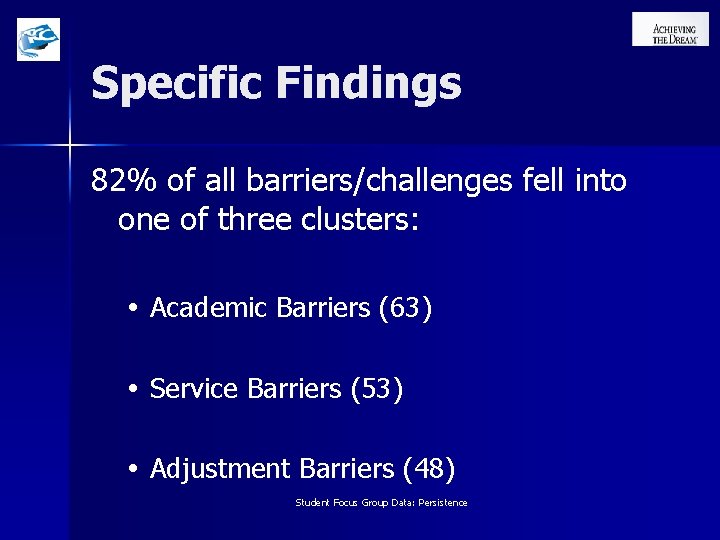
Specific Findings 82% of all barriers/challenges fell into one of three clusters: Academic Barriers (63) Service Barriers (53) Adjustment Barriers (48) Student Focus Group Data: Persistence
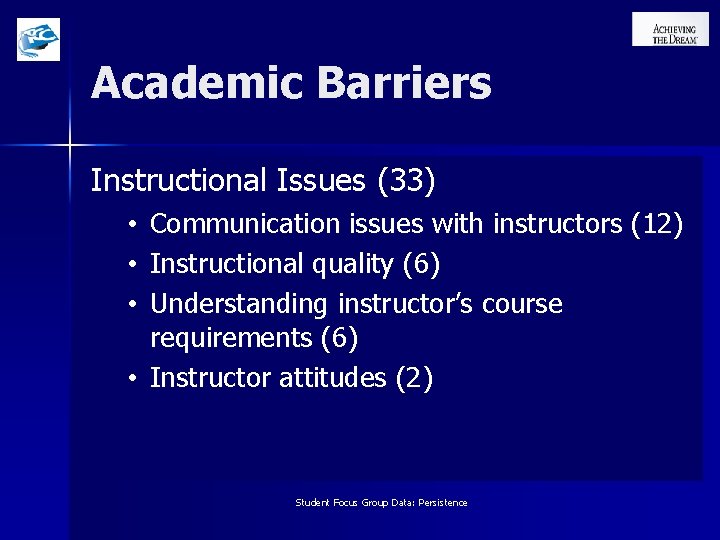
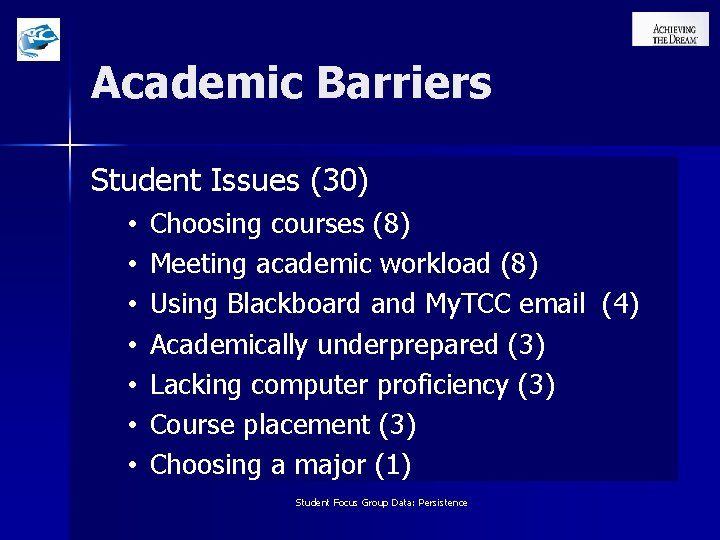
Academic Barriers (63) 63 Academic Barriers were grouped into two types: • Instructional Issues (33) • Student Issues (30) Student Focus Group Data: Persistence
Academic Barriers Instructional Issues (33) • Communication issues with instructors (12) • Instructional quality (6) • Understanding instructor’s course requirements (6) • Instructor attitudes (2) Student Focus Group Data: Persistence
Academic Barriers Student Issues (30) • • Choosing courses (8) Meeting academic workload (8) Using Blackboard and My. TCC email (4) Academically underprepared (3) Lacking computer proficiency (3) Course placement (3) Choosing a major (1) Student Focus Group Data: Persistence
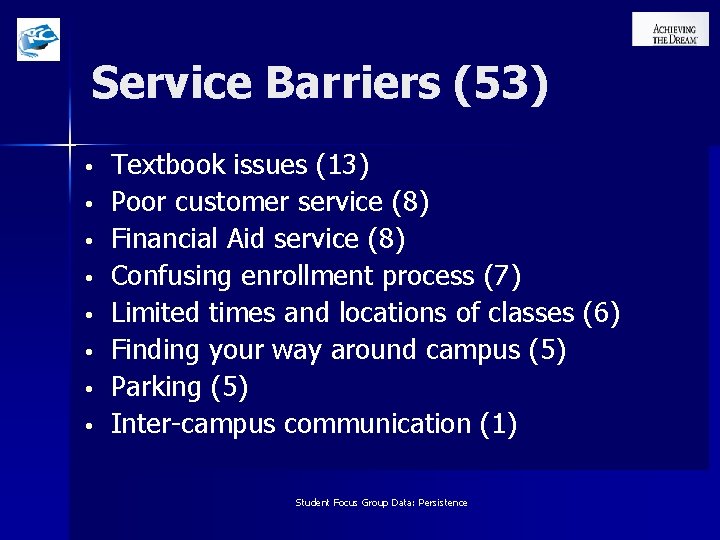
Service Barriers (53) Textbook issues (13) Poor customer service (8) Financial Aid service (8) Confusing enrollment process (7) Limited times and locations of classes (6) Finding your way around campus (5) Parking (5) Inter-campus communication (1) Student Focus Group Data: Persistence
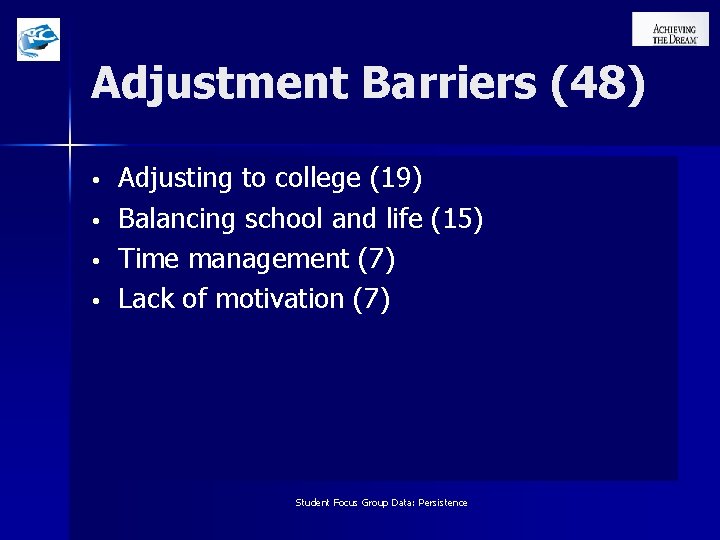
Adjustment Barriers (48) Adjusting to college (19) Balancing school and life (15) Time management (7) Lack of motivation (7) Student Focus Group Data: Persistence
Tulsa Achieves Implementation Issues n 13 barriers/challenges identified These were not included in the three clusters. n Examples: • • • Paying for textbooks Financial aid processing Information about TA changed and sometimes not accurate Student Focus Group Data: Persistence
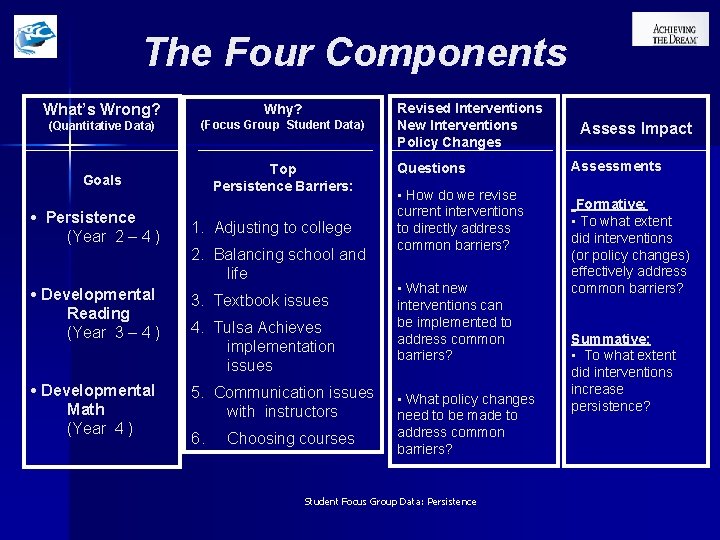
The Four Components What’s Wrong? Why? (Quantitative Data) (Focus Group Student Data) Goals Top Persistence Barriers: • Persistence (Year 2 – 4 ) 1. Adjusting to college 2. Balancing school and life • Developmental Reading (Year 3 – 4 ) 3. Textbook issues • Developmental Math (Year 4 ) 5. Communication issues with instructors 4. Tulsa Achieves implementation issues 6. Choosing courses Revised Interventions New Interventions Policy Changes Questions • How do we revise current interventions to directly address common barriers? • What new interventions can be implemented to address common barriers? • What policy changes need to be made to address common barriers? Student Focus Group Data: Persistence Assess Impact Assessments Formative: • To what extent did interventions (or policy changes) effectively address common barriers? Summative: • To what extent did interventions increase persistence?
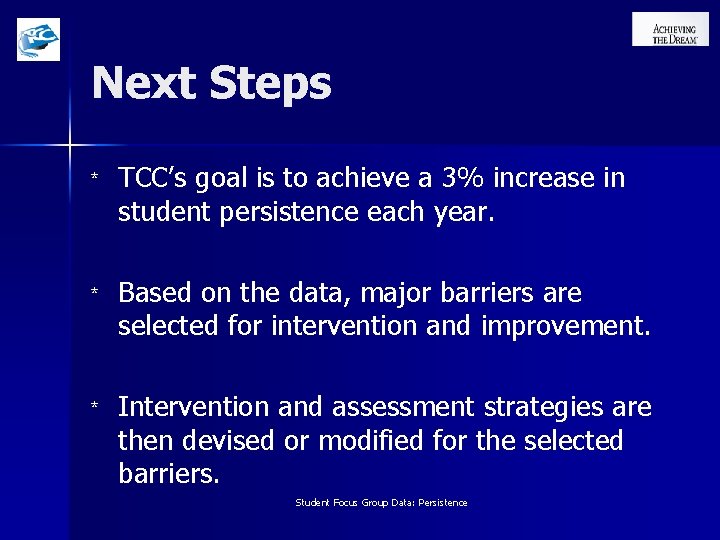
Next Steps * TCC’s goal is to achieve a 3% increase in student persistence each year. * Based on the data, major barriers are selected for intervention and improvement. * Intervention and assessment strategies are then devised or modified for the selected barriers. Student Focus Group Data: Persistence