
Student Expectations 1 2 3 4 5 6


- Slides: 18
Student Expectations 1. 2. 3. 4. 5. 6. Turn off your camera. Mute your microphone (unless your teacher asks you to unmute). Engage in the lesson and only use the chat facility to ask or answer questions related to the lesson. All chat is recorded and is sent to Mrs Wilson and your Head of Year at the end of each session. Inappropriate behaviour will result in a phone call or a home visit during the lesson and you will be removed from the lesson by the teacher. Send your work to your teacher at the end of each session: colm. atkinson@astreadearne. org Please note: if you fail to follow these expectations, you will not be able to access Dearne Home Learning and will attend school for face to face teaching.
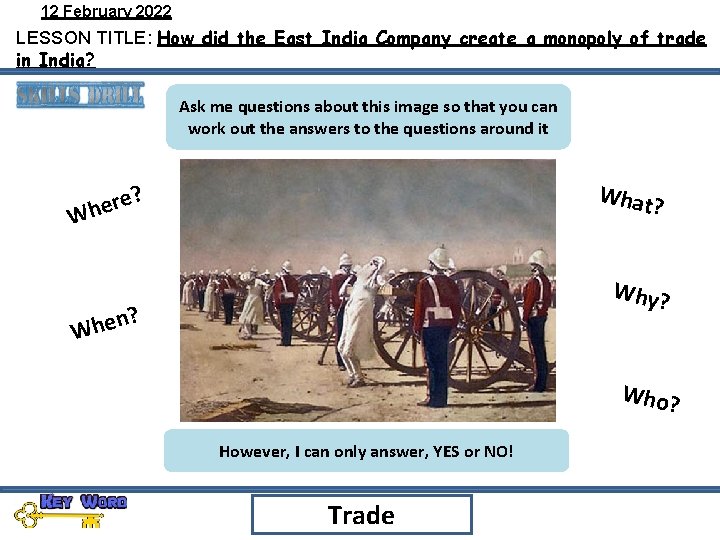
12 February 2022 LESSON TITLE: How did the East India Company create a monopoly of trade in India? Ask me questions about this image so that you can work out the answers to the questions around it What ? e r e Wh ? Why? n? e h W Who? However, I can only answer, YES or NO! Trade
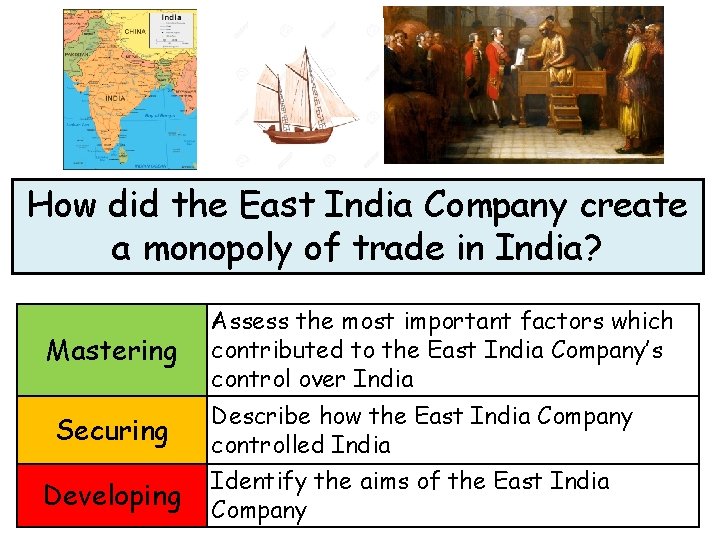
How did the East India Company create a monopoly of trade in India? Mastering Securing Developing Assess the most important factors which contributed to the East India Company’s control over India Describe how the East India Company controlled India Identify the aims of the East India Company
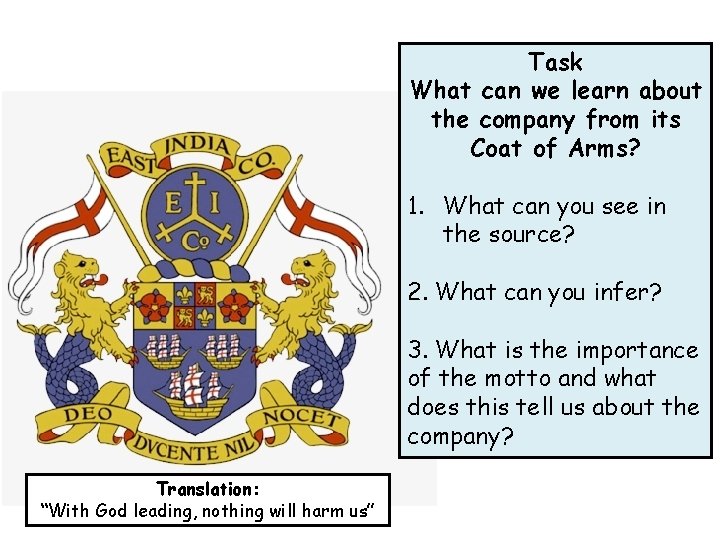
Task What can we learn about the company from its Coat of Arms? 1. What can you see in the source? 2. What can you infer? 3. What is the importance of the motto and what does this tell us about the company? Translation: “With God leading, nothing will harm us”
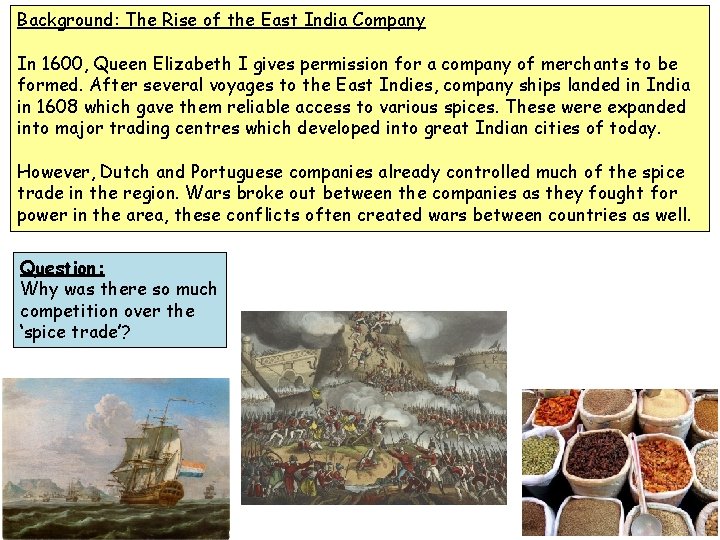
Background: The Rise of the East India Company In 1600, Queen Elizabeth I gives permission for a company of merchants to be formed. After several voyages to the East Indies, company ships landed in India in 1608 which gave them reliable access to various spices. These were expanded into major trading centres which developed into great Indian cities of today. However, Dutch and Portuguese companies already controlled much of the spice trade in the region. Wars broke out between the companies as they fought for power in the area, these conflicts often created wars between countries as well. Question: Why was there so much competition over the ‘spice trade’?
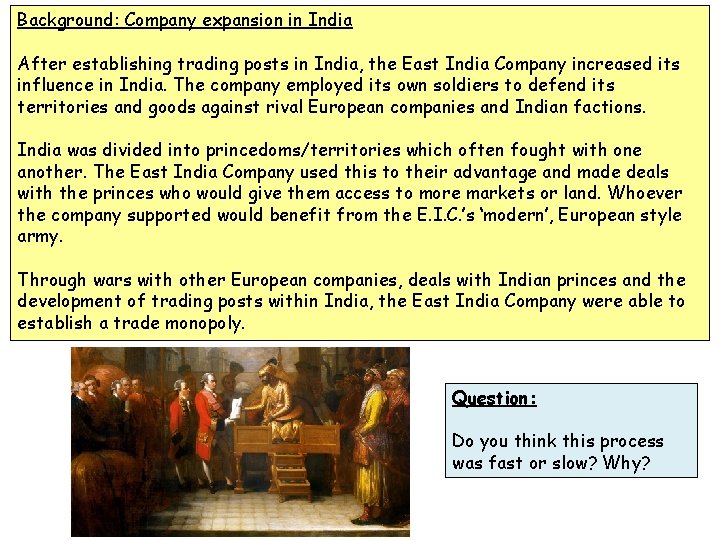
Background: Company expansion in India After establishing trading posts in India, the East India Company increased its influence in India. The company employed its own soldiers to defend its territories and goods against rival European companies and Indian factions. India was divided into princedoms/territories which often fought with one another. The East India Company used this to their advantage and made deals with the princes who would give them access to more markets or land. Whoever the company supported would benefit from the E. I. C. ’s ‘modern’, European style army. Through wars with other European companies, deals with Indian princes and the development of trading posts within India, the East India Company were able to establish a trade monopoly. Question: Do you think this process was fast or slow? Why?
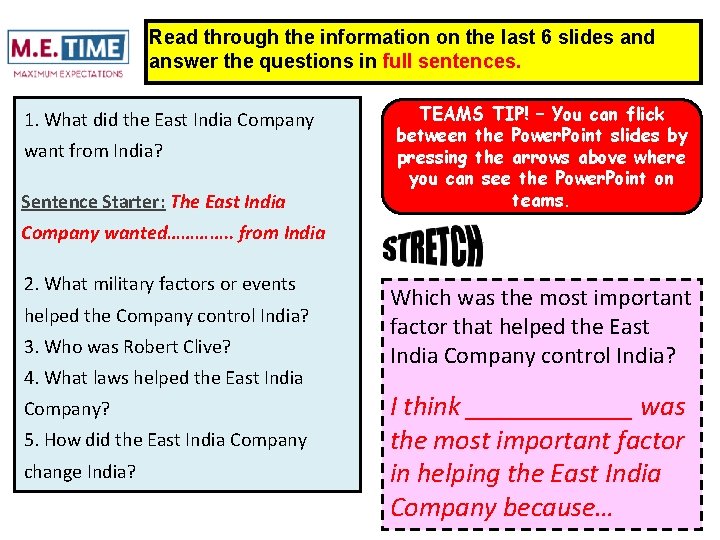
Read through the information on the next 6 slides and answer the questions in full sentences. 1. What did the East India Company want from India? Sentence Starter: The East India TEAMS TIP! – You can flick between the Power. Point slides by pressing the arrows above where you can see the Power. Point on teams. Company wanted…………. . from India 2. What military factors or events helped the Company control India? 3. Who was Robert Clive? 4. What laws helped the East India Company? 5. How did the East India Company change India? Which was the most important factor that helped the East India Company control India? I think ______ was the most important factor in helping the East India Company because…
“The East India Company’s employees did not set out to change the world. They were merchants who set sail to establish trade routes, to discover and bring back new goods, and in doing so broke down the barriers of the world. They were pioneering; creating many of the means and rules of commerce we use today. The Company become the single most powerful economic entity the world has ever seen. At its height it was responsible for 50% of world trade and employed 25% of Britain’s population. It minted its own currency, brought tea to India and China, was a patron of the arts and introduced many spices, textiles, chintz, silks and porcelain among others to the West. ” From the East India Company website
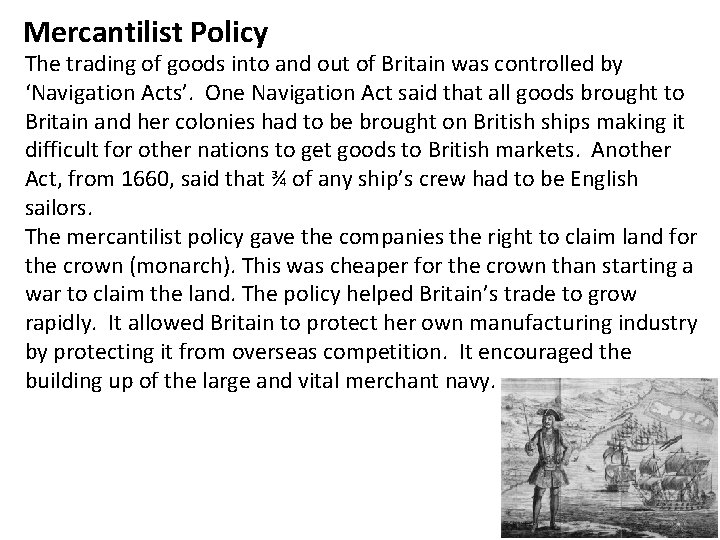
Mercantilist Policy The trading of goods into and out of Britain was controlled by ‘Navigation Acts’. One Navigation Act said that all goods brought to Britain and her colonies had to be brought on British ships making it difficult for other nations to get goods to British markets. Another Act, from 1660, said that ¾ of any ship’s crew had to be English sailors. The mercantilist policy gave the companies the right to claim land for the crown (monarch). This was cheaper for the crown than starting a war to claim the land. The policy helped Britain’s trade to grow rapidly. It allowed Britain to protect her own manufacturing industry by protecting it from overseas competition. It encouraged the building up of the large and vital merchant navy.
The Seven Years’ War In 1756, Britain went to war against France, Spain, Sweden, the Holy Roman Empire, Russia and the Mughal Empire. The conflict was a global war and was fought in Europe, America and India. In India, the French trading companies allied themselves with the Mughal Empire (a fragmenting Empire within India) to resist British expansion. The East India Company, under the leadership of Robert Clive, the French and Indian forces were defeated. The outcome of the Seven Years’ War was the dominance of the East India Company within India. France was required to demolish all military fortifications within their Indian trading posts and could only maintain a small garrison at each location. This outcome established the dominance of the East India Company in later years.
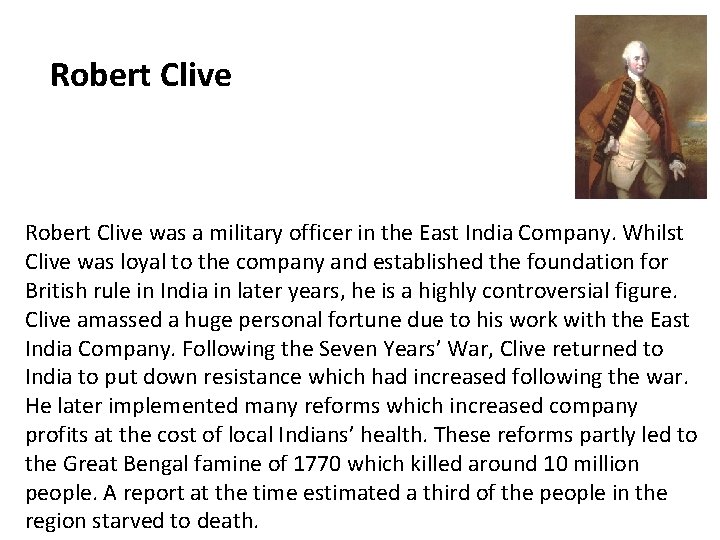
Robert Clive was a military officer in the East India Company. Whilst Clive was loyal to the company and established the foundation for British rule in India in later years, he is a highly controversial figure. Clive amassed a huge personal fortune due to his work with the East India Company. Following the Seven Years’ War, Clive returned to India to put down resistance which had increased following the war. He later implemented many reforms which increased company profits at the cost of local Indians’ health. These reforms partly led to the Great Bengal famine of 1770 which killed around 10 million people. A report at the time estimated a third of the people in the region starved to death.
Background in India The East India Company’s first trips to India took place in 1608. The main aim was to break into the lucrative spice and textile trades. They were successful and made most of their money from trading in textiles. India’s geographical position meant that it would be a vital link between Britain, Europe and Asia. As the East India Company grew it found ways in which nearby China could be increased. It was here that large fortunes could be made through the lucrative opium trade. The British needed India as a close base from which to trade with China effectively. ‘Kingmakers’ The East India Company was able to improve is position by influencing the politics in India at the time was divided into different princedoms who fought with each other. The East India company made deals with whichever side would give them access to more markets, to control more land and, eventually, to charge taxes.
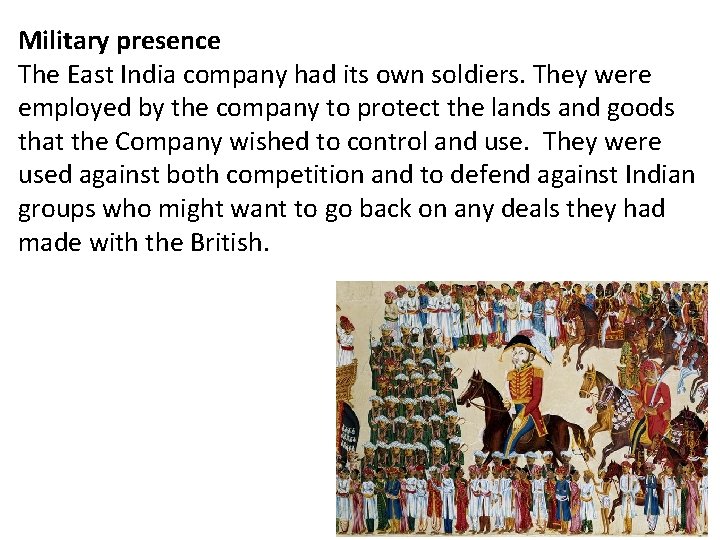
Military presence The East India company had its own soldiers. They were employed by the company to protect the lands and goods that the Company wished to control and use. They were used against both competition and to defend against Indian groups who might want to go back on any deals they had made with the British.
Read through the information on the last 6 slides and answer the questions in full sentences. 1. What did the East India Company want from India? Sentence Starter: The East India TEAMS TIP! – You can flick between the Power. Point slides by pressing the arrows above where you can see the Power. Point on teams. Company wanted…………. . from India 2. What military factors or events helped the Company control India? 3. Who was Robert Clive? 4. What laws helped the East India Company? 5. How did the East India Company change India? Which was the most important factor that helped the East India Company control India? I think ______ was the most important factor in helping the East India Company because…
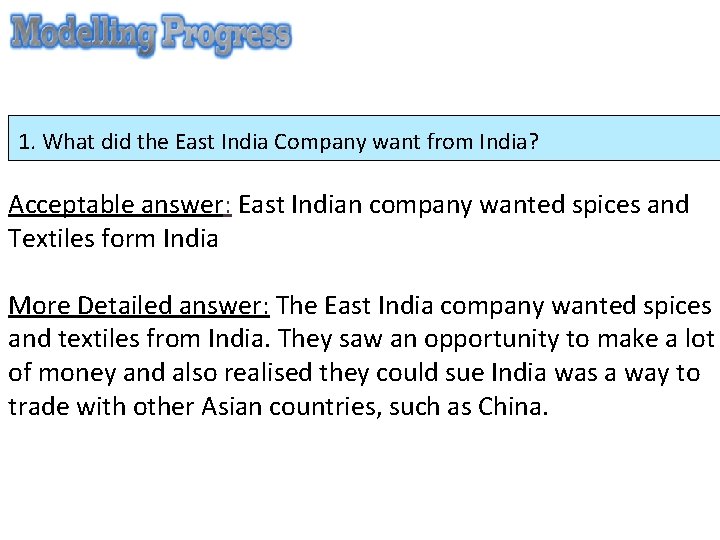
1. What did the East India Company want from India? Acceptable answer: East Indian company wanted spices and Textiles form India More Detailed answer: The East India company wanted spices and textiles from India. They saw an opportunity to make a lot of money and also realised they could sue India was a way to trade with other Asian countries, such as China.
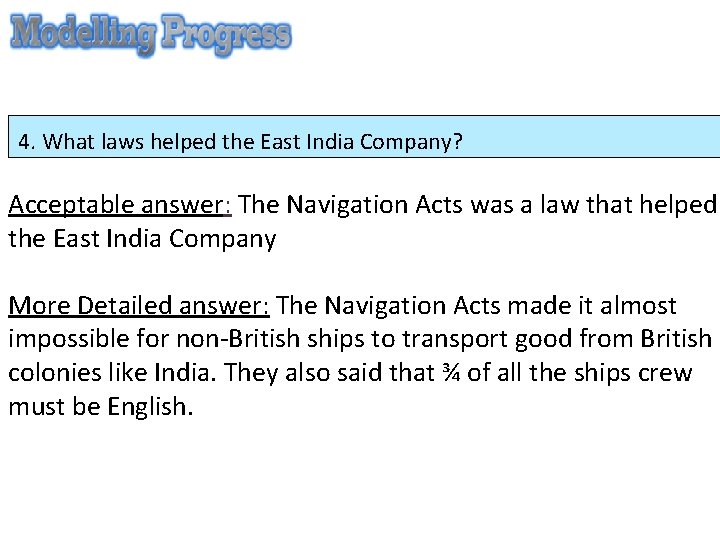
4. What laws helped the East India Company? Acceptable answer: The Navigation Acts was a law that helped the East India Company More Detailed answer: The Navigation Acts made it almost impossible for non-British ships to transport good from British colonies like India. They also said that ¾ of all the ships crew must be English.
Think, pair share: How would you feel if these companies acted the same as the East India Company today? How much control should companies be able to have?
Life is really tough at the moment. There is always someone for you to talk to: School Support Mrs Crawford (Mental Wellbeing Lead Practitioner) kirsty. crawford@astreadearne. org Your Head of Year firstname. surname@astreadearne. org Mrs Dowling (Designated Safeguarding Officer) katie. dowling@astreadearne. org Mrs Fisher (Deputy Designated Safeguarding Officer) Telephone Support sally. fisher@astreadearne. org Childline - 0800 1111 Bereavement Services - 0800 048 5224 MIND - 01226 211188 / 01709 Websites 919929 YOUNG MINDS www. youngminds. co. uk. SHOUT - Text to 85258 SHOUT www. giveusashout. org TADS - 01226 872120 SELF HARM Targeted Youth Support www. selfharm. co. uk 08000345340 www. nhs/conditions/selfharm NSPCC - 0800 1111 www. harmless. org. uk APP Support SUICIDAL TEENS www. papyrus-uk. org BLUEICE CHILDLINE www. childline. org. uk CALMHARM NSPCC www. nspcc. org. uk CATCH IT THE MIX www. themix. org. uk CHILL PANDA NIGHTLINE www. nightline. ac. uk