
Student Engagement What Is It Why Should We








- Slides: 26
Student Engagement: What Is It, Why Should We Care, and How Can We Promote It? Illinois Wesleyan University May 3, 2016 Dr. Claire Lamonica Director, Center for Teaching, Learning, and Technology Illinois State University
What is Student Engagement?
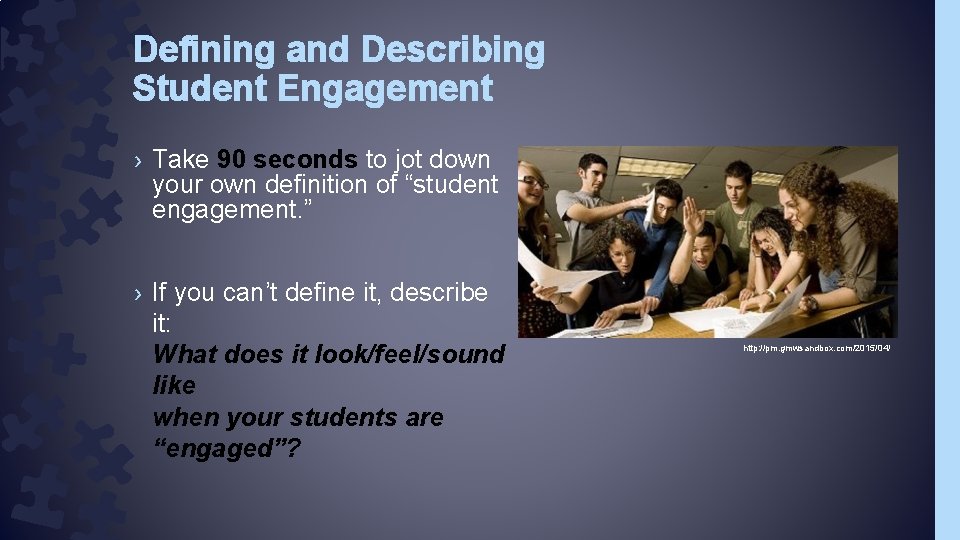
Defining and Describing Student Engagement › Take 90 seconds to jot down your own definition of “student engagement. ” › If you can’t define it, describe it: What does it look/feel/sound like when your students are “engaged”? http: //pm. gmwsandbox. com/2015/04/
Did You Use These Words? › Motivated › Active › Learning https: //www. google. com/search? site=&tbm=isch&source=hp&biw=168 0&bih=890&q=raised+hands&oq=raised+hands&gs_l=img. 3. . 0 l 10. 196 6. 3784. 0. 4267. 12. 11. 0. 177. 881. 7 j 3. 10. 0. . . 1 ac. 1. 64. img. . 1. 11. 884. p-s. LP 8 MEMq. M#imgrc=7 O 3 QAl 8 bj 3 Hth. M%3 A/
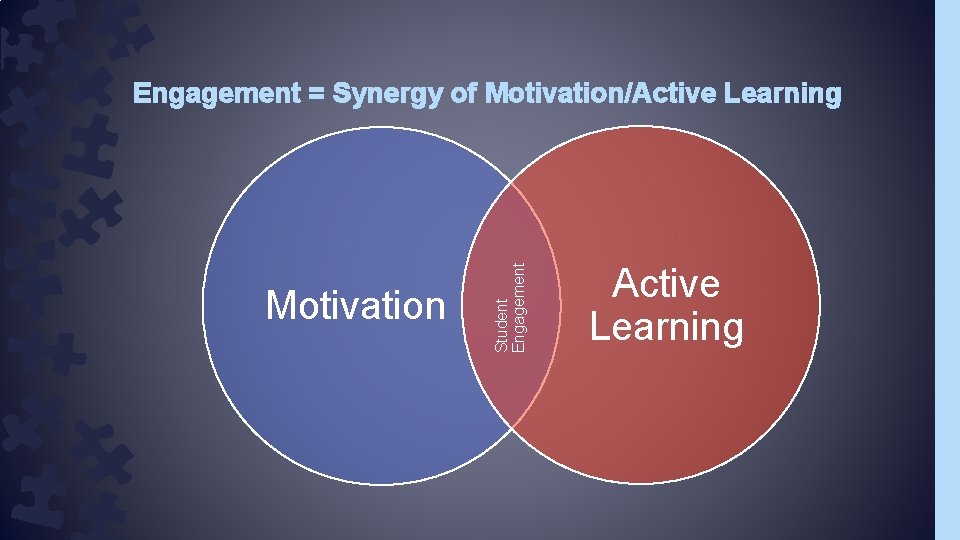
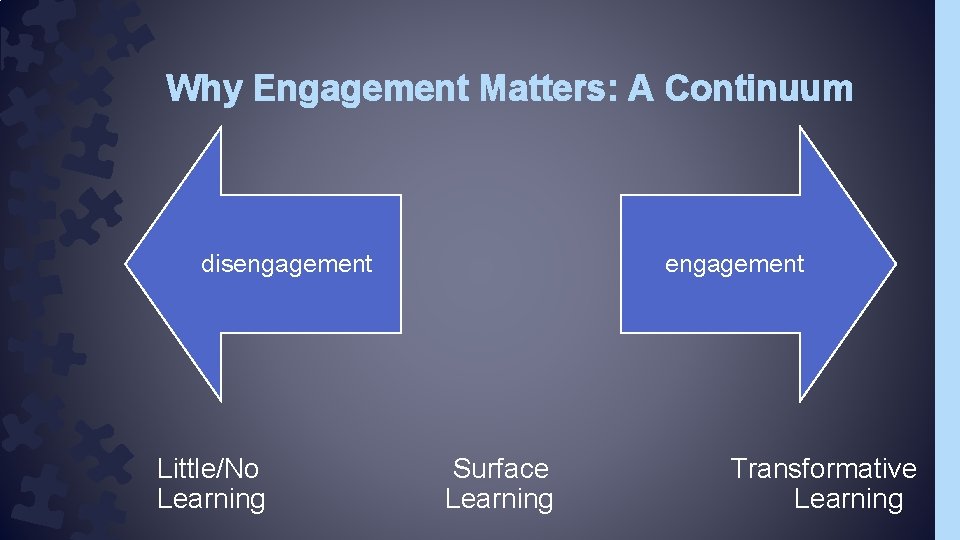
An Expert’s Definition Student engagement is a process and a product … experienced on a continuum and result[ing] from the synergistic interaction between motivation and active learning. --Elizabeth F. Barkley
Motivation Student Engagement = Synergy of Motivation/Active Learning
Why Do We Care about Student Engagement?
Why Engagement Matters: A Continuum disengagement Little/No Learning engagement Surface Learning Transformative Learning
How Can We Promote Student Engagement?
Active Learning
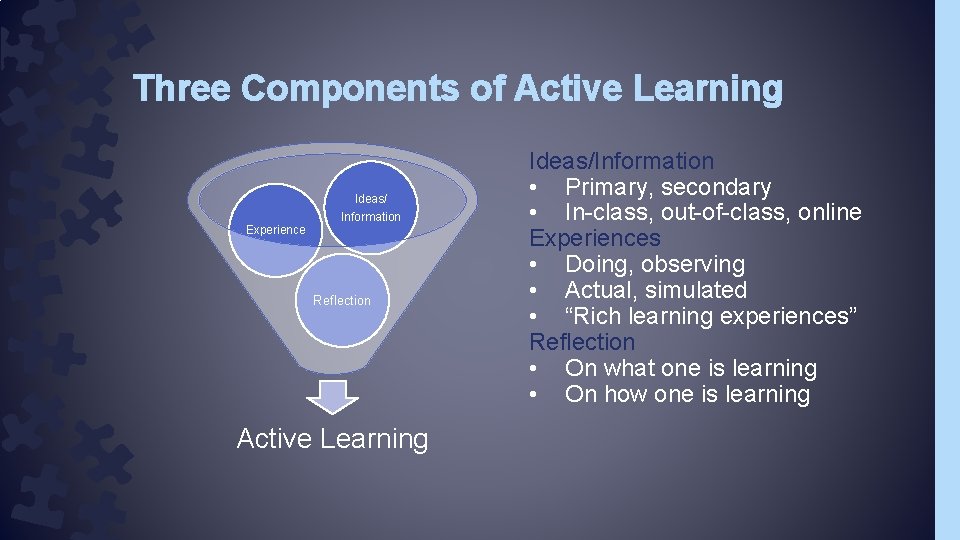
Three Components of Active Learning Ideas/ Information Experience Reflection Active Learning Ideas/Information • Primary, secondary • In-class, out-of-class, online Experiences • Doing, observing • Actual, simulated • “Rich learning experiences” Reflection • On what one is learning • On how one is learning
Let’s Try It Using Active Learning To Explore “Motivation”
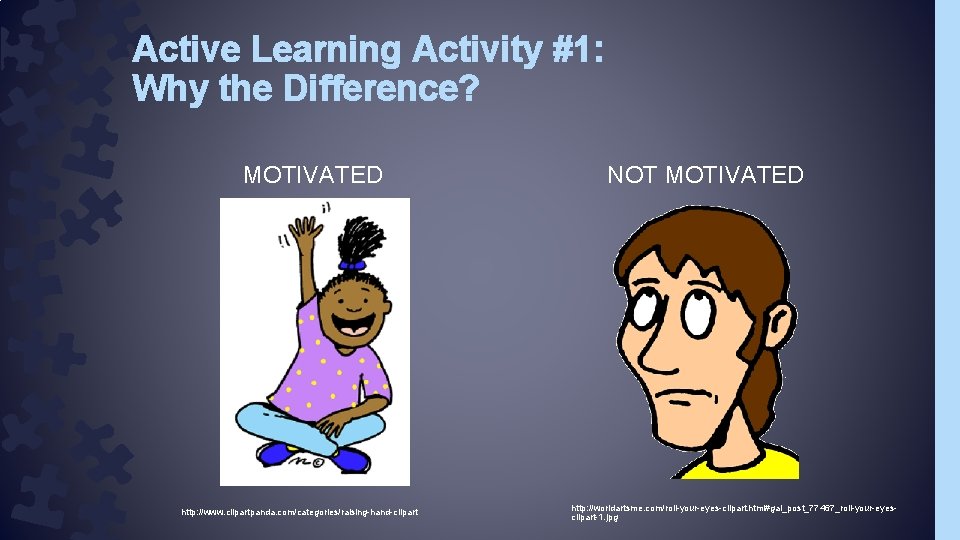
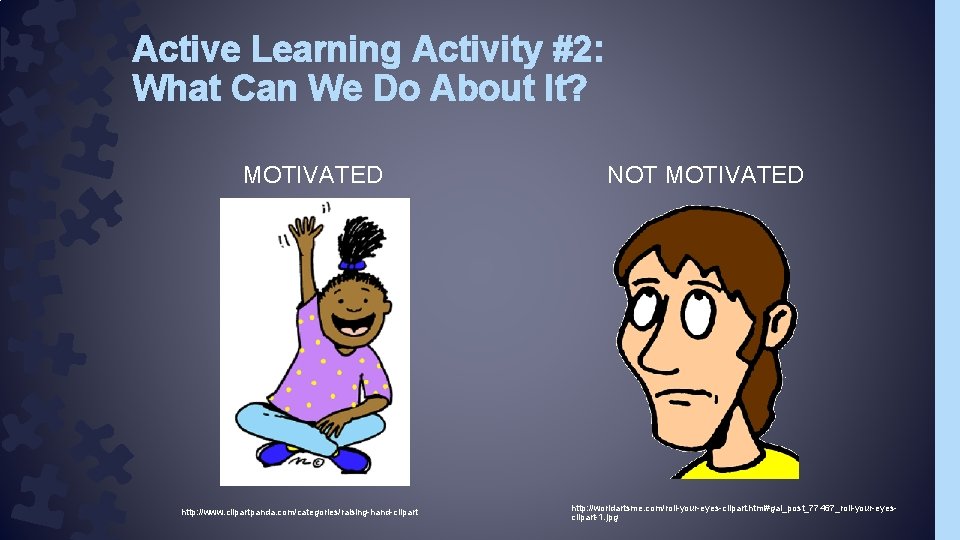
Active Learning Activity #1: Why the Difference? MOTIVATED http: //www. clipartpanda. com/categories/raising-hand-clipart NOT MOTIVATED http: //worldartsme. com/roll-your-eyes-clipart. html#gal_post_77467_roll-your-eyesclipart-1. jpg
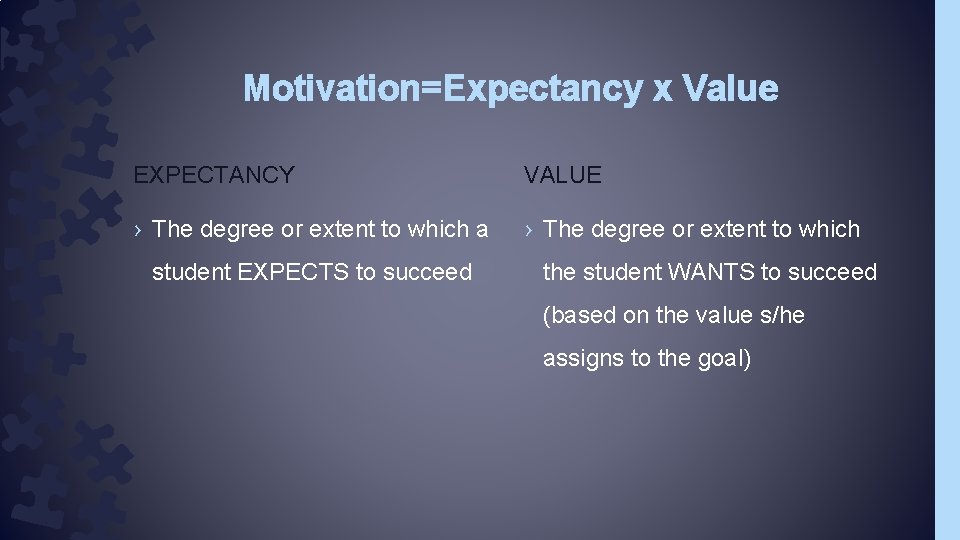
Motivation=Expectancy x Value EXPECTANCY VALUE › The degree or extent to which a › The degree or extent to which student EXPECTS to succeed the student WANTS to succeed (based on the value s/he assigns to the goal)
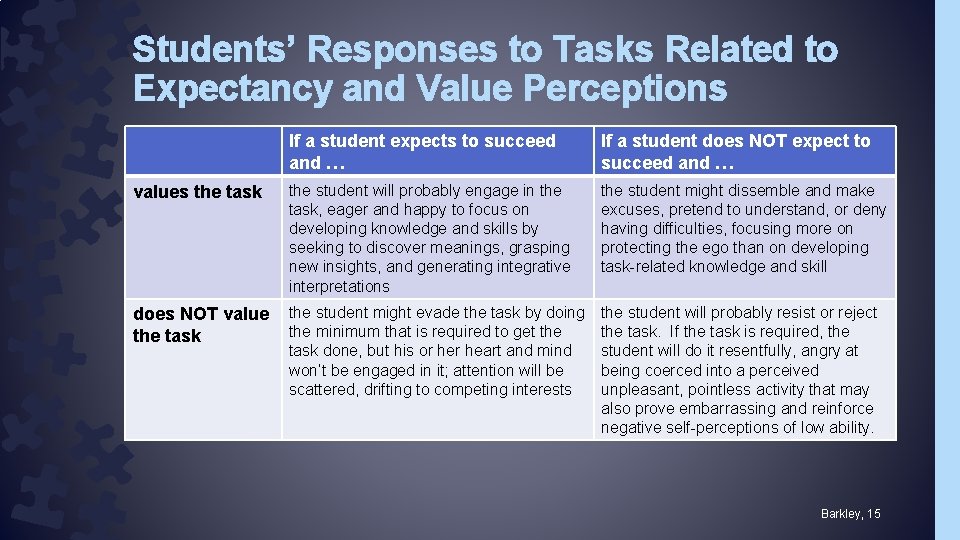
Students’ Responses to Tasks Related to Expectancy and Value Perceptions If a student expects to succeed and … If a student does NOT expect to succeed and … values the task the student will probably engage in the task, eager and happy to focus on developing knowledge and skills by seeking to discover meanings, grasping new insights, and generating integrative interpretations the student might dissemble and make excuses, pretend to understand, or deny having difficulties, focusing more on protecting the ego than on developing task-related knowledge and skill does NOT value the task the student might evade the task by doing the minimum that is required to get the task done, but his or heart and mind won’t be engaged in it; attention will be scattered, drifting to competing interests the student will probably resist or reject the task. If the task is required, the student will do it resentfully, angry at being coerced into a perceived unpleasant, pointless activity that may also prove embarrassing and reinforce negative self-perceptions of low ability. Barkley, 15
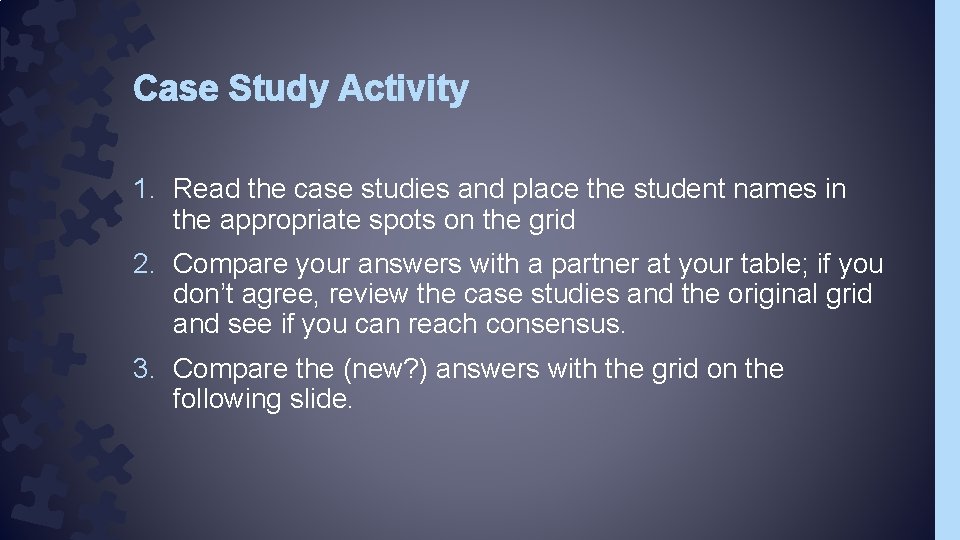
Case Study Activity 1. Read the case studies and place the student names in the appropriate spots on the grid 2. Compare your answers with a partner at your table; if you don’t agree, review the case studies and the original grid and see if you can reach consensus. 3. Compare the (new? ) answers with the grid on the following slide.
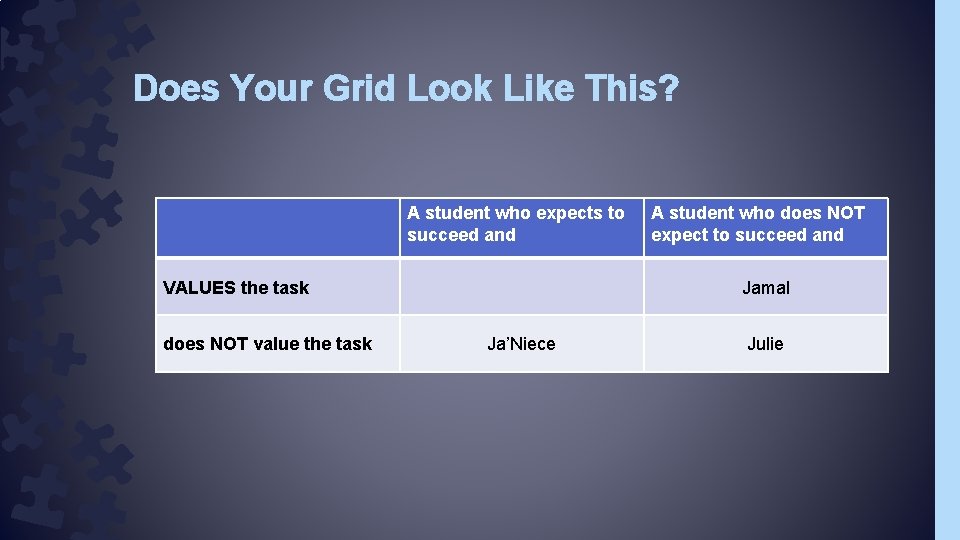
Does Your Grid Look Like This? A student who expects to succeed and VALUES the task does NOT value the task A student who does NOT expect to succeed and Jamal Ja’Niece Julie
Active Learning Activity #2: What Can We Do About It? MOTIVATED http: //www. clipartpanda. com/categories/raising-hand-clipart NOT MOTIVATED http: //worldartsme. com/roll-your-eyes-clipart. html#gal_post_77467_roll-your-eyesclipart-1. jpg
Think-Pair-Share
Step 1: THINK Take a couple of minutes to reflect on and jot down some answers to this question: How might we help Ja’Niece (build value), Jamal (build expectancy), and/or Julie (build value AND expectancy)?
Step 2: PAIR Turn to a partner at your table; share your ideas with each other. Does the sharing suggest other ideas? If so, jot them down as well.
Step 3: Share JA’NIECE (BUILD VALUE) JAMAL (BUILD EXPECTANCY) JULIE (BUILD VALUE AND EXPECTANCY)
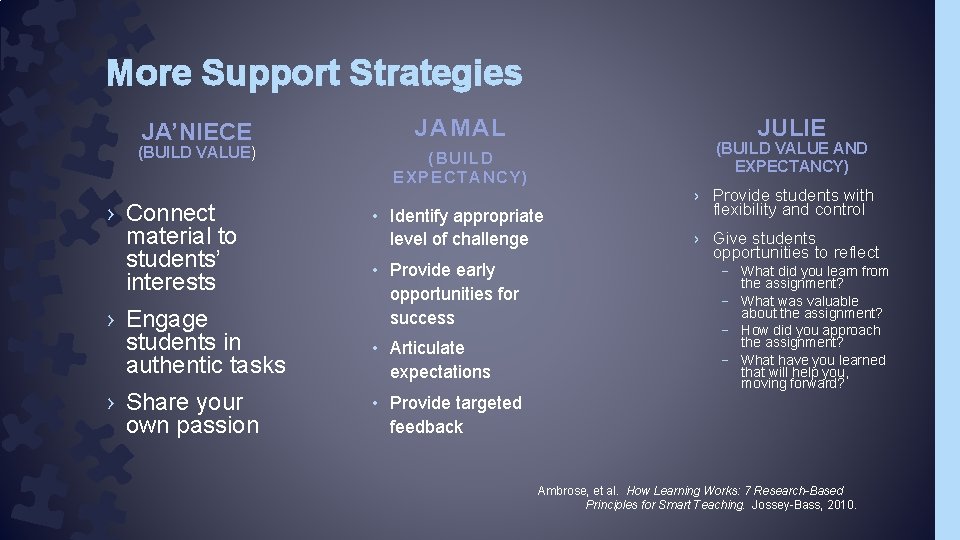
More Support Strategies JA’NIECE (BUILD VALUE) › Connect material to students’ interests › Engage students in authentic tasks › Share your own passion JULIE JAMAL (BUILD VALUE AND EXPECTANCY) (BUILD EXPECTANCY) • Identify appropriate level of challenge • Provide early opportunities for success • Articulate expectations › Provide students with flexibility and control › Give students opportunities to reflect – What did you learn from the assignment? – What was valuable about the assignment? – How did you approach the assignment? – What have you learned that will help you, moving forward? • Provide targeted feedback Ambrose, et al. How Learning Works: 7 Research-Based Principles for Smart Teaching. Jossey-Bass, 2010.
Time to Reflect • What’s one important thing you learned about student engagement today? • Why is this significant to you, in terms of your teaching? • How will you use this new insight to increase student engagement in your classroom?
Q&A (if time) What do you still want to know and/or talk about?
Thanks! cclamon@ilstu. edu 309 -438 -7695