
STUDENT ENGAGEMENT IN ONLINE LEARNING Student engagement is
![ENGAGEMENT ONLINE “[T]here is a particular focus on the factors which are most relevant](https://slidetodoc.com/presentation_image_h2/ecc7bc7cab5a65403b934fa63bf43aa9/image-10.jpg "ENGAGEMENT ONLINE “[T]here is a particular focus on the factors which are most relevant")
![INFERENCES AT A DISTANCE The phrase ‘mental-state inference’ refers to a person inferring [judging]](https://slidetodoc.com/presentation_image_h2/ecc7bc7cab5a65403b934fa63bf43aa9/image-12.jpg "INFERENCES AT A DISTANCE The phrase ‘mental-state inference’ refers to a person inferring [judging]")

- Slides: 34
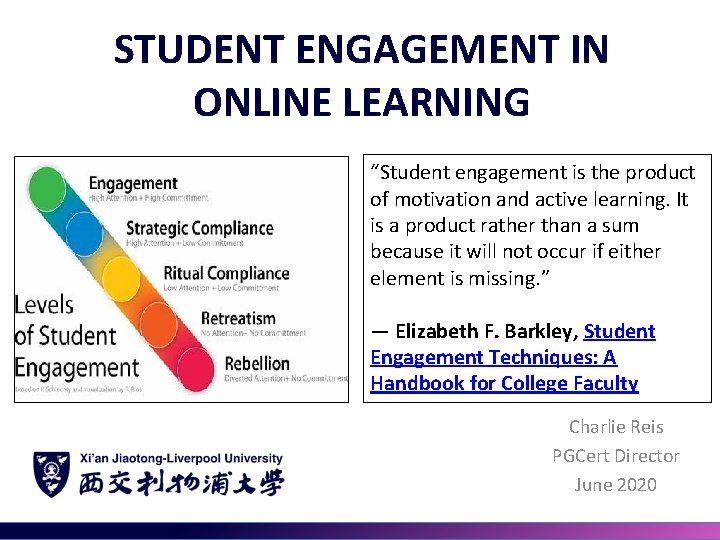
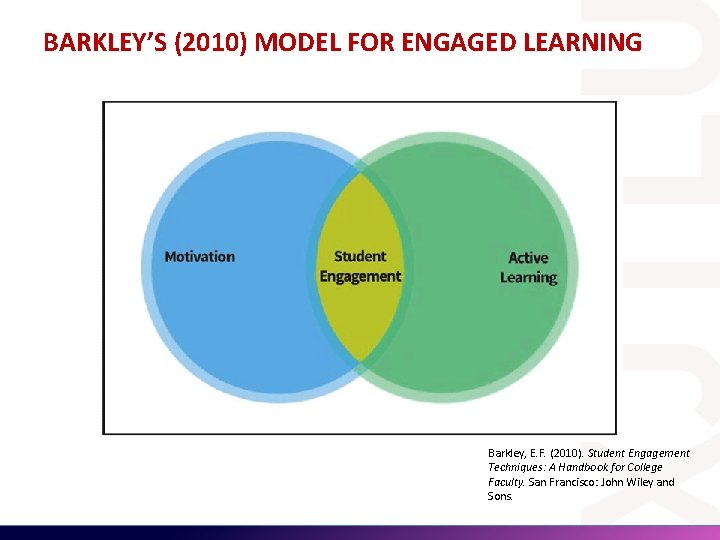
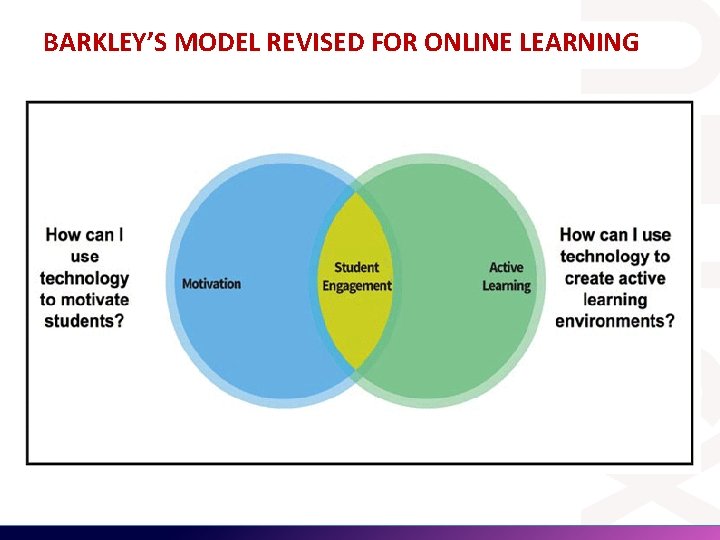
STUDENT ENGAGEMENT IN ONLINE LEARNING “Student engagement is the product of motivation and active learning. It is a product rather than a sum because it will not occur if either element is missing. ” ― Elizabeth F. Barkley, Student Engagement Techniques: A Handbook for College Faculty Charlie Reis PGCert Director June 2020
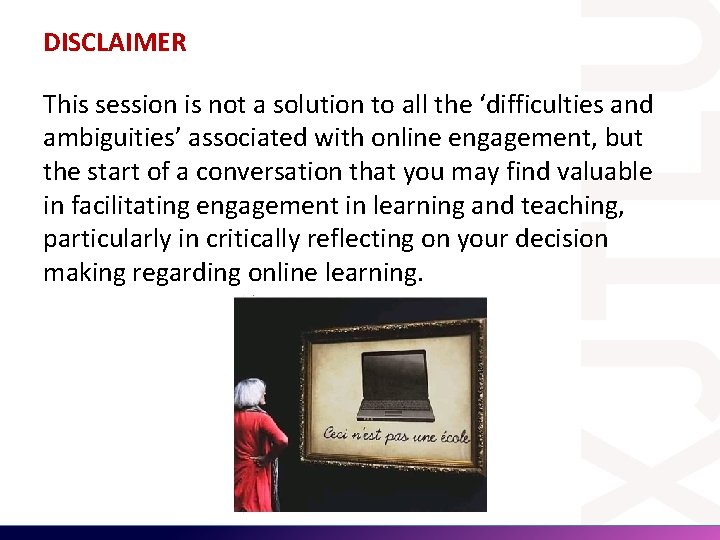
DISCLAIMER This session is not a solution to all the ‘difficulties and ambiguities’ associated with online engagement, but the start of a conversation that you may find valuable in facilitating engagement in learning and teaching, particularly in critically reflecting on your decision making regarding online learning.
OBJECTIVES • Increase your comfort and confidence curating online learning environments; • Move towards individual definitions of student engagement; • Review some relevant literature and frameworks; • Think about how to improve student learning and the student learning experience; • Think of how to redesign curriculum for online learning for your specific modules and programmes.
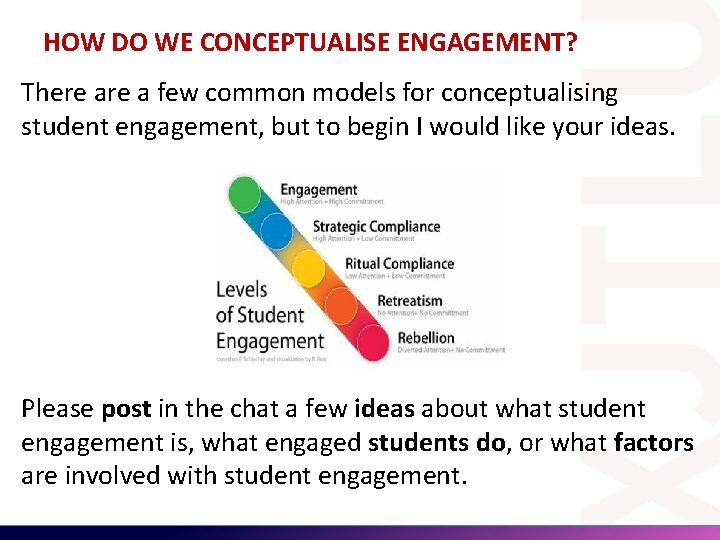
HOW DO WE CONCEPTUALISE ENGAGEMENT? There a few common models for conceptualising student engagement, but to begin I would like your ideas. Please post in the chat a few ideas about what student engagement is, what engaged students do, or what factors are involved with student engagement.
STUDENT ENGAGEMENT “Student engagement is the energy and effort that students employ within their learning community, observable via any number of behavioural, cognitive or affective indicators across a continuum. “It is shaped by a range of structural and internal influences, including the complex interplay of relationships, learning activities and the learning environment. The more students are engaged and empowered within their learning community, the more likely they are to channel that energy back into their learning, leading to a range of short and long term outcomes, that can likewise further fuel engagement. ” Bond et al. International Journal of Educational Technology in Higher Education (2020) 17: 2 https: //doi. org/10. 1186/s 41239 -0176 -8
STUDENT ENGAGEMENT “Student engagement is the energy and effort that students employ within their learning community, observable via any number of behavioural, cognitive or affective indicators across a continuum. “It is shaped by a range of structural and internal influences, including the complex interplay of relationships, learning activities and the learning environment. The more students are engaged and empowered within their learning community, the more likely they are to channel that energy back into their learning, leading to a range of short and long term outcomes, that can likewise further fuel engagement. ” Bond et al. International Journal of Educational Technology in Higher Education (2020) 17: 2 https: //doi. org/10. 1186/s 41239 -0176 -8
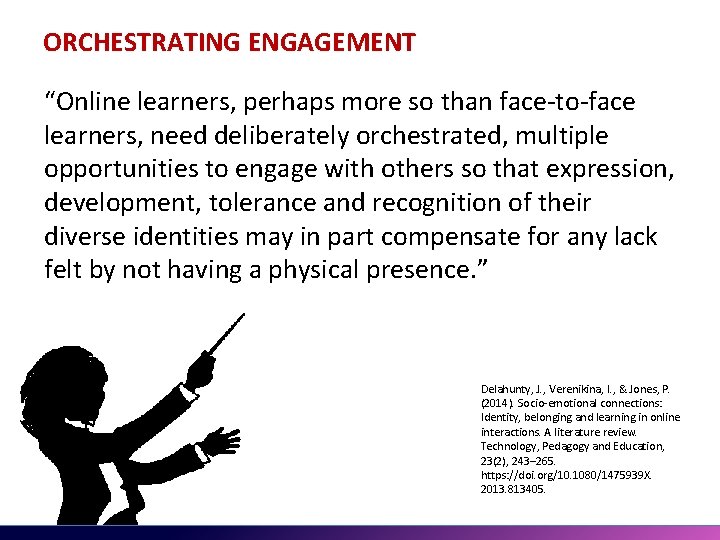
ORCHESTRATING ENGAGEMENT “Online learners, perhaps more so than face-to-face learners, need deliberately orchestrated, multiple opportunities to engage with others so that expression, development, tolerance and recognition of their diverse identities may in part compensate for any lack felt by not having a physical presence. ” Delahunty, J. , Verenikina, I. , & Jones, P. (2014). Socio-emotional connections: Identity, belonging and learning in online interactions. A literature review. Technology, Pedagogy and Education, 23(2), 243– 265. https: //doi. org/10. 1080/1475939 X. 2013. 813405.
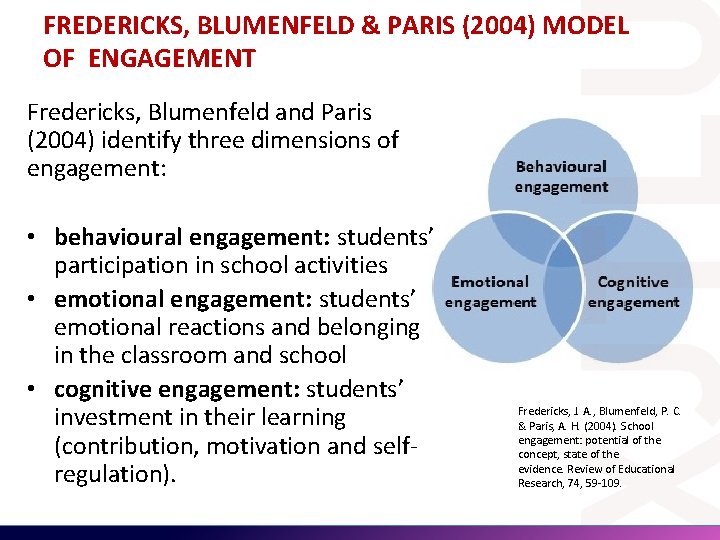
FREDERICKS, BLUMENFELD & PARIS (2004) MODEL OF ENGAGEMENT Fredericks, Blumenfeld and Paris (2004) identify three dimensions of engagement: • behavioural engagement: students’ participation in school activities • emotional engagement: students’ emotional reactions and belonging in the classroom and school • cognitive engagement: students’ investment in their learning (contribution, motivation and selfregulation). Fredericks, J. A. , Blumenfeld, P. C. & Paris, A. H. (2004). School engagement: potential of the concept, state of the evidence. Review of Educational Research, 74, 59 -109.
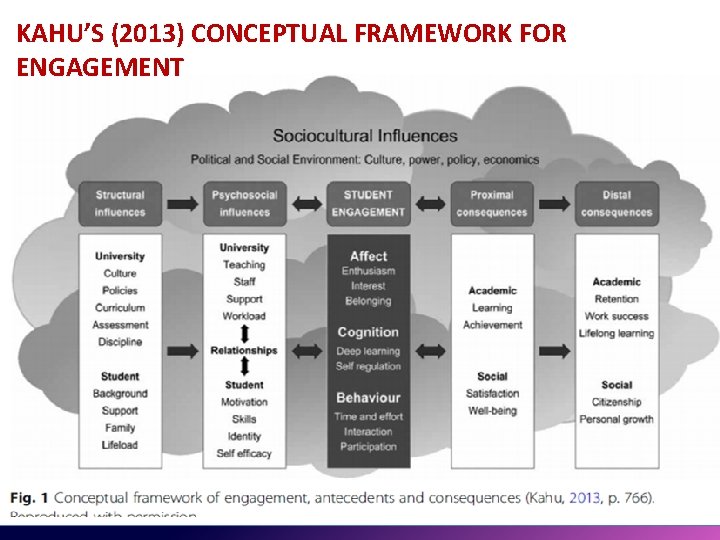
KAHU’S (2013) CONCEPTUAL FRAMEWORK FOR ENGAGEMENT
ENGAGEMENT ONLINE “[T]here is a particular focus on the factors which are most relevant to online students, as ‘when shifting to online contexts, engagement takes on different manifestations, due to the lack of face to face contact and the ways in which teaching and learning are mediated through technology’ (O’ Shea et al. , 2015, p. 43). ” Farrell and Brunton International Journal of Educational Technology in Higher Education (2020) 17: 25 https: //doi. org/10. 1186/s 41239020 -00199 -x
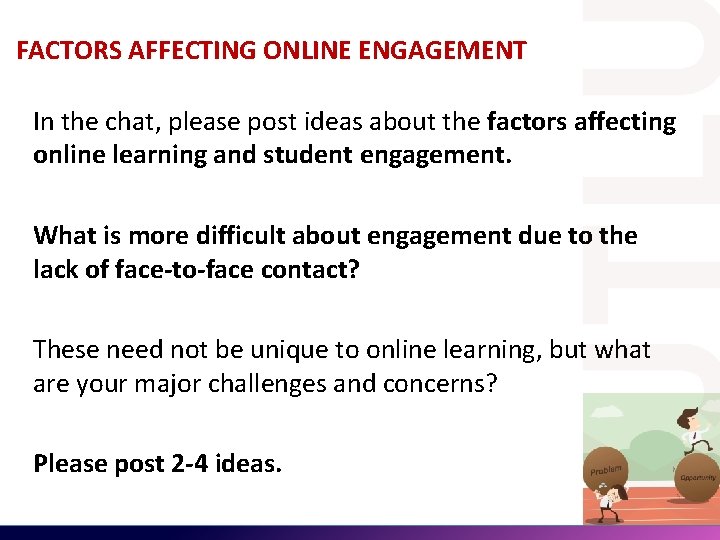
FACTORS AFFECTING ONLINE ENGAGEMENT In the chat, please post ideas about the factors affecting online learning and student engagement. What is more difficult about engagement due to the lack of face-to-face contact? These need not be unique to online learning, but what are your major challenges and concerns? Please post 2 -4 ideas.
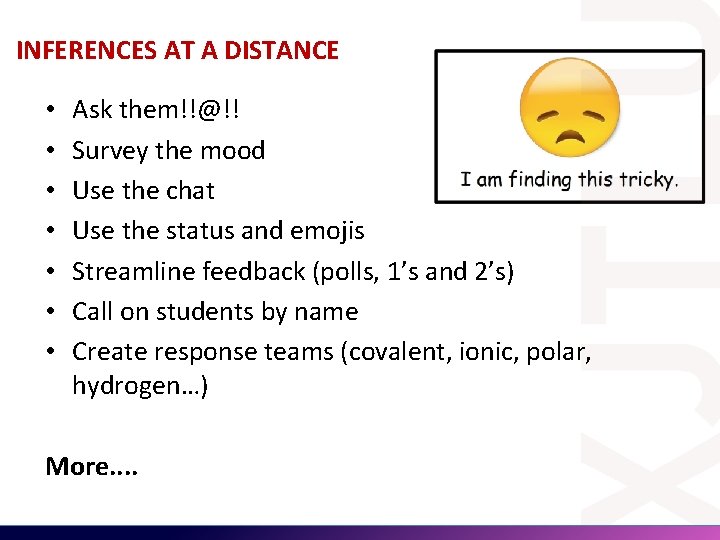
INFERENCES AT A DISTANCE The phrase ‘mental-state inference’ refers to a person inferring [judging] what another person is thinking (Ames, 2004; Epley & Waytz, 2010). Being online shifts all the classroom cues we are used to using. What can we do about these difficulties?
INFERENCES AT A DISTANCE • • Ask them!!@!! Survey the mood Use the chat Use the status and emojis Streamline feedback (polls, 1’s and 2’s) Call on students by name Create response teams (covalent, ionic, polar, hydrogen…) More. .
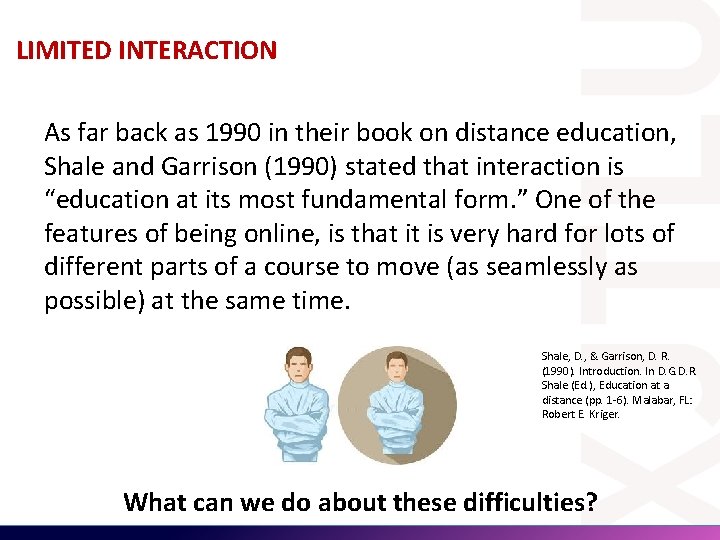
LIMITED INTERACTION As far back as 1990 in their book on distance education, Shale and Garrison (1990) stated that interaction is “education at its most fundamental form. ” One of the features of being online, is that it is very hard for lots of different parts of a course to move (as seamlessly as possible) at the same time. Shale, D. , & Garrison, D. R. (1990). Introduction. In D. G. D. R. Shale (Ed. ), Education at a distance (pp. 1 -6). Malabar, FL: Robert E. Kriger. What can we do about these difficulties?
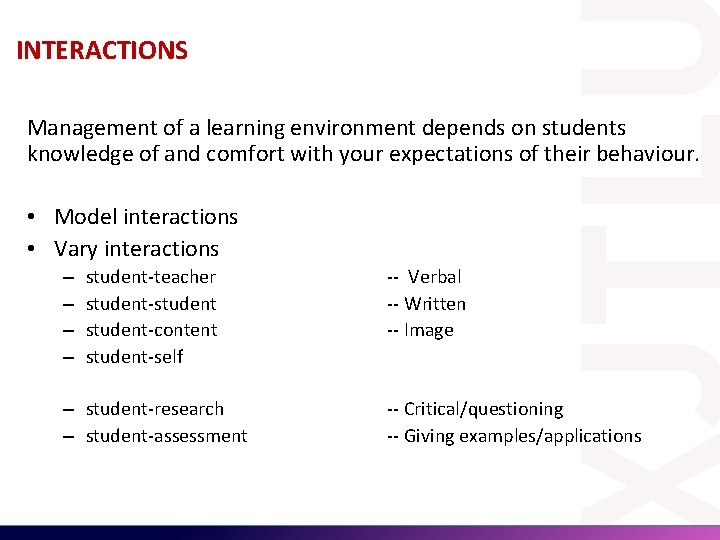
INTERACTIONS Management of a learning environment depends on students knowledge of and comfort with your expectations of their behaviour. • Model interactions • Vary interactions – – student-teacher student-student-content student-self – student-research – student-assessment -- Verbal -- Written -- Image -- Critical/questioning -- Giving examples/applications
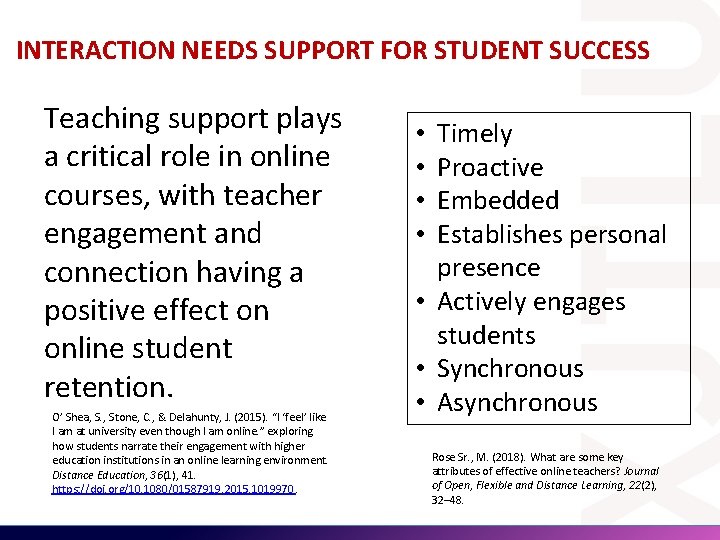
INTERACTION NEEDS SUPPORT FOR STUDENT SUCCESS Teaching support plays a critical role in online courses, with teacher engagement and connection having a positive effect on online student retention. O’ Shea, S. , Stone, C. , & Delahunty, J. (2015). “I ‘feel’ like I am at university even though I am online. ” exploring how students narrate their engagement with higher education institutions in an online learning environment. Distance Education, 36(1), 41. https: //doi. org/10. 1080/01587919. 2015. 1019970. Timely Proactive Embedded Establishes personal presence • Actively engages students • Synchronous • Asynchronous • • Rose Sr. , M. (2018). What are some key attributes of effective online teachers? Journal of Open, Flexible and Distance Learning, 22(2), 32– 48.
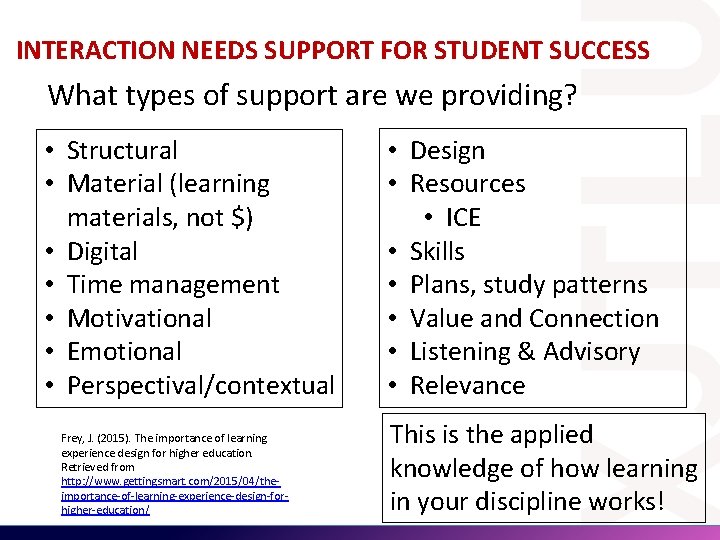
INTERACTION NEEDS SUPPORT FOR STUDENT SUCCESS What types of support are we providing? • Structural • Material (learning materials, not $) • Digital • Time management • Motivational • Emotional • Perspectival/contextual Frey, J. (2015). The importance of learning experience design for higher education. Retrieved from http: //www. gettingsmart. com/2015/04/theimportance-of-learning-experience-design-forhigher-education/ • Design • Resources • ICE • Skills • Plans, study patterns • Value and Connection • Listening & Advisory • Relevance This is the applied knowledge of how learning in your discipline works!
BARKLEY’S (2010) MODEL FOR ENGAGED LEARNING Barkley, E. F. (2010). Student Engagement Techniques: A Handbook for College Faculty. San Francisco: John Wiley and Sons.
BARKLEY’S MODEL REVISED FOR ONLINE LEARNING
MOTIVATION How do you motivate students? NB: I don’t care about theories of motivation just now; I want us to share what we actually do.
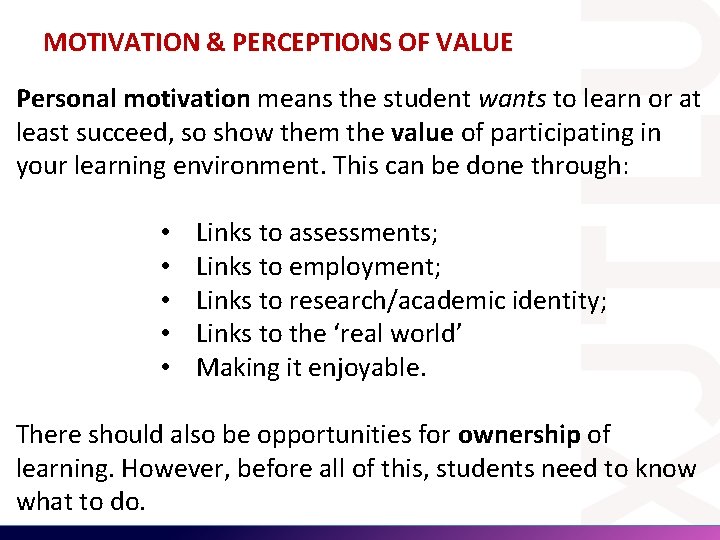
MOTIVATION & PERCEPTIONS OF VALUE Personal motivation means the student wants to learn or at least succeed, so show them the value of participating in your learning environment. This can be done through: • • • Links to assessments; Links to employment; Links to research/academic identity; Links to the ‘real world’ Making it enjoyable. There should also be opportunities for ownership of learning. However, before all of this, students need to know what to do.
MOTIVATION & STUDENT OWNERSHIP OF LEARNING What does student ownership of learning mean to you?
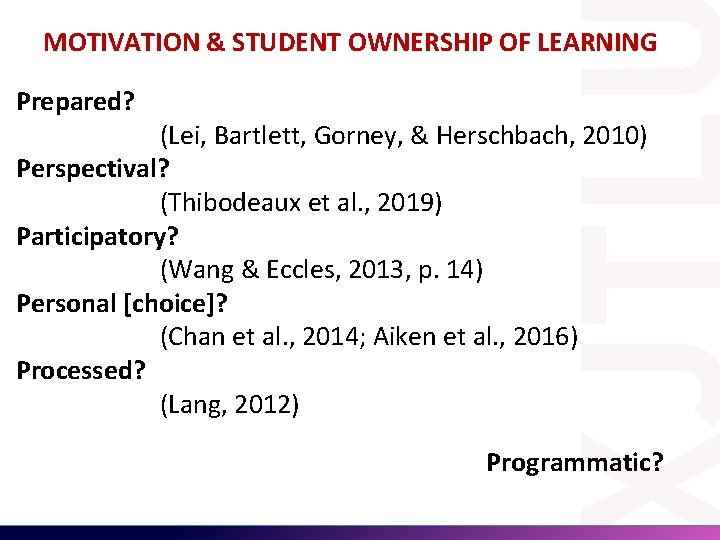
MOTIVATION & STUDENT OWNERSHIP OF LEARNING Prepared? (Lei, Bartlett, Gorney, & Herschbach, 2010) Perspectival? (Thibodeaux et al. , 2019) Participatory? (Wang & Eccles, 2013, p. 14) Personal [choice]? (Chan et al. , 2014; Aiken et al. , 2016) Processed? (Lang, 2012) Programmatic?
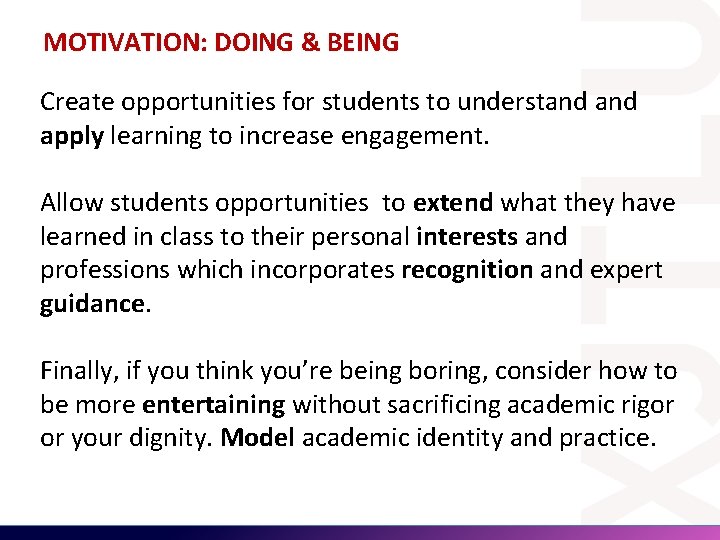
MOTIVATION: DOING & BEING Create opportunities for students to understand apply learning to increase engagement. Allow students opportunities to extend what they have learned in class to their personal interests and professions which incorporates recognition and expert guidance. Finally, if you think you’re being boring, consider how to be more entertaining without sacrificing academic rigor or your dignity. Model academic identity and practice.
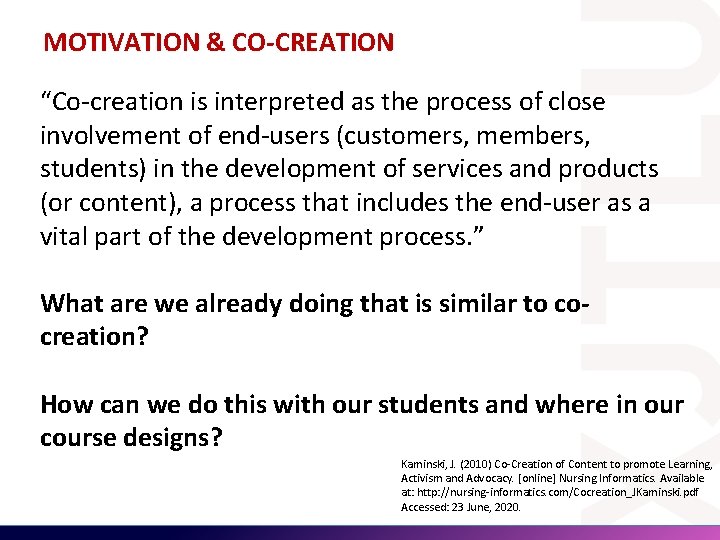
MOTIVATION & CO-CREATION “Co-creation is interpreted as the process of close involvement of end-users (customers, members, students) in the development of services and products (or content), a process that includes the end-user as a vital part of the development process. ” What are we already doing that is similar to cocreation? How can we do this with our students and where in our course designs? Kaminski, J. (2010) Co-Creation of Content to promote Learning, Activism and Advocacy. [online] Nursing Informatics. Available at: http: //nursing-informatics. com/Cocreation_JKaminski. pdf Accessed: 23 June, 2020.
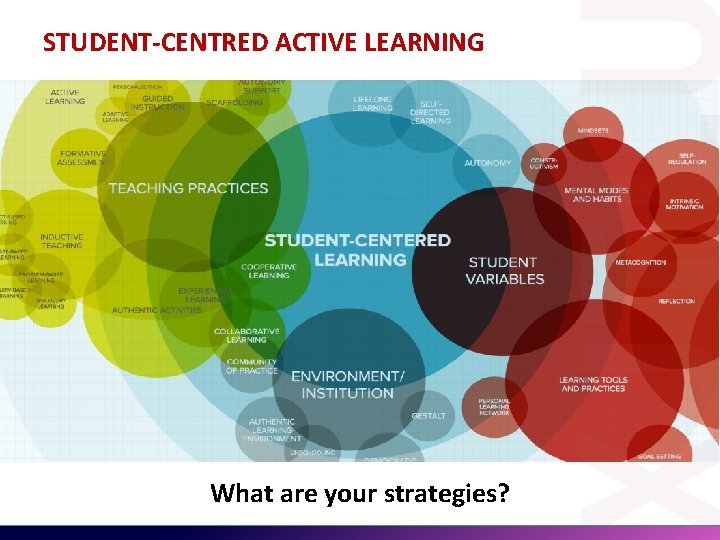
STUDENT-CENTRED ACTIVE LEARNING What are your strategies?
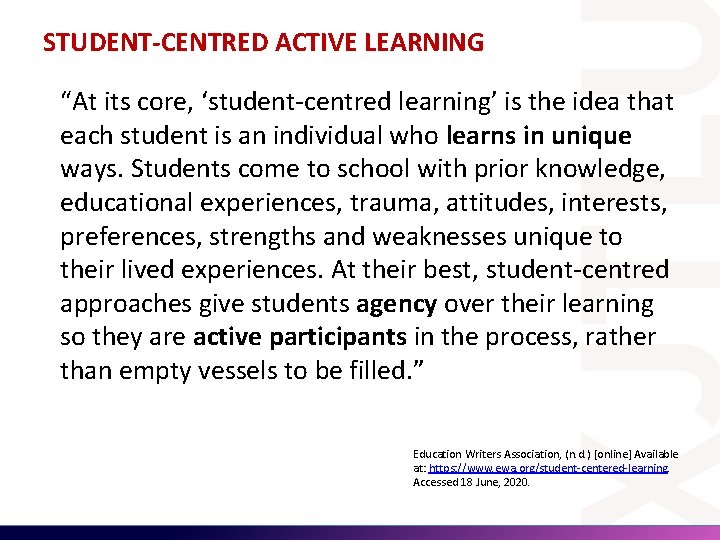
STUDENT-CENTRED ACTIVE LEARNING “At its core, ‘student-centred learning’ is the idea that each student is an individual who learns in unique ways. Students come to school with prior knowledge, educational experiences, trauma, attitudes, interests, preferences, strengths and weaknesses unique to their lived experiences. At their best, student-centred approaches give students agency over their learning so they are active participants in the process, rather than empty vessels to be filled. ” Education Writers Association, (n. d. ) [online] Available at: https: //www. ewa. org/student-centered-learning. Accessed 18 June, 2020.
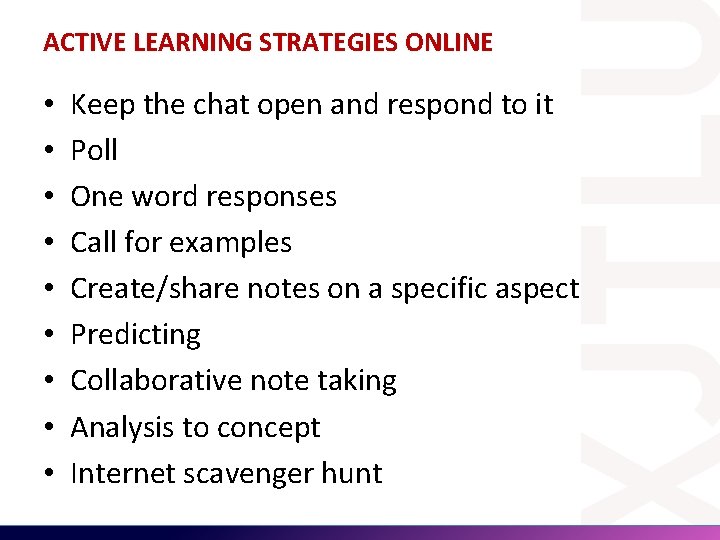
ACTIVE LEARNING STRATEGIES ONLINE • • • Keep the chat open and respond to it Poll One word responses Call for examples Create/share notes on a specific aspect Predicting Collaborative note taking Analysis to concept Internet scavenger hunt
PHYSICAL INTERACTION While I am sure there is no shortage of ways we can think of for students to interact through sharing text, like forums and comments, what are some other ways they can physically participate in learning while online?
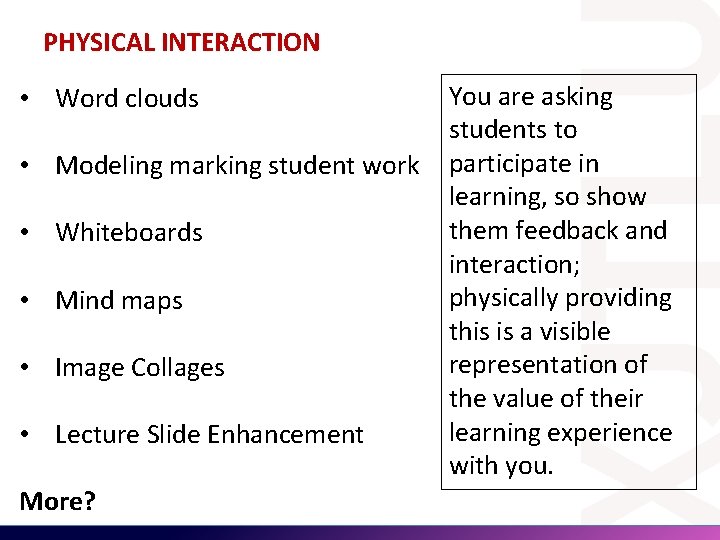
PHYSICAL INTERACTION • Word clouds • Modeling marking student work • Whiteboards • Mind maps • Image Collages • Lecture Slide Enhancement More? You are asking students to participate in learning, so show them feedback and interaction; physically providing this is a visible representation of the value of their learning experience with you.
TALK TO YOUR STUDENTS ABOUT ACTIVE LEARNING Allison Leich Hilbun, senior lecturer in biological sciences at Vanderbilt, remarks: “I feel like engaging students can be helped by having honest conversations with the students about how they are feeling about this novel approach to learning. Even stopping class to ask how students feel emotionally and whether or not they feel connected could potentially help foster social connections and comfort with the new system. ” Bruff, D. (2020) Active Learning in Hybrid and Socially Distanced Classrooms. Vanderbilt [online] Available at: https: //cft. vanderbilt. edu/2020/06/active-learning-in-hybrid-and-socially-distanced-classrooms/. Accessed 14 June, 2020
TALK TO YOUR STUDENTS ABOUT ACTIVE LEARNING Online student self-efficacy is a predictor of success. (Kahu, Picton, & Nelson, 2019) found that student self-efficacy influenced interest and enjoyment, and behavioural engagement with learning. Kahu, E. R. , Picton, C. , & Nelson, K. (2019). Pathways to engagement: A longitudinal study of the first-year student experience in the educational interface. Higher Education. https: //doi. org/10. 1007/s 10734 -019 -00429 -w.
REVIEW • Student engagement is essential to all learning and much more visible through it’s absence in online contexts. It must be designed for, embedded, curated, and valued. As a final activity, please post in the chat two things you will do to facilitate engagement or some themes from today you want to think over.
THANK YOU VISIT US FOLLOW US WWW. XJTLU. EDU. CN @XJTLU