
STUDENT DIRECTIONS As you read for this independent
- Slides: 6
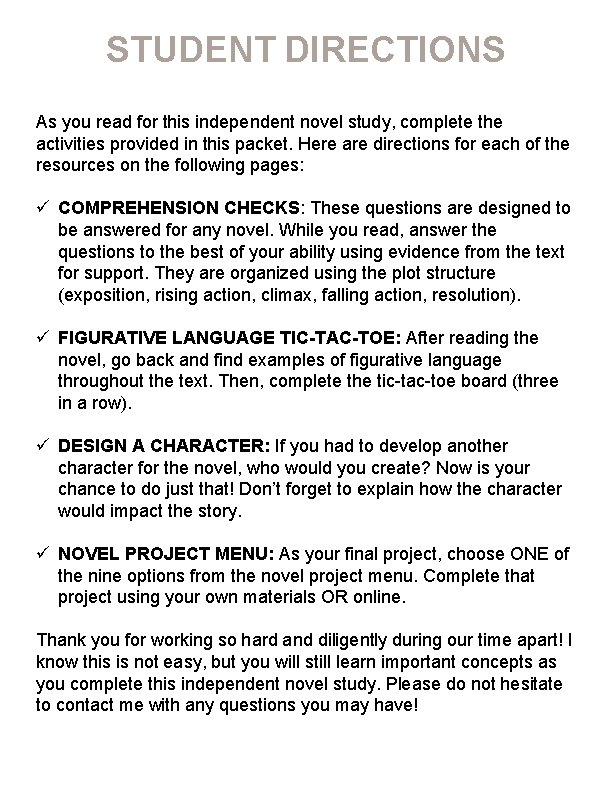
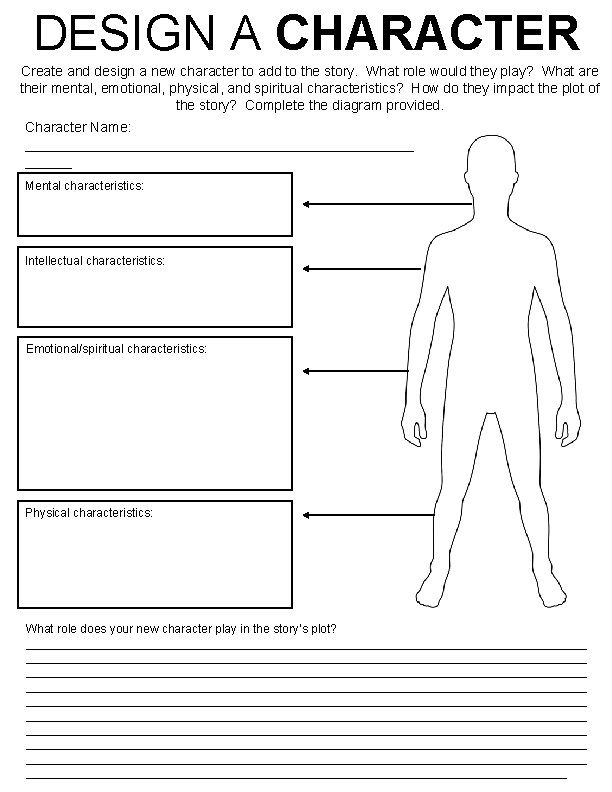
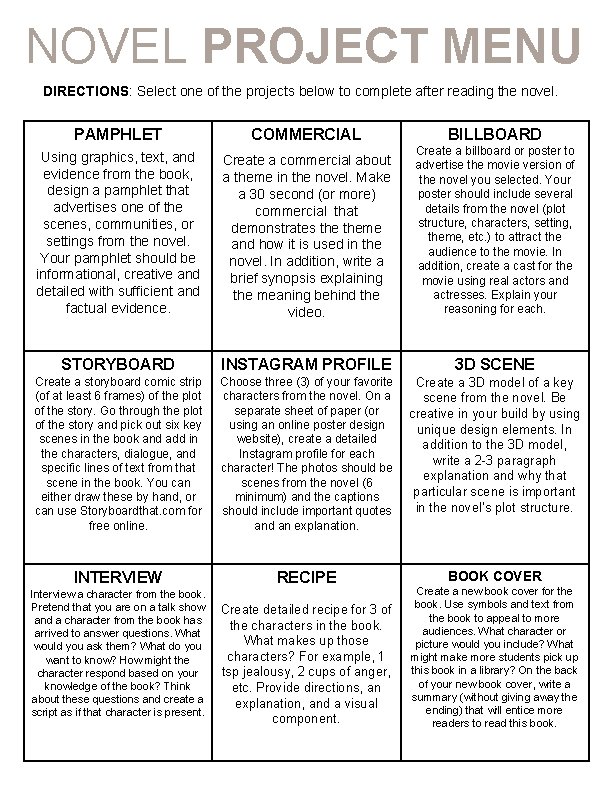
STUDENT DIRECTIONS As you read for this independent novel study, complete the activities provided in this packet. Here are directions for each of the resources on the following pages: ü COMPREHENSION CHECKS: These questions are designed to be answered for any novel. While you read, answer the questions to the best of your ability using evidence from the text for support. They are organized using the plot structure (exposition, rising action, climax, falling action, resolution). ü FIGURATIVE LANGUAGE TIC-TAC-TOE: After reading the novel, go back and find examples of figurative language throughout the text. Then, complete the tic-tac-toe board (three in a row). ü DESIGN A CHARACTER: If you had to develop another character for the novel, who would you create? Now is your chance to do just that! Don’t forget to explain how the character would impact the story. ü NOVEL PROJECT MENU: As your final project, choose ONE of the nine options from the novel project menu. Complete that project using your own materials OR online. Thank you for working so hard and diligently during our time apart! I know this is not easy, but you will still learn important concepts as you complete this independent novel study. Please do not hesitate to contact me with any questions you may have!
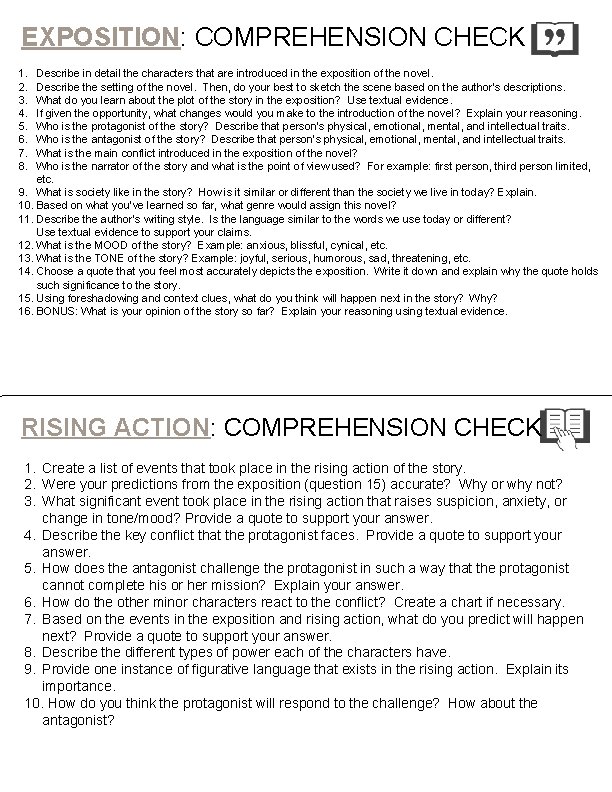
EXPOSITION: COMPREHENSION CHECK 1. 2. 3. 4. 5. 6. 7. 8. Describe in detail the characters that are introduced in the exposition of the novel. Describe the setting of the novel. Then, do your best to sketch the scene based on the author’s descriptions. What do you learn about the plot of the story in the exposition? Use textual evidence. If given the opportunity, what changes would you make to the introduction of the novel? Explain your reasoning. Who is the protagonist of the story? Describe that person’s physical, emotional, mental, and intellectual traits. Who is the antagonist of the story? Describe that person’s physical, emotional, mental, and intellectual traits. What is the main conflict introduced in the exposition of the novel? Who is the narrator of the story and what is the point of view used? For example: first person, third person limited, etc. 9. What is society like in the story? How is it similar or different than the society we live in today? Explain. 10. Based on what you’ve learned so far, what genre would assign this novel? 11. Describe the author’s writing style. Is the language similar to the words we use today or different? Use textual evidence to support your claims. 12. What is the MOOD of the story? Example: anxious, blissful, cynical, etc. 13. What is the TONE of the story? Example: joyful, serious, humorous, sad, threatening, etc. 14. Choose a quote that you feel most accurately depicts the exposition. Write it down and explain why the quote holds such significance to the story. 15. Using foreshadowing and context clues, what do you think will happen next in the story? Why? 16. BONUS: What is your opinion of the story so far? Explain your reasoning using textual evidence. RISING ACTION: COMPREHENSION CHECK 1. Create a list of events that took place in the rising action of the story. 2. Were your predictions from the exposition (question 15) accurate? Why or why not? 3. What significant event took place in the rising action that raises suspicion, anxiety, or change in tone/mood? Provide a quote to support your answer. 4. Describe the key conflict that the protagonist faces. Provide a quote to support your answer. 5. How does the antagonist challenge the protagonist in such a way that the protagonist cannot complete his or her mission? Explain your answer. 6. How do the other minor characters react to the conflict? Create a chart if necessary. 7. Based on the events in the exposition and rising action, what do you predict will happen next? Provide a quote to support your answer. 8. Describe the different types of power each of the characters have. 9. Provide one instance of figurative language that exists in the rising action. Explain its importance. 10. How do you think the protagonist will respond to the challenge? How about the antagonist?
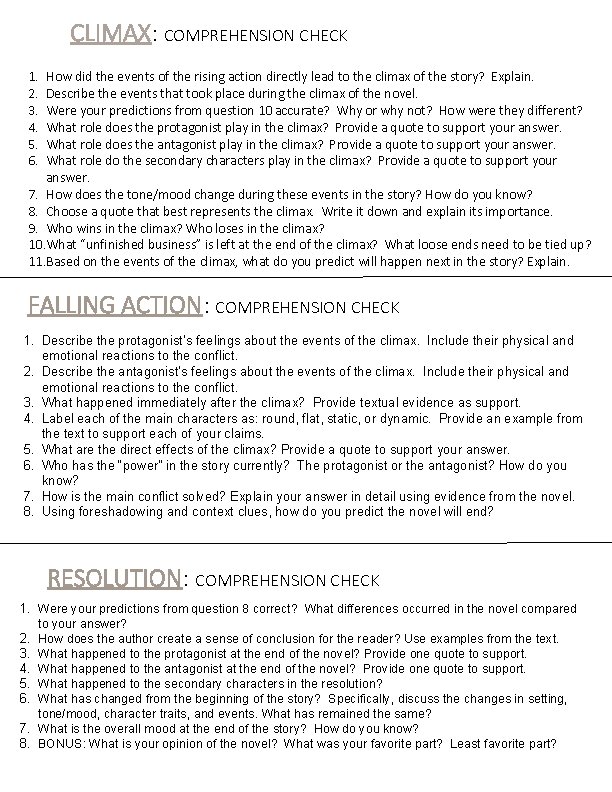
CLIMAX: COMPREHENSION CHECK 1. 2. 3. 4. 5. 6. How did the events of the rising action directly lead to the climax of the story? Explain. Describe the events that took place during the climax of the novel. Were your predictions from question 10 accurate? Why or why not? How were they different? What role does the protagonist play in the climax? Provide a quote to support your answer. What role does the antagonist play in the climax? Provide a quote to support your answer. What role do the secondary characters play in the climax? Provide a quote to support your answer. 7. How does the tone/mood change during these events in the story? How do you know? 8. Choose a quote that best represents the climax. Write it down and explain its importance. 9. Who wins in the climax? Who loses in the climax? 10. What “unfinished business” is left at the end of the climax? What loose ends need to be tied up? 11. Based on the events of the climax, what do you predict will happen next in the story? Explain. FALLING ACTION: COMPREHENSION CHECK 1. Describe the protagonist’s feelings about the events of the climax. Include their physical and emotional reactions to the conflict. 2. Describe the antagonist’s feelings about the events of the climax. Include their physical and emotional reactions to the conflict. 3. What happened immediately after the climax? Provide textual evidence as support. 4. Label each of the main characters as: round, flat, static, or dynamic. Provide an example from the text to support each of your claims. 5. What are the direct effects of the climax? Provide a quote to support your answer. 6. Who has the “power” in the story currently? The protagonist or the antagonist? How do you know? 7. How is the main conflict solved? Explain your answer in detail using evidence from the novel. 8. Using foreshadowing and context clues, how do you predict the novel will end? RESOLUTION: COMPREHENSION CHECK 1. Were your predictions from question 8 correct? What differences occurred in the novel compared to your answer? 2. How does the author create a sense of conclusion for the reader? Use examples from the text. 3. What happened to the protagonist at the end of the novel? Provide one quote to support. 4. What happened to the antagonist at the end of the novel? Provide one quote to support. 5. What happened to the secondary characters in the resolution? 6. What has changed from the beginning of the story? Specifically, discuss the changes in setting, tone/mood, character traits, and events. What has remained the same? 7. What is the overall mood at the end of the story? How do you know? 8. BONUS: What is your opinion of the novel? What was your favorite part? Least favorite part?
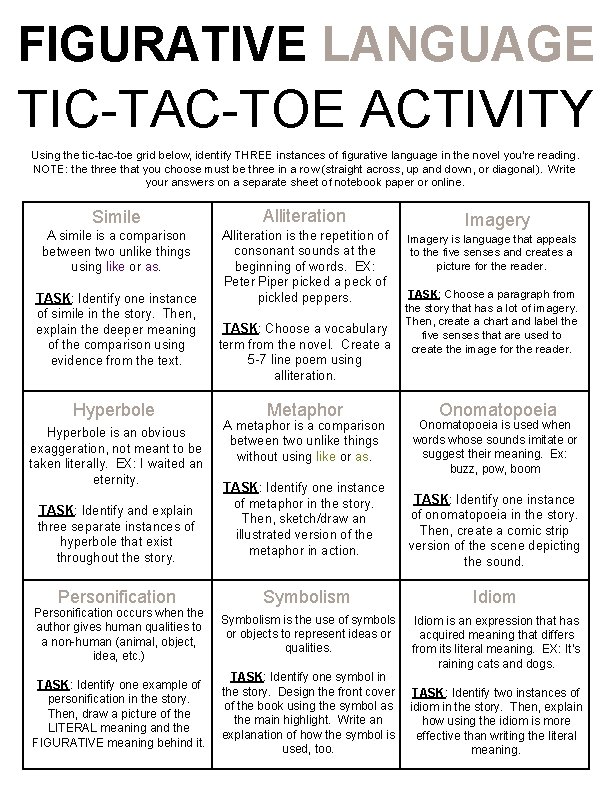
FIGURATIVE LANGUAGE TIC-TAC-TOE ACTIVITY Using the tic-tac-toe grid below, identify THREE instances of figurative language in the novel you’re reading. NOTE: the three that you choose must be three in a row (straight across, up and down, or diagonal). Write your answers on a separate sheet of notebook paper or online. Simile Alliteration A simile is a comparison between two unlike things using like or as. Alliteration is the repetition of consonant sounds at the beginning of words. EX: Peter Piper picked a peck of pickled peppers. TASK: Identify one instance of simile in the story. Then, explain the deeper meaning of the comparison using evidence from the text. Hyperbole is an obvious exaggeration, not meant to be taken literally. EX: I waited an eternity. TASK: Identify and explain three separate instances of hyperbole that exist throughout the story. Personification TASK: Choose a vocabulary term from the novel. Create a 5 -7 line poem using alliteration. Metaphor A metaphor is a comparison between two unlike things without using like or as. TASK: Identify one instance of metaphor in the story. Then, sketch/draw an illustrated version of the metaphor in action. Imagery is language that appeals to the five senses and creates a picture for the reader. TASK: Choose a paragraph from the story that has a lot of imagery. Then, create a chart and label the five senses that are used to create the image for the reader. Onomatopoeia is used when words whose sounds imitate or suggest their meaning. Ex: buzz, pow, boom TASK: Identify one instance of onomatopoeia in the story. Then, create a comic strip version of the scene depicting the sound. Personification occurs when the author gives human qualities to a non-human (animal, object, idea, etc. ) Symbolism Idiom Symbolism is the use of symbols or objects to represent ideas or qualities. TASK: Identify one example of personification in the story. Then, draw a picture of the LITERAL meaning and the FIGURATIVE meaning behind it. TASK: Identify one symbol in the story. Design the front cover of the book using the symbol as the main highlight. Write an explanation of how the symbol is used, too. Idiom is an expression that has acquired meaning that differs from its literal meaning. EX: It’s raining cats and dogs. TASK: Identify two instances of idiom in the story. Then, explain how using the idiom is more effective than writing the literal meaning.
DESIGN A CHARACTER Create and design a new character to add to the story. What role would they play? What are their mental, emotional, physical, and spiritual characteristics? How do they impact the plot of the story? Complete the diagram provided. Character Name: _________________________ Mental characteristics: Intellectual characteristics: Emotional/spiritual characteristics: Physical characteristics: What role does your new character play in the story’s plot? ____________________________________________________________________________________ ____________________________________________________________________________________ __________________________________________
NOVEL PROJECT MENU DIRECTIONS: Select one of the projects below to complete after reading the novel. PAMPHLET COMMERCIAL BILLBOARD Using graphics, text, and evidence from the book, design a pamphlet that advertises one of the scenes, communities, or settings from the novel. Your pamphlet should be informational, creative and detailed with sufficient and factual evidence. Create a commercial about a theme in the novel. Make a 30 second (or more) commercial that demonstrates theme and how it is used in the novel. In addition, write a brief synopsis explaining the meaning behind the video. Create a billboard or poster to advertise the movie version of the novel you selected. Your poster should include several details from the novel (plot structure, characters, setting, theme, etc. ) to attract the audience to the movie. In addition, create a cast for the movie using real actors and actresses. Explain your reasoning for each. STORYBOARD INSTAGRAM PROFILE 3 D SCENE Create a storyboard comic strip (of at least 6 frames) of the plot of the story. Go through the plot of the story and pick out six key scenes in the book and add in the characters, dialogue, and specific lines of text from that scene in the book. You can either draw these by hand, or can use Storyboardthat. com for free online. Choose three (3) of your favorite characters from the novel. On a separate sheet of paper (or using an online poster design website), create a detailed Instagram profile for each character! The photos should be scenes from the novel (6 minimum) and the captions should include important quotes and an explanation. Create a 3 D model of a key scene from the novel. Be creative in your build by using unique design elements. In addition to the 3 D model, write a 2 -3 paragraph explanation and why that particular scene is important in the novel’s plot structure. INTERVIEW RECIPE Interview a character from the book. Pretend that you are on a talk show and a character from the book has arrived to answer questions. What would you ask them? What do you want to know? How might the character respond based on your knowledge of the book? Think about these questions and create a script as if that character is present. Create detailed recipe for 3 of the characters in the book. What makes up those characters? For example, 1 tsp jealousy, 2 cups of anger, etc. Provide directions, an explanation, and a visual component. BOOK COVER Create a new book cover for the book. Use symbols and text from the book to appeal to more audiences. What character or picture would you include? What might make more students pick up this book in a library? On the back of your new book cover, write a summary (without giving away the ending) that will entice more readers to read this book.