
STUDENT CHAPTER 10 MANAGERIAL ACCOUNTING Power Point Presentation


- Slides: 29
STUDENT CHAPTER 10 MANAGERIAL ACCOUNTING Power. Point Presentation by Gail B. Wright Professor Emeritus of Accounting Bryant University © Copyright 2008 Thomson South-Western, a part of The Thomson Corporation. Thomson, the Star Logo, and South. Western are trademarks used herein under license. 10 TH EDITION BY MAHER, STICKNEY & WEIL PROFIT & COST CENTER PERFORMANCE EVALUATION
Managerial Planning, Control, & Performance Evaluation LEARNING OBJECTIVES 1. Explain reasons for conducting variance analyses. 2. Describe how to use budget for performance evaluation. 3. Identify different types of variances between actual results & flexible budget. 4. Assign responsibility for variances. Continued 2
Managerial Planning, Control, & Performance Evaluation LEARNING OBJECTIVES 5. Describe the role of variance analysis in service organizations. 6. Explain the difference between price & efficiency variances. 7. Identify the relation between actual, budgeted, & applied fixed manufacturing costs. Continued 3
Managerial Planning, Control, & Performance Evaluation LEARNING OBJECTIVES 8. Explain why an effective performance measurement system requires employee involvement. 9. Explain how to compute the mix variance (Appendix 10. 1). 4
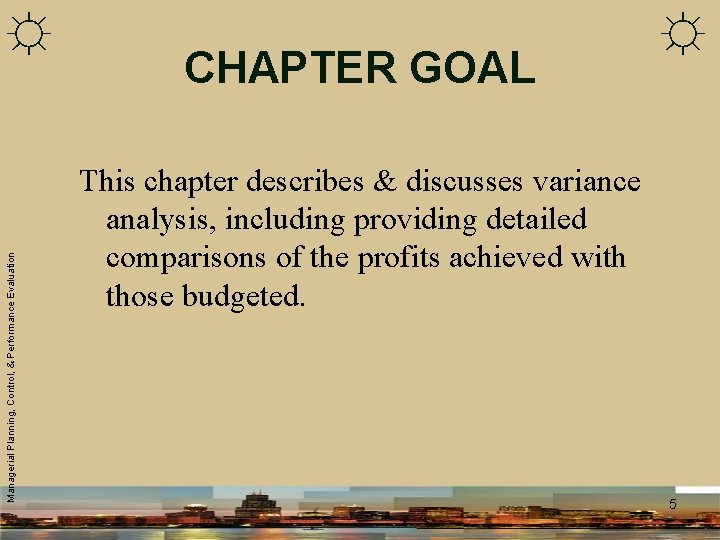
Managerial Planning, Control, & Performance Evaluation ☼ CHAPTER GOAL ☼ This chapter describes & discusses variance analysis, including providing detailed comparisons of the profits achieved with those budgeted. 5
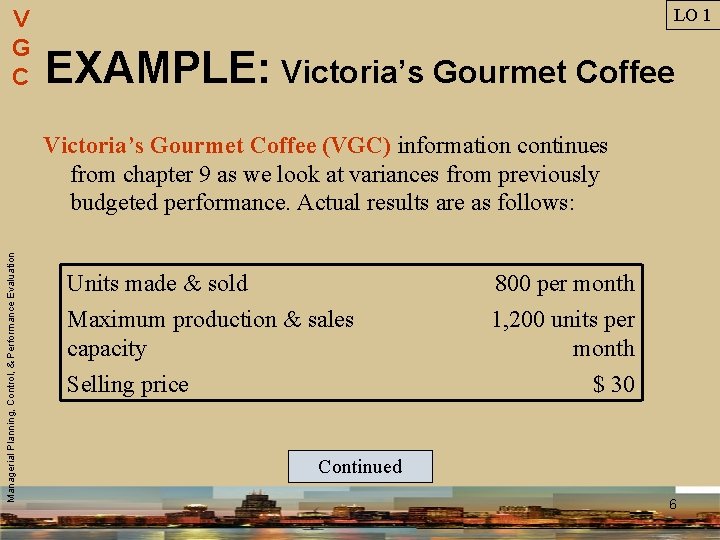
V G C LO 1 EXAMPLE: Victoria’s Gourmet Coffee Managerial Planning, Control, & Performance Evaluation Victoria’s Gourmet Coffee (VGC) information continues from chapter 9 as we look at variances from previously budgeted performance. Actual results are as follows: Units made & sold Maximum production & sales capacity Selling price 800 per month 1, 200 units per month $ 30 Continued 6
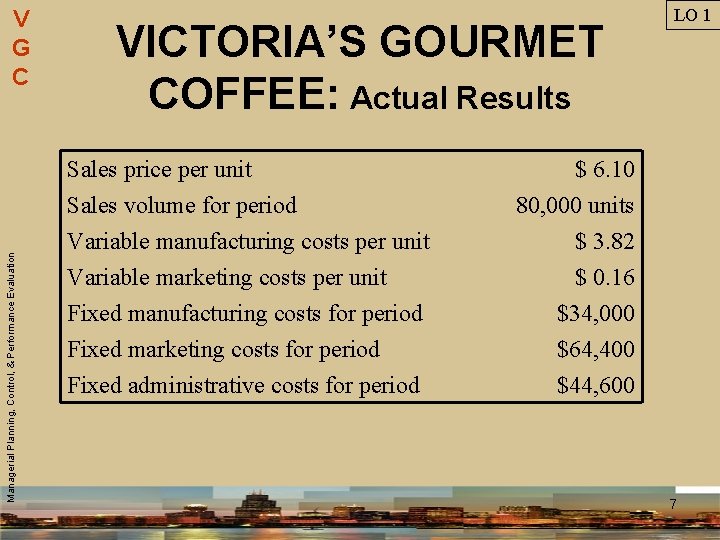
Managerial Planning, Control, & Performance Evaluation V G C VICTORIA’S GOURMET COFFEE: Actual Results Sales price per unit Sales volume for period Variable manufacturing costs per unit Variable marketing costs per unit $ 6. 10 80, 000 units $ 3. 82 $ 0. 16 Fixed manufacturing costs for period Fixed marketing costs for period Fixed administrative costs for period $34, 000 $64, 400 $44, 600 LO 1 7
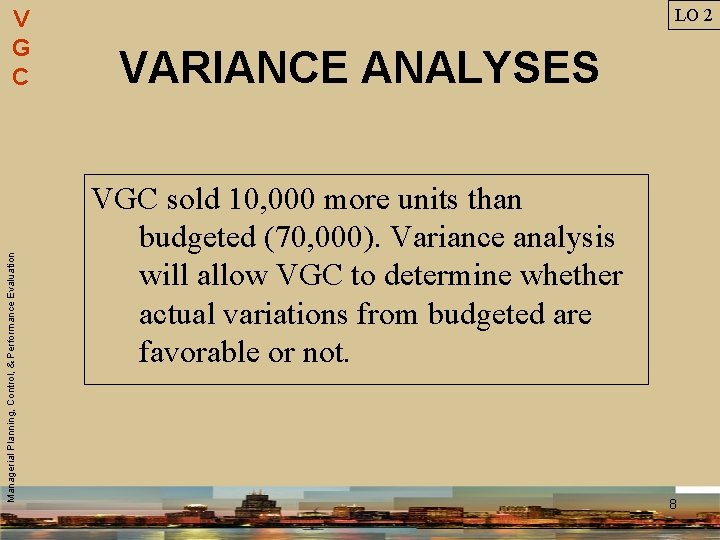
Managerial Planning, Control, & Performance Evaluation V G C LO 2 VARIANCE ANALYSES VGC sold 10, 000 more units than budgeted (70, 000). Variance analysis will allow VGC to determine whether actual variations from budgeted are favorable or not. 8
LO 3 Managerial Planning, Control, & Performance Evaluation TYPES OF VARIANCES Variances are calculated for materials, labor, fixed & variable manufacturing overhead. Variances are divided between ¯Price variance ¯Efficiency variance (Production volume variance for fixed manufacturing overhead) 9
LO 3 Managerial Planning, Control, & Performance Evaluation REASONS FOR VARIANCE ¯A variance is the difference between a predetermined norm or standard & actual results ¯Standards may be biased ¯Systematic reasons ¯Change in prices ¯More/less efficient use of inputs 10
LO 3 Managerial Planning, Control, & Performance Evaluation What do the terms “favorable” & “unfavorable” variance mean? Favorable means the variance will increase profits; unfavorable means the variance will decrease profits. 11
MANAGERS WANT TO KNOW! LO 4 Managerial Planning, Control, & Performance Evaluation ADMINISTRATIVE VARIANCES Administrative variances are more difficult to manage because there is no welldefined causal relationship between administrative costs & production or sales output. 12
Managerial Planning, Control, & Performance Evaluation PRODUCTION COST VARIANCE ANALYSIS LO 5 Variances are calculated for major responsibility centers, holding all other things constant. After variances are computed, managers investigate the causes of these variances & take corrective action if necessary. 13
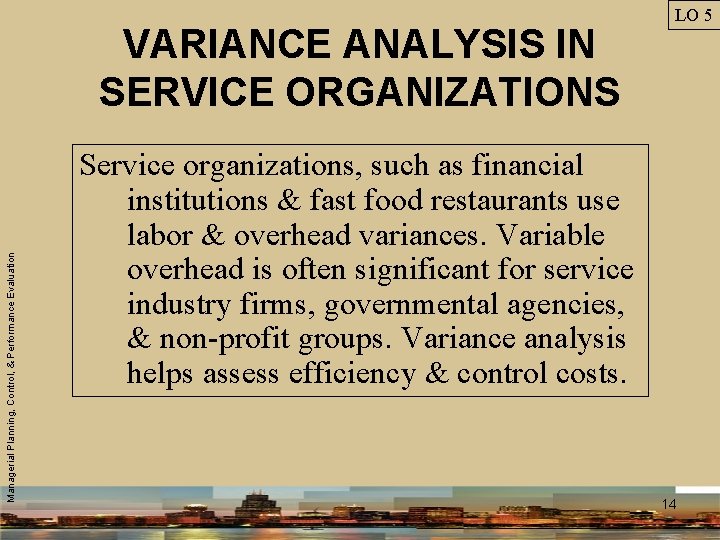
Managerial Planning, Control, & Performance Evaluation VARIANCE ANALYSIS IN SERVICE ORGANIZATIONS LO 5 Service organizations, such as financial institutions & fast food restaurants use labor & overhead variances. Variable overhead is often significant for service industry firms, governmental agencies, & non-profit groups. Variance analysis helps assess efficiency & control costs. 14
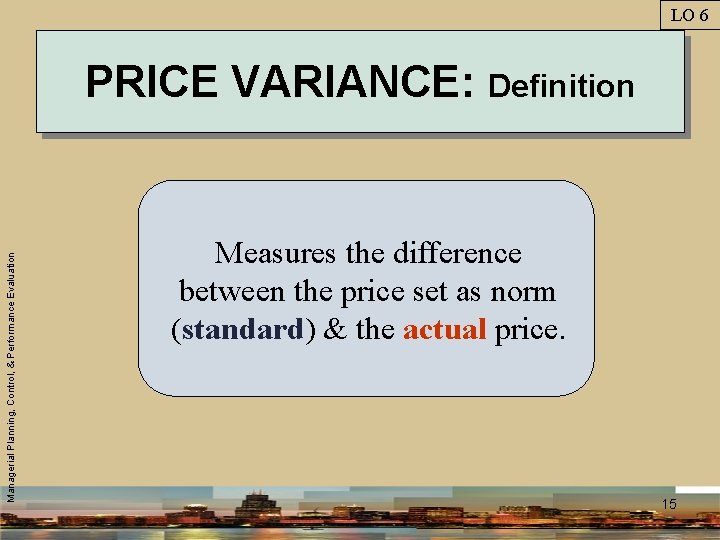
LO 6 Managerial Planning, Control, & Performance Evaluation PRICE VARIANCE: Definition Measures the difference between the price set as norm (standard) & the actual price. 15
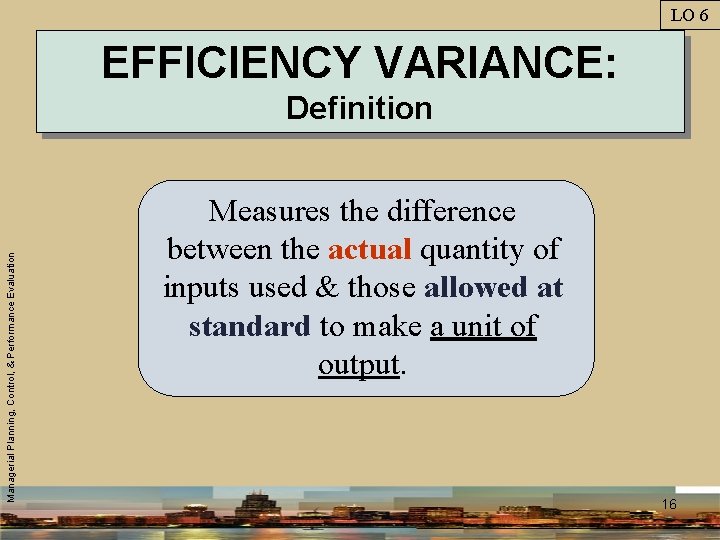
LO 6 EFFICIENCY VARIANCE: Managerial Planning, Control, & Performance Evaluation Definition Measures the difference between the actual quantity of inputs used & those allowed at standard to make a unit of output. 16
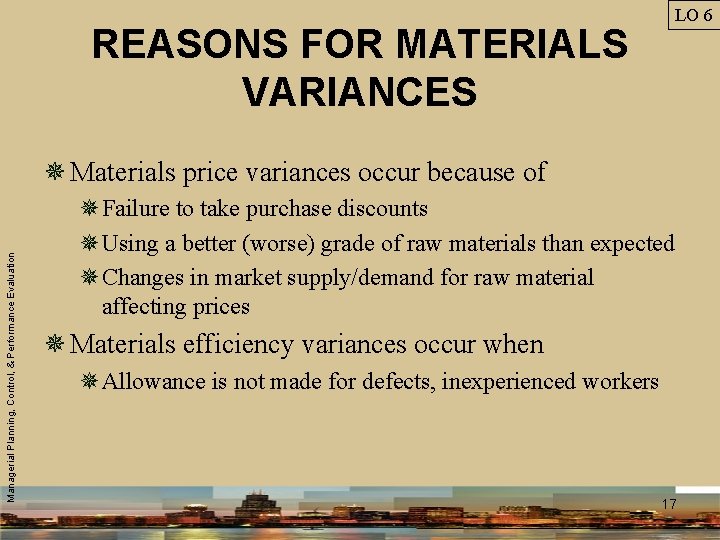
LO 6 REASONS FOR MATERIALS VARIANCES Managerial Planning, Control, & Performance Evaluation ¯ Materials price variances occur because of ¯Failure to take purchase discounts ¯Using a better (worse) grade of raw materials than expected ¯Changes in market supply/demand for raw material affecting prices ¯ Materials efficiency variances occur when ¯Allowance is not made for defects, inexperienced workers 17
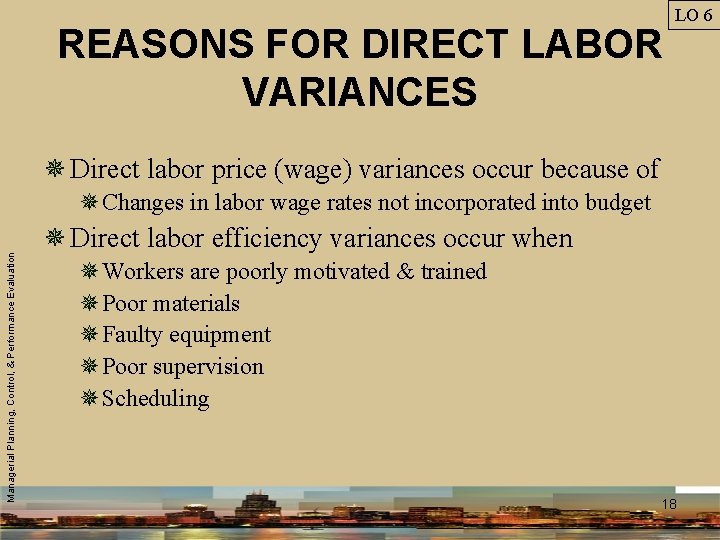
REASONS FOR DIRECT LABOR VARIANCES LO 6 ¯ Direct labor price (wage) variances occur because of Managerial Planning, Control, & Performance Evaluation ¯Changes in labor wage rates not incorporated into budget ¯ Direct labor efficiency variances occur when ¯Workers are poorly motivated & trained ¯Poor materials ¯Faulty equipment ¯Poor supervision ¯Scheduling 18
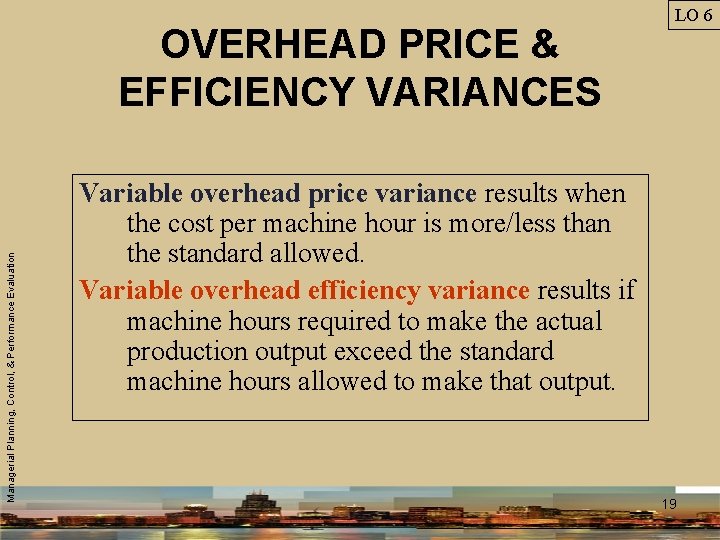
Managerial Planning, Control, & Performance Evaluation OVERHEAD PRICE & EFFICIENCY VARIANCES LO 6 Variable overhead price variance results when the cost per machine hour is more/less than the standard allowed. Variable overhead efficiency variance results if machine hours required to make the actual production output exceed the standard machine hours allowed to make that output. 19
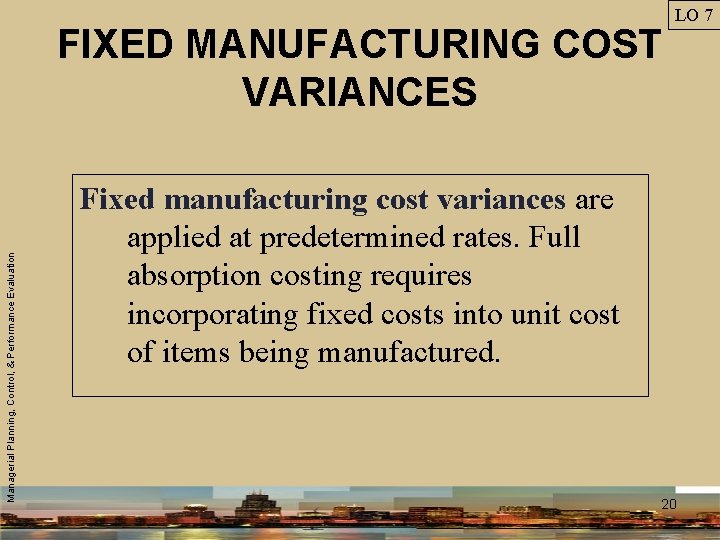
Managerial Planning, Control, & Performance Evaluation FIXED MANUFACTURING COST VARIANCES LO 7 Fixed manufacturing cost variances are applied at predetermined rates. Full absorption costing requires incorporating fixed costs into unit cost of items being manufactured. 20
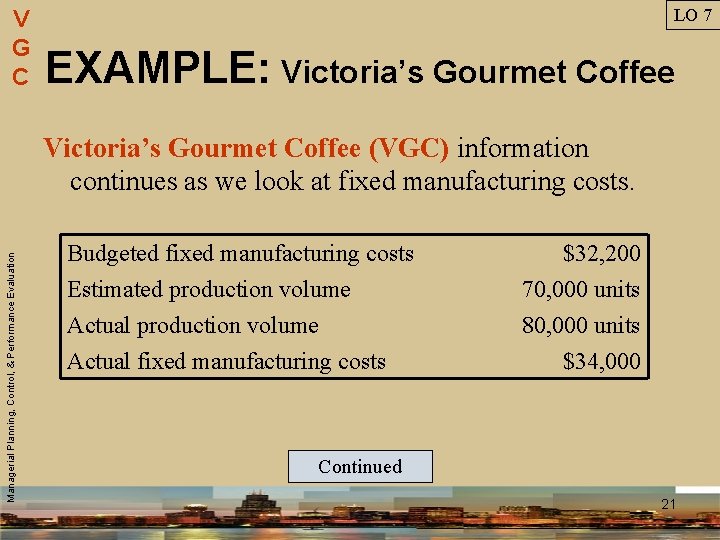
V G C LO 7 EXAMPLE: Victoria’s Gourmet Coffee Managerial Planning, Control, & Performance Evaluation Victoria’s Gourmet Coffee (VGC) information continues as we look at fixed manufacturing costs. Budgeted fixed manufacturing costs Estimated production volume Actual fixed manufacturing costs $32, 200 70, 000 units 80, 000 units $34, 000 Continued 21
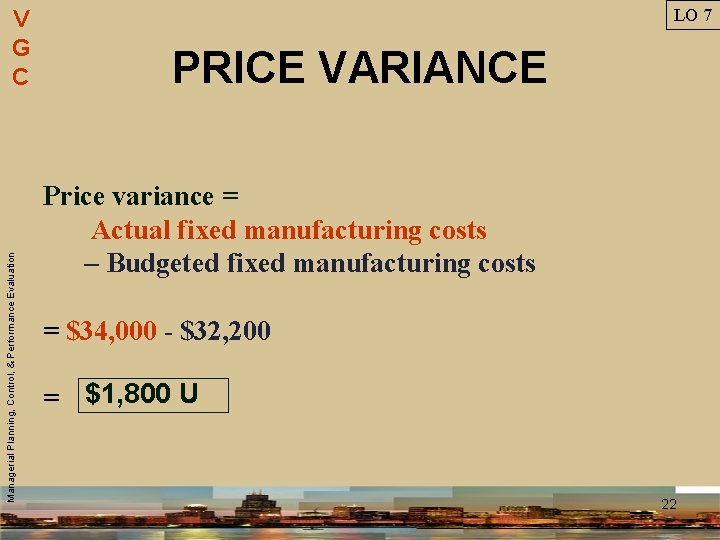
Managerial Planning, Control, & Performance Evaluation V G C LO 7 PRICE VARIANCE Price variance = Actual fixed manufacturing costs – Budgeted fixed manufacturing costs = $34, 000 - $32, 200 = $1, 800 U 22
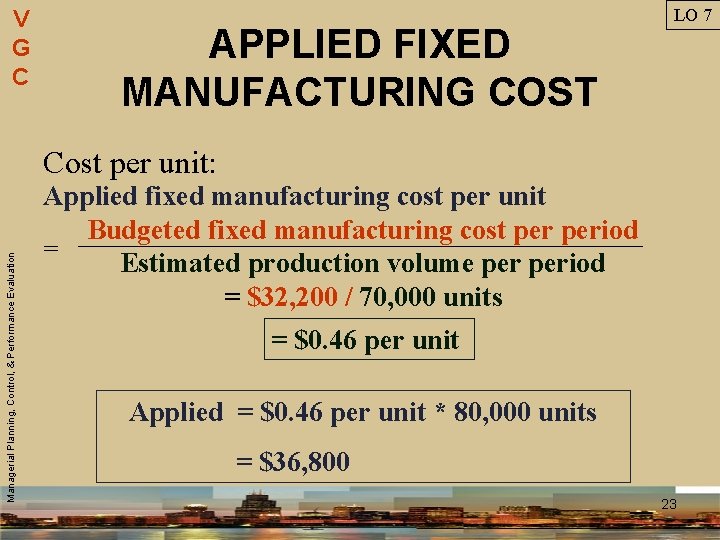
V G C APPLIED FIXED MANUFACTURING COST LO 7 Managerial Planning, Control, & Performance Evaluation Cost per unit: Applied fixed manufacturing cost per unit Budgeted fixed manufacturing cost period = Estimated production volume period = $32, 200 / 70, 000 units = $0. 46 per unit Applied = $0. 46 per unit * 80, 000 units = $36, 800 23
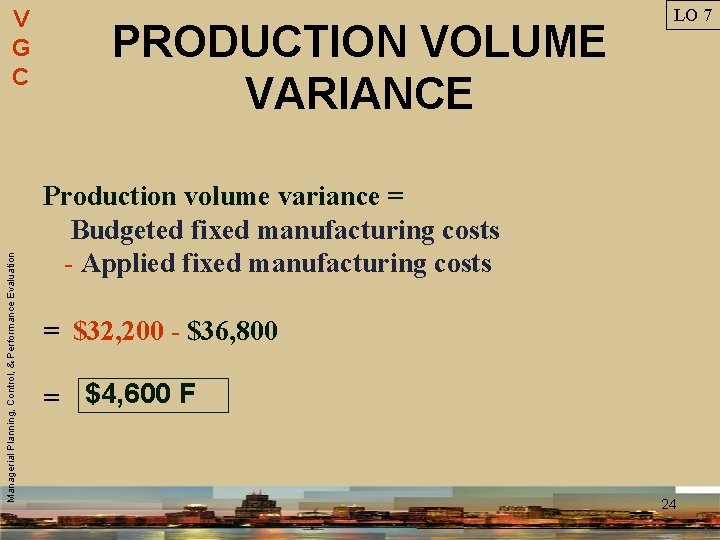
Managerial Planning, Control, & Performance Evaluation V G C PRODUCTION VOLUME VARIANCE LO 7 Production volume variance = Budgeted fixed manufacturing costs - Applied fixed manufacturing costs = $32, 200 - $36, 800 = $4, 600 F 24
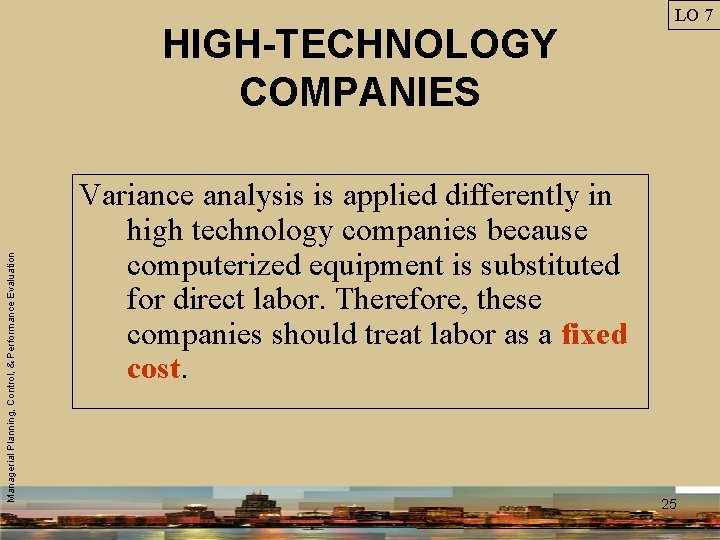
Managerial Planning, Control, & Performance Evaluation HIGH-TECHNOLOGY COMPANIES LO 7 Variance analysis is applied differently in high technology companies because computerized equipment is substituted for direct labor. Therefore, these companies should treat labor as a fixed cost. 25
LO 7 Managerial Planning, Control, & Performance Evaluation DECISION RULE Management should create a decision rule for conducting a variance investigation. Investigations should be conducted on a cost-benefit basis. Quality should be allowed to vary within preset tolerance limits. 26
LO 8 Managerial Planning, Control, & Performance Evaluation WORKER INVOLVEMENT: Benefits ¯Commitment improves & goals increase when workers have decision-making authority ¯When workers can make decisions, the company is closer to customers ¯Giving decision-making responsibility to workers uses their skills & knowledge & provides motivation to develop further 27
LO 8 WORKER INVOLVEMENT: Managerial Planning, Control, & Performance Evaluation Challenges ¯ Management must create a system that conveys organization goals & critical success to all members ¯ Determining measures to determine success may not be as easy & must ensure ¯Promoting desired behavior ¯Comprehensive measures ¯Supporting organization goals ¯Reflecting unit’s role in organization ¯ Performance measures most be applied consistently & accurately 28
Managerial Planning, Control, & Performance Evaluation CHAPTER 10 THE END 29