
Student Assessment of Their Learning Gains from Conducting
- Slides: 1
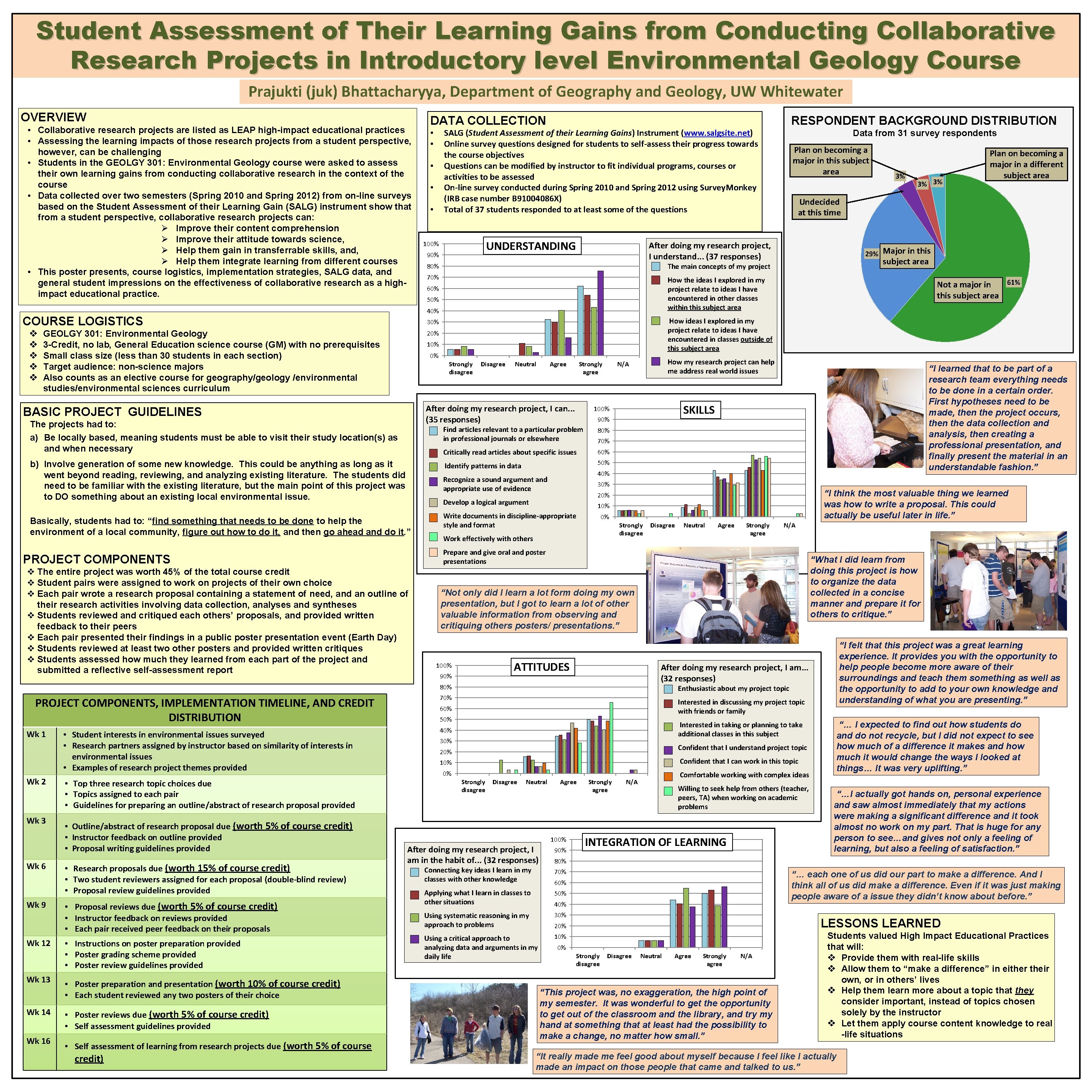
Student Assessment of Their Learning Gains from Conducting Collaborative Research Projects in Introductory level Environmental Geology Course Prajukti (juk) Bhattacharyya, Department of Geography and Geology, UW Whitewater OVERVIEW • Collaborative research projects are listed as LEAP high-impact educational practices • Assessing the learning impacts of those research projects from a student perspective, however, can be challenging • Students in the GEOLGY 301: Environmental Geology course were asked to assess their own learning gains from conducting collaborative research in the context of the course • Data collected over two semesters (Spring 2010 and Spring 2012) from on-line surveys based on the Student Assessment of their Learning Gain (SALG) instrument show that from a student perspective, collaborative research projects can: Ø Improve their content comprehension Ø Improve their attitude towards science, Ø Help them gain in transferrable skills, and, Ø Help them integrate learning from different courses • This poster presents, course logistics, implementation strategies, SALG data, and general student impressions on the effectiveness of collaborative research as a highimpact educational practice. RESPONDENT BACKGROUND DISTRIBUTION SALG (Student Assessment of their Learning Gains) Instrument (www. salgsite. net) Online survey questions designed for students to self-assess their progress towards the course objectives Questions can be modified by instructor to fit individual programs, courses or activities to be assessed On-line survey conducted during Spring 2010 and Spring 2012 using Survey. Monkey (IRB case number B 91004086 X) Total of 37 students responded to at least some of the questions • • • UNDERSTANDING 100% 90% 80% • The main concepts of my project 70% • How the ideas I explored in my project relate to ideas I have encountered in other classes within this subject area • How ideas I explored in my project relate to ideas I have encountered in classes outside of this subject area • How my research project can help me address real world issues 60% 50% 30% GEOLGY 301: Environmental Geology 3 -Credit, no lab, General Education science course (GM) with no prerequisites Small class size (less than 30 students in each section) Target audience: non-science majors Also counts as an elective course for geography/geology /environmental studies/environmental sciences curriculum 20% 10% 0% Strongly disagree Disagree Neutral Agree Strongly agree After doing my research project, I can. . . (35 responses) BASIC PROJECT GUIDELINES The projects had to: a) Be locally based, meaning students must be able to visit their study location(s) as and when necessary b) Involve generation of some new knowledge. This could be anything as long as it went beyond reading, reviewing, and analyzing existing literature. The students did need to be familiar with the existing literature, but the main point of this project was to DO something about an existing local environmental issue. Basically, students had to: “find something that needs to be done to help the environment of a local community, figure out how to do it, and then go ahead and do it. ” PROJECT COMPONENTS v The entire project was worth 45% of the total course credit v Student pairs were assigned to work on projects of their own choice v Each pair wrote a research proposal containing a statement of need, and an outline of their research activities involving data collection, analyses and syntheses v Students reviewed and critiqued each others’ proposals, and provided written feedback to their peers v Each pair presented their findings in a public poster presentation event (Earth Day) v Students reviewed at least two other posters and provided written critiques v Students assessed how much they learned from each part of the project and submitted a reflective self-assessment report N/A 90% 80% • Critically read articles about specific issues 60% • Identify patterns in data 50% • Recognize a sound argument and appropriate use of evidence 30% • Write documents in discipline-appropriate style and format • Prepare and give oral and poster presentations Wk 3 90% Strongly disagree Wk 6 Wk 9 Wk 12 Wk 13 • Proposal reviews due (worth 5% of course credit) • Instructor feedback on reviews provided • Each pair received peer feedback on their proposals • Instructions on poster preparation provided • Poster grading scheme provided • Poster review guidelines provided • Poster preparation and presentation (worth 10% of course credit) • Each student reviewed any two posters of their choice Wk 14 • Poster reviews due (worth 5% of course credit) • Self assessment guidelines provided Wk 16 • Self assessment of learning from research projects due (worth 5% of course credit) Neutral Agree Strongly agree N/A “What I did learn from doing this project is how to organize the data collected in a concise manner and prepare it for others to critique. ” • Enthusiastic about my project topic • Interested in discussing my project topic with friends or family • Interested in taking or planning to take additional classes in this subject • Confident that I understand project topic 10% • Confident that I can work in this topic 0% • Comfortable working with complex ideas • Willing to seek help from others (teacher, peers, TA) when working on academic problems 50% 40% 30% 20% Strongly disagree Disagree Neutral Agree 100% After doing my research project, I am in the habit of. . . (32 responses) • • 90% “I felt that this project was a great learning experience. It provides you with the opportunity to help people become more aware of their surroundings and teach them something as well as the opportunity to add to your own knowledge and understanding of what you are presenting. ” After doing my research project, I am. . . (32 responses) 60% • Top three research topic choices due • Topics assigned to each pair • Guidelines for preparing an outline/abstract of research proposal provided • Research proposals due (worth 15% of course credit) • Two student reviewers assigned for each proposal (double-blind review) • Proposal review guidelines provided Disagree 70% • Student interests in environmental issues surveyed • Research partners assigned by instructor based on similarity of interests in environmental issues • Examples of research project themes provided • Outline/abstract of research proposal due (worth 5% of course credit) • Instructor feedback on outline provided • Proposal writing guidelines provided “I learned that to be part of a research team everything needs to be done in a certain order. First hypotheses need to be made, then the project occurs, then the data collection and analysis, then creating a professional presentation, and finally present the material in an understandable fashion. ” “I think the most valuable thing we learned was how to write a proposal. This could actually be useful later in life. ” ATTITUDES 100% Major in this subject area 61% Not a major in this subject area “Not only did I learn a lot form doing my own presentation, but I got to learn a lot of other valuable information from observing and critiquing others posters/ presentations. ” PROJECT COMPONENTS, IMPLEMENTATION TIMELINE, AND CREDIT DISTRIBUTION Wk 2 29% 10% 0% Strongly agree Plan on becoming a major in a different subject area Undecided at this time 20% Develop a logical argument Work effectively with others 3% 3% 40% • • 3% 70% 80% Wk 1 Plan on becoming a major in this subject area SKILLS 100% Find articles relevant to a particular problem in professional journals or elsewhere • Data from 31 survey respondents After doing my research project, I understand. . . (37 responses) 40% COURSE LOGISTICS v v v DATA COLLECTION N/A INTEGRATION OF LEARNING “… I expected to find out how students do and do not recycle, but I did not expect to see how much of a difference it makes and how much it would change the ways I looked at things… It was very uplifting. ” “…I actually got hands on, personal experience and saw almost immediately that my actions were making a significant difference and it took almost no work on my part. That is huge for any person to see…and gives not only a feeling of learning, but also a feeling of satisfaction. ” 80% Connecting key ideas I learn in my classes with other knowledge 70% Applying what I learn in classes to other situations 50% Using systematic reasoning in my approach to problems 30% Using a critical approach to analyzing data and arguments in my daily life 10% “… each one of us did our part to make a difference. And I think all of us did make a difference. Even if it was just making people aware of a issue they didn’t know about before. ” 60% 40% LESSONS LEARNED 20% 0% Strongly disagree Disagree Neutral Agree Strongly agree N/A “This project was, no exaggeration, the high point of my semester. It was wonderful to get the opportunity to get out of the classroom and the library, and try my hand at something that at least had the possibility to make a change, no matter how small. ” Students valued High Impact Educational Practices that will: v Provide them with real-life skills v Allow them to “make a difference” in either their own, or in others’ lives v Help them learn more about a topic that they consider important, instead of topics chosen solely by the instructor v Let them apply course content knowledge to real -life situations “It really made me feel good about myself because I feel like I actually made an impact on those people that came and talked to us. ”