
STUDENT ASSESSMENT AND EDUCATIONAL TESTING 1 Purpose Monitor
- Slides: 23
STUDENT ASSESSMENT AND EDUCATIONAL TESTING 1
Purpose § Monitor student progress of the Next Generation Sunshine State Standards (NGSSS) and the Sunshine State Standards (SSS). § Provide valid and reliable information regarding content mastery and/or instructional focus. § Utilize the data to make meaningful and timely curricular decisions. § Progress reporting tool for School Improvement Plans. Program Guide, pp. 1 -3 2
Students To Be Tested All eligible students must take the Interim Assessment in Reading, Mathematics, and Science. §Reading, Grades 3 -10, * §Reading, Grades 11 -12, for students enrolled in Intensive Reading §Mathematics, Grades 3 -8* §Mathematics, Grade 10 and Grades 11 – 12 for students enrolled in Intensive Mathematics §Algebra I, for Grade 9 students and others enrolled in Algebra I §Science: Grades 5, 8, and 11* *Students MUST take the test corresponding to the grade level in which they are listed in ISIS. Program Guide, p. 4 3
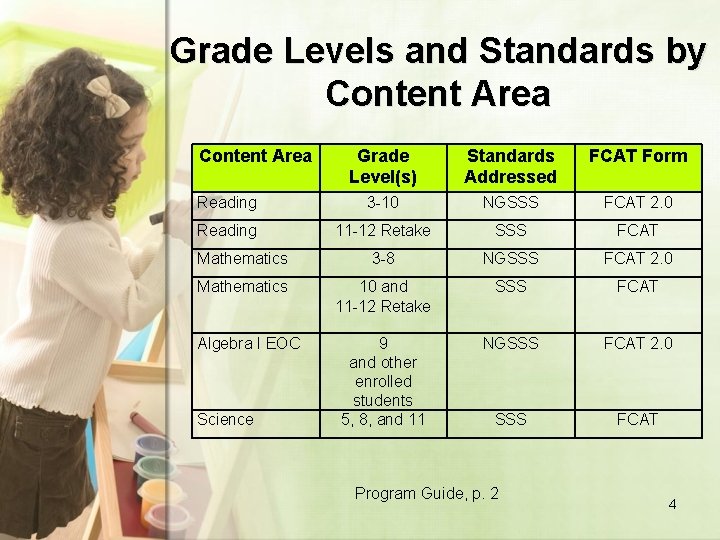
Grade Levels and Standards by Content Area Grade Level(s) Standards Addressed FCAT Form Reading 3 -10 NGSSS FCAT 2. 0 Reading 11 -12 Retake SSS FCAT Mathematics 3 -8 NGSSS FCAT 2. 0 Mathematics 10 and 11 -12 Retake SSS FCAT 9 and other enrolled students 5, 8, and 11 NGSSS FCAT 2. 0 SSS FCAT Algebra I EOC Science Program Guide, p. 2 4
Accommodations § Accommodations must be provided for students with disabilities, students with 504 plans, and English language learners. § Use of accommodations must be dictated by a student’s educational plan and mirror those consistently being used for curricular instruction. § Reading tests cannot be read to students because the tests are designed to assess reading comprehension. § Refer to the Program Guide section on Students to be Tested for further details on Accommodations (pages 5 -6). Program Guide, pp. 5 -6 5
Preparation of Materials § Inventory all Interim Assessment materials upon receipt ØIf materials are missing from your order, please contact Student Assessment and Educational Testing at 305 -995 -7520. § Charter Schools must print IA test forms from provided PDF files § Check Edusoft rosters to ensure that students are enrolled § Print Reference Sheets § Print Edusoft Answer Sheets § Train test administrators § Plan for use of calculators § Prepare Teacher Count Sheet (Appendix A of the Program Guide) Program Guide, pp. 7 -10 6
Printing Answer Sheets § Answer sheets are available for printing as specified on the Schedule of Activities for the current testing window. § Students listed in ISIS on or before the designated date will have their name on a period specific answer sheet. § Students entering after the designated date will need a generic answer sheet. § Period specific answer sheets should be printed by teacher and grade level. § Master student answer sheets should be printed from a highquality printer laser printer and copied using a high-quality copier. § Students enrolled in Intensive Reading and/or Mathematics will use the answer sheet that reads “Intensive Reading/Mathematics Grades 11 -12”. Program Guide, p. 9 7
Assembling Classroom Test Materials § Test booklets, one per student for each content area being tested § Answer sheets, one per student for each content area being tested § No. 2 pencils § Mathematics and Science reference sheets are found at http: //oada. dadeschools. net/IAP. asp § Calculators (Grades 7 – Retake, Algebra I, and Science, Grades 8 and 11) Program Guide, p. 12 8
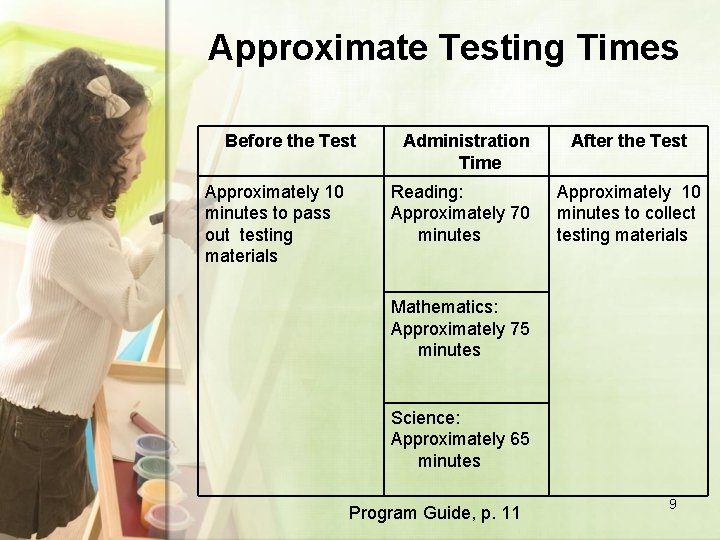
Approximate Testing Times Before the Test Approximately 10 minutes to pass out testing materials Administration Time Reading: Approximately 70 minutes After the Test Approximately 10 minutes to collect testing materials Mathematics: Approximately 75 minutes Science: Approximately 65 minutes Program Guide, p. 11 9
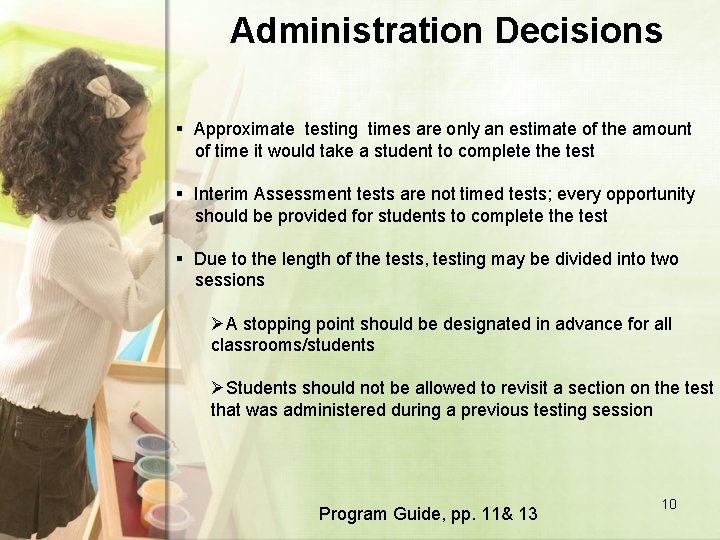
Administration Decisions § Approximate testing times are only an estimate of the amount of time it would take a student to complete the test § Interim Assessment tests are not timed tests; every opportunity should be provided for students to complete the test § Due to the length of the tests, testing may be divided into two sessions ØA stopping point should be designated in advance for all classrooms/students ØStudents should not be allowed to revisit a section on the test that was administered during a previous testing session Program Guide, pp. 11& 13 10
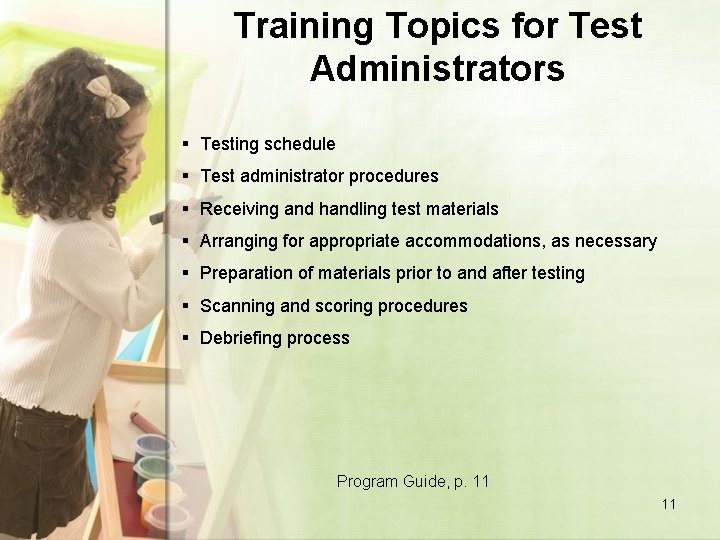
Training Topics for Test Administrators § Testing schedule § Test administrator procedures § Receiving and handling test materials § Arranging for appropriate accommodations, as necessary § Preparation of materials prior to and after testing § Scanning and scoring procedures § Debriefing process Program Guide, p. 11 11
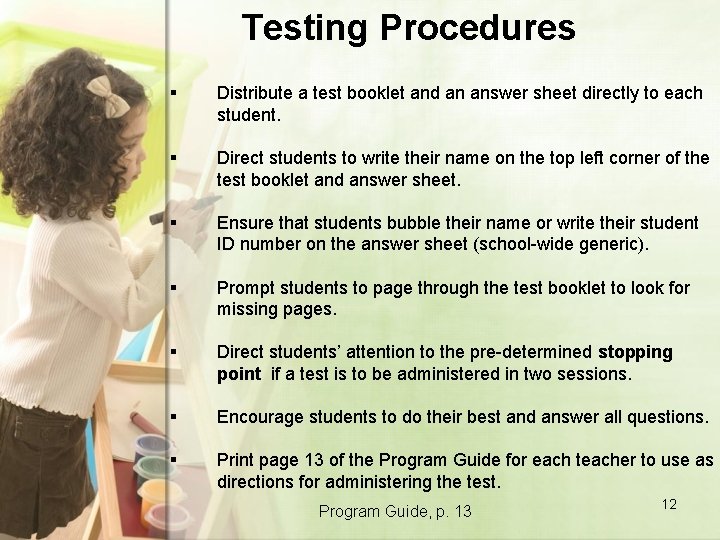
Testing Procedures § Distribute a test booklet and an answer sheet directly to each student. § Direct students to write their name on the top left corner of the test booklet and answer sheet. § Ensure that students bubble their name or write their student ID number on the answer sheet (school-wide generic). § Prompt students to page through the test booklet to look for missing pages. § Direct students’ attention to the pre-determined stopping point if a test is to be administered in two sessions. § Encourage students to do their best and answer all questions. § Print page 13 of the Program Guide for each teacher to use as directions for administering the test. Program Guide, p. 13 12
Post Test Procedures § Collect testing materials individually from each student. § Separate the testing materials. ØPack used test booklets for secure disposal ØDiscard unused answer sheets ØPack and retain unused test booklets at school for subsequent administrations ØRetain reference sheets for use in class, if applicable § Scan answer sheets using Edusoft. Program Guide, p. 18 13
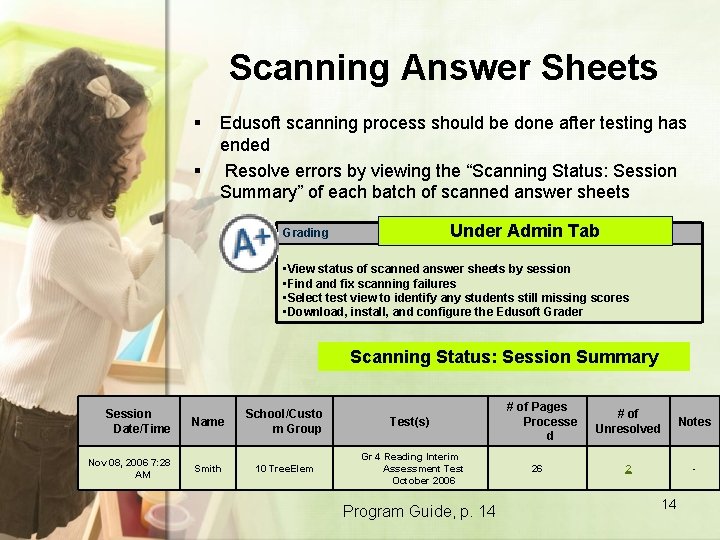
Scanning Answer Sheets § § Edusoft scanning process should be done after testing has ended Resolve errors by viewing the “Scanning Status: Session Summary” of each batch of scanned answer sheets Under Admin Tab Grading • View status of scanned answer sheets by session • Find and fix scanning failures • Select test view to identify any students still missing scores • Download, install, and configure the Edusoft Grader Scanning Status: Session Summary Session Date/Time Nov 08, 2006 7: 28 AM Name School/Custo m Group Test(s) Smith 10 Tree. Elem Gr 4 Reading Interim Assessment Test October 2006 Program Guide, p. 14 # of Pages Processe d 26 # of Unresolved Notes 2 - 14
Printing Reports § Downloading score reports as specified on the Schedule of Activities § Provide reports to classroom teachers and administrators as identified in the Program Guide on pages 14 -16. § Print answer keys for classroom teachers to use during debriefing process. Program Guide, p. 14 15
Score Reports Useful reports that can be retrieved via Edusoft: § Class List § Item Analysis § Item Response § Performance Band Program Guide, pp. 15 -16 16
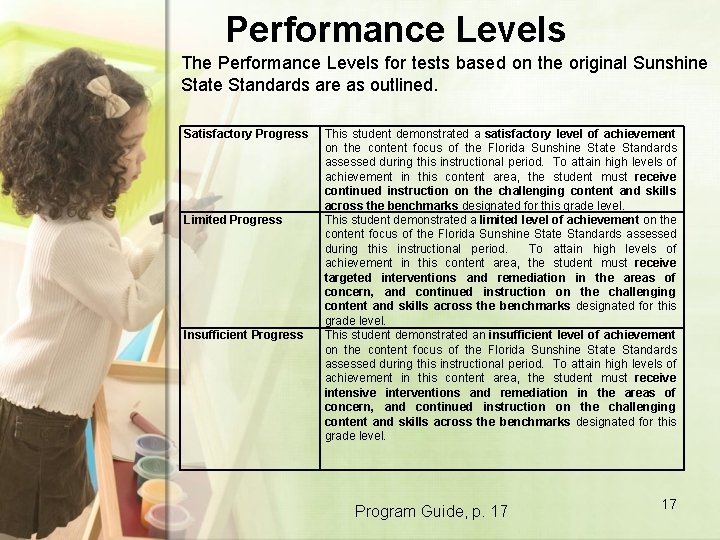
Performance Levels The Performance Levels for tests based on the original Sunshine State Standards are as outlined. Satisfactory Progress Limited Progress Insufficient Progress This student demonstrated a satisfactory level of achievement on the content focus of the Florida Sunshine State Standards assessed during this instructional period. To attain high levels of achievement in this content area, the student must receive continued instruction on the challenging content and skills across the benchmarks designated for this grade level. This student demonstrated a limited level of achievement on the content focus of the Florida Sunshine State Standards assessed during this instructional period. To attain high levels of achievement in this content area, the student must receive targeted interventions and remediation in the areas of concern, and continued instruction on the challenging content and skills across the benchmarks designated for this grade level. This student demonstrated an insufficient level of achievement on the content focus of the Florida Sunshine State Standards assessed during this instructional period. To attain high levels of achievement in this content area, the student must receive intensive interventions and remediation in the areas of concern, and continued instruction on the challenging content and skills across the benchmarks designated for this grade level. Program Guide, p. 17 17
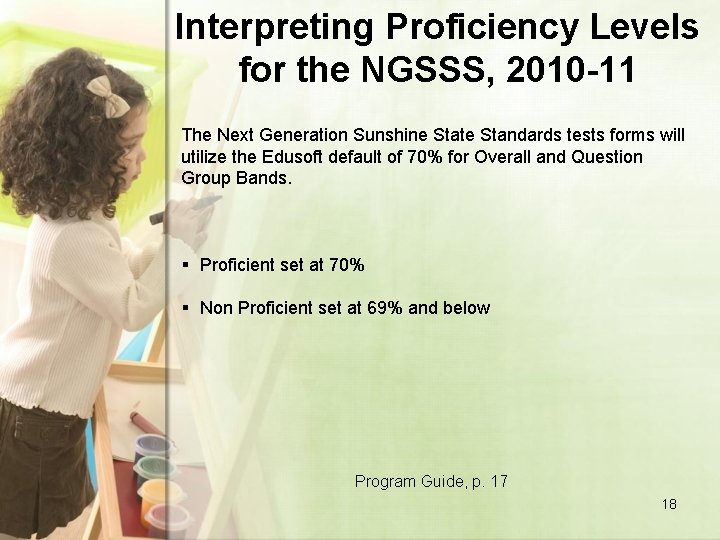
Interpreting Proficiency Levels for the NGSSS, 2010 -11 The Next Generation Sunshine State Standards tests forms will utilize the Edusoft default of 70% for Overall and Question Group Bands. § Proficient set at 70% § Non Proficient set at 69% and below Program Guide, p. 17 18
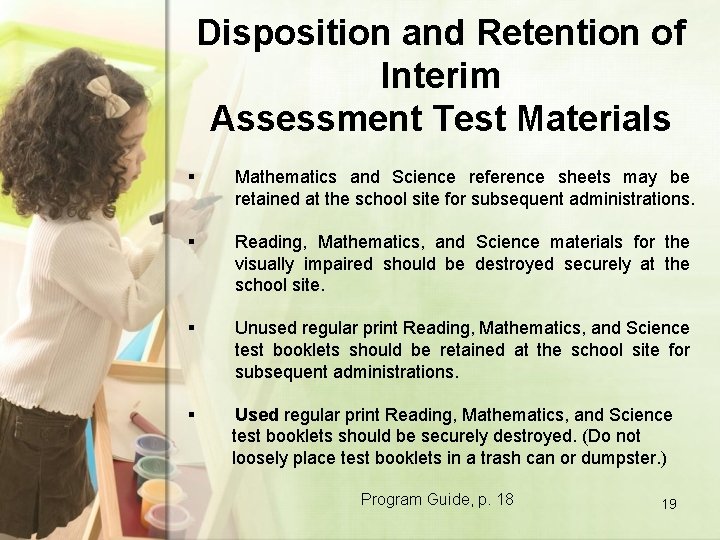
Disposition and Retention of Interim Assessment Test Materials § Mathematics and Science reference sheets may be retained at the school site for subsequent administrations. § Reading, Mathematics, and Science materials for the visually impaired should be destroyed securely at the school site. § Unused regular print Reading, Mathematics, and Science test booklets should be retained at the school site for subsequent administrations. § Used regular print Reading, Mathematics, and Science test booklets should be securely destroyed. (Do not loosely place test booklets in a trash can or dumpster. ) Program Guide, p. 18 19
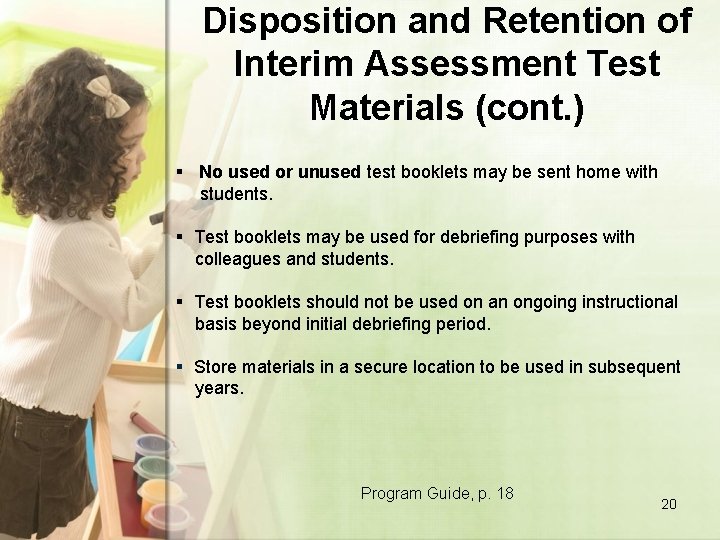
Disposition and Retention of Interim Assessment Test Materials (cont. ) § No used or unused test booklets may be sent home with students. § Test booklets may be used for debriefing purposes with colleagues and students. § Test booklets should not be used on an ongoing instructional basis beyond initial debriefing period. § Store materials in a secure location to be used in subsequent years. Program Guide, p. 18 20
Debriefing § Collaborative debriefings (administration, department heads, and classroom teachers): should take place in a timely manner to identify strengths and weaknesses in order to effectively target instruction. § Classroom debriefings (classroom teacher with students): provide students with the opportunity to review their responses and teachers with teachable moments to identify and address concepts not initially understood. Program Guide, p. 18 21
Use the Results Debriefing Guidelines § Provide students with their test and answer sheet. § Discuss any items you found to be problematic for the class as a whole. § Listen to students’ comments and reactions. § Make notes of any deficient or problematic areas during this process. Program Guide, p. 18 22
Program Contacts Ms. Felicia Mallory, Executive Director FMallory@dadeschools. net Phone: 305 -995 -1213 Ms. Denetra Collins, Staff Specialist Collinsd@dadeschools. net Phone: 305 -995 -4580 Student Assessment and Educational Testing 305 -995 -7520 23