
Student Acquisition of Academic Language and Vocabulary Jim

Student Acquisition of Academic Language and Vocabulary Jim Poirier M. Ed, B. A. jim. poirier@ffca-calgary. com
Presentation Goals: 1. Definir academique du lexique and give a theoretique contexte of acquisition d’une langue. 2. Offer idees and exemple of how to aide eleves in acquisition strategie du academique d’une langue. 3. Fournis some donnees based on exploit du eleves when incorporer modification to my enseignement du habitude.

Presentation Goals: 1. Define academic vocabulary and give a theoretical background of language acquisition. 2. Offer ideas and examples of how to aid students in acquisition strategies of academic language. 3. Provide some data based on student achievement when incorporating changes to my teaching practice.
Academic Vocabulary ▪ Beck, Mc. Keown & Kucan (2002) offer a 3 Tiered framework for thinking about vocabulary: ▪ Tier 1: Words acquired through everyday speech – learned early. ▪ Tier 2: Precise words that are used by the author in place of common words. (i. e. gallop instead of run). They change meaning with use. ▪ Tier 3: Subject/discipline specific words - the types of vocabulary words that are included in glossaries, highlighted in textbooks and address by teachers (i. e. onomatopoeia, denouement).
Academic Vocabulary ▪ Bauman & Graves (2010), Cummins, (1982) and Corson (1997) ▪ Academic language is associated with ‘the secret language of books’. It is de-contextualized, and abstract; often involves metaphor, technical uses of common words and words with Latinate roots. They involve complex, cognitive constructs: construct vs build; create vs make; obtain vs get; object vs thing ▪ It is the Tier 2 words that are the focus of academic vocabulary instruction. Teachers tend to neglect these words, focusing instead on Tier 3 words of their subject.
Pair-Share ▪ What strategies do you currently use in your classroom to teach vocabulary?
Marzano: Six Steps to Effective Vocabulary Instruction ▪ Step 1: The Teacher Provides a Description, Explanation, or Example of the New Term ▪ Step 2: Students Restate the Explanation of the New Term in Their Own Words ▪ Step 3: Students Create a Nonlinguistic Representation of the Term ▪ Step 4: Students Periodically Do Activities That Help Them Add to Their Knowledge of Vocabulary Terms ▪ Step 5: Periodically Students Are Asked to Discuss the Terms with One Another ▪ Step 6: Periodically Students Are Involved in Games That Allow Them to Play with the Terms R. J. Marzano. Building Background Knowledge for Academic Achievement: Research on What Works in Schools. Alexandria, VA: ASCD, 2004
A Multi-Faceted Approach ▪ Direct and explicit instruction of ‘big bang for your buck’ words ▪ Word study – Morphological analysis: (Nagy et al, 1989). More than 60% of new words in upper elementary have a transparent morphological structure. ▪ Prefixes, suffixes, inflected endings, root words, homophones, homographs, homonyms. These are common in English, and present difficulty for ELLs. ▪ Strategy Instruction – Context clues → making inferences ▪ Reading Program → promote reading informational/expository text: this is where the important words are! ▪ Academic Conversations – Teacher-led discussions around current and high interest topics.
1. Direct and Explicit Instruction: We need to include: • Definition and contextual information about words • Across modalities – multiple exposure: hear it/see it/say it/ write it (Stahl, 2003). • Strong engagement: opportunities to manipulate, transform, and practice → move from receptive to productive vocabulary.
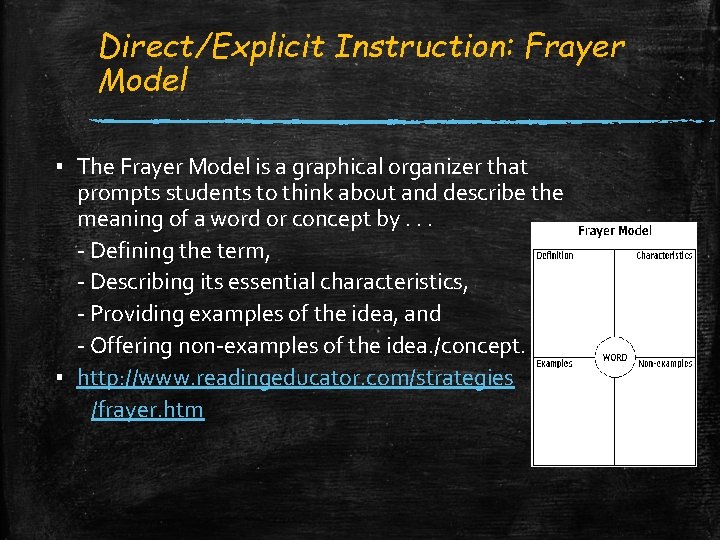
Direct/Explicit Instruction: Frayer Model ▪ The Frayer Model is a graphical organizer that prompts students to think about and describe the meaning of a word or concept by. . . - Defining the term, - Describing its essential characteristics, - Providing examples of the idea, and - Offering non-examples of the idea. /concept. ▪ http: //www. readingeducator. com/strategies /frayer. htm
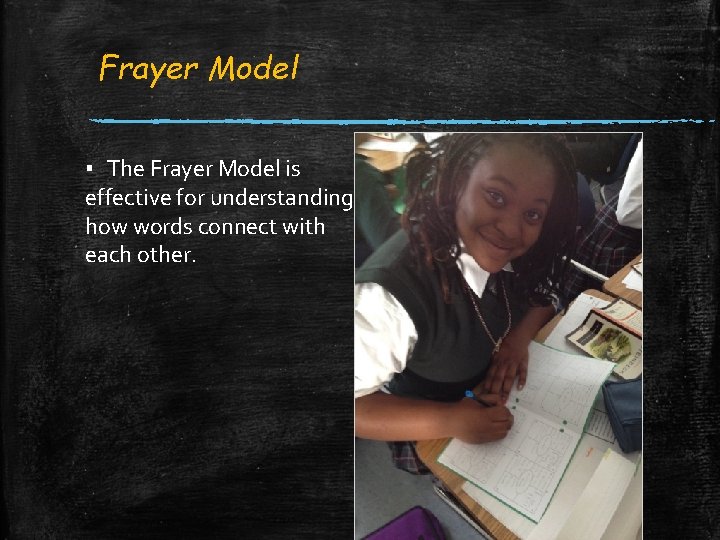
Frayer Model ▪ The Frayer Model is effective for understanding how words connect with each other.
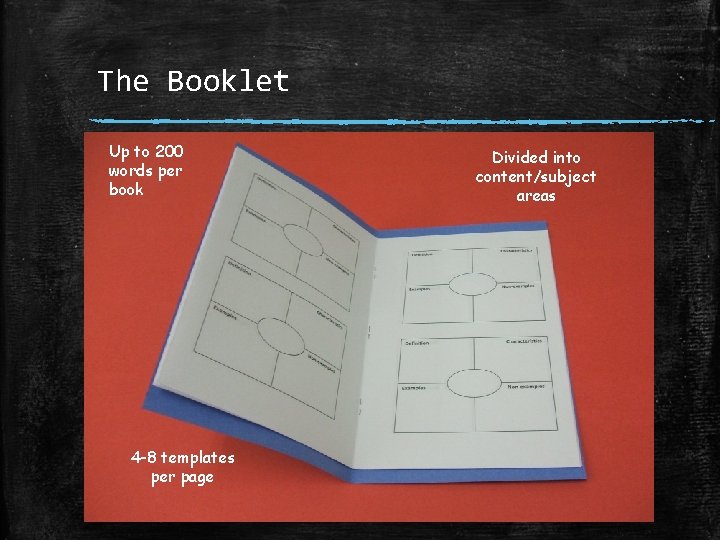
The Booklet Up to 200 words per book 4 -8 templates per page Divided into content/subject areas
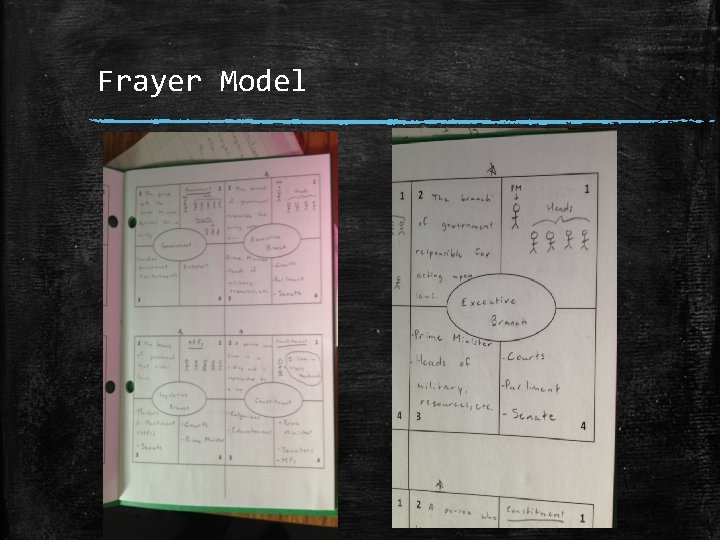
Frayer Model
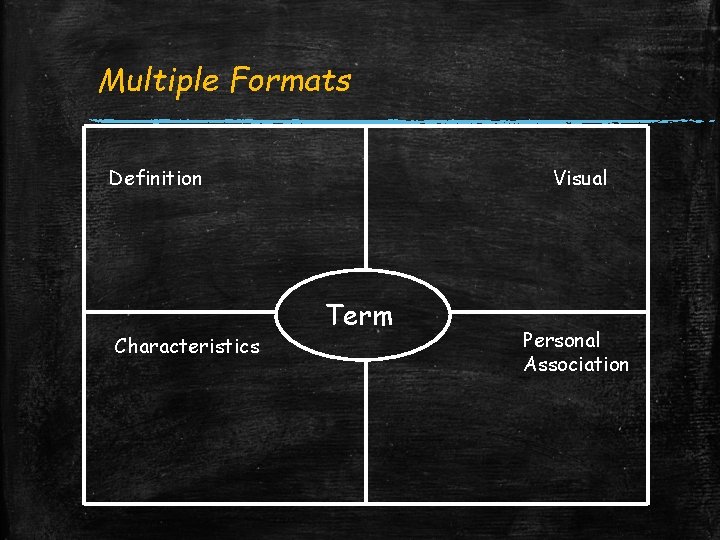
Multiple Formats Definition Characteristics Visual Term Personal Association
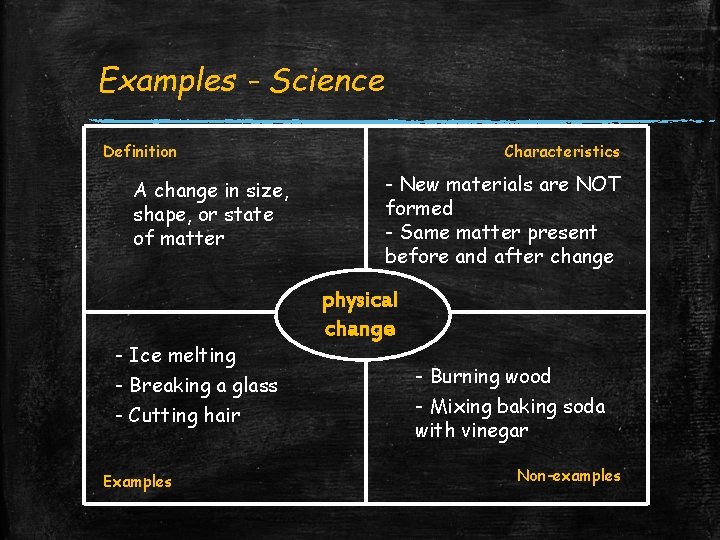
Examples - Science Definition A change in size, shape, or state of matter - Ice melting - Breaking a glass - Cutting hair Examples Characteristics - New materials are NOT formed - Same matter present before and after change physical change - Burning wood - Mixing baking soda with vinegar Non-examples
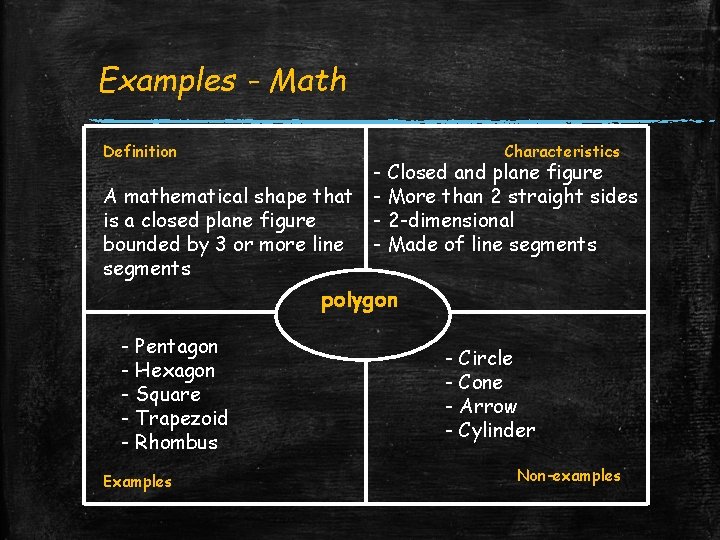
Examples - Math Definition Characteristics - Closed and plane figure A mathematical shape that - More than 2 straight sides is a closed plane figure - 2 -dimensional bounded by 3 or more line - Made of line segments polygon - Pentagon - Hexagon - Square - Trapezoid - Rhombus Examples - Circle - Cone - Arrow - Cylinder Non-examples
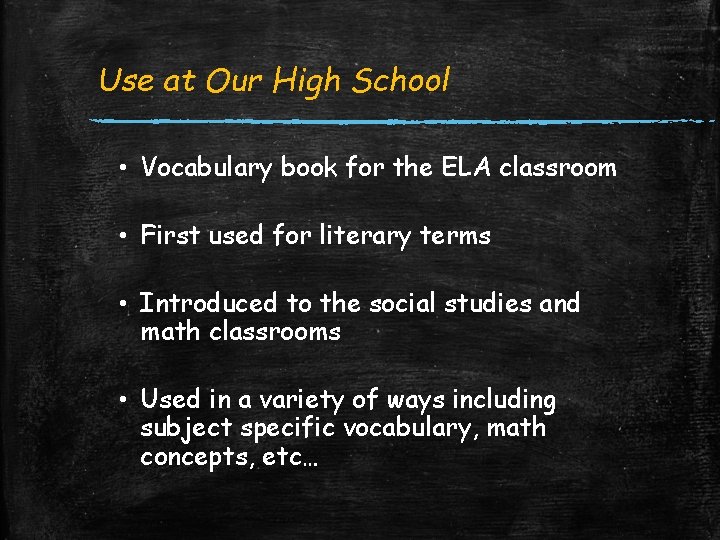
Use at Our High School • Vocabulary book for the ELA classroom • First used for literary terms • Introduced to the social studies and math classrooms • Used in a variety of ways including subject specific vocabulary, math concepts, etc…
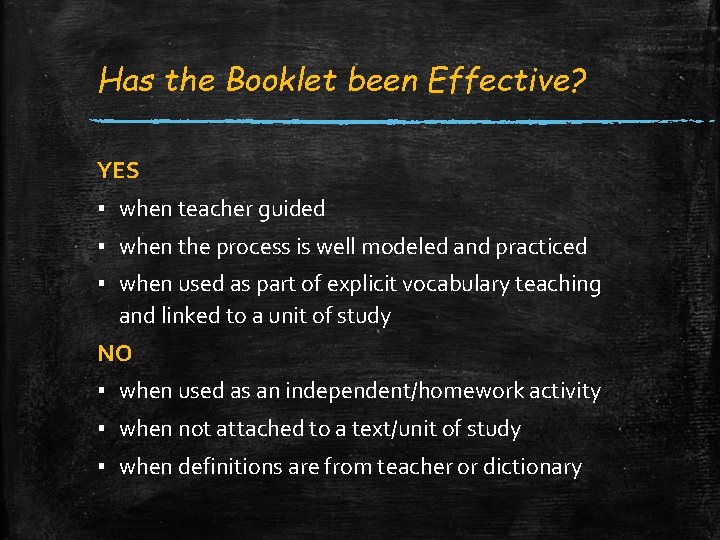
Has the Booklet been Effective? YES ▪ when teacher guided ▪ when the process is well modeled and practiced ▪ when used as part of explicit vocabulary teaching and linked to a unit of study NO ▪ when used as an independent/homework activity ▪ when not attached to a text/unit of study ▪ when definitions are from teacher or dictionary
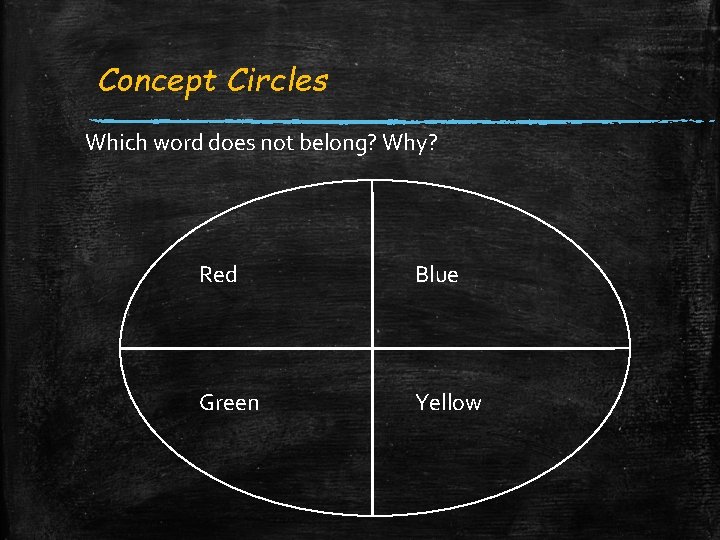
Concept Circles Which word does not belong? Why? Red Blue Green Yellow
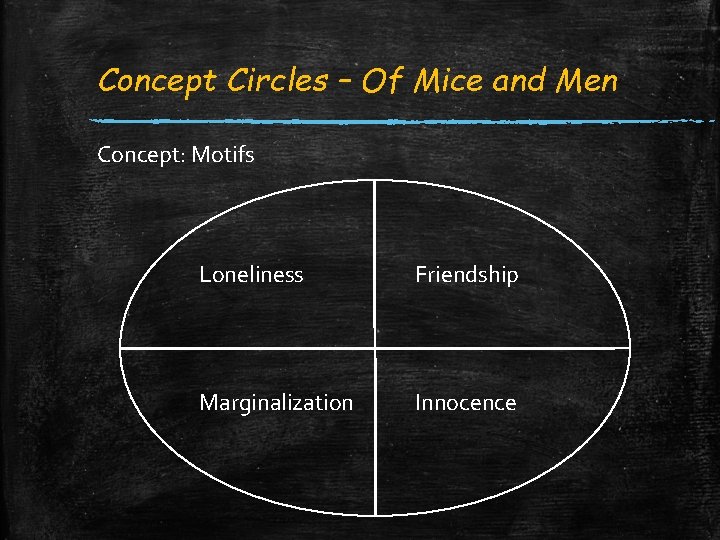
Concept Circles – Of Mice and Men Concept: Motifs Loneliness Friendship Marginalization Innocence
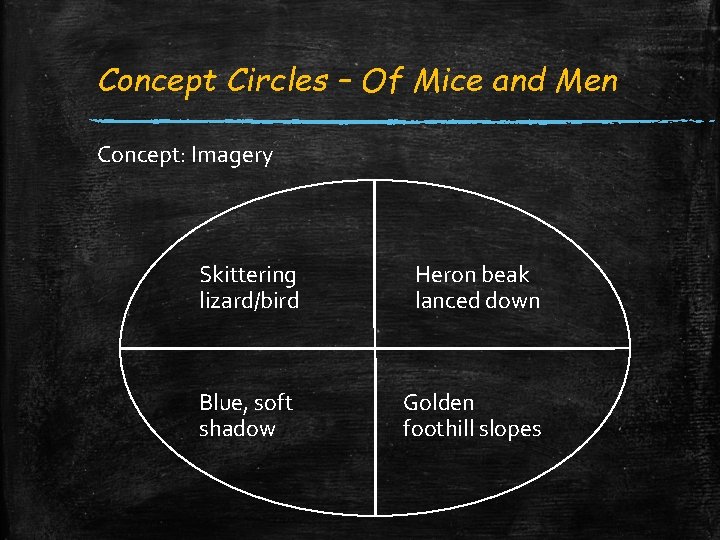
Concept Circles – Of Mice and Men Concept: Imagery Skittering lizard/bird Heron beak lanced down Blue, soft shadow Golden foothill slopes
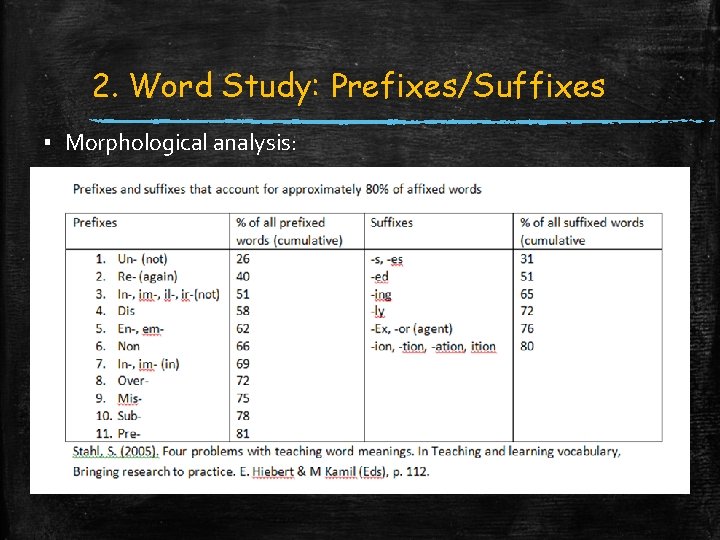
2. Word Study: Prefixes/Suffixes ▪ Morphological analysis:
3. Strategy Instruction Teach students to use context clues to infer meaning: – Not only direct definitions - synonyms, antonyms, examples, etc. - Teach students how to make inferences.
Strategies: Five Step Teaching 1. Name the strategy and explain how it works. 2. Teach, model, demonstrate, talk aloud protocol 3. Guided practice 4. Independent work. 5. Assess. We need to TEACH students how to be strategic learners.
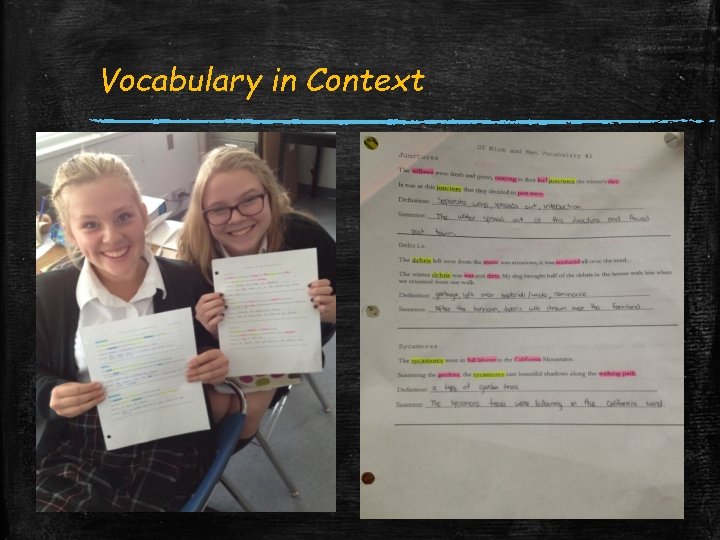
Vocabulary in Context
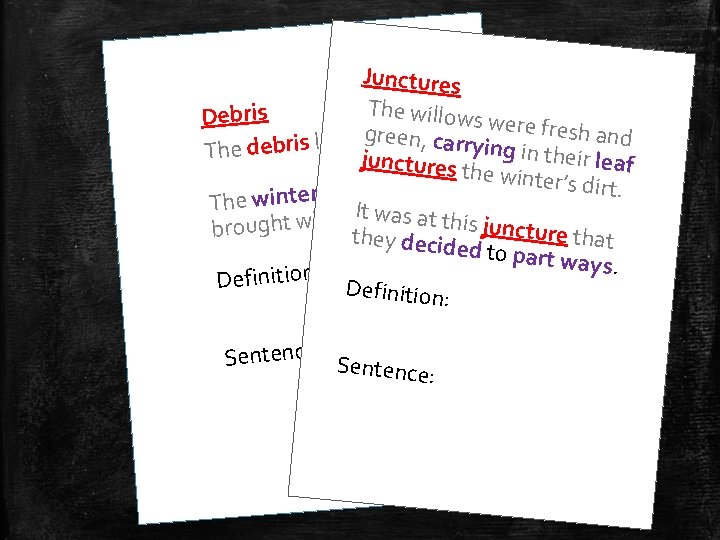
Junctures The willow Debris s were fres h and green, carr t f e l s i r y The deb junctures ing in their leaf the winter ’s dirt. s i r b e d r e t The win It was at th i w t is h broug they decid juncture that ed to part ways. _ _ _ : n o i t i Definition: Sentence: Sente nce:
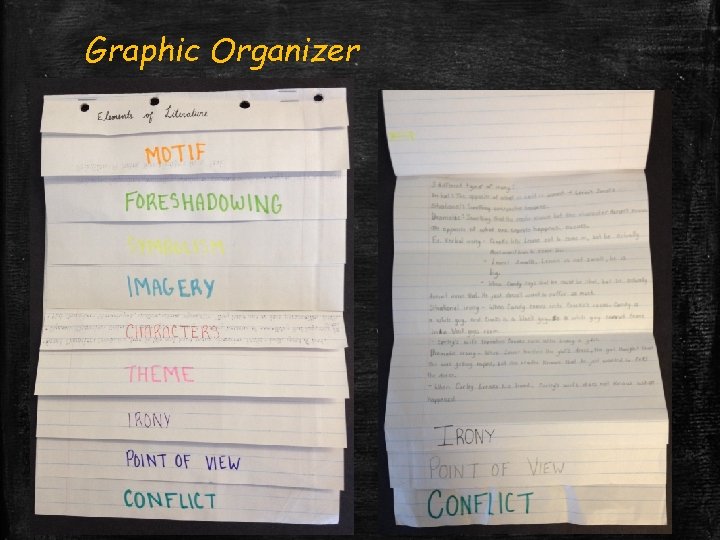
Graphic Organizer
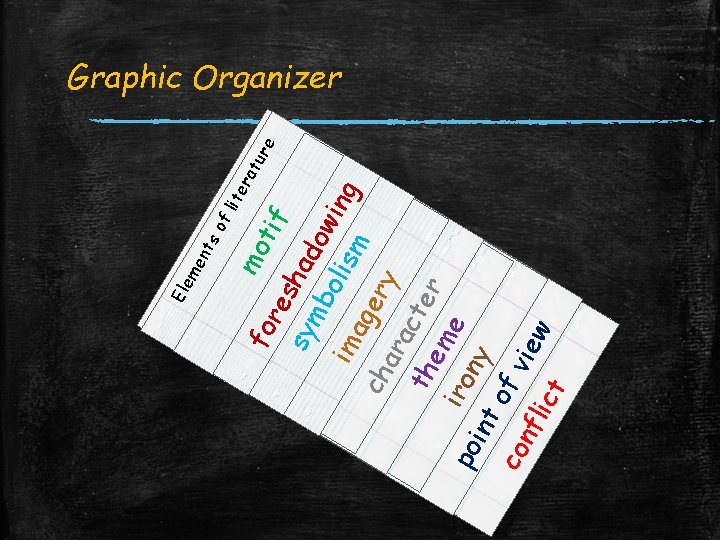
fl ite rat m ur fo ot e if re sy shad mb o w o lis ing im m ag er ch y ara th cter em po iron e int y co of v nf i lic ew t nt so me Ele Graphic Organizer
4. A Reading Program for Students ▪ Research tells us that children do not read enough, especially those who struggle. Through vast amounts of exposure to texts, good readers develop independent ways of learning new words. ▪ Effective reading programs: – Build intrinsic motivation and pleasure of reading. – Breadth and depth of topics - variation in genres. Words students need to learn are in non-fiction/information texts.
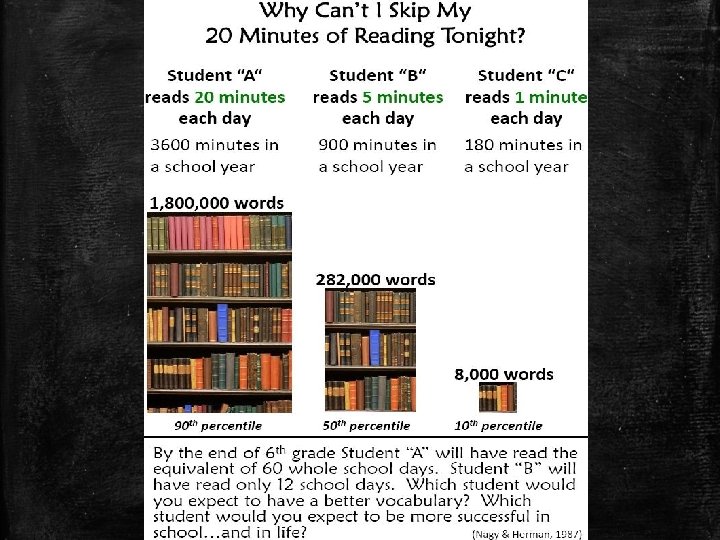
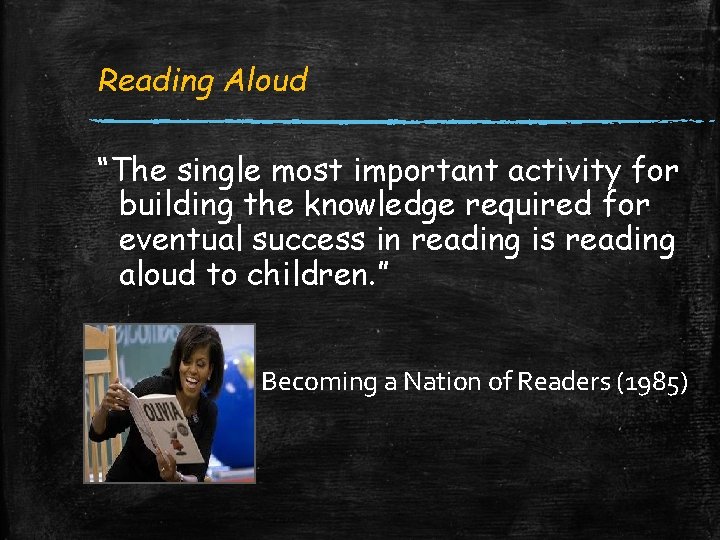
Reading Aloud “The single most important activity for building the knowledge required for eventual success in reading is reading aloud to children. ” Becoming a Nation of Readers (1985)
5. Academic Conversations ▪ Children with large vocabularies acquire them from home. Meal time conversations that are engaging, challenging and that invite lively exchange are a key feature of this kind of talk (Beals, 1997). ▪ With this in mind - how can we reconstruct the traditional family dinner table in our classrooms?
Socratic Seminar The purpose of a Socratic Seminar: ▪ achieve a deeper understanding about the ideas and values in a text ▪ participants systematically question and examine issues and principles related to the content ▪ participants articulate different points-of-view ▪ the conversation assists participants in constructing meaning through disciplined analysis, interpretation, listening, and participation.
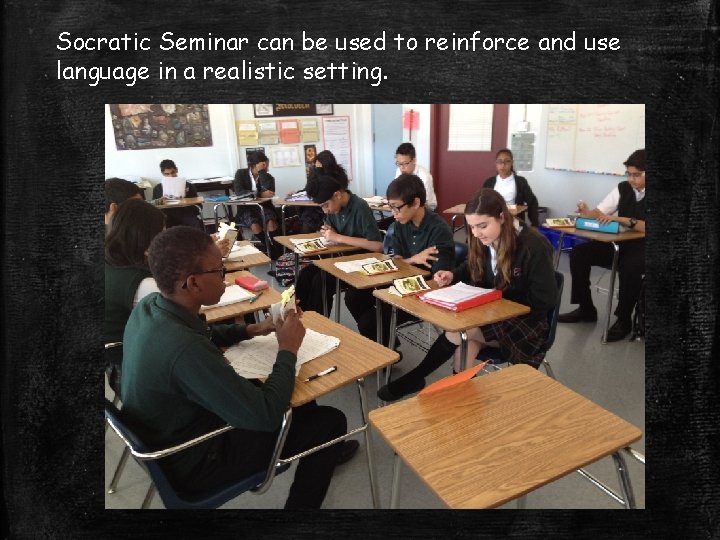
Socratic Seminar can be used to reinforce and use language in a realistic setting.
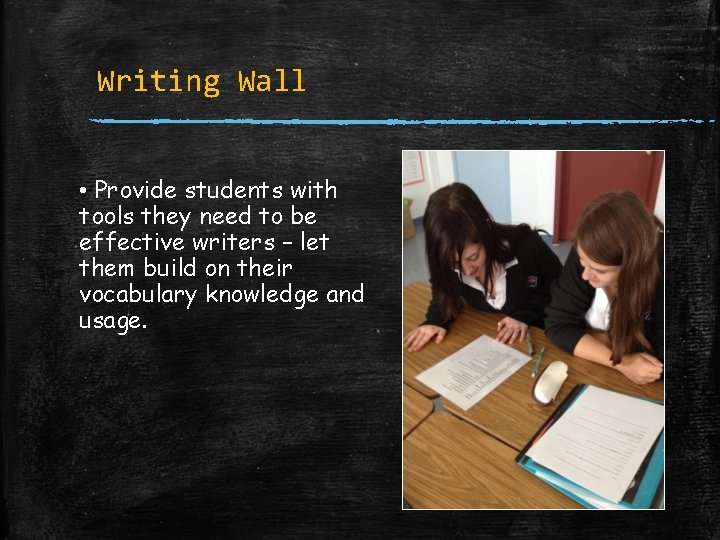
Writing Wall • Provide students with tools they need to be effective writers – let them build on their vocabulary knowledge and usage.
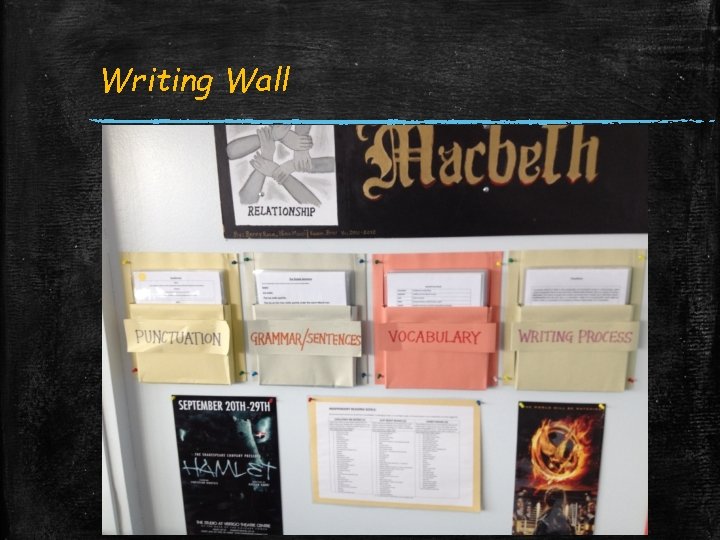
Writing Wall
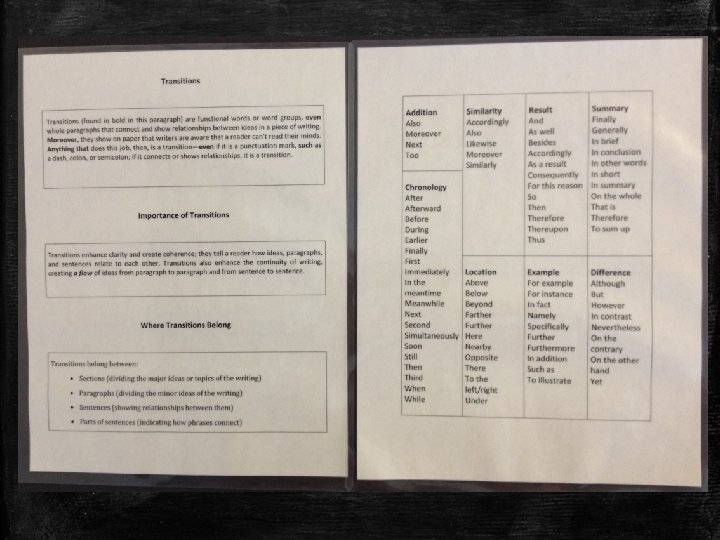
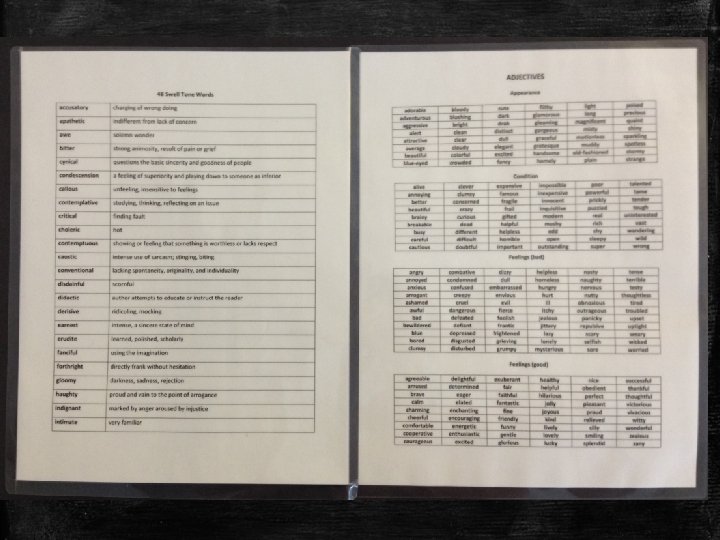
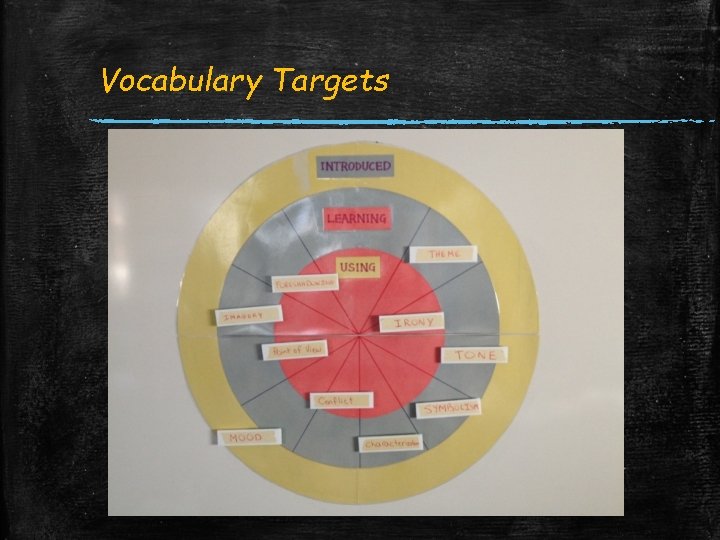
Vocabulary Targets
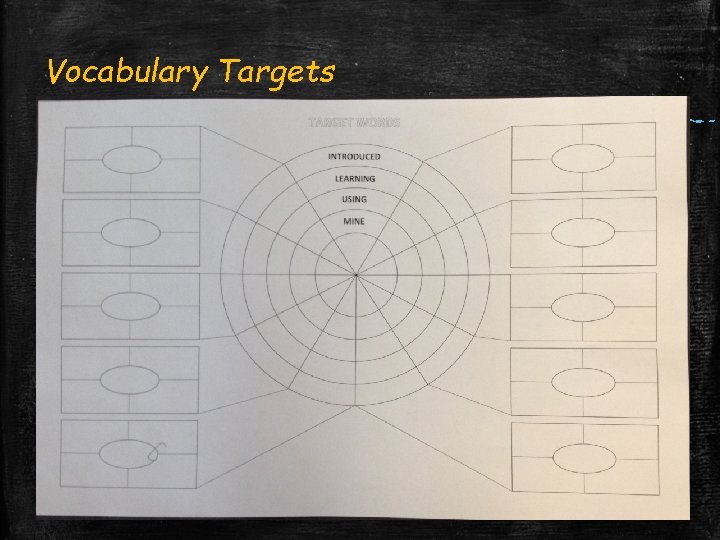
Vocabulary Targets

Classroom Data ▪ Students in Alberta, Canada write Provincial Achievement Tests for English at the conclusion of grades three, six, and nine. ▪ These tests assess the students proficiency in reading comprehension, and writing. ▪ Alberta Education Website http: //education. alberta. ca/admin/testing/a chievement. aspx ▪ I also use Gates-Mac. Ginitie scoring for vocabulary and reading comprehension evaluation. http: //www. assess. nelson. com/group/gpgates. html
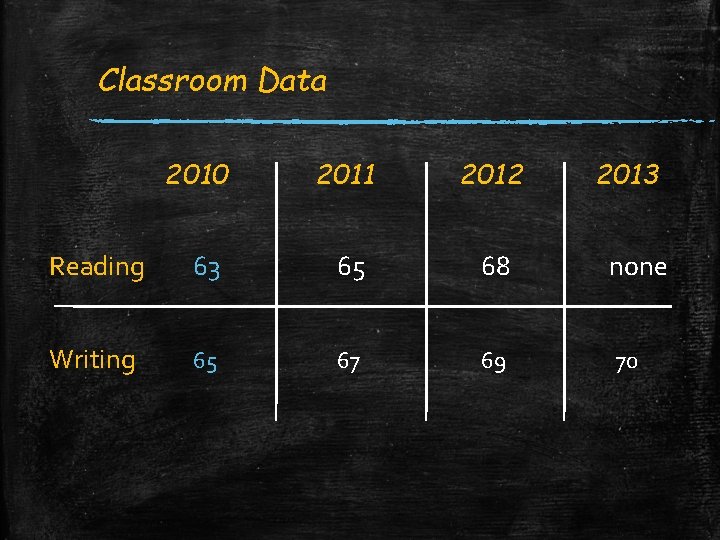
Classroom Data 2010 2011 2012 2013 Reading 63 65 68 none Writing 65 67 69 70
Pair-Share ▪ Reflect on the strategies you saw today. 1) Are there any strategies that could be of use to you in your classroom? 2) Describe how you plan to use one or more of these strategies in your classroom.

References Beals, D. (1997). Sources of support for learning words in conversation: Evidence from mealtimes. Journal of Child Language, 24, 673– 94. Beck, I. L. , Mc. Keown, M. G. , & Kucan, L. (2002). Bringing words to life: Robust vocabulary instruction. New York: Guilford. Biemiller, A. (2001). Teaching vocabulary: Early, direct and sequential. American Educator, Spring, 2001. http: //www. aft. org/newspubs/periodicals/ae/spring 2001/bie miller. cfm Nagy, W. et al (1989). Morphological families in the internal lexicon. Reading Research Quarterly, 24, 263 -282. Roessingh, H. (2012). The importance of the prompt for eliciting language samples: Insights from research and considerations for practice. Tex. ELT: Texas English Language Teaching, 1(1), 37 -56. Available online: http: //www. textesolv. org
References Snow, C. (2010). Academic language and the challenge of reading for learning about science. Science, 328, 450 – 452. http: //colabradio. mit. edu/wpcontent/uploads/2010/05/academiclanguage. pdf Stahl, S. (2003). How words are learned incrementally over multiple exposures. American Educator, 27(1), 18 -19. http: //www. aft. org/pdfs/americaneducator/spri ng 2003/AE_SPRNG. pdf#page=6 Common prefixes and suffixes: http: //www. sdc. uwo. ca/writing/handouts/Commo n%20 Prefixes. pdf
- Slides: 45