
STT 592 002 Intro to Statistical Learning RESAMPLING
- Slides: 47
STT 592 -002: Intro. to Statistical Learning RESAMPLING METHODS Chapter 05 Disclaimer: This PPT is modified based on IOM 530: Intro. to Statistical Learning "Some of the figures in this presentation are taken from "An Introduction to Statistical Learning, with applications in R" (Springer, 2013) with permission from the authors: G. James, D. Witten, T. Hastie and R. Tibshirani " 1
STT 592 -002: Intro. to Statistical Learning Outline ØCross Validation ØThe Validation Set Approach ØLeave-One-Out Cross Validation ØK-fold Cross Validation ØBias-Variance Trade-off for k-fold Cross Validation ØCross Validation on Classification Problems 2
STT 592 -002: Intro. to Statistical Learning 3 What are resampling methods? • Tools that involves repeatedly drawing samples from a training set and refitting a model of interest on each sample in order to obtain more information about the fitted model • Model Assessment: estimate test error rates • Model Selection: select appropriate level of model flexibility • They are computationally expensive! But these days we have powerful computers • Two resampling methods: • Cross Validation • Bootstrapping
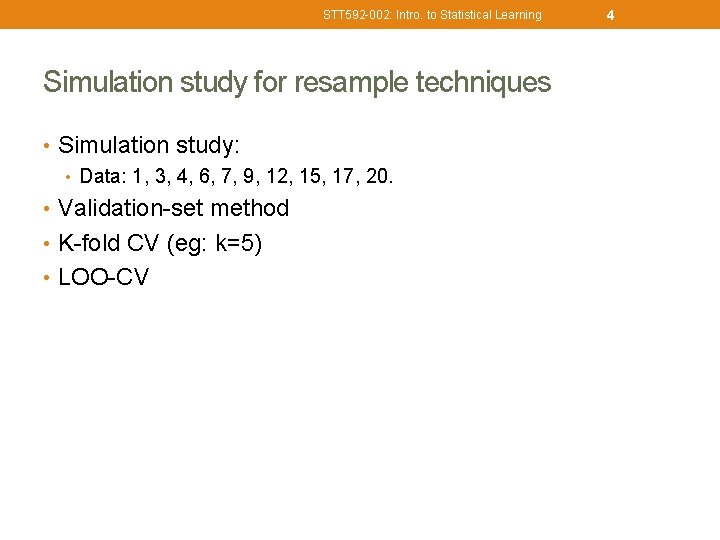
STT 592 -002: Intro. to Statistical Learning Simulation study for resample techniques • Simulation study: • Data: 1, 3, 4, 6, 7, 9, 12, 15, 17, 20. • Validation-set method • K-fold CV (eg: k=5) • LOO-CV 4
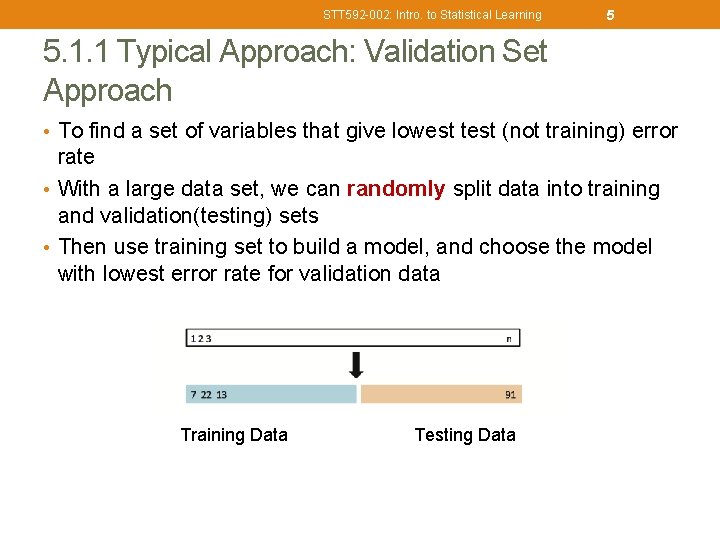
STT 592 -002: Intro. to Statistical Learning 5 5. 1. 1 Typical Approach: Validation Set Approach • To find a set of variables that give lowest test (not training) error rate • With a large data set, we can randomly split data into training and validation(testing) sets • Then use training set to build a model, and choose the model with lowest error rate for validation data Training Data Testing Data
STT 592 -002: Intro. to Statistical Learning 6 Example: Auto Data • Suppose that we want to predict mpg from horsepower • Two models: • mpg ~ horsepower + horspower 2 • Which model gives a better fit? • Randomly split Auto data set into training (196 obs. ) and validation data (196 obs. ) • Fit both models using training data set • Then, evaluate both models using validation data set • The model with lowest validation (testing) MSE is the winner!
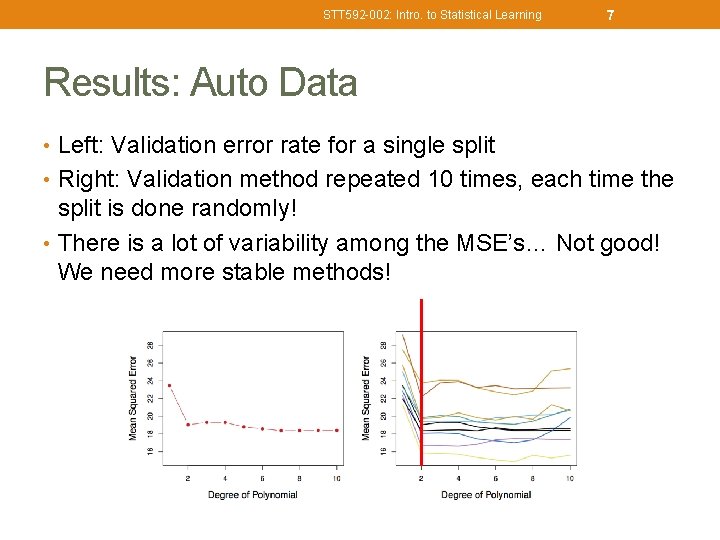
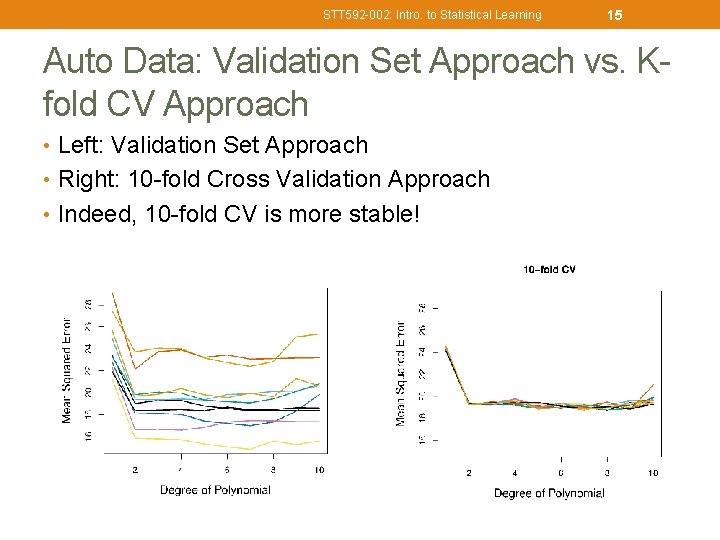
STT 592 -002: Intro. to Statistical Learning 7 Results: Auto Data • Left: Validation error rate for a single split • Right: Validation method repeated 10 times, each time the split is done randomly! • There is a lot of variability among the MSE’s… Not good! We need more stable methods!
STT 592 -002: Intro. to Statistical Learning 8 The Validation Set Approach • Advantages: • Simple • Easy to implement • Disadvantages: • The validation MSE can be highly variable • Only a subset of observations are used to fit the model (training data). Statistical methods tend to perform worse when trained on fewer observations
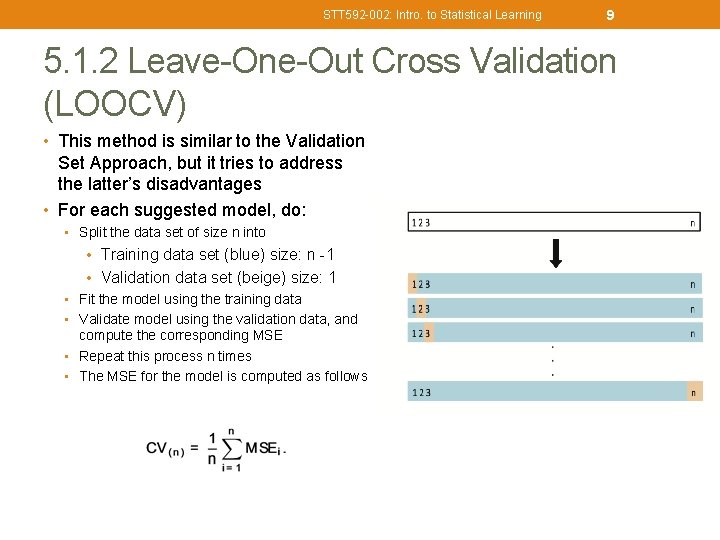
STT 592 -002: Intro. to Statistical Learning 9 5. 1. 2 Leave-One-Out Cross Validation (LOOCV) • This method is similar to the Validation Set Approach, but it tries to address the latter’s disadvantages • For each suggested model, do: • Split the data set of size n into • Training data set (blue) size: n -1 • Validation data set (beige) size: 1 • Fit the model using the training data • Validate model using the validation data, and compute the corresponding MSE • Repeat this process n times • The MSE for the model is computed as follows:
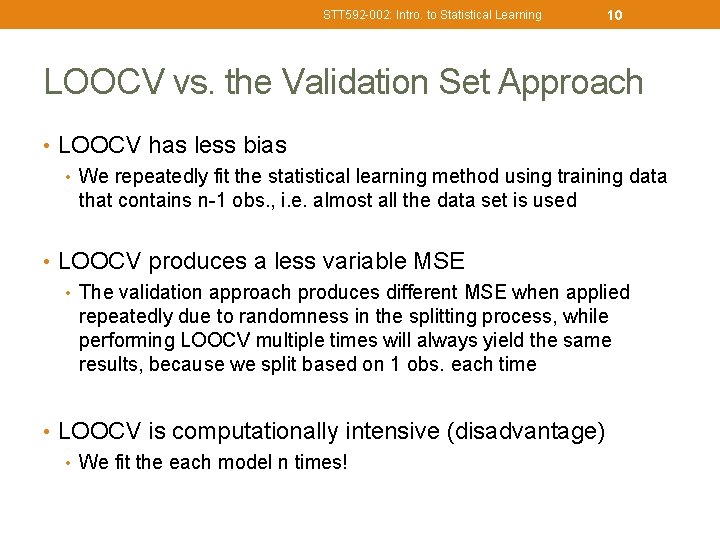
STT 592 -002: Intro. to Statistical Learning 10 LOOCV vs. the Validation Set Approach • LOOCV has less bias • We repeatedly fit the statistical learning method using training data that contains n-1 obs. , i. e. almost all the data set is used • LOOCV produces a less variable MSE • The validation approach produces different MSE when applied repeatedly due to randomness in the splitting process, while performing LOOCV multiple times will always yield the same results, because we split based on 1 obs. each time • LOOCV is computationally intensive (disadvantage) • We fit the each model n times!
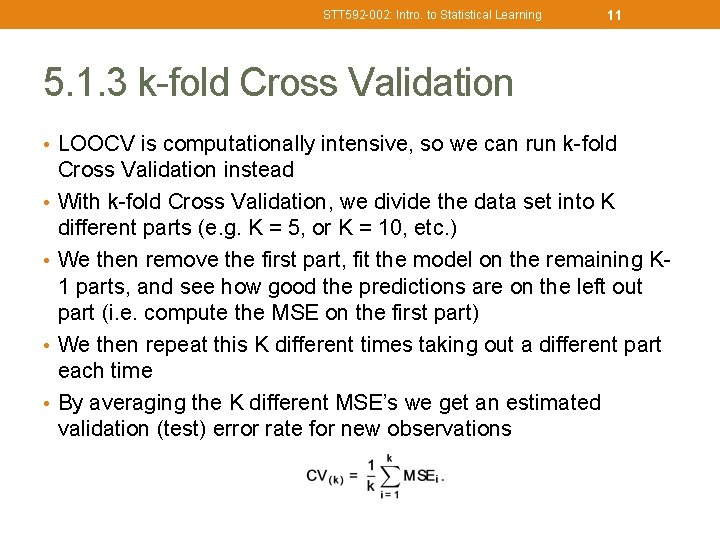
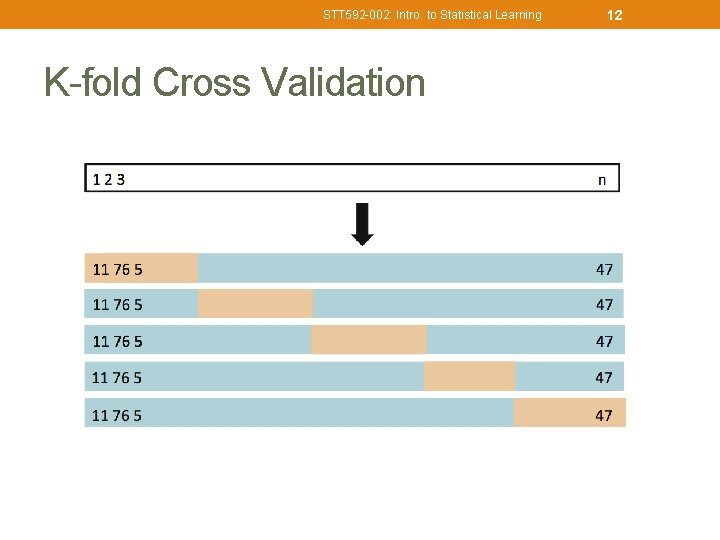
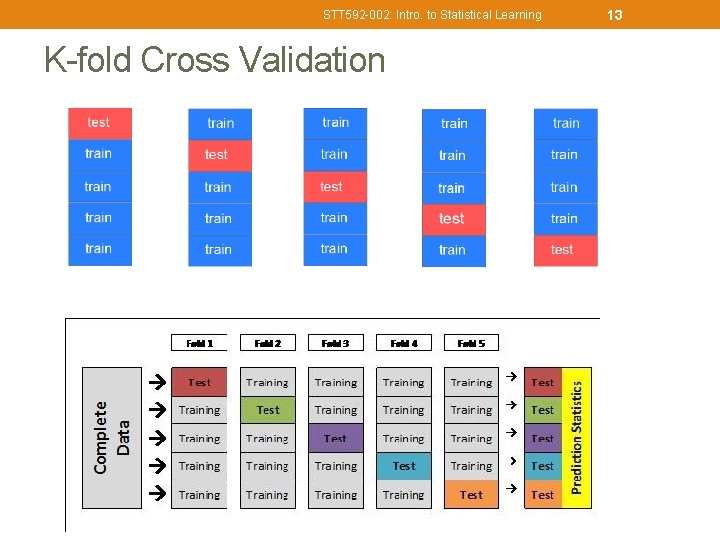
STT 592 -002: Intro. to Statistical Learning 11 5. 1. 3 k-fold Cross Validation • LOOCV is computationally intensive, so we can run k-fold • • Cross Validation instead With k-fold Cross Validation, we divide the data set into K different parts (e. g. K = 5, or K = 10, etc. ) We then remove the first part, fit the model on the remaining K 1 parts, and see how good the predictions are on the left out part (i. e. compute the MSE on the first part) We then repeat this K different times taking out a different part each time By averaging the K different MSE’s we get an estimated validation (test) error rate for new observations
STT 592 -002: Intro. to Statistical Learning K-fold Cross Validation 12
STT 592 -002: Intro. to Statistical Learning K-fold Cross Validation 13
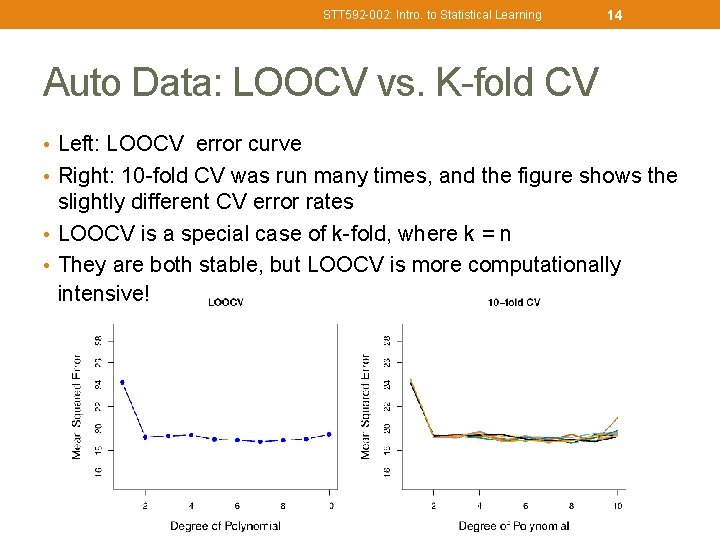
STT 592 -002: Intro. to Statistical Learning 14 Auto Data: LOOCV vs. K-fold CV • Left: LOOCV error curve • Right: 10 -fold CV was run many times, and the figure shows the slightly different CV error rates • LOOCV is a special case of k-fold, where k = n • They are both stable, but LOOCV is more computationally intensive!
STT 592 -002: Intro. to Statistical Learning 15 Auto Data: Validation Set Approach vs. Kfold CV Approach • Left: Validation Set Approach • Right: 10 -fold Cross Validation Approach • Indeed, 10 -fold CV is more stable!
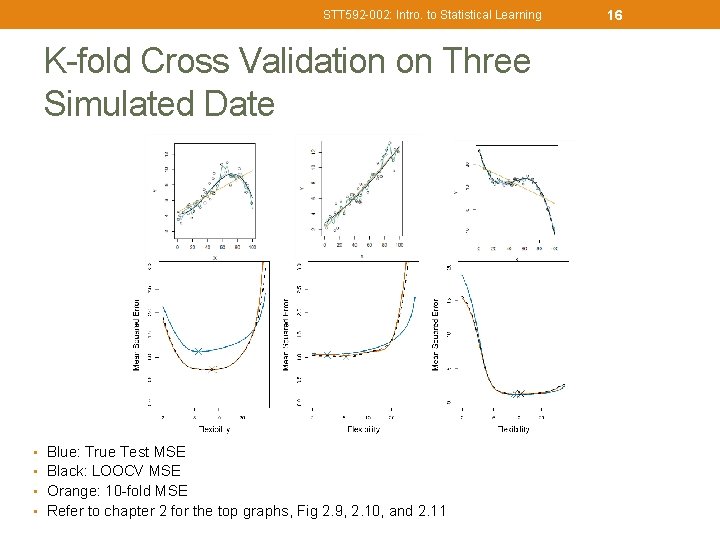
STT 592 -002: Intro. to Statistical Learning K-fold Cross Validation on Three Simulated Date • • Blue: True Test MSE Black: LOOCV MSE Orange: 10 -fold MSE Refer to chapter 2 for the top graphs, Fig 2. 9, 2. 10, and 2. 11 16
STT 592 -002: Intro. to Statistical Learning 17 THE BIAS-VARIANCE TRADE -OFF Let’s Go back to Chapter 02: Statistical Learning
Where does the error come from? Disclaimer: This PPT is modified based on Dr. Hung-yi Lee http: //speech. ee. ntu. edu. tw/~tlkagk/courses_ML 17. html
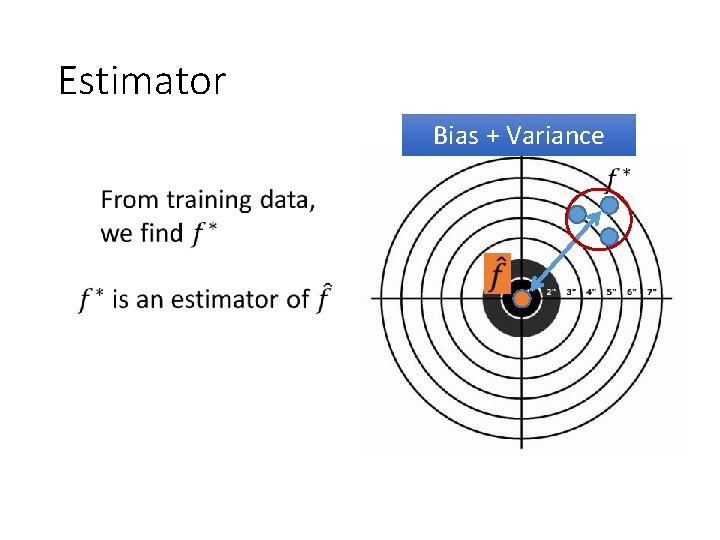
Estimator Bias + Variance
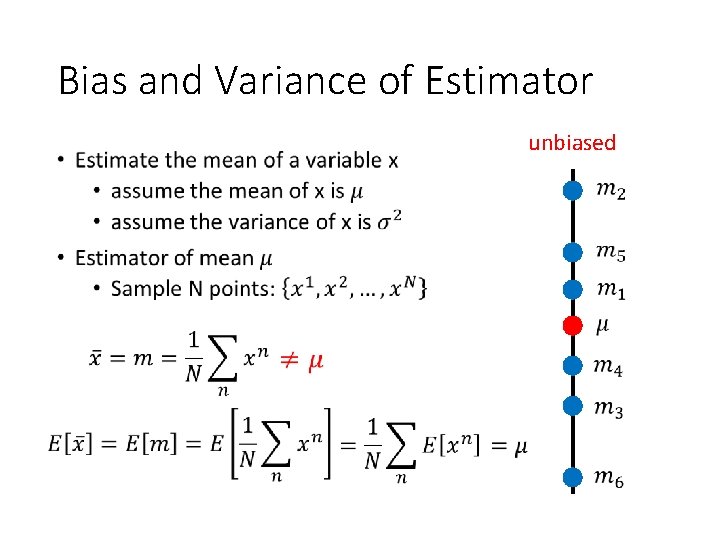
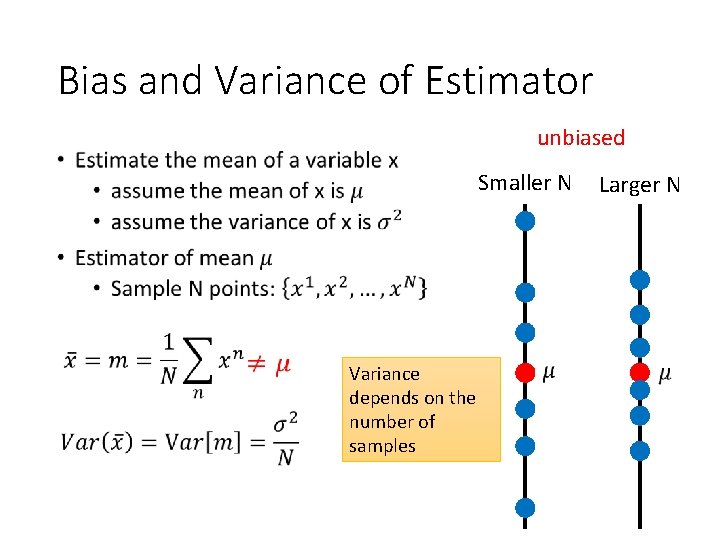
Bias and Variance of Estimator unbiased •
Bias and Variance of Estimator unbiased • Smaller N Variance depends on the number of samples Larger N
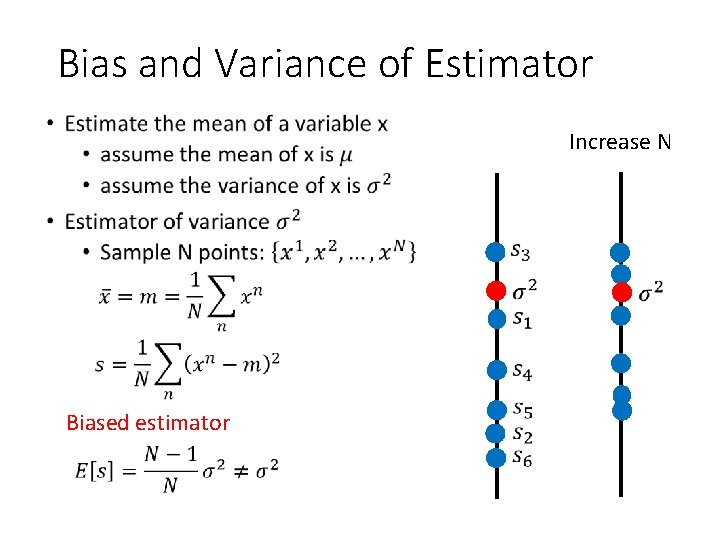
Bias and Variance of Estimator • Increase N Biased estimator
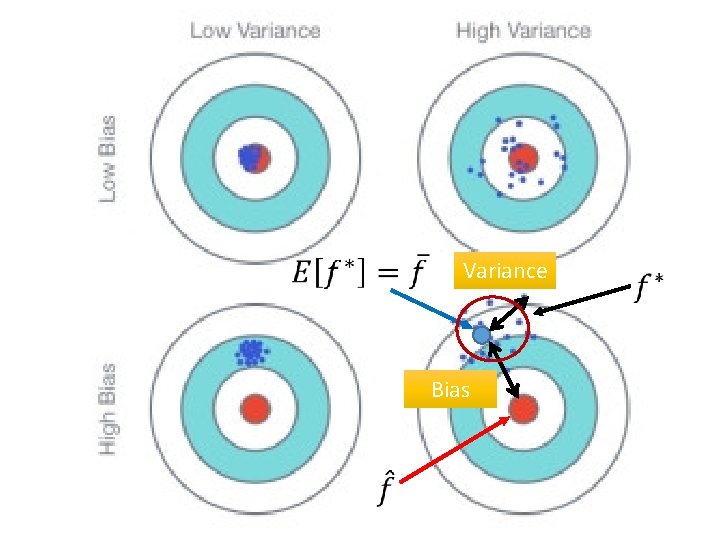
Variance Bias
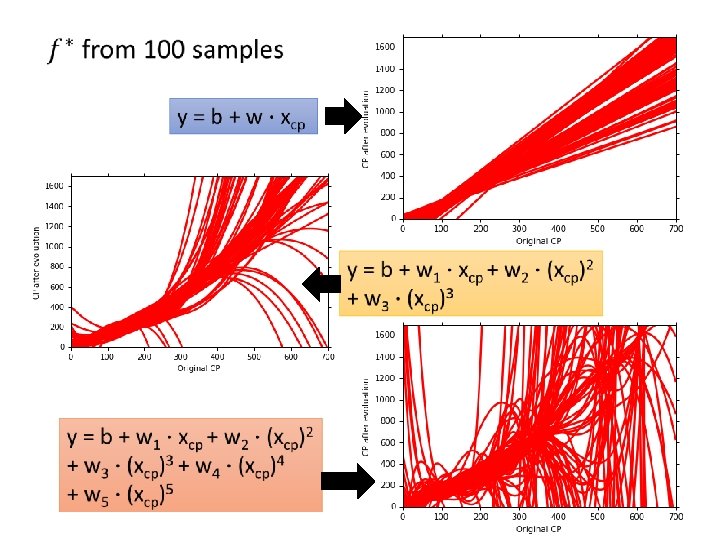
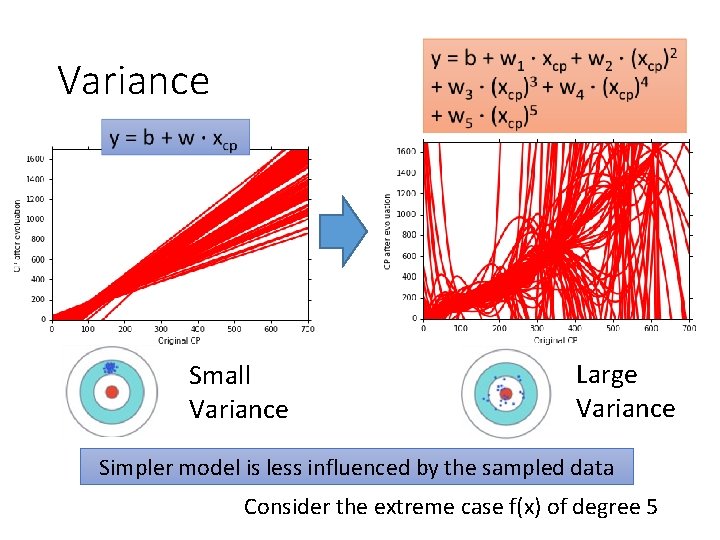
Variance Small Variance Large Variance Simpler model is less influenced by the sampled data Consider the extreme case f(x) of degree 5
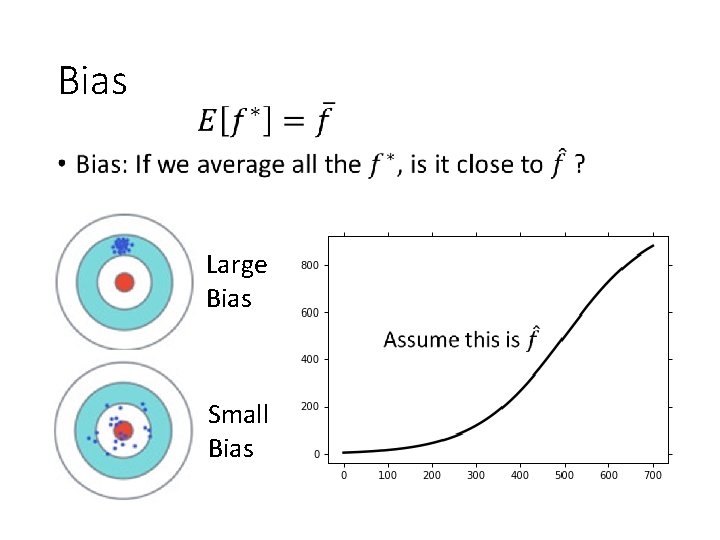
Bias • Large Bias Small Bias
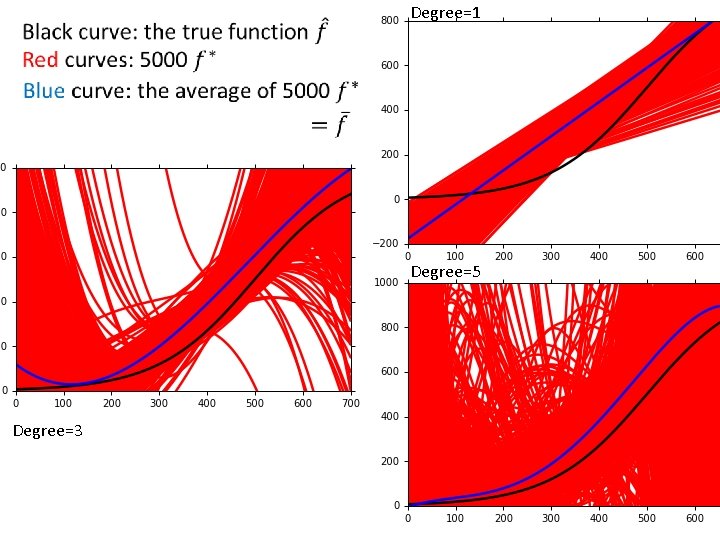
Degree=1 Degree=5 Degree=3
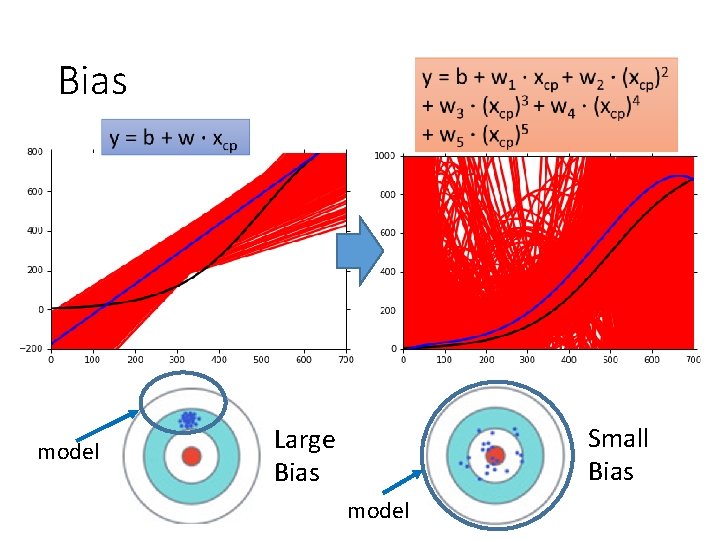
Bias model Small Bias Large Bias model
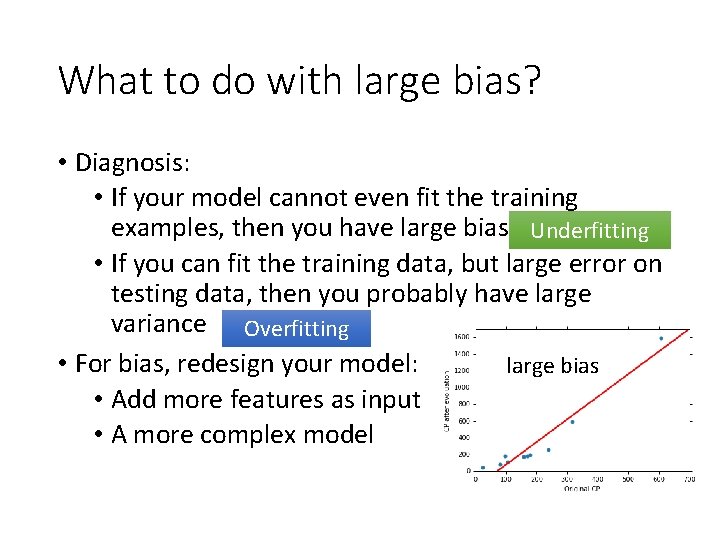
What to do with large bias? • Diagnosis: • If your model cannot even fit the training examples, then you have large bias Underfitting • If you can fit the training data, but large error on testing data, then you probably have large variance Overfitting • For bias, redesign your model: large bias • Add more features as input • A more complex model
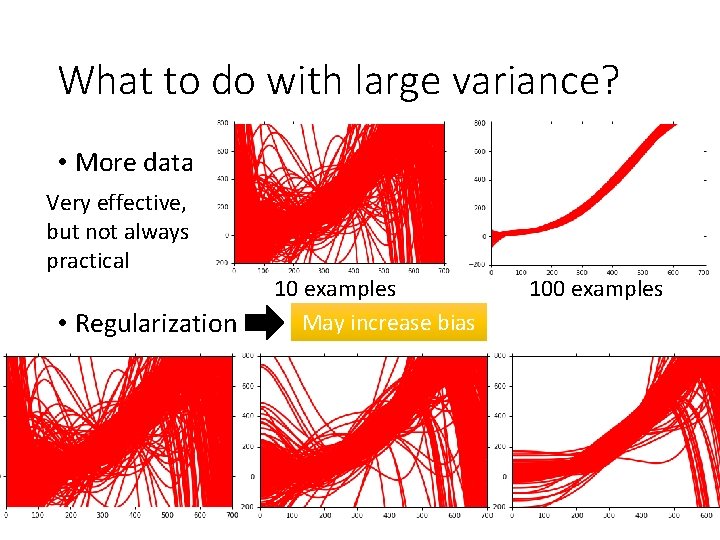
What to do with large variance? • More data Very effective, but not always practical • Regularization 10 examples May increase bias 100 examples
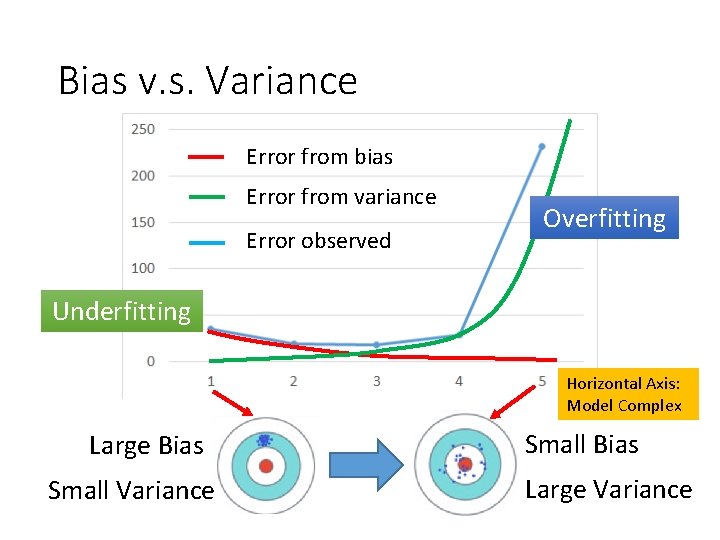
Bias v. s. Variance Error from bias Error from variance Error observed Overfitting Underfitting Horizontal Axis: Model Complex Large Bias Small Variance Small Bias Large Variance
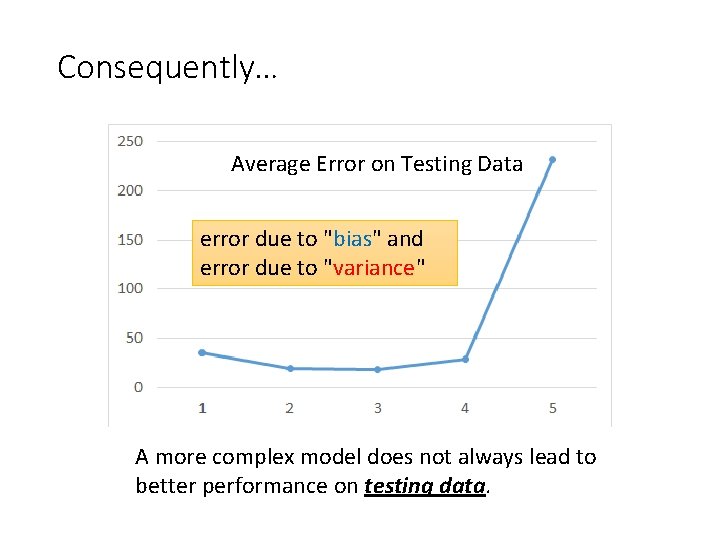
Consequently… Average Error on Testing Data error due to "bias" and error due to "variance" A more complex model does not always lead to better performance on testing data.
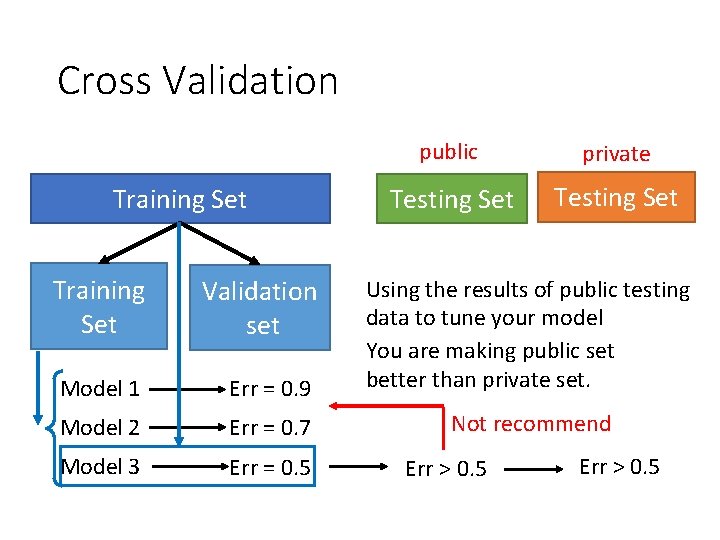
Cross Validation Training Set Validation set public private Testing Set Model 1 Err = 0. 9 Using the results of public testing data to tune your model You are making public set better than private set. Model 2 Err = 0. 7 Not recommend Model 3 Err = 0. 5 Err > 0. 5
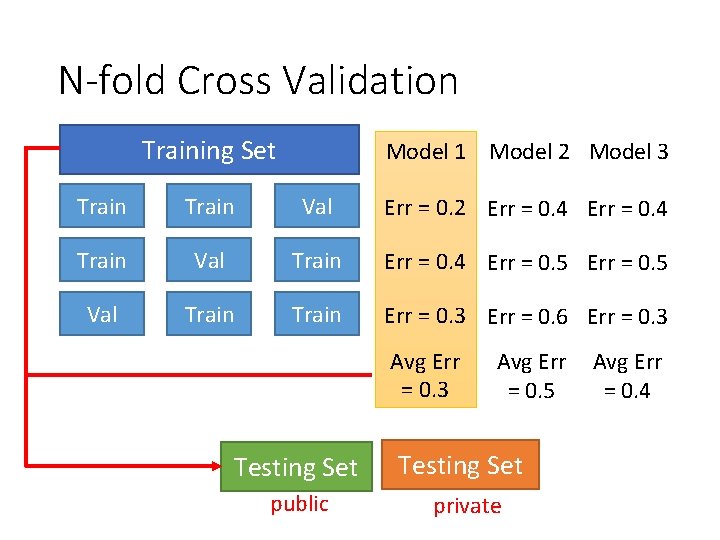
N-fold Cross Validation Training Set Model 1 Model 2 Model 3 Train Val Err = 0. 2 Err = 0. 4 Train Val Train Err = 0. 4 Err = 0. 5 Val Train Err = 0. 3 Err = 0. 6 Err = 0. 3 Avg Err = 0. 5 = 0. 4 Testing Set public private
STT 592 -002: Intro. to Statistical Learning RESAMPLING METHODS— CONTINUE. . . Chapter 05 Disclaimer: This PPT is modified based on IOM 530: Intro. to Statistical Learning 35
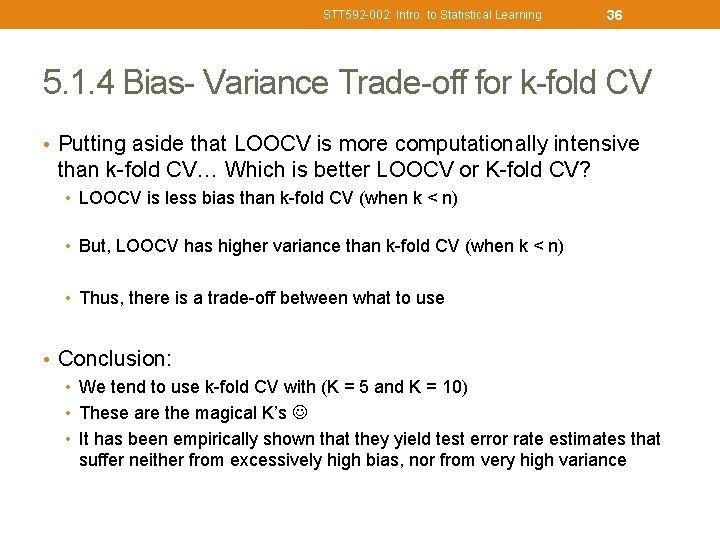
STT 592 -002: Intro. to Statistical Learning 36 5. 1. 4 Bias- Variance Trade-off for k-fold CV • Putting aside that LOOCV is more computationally intensive than k-fold CV… Which is better LOOCV or K-fold CV? • LOOCV is less bias than k-fold CV (when k < n) • But, LOOCV has higher variance than k-fold CV (when k < n) • Thus, there is a trade-off between what to use • Conclusion: • We tend to use k-fold CV with (K = 5 and K = 10) • These are the magical K’s • It has been empirically shown that they yield test error rate estimates that suffer neither from excessively high bias, nor from very high variance
STT 592 -002: Intro. to Statistical Learning 37 5. 1. 5 Cross Validation on Classification Problems • So far, we have been dealing with CV on regression problems • We can use cross validation in a classification situation in a similar manner • Divide data into K parts • Hold out one part, fit using the remaining data and compute the error rate on the hold out data • Repeat K times • CV error rate is the average over the K errors we have computed
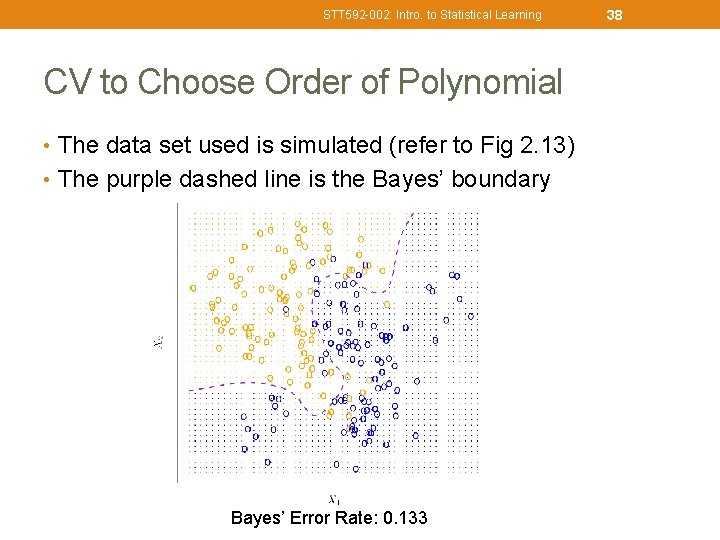
STT 592 -002: Intro. to Statistical Learning CV to Choose Order of Polynomial • The data set used is simulated (refer to Fig 2. 13) • The purple dashed line is the Bayes’ boundary Bayes’ Error Rate: 0. 133 38
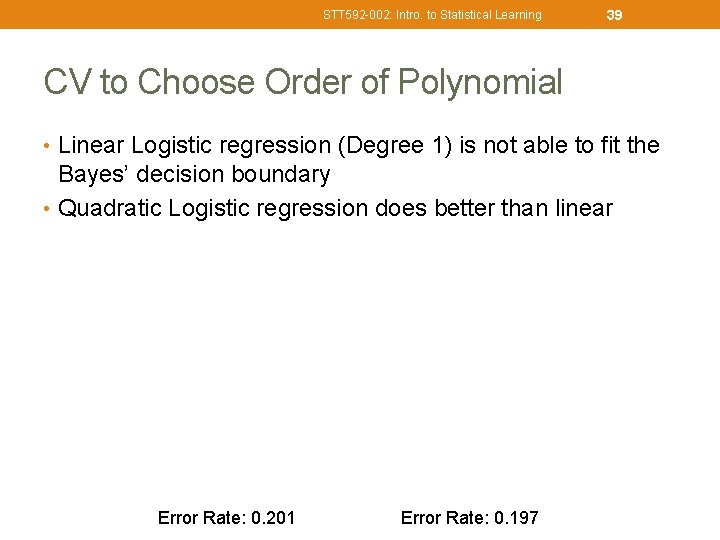
STT 592 -002: Intro. to Statistical Learning 39 CV to Choose Order of Polynomial • Linear Logistic regression (Degree 1) is not able to fit the Bayes’ decision boundary • Quadratic Logistic regression does better than linear Error Rate: 0. 201 Error Rate: 0. 197
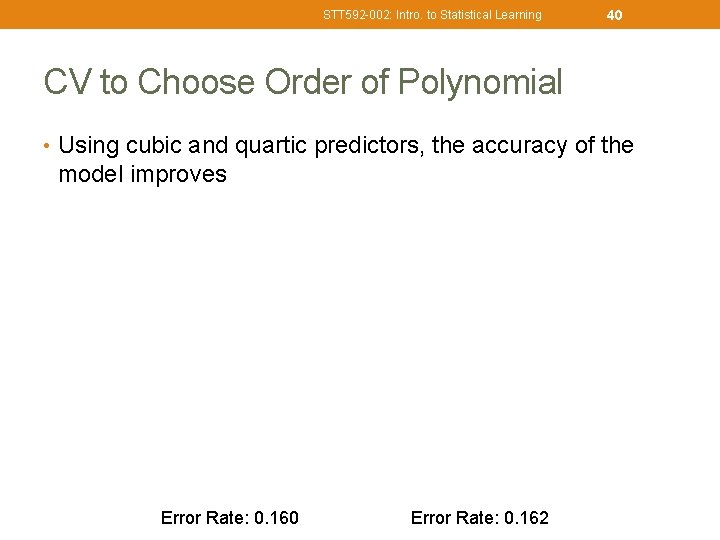
STT 592 -002: Intro. to Statistical Learning 40 CV to Choose Order of Polynomial • Using cubic and quartic predictors, the accuracy of the model improves Error Rate: 0. 160 Error Rate: 0. 162
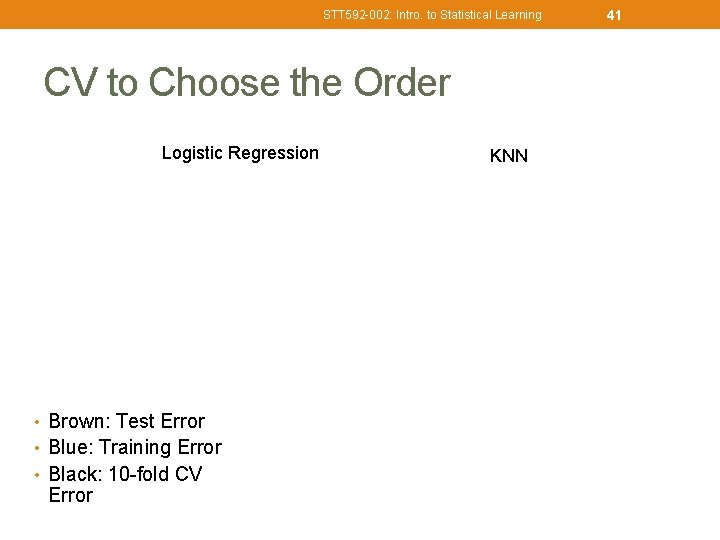
STT 592 -002: Intro. to Statistical Learning CV to Choose the Order Logistic Regression • Brown: Test Error • Blue: Training Error • Black: 10 -fold CV Error KNN 41
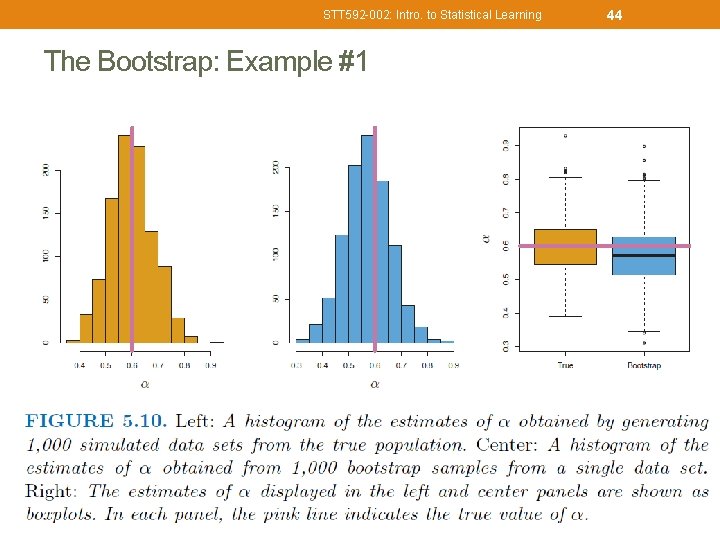
STT 592 -002: Intro. to Statistical Learning 42 The Bootstrap • Bootstrap is a widely applicable and extremely powerful statistical tool. • Can be used to quantify the uncertainty associated with a given estimator or statistical learning method. • Ideally, we can repeatedly obtain independent data sets from the population
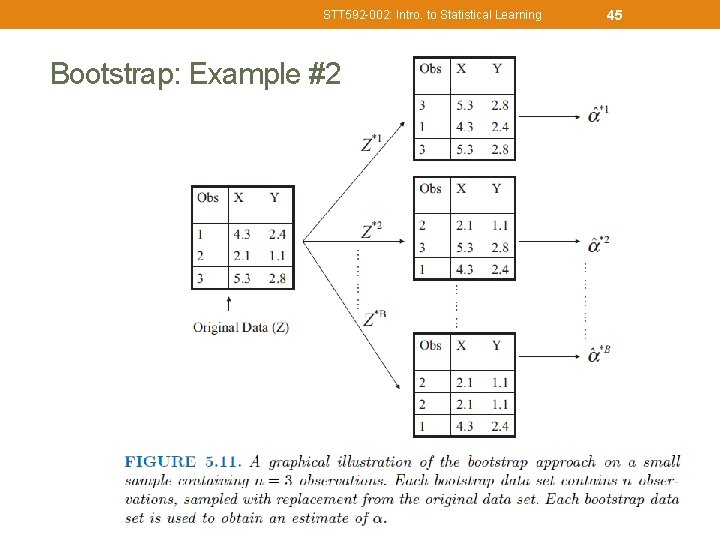
STT 592 -002: Intro. to Statistical Learning 43 The Bootstrap • In practice, it will not work because for real data we can NOT generate new samples from original population. • Instead obtain distinct data sets by repeatedly sampling observations from original data set. • The sampling is performed with replacement, which means that the replacement same observation can occur more than once in the bootstrap data set.
STT 592 -002: Intro. to Statistical Learning The Bootstrap: Example #1 44
STT 592 -002: Intro. to Statistical Learning Bootstrap: Example #2 45
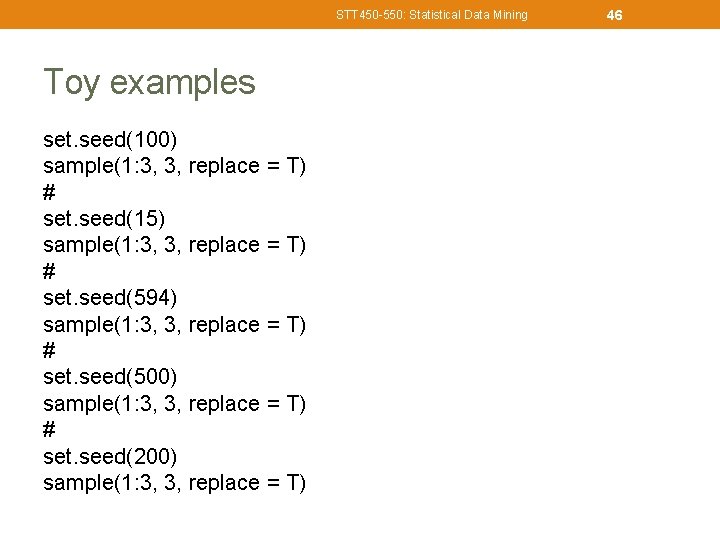
STT 450 -550: Statistical Data Mining Toy examples set. seed(100) sample(1: 3, 3, replace = T) # set. seed(15) sample(1: 3, 3, replace = T) # set. seed(594) sample(1: 3, 3, replace = T) # set. seed(500) sample(1: 3, 3, replace = T) # set. seed(200) sample(1: 3, 3, replace = T) 46
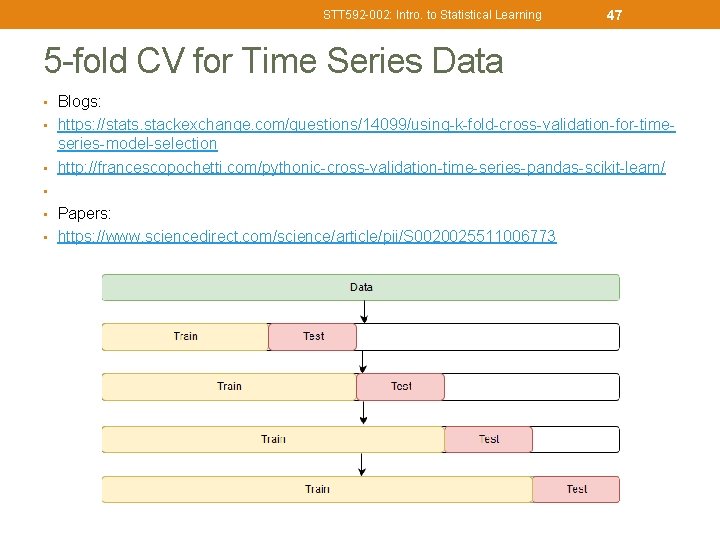
STT 592 -002: Intro. to Statistical Learning 47 5 -fold CV for Time Series Data • Blogs: • https: //stats. stackexchange. com/questions/14099/using-k-fold-cross-validation-for-time • • series-model-selection http: //francescopochetti. com/pythonic-cross-validation-time-series-pandas-scikit-learn/ Papers: https: //www. sciencedirect. com/science/article/pii/S 0020025511006773