
STRUT TIE MODELS STM Module 2 1 Topics

- Slides: 57
STRUT & TIE MODELS (S-T-M) Module 2 1
Topics • • • Introduction Development Design Methodology IS and ACI provisions Applications – Deep beams – Corbels – Beam-column joints 2
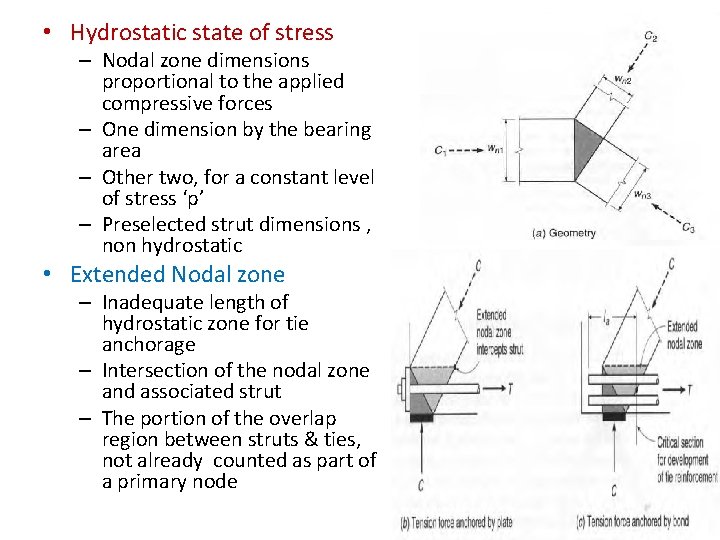
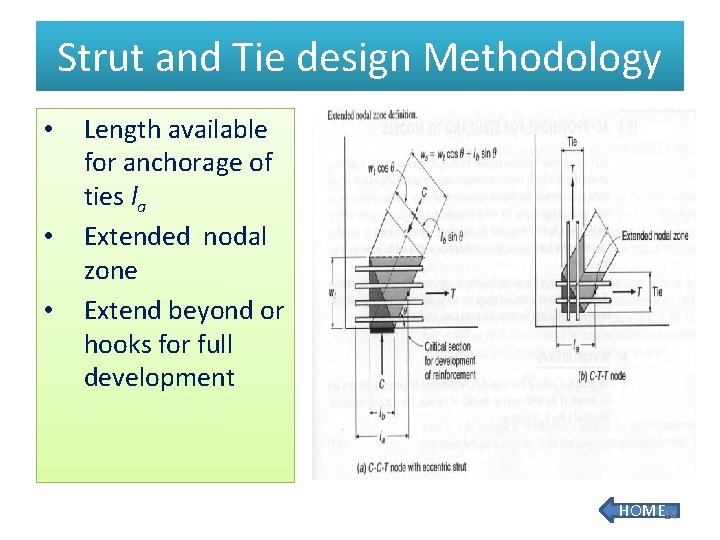
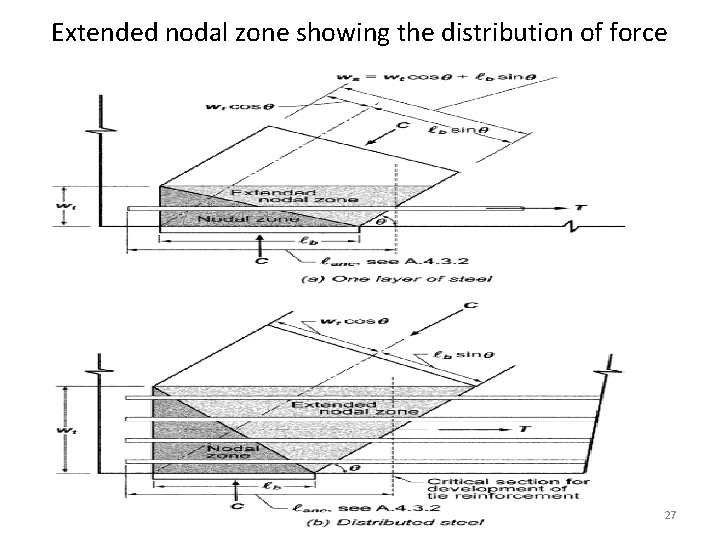
• Hydrostatic state of stress – Nodal zone dimensions proportional to the applied compressive forces – One dimension by the bearing area – Other two, for a constant level of stress ‘p’ – Preselected strut dimensions , non hydrostatic • Extended Nodal zone – Inadequate length of hydrostatic zone for tie anchorage – Intersection of the nodal zone and associated strut – The portion of the overlap region between struts & ties, not already counted as part of a primary node 3
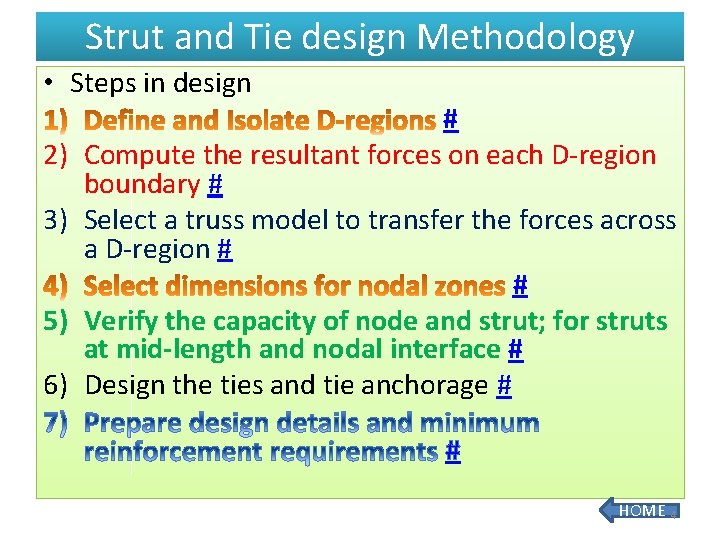
Strut and Tie design Methodology • Steps in design 2) 3) 5) 6) # Compute the resultant forces on each D-region boundary # Select a truss model to transfer the forces across a D-region # # Verify the capacity of node and strut; for struts at mid-length and nodal interface # Design the ties and tie anchorage # # HOME 4
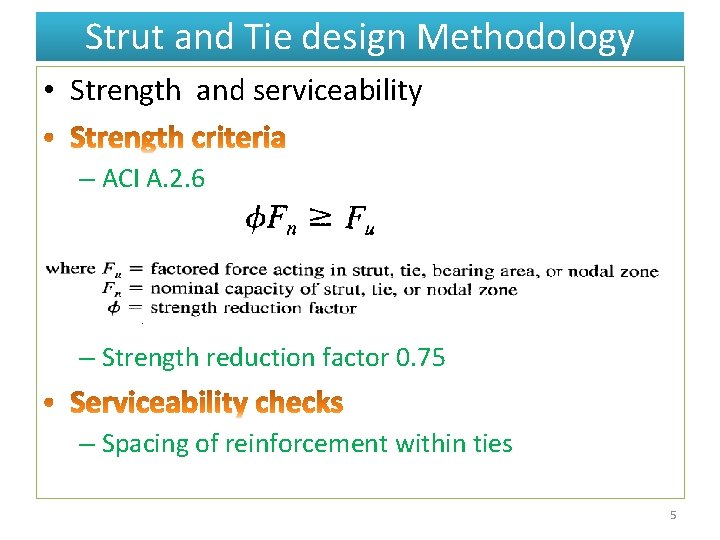
Strut and Tie design Methodology • Strength and serviceability – ACI A. 2. 6 – Strength reduction factor 0. 75 – Spacing of reinforcement within ties 5
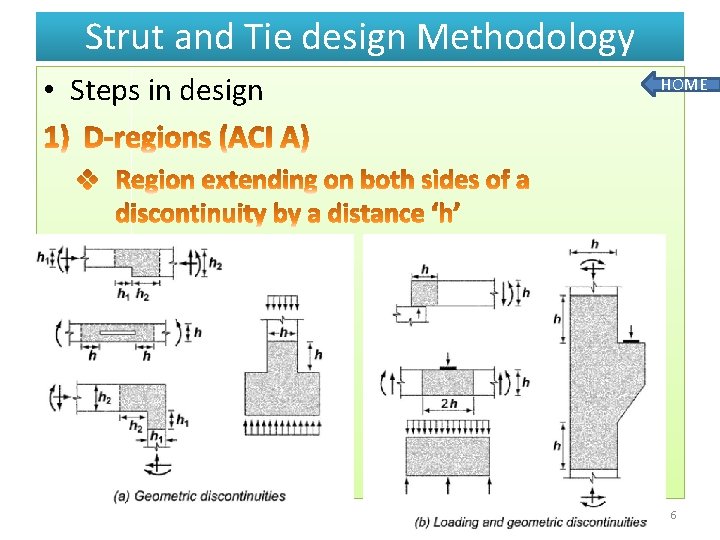
Strut and Tie design Methodology • Steps in design HOME 6
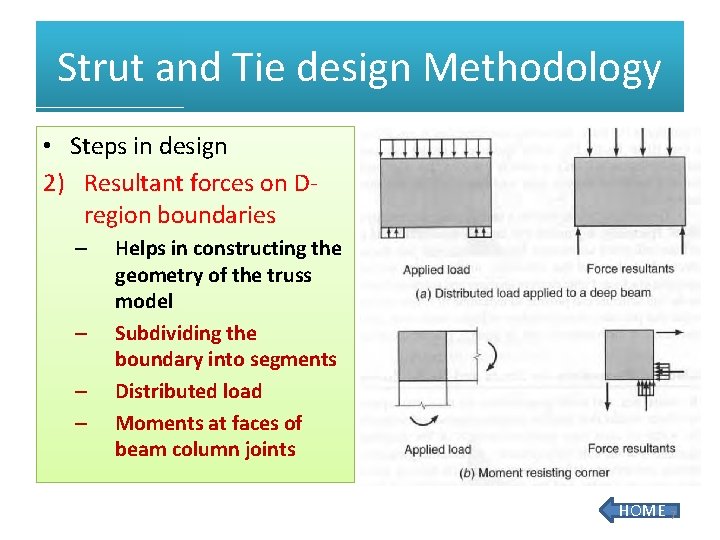
Strut and Tie design Methodology • Steps in design 2) Resultant forces on Dregion boundaries – – Helps in constructing the geometry of the truss model Subdividing the boundary into segments Distributed load Moments at faces of beam column joints HOME 7
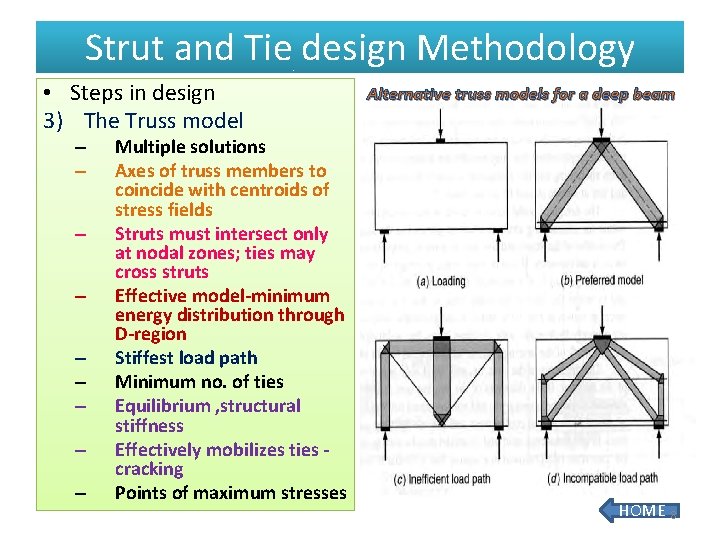
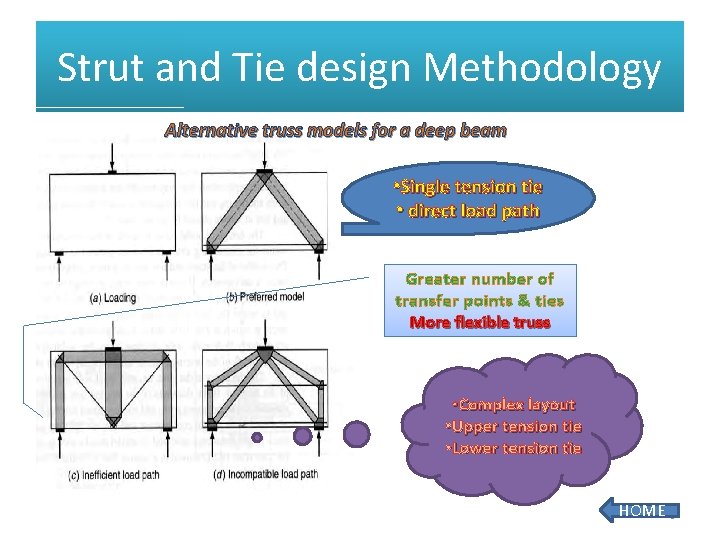
Strut and Tie design Methodology • Steps in design 3) The Truss model – – – – – Multiple solutions Axes of truss members to coincide with centroids of stress fields Struts must intersect only at nodal zones; ties may cross struts Effective model-minimum energy distribution through D-region Stiffest load path Minimum no. of ties Equilibrium , structural stiffness Effectively mobilizes ties cracking Points of maximum stresses Alternative truss models for a deep beam HOME 8
Strut and Tie design Methodology Alternative truss models for a deep beam • Single tension tie • direct load path Greater number of transfer points & ties More flexible truss • Complex layout • Upper tension tie • Lower tension tie HOME 9
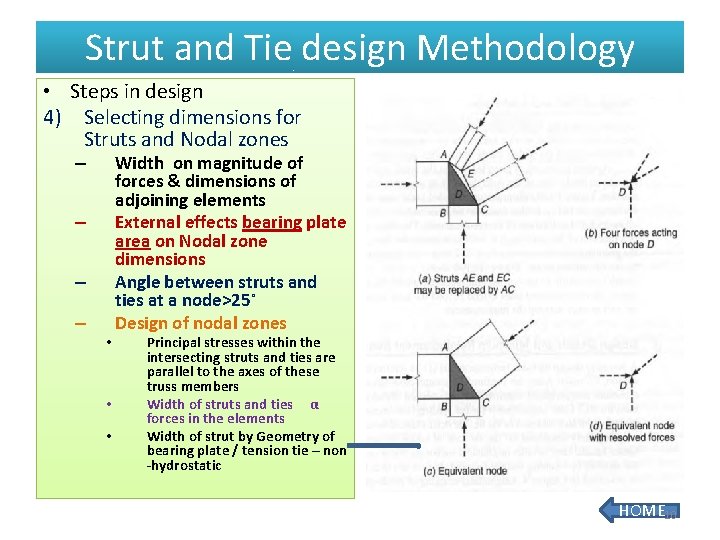
Strut and Tie design Methodology • Steps in design 4) Selecting dimensions for Struts and Nodal zones – – • • • Width on magnitude of forces & dimensions of adjoining elements External effects bearing plate area on Nodal zone dimensions Angle between struts and ties at a node>25◦ Design of nodal zones Principal stresses within the intersecting struts and ties are parallel to the axes of these truss members Width of struts and ties α forces in the elements Width of strut by Geometry of bearing plate / tension tie – non -hydrostatic HOME 10
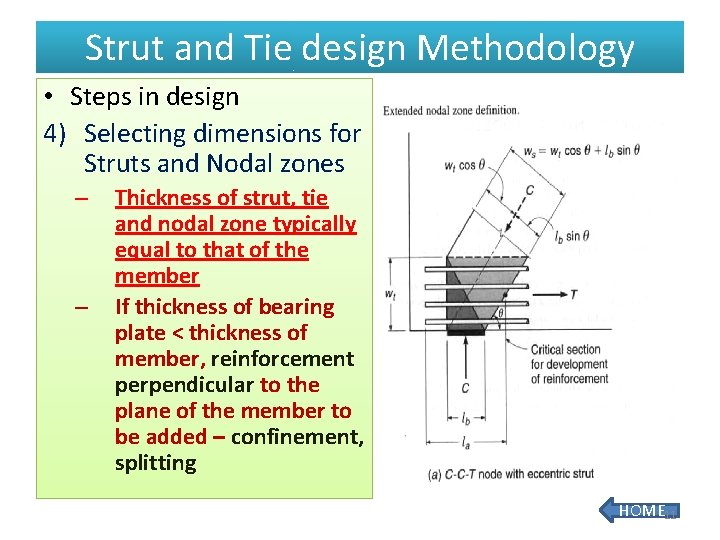
Strut and Tie design Methodology • Steps in design 4) Selecting dimensions for Struts and Nodal zones – – Thickness of strut, tie and nodal zone typically equal to that of the member If thickness of bearing plate < thickness of member, reinforcement perpendicular to the plane of the member to be added – confinement, splitting HOME 11
Strut and Tie design Methodology • Steps in design 5) Capacity of Struts – Based on, the strength of the strut & strength of nodal zone – Insufficient capacity of strut – revising the design • • • Add compression reinforcement Increase size of nodal zone Bearing area of plate and column HOME 12
Strut and Tie design Methodology • Steps in design 6) Design of Ties and Anchorage o At service loads, stress in reinforcement well below yield stress (crack control) o Geometry of tie – reinforcement fits within tie dimensions, full anchoring o Anchorage – nodal and extended nodal zones + available regions on far side HOME 13
Strut and Tie design Methodology • • • Length available for anchorage of ties la Extended nodal zone Extend beyond or hooks for full development HOME 14
Strut and Tie design Methodology • Steps in design 7) Design details and minimum reinforcement requirements o Complete design demands the verification § § § Tie reinforcement can be placed in the section Nodal zones confined by compressive forces or ties Minimum reinforcement requirements o Tie details – development length, mechanical anchorage o Shear reinforcement – permissible shear force(code), controlled longitudinal cracking of bottle shaped struts, minimum reinforcement (code) HOME 15
ACI Code Provisions Strength of struts Strength of nodal zones Strength of ties Shear reinforcement requirements HOME 16
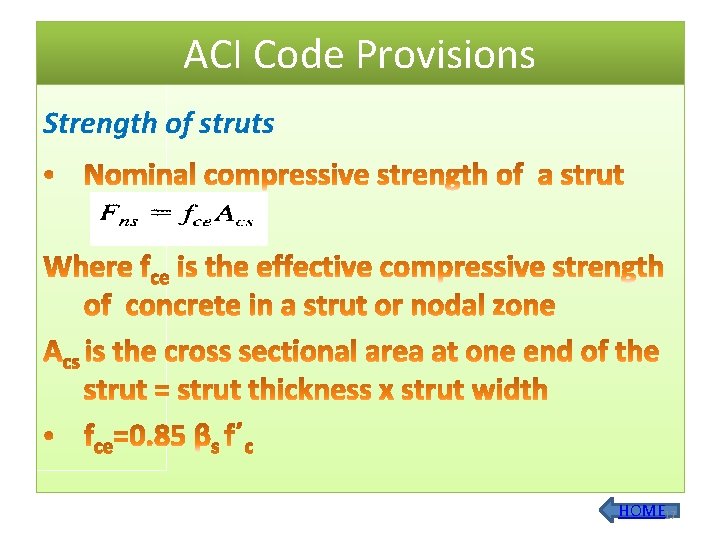
ACI Code Provisions Strength of struts HOME 17
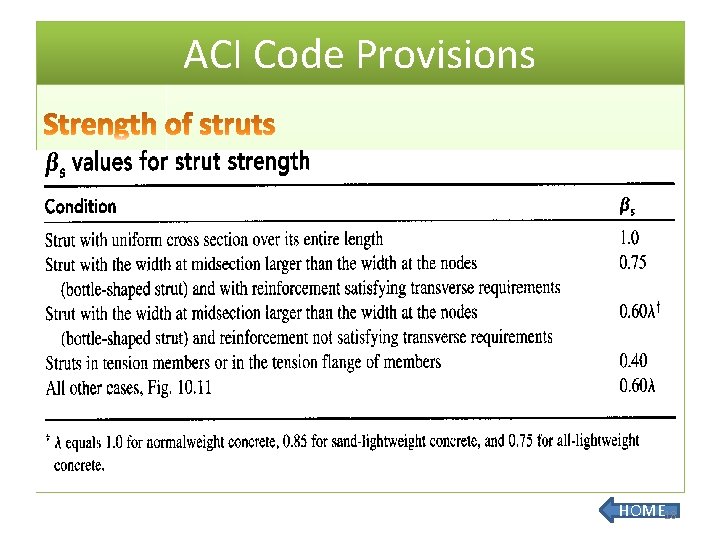
ACI Code Provisions HOME 18
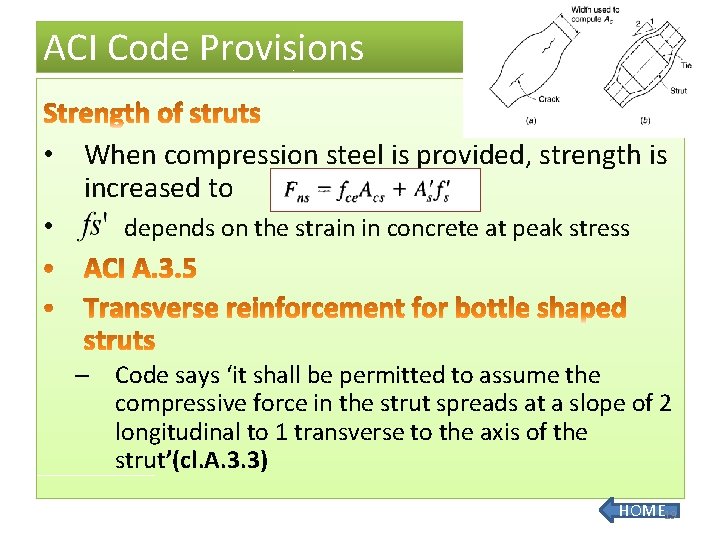
ACI Code Provisions • When compression steel is provided, strength is increased to • depends on the strain in concrete at peak stress – Code says ‘it shall be permitted to assume the compressive force in the strut spreads at a slope of 2 longitudinal to 1 transverse to the axis of the strut’(cl. A. 3. 3) HOME 19
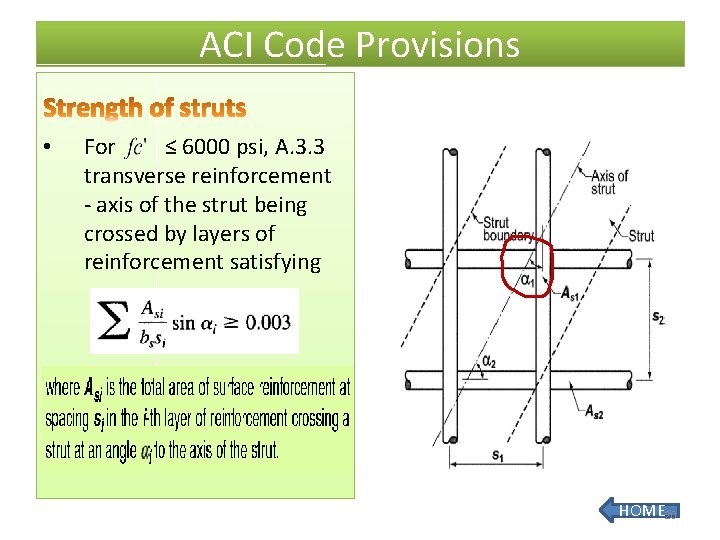
ACI Code Provisions • For ≤ 6000 psi, A. 3. 3 transverse reinforcement - axis of the strut being crossed by layers of reinforcement satisfying • HOME 20
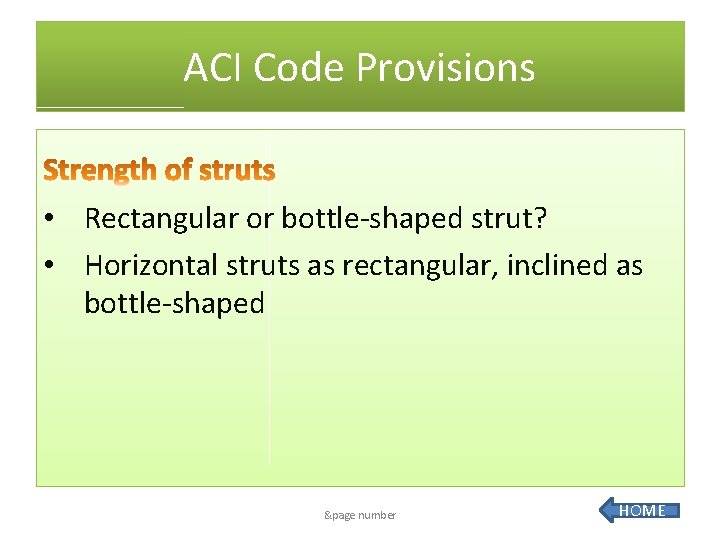
ACI Code Provisions • Rectangular or bottle-shaped strut? • Horizontal struts as rectangular, inclined as bottle-shaped &page number HOME
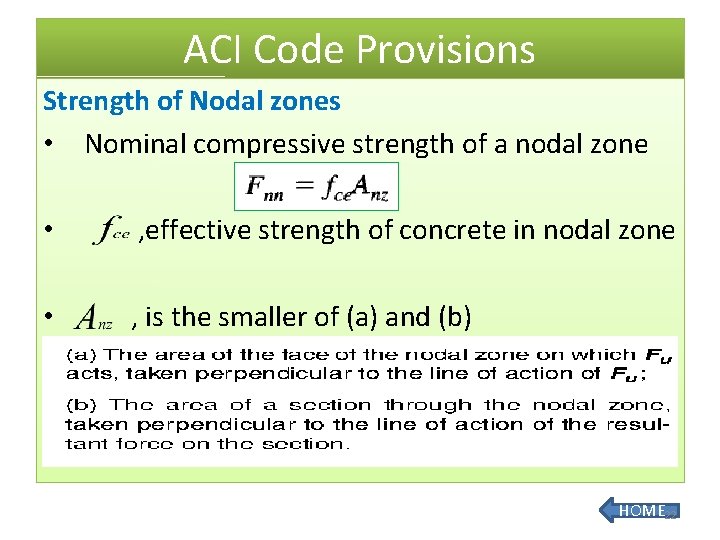
ACI Code Provisions Strength of Nodal zones • Nominal compressive strength of a nodal zone • , effective strength of concrete in nodal zone • , is the smaller of (a) and (b) • HOME 22
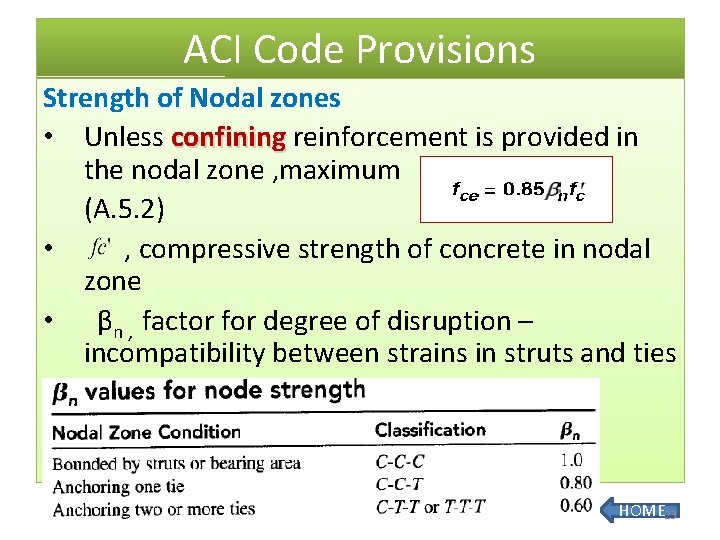
ACI Code Provisions Strength of Nodal zones • Unless confining reinforcement is provided in the nodal zone , maximum (A. 5. 2) • , compressive strength of concrete in nodal zone • βn , factor for degree of disruption – incompatibility between strains in struts and ties • HOME 23
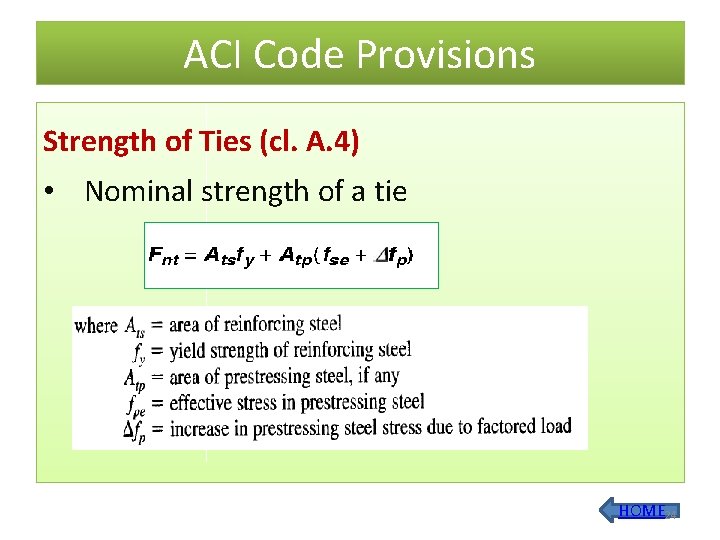
ACI Code Provisions Strength of Ties (cl. A. 4) • Nominal strength of a tie HOME 24
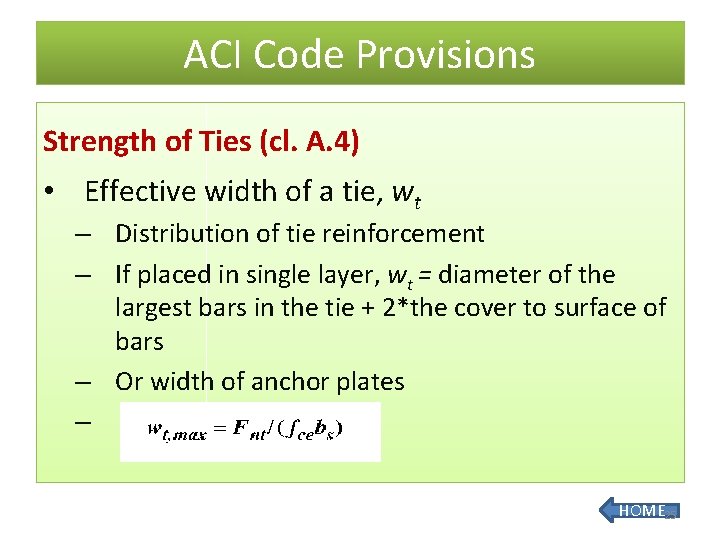
ACI Code Provisions Strength of Ties (cl. A. 4) • Effective width of a tie, wt – Distribution of tie reinforcement – If placed in single layer, wt = diameter of the largest bars in the tie + 2*the cover to surface of bars – Or width of anchor plates – HOME 25
ACI Code Provisions Strength of Ties (cl. A. 4) – The axis of reinforcement in a tie shall coincide with the axis of the tie in STM – Anchor the reinforcement as required by mechanical devices, post-tensioning anchorage devices, standard hooks etc. – Ties must be anchored before they leave the extended nodal zone at a point defined by the centroid of the bars in the tie and the extensions of either the strut or the bearing area. HOME 26
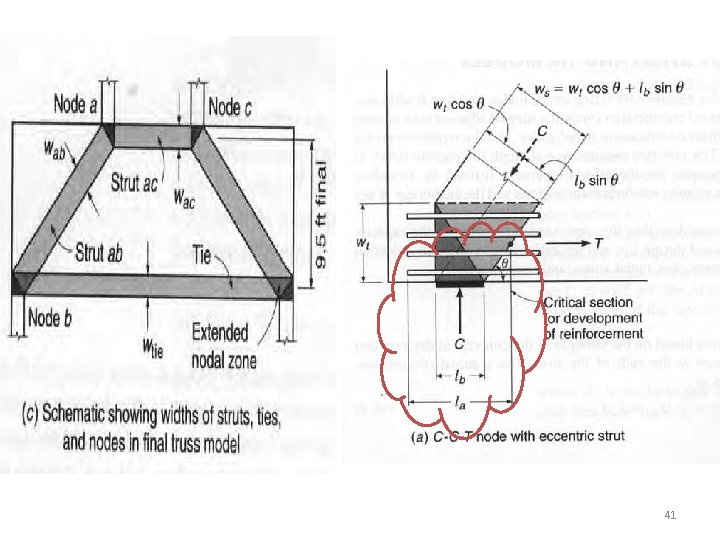
Extended nodal zone showing the distribution of force 27
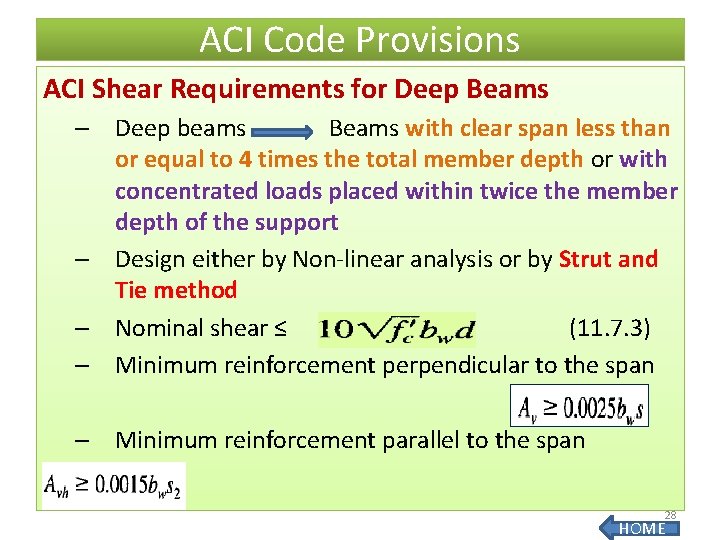
ACI Code Provisions ACI Shear Requirements for Deep Beams – Deep beams Beams with clear span less than or equal to 4 times the total member depth or with concentrated loads placed within twice the member depth of the support – Design either by Non-linear analysis or by Strut and Tie method – Nominal shear ≤ (11. 7. 3) – Minimum reinforcement perpendicular to the span – Minimum reinforcement parallel to the span 28 HOME
ACI Code Provisions • s and s 2 may not exceed d/5 or 12 inches • For STM, bw is thickness of element b 29
Applications • Deep beams • Beam-column joints • Corbel 30
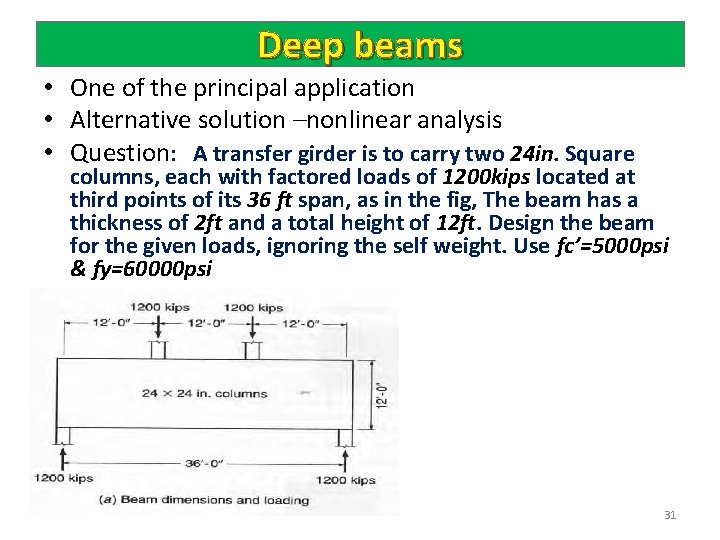
Deep beams • One of the principal application • Alternative solution –nonlinear analysis • Question: A transfer girder is to carry two 24 in. Square columns, each with factored loads of 1200 kips located at third points of its 36 ft span, as in the fig, The beam has a thickness of 2 ft and a total height of 12 ft. Design the beam for the given loads, ignoring the self weight. Use fc’=5000 psi & fy=60000 psi • • • 31
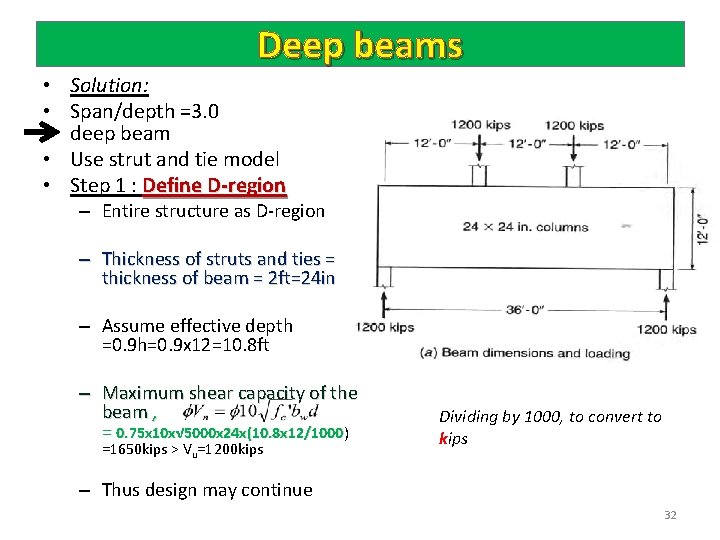
Deep beams • Solution: • Span/depth =3. 0 deep beam • Use strut and tie model • Step 1 : Define D-region – Entire structure as D-region – Thickness of struts and ties = thickness of beam = 2 ft=24 in – Assume effective depth =0. 9 h=0. 9 x 12=10. 8 ft – Maximum shear capacity of the beam , = 0. 75 x 10 x√ 5000 x 24 x(10. 8 x 12/1000) 0. 75 x 10 x√ 5000 x 24 x(10. 8 x 12/1000 =1650 kips > Vu=1200 kips Dividing by 1000, to convert to kips – Thus design may continue 32
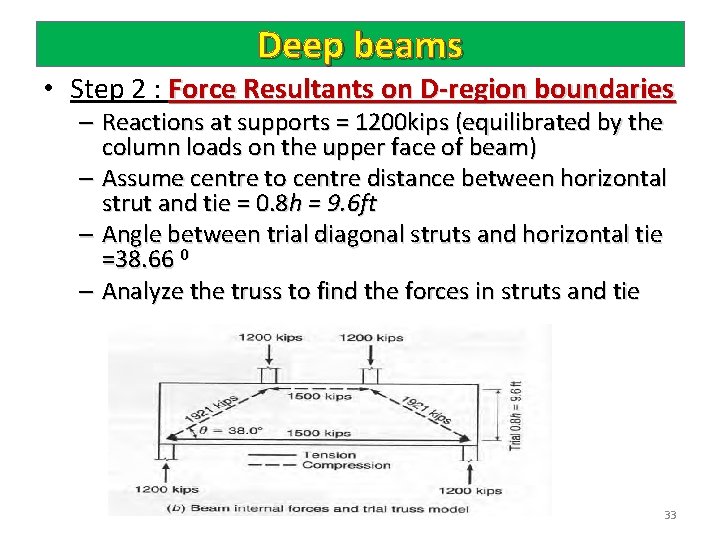
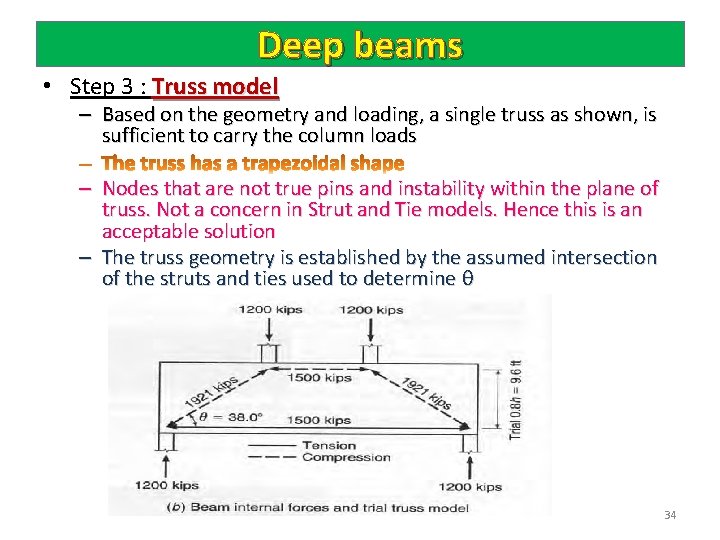
Deep beams • Step 2 : Force Resultants on D-region boundaries – Reactions at supports = 1200 kips (equilibrated by the column loads on the upper face of beam) – Assume centre to centre distance between horizontal strut and tie = 0. 8 h = 9. 6 ft – Angle between trial diagonal struts and horizontal tie =38. 66 0 – Analyze the truss to find the forces in struts and tie 33
Deep beams • Step 3 : Truss model – Based on the geometry and loading, a single truss as shown, is sufficient to carry the column loads – Nodes that are not true pins and instability within the plane of truss. Not a concern in Strut and Tie models. Hence this is an acceptable solution – The truss geometry is established by the assumed intersection of the struts and ties used to determine θ 34
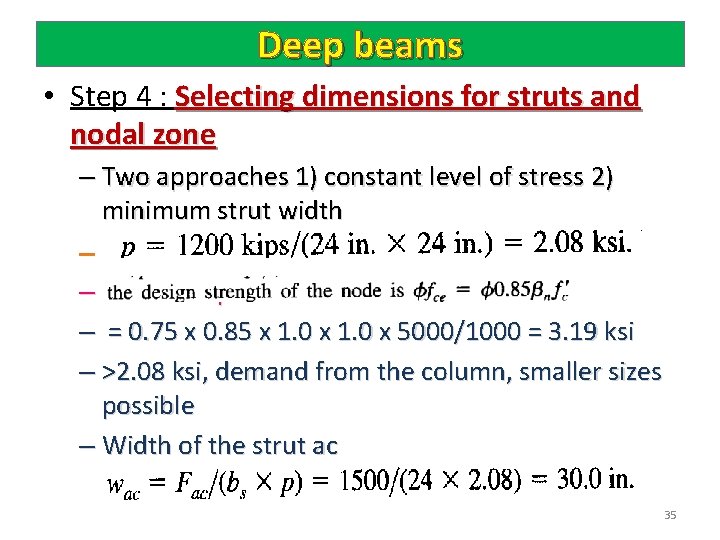
Deep beams • Step 4 : Selecting dimensions for struts and nodal zone – Two approaches 1) constant level of stress 2) minimum strut width – CCC node βn =1. 0 – = 0. 75 x 0. 85 x 1. 0 x 5000/1000 = 3. 19 ksi – >2. 08 ksi, demand from the column, smaller sizes possible – Width of the strut ac 35
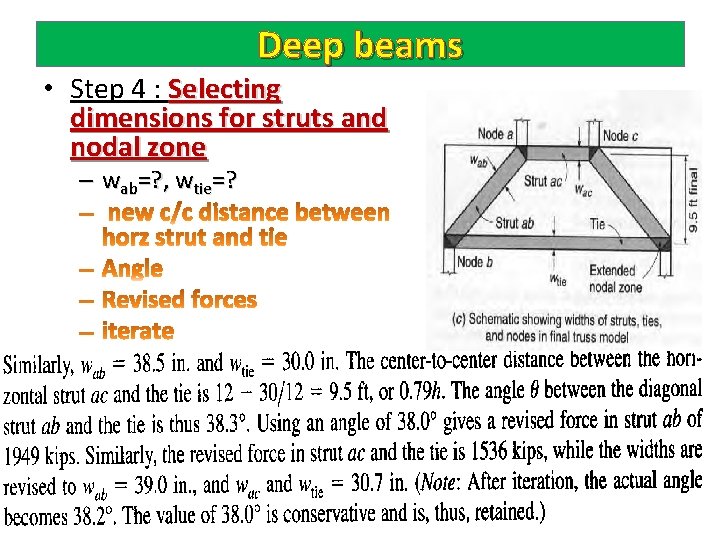
Deep beams • Step 4 : Selecting dimensions for struts and nodal zone – wab=? , wtie=? 36
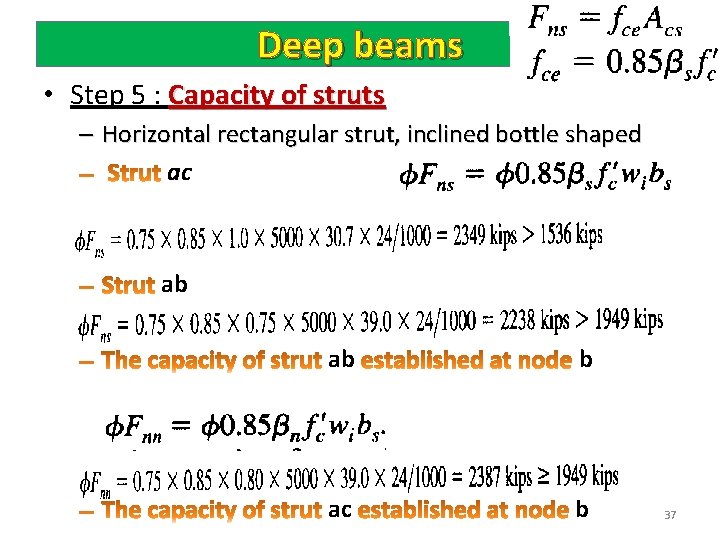
Deep beams • Step 5 : Capacity of struts – Horizontal rectangular strut, inclined bottle shaped ac ab ab b ac b 37
Deep beams • Step 5 : Capacity of struts • Capacity at the end of the struts and at the nodes exceeds the factored loads • Hence the struts are adequate 38
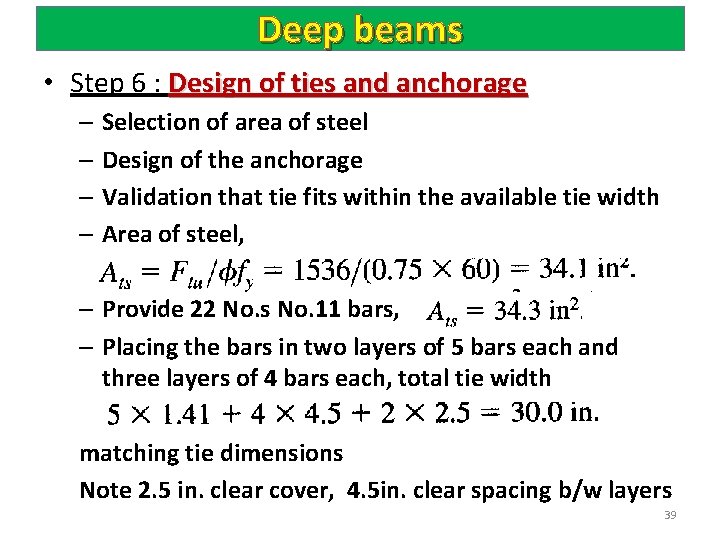
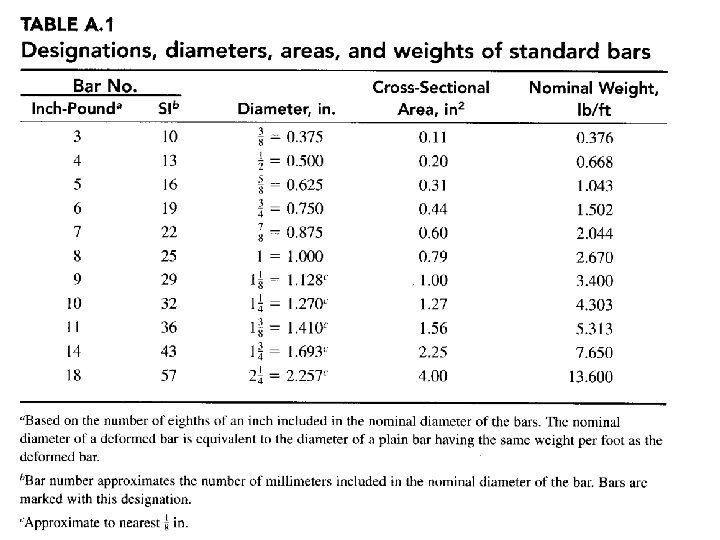
Deep beams • Step 6 : Design of ties and anchorage – Selection of area of steel – Design of the anchorage – Validation that tie fits within the available tie width – Area of steel, – Provide 22 No. s No. 11 bars, – Placing the bars in two layers of 5 bars each and three layers of 4 bars each, total tie width matching tie dimensions Note 2. 5 in. clear cover, 4. 5 in. clear spacing b/w layers 39
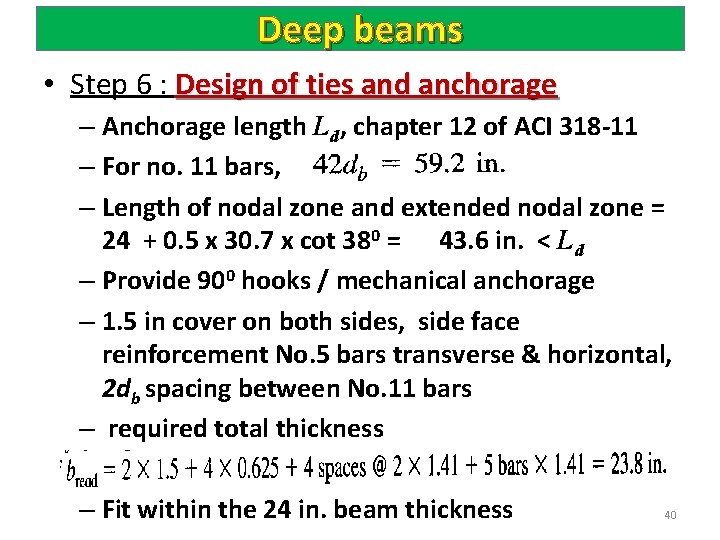
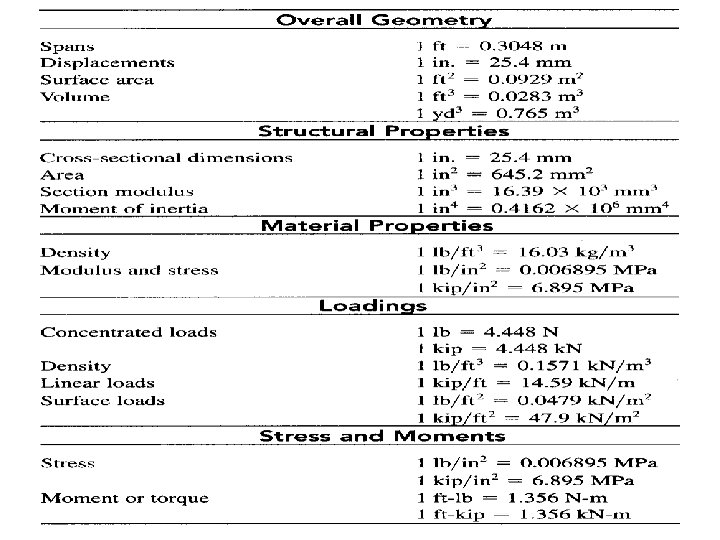
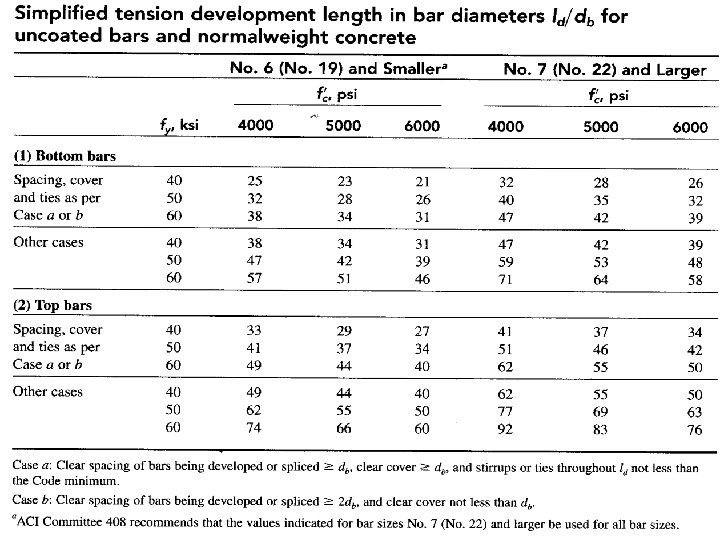
Deep beams • Step 6 : Design of ties and anchorage – Anchorage length Ld, chapter 12 of ACI 318 -11 – For no. 11 bars, – Length of nodal zone and extended nodal zone = 24 + 0. 5 x 30. 7 x cot 380 = 43. 6 in. < Ld – Provide 900 hooks / mechanical anchorage – 1. 5 in cover on both sides, side face reinforcement No. 5 bars transverse & horizontal, 2 db spacing between No. 11 bars – required total thickness – Fit within the 24 in. beam thickness 40
41
42
43
44
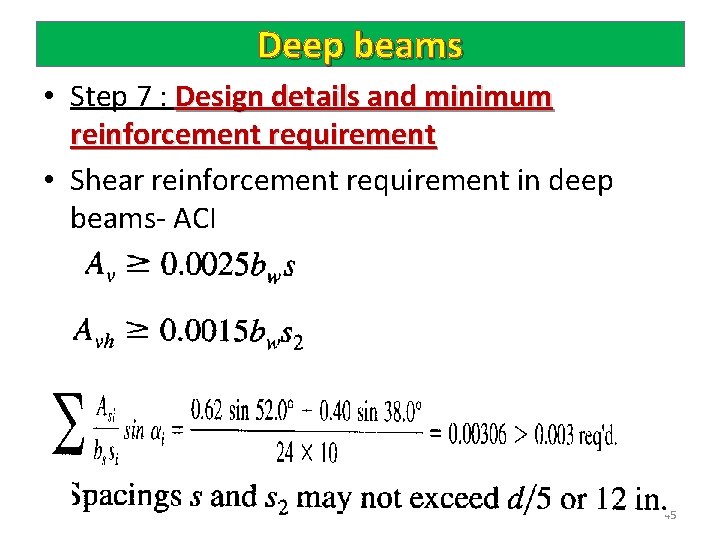
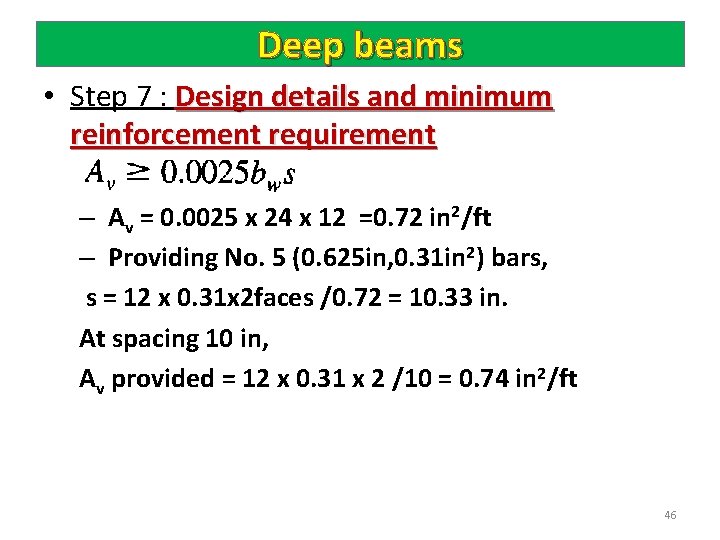
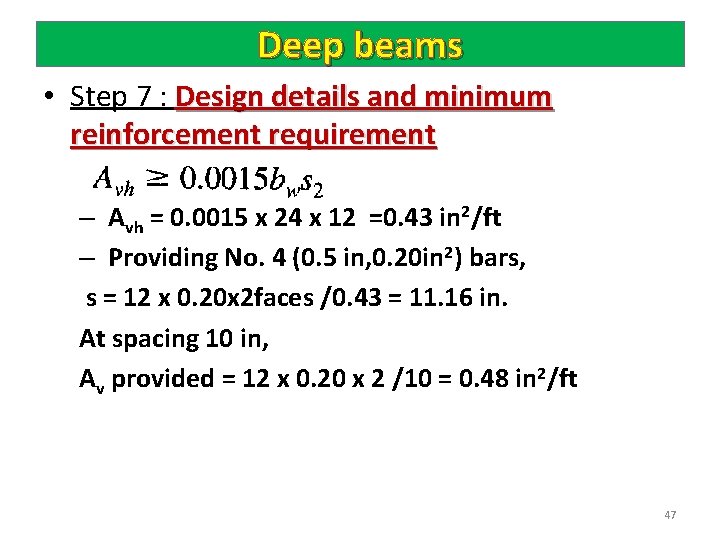
Deep beams • Step 7 : Design details and minimum reinforcement requirement • Shear reinforcement requirement in deep beams- ACI 45
Deep beams • Step 7 : Design details and minimum reinforcement requirement – Av = 0. 0025 x 24 x 12 =0. 72 in 2/ft – Providing No. 5 (0. 625 in, 0. 31 in 2) bars, s = 12 x 0. 31 x 2 faces /0. 72 = 10. 33 in. At spacing 10 in, Av provided = 12 x 0. 31 x 2 /10 = 0. 74 in 2/ft 46
Deep beams • Step 7 : Design details and minimum reinforcement requirement – Avh = 0. 0015 x 24 x 12 =0. 43 in 2/ft – Providing No. 4 (0. 5 in, 0. 20 in 2) bars, s = 12 x 0. 20 x 2 faces /0. 43 = 11. 16 in. At spacing 10 in, Av provided = 12 x 0. 20 x 2 /10 = 0. 48 in 2/ft 47
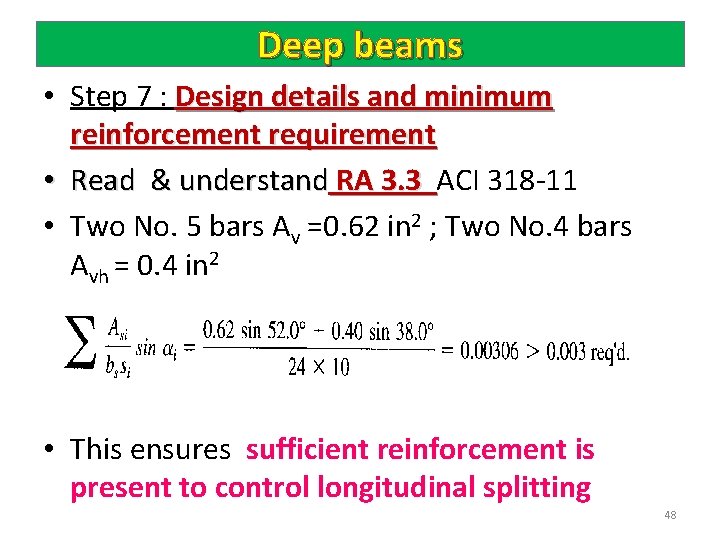
Deep beams • Step 7 : Design details and minimum reinforcement requirement • Read & understand RA 3. 3 ACI 318 -11 • Two No. 5 bars Av =0. 62 in 2 ; Two No. 4 bars Avh = 0. 4 in 2 • This ensures sufficient reinforcement is present to control longitudinal splitting 48
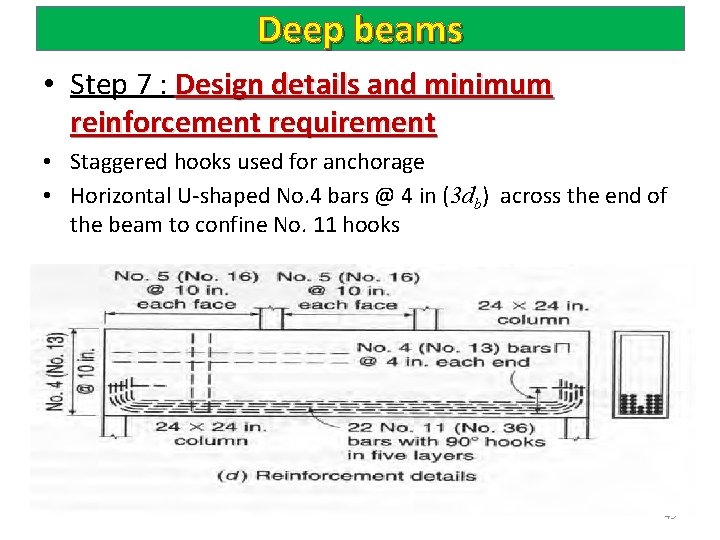
Deep beams • Step 7 : Design details and minimum reinforcement requirement • Staggered hooks used for anchorage • Horizontal U-shaped No. 4 bars @ 4 in (3 db) across the end of the beam to confine No. 11 hooks 49
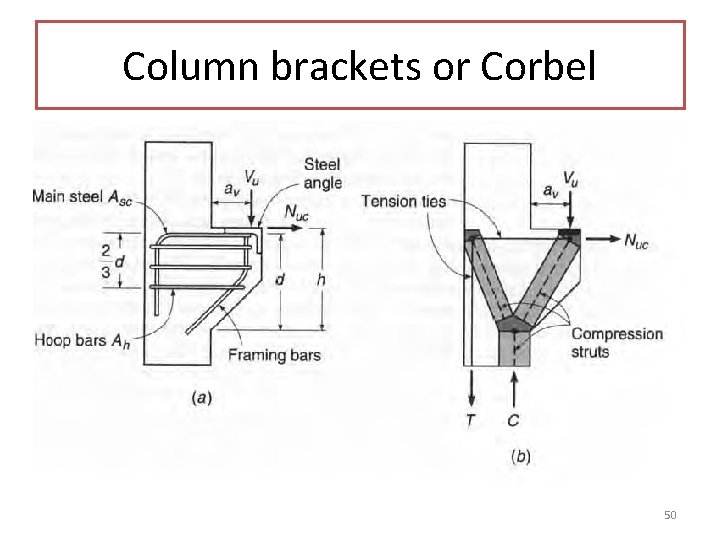
Column brackets or Corbel 50
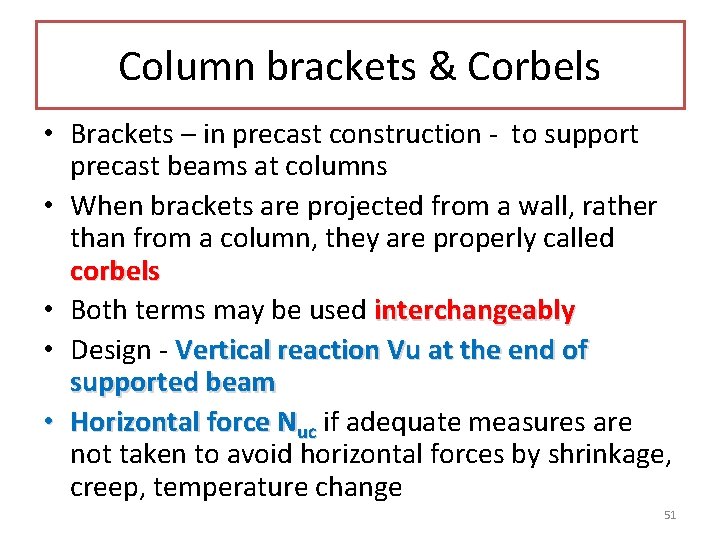
Column brackets & Corbels • Brackets – in precast construction - to support precast beams at columns • When brackets are projected from a wall, rather than from a column, they are properly called corbels • Both terms may be used interchangeably • Design - Vertical reaction Vu at the end of supported beam • Horizontal force Nuc if adequate measures are not taken to avoid horizontal forces by shrinkage, creep, temperature change 51
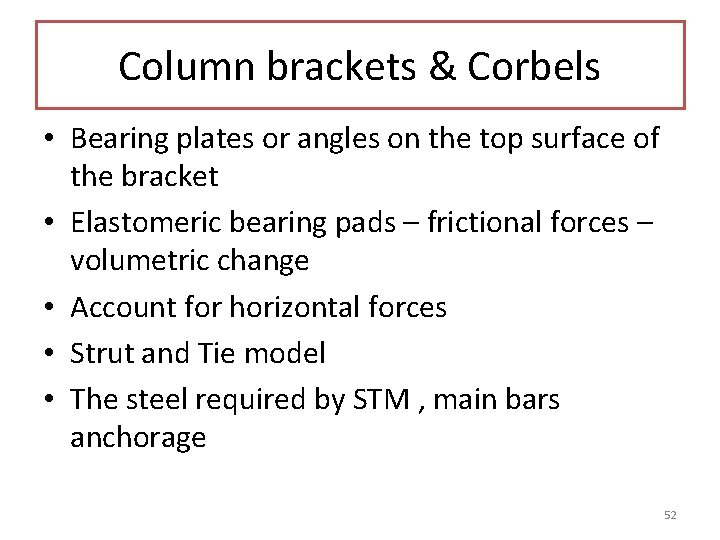
Column brackets & Corbels • Bearing plates or angles on the top surface of the bracket • Elastomeric bearing pads – frictional forces – volumetric change • Account for horizontal forces • Strut and Tie model • The steel required by STM , main bars anchorage 52
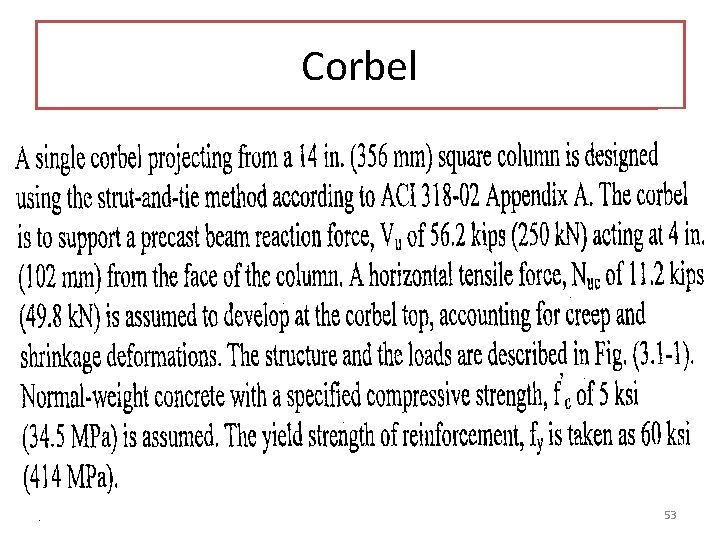
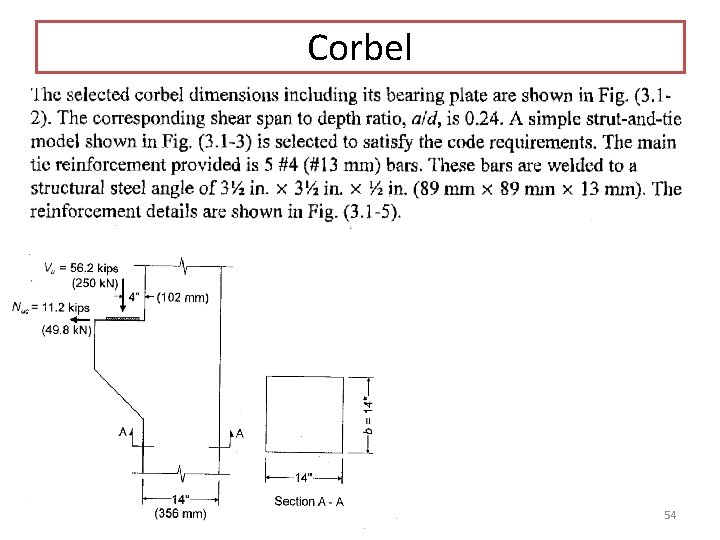
Corbel 53
Corbel 54
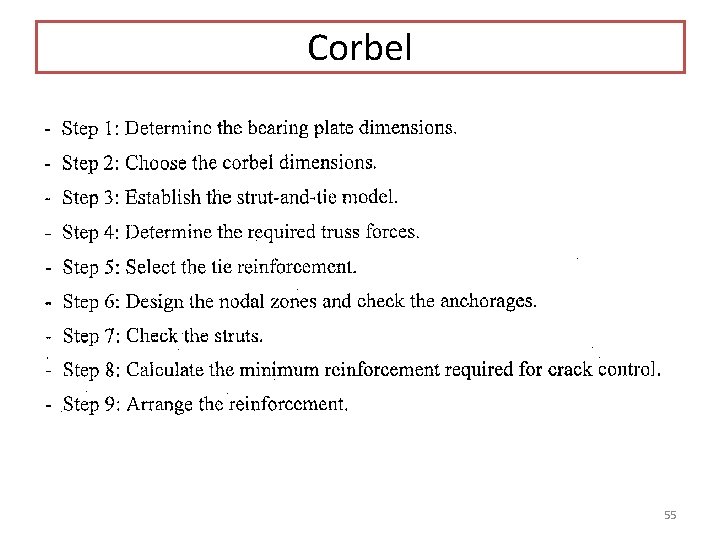
Corbel 55
Beam-Column Joints • Inadequate attention to the detailing of reinforcement • Mainly at the connection of main structural elements • The basic requirement at joint – all of the forces existing at the ends of the members must be transmitted through the joint to the supporting members 56
References: • Design of concrete structures, by A H Nilson 57