
STRUNK WHITE Rules 7 11 RULE 7 USE

- Slides: 14
STRUNK & WHITE Rules 7 -11
RULE 7: USE A COLON AFTER AN INDEPENDENT CLAUSE… v TO INTRODUCE A LIST OF PARTICULARS: • DO NOT SEPARATE A VERB FROM ITS COMPLIMENT: • INCORRECT: Your dedicated whittler requires: a knife, a piece of wood, and a porch. • CORRECT: • Your dedicated whittler requires three props: a knife, a piece of wood, and a porch.
RULE 7 (CONT. ) v Join with a colon if the second interprets or amplifies the first: • Try inserting the word “because” to see if it fits. • I hate broccoli: my mom makes it every day. v A colon may introduce a quotation that supports the preceding clause: • The squalor of the streets reminded her of a line from A Tale of Two Cities : “It was the best of the times; It was the worst of times. ”
RULE 7 (CONT. ) v Other functions of the colon: • Salutation of a formal letter • To Whom It May Concern: • Notation of time • 10: 48 P. M. • Separate the title of a work • Taxes for Dummies: A Do-It Yourself Guide • Bible chapter from a verse • Genesis 1: 1
RULE 8: USE A DASH… v. To set off an abrupt break or interruption: • His first thought on getting out of bed—if he had any thought at all—was to get back in again. v. To show a long appositive or summary: • The rear-axle began to make a noise—a grinding, chattering rasp.
RULE 9: THE NUMBER OF THE SUBJECT IS THE NUMBER OF THE VERB v Words that intervene between subject and verb, do not affect the verb. • The bittersweet flavor of youth—its trials, its joys, its adventures—is not soon forgotten. v Use a singular verb form after each, either, everyone, everybody, neither, nobody, someone. • Everybody thinks he has a unique sense of humor.
RULE 9 (CONT. ) v. With none, use a singular verb when the word means “no one” or “not one. ” • None of us is perfect. v. A plural verb is used when none suggests more than one thing or person. • None are so fallible as those who are sure they are right.
RULE 9 (CONT. ) v. A compound subject joined by and almost always requires a plural verb. • Joey and Susie are holding hands. v. Exception: some compound subjects function as ONE UNIT so they would have a singular verb: • Bread and butter is all she will eat. • Give and take is essential for a happy home.
RULE 9 (CONT. ) v A singular subject remains singular even if other nouns are connected to it by with, as well as, in addition to, except, together with, and no less than. • His speech as well as his manner is questionable. v Some nouns appear to be plural but are singular (function as one unit), so need a singular verb: • The Republican Headquarters is down the street.
RULE 10: USE THE PROPER CASE OF PRONOUN v Personal pronouns and the pronoun who, change form as they function as subject or object: • • SUBJECT: Who is going dancing tonight? OBJECT: He is dancing with whom? SUBJECT: Sally is the candidate who we think will win. OBJECT: Sally is the candidate whom we hope to elect. (We hope to elect her. ) v Use the pronoun I if it’s the subject of an understood verb. • Sandy writes better than I. (…than I write)
RULE 10 (CONT. ) v. Possessive Pronouns show ownership: • Adjective modifier (your hat) • Noun form (the hat of yours) v. Gerunds (verb +ing) require a possessive case: • Mother objected to our driving on the icy roads.
PARTICIPIAL PHRASE OR GERUND? v Participle phrases always function as adjectives, adding description to the sentence. Read these examples: v The horse trotting up to the fence hopes that you have an apple or carrot. • Trotting up to the fence modifies the noun horse. v The water drained slowly in the pipe clogged with dog hair. • Clogged with dog hair modifies the noun pipe. v Eaten by mosquitoes, we wished that we had made hotel, not campsite, reservations. • Eaten by mosquitoes modifies the pronoun we.
PARTICIPIAL PHRASE OR GERUND? v Gerund and present participle phrases are easy to confuse because they both begin with an ing word. The difference is the function that they provide in the sentence. A gerund phrase will always behave as a noun while a present participle phrase will act as an adjective. v Walking on the beach, Delores dodged jellyfish that had washed ashore. • Walking on the beach = present participle phrase describing the noun Delores. v Walking on the beach is painful if jellyfish have washed ashore. • Walking on the beach = gerund phrase, the subject of the verb is.
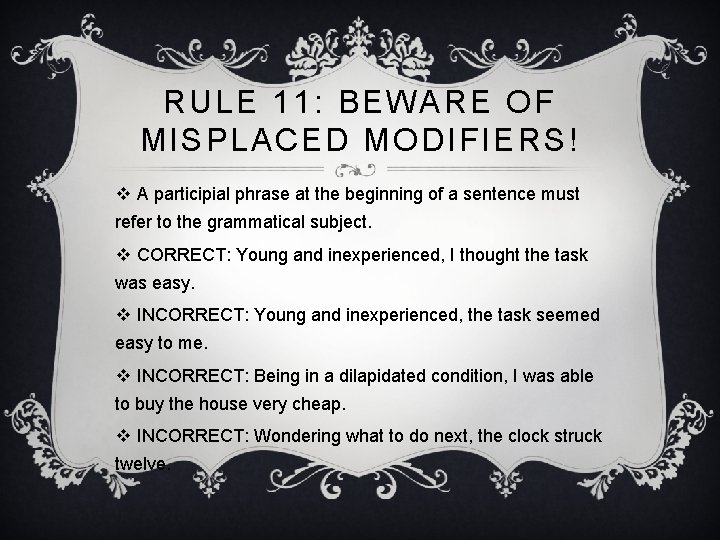
RULE 11: BEWARE OF MISPLACED MODIFIERS! v A participial phrase at the beginning of a sentence must refer to the grammatical subject. v CORRECT: Young and inexperienced, I thought the task was easy. v INCORRECT: Young and inexperienced, the task seemed easy to me. v INCORRECT: Being in a dilapidated condition, I was able to buy the house very cheap. v INCORRECT: Wondering what to do next, the clock struck twelve.