
Structures Strategies Topic 3 1 Retrieval Reward Challenge
- Slides: 2
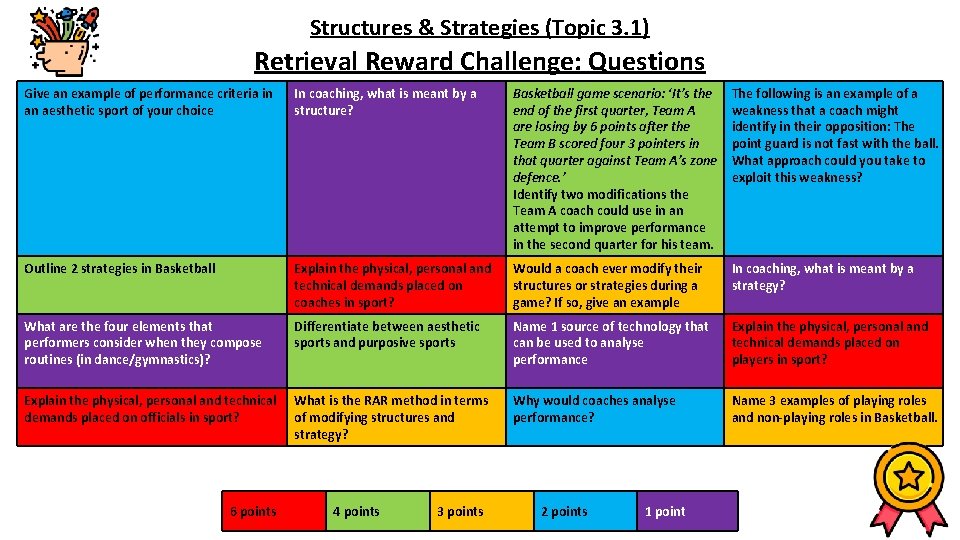
Structures & Strategies (Topic 3. 1) Retrieval Reward Challenge: Questions Give an example of performance criteria in an aesthetic sport of your choice In coaching, what is meant by a structure? Basketball game scenario: ‘It’s the end of the first quarter, Team A are losing by 6 points after the Team B scored four 3 pointers in that quarter against Team A’s zone defence. ’ Identify two modifications the Team A coach could use in an attempt to improve performance in the second quarter for his team. The following is an example of a weakness that a coach might identify in their opposition: The point guard is not fast with the ball. What approach could you take to exploit this weakness? Outline 2 strategies in Basketball Explain the physical, personal and technical demands placed on coaches in sport? Would a coach ever modify their structures or strategies during a game? If so, give an example In coaching, what is meant by a strategy? What are the four elements that performers consider when they compose routines (in dance/gymnastics)? Differentiate between aesthetic sports and purposive sports Name 1 source of technology that can be used to analyse performance Explain the physical, personal and technical demands placed on players in sport? Explain the physical, personal and technical demands placed on officials in sport? What is the RAR method in terms of modifying structures and strategy? Why would coaches analyse performance? Name 3 examples of playing roles and non-playing roles in Basketball. 6 points 4 points 3 points 2 points 1 point
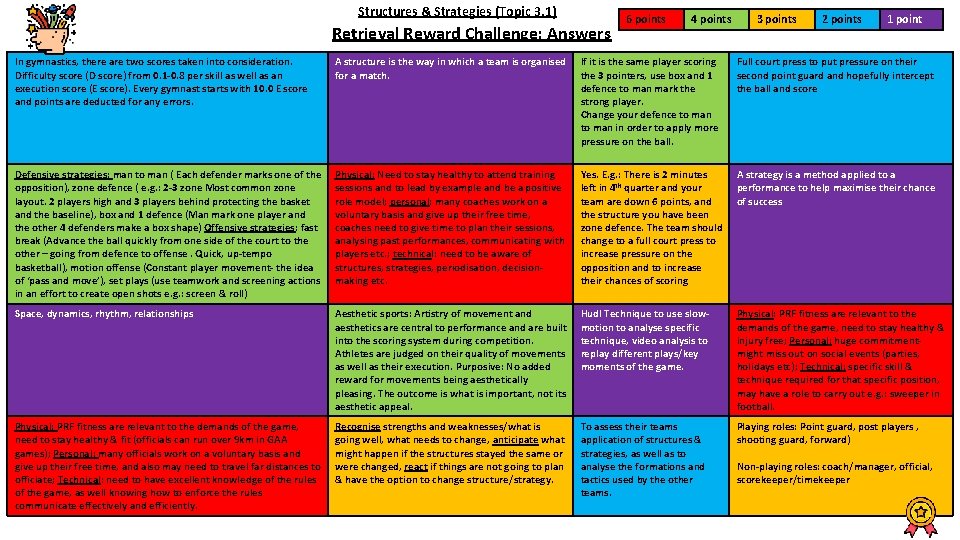
Structures & Strategies (Topic 3. 1) Retrieval Reward Challenge: Answers 6 points 4 points 3 points 2 points 1 point In gymnastics, there are two scores taken into consideration. Difficulty score (D score) from 0. 1 -0. 8 per skill as well as an execution score (E score). Every gymnast starts with 10. 0 E score and points are deducted for any errors. A structure is the way in which a team is organised for a match. If it is the same player scoring the 3 pointers, use box and 1 defence to man mark the strong player. Change your defence to man in order to apply more pressure on the ball. Full court press to put pressure on their second point guard and hopefully intercept the ball and score Defensive strategies: man to man ( Each defender marks one of the opposition), zone defence ( e. g. : 2 -3 zone Most common zone layout. 2 players high and 3 players behind protecting the basket and the baseline), box and 1 defence (Man mark one player and the other 4 defenders make a box shape) Offensive strategies: fast break (Advance the ball quickly from one side of the court to the other – going from defence to offense. Quick, up-tempo basketball), motion offense (Constant player movement- the idea of ‘pass and move’), set plays (use teamwork and screening actions in an effort to create open shots e. g. : screen & roll) Physical: Need to stay healthy to attend training sessions and to lead by example and be a positive role model; personal: many coaches work on a voluntary basis and give up their free time, coaches need to give time to plan their sessions, analysing past performances, communicating with players etc. ; technical: need to be aware of structures, strategies, periodisation, decisionmaking etc. Yes. E. g. : There is 2 minutes left in 4 th quarter and your team are down 6 points, and the structure you have been zone defence. The team should change to a full court press to increase pressure on the opposition and to increase their chances of scoring A strategy is a method applied to a performance to help maximise their chance of success Space, dynamics, rhythm, relationships Aesthetic sports: Artistry of movement and aesthetics are central to performance and are built into the scoring system during competition. Athletes are judged on their quality of movements as well as their execution. Purposive: No added reward for movements being aesthetically pleasing. The outcome is what is important, not its aesthetic appeal. Hudl Technique to use slowmotion to analyse specific technique, video analysis to replay different plays/key moments of the game. Physical: PRF fitness are relevant to the demands of the game, need to stay healthy & injury free; Personal: huge commitmentmight miss out on social events (parties, holidays etc); Technical: specific skill & technique required for that specific position, may have a role to carry out e. g. : sweeper in football. Physical: PRF fitness are relevant to the demands of the game, need to stay healthy & fit (officials can run over 9 km in GAA games); Personal: many officials work on a voluntary basis and give up their free time, and also may need to travel far distances to officiate; Technical: need to have excellent knowledge of the rules of the game, as well knowing how to enforce the rules communicate effectively and efficiently. Recognise strengths and weaknesses/what is going well, what needs to change, anticipate what might happen if the structures stayed the same or were changed, react if things are not going to plan & have the option to change structure/strategy. To assess their teams application of structures & strategies, as well as to analyse the formations and tactics used by the other teams. Playing roles: Point guard, post players , shooting guard, forward) Non-playing roles: coach/manager, official, scorekeeper/timekeeper