
Structures of Networks D Watts S Strogatz Collective

- Slides: 24
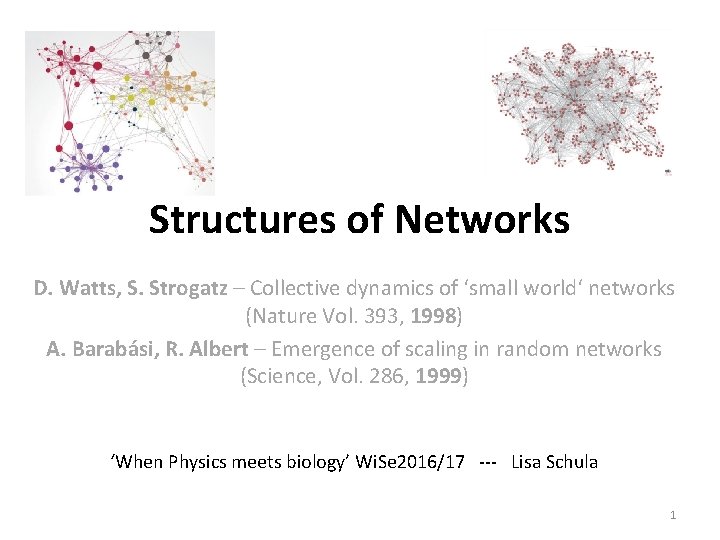
Structures of Networks D. Watts, S. Strogatz – Collective dynamics of ‘small world‘ networks (Nature Vol. 393, 1998) A. Barabási, R. Albert – Emergence of scaling in random networks (Science, Vol. 286, 1999) ‘When Physics meets biology’ Wi. Se 2016/17 --- Lisa Schula 1
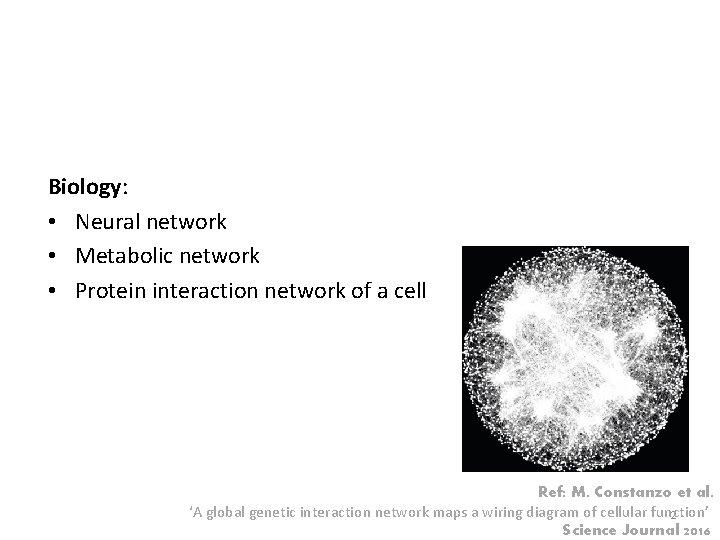
Biology: • Neural network • Metabolic network • Protein interaction network of a cell Ref: M. Constanzo et al. ‘A global genetic interaction network maps a wiring diagram of cellular function’ 2 Science Journal 2016
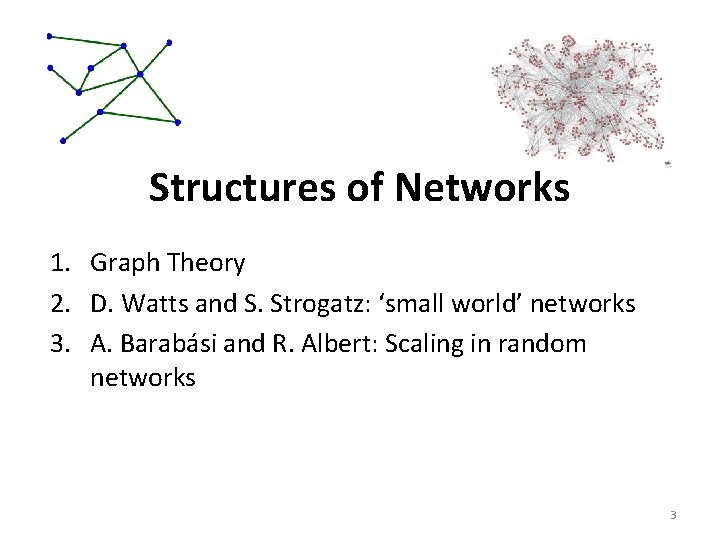
Structures of Networks 1. Graph Theory 2. D. Watts and S. Strogatz: ‘small world’ networks 3. A. Barabási and R. Albert: Scaling in random networks 3
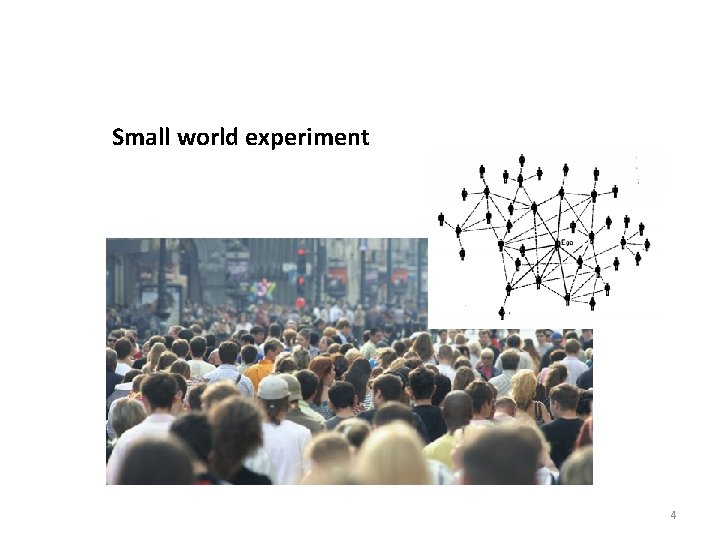
Small world experiment 4
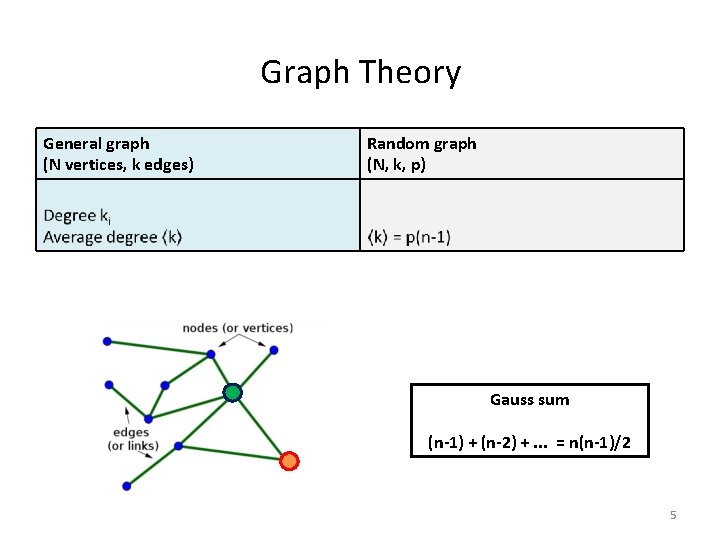
Graph Theory General graph (N vertices, k edges) Random graph (N, k, p) Gauss sum (n-1) + (n-2) +. . . = n(n-1)/2 5
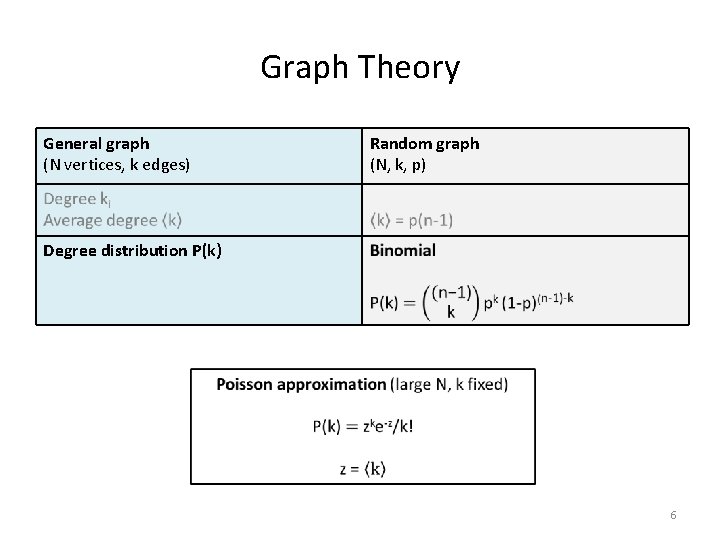
Graph Theory General graph (N vertices, k edges) Random graph (N, k, p) Degree distribution P(k) 6
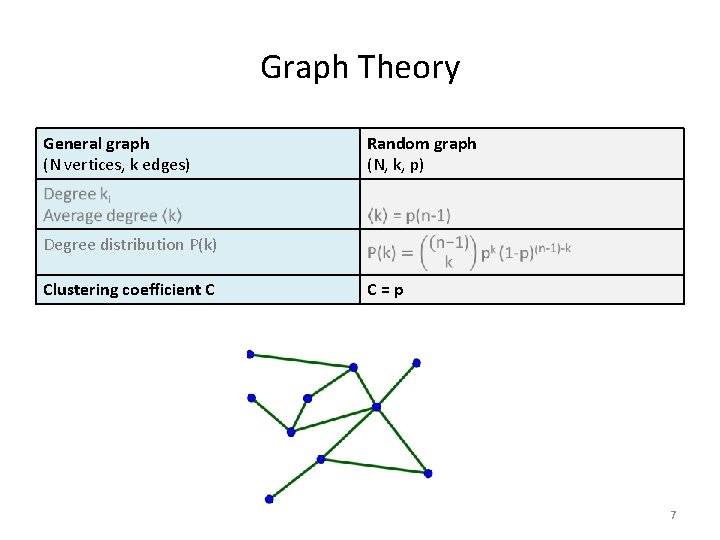
Graph Theory General graph (N vertices, k edges) Random graph (N, k, p) Degree distribution P(k) Clustering coefficient C C=p 7
Graph Theory General graph (N vertices, k edges) Random graph (N, k, p) Degree distribution P(k) Clustering C C = p Shortest path length Lij Average path length L Random graph versus Regular grid 8
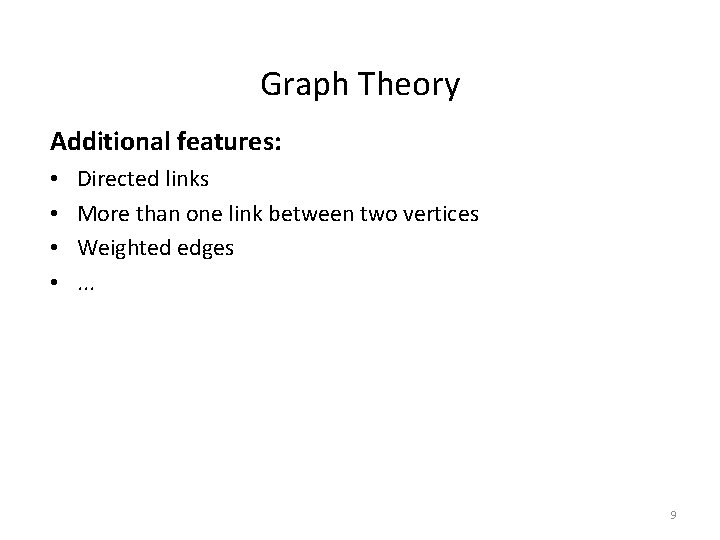
Graph Theory Additional features: • • Directed links More than one link between two vertices Weighted edges. . . 9
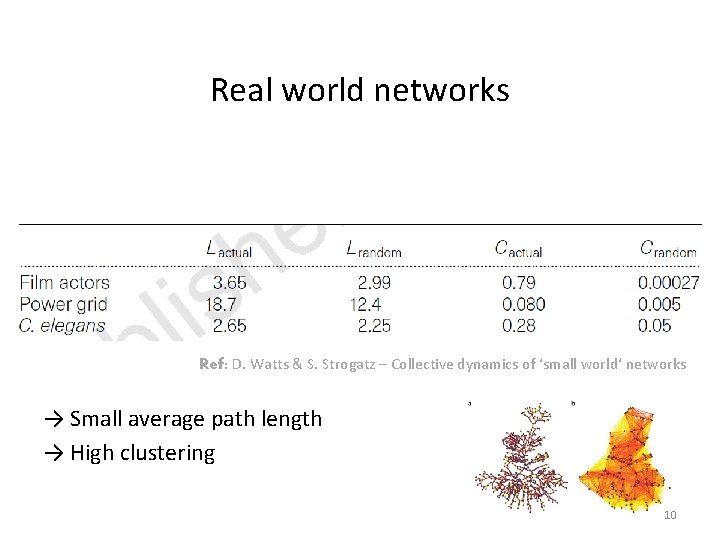
Real world networks Ref: D. Watts & S. Strogatz – Collective dynamics of ‘small world‘ networks → Small average path length → High clustering 10
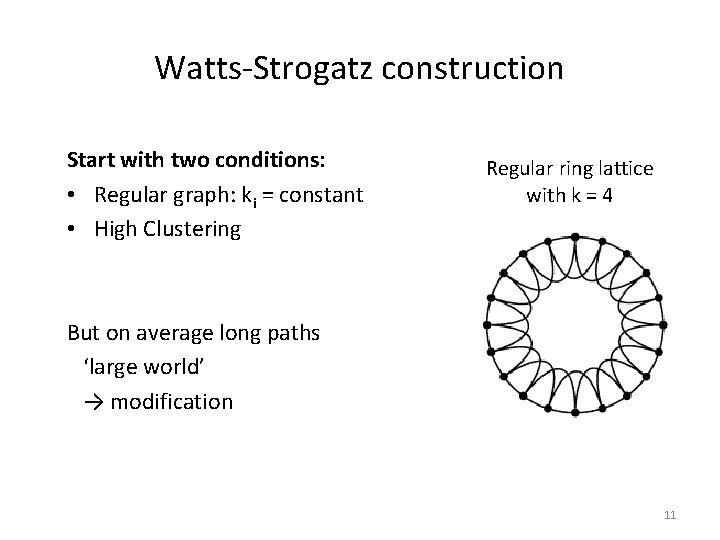
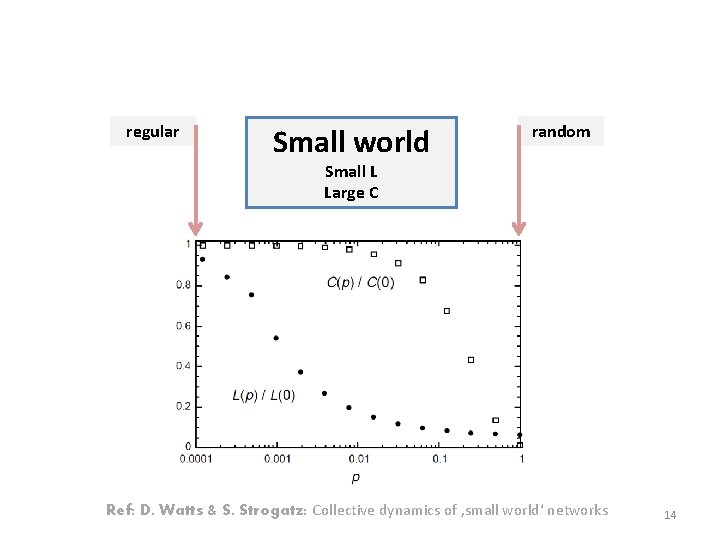
Watts-Strogatz construction Start with two conditions: • Regular graph: ki = constant • High Clustering Regular ring lattice with k = 4 But on average long paths ‘large world’ → modification 11
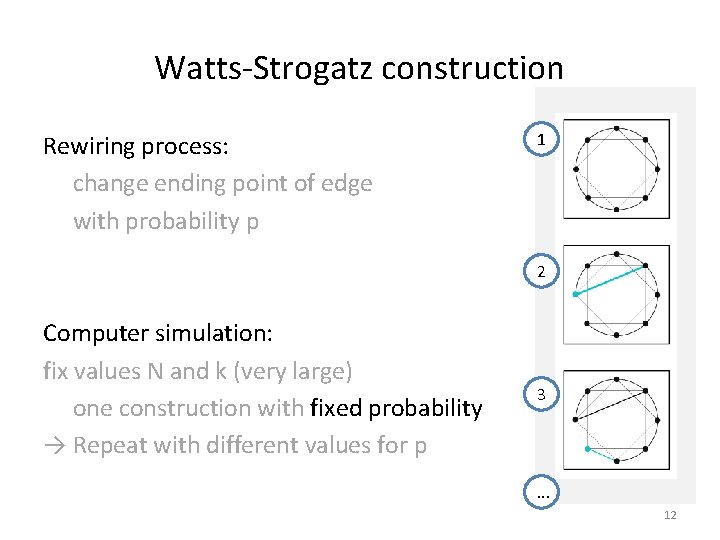
Watts-Strogatz construction Rewiring process: change ending point of edge with probability p 1 2 Computer simulation: fix values N and k (very large) one construction with fixed probability → Repeat with different values for p 3 . . . 12
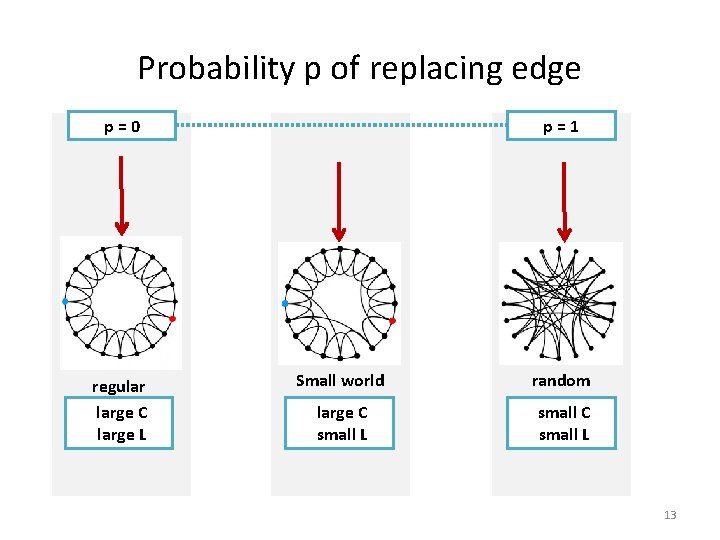
Probability p of replacing edge p=0 regular large C large L p=1 Small world random large C small L small C small L 13
regular Small world random Small L Large C Ref: D. Watts & S. Strogatz: Collective dynamics of ‚small world‘ networks 14
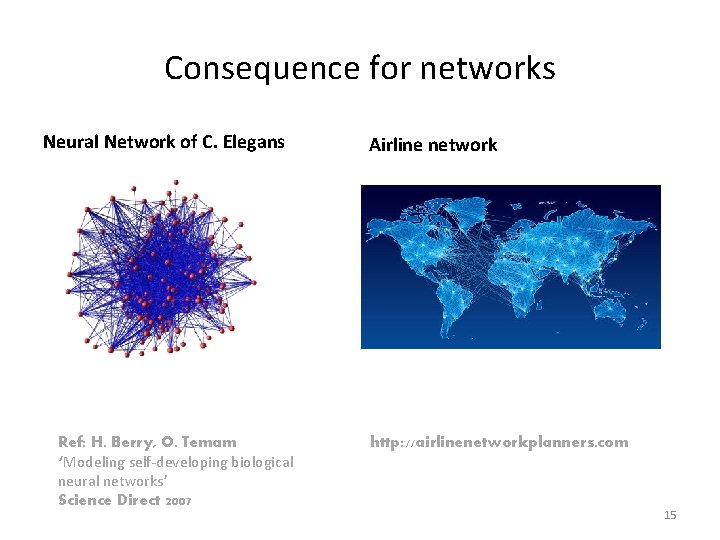
Consequence for networks Neural Network of C. Elegans Ref: H. Berry, O. Temam ‘Modeling self-developing biological neural networks’ Science Direct 2007 Airline network http: //airlinenetworkplanners. com 15
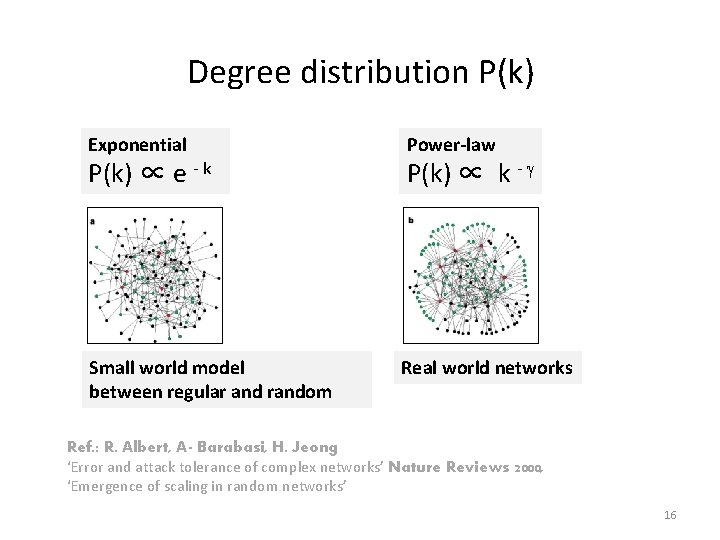
Degree distribution P(k) Exponential Power-law Small world model between regular and random Real world networks P(k) ∝ e - k P(k) ∝ k - Ref. : R. Albert, A- Barabasi, H. Jeong ‘Error and attack tolerance of complex networks’ Nature Reviews 2000, ‘Emergence of scaling in random networks’ 16
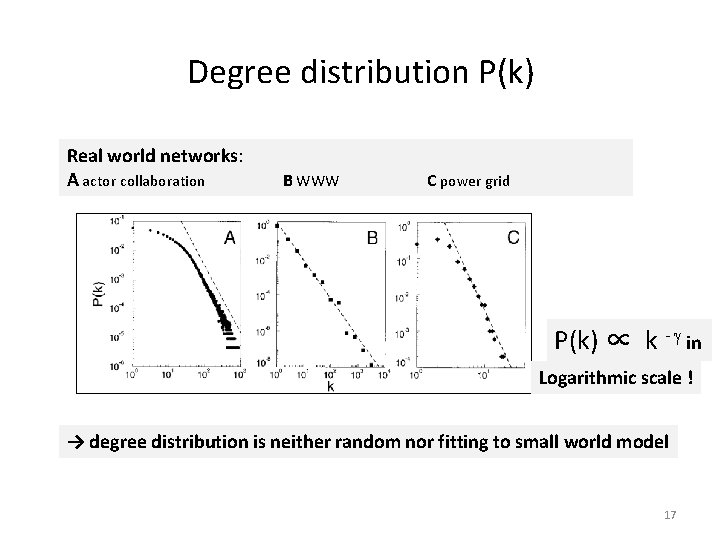
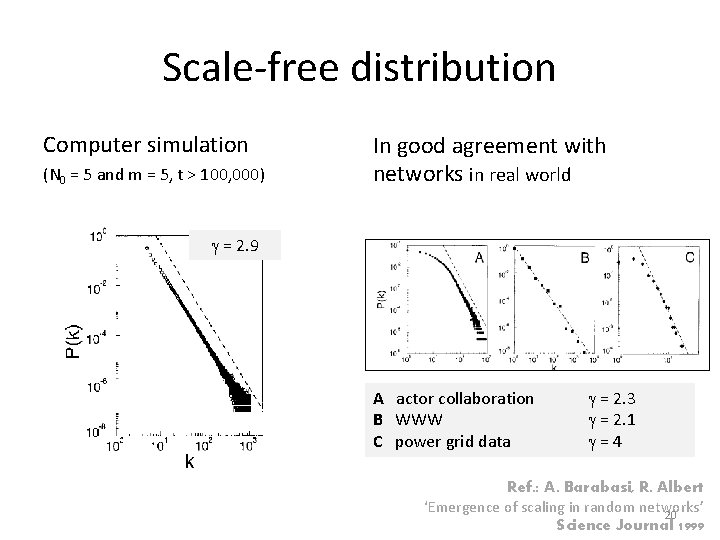
Degree distribution P(k) Real world networks: A actor collaboration B WWW C power grid P(k) ∝ k - in Logarithmic scale ! → degree distribution is neither random nor fitting to small world model 17
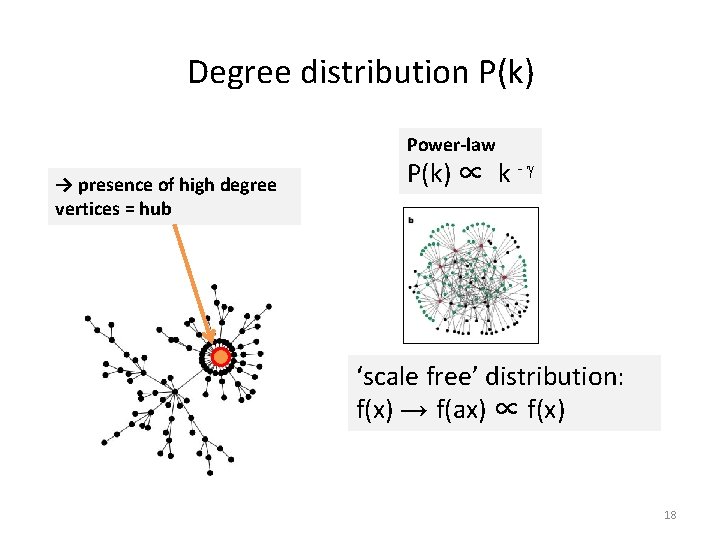
Degree distribution P(k) Power-law → presence of high degree vertices = hub P(k) ∝ k - ‘scale free’ distribution: f(x) → f(ax) ∝ f(x) 18
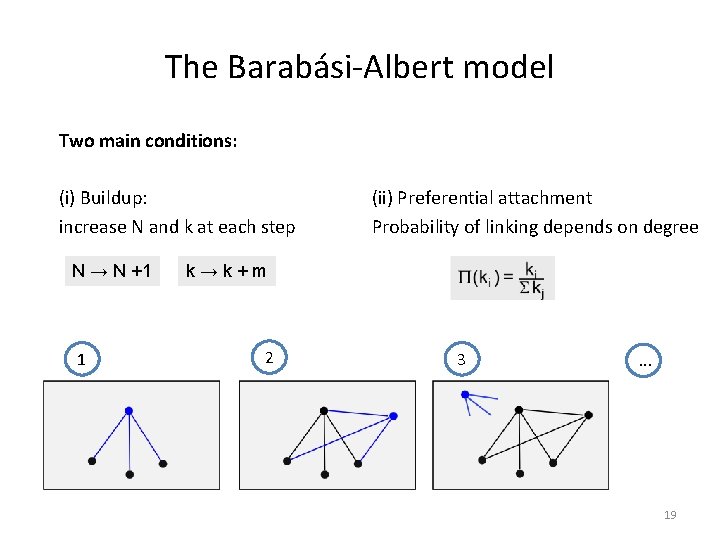
The Barabási-Albert model Two main conditions: (i) Buildup: increase N and k at each step N → N +1 1 k→k+m 2 (ii) Preferential attachment Probability of linking depends on degree 3 . . . 19
Scale-free distribution Computer simulation (N 0 = 5 and m = 5, t > 100, 000) In good agreement with networks in real world = 2. 9 A actor collaboration B WWW C power grid data = 2. 3 = 2. 1 = 4 Ref. : A. Barabasi, R. Albert ‘Emergence of scaling in random networks’ 20 Science Journal 1999
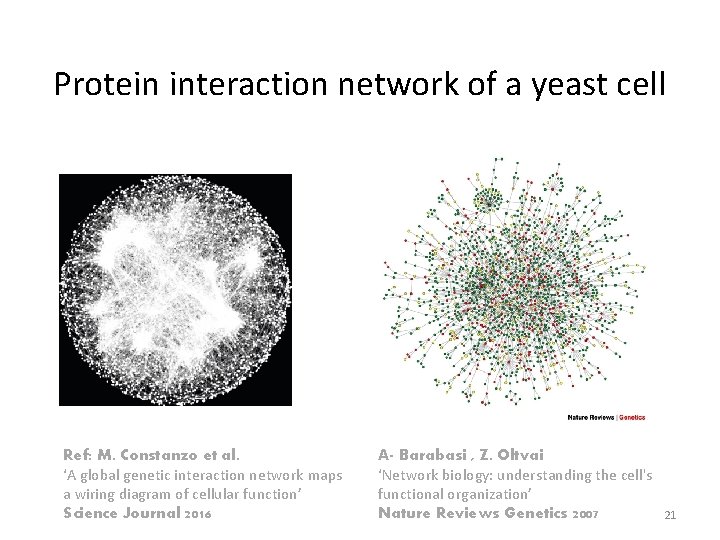
Protein interaction network of a yeast cell Ref: M. Constanzo et al. ‘A global genetic interaction network maps a wiring diagram of cellular function’ Science Journal 2016 A- Barabasi , Z. Oltvai ‘Network biology: understanding the cell's functional organization’ Nature Reviews Genetics 2007 21
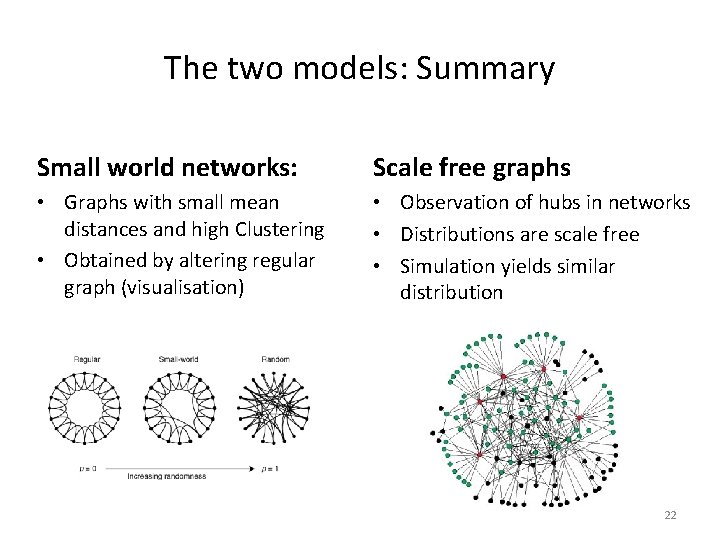
The two models: Summary Small world networks: Scale free graphs • Graphs with small mean distances and high Clustering • Obtained by altering regular graph (visualisation) • Observation of hubs in networks • Distributions are scale free • Simulation yields similar distribution 22
The use of modelling Watts-Strogatz Barabási-Albert • Few short cuts in regular system lead to ‘small world‘ • Fast information exchange but also fast disease spread • Indicate presence of hubs → learn about vulnerability • Trying to find universal laws and study evolution of networks Networks appearing in nature are not fundamentally random 23
references • D. Watts, S. Strogatz – Collective dynamics of ‘small world‘ networks (Nature Vol. 393, 1998) • A. Barabási, R. Albert – Emergence of scaling in random networks (Science, Vol. 286, 1999) • M. Newman – Random graphs as models of networks (SFI Working Papers, 2002) • S. Wuchty, W. Ravasz, A. Barabási – The architecture of biological networks (University of Notre Dame, Indiana) 24