
Structures Jordi Cortadella Department of Computer Science Structures
- Slides: 13
Structures Jordi Cortadella Department of Computer Science
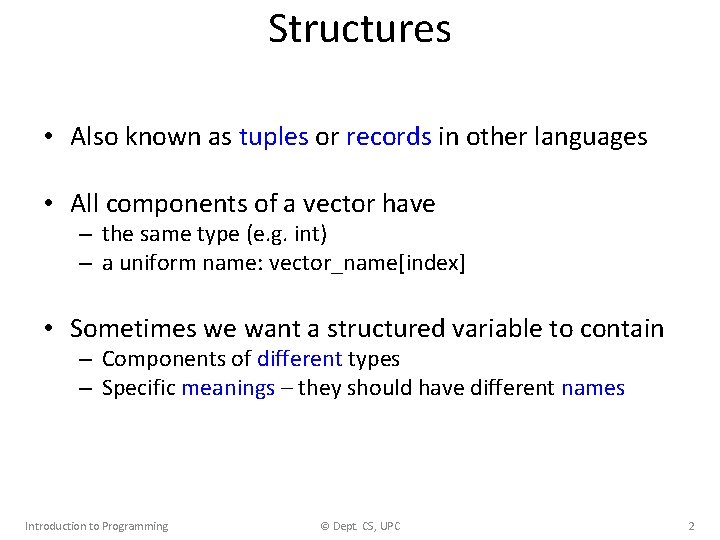
Structures • Also known as tuples or records in other languages • All components of a vector have – the same type (e. g. int) – a uniform name: vector_name[index] • Sometimes we want a structured variable to contain – Components of different types – Specific meanings – they should have different names Introduction to Programming © Dept. CS, UPC 2
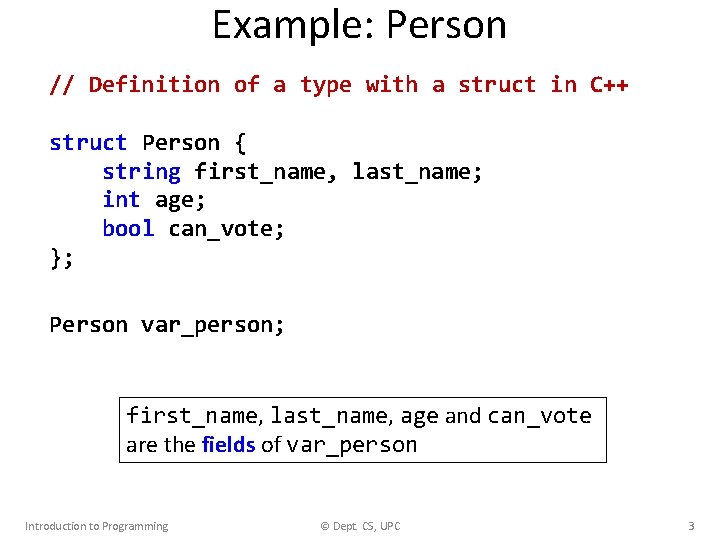
Example: Person // Definition of a type with a struct in C++ struct Person { string first_name, last_name; int age; bool can_vote; }; Person var_person; first_name, last_name, age and can_vote are the fields of var_person Introduction to Programming © Dept. CS, UPC 3
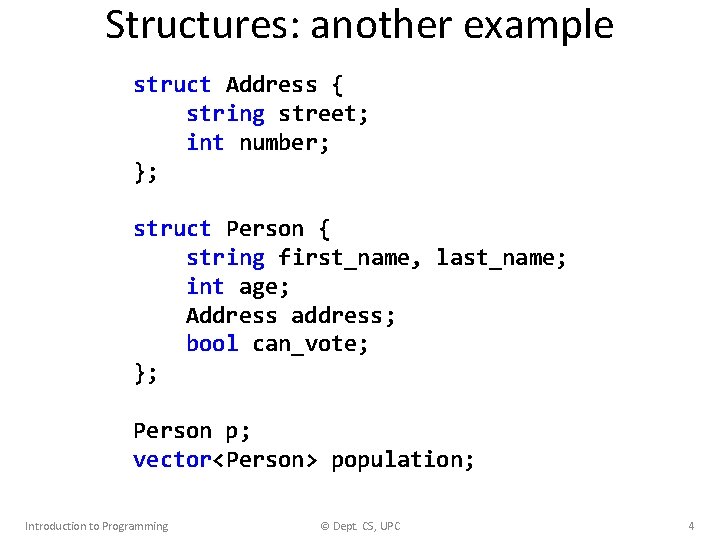
Structures: another example struct Address { string street; int number; }; struct Person { string first_name, last_name; int age; Address address; bool can_vote; }; Person p; vector<Person> population; Introduction to Programming © Dept. CS, UPC 4
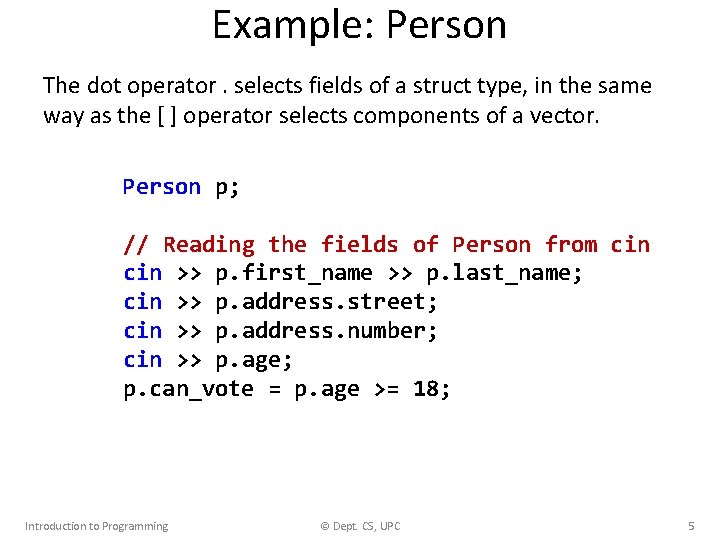
Example: Person The dot operator. selects fields of a struct type, in the same way as the [ ] operator selects components of a vector. Person p; // Reading the fields of Person from cin >> p. first_name >> p. last_name; cin >> p. address. street; cin >> p. address. number; cin >> p. age; p. can_vote = p. age >= 18; Introduction to Programming © Dept. CS, UPC 5
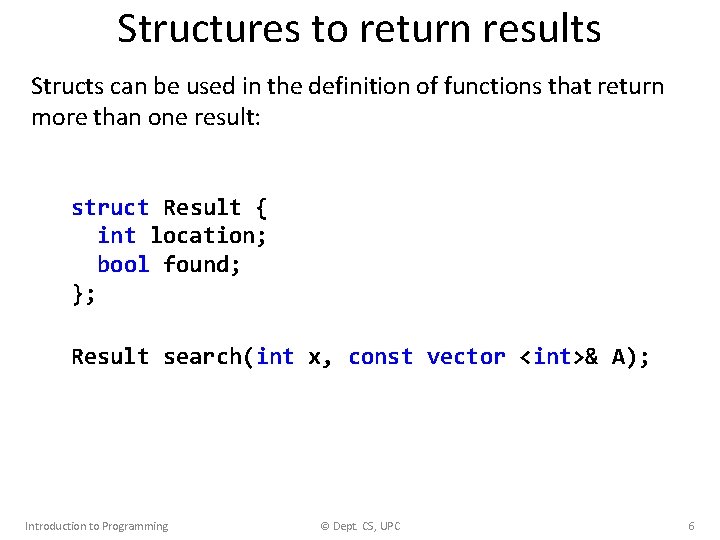
Structures to return results Structs can be used in the definition of functions that return more than one result: struct Result { int location; bool found; }; Result search(int x, const vector <int>& A); Introduction to Programming © Dept. CS, UPC 6
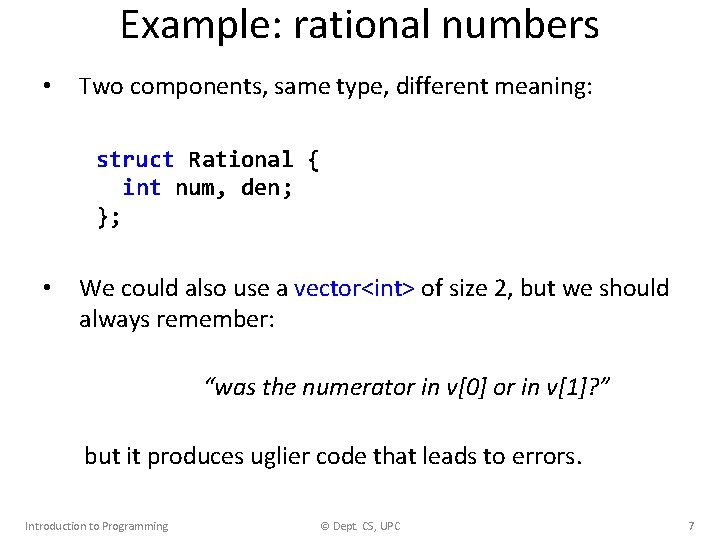
Example: rational numbers • Two components, same type, different meaning: struct Rational { int num, den; }; • We could also use a vector<int> of size 2, but we should always remember: “was the numerator in v[0] or in v[1]? ” but it produces uglier code that leads to errors. Introduction to Programming © Dept. CS, UPC 7
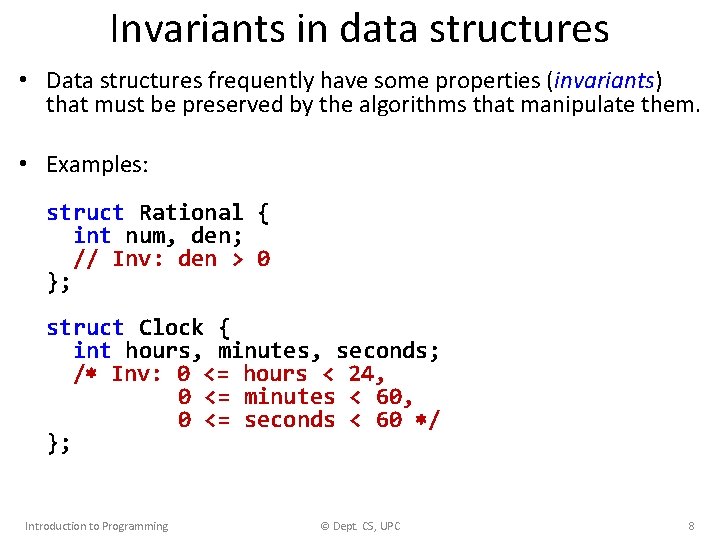
Invariants in data structures • Data structures frequently have some properties (invariants) that must be preserved by the algorithms that manipulate them. • Examples: struct Rational { int num, den; // Inv: den > 0 }; struct Clock { int hours, minutes, seconds; / Inv: 0 <= hours < 24, 0 <= minutes < 60, 0 <= seconds < 60 / }; Introduction to Programming © Dept. CS, UPC 8
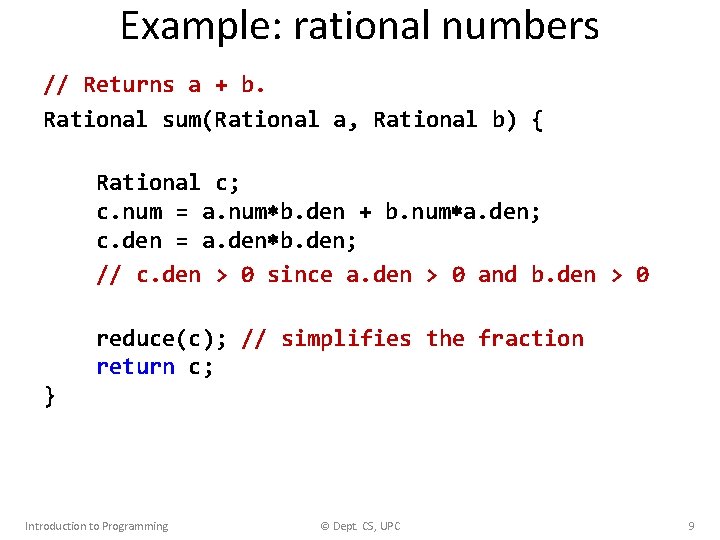
Example: rational numbers // Returns a + b. Rational sum(Rational a, Rational b) { Rational c; c. num = a. num b. den + b. num a. den; c. den = a. den b. den; // c. den > 0 since a. den > 0 and b. den > 0 reduce(c); // simplifies the fraction return c; } Introduction to Programming © Dept. CS, UPC 9
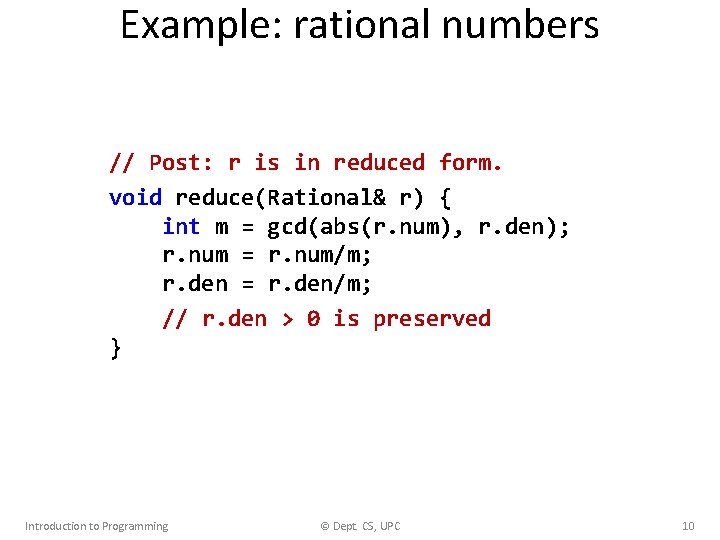
Example: rational numbers // Post: r is in reduced form. void reduce(Rational& r) { int m = gcd(abs(r. num), r. den); r. num = r. num/m; r. den = r. den/m; // r. den > 0 is preserved } Introduction to Programming © Dept. CS, UPC 10
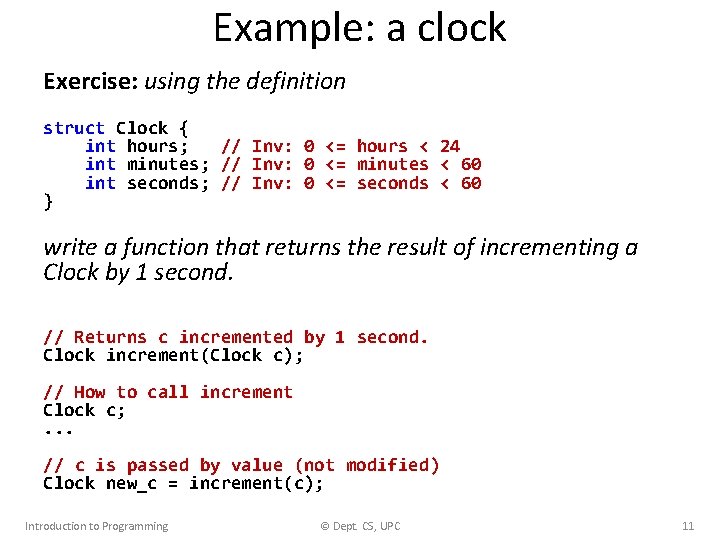
Example: a clock Exercise: using the definition struct Clock { int hours; // Inv: 0 <= hours < 24 int minutes; // Inv: 0 <= minutes < 60 int seconds; // Inv: 0 <= seconds < 60 } write a function that returns the result of incrementing a Clock by 1 second. // Returns c incremented by 1 second. Clock increment(Clock c); // How to call increment Clock c; . . . // c is passed by value (not modified) Clock new_c = increment(c); Introduction to Programming © Dept. CS, UPC 11
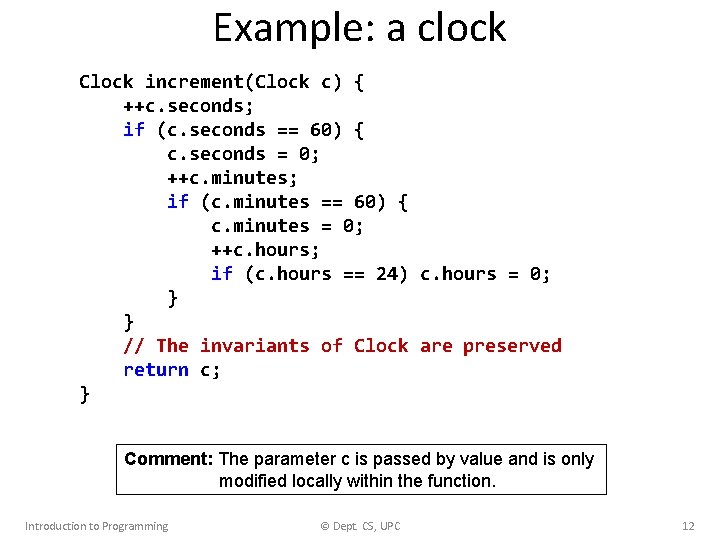
Example: a clock Clock increment(Clock c) { ++c. seconds; if (c. seconds == 60) { c. seconds = 0; ++c. minutes; if (c. minutes == 60) { c. minutes = 0; ++c. hours; if (c. hours == 24) c. hours = 0; } } // The invariants of Clock are preserved return c; } Comment: The parameter c is passed by value and is only modified locally within the function. Introduction to Programming © Dept. CS, UPC 12
Summary • Structures can hold multiple heterogeneous data under a single variable. • They can provide simple abstractions of complex objects. • The generalization of structures with their own methods (functions) leads to the Object. Oriented Programming (OOP) paradigm. Introduction to Programming © Dept. CS, UPC 13