
Structures and Bonding Giant Covalent Structures Worksheet Combined
Structures and Bonding Giant Covalent Structures Worksheet Combined Science - Chemistry - Key Stage 4 Mr Robbins 1
2
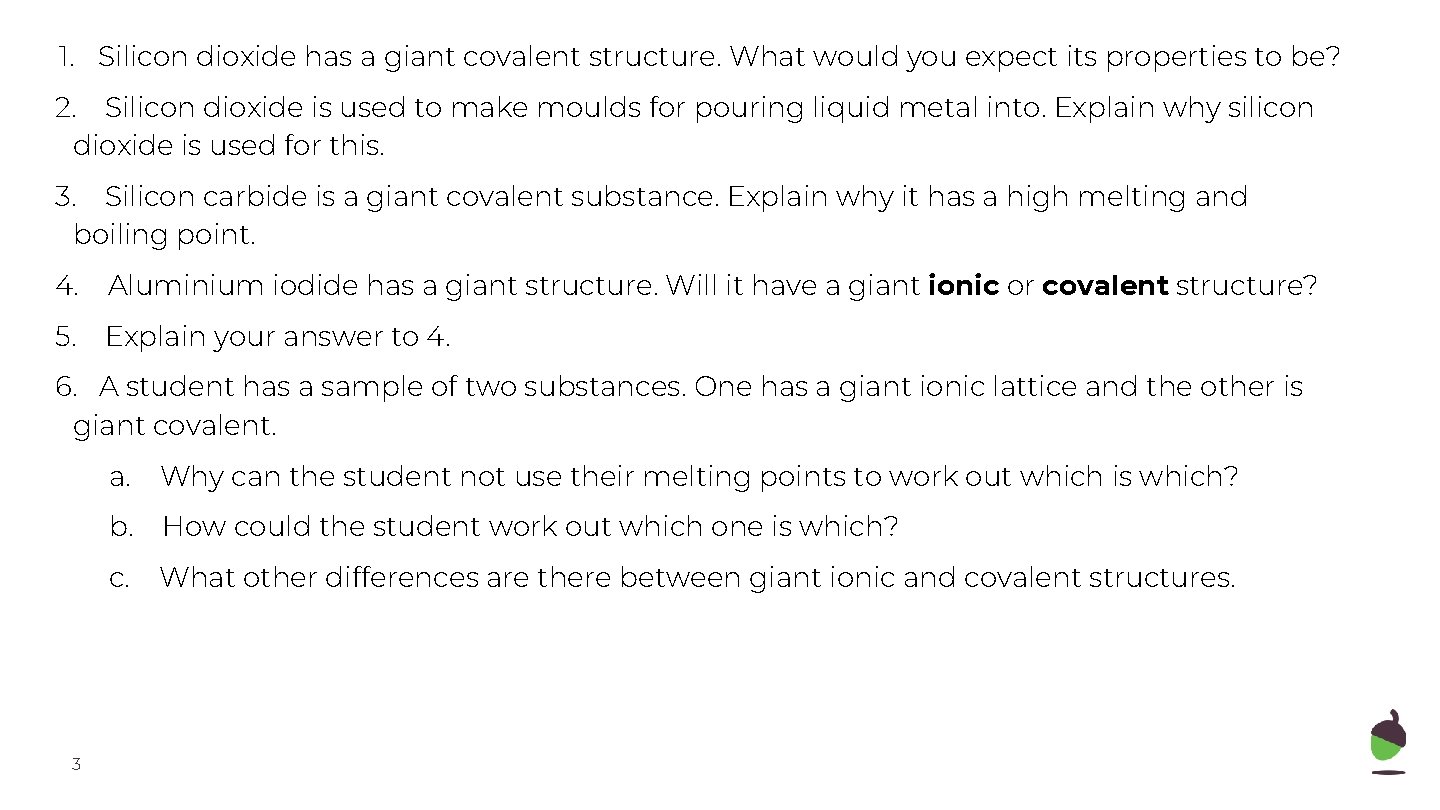
1. Silicon dioxide has a giant covalent structure. What would you expect its properties to be? 2. Silicon dioxide is used to make moulds for pouring liquid metal into. Explain why silicon dioxide is used for this. 3. Silicon carbide is a giant covalent substance. Explain why it has a high melting and boiling point. 4. Aluminium iodide has a giant structure. Will it have a giant ionic or covalent structure? 5. Explain your answer to 4. 6. A student has a sample of two substances. One has a giant ionic lattice and the other is giant covalent. 3 a. Why can the student not use their melting points to work out which is which? b. How could the student work out which one is which? c. What other differences are there between giant ionic and covalent structures.
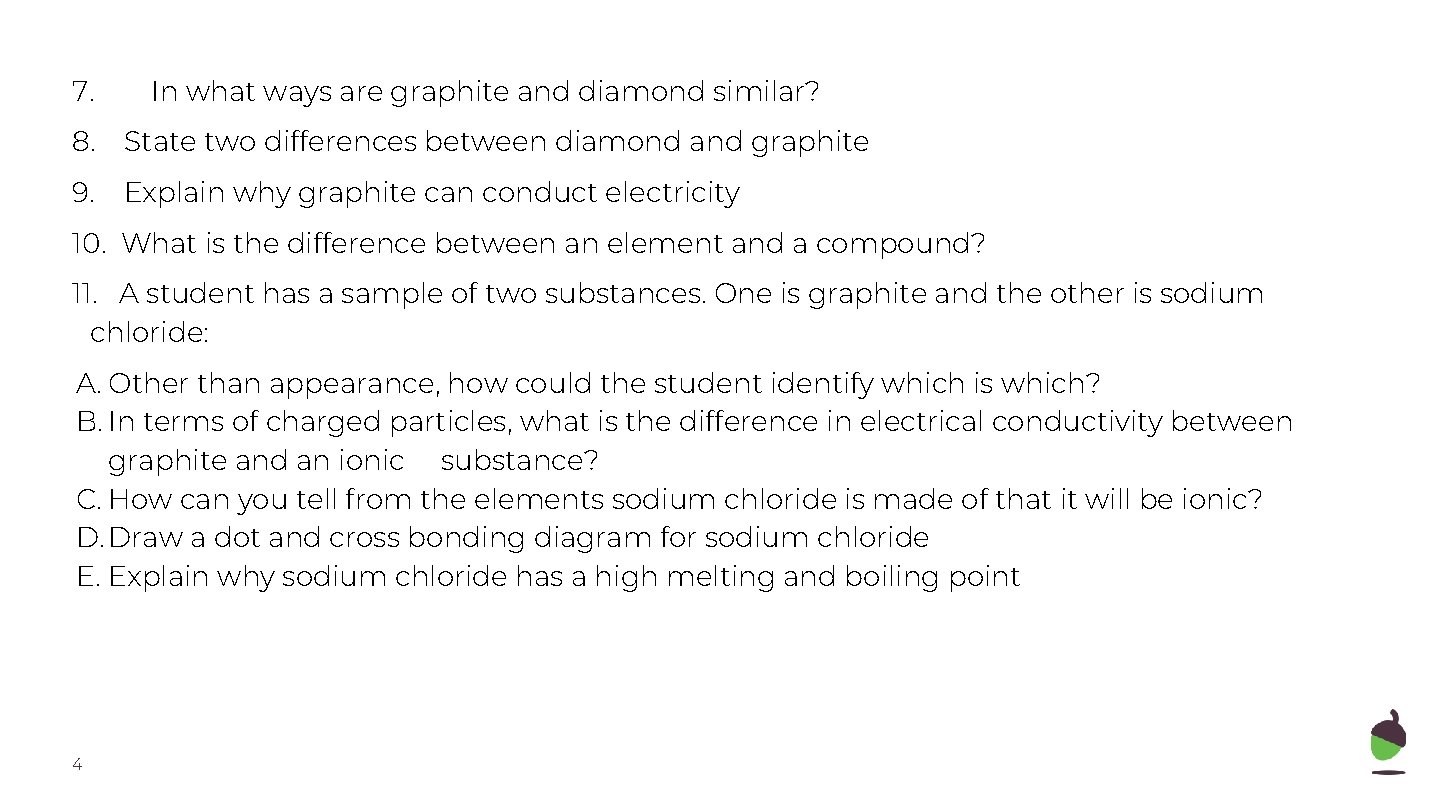
7. In what ways are graphite and diamond similar? 8. State two differences between diamond and graphite 9. Explain why graphite can conduct electricity 10. What is the difference between an element and a compound? 11. A student has a sample of two substances. One is graphite and the other is sodium chloride: A. Other than appearance, how could the student identify which is which? B. In terms of charged particles, what is the difference in electrical conductivity between graphite and an ionic substance? C. How can you tell from the elements sodium chloride is made of that it will be ionic? D. Draw a dot and cross bonding diagram for sodium chloride E. Explain why sodium chloride has a high melting and boiling point 4
Answers 1. 2. 3. 4. 5. 6. Hard, high melting and boiling point, not conduct electricity High melting point Strong covalent bonds between the atoms require lots of energy to break Ionic Aluminium loses electrons, iodine gains/ metal bonding to a non-metal a. They would both be high b. Melt them/dissolve and see which conducts electricity c. One is made of ions, the other of atoms 1. 2. 3. 4. 5. Made of carbon atoms, giant covalent structures Graphite is in layers, is soft and conducts electricity Delocalised electrons are free to move through the graphite Element is only one type of atoms chemically bonded, compound is two or more a. See which conducts electricity when solid b. Ionic substance conducts by the movement of ions, graphite by the movement of electrons c. Sodium is a metal and chlorine is a non-metal d. Sodium is 2, 8 with a 1+ charge, chlorine is 2, 8, 8 with a 1 - charge 5 e. Giant ionic lattice; strong ionic bonds formed from electrostatic force of attraction between oppositely charged ions, requires lots of energy to break
Quick check Giant covalent structures have high _________ and boiling points because the atoms are held together by ________ bonds in a _______ covalent lattice. These need a lot of ______ to break so we need to _______ them to a high temperature. 6
Independent task 1. Why do diamond and graphite have a high melting and boiling point? 1. Why is diamond hard? 2. Why is graphite soft? 3. Why can graphite conduct electricity? 4. Why does diamond not conduct electricity? 7
Independent practice Graphite is used in Lubricants. Explain why graphite is used this way. Include information about the structure and bonding of graphite in your answer. - State the property of graphite State the structure of graphite Describe the number and type of bonds in graphite Explain why these bonds give graphite the right property Keywords: soft, carbon, covalent bond, three, strong, layers, weak forces of attraction 8
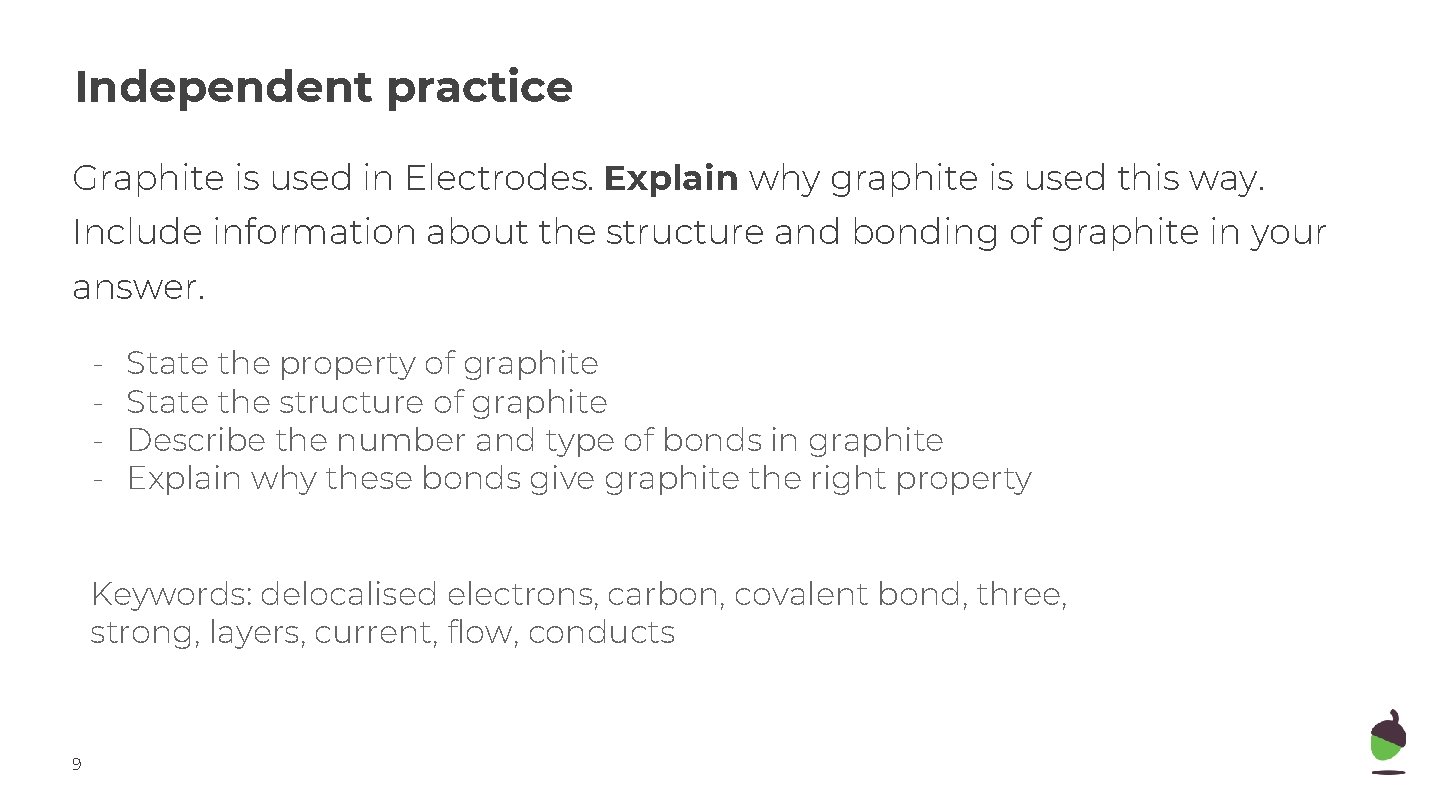
Independent practice Graphite is used in Electrodes. Explain why graphite is used this way. Include information about the structure and bonding of graphite in your answer. - State the property of graphite State the structure of graphite Describe the number and type of bonds in graphite Explain why these bonds give graphite the right property Keywords: delocalised electrons, carbon, covalent bond, three, strong, layers, current, flow, conducts 9
- Slides: 9