
Structures A structure can be used to define
Structures § A structure can be used to define a new data type that contains items that logically belong together, even if the items are of different types § Structures must be defined before use § Defining a struct simply tells the compiler what the new data type looks like; it does not cause any storage space in memory to be reserved for anything until you declare a variable of that type 1
Structures § C has three different methods to define a structure �tagged structures �variable structures �type-defined structures 2
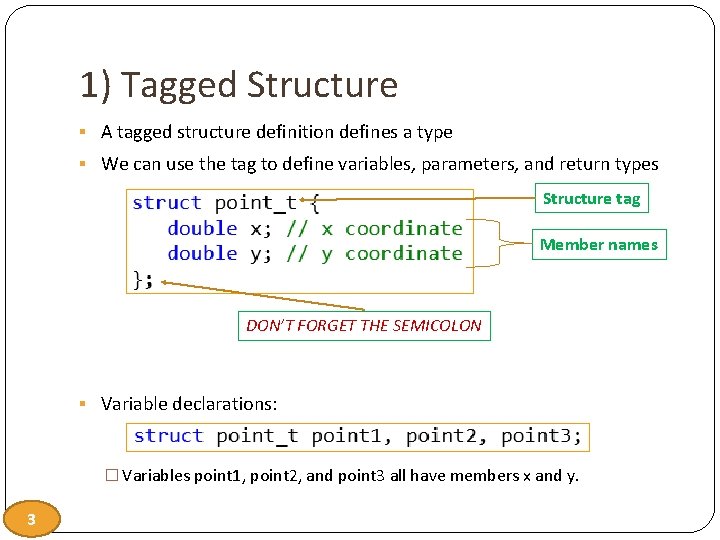
1) Tagged Structure § A tagged structure definition defines a type § We can use the tag to define variables, parameters, and return types Structure tag Member names DON’T FORGET THE SEMICOLON § Variable declarations: � Variables point 1, point 2, and point 3 all have members x and y. 3
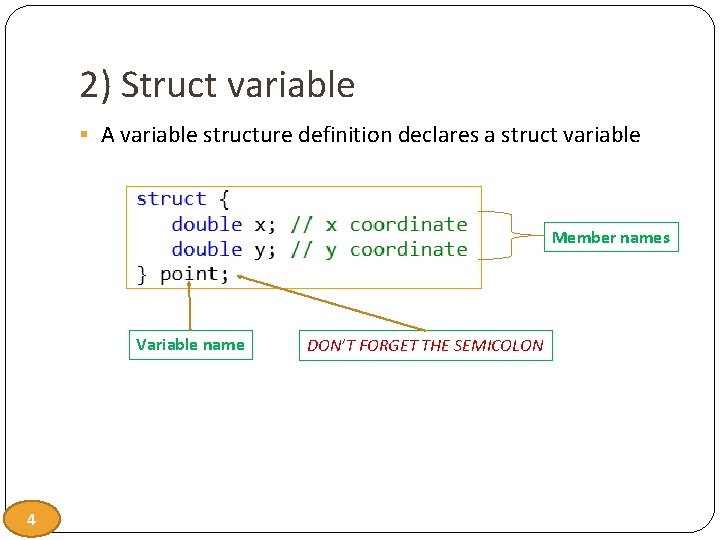
2) Struct variable § A variable structure definition declares a struct variable Member names Variable name 4 DON’T FORGET THE SEMICOLON
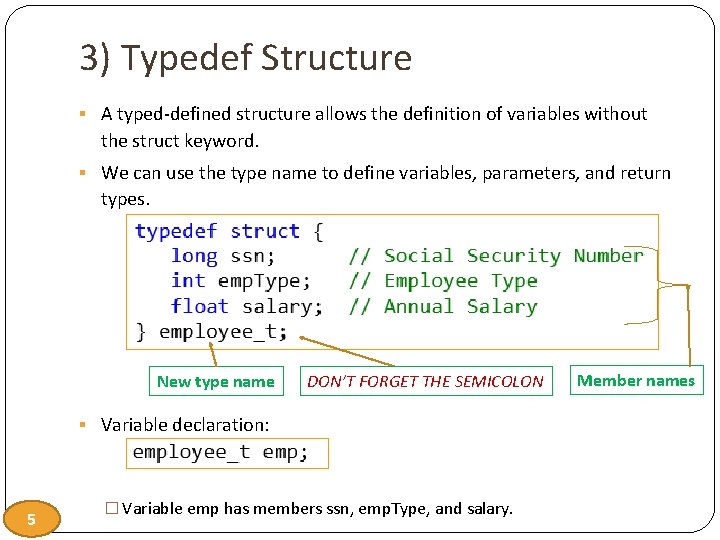
3) Typedef Structure § A typed-defined structure allows the definition of variables without the struct keyword. § We can use the type name to define variables, parameters, and return types. New type name DON’T FORGET THE SEMICOLON § Variable declaration: 5 � Variable emp has members ssn, emp. Type, and salary. Member names

Dot Operator (. ) § Used to access member variables �Syntax: structure_variable_name. member_name �These variables may be used like any other variables 6
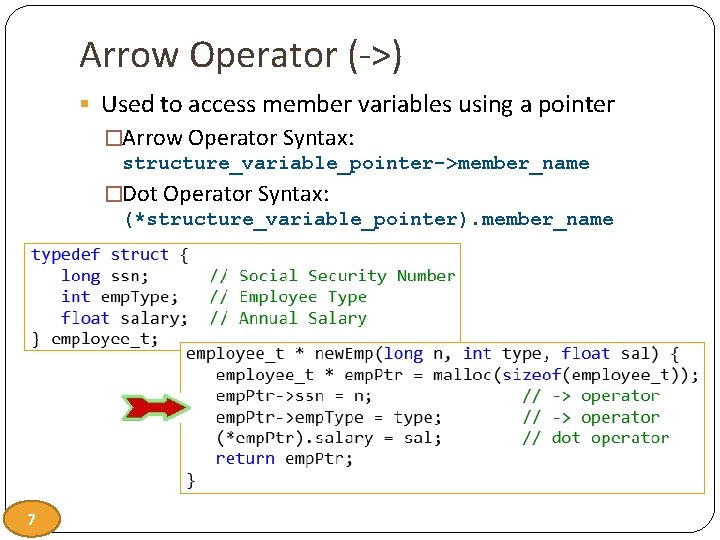
Arrow Operator (->) § Used to access member variables using a pointer �Arrow Operator Syntax: structure_variable_pointer->member_name �Dot Operator Syntax: (*structure_variable_pointer). member_name 7
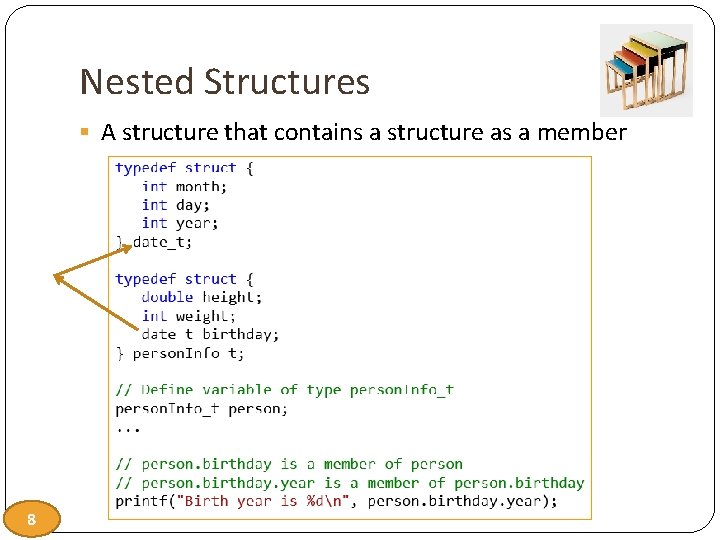
Nested Structures § A structure that contains a structure as a member 8
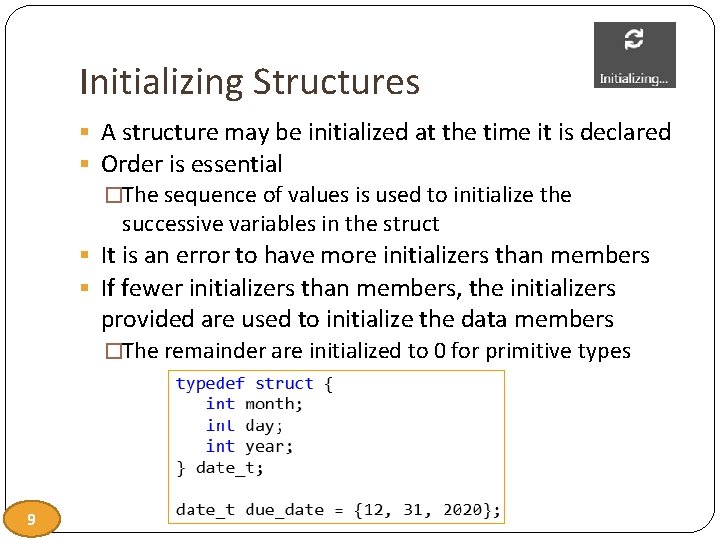
Initializing Structures § A structure may be initialized at the time it is declared § Order is essential �The sequence of values is used to initialize the successive variables in the struct § It is an error to have more initializers than members § If fewer initializers than members, the initializers provided are used to initialize the data members �The remainder are initialized to 0 for primitive types 9
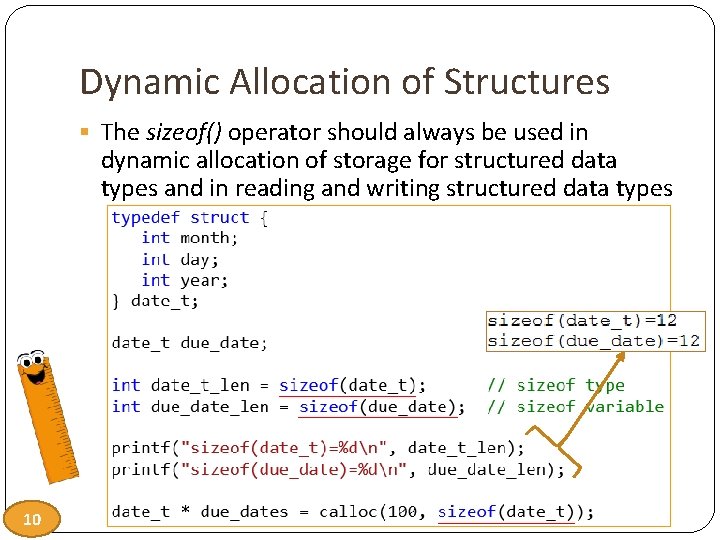
Dynamic Allocation of Structures § The sizeof() operator should always be used in dynamic allocation of storage for structured data types and in reading and writing structured data types 10
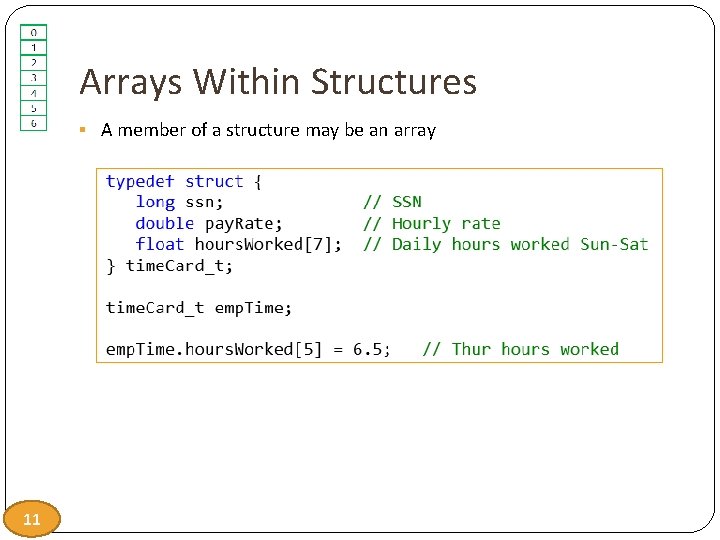
Arrays Within Structures § A member of a structure may be an array 11
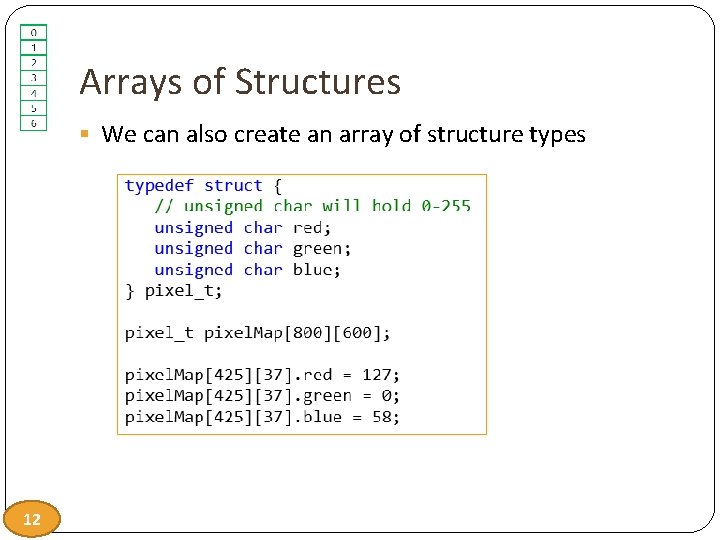
Arrays of Structures § We can also create an array of structure types 12
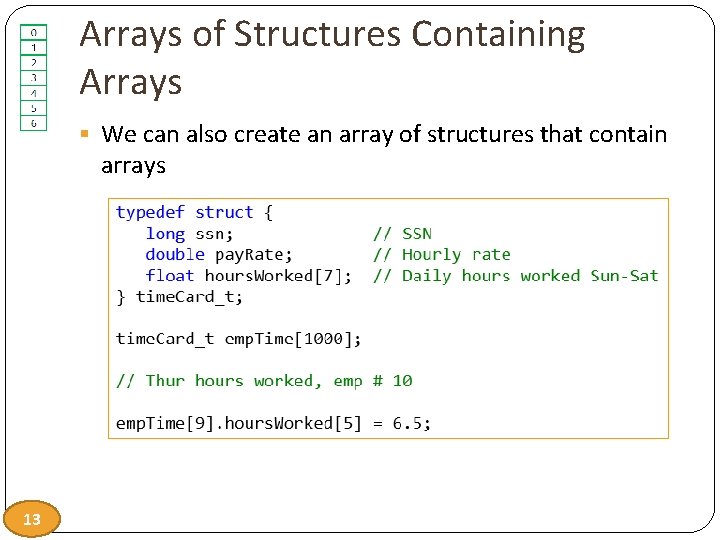
Arrays of Structures Containing Arrays § We can also create an array of structures that contain arrays 13
Structures as Parameters § A struct, like an int, may be passed to a function § The process works just like passing an int, in that: �The complete structure is copied to the stack �Called function is unable to modify the caller's copy of the variable 14
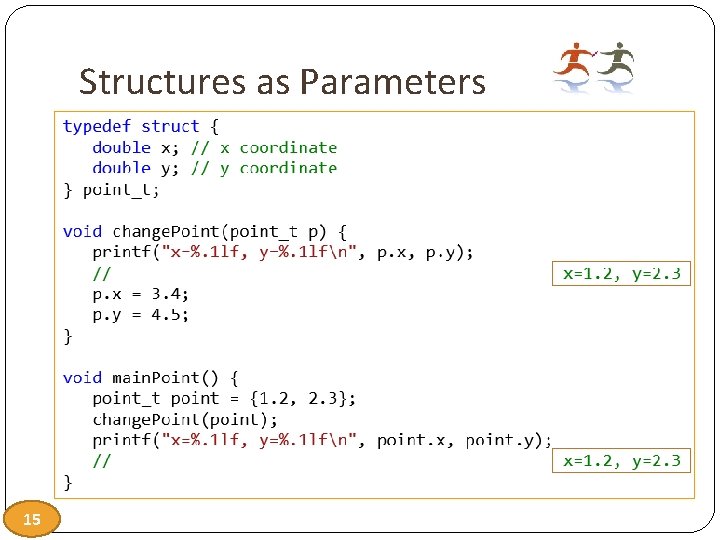
Structures as Parameters 15
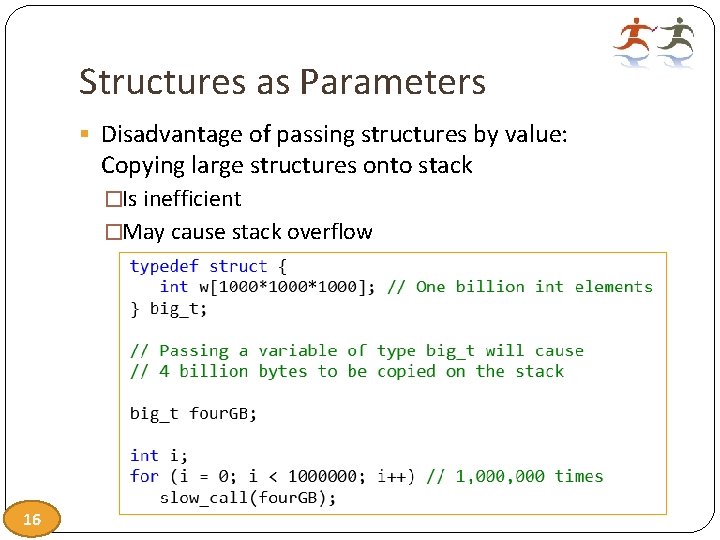
Structures as Parameters § Disadvantage of passing structures by value: Copying large structures onto stack �Is inefficient �May cause stack overflow 16
Structure Pointers as Parameters § More efficient: Pass the address of the struct § Passing an address requires that only a single word be pushed on the stack, no matter the size �Called function can then modify the structure. 17
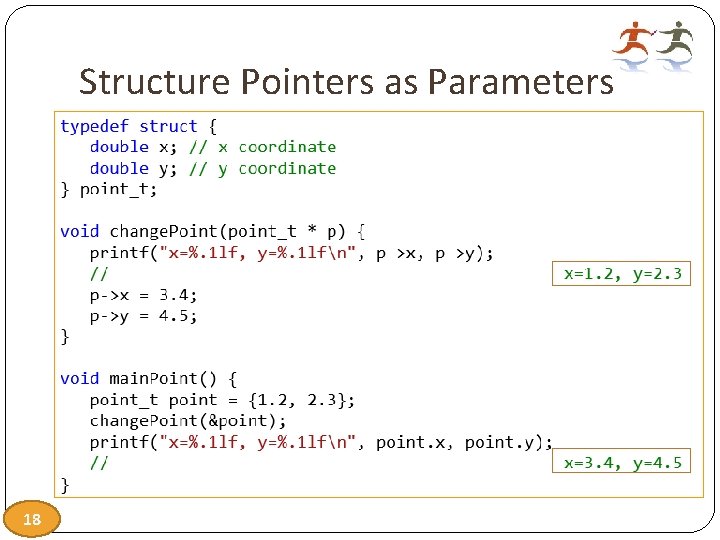
Structure Pointers as Parameters 18
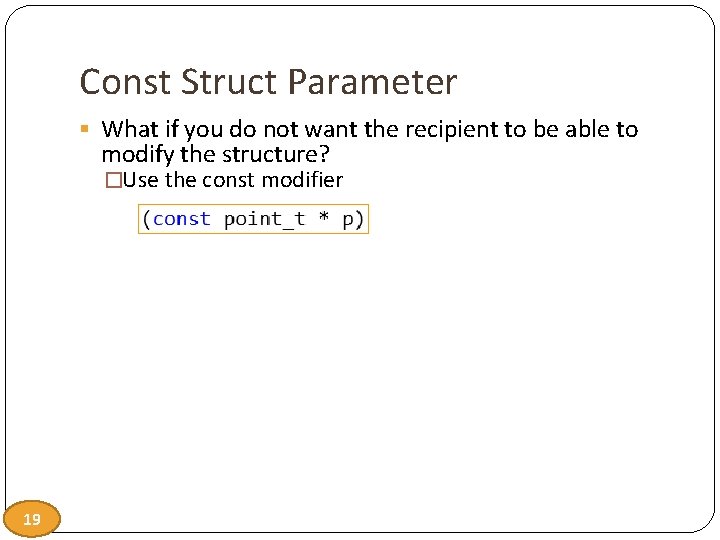
Const Struct Parameter § What if you do not want the recipient to be able to modify the structure? �Use the const modifier 19
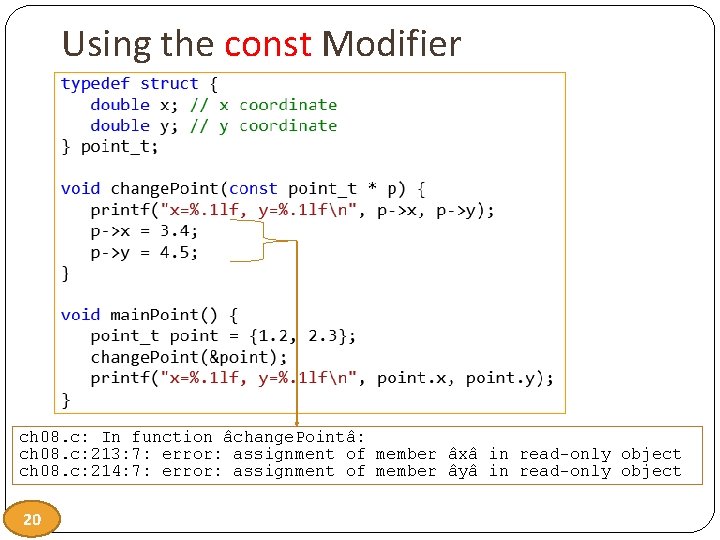
Using the const Modifier Compile time errors: ch 08. c: In function âchange. Pointâ: ch 08. c: 213: 7: error: assignment of member âxâ in read-only object ch 08. c: 214: 7: error: assignment of member âyâ in read-only object 20
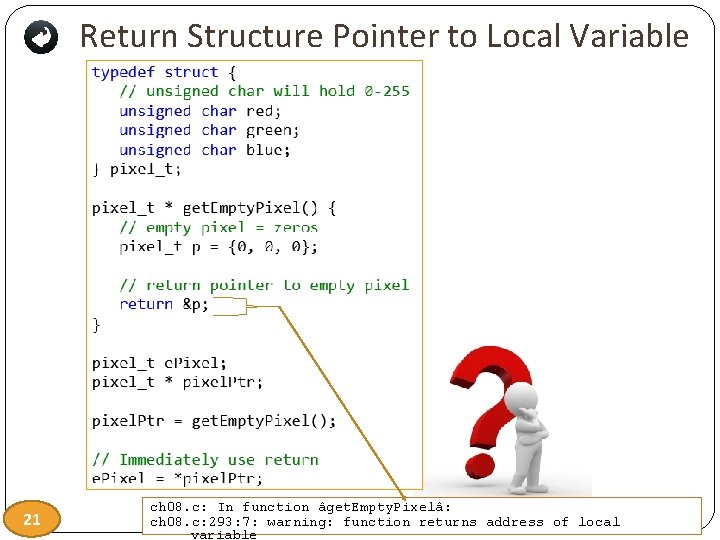
Return Structure Pointer to Local Variable 21 ch 08. c: In function âget. Empty. Pixelâ: ch 08. c: 293: 7: warning: function returns address of local variable
Return Structure Pointer to Local Variable § Reason: function is returning a pointer to a variable that was allocated on the stack during execution of the function �Such variables are subject to being wiped out by subsequent function calls 22
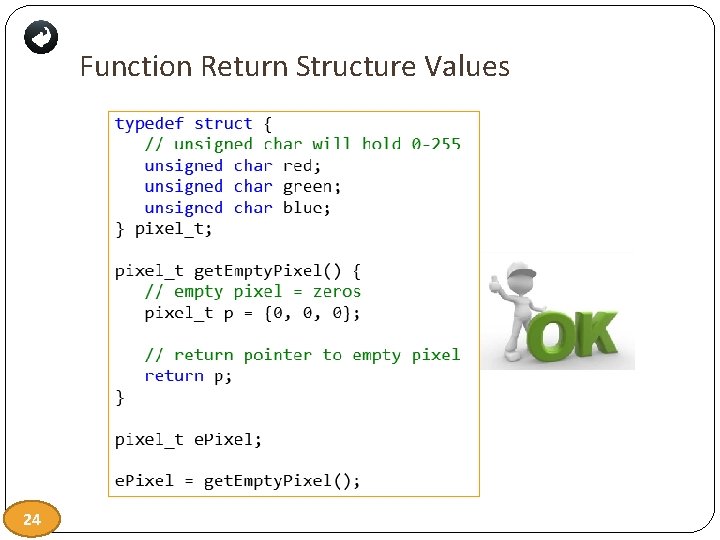
Function Return Structure Values § It is possible for a function to return a structure. § This facility depends upon the structure assignment mechanisms which copies one complete structure to another. �Avoids the unsafe condition associated with returning a pointer, but �Incurs the possibly extreme penalty of copying a very large structure 23
Function Return Structure Values 24
Arrays as Parameters & Return § Array’s address is passed as parameter �Simulates passing by reference § Embedding array in structure �The only way to pass an array by value is to embed it in a structure �The only way to return an array is to embed it in a structure �Both involve copying Ø Beware of size 25
- Slides: 25