
StructureProperty Relationships in Crystal Structures of Molecules With
- Slides: 1
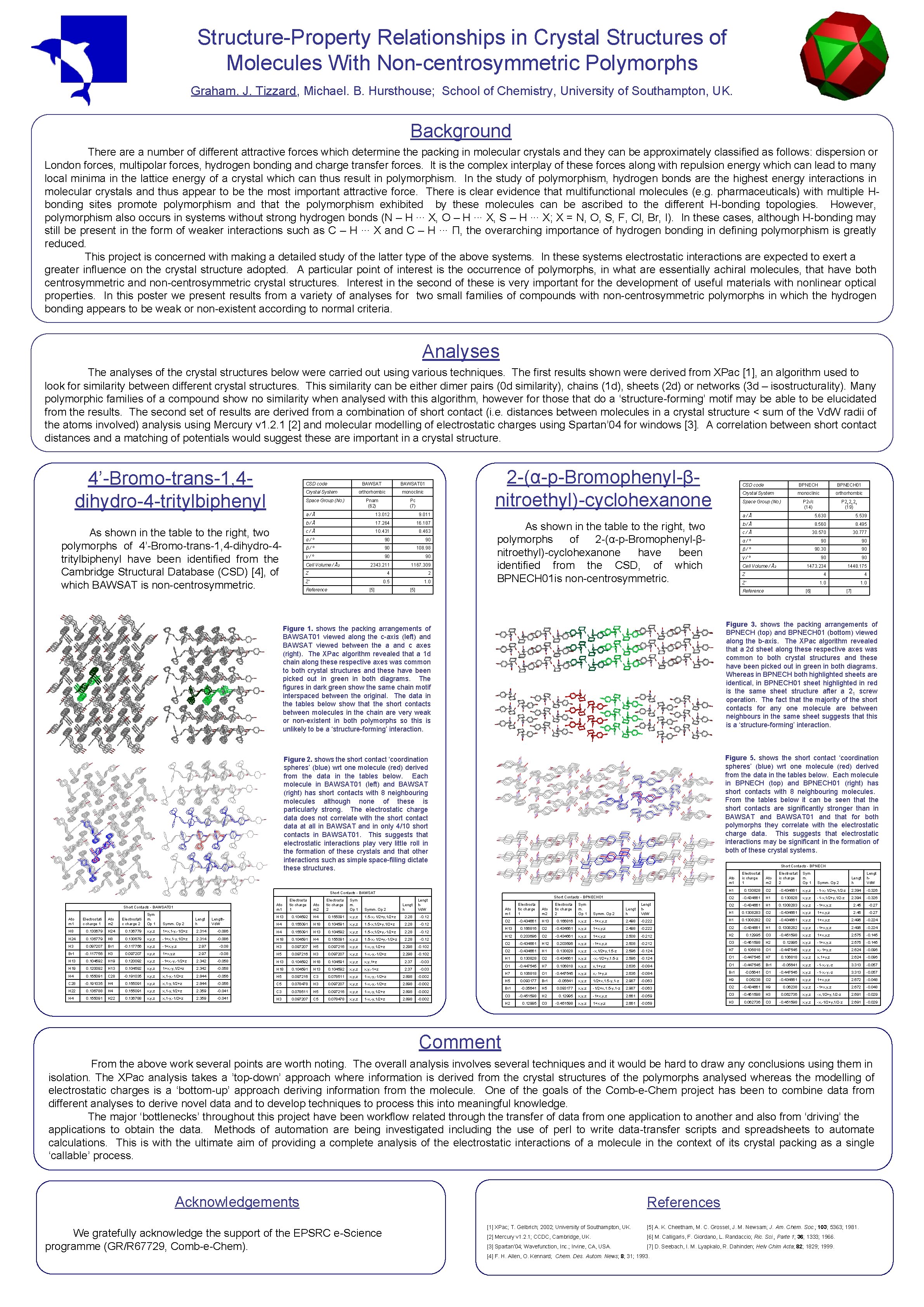
Structure-Property Relationships in Crystal Structures of Molecules With Non-centrosymmetric Polymorphs Graham. J. Tizzard, Michael. B. Hursthouse; School of Chemistry, University of Southampton, UK. Background There a number of different attractive forces which determine the packing in molecular crystals and they can be approximately classified as follows: dispersion or London forces, multipolar forces, hydrogen bonding and charge transfer forces. It is the complex interplay of these forces along with repulsion energy which can lead to many local minima in the lattice energy of a crystal which can thus result in polymorphism. In the study of polymorphism, hydrogen bonds are the highest energy interactions in molecular crystals and thus appear to be the most important attractive force. There is clear evidence that multifunctional molecules (e. g. pharmaceuticals) with multiple Hbonding sites promote polymorphism and that the polymorphism exhibited by these molecules can be ascribed to the different H-bonding topologies. However, polymorphism also occurs in systems without strong hydrogen bonds (N – H ∙∙∙ X, O – H ∙∙∙ X, S – H ∙∙∙ X; X = N, O, S, F, Cl, Br, I). In these cases, although H-bonding may still be present in the form of weaker interactions such as C – H ∙∙∙ X and C – H ∙∙∙ П, the overarching importance of hydrogen bonding in defining polymorphism is greatly reduced. This project is concerned with making a detailed study of the latter type of the above systems. In these systems electrostatic interactions are expected to exert a greater influence on the crystal structure adopted. A particular point of interest is the occurrence of polymorphs, in what are essentially achiral molecules, that have both centrosymmetric and non-centrosymmetric crystal structures. Interest in the second of these is very important for the development of useful materials with nonlinear optical properties. In this poster we present results from a variety of analyses for two small families of compounds with non-centrosymmetric polymorphs in which the hydrogen bonding appears to be weak or non-existent according to normal criteria. Analyses The analyses of the crystal structures below were carried out using various techniques. The first results shown were derived from XPac [1], an algorithm used to look for similarity between different crystal structures. This similarity can be either dimer pairs (0 d similarity), chains (1 d), sheets (2 d) or networks (3 d – isostructurality). Many polymorphic families of a compound show no similarity when analysed with this algorithm, however for those that do a ‘structure-forming’ motif may be able to be elucidated from the results. The second set of results are derived from a combination of short contact (i. e. distances between molecules in a crystal structure < sum of the Vd. W radii of the atoms involved) analysis using Mercury v 1. 2. 1 [2] and molecular modelling of electrostatic charges using Spartan’ 04 for windows [3]. A correlation between short contact distances and a matching of potentials would suggest these are important in a crystal structure. 4’-Bromo-trans-1, 4 dihydro-4 -tritylbiphenyl CSD code Crystal System Space Group (No. ) As shown in the table to the right, two polymorphs of 4’-Bromo-trans-1, 4 -dihydro-4 tritylbiphenyl have been identified from the Cambridge Structural Database (CSD) [4], of which BAWSAT is non-centrosymmetric. BAWSAT 01 orthorhombic monoclinic Pnam (62) Pc (7) 2 -(α-p-Bromophenyl-βnitroethyl)-cyclohexanone a/Å 13. 012 9. 011 b/Å 17. 264 16. 187 c/Å 10. 431 8. 463 α/º 90 90 β/º 90 108. 98 γ/º 90 90 2343. 211 1167. 309 Z 4 2 Z’ 0. 5 1. 0 Cell Volume / Å3 Reference [5] Ato m 2 Electrosta tic charge 2 Sym m. Op 1 Symm. Op 2 Electrostati c charge 2 Sym m. Op 1 H 13 0. 104592 H 4 0. 155091 x, y, z 1. 5 -x, -1/2+y, 1/2+z 2. 28 -0. 12 Symm. Op 2 Lengt h Length. Vd. W H 4 0. 155091 H 18 0. 104591 x, y, z 1. 5 -x, 1/2+y, 1/2+z 2. 28 -0. 12 Lengt h Crystal System monoclinic orthorhombic P 21/c (14) P 212121 (19) a/Å 5. 630 5. 539 b/Å 8. 560 8. 495 c/Å 30. 570 30. 777 α/º 90 90 β/º 90. 30 90 γ/º 90 90 1473. 234 1448. 175 Z 4 4 Z’ 1. 0 Reference Electrostati c charge 1 H 8 0. 130679 H 24 0. 136779 x, y, z 1+x, 1 -y, -1/2+z 2. 314 -0. 086 H 4 0. 155091 H 13 0. 104592 x, y, z 1. 5 -x, 1/2+y, -1/2+z 2. 28 -0. 12 H 24 0. 136779 H 8 0. 130679 x, y, z -1+x, 1 -y, 1/2+z 2. 314 -0. 086 H 18 0. 104591 H 4 0. 155091 x, y, z 1. 5 -x, -1/2+y, -1/2+z 2. 28 -0. 12 H 3 0. 097207 Br 1 -0. 117756 x, y, z -1+x, y, z 2. 97 -0. 08 H 3 0. 097207 H 5 0. 097216 x, y, z 1 -x, -y, 1/2+z 2. 298 -0. 102 Br 1 -0. 117756 H 3 0. 097207 x, y, z 1+x, y, z 2. 97 -0. 08 H 5 0. 097216 H 3 0. 097207 x, y, z 1 -x, -y, -1/2+z 2. 298 -0. 102 H 13 0. 104592 H 19 0. 120092 x, y, z -1+x, -y, -1/2+z 2. 342 -0. 058 H 13 0. 104592 H 18 0. 104591 x, y, z x, y, 1+z 2. 37 -0. 03 H 19 0. 120092 H 13 0. 104592 x, y, z 1+x, -y, 1/2+z 2. 342 -0. 058 H 18 0. 104591 H 13 0. 104592 x, y, z x, y, -1+z 2. 37 -0. 03 H 4 0. 155091 C 28 -0. 191035 x, y, z x, 1 -y, -1/2+z 2. 844 -0. 056 H 5 0. 097216 C 3 0. 078511 x, y, z 1 -x, -y, -1/2+z 2. 898 -0. 002 C 28 -0. 191035 H 4 0. 155091 x, y, z x, 1 -y, 1/2+z 2. 844 -0. 056 C 5 0. 078478 H 3 0. 097207 x, y, z 1 -x, -y, -1/2+z 2. 898 -0. 002 H 22 0. 136788 H 4 0. 155091 x, y, z x, 1 -y, 1/2+z 2. 359 -0. 041 C 3 0. 078511 H 5 0. 097216 x, y, z 1 -x, -y, 1/2+z 2. 898 -0. 002 H 4 0. 155091 H 22 0. 136788 x, y, z x, 1 -y, -1/2+z 2. 359 -0. 041 H 3 0. 097207 C 5 0. 078478 x, y, z 1 -x, -y, 1/2+z 2. 898 -0. 002 [7] Figure 5. shows the short contact ‘coordination spheres’ (blue) wrt one molecule (red) derived from the data in the tables below. Each molecule in BPNECH (top) and BPNECH 01 (right) has short contacts with 8 neighbouring molecules. From the tables below it can be seen that the short contacts are significantly stronger than in BAWSAT and BAWSAT 01 and that for both polymorphs they correlate with the electrostatic charge data. This suggests that electrostatic interactions may be significant in the formation of both of these crystal systems. Short Contacts - BPNECH 01 Lengt h. Vd. W Ato m 1 [6] Figure 3. shows the packing arrangements of BPNECH (top) and BPNECH 01 (bottom) viewed along the b-axis. The XPac algorithm revealed that a 2 d sheet along these respective axes was common to both crystal structures and these have been picked out in green in both diagrams. Whereas in BPNECH both highlighted sheets are identical, in BPNECH 01 sheet highlighted in red is the same sheet structure after a 21 screw operation. The fact that the majority of the short contacts for any one molecule are between neighbours in the same sheet suggests that this is a ‘structure-forming’ interaction. Short Contacts - BAWSAT Ato m 1 BPNECH 01 Cell Volume / Å3 [5] Figure 2. shows the short contact ‘coordination spheres’ (blue) wrt one molecule (red) derived from the data in the tables below. Each molecule in BAWSAT 01 (left) and BAWSAT (right) has short contacts with 8 neighbouring molecules although none of these is particularly strong. The electrostatic charge data does not correlate with the short contact data at all in BAWSAT and in only 4/10 short contacts in BAWSAT 01. This suggests that electrostatic interactions play very little roll in the formation of these crystals and that other interactions such as simple space-filling dictate these structures. Short Contacts - BAWSAT 01 BPNECH Space Group (No. ) As shown in the table to the right, two polymorphs of 2 -(α-p-Bromophenyl-βnitroethyl)-cyclohexanone have been identified from the CSD, of which BPNECH 01 is non-centrosymmetric. Figure 1. shows the packing arrangements of BAWSAT 01 viewed along the c-axis (left) and BAWSAT viewed between the a and c axes (right). The XPac algorithm revealed that a 1 d chain along these respective axes was common to both crystal structures and these have been picked out in green in both diagrams. The figures in dark green show the same chain motif interspaced between the original. The data in the tables below show that the short contacts between molecules in the chain are very weak or non-existent in both polymorphs so this is unlikely to be a ‘structure-forming’ interaction. Electrosta tic charge 1 CSD code Ato m 1 Electrosta tic charge 1 Ato m 2 Electrosta tic charge 2 Sym m. Op 1 O 2 -0. 434661 H 13 0. 166816 O 2 H 12 0. 203696 O 2 Ato m 1 Electrostat ic charge 1 Ato m 2 Electrostat ic charge 2 Sym m. Op 1 Symm. Op 2 Lengt h. Vd. W H 1 0. 130828 O 2 -0. 434661 x, y, z -1 -x, -1/2+y, 1/2 -z 2. 394 -0. 326 O 2 -0. 434661 H 1 0. 130828 x, y, z -1 -x, 1/2+y, 1/2 -z 2. 394 -0. 326 Lengt h. Vd. W O 2 -0. 434661 H 1 0. 1308283 x, y, z -1+x, y, z 2. 45 -0. 27 Symm. Op 2 Lengt h H 1 0. 1308283 O 2 -0. 434661 x, y, z 1+x, y, z 2. 45 -0. 27 x, y, z -1+x, y, z 2. 498 -0. 222 H 1 0. 1308282 O 2 -0. 434661 x, y, z 1+x, y, z 2. 496 -0. 224 -0. 434661 x, y, z 1+x, y, z 2. 498 -0. 222 O 2 -0. 434661 H 1 0. 1308282 x, y, z -1+x, y, z 2. 496 -0. 224 O 2 -0. 434661 x, y, z 1+x, y, z 2. 508 -0. 212 H 2 0. 12995 O 3 -0. 451598 x, y, z 1+x, y, z 2. 575 -0. 145 -0. 434661 H 12 0. 203696 x, y, z -1+x, y, z 2. 508 -0. 212 O 3 -0. 451598 H 2 0. 12995 x, y, z -1+x, y, z 2. 575 -0. 145 O 2 -0. 434661 H 1 0. 130828 x, y, z -x, 1/2+y, 1. 5 -z 2. 596 -0. 124 H 7 0. 106818 O 1 -0. 447545 x, y, z x, -1+y, z 2. 624 -0. 096 H 1 0. 130828 O 2 -0. 434661 x, y, z -x, -1/2+y, 1. 5 -z 2. 596 -0. 124 O 1 -0. 447545 H 7 0. 106818 x, y, z x, 1+y, z 2. 624 -0. 096 O 1 -0. 447545 H 7 0. 106818 x, y, z x, 1+y, z 2. 636 -0. 084 O 1 -0. 447545 Br 1 -0. 05641 x, y, z -1 -x, -y, -z 3. 313 -0. 057 H 7 0. 106818 O 1 -0. 447545 x, y, z x, -1+y, z 2. 636 -0. 084 Br 1 -0. 05641 O 1 -0. 447545 x, y, z -1 -x, -y, -z 3. 313 -0. 057 H 5 0. 093177 Br 1 -0. 05641 x, y, z 1/2+x, 1. 5 -y, 1 -z 2. 987 -0. 063 H 9 0. 06238 O 2 -0. 434661 x, y, z 1+x, y, z 2. 672 -0. 048 Br 1 -0. 05641 H 5 0. 093177 x, y, z -1/2+x, 1. 5 -y, 1 -z 2. 987 -0. 063 O 2 -0. 434661 H 9 0. 06238 x, y, z -1+x, y, z 2. 672 -0. 048 O 3 -0. 451598 H 2 0. 12995 x, y, z -1+x, y, z 2. 661 -0. 059 O 3 -0. 451598 H 3 0. 062736 x, y, z -x, 1/2+y, 1/2 -z 2. 691 -0. 029 H 2 0. 12995 O 3 -0. 451598 x, y, z 1+x, y, z 2. 661 -0. 059 H 3 0. 062736 O 3 -0. 451598 x, y, z -x, -1/2+y, 1/2 -z 2. 691 -0. 029 Comment From the above work several points are worth noting. The overall analysis involves several techniques and it would be hard to draw any conclusions using them in isolation. The XPac analysis takes a ’top-down’ approach where information is derived from the crystal structures of the polymorphs analysed whereas the modelling of electrostatic charges is a ‘bottom-up’ approach deriving information from the molecule. One of the goals of the Comb-e-Chem project has been to combine data from different analyses to derive novel data and to develop techniques to process this into meaningful knowledge. The major ‘bottlenecks’ throughout this project have been workflow related through the transfer of data from one application to another and also from ‘driving’ the applications to obtain the data. Methods of automation are being investigated including the use of perl to write data-transfer scripts and spreadsheets to automate calculations. This is with the ultimate aim of providing a complete analysis of the electrostatic interactions of a molecule in the context of its crystal packing as a single ‘callable’ process. Acknowledgements We gratefully acknowledge the support of the EPSRC e-Science programme (GR/R 67729, Comb-e-Chem). References [1] XPac; T. Gelbrich; 2002; University of Southampton, UK. [5] A. K. Cheetham, M. C. Grossel, J. M. Newsam; J. Am. Chem. Soc. ; 103; 5363; 1981. [2] Mercury v 1. 2. 1; CCDC, Cambridge, UK. [6] M. Calligaris, F. Giordano, L. Randaccio; Ric. Sci. , Parte 1; 36; 1333; 1966. [3] Spartan’ 04; Wavefunction, Inc. ; Irvine, CA, USA. [7] D. Seebach, I. M. Lyapkalo, R. Dahinden; Helv Chim Acta; 82; 1829; 1999. [4] F. H. Allen, O. Kennard; Chem. Des. Autom. News; 8; 31; 1993.