
Structured Light Range Imaging Lecture 17 Thanks to


![Binary Coding • Assign each stripe a unique illumination code over time [Posdamer 82]](https://slidetodoc.com/presentation_image_h/a5fe003c02778d20fcf67181cbec9b3a/image-23.jpg "Binary Coding • Assign each stripe a unique illumination code over time [Posdamer 82]")
- Slides: 41
Structured Light + Range Imaging Lecture #17 (Thanks to Content from Levoy, Rusinkiewicz, Bouguet, Perona, Hendrik Lensch)
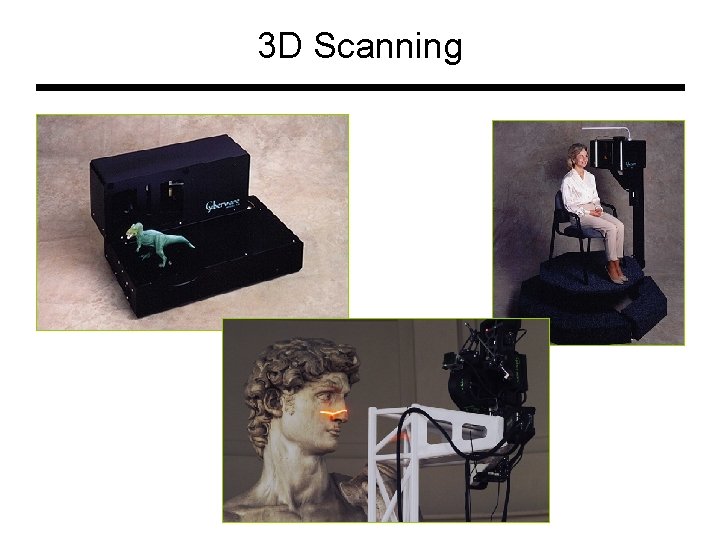
3 D Scanning
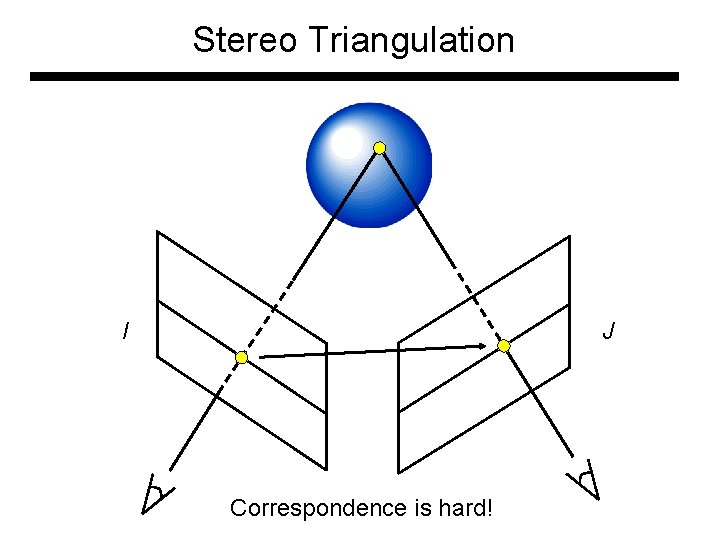
Stereo Triangulation I J Correspondence is hard!
Structured Light Triangulation I J Correspondence becomes easier!
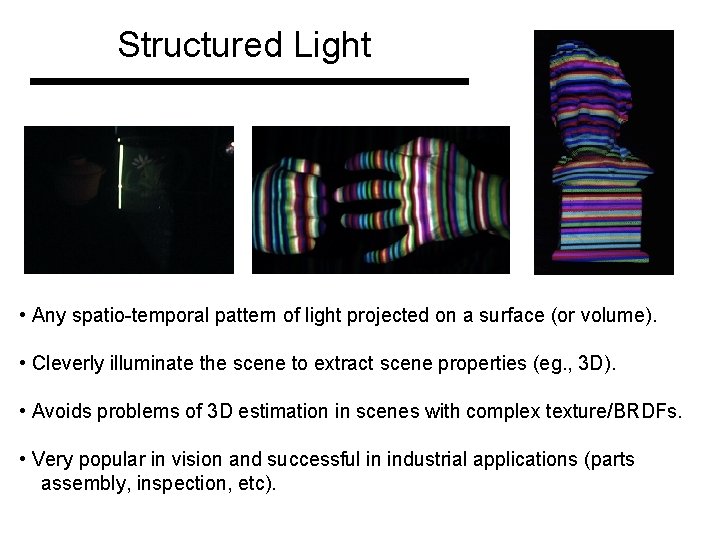
Structured Light • Any spatio-temporal pattern of light projected on a surface (or volume). • Cleverly illuminate the scene to extract scene properties (eg. , 3 D). • Avoids problems of 3 D estimation in scenes with complex texture/BRDFs. • Very popular in vision and successful in industrial applications (parts assembly, inspection, etc).
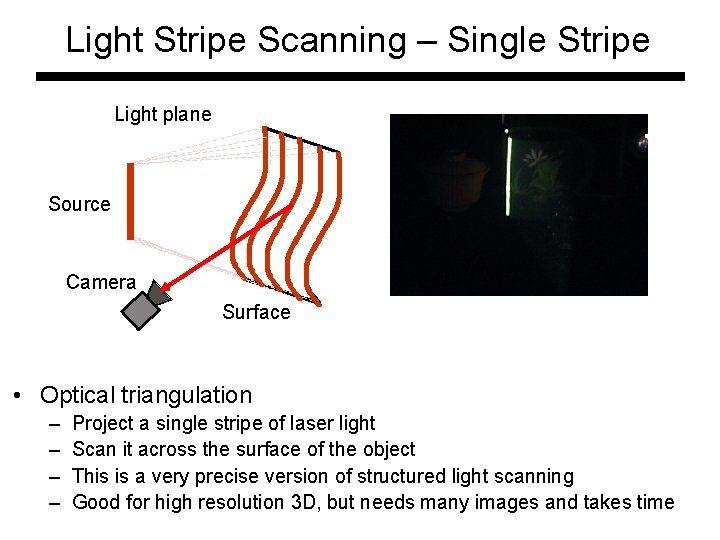
Light Stripe Scanning – Single Stripe Light plane Source Camera Surface • Optical triangulation – – Project a single stripe of laser light Scan it across the surface of the object This is a very precise version of structured light scanning Good for high resolution 3 D, but needs many images and takes time
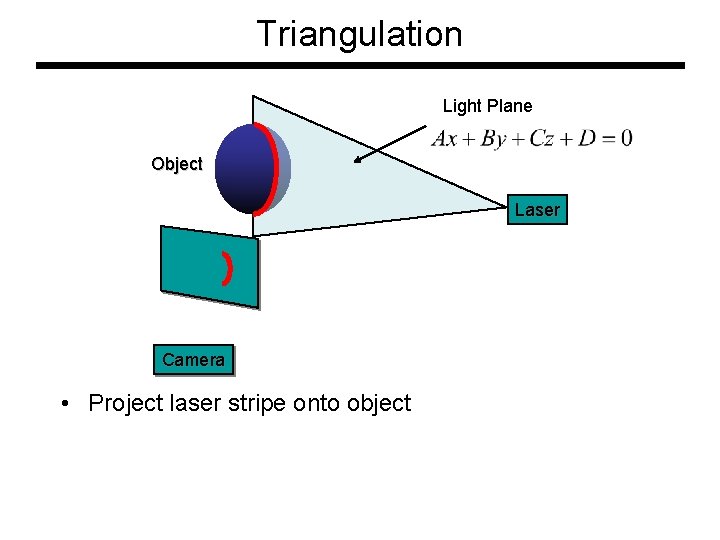
Triangulation Light Plane Object Laser Camera • Project laser stripe onto object
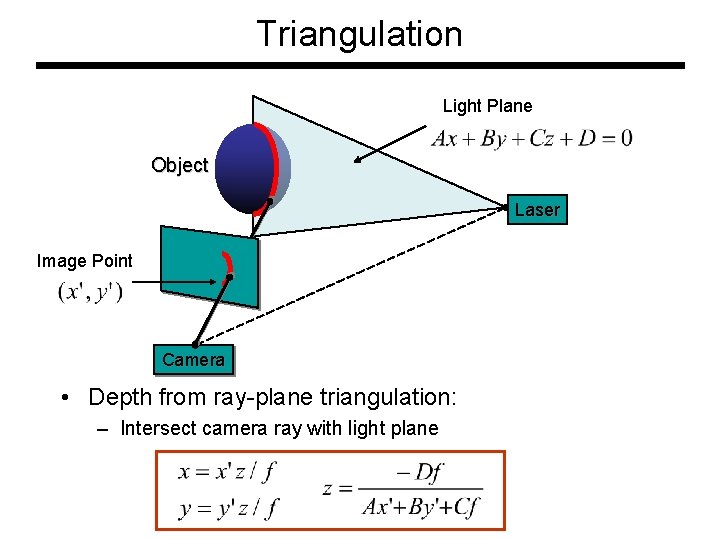
Triangulation Light Plane Object Laser Image Point Camera • Depth from ray-plane triangulation: – Intersect camera ray with light plane
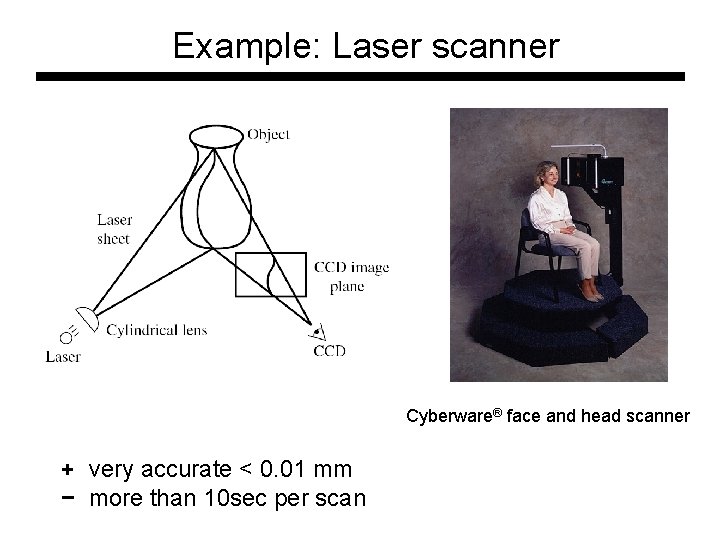
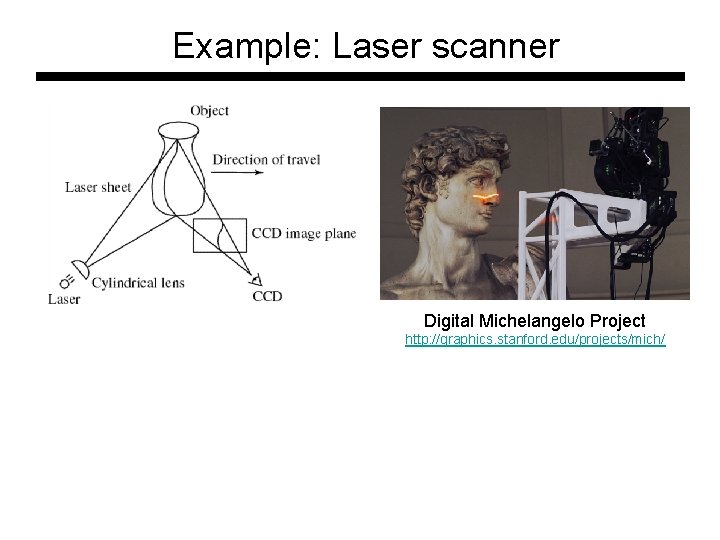
Example: Laser scanner Cyberware® face and head scanner + very accurate < 0. 01 mm − more than 10 sec per scan
Example: Laser scanner Digital Michelangelo Project http: //graphics. stanford. edu/projects/mich/
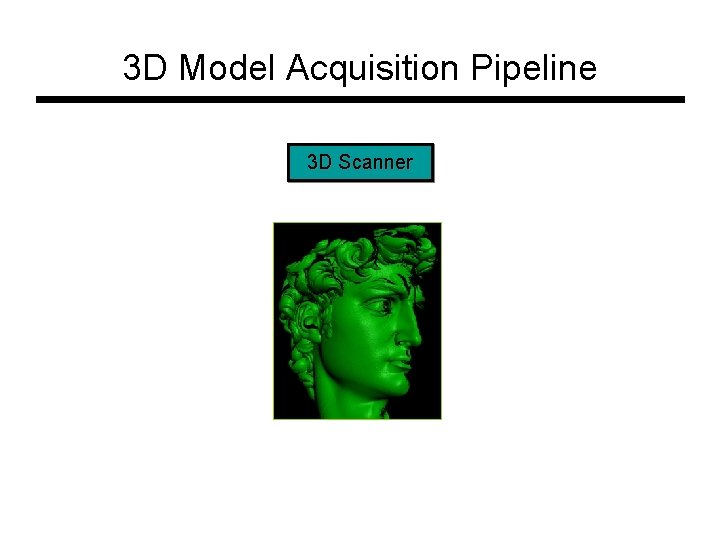
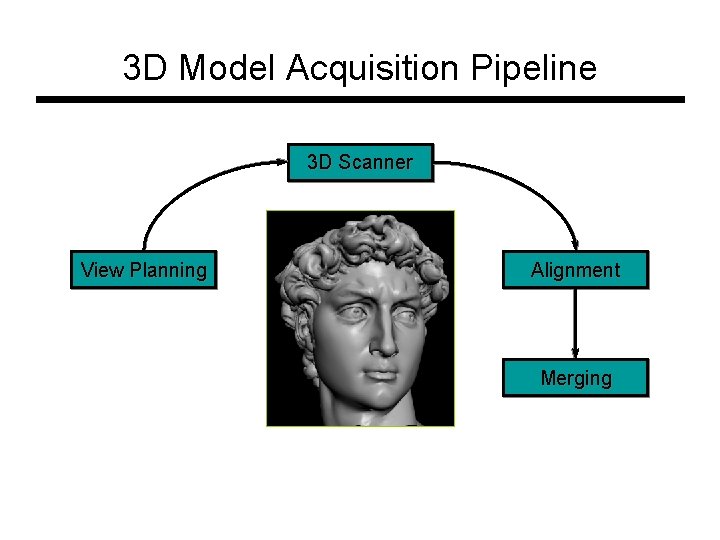
3 D Model Acquisition Pipeline 3 D Scanner
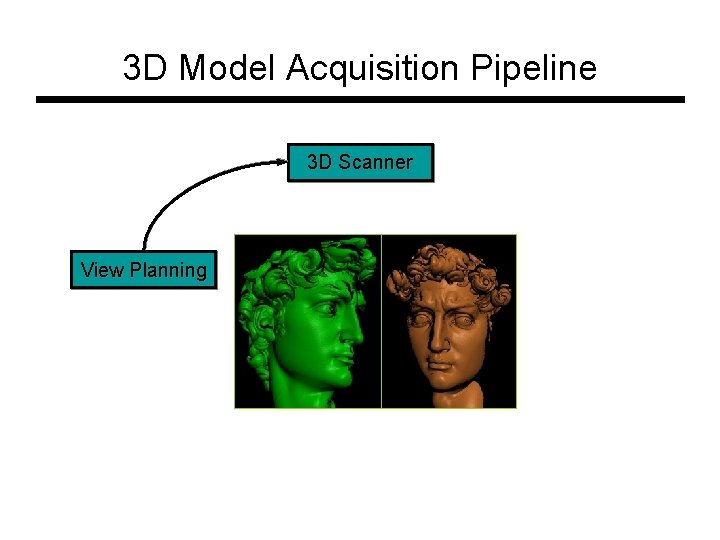
3 D Model Acquisition Pipeline 3 D Scanner View Planning
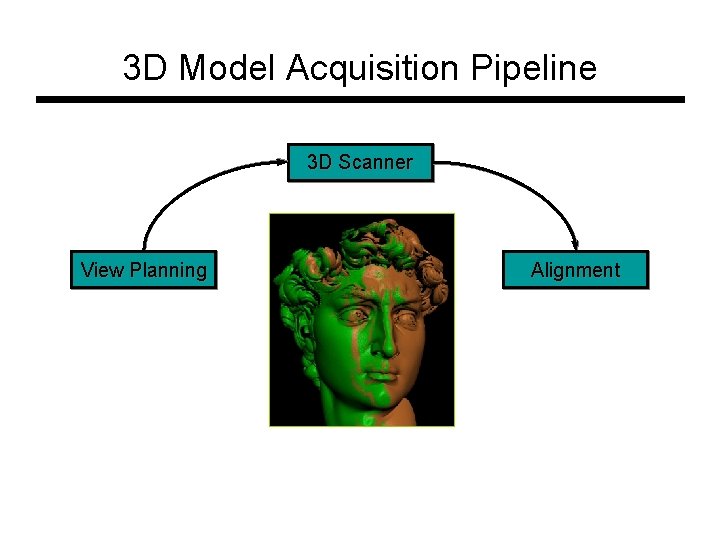
3 D Model Acquisition Pipeline 3 D Scanner View Planning Alignment
3 D Model Acquisition Pipeline 3 D Scanner View Planning Alignment Merging
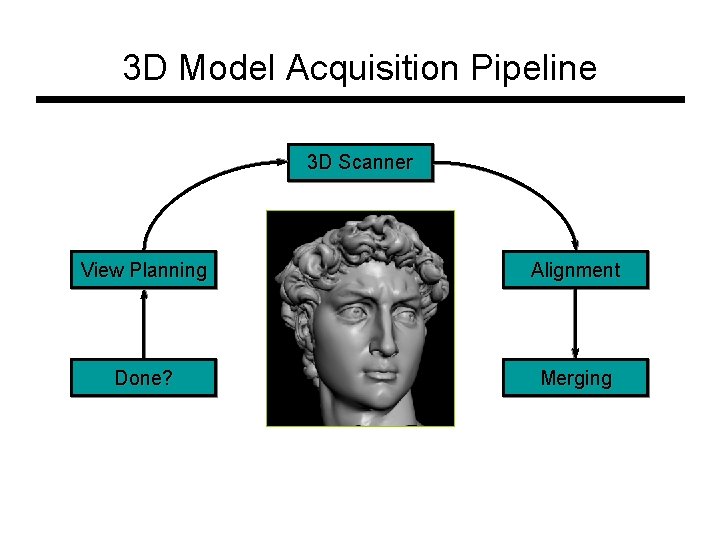
3 D Model Acquisition Pipeline 3 D Scanner View Planning Alignment Done? Merging
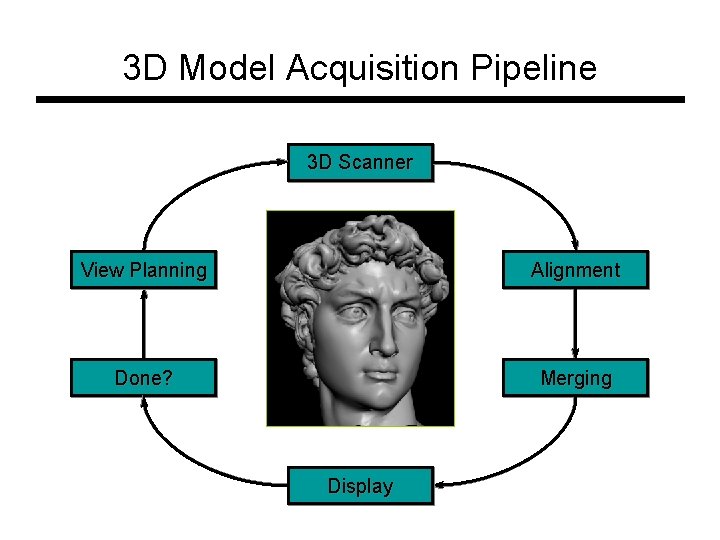
3 D Model Acquisition Pipeline 3 D Scanner View Planning Alignment Done? Merging Display
http: //graphics. stanford. edu/projects/mich/
Great Buddha of Nara http: //www. cvl. iis. u-tokyo. ac. jp/gallery_e/nara-hp/nara. html
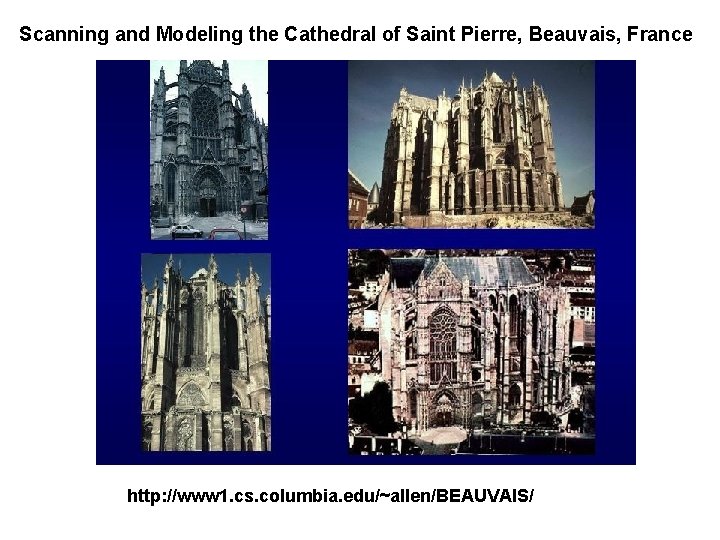
Scanning and Modeling the Cathedral of Saint Pierre, Beauvais, France http: //www 1. cs. columbia. edu/~allen/BEAUVAIS/
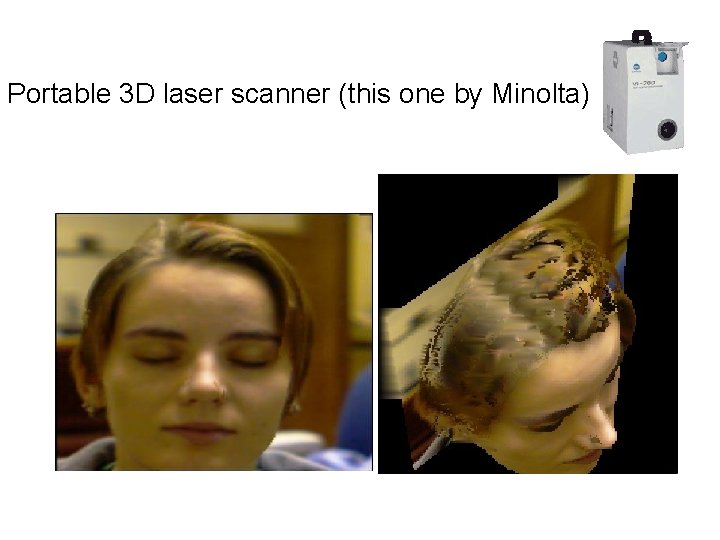
Portable 3 D laser scanner (this one by Minolta)
Faster Acquisition? • Project multiple stripes simultaneously • Correspondence problem: which stripe is which? • Common types of patterns: • Binary coded light striping • Gray/color coded light striping
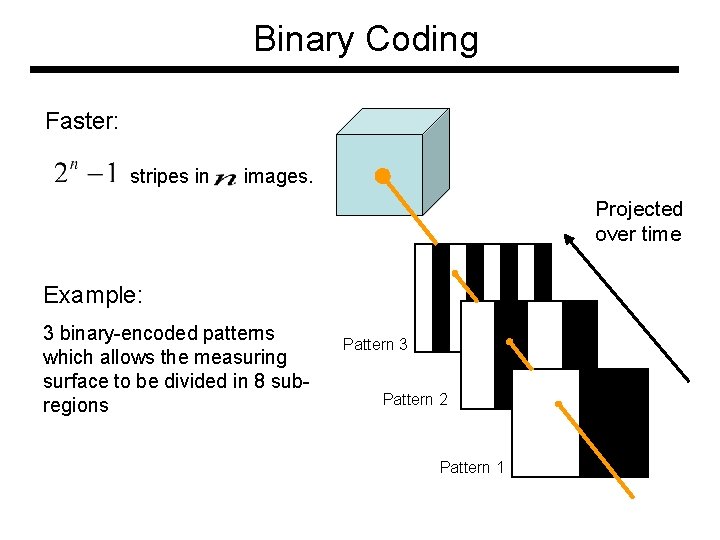
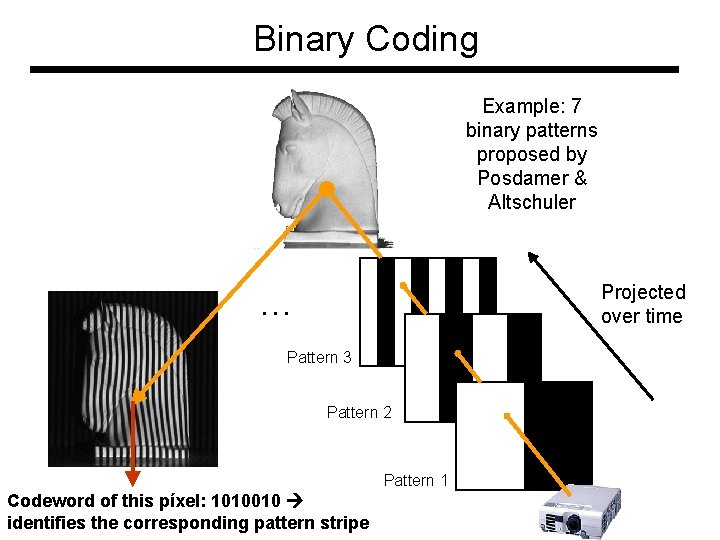
Binary Coding Faster: stripes in images. Projected over time Example: 3 binary-encoded patterns which allows the measuring surface to be divided in 8 subregions Pattern 3 Pattern 2 Pattern 1
Binary Coding • Assign each stripe a unique illumination code over time [Posdamer 82] Time Space
Binary Coding Example: 7 binary patterns proposed by Posdamer & Altschuler Projected over time … Pattern 3 Pattern 2 Pattern 1 Codeword of this píxel: 1010010 identifies the corresponding pattern stripe
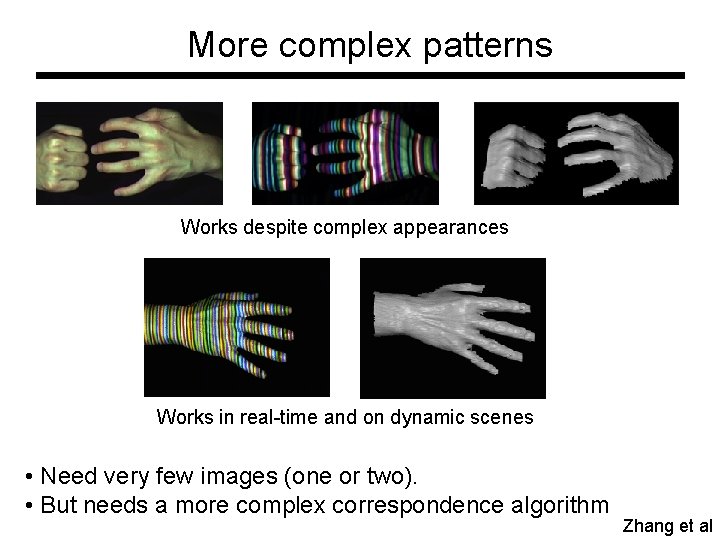
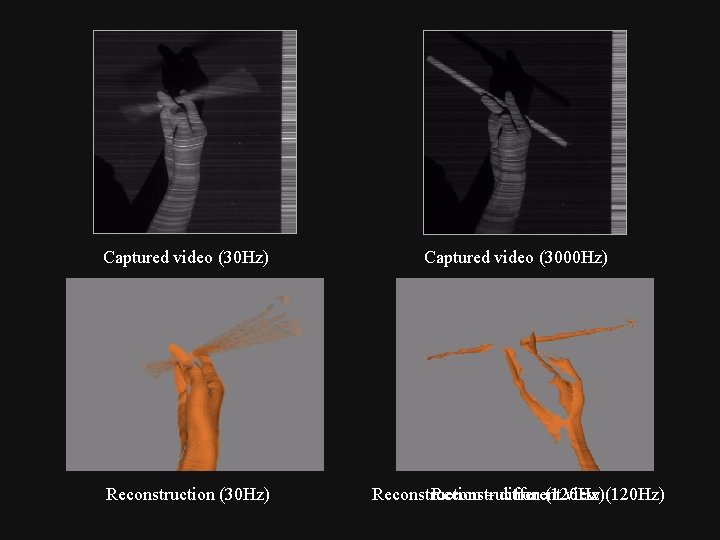
More complex patterns Works despite complex appearances Works in real-time and on dynamic scenes • Need very few images (one or two). • But needs a more complex correspondence algorithm Zhang et al
Real-Time 3 D Model Acquisition http: //graphics. stanford. edu/papers/rt_model/
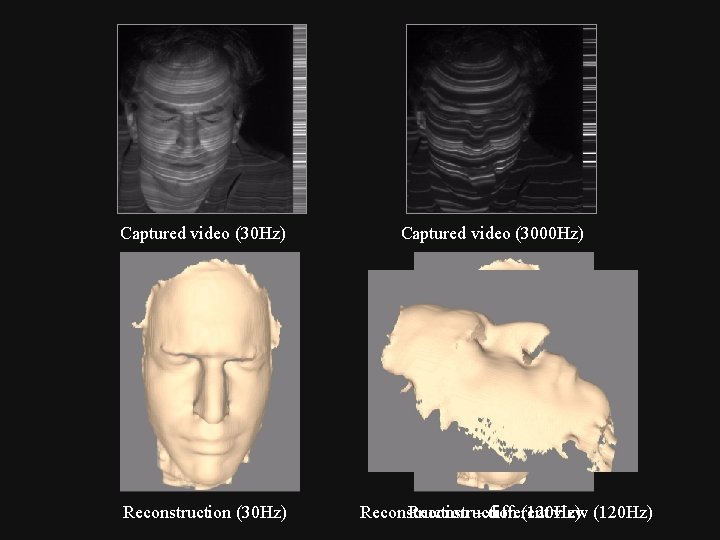
Captured video (30 Hz) Reconstruction (30 Hz) Captured video (3000 Hz) Reconstruction – different (120 Hz) view (120 Hz)
Captured video (30 Hz) Captured video (3000 Hz) Reconstruction (30 Hz) Reconstruction – different (120 Hz) view (120 Hz)
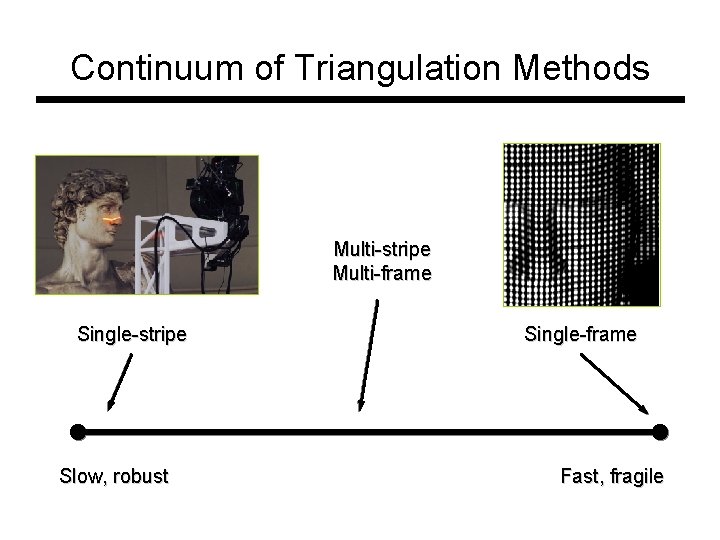
Continuum of Triangulation Methods Multi-stripe Multi-frame Single-stripe Slow, robust Single-frame Fast, fragile
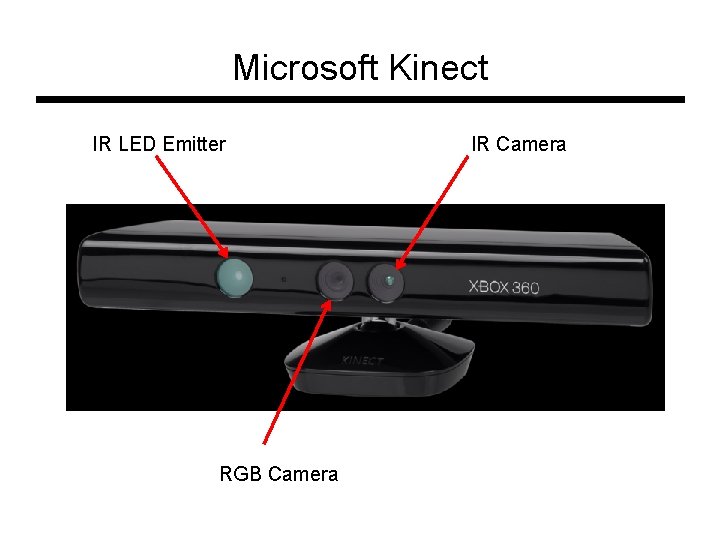
Microsoft Kinect IR LED Emitter RGB Camera IR Camera
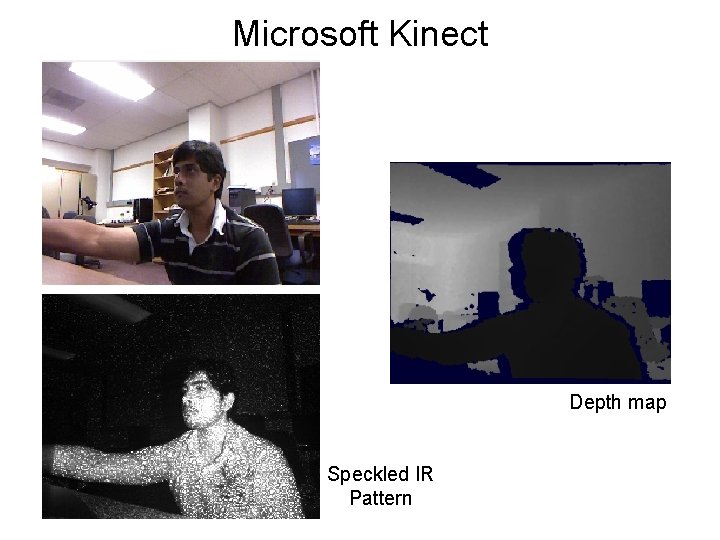
Microsoft Kinect Depth map Speckled IR Pattern
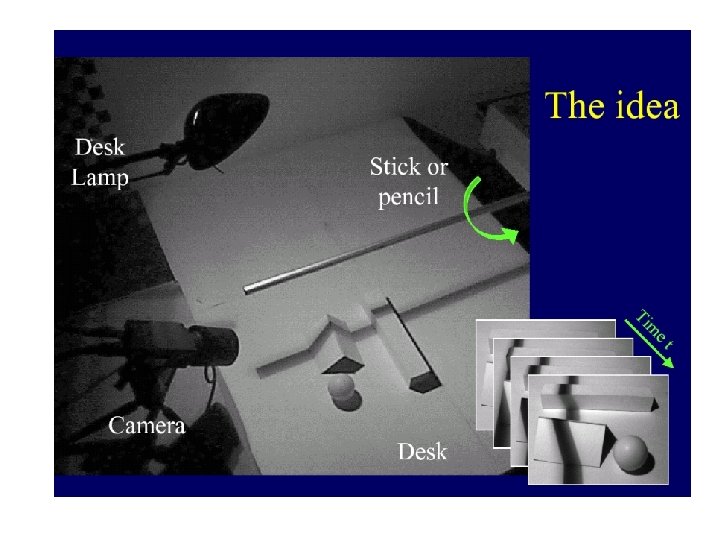
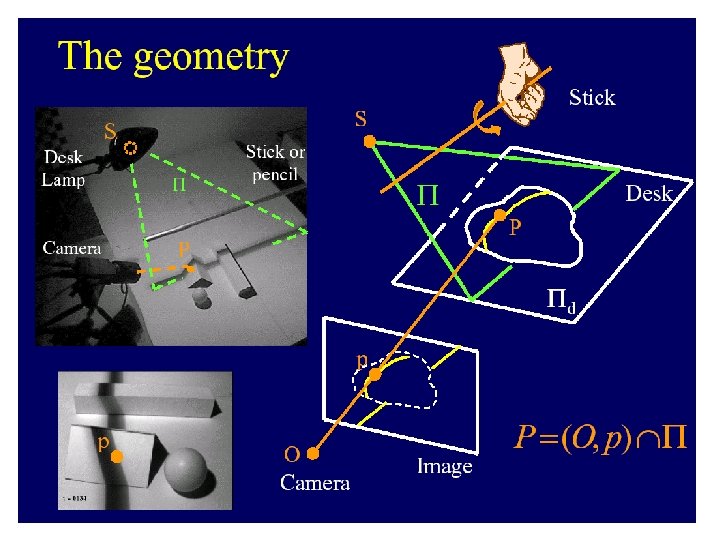
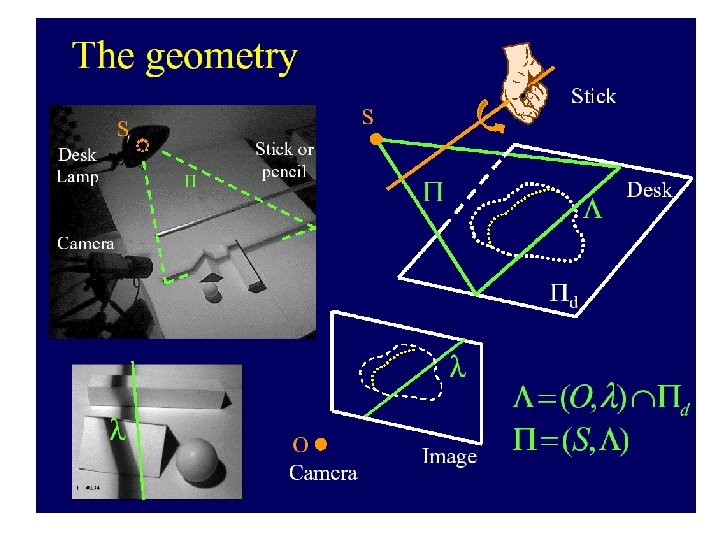
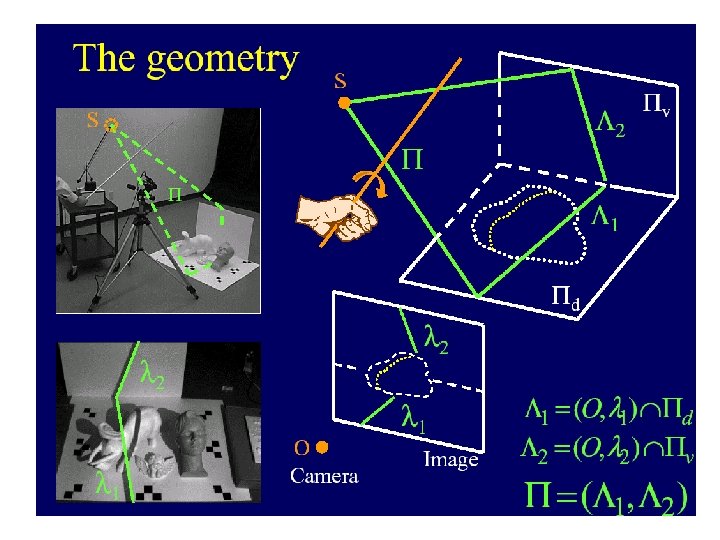
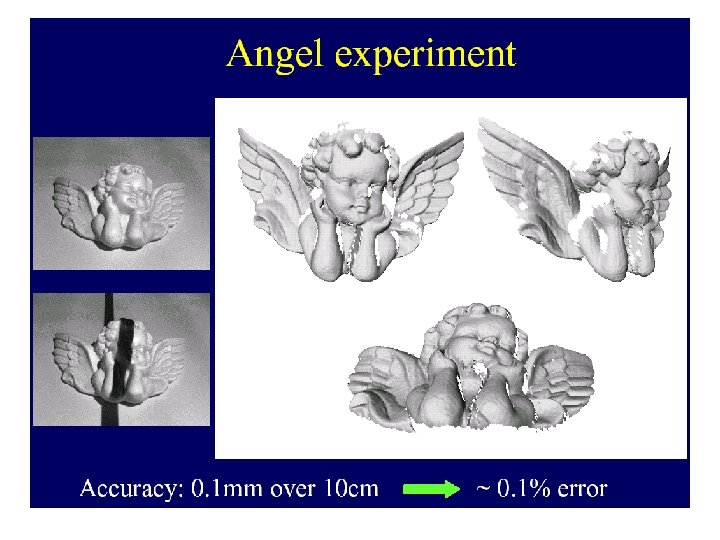
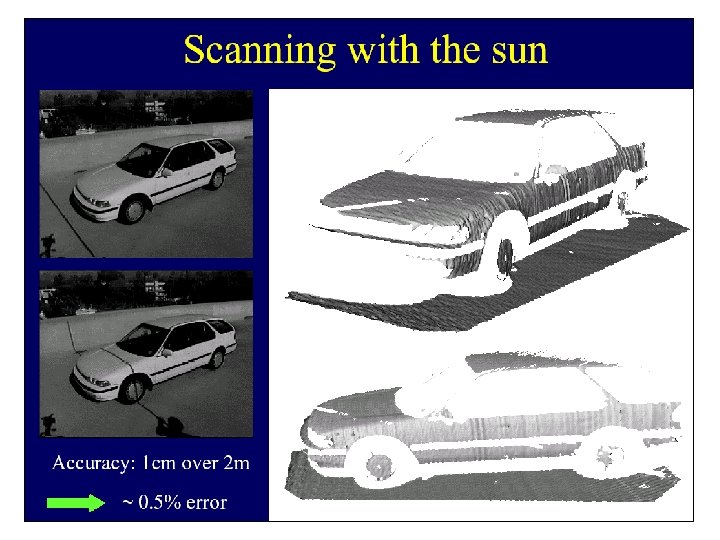
3 D Acquisition from Shadows Bouguet-Perona, ICCV 98
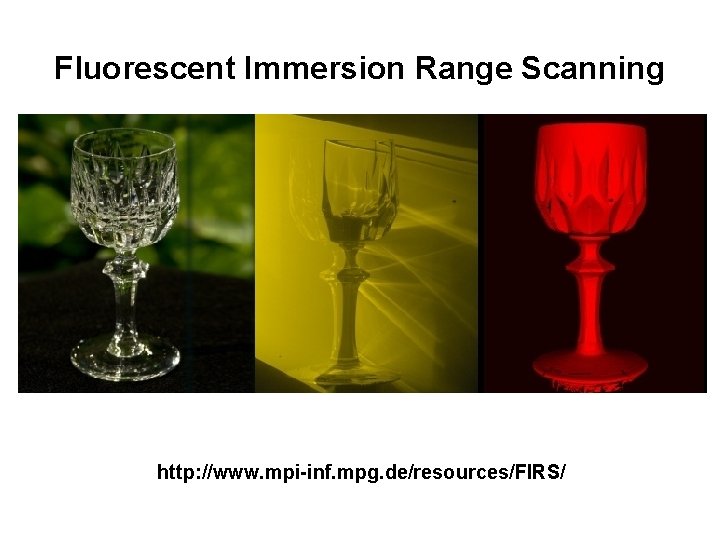
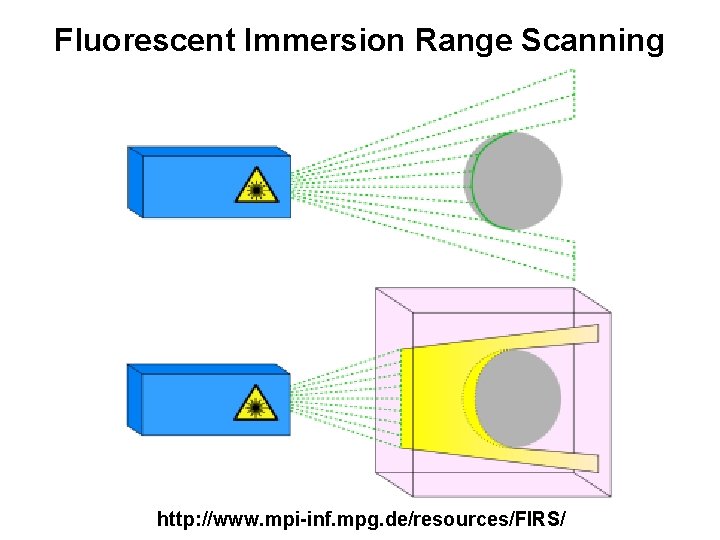
Fluorescent Immersion Range Scanning http: //www. mpi-inf. mpg. de/resources/FIRS/
Fluorescent Immersion Range Scanning http: //www. mpi-inf. mpg. de/resources/FIRS/
Structured Light Reconstruction • • Avoid problems due to correspondence Avoid problems due to surface appearance Much more accurate Very popular in industrial settings • Reading: – Marc Levoy’s webpages (Stanford) – Katsu Ikeuchi’s webpages (U Tokyo) – Peter Allen’s webpages (Columbia)