
Structured lexicons and Lexical semantics Especially Word Net

- Slides: 28
Structured lexicons and Lexical semantics Especially Word. Net® See D Jurafsky & JH Martin: Speech and Language Processing, Upper Saddle River NJ (2000): Prentice Hall, Chapter 16. and http: //en. wikipedia. org/wiki/Word. Net and explore Word. Net: http: //wordnet. princeton. edu/
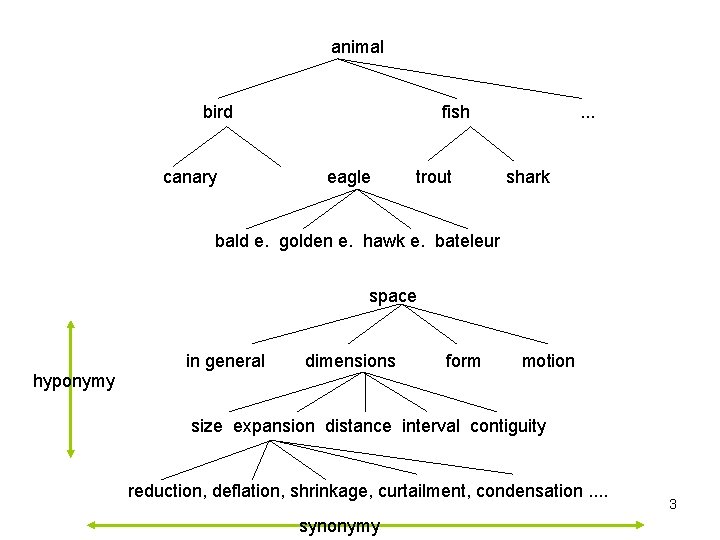
Structured lexicons • • • Alternative to alphabetical dictionary List of words grouped according to meaning Classic example Roget’s Thesaurus Hierarchical organization is important Hierarchies familiar as taxonomies, eg in natural sciences – Daughters are “types of” and share certain properties, inherited from the mother • Similar idea for ordinary words: hyponymy and synonymy 2
animal bird canary fish eagle trout . . . shark bald e. golden e. hawk e. bateleur space in general dimensions form motion hyponymy size expansion distance interval contiguity reduction, deflation, shrinkage, curtailment, condensation. . synonymy 3
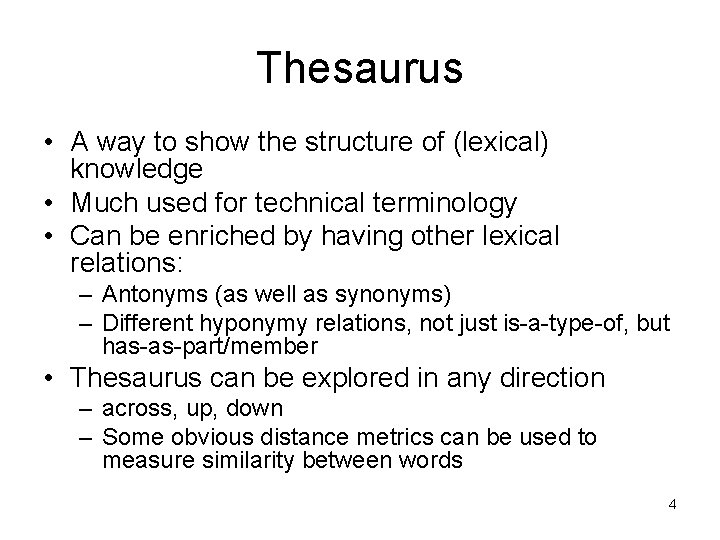
Thesaurus • A way to show the structure of (lexical) knowledge • Much used for technical terminology • Can be enriched by having other lexical relations: – Antonyms (as well as synonyms) – Different hyponymy relations, not just is-a-type-of, but has-as-part/member • Thesaurus can be explored in any direction – across, up, down – Some obvious distance metrics can be used to measure similarity between words 4
Word. Net: History • 1985: a group of psychologists and linguists start to develop a “lexical database” – Princeton University – theoretical basis: results from • psycholinguistics and psycholexicology – What are properties of the “mental lexicon”? 5
Global organisation • division of the lexicon into five categories: – Nouns – Verbs – Adjectives – Adverbs – function words (“probably stored separately as part of the syntactic component of language” [Miller et al. ] 6
Global organization • • nouns: organized as topical hierarchies verbs: entailment relations adjectives: multi-dimensional hyperspaces adverbs: multi-dimensional hyperspaces 7
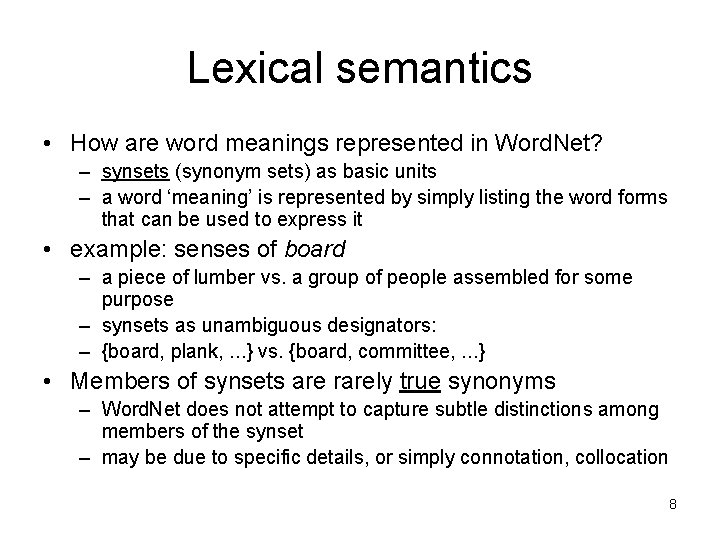
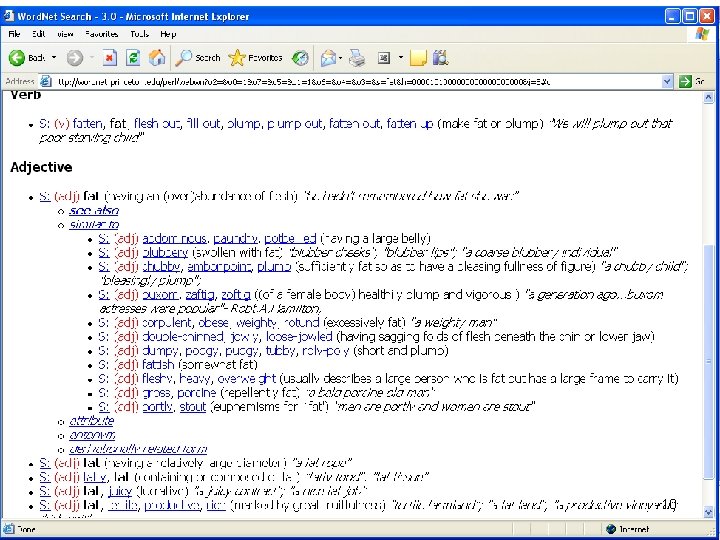
Lexical semantics • How are word meanings represented in Word. Net? – synsets (synonym sets) as basic units – a word ‘meaning’ is represented by simply listing the word forms that can be used to express it • example: senses of board – a piece of lumber vs. a group of people assembled for some purpose – synsets as unambiguous designators: – {board, plank, . . . } vs. {board, committee, . . . } • Members of synsets are rarely true synonyms – Word. Net does not attempt to capture subtle distinctions among members of the synset – may be due to specific details, or simply connotation, collocation 8
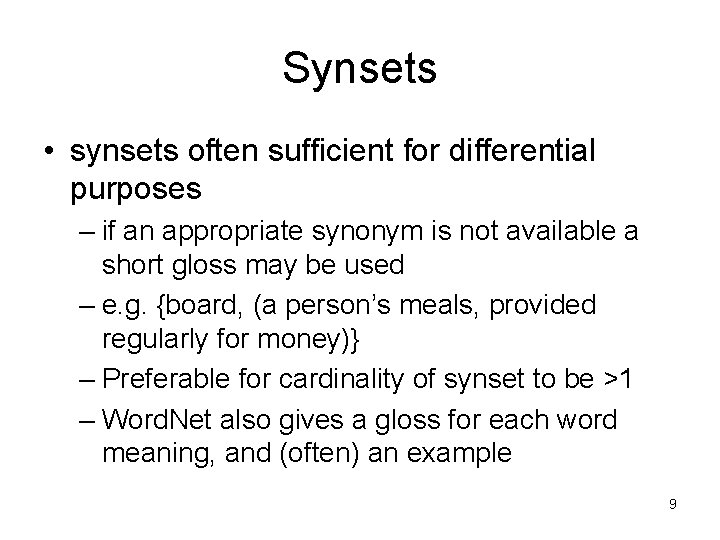
Synsets • synsets often sufficient for differential purposes – if an appropriate synonym is not available a short gloss may be used – e. g. {board, (a person’s meals, provided regularly for money)} – Preferable for cardinality of synset to be >1 – Word. Net also gives a gloss for each word meaning, and (often) an example 9
10
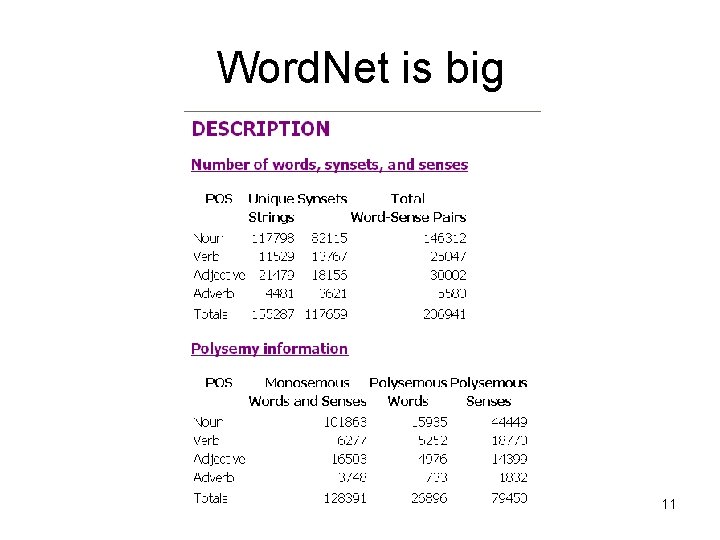
Word. Net is big 11
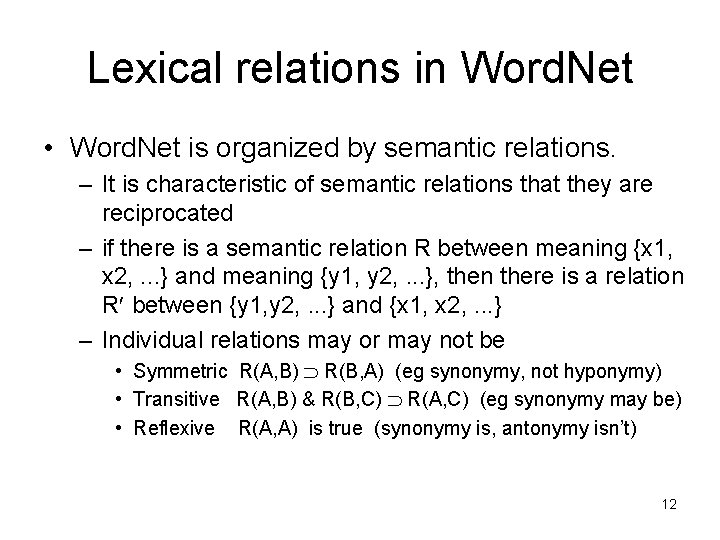
Lexical relations in Word. Net • Word. Net is organized by semantic relations. – It is characteristic of semantic relations that they are reciprocated – if there is a semantic relation R between meaning {x 1, x 2, . . . } and meaning {y 1, y 2, . . . }, then there is a relation R between {y 1, y 2, . . . } and {x 1, x 2, . . . } – Individual relations may or may not be • Symmetric R(A, B) R(B, A) (eg synonymy, not hyponymy) • Transitive R(A, B) & R(B, C) R(A, C) (eg synonymy may be) • Reflexive R(A, A) is true (synonymy is, antonymy isn’t) 12
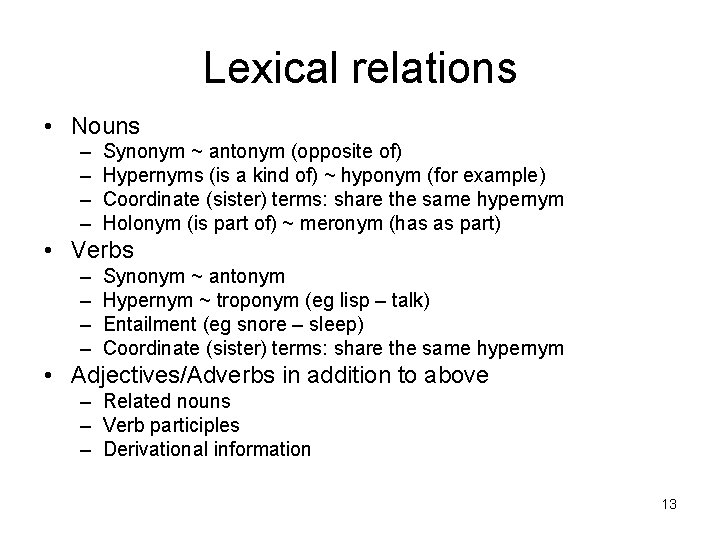
Lexical relations • Nouns – – Synonym ~ antonym (opposite of) Hypernyms (is a kind of) ~ hyponym (for example) Coordinate (sister) terms: share the same hypernym Holonym (is part of) ~ meronym (has as part) • Verbs – – Synonym ~ antonym Hypernym ~ troponym (eg lisp – talk) Entailment (eg snore – sleep) Coordinate (sister) terms: share the same hypernym • Adjectives/Adverbs in addition to above – Related nouns – Verb participles – Derivational information 13
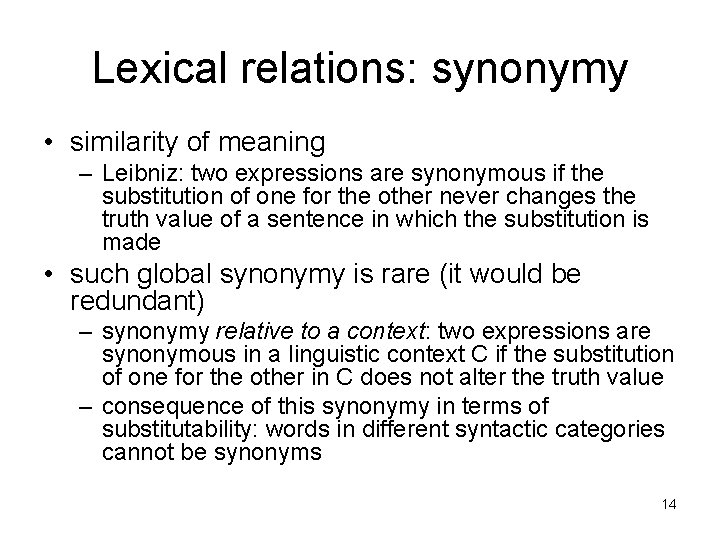
Lexical relations: synonymy • similarity of meaning – Leibniz: two expressions are synonymous if the substitution of one for the other never changes the truth value of a sentence in which the substitution is made • such global synonymy is rare (it would be redundant) – synonymy relative to a context: two expressions are synonymous in a linguistic context C if the substitution of one for the other in C does not alter the truth value – consequence of this synonymy in terms of substitutability: words in different syntactic categories cannot be synonyms 14
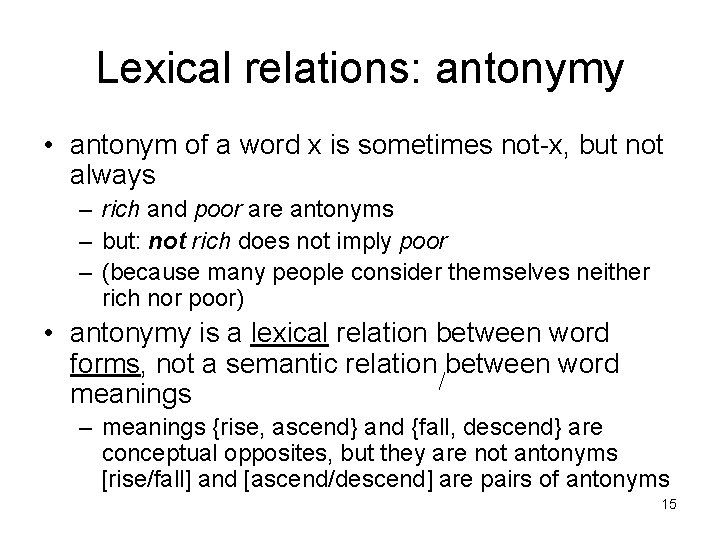
Lexical relations: antonymy • antonym of a word x is sometimes not-x, but not always – rich and poor are antonyms – but: not rich does not imply poor – (because many people consider themselves neither rich nor poor) • antonymy is a lexical relation between word forms, not a semantic relation between word meanings – meanings {rise, ascend} and {fall, descend} are conceptual opposites, but they are not antonyms [rise/fall] and [ascend/descend] are pairs of antonyms 15
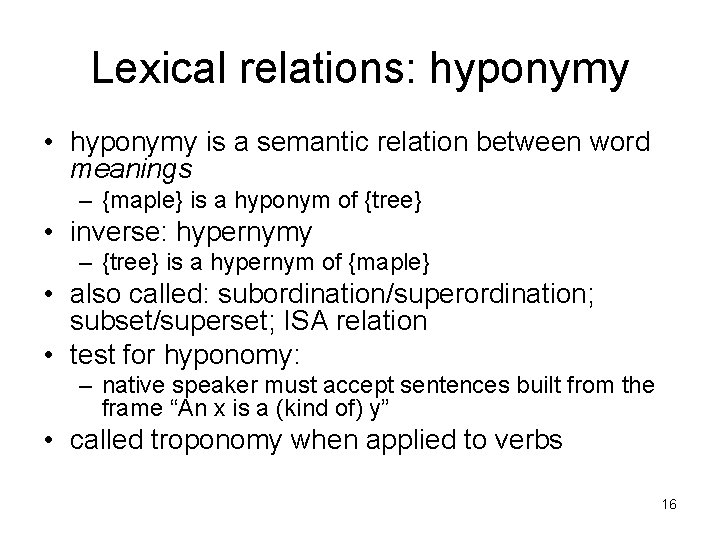
Lexical relations: hyponymy • hyponymy is a semantic relation between word meanings – {maple} is a hyponym of {tree} • inverse: hypernymy – {tree} is a hypernym of {maple} • also called: subordination/superordination; subset/superset; ISA relation • test for hyponomy: – native speaker must accept sentences built from the frame “An x is a (kind of) y” • called troponomy when applied to verbs 16
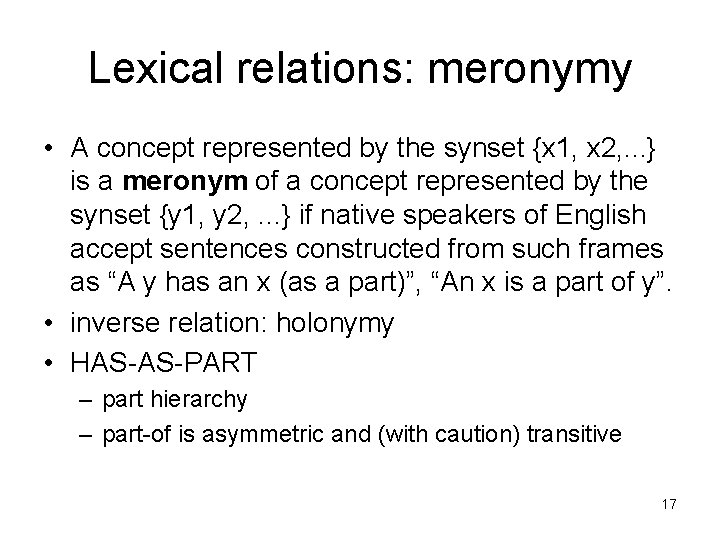
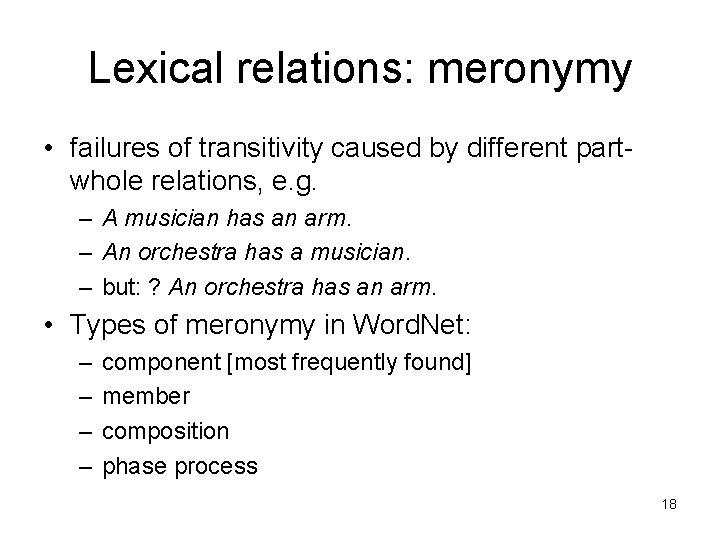
Lexical relations: meronymy • A concept represented by the synset {x 1, x 2, . . . } is a meronym of a concept represented by the synset {y 1, y 2, . . . } if native speakers of English accept sentences constructed from such frames as “A y has an x (as a part)”, “An x is a part of y”. • inverse relation: holonymy • HAS-AS-PART – part hierarchy – part-of is asymmetric and (with caution) transitive 17
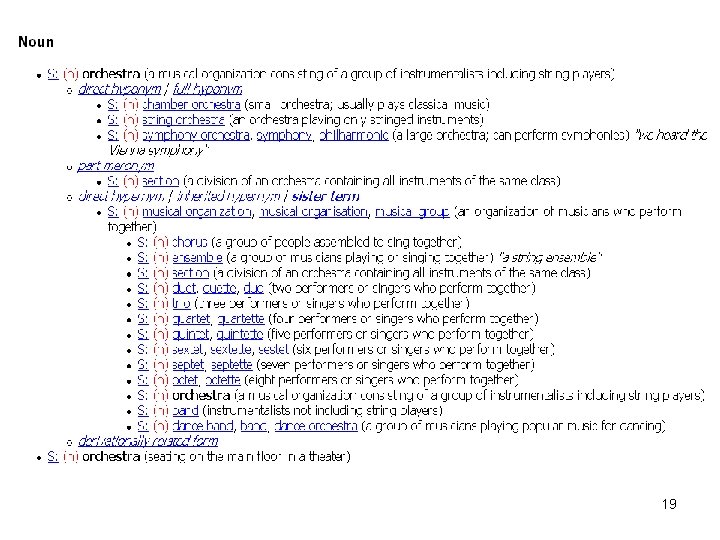
Lexical relations: meronymy • failures of transitivity caused by different partwhole relations, e. g. – A musician has an arm. – An orchestra has a musician. – but: ? An orchestra has an arm. • Types of meronymy in Word. Net: – – component [most frequently found] member composition phase process 18
19
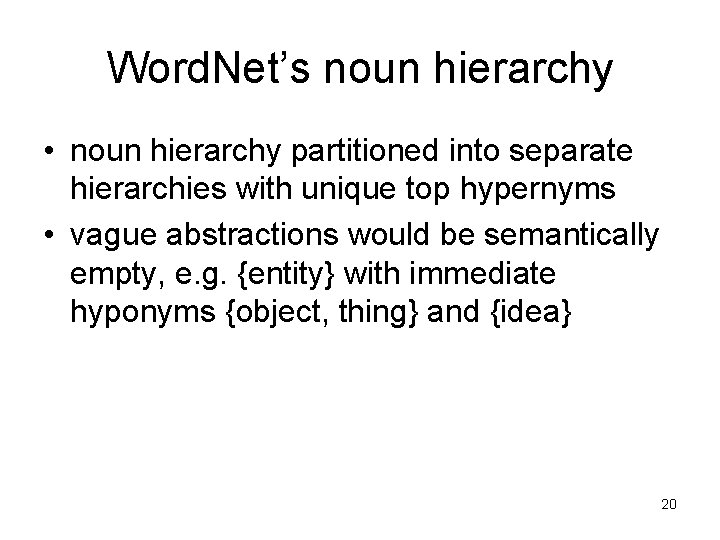
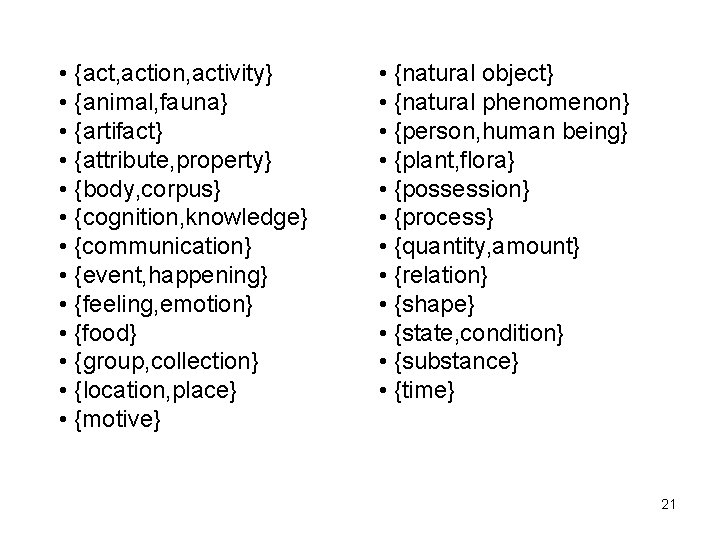
Word. Net’s noun hierarchy • noun hierarchy partitioned into separate hierarchies with unique top hypernyms • vague abstractions would be semantically empty, e. g. {entity} with immediate hyponyms {object, thing} and {idea} 20
• {act, action, activity} • {animal, fauna} • {artifact} • {attribute, property} • {body, corpus} • {cognition, knowledge} • {communication} • {event, happening} • {feeling, emotion} • {food} • {group, collection} • {location, place} • {motive} • {natural object} • {natural phenomenon} • {person, human being} • {plant, flora} • {possession} • {process} • {quantity, amount} • {relation} • {shape} • {state, condition} • {substance} • {time} 21
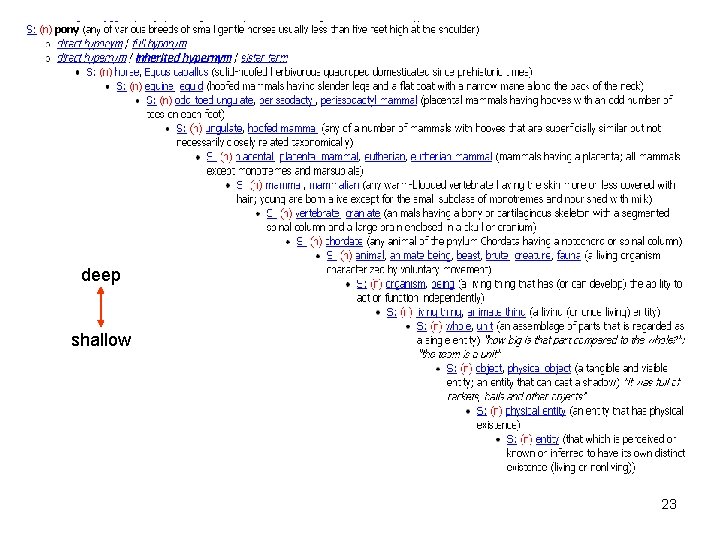
Nouns in Word. Net • noun hierarchy as lexical inheritance system – seldom goes more than ten levels deep, – the deepest examples usually contain technical levels that are not part of everyday vocabulary – shallowest levels are too vague – “Inherited hypernym” option shows full hierarchy 22
deep shallow 23
Nouns in Word. Net • man-made artefacts: sometimes six or seven levels deep – roadster → car → motor vehicle → wheeled vehicle → conveyance → artefact • hierarchy of persons: about three or four levels – televangelist → preacher → clergyman → spiritual leader → person • Like all thesaurus structures, words can have multiple hypernyms 24
Word. Nets for other languages • Idea has been widely copied • Sometimes by “translating” Princeton Word. Net – Lexical relations in general are universal. . . – But are they in practice? – Are synsets universal? • Euro. Word. Net: combining multilingual Word. Nets to include cross-language equivalence – Inherent difficulties, as above 25
What can Word. Net be used for? • As a lexical resource, an online dictionary, for human use • Word-sense disambiguation (including homophone correction) – neighbouring words will be more closely related to correct sense (desert/dessert ~ camel) • Document classification – What is this text about? Look for recurring hypernyms 26
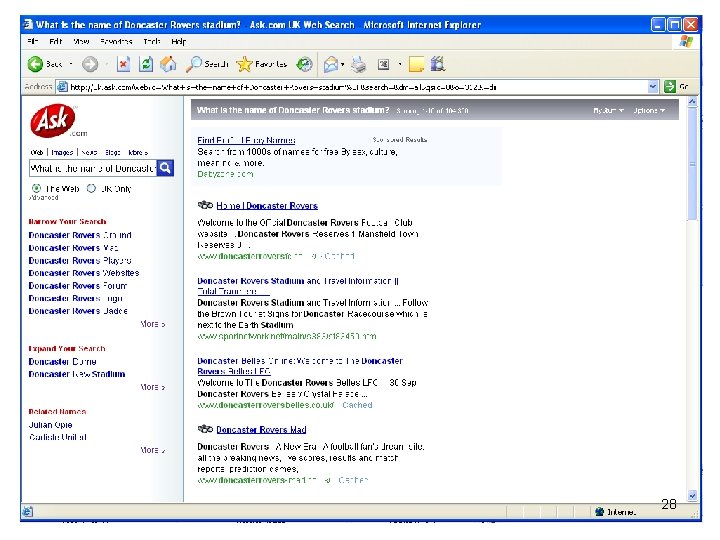
What can Word. Net be used for? • Document retrieval – eg looking for texts about sports cars, search for synonyms and hyponyms of sports car • Open-domain Q/A – Searching texts (eg WWW) to answer questions expressed in natural language – eg http: //uk. ask. com/ [example] • Textual entailment – Answering questions implied by text 27
28