
STRUCTURED INTERVIEWING AND QUESTIONNAIRE SURVEYS THE SURVEY A
- Slides: 58
STRUCTURED INTERVIEWING AND QUESTIONNAIRE SURVEYS
THE SURVEY A process of collecting information from a sample of people who have been selected to represent a defined population
THE SURVEY • The Survey is the research method and the questionnaire and interview are the primary research instruments or techniques used in a survey. • Surveying is a quasi experimental method as there is minimal control and it is usually conducted in a field setting.
CHIEF CHARACTERISTICS OF THE SURVEY – A sample of respondents from a defined population reply to a number of standard questions under comparable conditions. – Standard questions enable comparisons to be made between individuals, and between strata or subsets of the sample. – The aim is to generalize sample results to the defined population. – Administration can be by face-to-face interview, group self completion, mailing respondent a form for self completion, using internet or by telephone.
MAJOR FORMS OF SURVEY • The descriptive survey estimates the nature of existing conditions or the attributes of a population • The explanatory survey seeks to establish cause and effect relationships, but without experimental manipulation
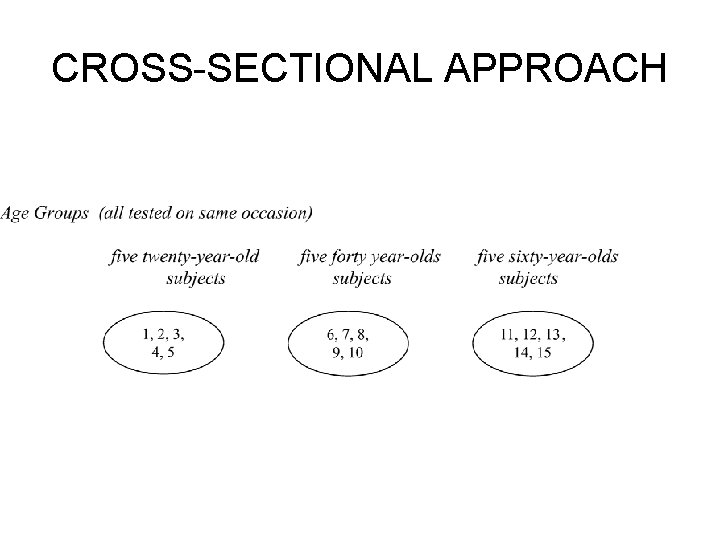
Longitudinal and Cross. Sectional Designs • The Cross-sectional approach – A survey conducted once at a particular time across a range of groups • The Longitudinal approach – A survey repeated on a number of occasions on the same group(s)
CROSS-SECTIONAL APPROACH
LONGITUDINAL SURVEY
THE STRENGTH OF THE SURVEY METHOD – often the only way to obtain information about certain behaviours, beliefs, motives, personal information and work context issues – can be used on most populations except young children – an efficient way of collecting large amounts of data at low cost in a short period of time – structured surveys and interviews are amenable to statistical analysis, using t tests, correlation, ANOVA, chi square etc.
SELECTING THE SURVEY METHOD The selection of the survey method is affected by the following considerations: – Nature of population; such as, age, reading or writing skills, wide or localized geographical dispersal. – Nature of information sought; for example, degree of complexity, degree of sensitivity, whether emotive, unimportant, boring, or politically dangerous. – Length of questionnaire/interview. – Financial and other resources; for example, time, and number of interviewers available.
SIMULTANEOUS SELF COMPLETION • The cheapest, quickest and least resource intensive approach is the self completion questionnaire filled in simultaneously by many respondents. E. g. in a university lecture theatre. • There is no problem of returning completed forms so response rate is high. • The presence of the researcher enables queries to be answered.
Advantages of Mail Questionnaires • Each respondent receives an identical set of questions. • The respondent is free to answer in their own time and at their own pace • Anxiety and embarrassment, which may result from direct contact, are avoided • Possible to include a larger number of subjects as well as subjects in more diverse and distant locations • Can guarantee confidentiality perhaps eliciting more truthful responses • The personal appearance, mood or conduct of the interviewer does not influence the results
DISADVANTAGES OF A MAILED QUESTIONNAIRE • Difficulty of securing an adequate return of completed questionnaires • Sampling problems • Possibility of misinterpretation of the questions by the respondents • Questionnaire has to be short and simple • Unsuitable when probing is desirable. • No opportunity to acquire supplementary observational data. • Self administration is inappropriate for very young, illiterate or some disabled people.
TELEPHONE SURVEY • Infrequently used now due credibility issues; increased resistance from householders assailed by telemarketers • Economical and immediate results • Probing available • Possible sample bias - being contactable and willing to take part
INTERNET BASED SURVEYS • Increasingly popular - faster, cheaper, and easier to conduct than surveys using telephone or mail. • Permit researchers to reach a large population, world wide if necessary. • You can get a very specific sample by sending an invitational email directing your chosen sample to your web site on which your survey lies. Your selected sample is usually chosen from an available list e. g. professional association, university staff etc. • Internet surveys may be preferable to mail or telephone surveys when a list of e-mail addresses for the target population is available, eliminating the need for mail or phone invitations to potential respondents.
INTERNET BASED SURVEYS • To obtain a general population, simply place your survey on your website and wait. Surfers may find your website and complete the survey. • You will rarely know what the characteristics are of this population who found your survey. Uninvited visitors to your website are often haphazard and unintentional, and provide an opportunity sample. • Sample size requirements may be no problem but the only thing we can say about the sample with justification is that it is a population of persons who have access to the internet but what it represents in terms of age, ethnicity, employment groups etc. is impossible to say. • The sample is world wide too and therefore language and cultural nuances may come into play, affecting how people interpret the items and respond.
INTERNET BASED SURVEYS • Web surveys are easier to distribute, and are less intrusive for respondents with no interviewers or phone calls. • Web surveys allow you to use a full range of question formats (single select, multiple select, sliding scale, and open-ended questions) and additionally, a drop down list format that enhances the look of your web survey for questions with long lists of alternative answers. • They also offer better support than their paper counterparts for skip patterns (the ability to skip automatically over entire blocks of questions based on previous answers), and can provide multi-lingual formats.
SURVEY AND INTERVIEW QUESTIONNAIRE DESIGN • Which questions will obtain the information we need? • Have respondents the knowledge, literacy level and understanding to answer the questions? • Will respondents be willing to answer the questions? • Which question format is appropriate and can the responses be analysed statistically?
ORDERING OF QUESTIONS General Start with easy questions Start with 'relevant' questions Leave sensitive questions until later
COMMON SEQUENCE 1. 2. 3. 4. 5. 6. 7. Introduction to respondents Instructions Demographic data Core of questionnaire questions Sensitive personal data close to end Open-ended question at end Concluding the questionnaire – expression of thanks
QUESTIONNAIRE DESIGN INTRODUCTION Is there a short but proper introduction to the questionnaire ? 1. To explain the purpose of study 2. To note any sponsoring organization 3. To assure confidentiality 4. To appeal to respondent’s motivation to cooperate
QUESTIONNAIRE DESIGN Are questions placed in the best sequence…. from easiest to most difficult. . . from least to most sensitive? Can answers be easily coded or evaluated by other means? Is there a need for identifying respondents, groups of respondents by age, income, type of work, type of industry? i. e. a range of relevant demographic questions
GENERAL FORMAT • Make questionnaire 'appealing to the eye' and easy to complete. • Include brief but clear instructions so they do not require extensive instructions or examples. Print all instructions in bold type or italics. • Avoid constructing sections to be answered only by a subset of respondents - such sections cause frustration and result in fewer completed forms. • Leave plenty of 'white space‘ - Avoid overcrowding pages. • Include contact details to whom the completed questionnaire is to be returned, even if you have included a self addressed return envelope.
ASKING QUESTIONS Avoid jargon, abbreviations and acronyms Simplify wherever possible Avoid ambiguity Ask only one question at a time (avoid multi-purpose or double barrelled questions) Place positively worded and negatively worded items at random within a rating scale
TYPES OF QUESTIONS Closed Questions: Questions that have a preset range of response options. Open Ended Questions: Questions that permit the respondent to supply their individualized response. But more difficult to answer and analyse
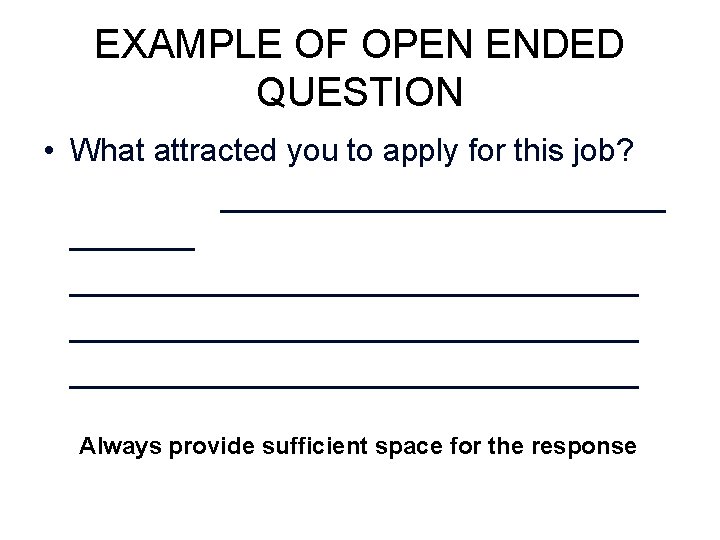
EXAMPLE OF OPEN ENDED QUESTION • What attracted you to apply for this job? ________________________________ Always provide sufficient space for the response
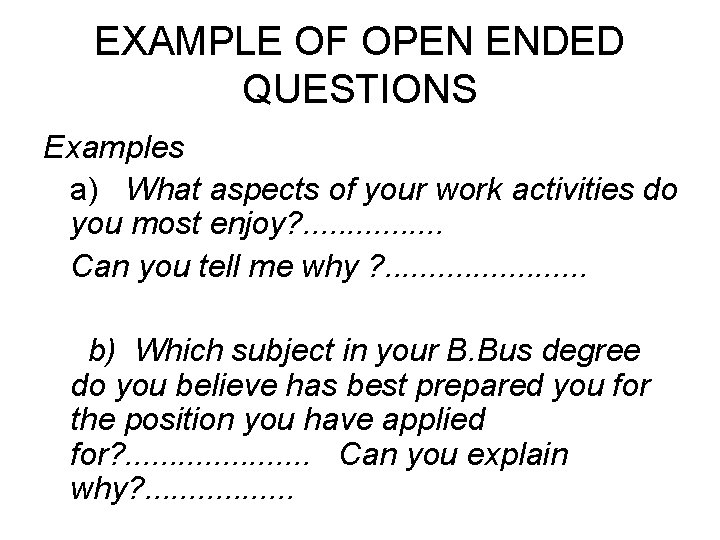
EXAMPLE OF OPEN ENDED QUESTIONS Examples a) What aspects of your work activities do you most enjoy? . . . . Can you tell me why ? . . . b) Which subject in your B. Bus degree do you believe has best prepared you for the position you have applied for? . . Can you explain why? . . . .
ADVANTAGES OF OPEN-ENDED QUESTIONS • In interviews, they allow the interviewer to probe so that they may go to more depth if they choose, or clear up any misunderstanding; • Test the limits of the respondent's knowledge; • Encourage cooperation and help establish rapport; and • Make a truer assessment of what the respondent really believes/knows.
EXAMPLE OF CLOSED QUESTION
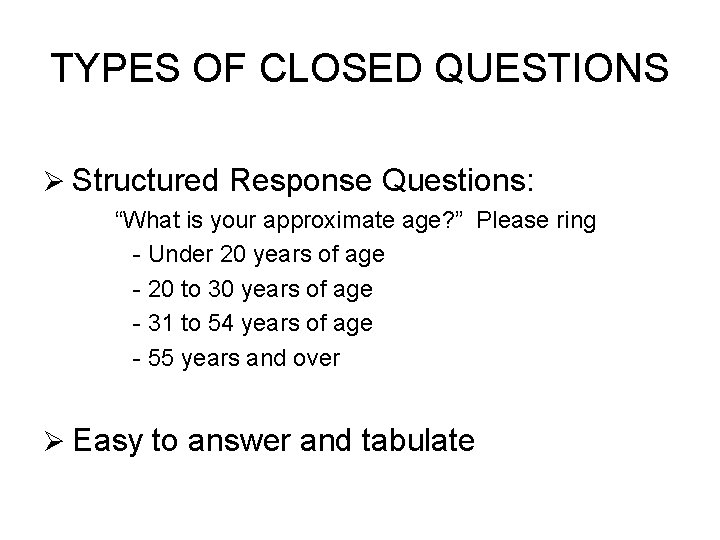
TYPES OF CLOSED QUESTIONS Structured Response Questions: “What is your approximate age? ” Please ring - Under 20 years of age - 20 to 30 years of age - 31 to 54 years of age - 55 years and over Easy to answer and tabulate
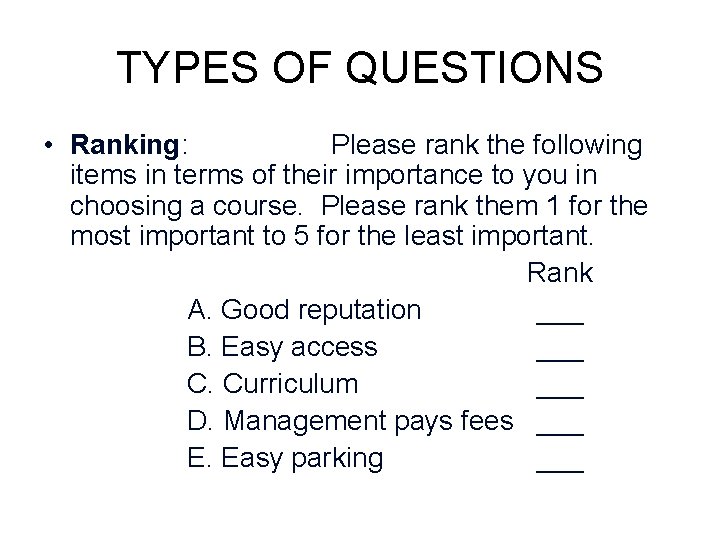
TYPES OF QUESTIONS • Ranking: Please rank the following items in terms of their importance to you in choosing a course. Please rank them 1 for the most important to 5 for the least important. Rank A. Good reputation ___ B. Easy access ___ C. Curriculum ___ D. Management pays fees ___ E. Easy parking ___
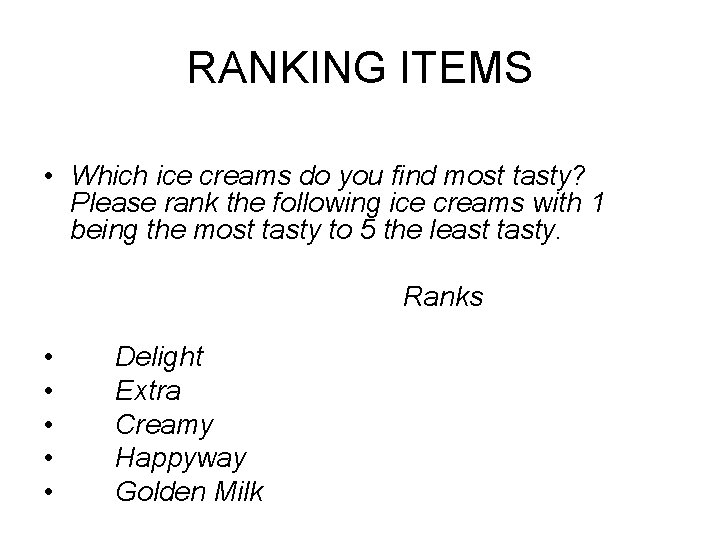
RANKING ITEMS • Which ice creams do you find most tasty? Please rank the following ice creams with 1 being the most tasty to 5 the least tasty. Ranks • • • Delight Extra Creamy Happyway Golden Milk
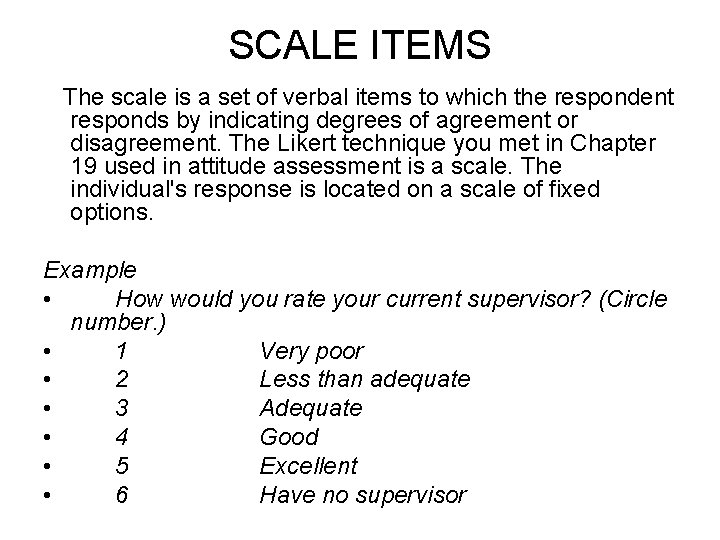
SCALE ITEMS The scale is a set of verbal items to which the respondent responds by indicating degrees of agreement or disagreement. The Likert technique you met in Chapter 19 used in attitude assessment is a scale. The individual's response is located on a scale of fixed options. Example • How would you rate your current supervisor? (Circle number. ) • 1 Very poor • 2 Less than adequate • 3 Adequate • 4 Good • 5 Excellent • 6 Have no supervisor
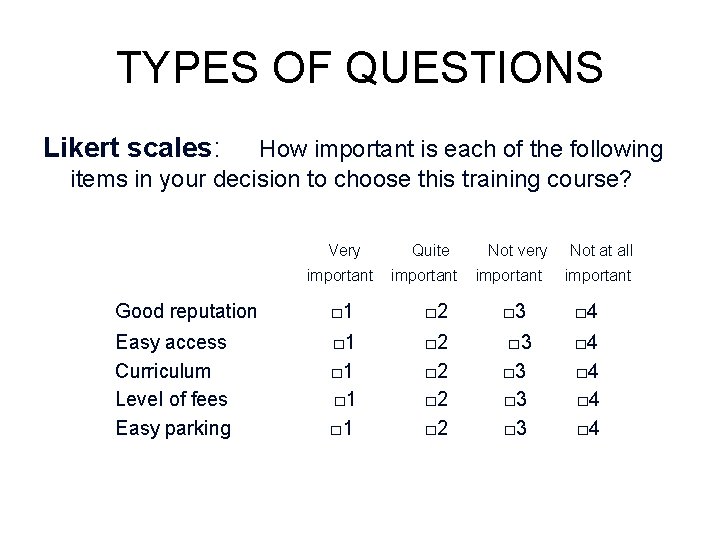
TYPES OF QUESTIONS Likert scales: How important is each of the following items in your decision to choose this training course? Very important Quite important Not very important Not at all important Good reputation □ 1 □ 2 □ 3 □ 4 Easy access Curriculum Level of fees Easy parking □ 1 □ 1 □ 2 □ 2 □ 3 □ 3 □ 4 □ 4
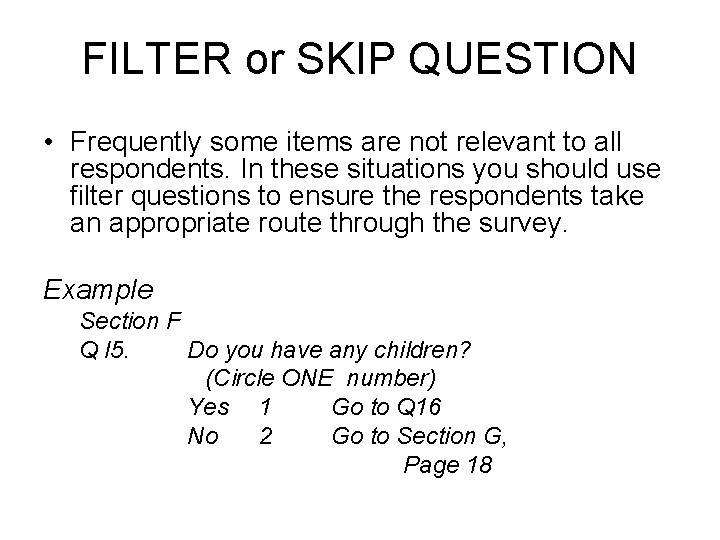
FILTER or SKIP QUESTION • Frequently some items are not relevant to all respondents. In these situations you should use filter questions to ensure the respondents take an appropriate route through the survey. Example Section F Q l 5. Do you have any children? (Circle ONE number) Yes 1 Go to Q 16 No 2 Go to Section G, Page 18
VERTICAL RESPONSE
POOR QUESTION FORMATS
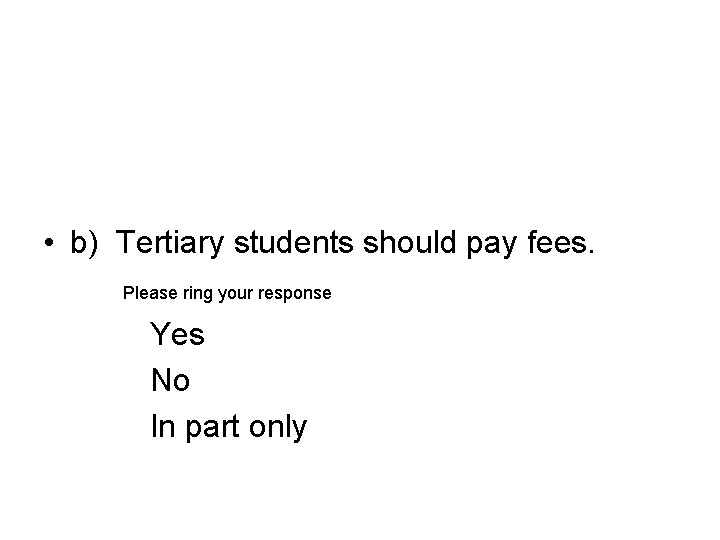
• b) Tertiary students should pay fees. Please ring your response Yes No In part only
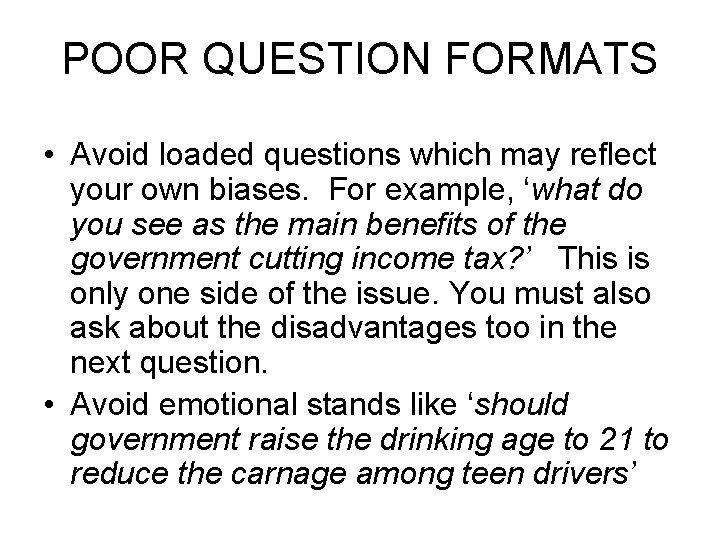
POOR QUESTION FORMATS • Avoid loaded questions which may reflect your own biases. For example, ‘what do you see as the main benefits of the government cutting income tax? ’ This is only one side of the issue. You must also ask about the disadvantages too in the next question. • Avoid emotional stands like ‘should government raise the drinking age to 21 to reduce the carnage among teen drivers’
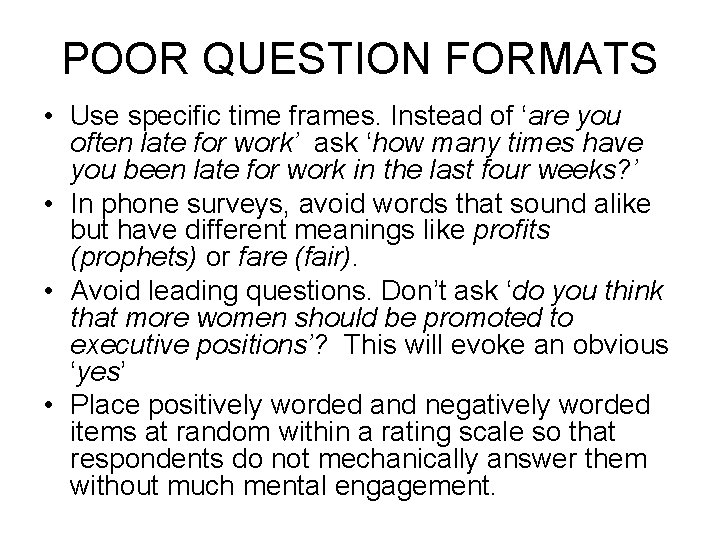
POOR QUESTION FORMATS • Use specific time frames. Instead of ‘are you often late for work’ ask ‘how many times have you been late for work in the last four weeks? ’ • In phone surveys, avoid words that sound alike but have different meanings like profits (prophets) or fare (fair). • Avoid leading questions. Don’t ask ‘do you think that more women should be promoted to executive positions’? This will evoke an obvious ‘yes’ • Place positively worded and negatively worded items at random within a rating scale so that respondents do not mechanically answer them without much mental engagement.
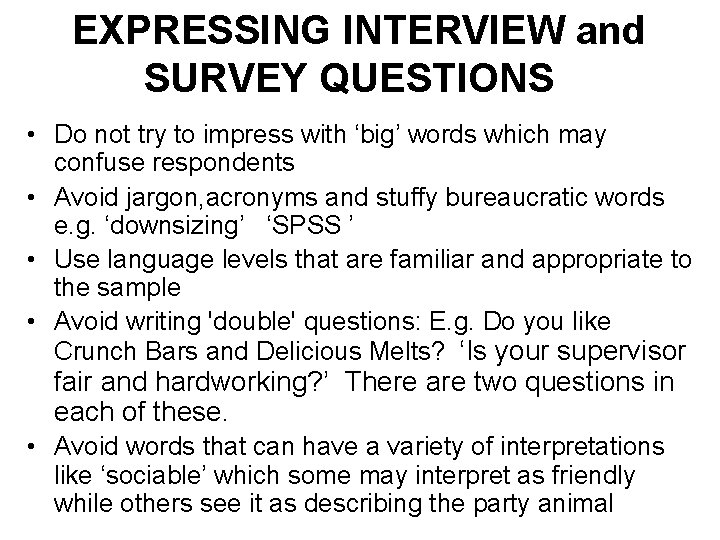
EXPRESSING INTERVIEW and SURVEY QUESTIONS • Do not try to impress with ‘big’ words which may confuse respondents • Avoid jargon, acronyms and stuffy bureaucratic words e. g. ‘downsizing’ ‘SPSS ’ • Use language levels that are familiar and appropriate to the sample • Avoid writing 'double' questions: E. g. Do you like Crunch Bars and Delicious Melts? ‘Is your supervisor fair and hardworking? ’ There are two questions in each of these. • Avoid words that can have a variety of interpretations like ‘sociable’ which some may interpret as friendly while others see it as describing the party animal
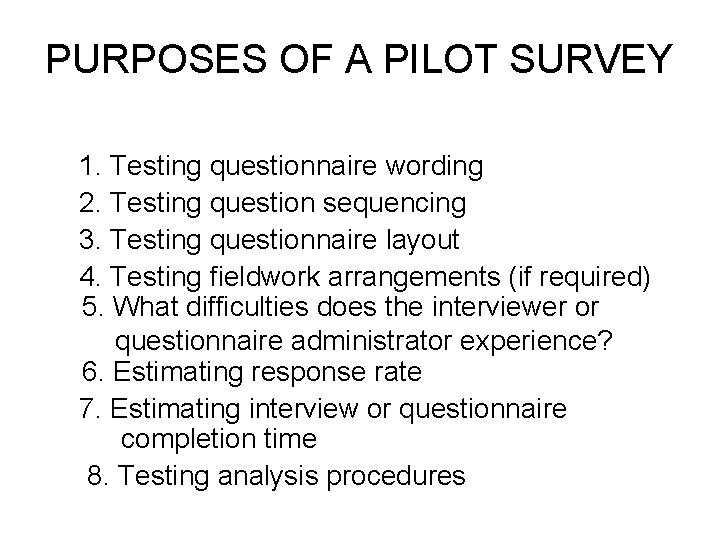
PURPOSES OF A PILOT SURVEY 1. Testing questionnaire wording 2. Testing question sequencing 3. Testing questionnaire layout 4. Testing fieldwork arrangements (if required) 5. What difficulties does the interviewer or questionnaire administrator experience? 6. Estimating response rate 7. Estimating interview or questionnaire completion time 8. Testing analysis procedures
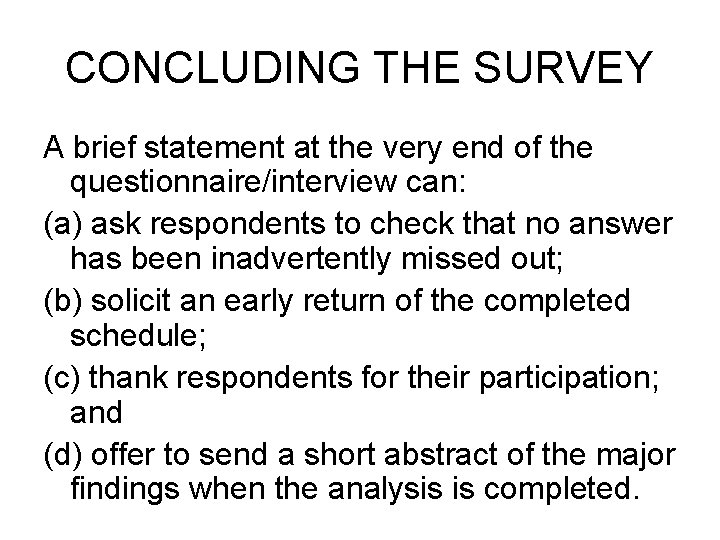
CONCLUDING THE SURVEY A brief statement at the very end of the questionnaire/interview can: (a) ask respondents to check that no answer has been inadvertently missed out; (b) solicit an early return of the completed schedule; (c) thank respondents for their participation; and (d) offer to send a short abstract of the major findings when the analysis is completed.
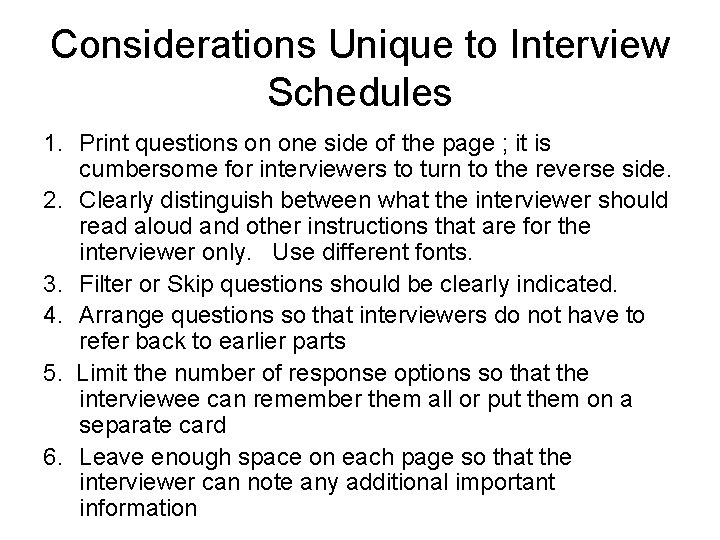
Considerations Unique to Interview Schedules 1. Print questions on one side of the page ; it is cumbersome for interviewers to turn to the reverse side. 2. Clearly distinguish between what the interviewer should read aloud and other instructions that are for the interviewer only. Use different fonts. 3. Filter or Skip questions should be clearly indicated. 4. Arrange questions so that interviewers do not have to refer back to earlier parts 5. Limit the number of response options so that the interviewee can remember them all or put them on a separate card 6. Leave enough space on each page so that the interviewer can note any additional important information
STRUCTURED PERSONAL INTERVIEW • Advantages – High response rate – Face-to-face interaction assists in the establishment of rapport and a higher level of motivation among respondents. – A useful method when extensive data is required on a small number of complex topics. – Probing may be used to elicit more complete responses and reduces the number of 'don't know' and non responses to questions
STRUCTURED PERSONAL INTERVIEW – Observation of the respondent's non-verbal communication and environment is possible. – This approach is useful in obtaining responses from people who would find a written response impossible, such as very young children, the elderly, illiterate and some disabled groups. – Individualized appreciation can be shown to the respondents.
STRUCTURED INTERVIEWS Disadvantages – Expensive and time-consuming – Finding skilled and trained interviewers may be difficult. – Interviewer effects may bias result from interaction between the interviewer and respondent. – Respondent effects also bias answers and include deference or acquiescence (informant agrees all the time) and expectancy (informant answers the way they think the interviewer wants them to) – Respondents may feel that they are being put on the spot.
RESPONSE RATE You need to maximize response rate. The most important principle is to maximize the rewards or benefits for the person responding while minimizing the costs for them. Do this by: – including stamped addressed envelopes for the return of the survey – making the survey short and interesting – clear instructions – not using small print, many arrows and boxes, and verbose instructions – many researchers include small tokens for completing the survey.
VALIDITY • Is the interview or questionnaire really measuring what it is supposed to measure • Content validity may be assessed by having some competent colleagues who are familiar with the purpose of the survey examine the items to judge whether their content is relevant. • Concurrent and predictive validity can be assessed by comparing to external criteria e. g. observed behaviour, such as making purchases of items they had indicated they would. Other data sources, such as third parties, may also be used as criteria.
Validity Other variables that influence the validity of a questionnaire as follows. (a) How important is the topic to the respondent? We can assume more valid responses from individuals who are interested in and motivated about the survey topic and/or are knowledgeable about it. (b) Does the questionnaire protect the respondent's anonymity? It is reasonable to assume that greater truthfulness will be obtained if the respondents could remain anonymous, especially when sensitive or personal questions are asked.
RELIABILITY • Usually not possible to undertake a test-re-test reliability of a questionnaire or interview with the same individuals after a period of time or to administer two different forms of the questionnaire to the same individuals. • Internal consistency is not feasible either unless there is a sequence of Likert items on one aspect. • Other factors influencing the reliability and validity of a subject's responses involve such issues as self insight, acquiescence, social desirability. • The interaction of interviewer and respondent variables such as gender, age, dress, race, social class and attractiveness are all known to influence responses and rapport.
Data Preparation for Computer Analysis • To facilitate analysis of survey data by computer, the questionnaire/interview must be written and formatted so that responses can easily be coded. • Refer back to Chapter 3 on how to set up a data file and insert variables into the variable view screen. • You must decide how to allocate a numerical coding (usually 1, 2, 3, …. n) to each respondent’s response to or position on every variable.
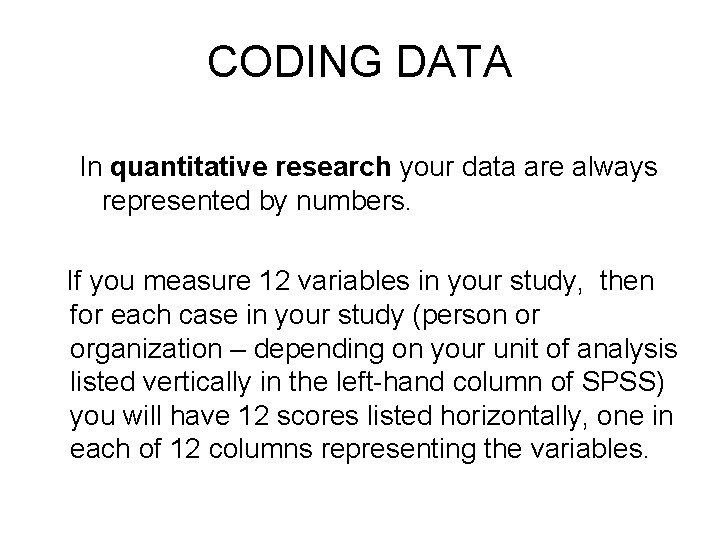
CODING DATA In quantitative research your data are always represented by numbers. If you measure 12 variables in your study, then for each case in your study (person or organization – depending on your unit of analysis listed vertically in the left-hand column of SPSS) you will have 12 scores listed horizontally, one in each of 12 columns representing the variables.
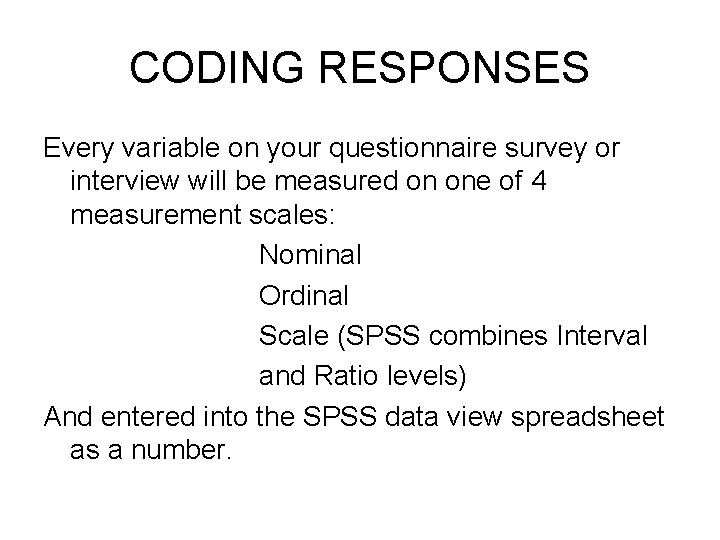
CODING RESPONSES Every variable on your questionnaire survey or interview will be measured on one of 4 measurement scales: Nominal Ordinal Scale (SPSS combines Interval and Ratio levels) And entered into the SPSS data view spreadsheet as a number.
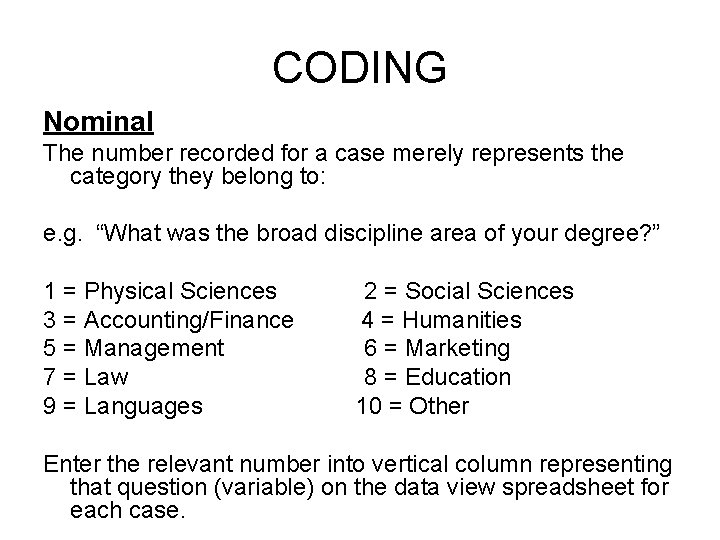
CODING Nominal The number recorded for a case merely represents the category they belong to: e. g. “What was the broad discipline area of your degree? ” 1 = Physical Sciences 3 = Accounting/Finance 5 = Management 7 = Law 9 = Languages 2 = Social Sciences 4 = Humanities 6 = Marketing 8 = Education 10 = Other Enter the relevant number into vertical column representing that question (variable) on the data view spreadsheet for each case.
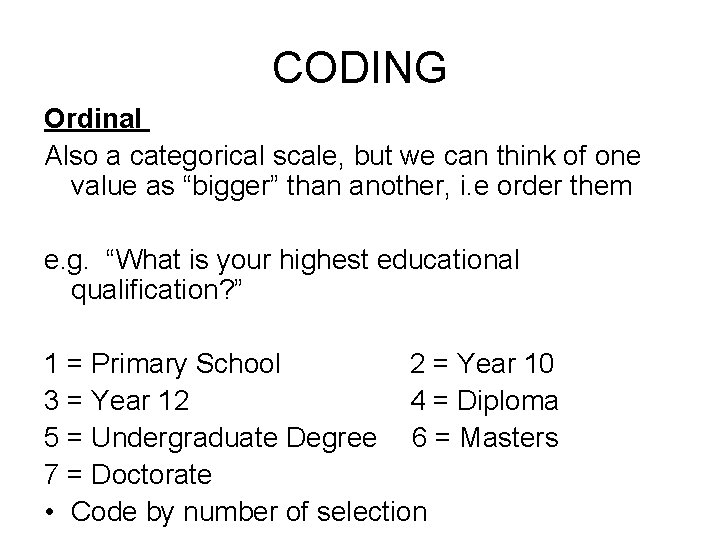
CODING Ordinal Also a categorical scale, but we can think of one value as “bigger” than another, i. e order them e. g. “What is your highest educational qualification? ” 1 = Primary School 2 = Year 10 3 = Year 12 4 = Diploma 5 = Undergraduate Degree 6 = Masters 7 = Doctorate • Code by number of selection
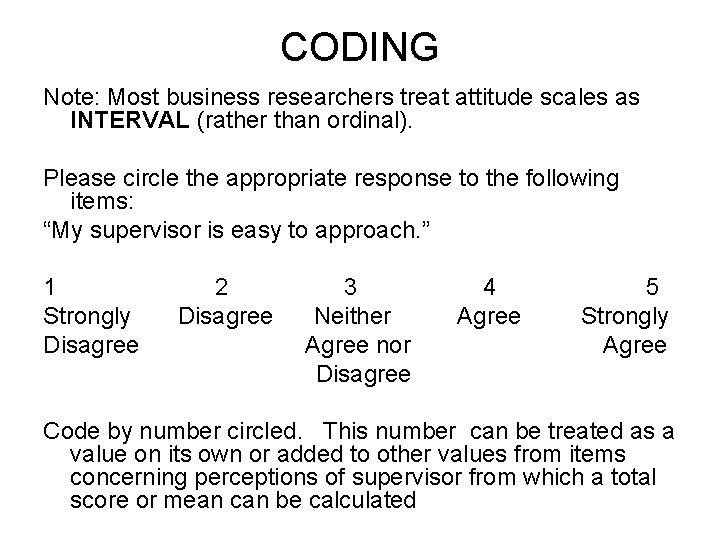
CODING Note: Most business researchers treat attitude scales as INTERVAL (rather than ordinal). Please circle the appropriate response to the following items: “My supervisor is easy to approach. ” 1 Strongly Disagree 2 Disagree 3 Neither Agree nor Disagree 4 Agree 5 Strongly Agree Code by number circled. This number can be treated as a value on its own or added to other values from items concerning perceptions of supervisor from which a total score or mean can be calculated
SUMMARY OF SEQUENCE OF QUESTIONNAIRE DEVELOPMENT