
Structured Chaos Using Mata and Stata to Draw



- Slides: 20
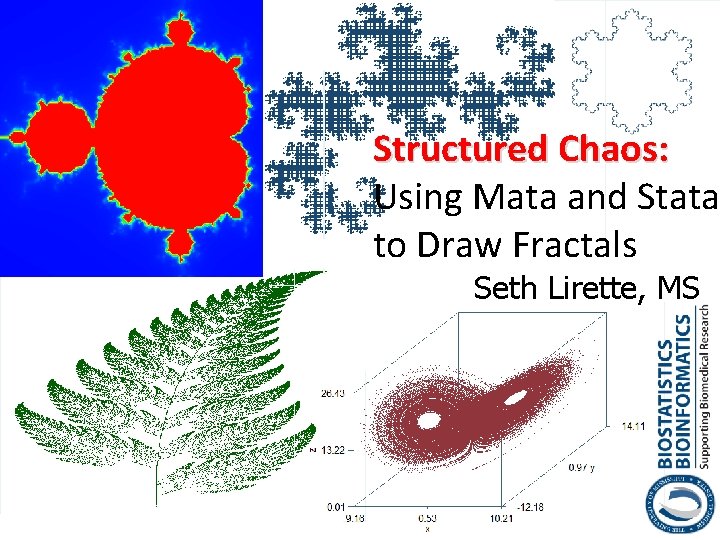
Structured Chaos: Using Mata and Stata to Draw Fractals Seth Lirette, MS
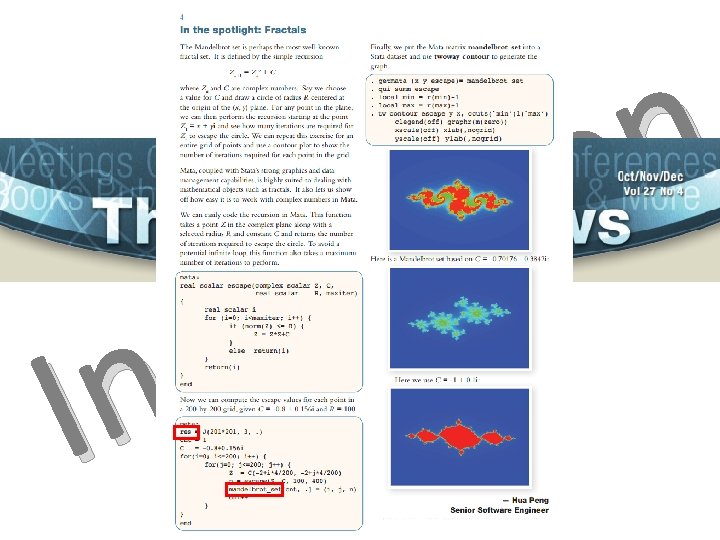
n o i t a r i p s n I
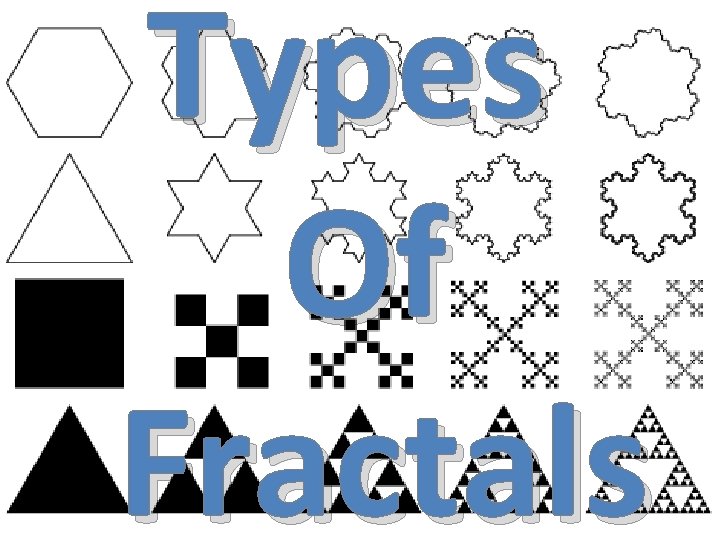
Types Of Fractals
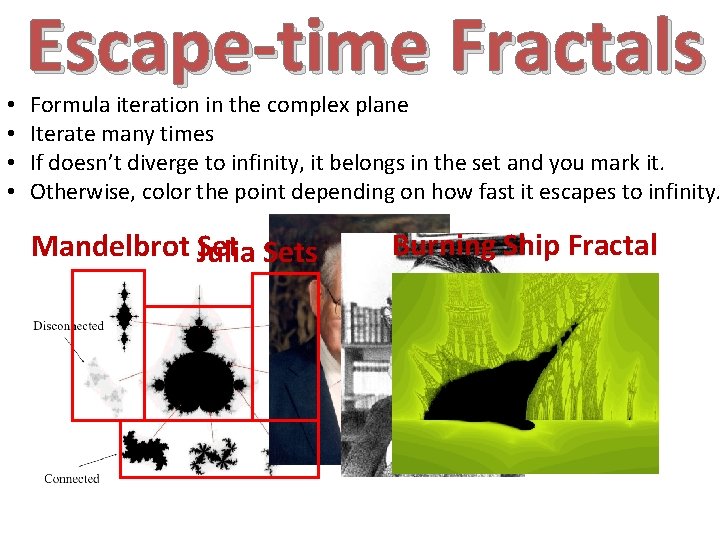
• • Escape-time Fractals Formula iteration in the complex plane Iterate many times If doesn’t diverge to infinity, it belongs in the set and you mark it. Otherwise, color the point depending on how fast it escapes to infinity. Mandelbrot Julia Sets Burning Ship Fractal
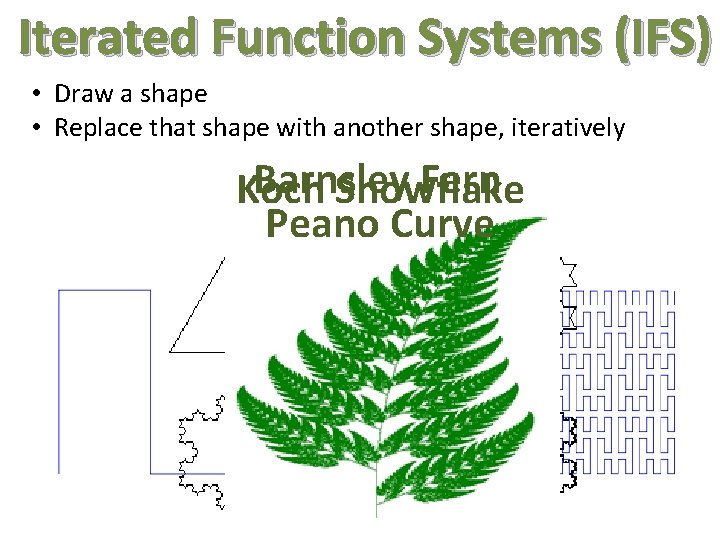
Iterated Function Systems (IFS) • Draw a shape • Replace that shape with another shape, iteratively Barnsley Fern Koch Snowflake Peano Curve
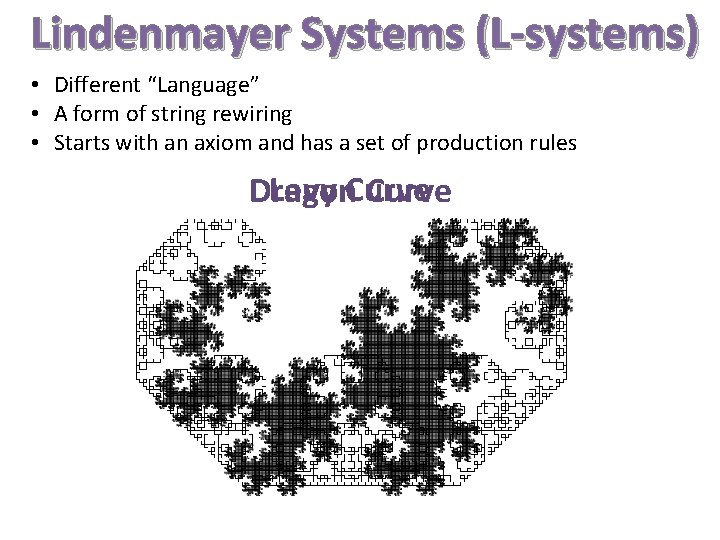
Lindenmayer Systems (L-systems) • Different “Language” • A form of string rewiring • Starts with an axiom and has a set of production rules Levy Curve Dragon Curve
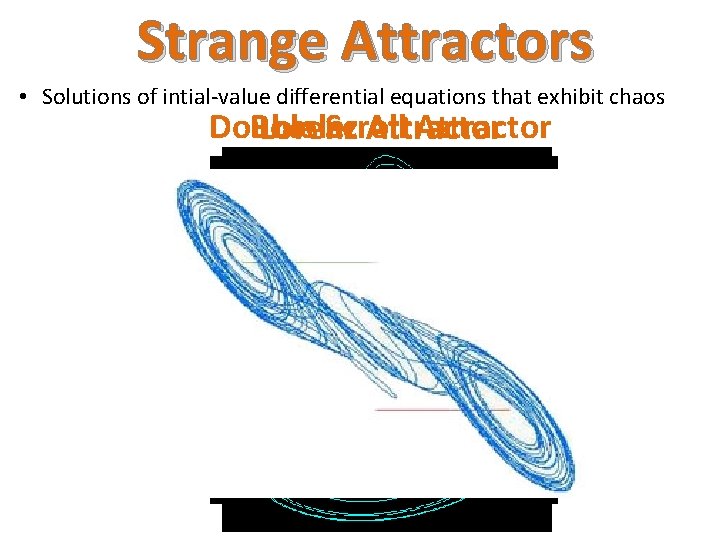
Strange Attractors • Solutions of intial-value differential equations that exhibit chaos Double Scroll Attractor Rossler Attractor Lorenz
mata + m a x E s e l p
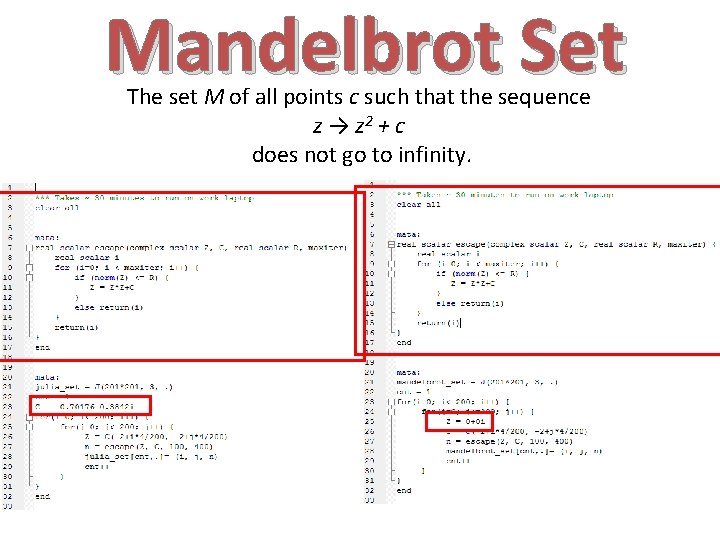
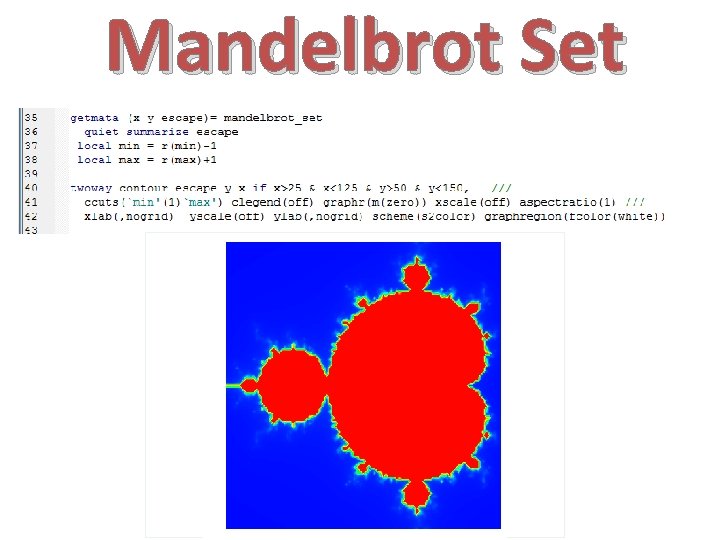
Mandelbrot Set The set M of all points c such that the sequence z → z 2 + c does not go to infinity.
Mandelbrot Set
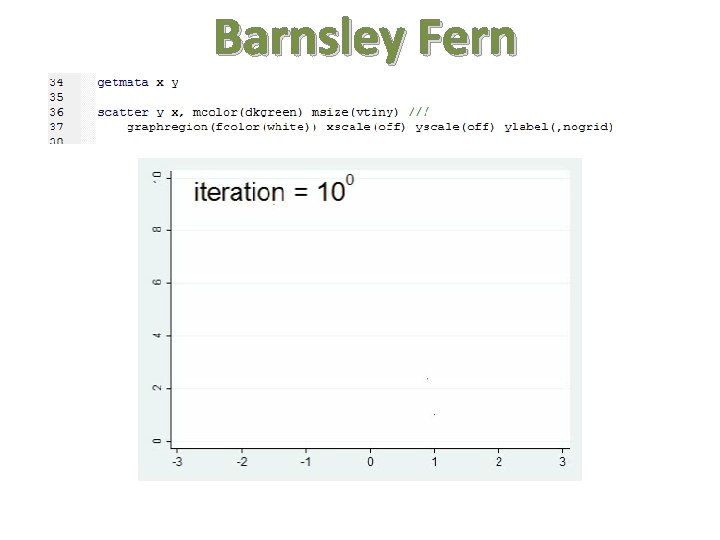
Barnsley Fern • Created by Michael Barnsley in his book Fractals Everywhere. Defined by four transformations Black Spleenwort with assigned probabilities:
Barnsley Fern
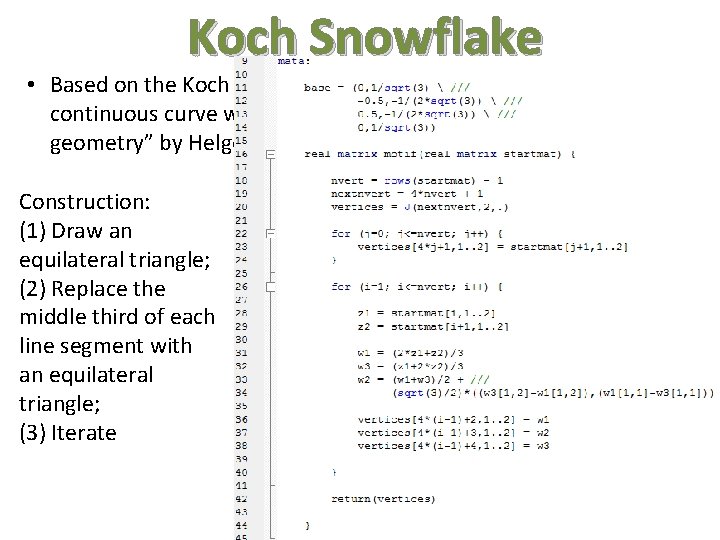
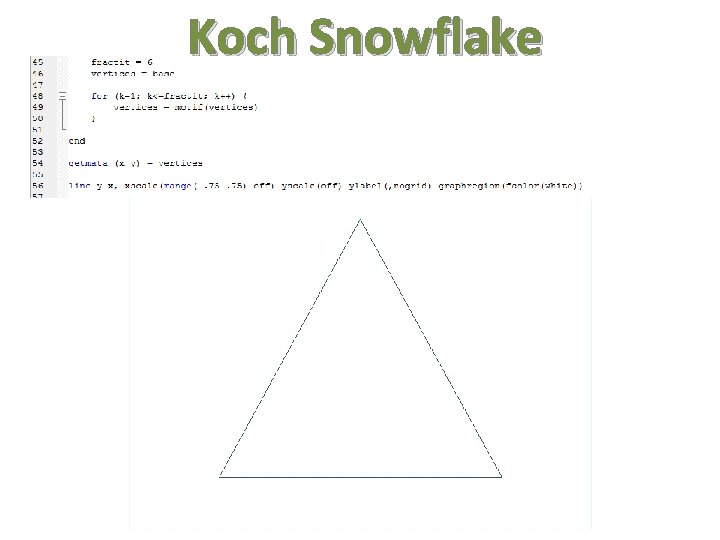
Koch Snowflake • Based on the Koch curve, described in the 1904 paper “On a continuous curve without tangents, constructible from elementary geometry” by Helge von Koch Construction: (1) Draw an equilateral triangle; (2) Replace the middle third of each line segment with an equilateral triangle; (3) Iterate
Koch Snowflake
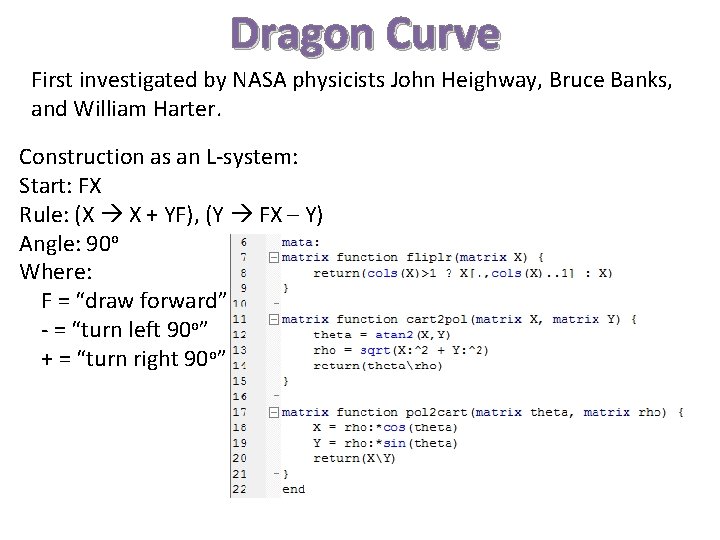
Dragon Curve First investigated by NASA physicists John Heighway, Bruce Banks, and William Harter. Construction as an L-system: Start: FX Rule: (X X + YF), (Y FX – Y) Angle: 90 o Where: F = “draw forward” - = “turn left 90 o” + = “turn right 90 o”
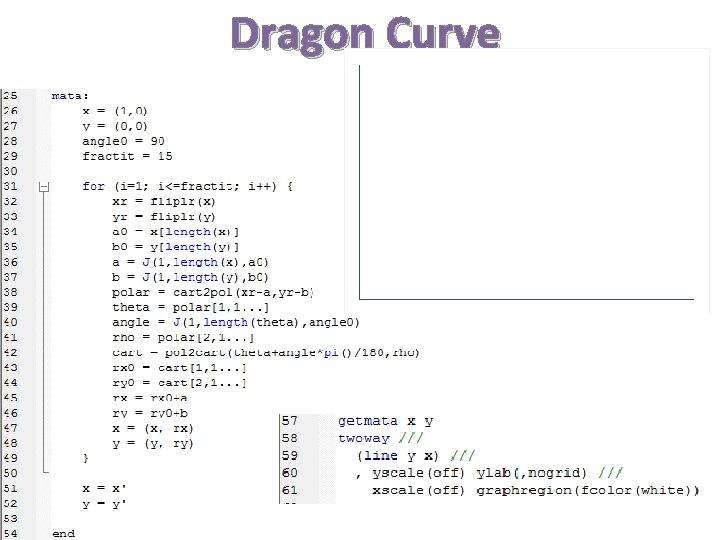
Dragon Curve
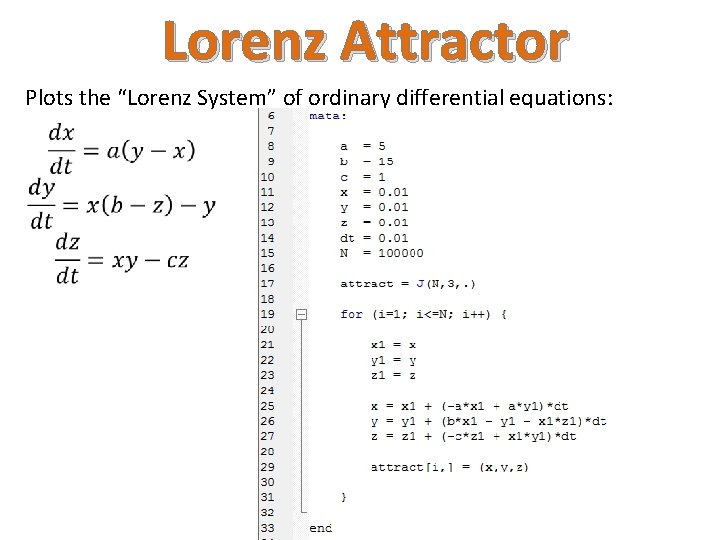
Lorenz Attractor Plots the “Lorenz System” of ordinary differential equations:
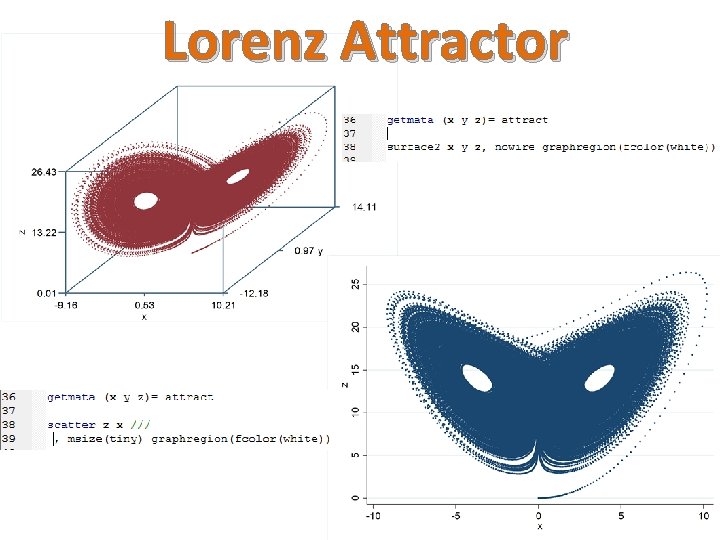
Lorenz Attractor
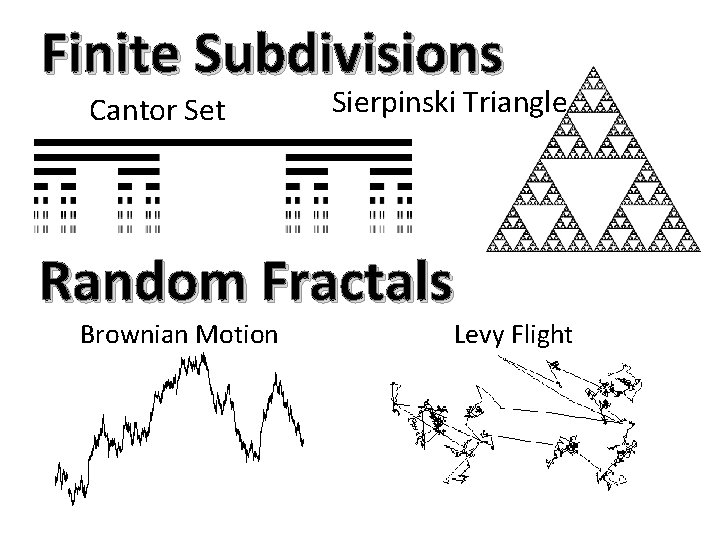
Finite Subdivisions Cantor Set Sierpinski Triangle Random Fractals Brownian Motion Levy Flight
Thank You