
Structured Backbone Design of Computer Networks Structured Backbone
Structured Backbone Design of Computer Networks

Structured Backbone Design of Computer Networks Department of Computer Engineering College of Computer Sciences & Engineering King Fahd University of Petroleum & Minerals Dhahran, Saudi Arabia Computer Networks -- February 17 - 21, 2001
Enterprise Networks l An Enterprise Networks is an interconnected collection of Local Area Networks (LANs). » Several LANs – Hubs, Chassis Hubs, Stackable Hubs, Bridges, (Workgroup) Switches – Horizontal cabling » Backbone – Core routers and switches – Vertical cabling Atef J. Al-Najjar 3
Structured Networks l A Enterprise Network should be » Logically structured – Has a layered communication structure: Local access layer, distribution layer, and backbone layer. » Physically structured – Topology is a hierarchical tree, with the backbone at the root of the tree. Atef J. Al-Najjar 4
Logically Structured Networks l Local Access Layer » Provides most convenient network access to the users. l Distribution Layer » Provides policy-based network access to the workgroup. This is where packet manipulation takes place. l Backbone Layer » Provides high-speed seamless transport of data among the workgroups. Atef J. Al-Najjar 5

Enterprise Network Example Token Ring Ethernet Backbone Router Backbone Ethernet Hub Ethernet Atef J. Al-Najjar 6
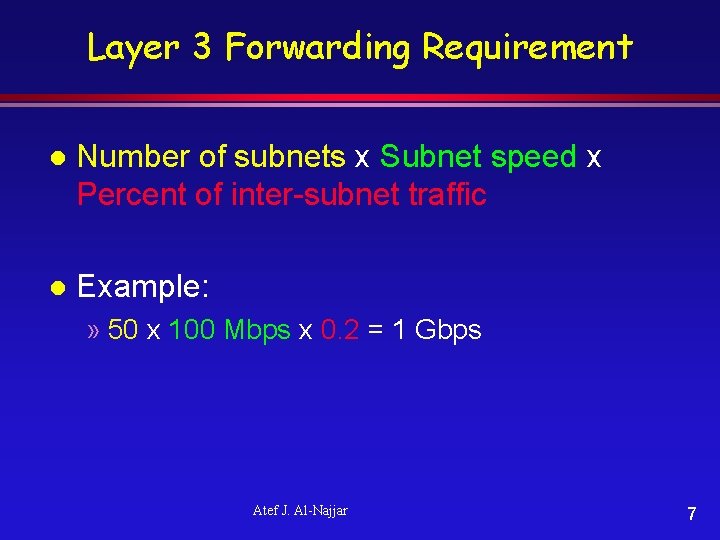
Layer 3 Forwarding Requirement l Number of subnets x Subnet speed x Percent of inter-subnet traffic l Example: » 50 x 100 Mbps x 0. 2 = 1 Gbps Atef J. Al-Najjar 7
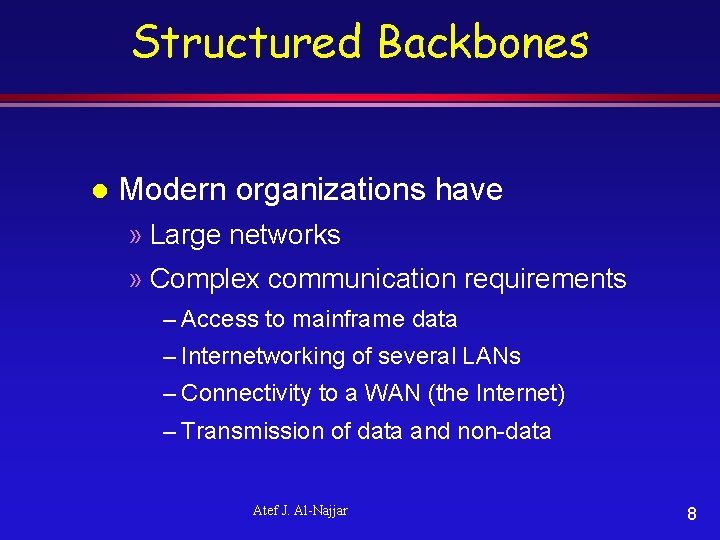
Structured Backbones l Modern organizations have » Large networks » Complex communication requirements – Access to mainframe data – Internetworking of several LANs – Connectivity to a WAN (the Internet) – Transmission of data and non-data Atef J. Al-Najjar 8

Backbone Basics Complex requirements mandated the structuring of enterprise-wide information distribution. l Such structuring is effectively achieved through a system called Backbone. l Structured wiring combined with Backbone solution provide a powerful and efficient networking solution to company-wide communication needs. l Atef J. Al-Najjar 9
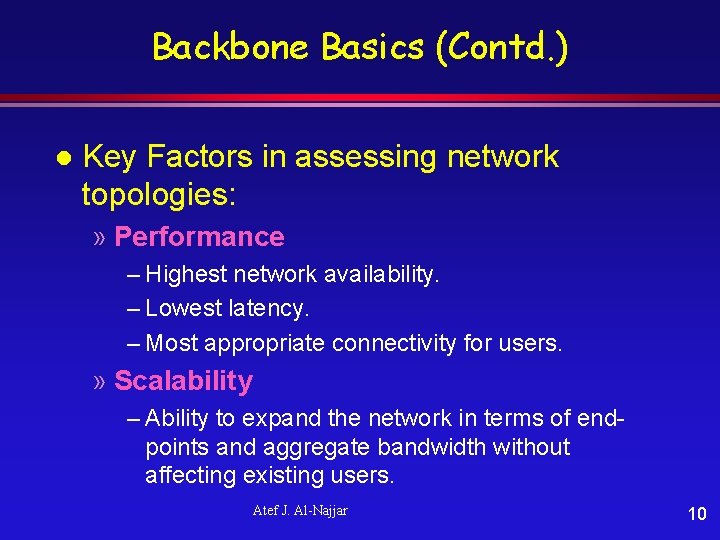
Backbone Basics (Contd. ) l Key Factors in assessing network topologies: » Performance – Highest network availability. – Lowest latency. – Most appropriate connectivity for users. » Scalability – Ability to expand the network in terms of endpoints and aggregate bandwidth without affecting existing users. Atef J. Al-Najjar 10
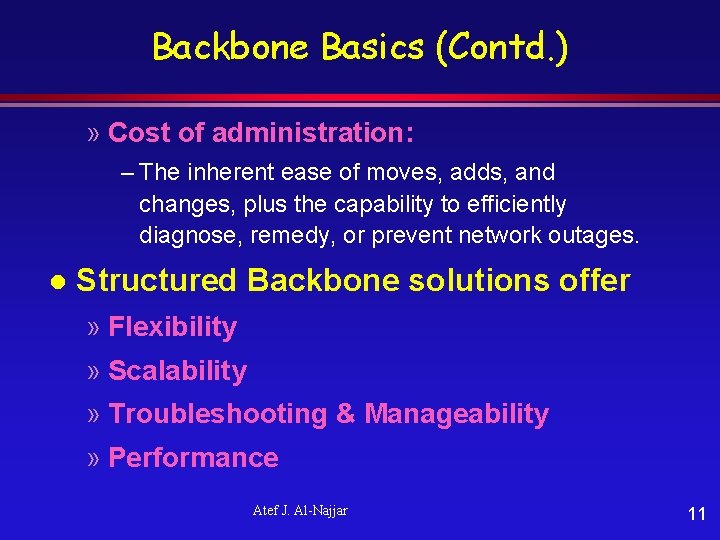
Backbone Basics (Contd. ) » Cost of administration: – The inherent ease of moves, adds, and changes, plus the capability to efficiently diagnose, remedy, or prevent network outages. l Structured Backbone solutions offer » Flexibility » Scalability » Troubleshooting & Manageability » Performance Atef J. Al-Najjar 11
Structured Cabling l Cabling plan should be easy to: » implement, and » accommodates future growth. l Two standards have been issued that specify cabling types and layout for structured commercial buildings wiring. l A network should follow a cabling plan: » Selection of cable types » Cable layout topology Atef J. Al-Najjar 12
Structured Cabling Standards l EIA/TIA-568: Issued jointly by the Electronic Industries Association and the Telecommunications Industry Assoc. l ISO 11801: Issued by the International Organization for Standardization. l Both Standards are similar. Atef J. Al-Najjar 13
Structured Cabling (Cont. ) l It is a generic wiring scheme with the following characteristics: » Wiring within a commercial building. » Cabling to support all forms of information transfer. » Cable selection and layout is independent of vendor and end-user equipment. » Cable layout designed to encompass distribution to all work areas within the building (relocation wouldn’t need rewiring). Atef J. Al-Najjar 14
Structured Cabling (Cont. ) l Based on the use of a hierarchical starwired cable layout. » External cables terminate at Equipment Room (ER). » Patch panel and cross-connect hardware connect ER to Internal Distribution Cable. » Typically, first level of distribution consists of Backbone cables. » Backbone cable(s) run from ER to Telecom Closets (Wiring Closets) on each floor. Atef J. Al-Najjar 15
Structured Cabling (Contd. ) » Wiring Closet contains cross-connect equipment for interconnecting cable on a single floor to the Backbone. l Cable distributed on a single floor is called Horizontal Cabling, and connects the Backbone to Wall Outlets that service individual telephone and data equipment. Atef J. Al-Najjar 16
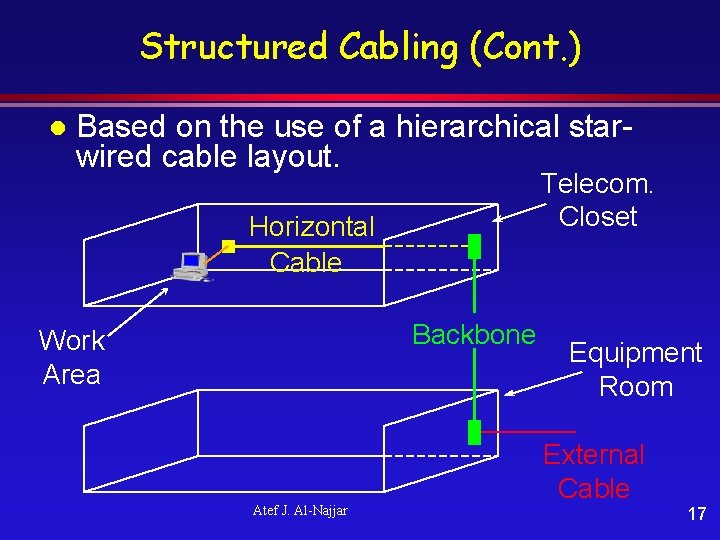
Structured Cabling (Cont. ) l Based on the use of a hierarchical starwired cable layout. Telecom. Closet Horizontal Cable Backbone Work Area Atef J. Al-Najjar Equipment Room External Cable 17
Structured Cabling Terminology Backbone A facility between telecommunications closets or floor distribution terminals, the entrance facilities, and the equipment rooms within or between buildings Horizontal Cabling The wiring/cabling between the telecom outlet and the horizontal cross-connect Atef J. Al-Najjar 18
Terminology (Cont. ) Cross-Connect A facility enabling the termination of cable elements & their interconnection, and/or cross-connection, primarily by means of a patch cord or jumper Equipment Room A centralized space for telecom equip. t that serves the occupants of the building (Bldg/Campus distributor in ISO 11801) Atef J. Al-Najjar 19
Terminology (Cont. ) Telecommunications Closet: An enclosed space for housing telecom equip. t, cable terminations, and crossconnect cabling; the location for crossconnection between the backbone and horizontal facilities Work Area A building space where the occupants interact with the telecom terminal equip. t Atef J. Al-Najjar 20
Terminology (Cont. ) Main Cross-Connect A cross-connect between 1 st and 2 nd level backbone cables, entrance cables, and equipment cables (no ISO name) Intermediate Cross-Connect A cross-connect between 1 st and 2 nd level backbone cabling (no ISO name) Atef J. Al-Najjar 21
Terminology (Cont. ) Horizontal Cross-Connect: A cross-connect of horizontal cabling to other cabling, e. g. horizontal, backbone, or equipment (no ISO name) Telecommunications Outlet A connecting device in the work area on which horizontal cable terminates Atef J. Al-Najjar 22
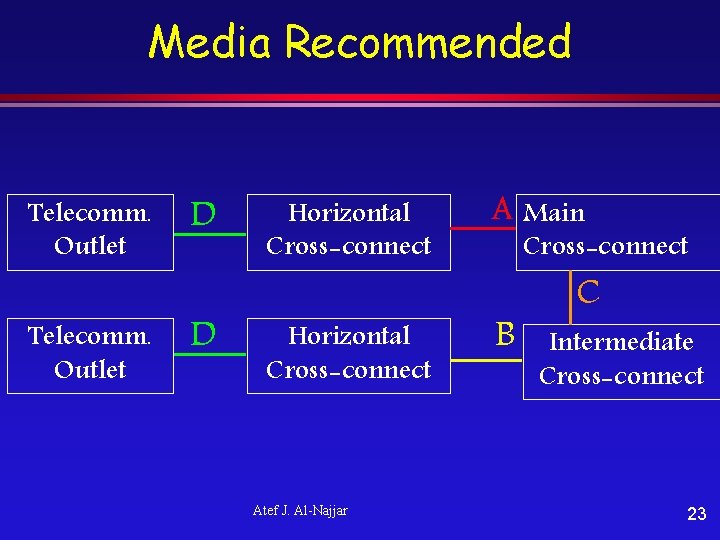
Media Recommended Telecomm. Outlet D Horizontal Cross-connect A Horizontal Cross-connect B Atef J. Al-Najjar Main Cross-connect C Intermediate Cross-connect 23
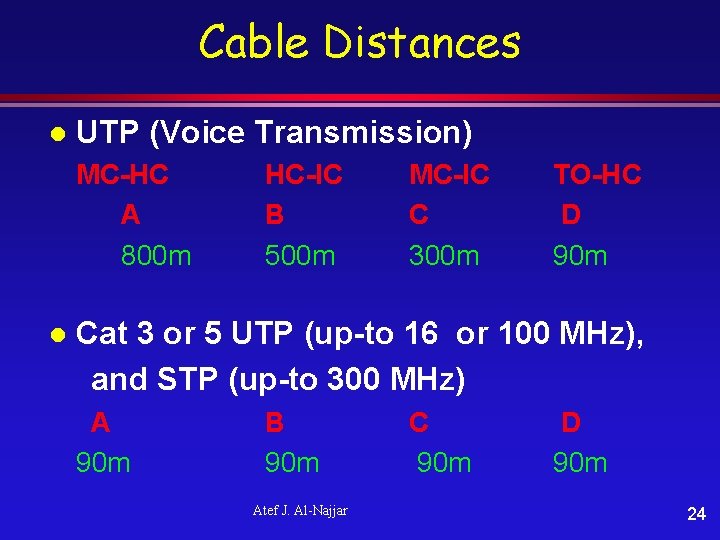
Cable Distances l UTP (Voice Transmission) MC-HC A 800 m l HC-IC B 500 m MC-IC C 300 m TO-HC D 90 m Cat 3 or 5 UTP (up-to 16 or 100 MHz), and STP (up-to 300 MHz) A 90 m B 90 m Atef J. Al-Najjar C 90 m D 90 m 24
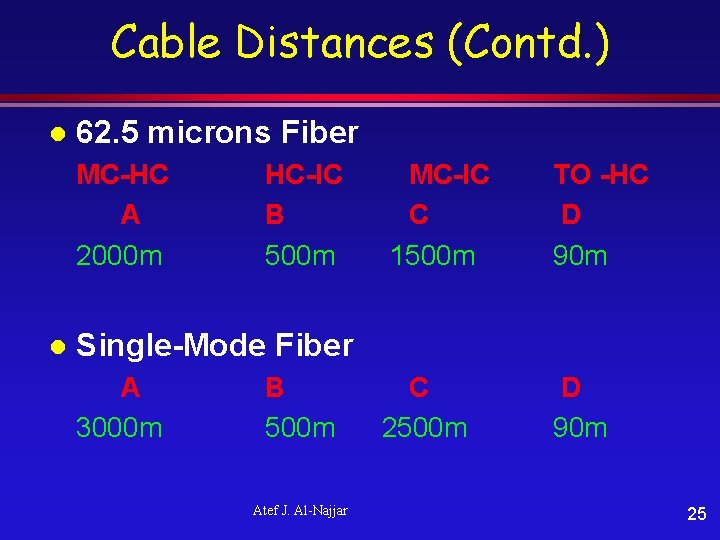
Cable Distances (Contd. ) l 62. 5 microns Fiber MC-HC A 2000 m l HC-IC B 500 m MC-IC C 1500 m TO -HC D 90 m C 2500 m D 90 m Single-Mode Fiber A 3000 m B 500 m Atef J. Al-Najjar 25
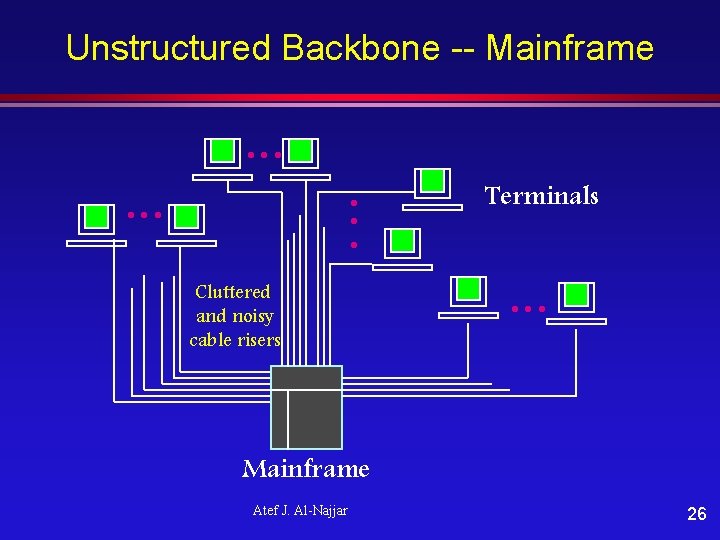
Unstructured Backbone -- Mainframe . . . Cluttered and noisy cable risers . . . Terminals . . . Mainframe Atef J. Al-Najjar 26
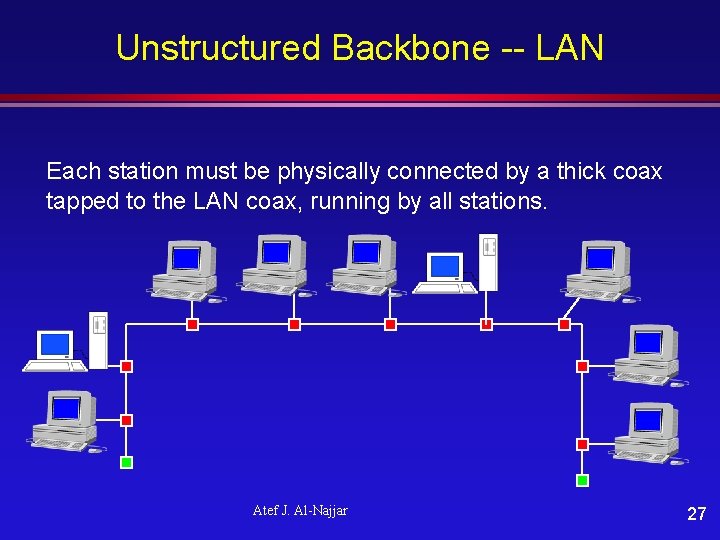
Unstructured Backbone -- LAN Each station must be physically connected by a thick coax tapped to the LAN coax, running by all stations. Atef J. Al-Najjar 27
Structured Backbone l By using a MUX or similar device, a backbone can be structured. » A single fiber pair replaces mounds of coax cable, and » floor-to-floor traffic is systematically organized. l With Structure comes enhanced » network control » reliability, and » efficiency. Atef J. Al-Najjar 28
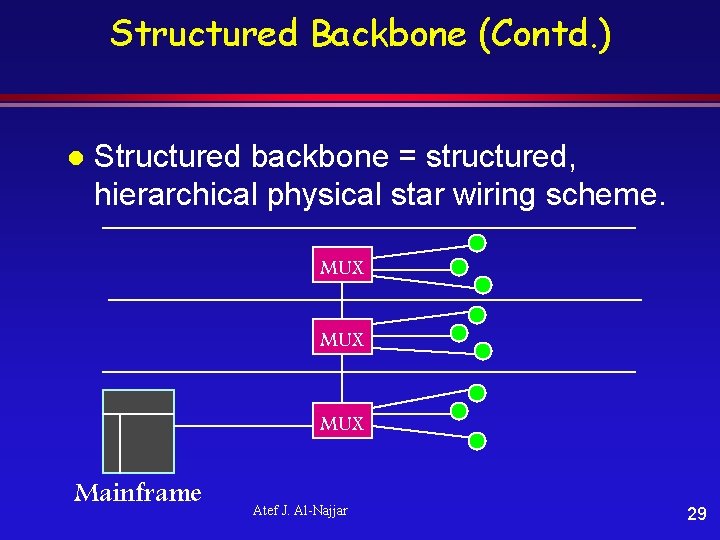
Structured Backbone (Contd. ) l Structured backbone = structured, hierarchical physical star wiring scheme. MUX MUX Mainframe Atef J. Al-Najjar 29
Structured Backbone(Contd. ) l The first information backbone emerged in the mid 1980’s. l An enterprise backbone is an aggregate data path (a central communication highway) for the transport of all signals to / from users distributed throughout the enterprise. l Early backbones were mainly muxes. Atef J. Al-Najjar 30
Structured Backbone(Contd. ) l The enterprise network is usually comprised of three main parts: » The horizontal access portion: Connecting individual workstations to wiring closets and most often accomplished via an intelligent cabling Hub. » The Backbone portion: Facilitating floor-to-floor or building-to-building connectivity. Atef J. Al-Najjar 31
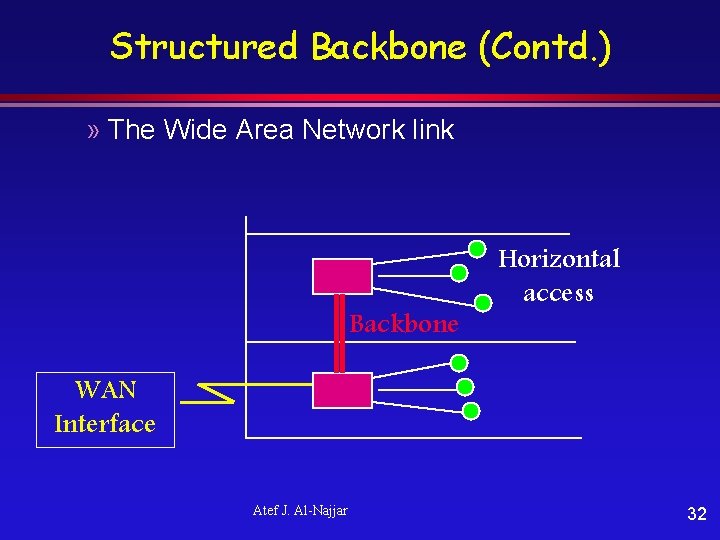
Structured Backbone (Contd. ) » The Wide Area Network link Backbone Horizontal access WAN Interface Atef J. Al-Najjar 32
When are Backbones needed? l Companies utilizing Backbone technology have typically one or more of the following communication needs: » Multiple data protocols and signals. » Heavy network traffic to be supported simultaneously. » Multiple work-groups, networks, and facilities that need to be internetworked. » Mission critical applications where high reliability and security are mandatory. Atef J. Al-Najjar 33
When are Backbones needed? (Contd. ) » Need to support varying media and device types. » A high degree of upgrade-ability, so that existing equipment can be preserved and higher performance hardware and software solutions can be implemented seamlessly. » A high degree of network moves, adds, and changes, requiring that the enterprise network be highly manageable. Atef J. Al-Najjar 34
Types of (private) Backbones Three broad categories: (1) Multiplexers-based. (2) LAN Backbones. FDDI, Ethernet, Token Ring, etc (3) Collapsed Backbones. High-speed Router, Switches, ATM. Atef J. Al-Najjar 35
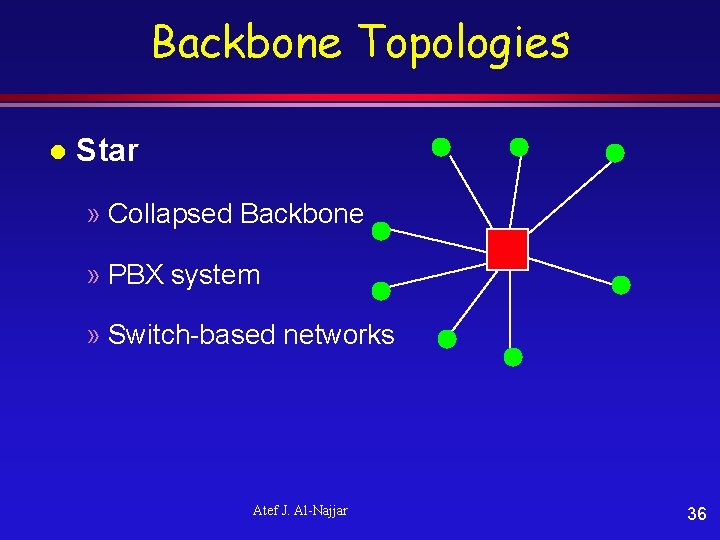
Backbone Topologies l Star » Collapsed Backbone » PBX system » Switch-based networks Atef J. Al-Najjar 36
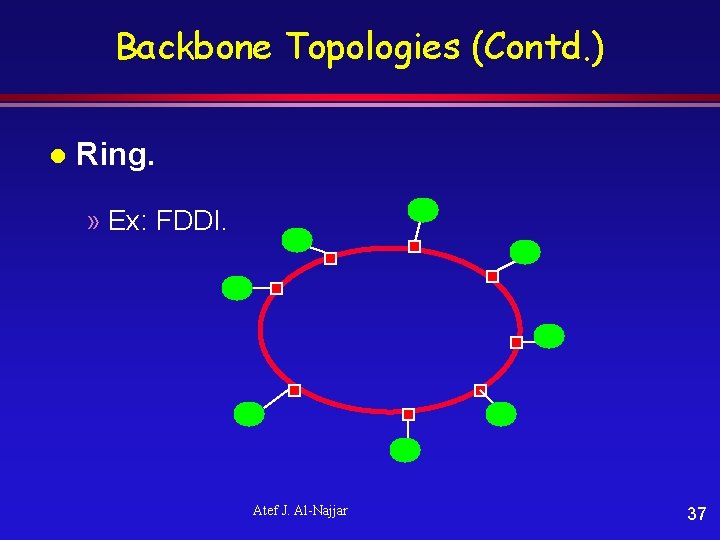
Backbone Topologies (Contd. ) l Ring. » Ex: FDDI. Atef J. Al-Najjar 37
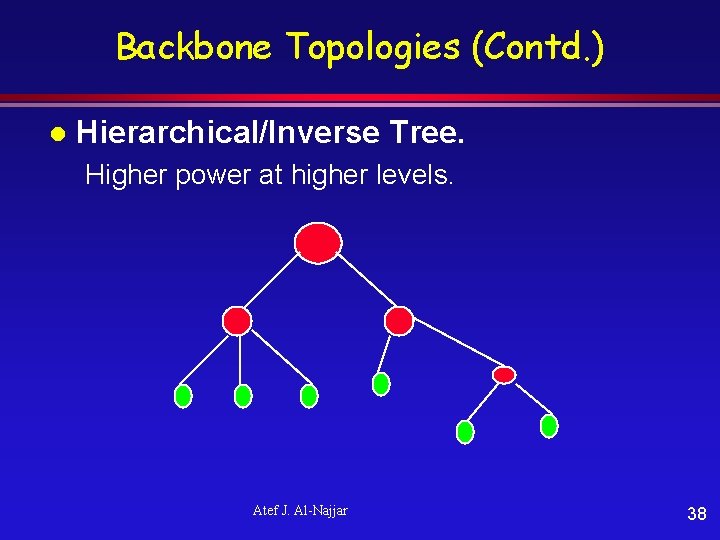
Backbone Topologies (Contd. ) l Hierarchical/Inverse Tree. Higher power at higher levels. Atef J. Al-Najjar 38
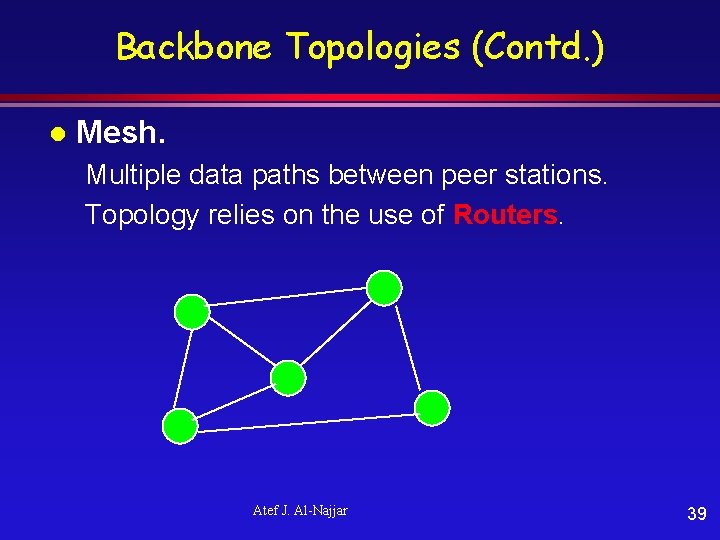
Backbone Topologies (Contd. ) l Mesh. Multiple data paths between peer stations. Topology relies on the use of Routers. Atef J. Al-Najjar 39
Backbone Benefits + Makes complex distributed computing environment easier to manage. + Allows Organizations to easily upgrade the system. + Creates an integrated communication path capable of accommodating the enterprise’s data transfer requirements safely and cost effectively. Atef J. Al-Najjar 40
Fiber Optics l Many of the Backbone advantages are enabled by the implementation of fiber. l Advantages of fiber: + Ability to combine data, voice & video signals over a single fiber pair. + Very large bandwidth: (allows large number of users, is cost effective and spaceconservative). + Increased data security & reliability. Atef J. Al-Najjar 41
Fiber in the Backbone l All Backbone solutions are based on the use of fiber because fiber: » Forms the bases for all future Backbone migrations. » Enables network managers to extend the life of their cabling plants. » Enables the network to easily migrate to better technology (network application software or network hardware). Atef J. Al-Najjar 42
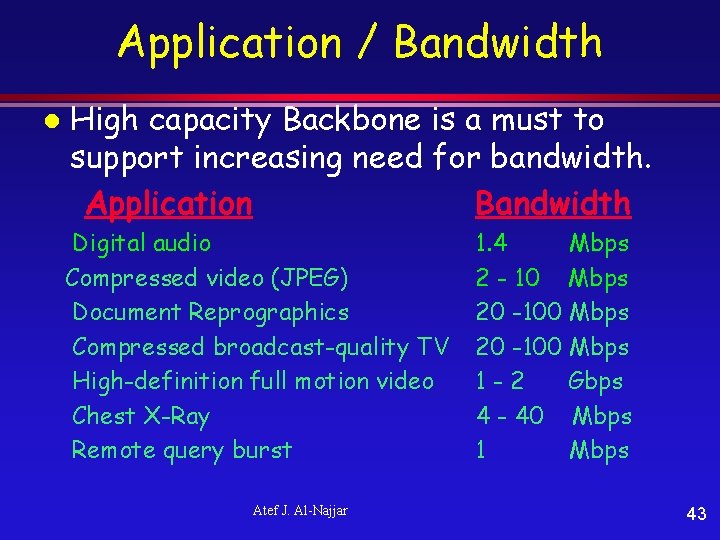
Application / Bandwidth l High capacity Backbone is a must to support increasing need for bandwidth. Application Bandwidth Digital audio Compressed video (JPEG) Document Reprographics Compressed broadcast-quality TV High-definition full motion video Chest X-Ray Remote query burst Atef J. Al-Najjar 1. 4 Mbps 2 - 10 Mbps 20 -100 Mbps 1 -2 Gbps 4 - 40 Mbps 1 Mbps 43
Get Connected l l Use your mouse Use your phone Use your car Select the best speed (Can be a Turtle!) Atef J. Al-Najjar 44
- Slides: 44