
Structure Preparation Techniques and New Materials DC breakdown

Structure Preparation Techniques and New Materials • DC breakdown testing – Test of new materials – Test of in situ and ex-situ heating, plasma treatments, e-beam bombardment – Effect of machining and chemical surface treatments – Breakdown rate – Modelling of the results • Laser + ultrasound fatigue testing – Influence of and material and surface state – Benchmarking with RF testing X-Band Stuctures Sergio Calatroni

DC spark testing experimental setup Sphere / Plane geometry Field Emission. Measurements Breakdown Switch C Switch HV supply 0 to + 12 k. V Q-meter UHV Sample A-meter Scope A second DC spark test station is being built, operating at 35 k. V X-Band Stuctures Workshop 18 -19 June 2007 Tip Sergio Calatroni From: T. Ramsvik 2
![Comparison DC - RF E sat (DC) breakd [MV/m] Max. surface field in RF](http://slidetodoc.com/presentation_image_h2/b4a54fffbacb78e85370ea913f0a578a/image-3.jpg "Comparison DC - RF E sat (DC) breakd [MV/m] Max. surface field in RF")
Comparison DC - RF E sat (DC) breakd [MV/m] Max. surface field in RF [MV/m] Cu 164± 30 260 W 313± 47 340 Mo 438± 32 420 DC and RF breakdown measurements give similar breakdown fields (PRST-AB 10, 042001 (2007)) Superior behavior of both Mo and W with respect to Cu. X-Band Stuctures Workshop 18 -19 June 2007 Sergio Calatroni From: T. Ramsvik 3
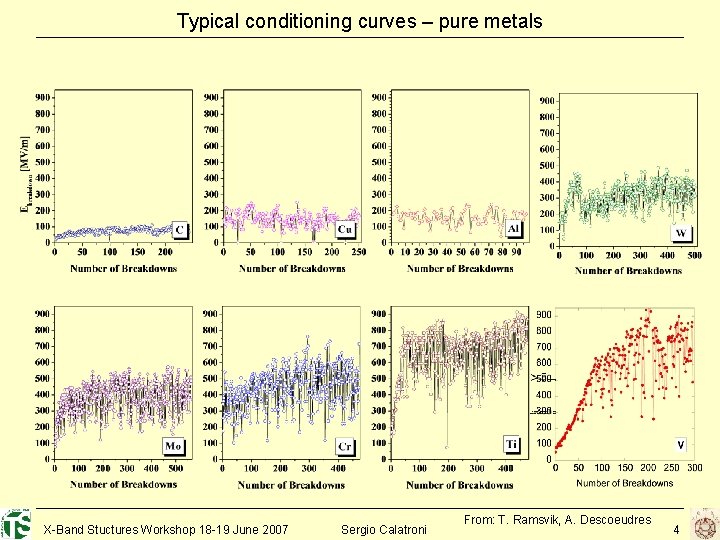
Typical conditioning curves – pure metals X-Band Stuctures Workshop 18 -19 June 2007 Sergio Calatroni From: T. Ramsvik, A. Descoeudres 4
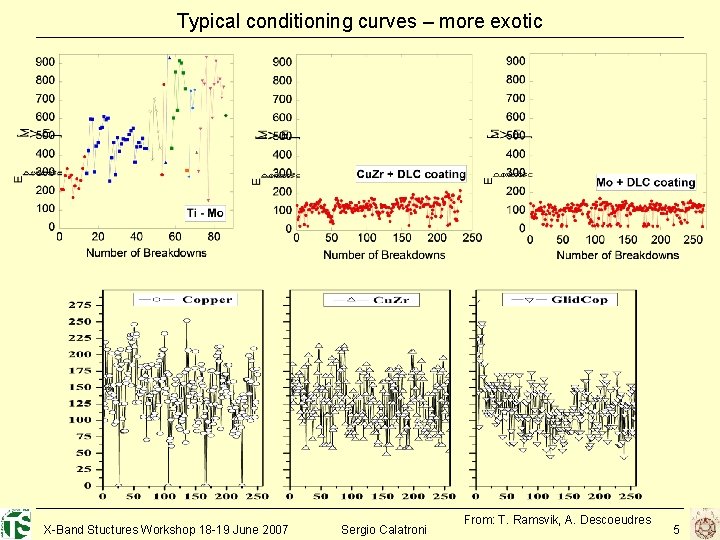
Typical conditioning curves – more exotic X-Band Stuctures Workshop 18 -19 June 2007 Sergio Calatroni From: T. Ramsvik, A. Descoeudres 5
New materials The guidelines that have led to the choice of refractory metals as new candidate materials for the high-field regions are the high melting point, the low vapour pressure (other ideas exist, cf. Perry Wilson) • Experimental evidence (either in DC or RF) indicates that these criteria are not enough. For example: – – Mechanical fragility hinders the performance of W The surface oxide plays a strong role in the conditioning behaviour of Mo The machining process affects the performance of Cu alloys ? ? ? makes that the performance of Ti is very good but highly unstable • More extensive experimental testing both in DC and in RF will help in refining our guidelines (although currently this is not the highest CLIC priority). • • • New materials alone are useless without a strategy for bimetal fabrication. Current best candidate is Mo-Cu. Zr (discussed by M. Taborelli). There are ides for bimetallic structure fabrication by plating technology. This will be first tested with chromium and validated in DC. X-Band Stuctures Workshop 18 -19 June 2007 Sergio Calatroni 6
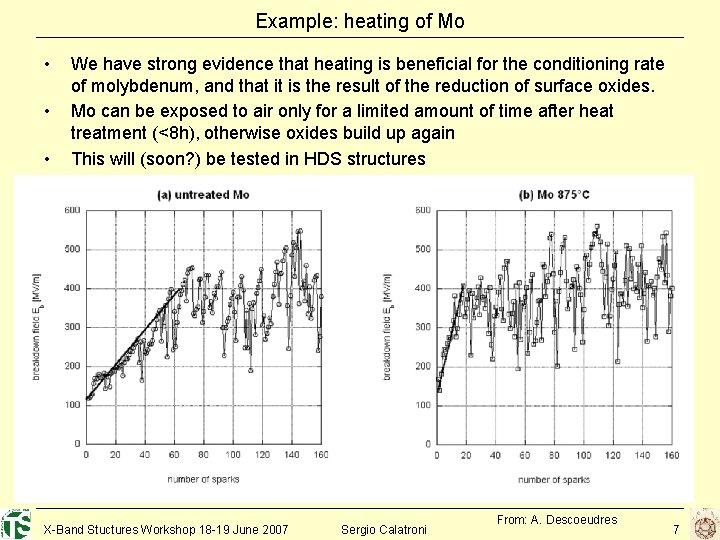
Example: heating of Mo • • • We have strong evidence that heating is beneficial for the conditioning rate of molybdenum, and that it is the result of the reduction of surface oxides. Mo can be exposed to air only for a limited amount of time after heat treatment (<8 h), otherwise oxides build up again This will (soon? ) be tested in HDS structures X-Band Stuctures Workshop 18 -19 June 2007 Sergio Calatroni From: A. Descoeudres 7
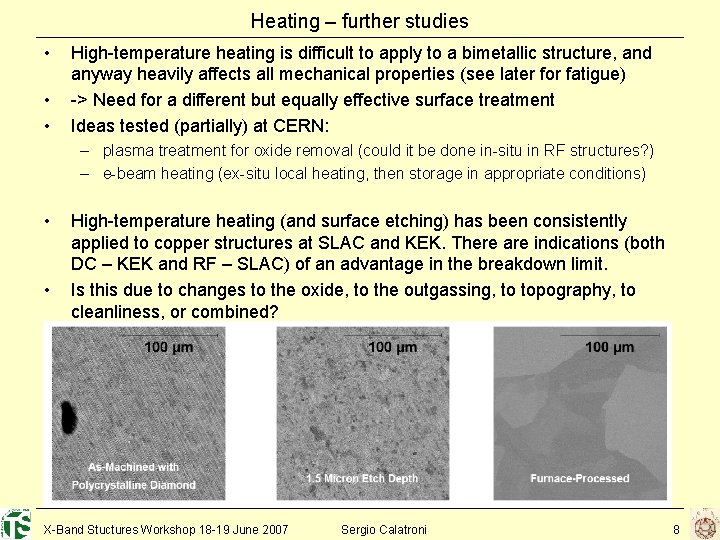
Heating – further studies • • • High-temperature heating is difficult to apply to a bimetallic structure, and anyway heavily affects all mechanical properties (see later for fatigue) -> Need for a different but equally effective surface treatment Ideas tested (partially) at CERN: – plasma treatment for oxide removal (could it be done in-situ in RF structures? ) – e-beam heating (ex-situ local heating, then storage in appropriate conditions) • • High-temperature heating (and surface etching) has been consistently applied to copper structures at SLAC and KEK. There are indications (both DC – KEK and RF – SLAC) of an advantage in the breakdown limit. Is this due to changes to the oxide, to the outgassing, to topography, to cleanliness, or combined? X-Band Stuctures Workshop 18 -19 June 2007 Sergio Calatroni 8
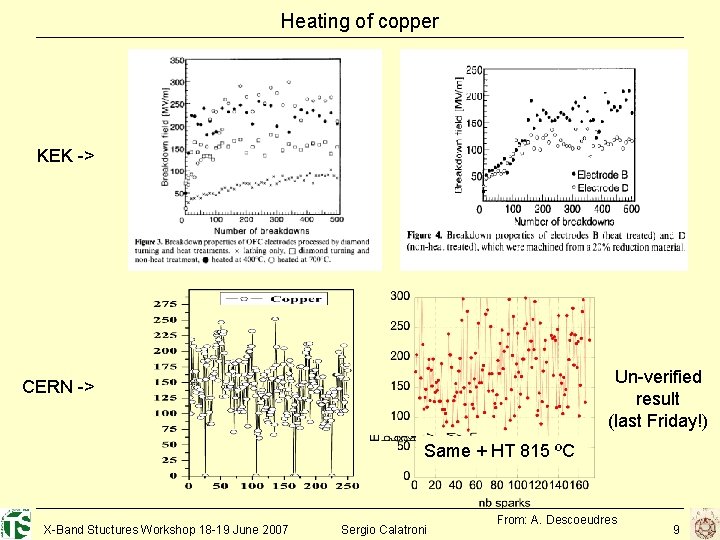
Heating of copper KEK -> Un-verified result (last Friday!) CERN -> Same + HT 815 ºC X-Band Stuctures Workshop 18 -19 June 2007 Sergio Calatroni From: A. Descoeudres 9
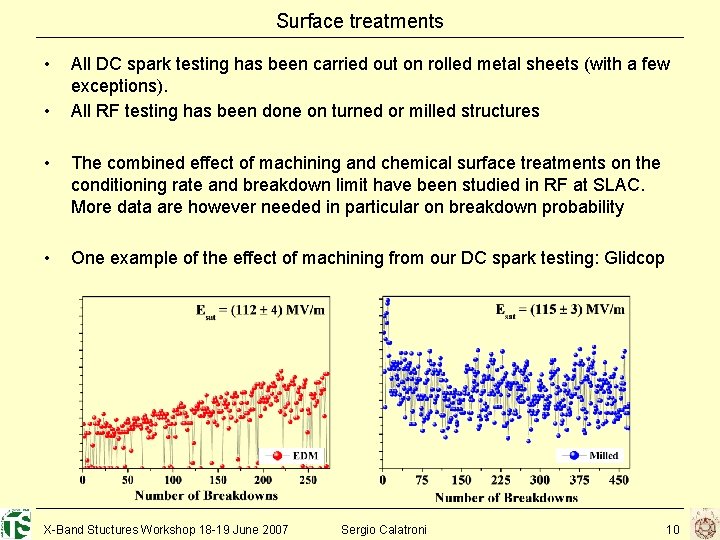
Surface treatments • • All DC spark testing has been carried out on rolled metal sheets (with a few exceptions). All RF testing has been done on turned or milled structures • The combined effect of machining and chemical surface treatments on the conditioning rate and breakdown limit have been studied in RF at SLAC. More data are however needed in particular on breakdown probability • One example of the effect of machining from our DC spark testing: Glidcop X-Band Stuctures Workshop 18 -19 June 2007 Sergio Calatroni 10

Surface treatments: helicon plasma? Modeling of laser-ablation damage of Mo sample and cleaning of the micro tips by H + He helicon discharge a) Image of Mo sample after 1 laser pulse (energy 20 m. J, time of pulse 50 ns) b) Image of Mo sample after 10 laser pulse (energy 20 m. J, time of pulse 50 ns) c) Image of Mo sample (1 laser pulse) after cleaning by helicon discharge (Prf=200 W, p=20 m. Torr) a) b) d) Image of Mo sample (10 laser pulse) after cleaning by helicon discharge (Prf=200 W, p=20 m. Torr) Time of discharge only 2 hours (hydrogen) and 1 hour (helium) Conclusion: 1) RF structure need cleaning before installation by glow or helicon discharge c) X-Band Stuctures Workshop 18 -19 June 2007 d) Sergio Calatroni 2) There is possibilities of repairing rf structure by low pressure (10 -100 m. Torr) helicon discharge From: S. Mordyk, SUMY 11
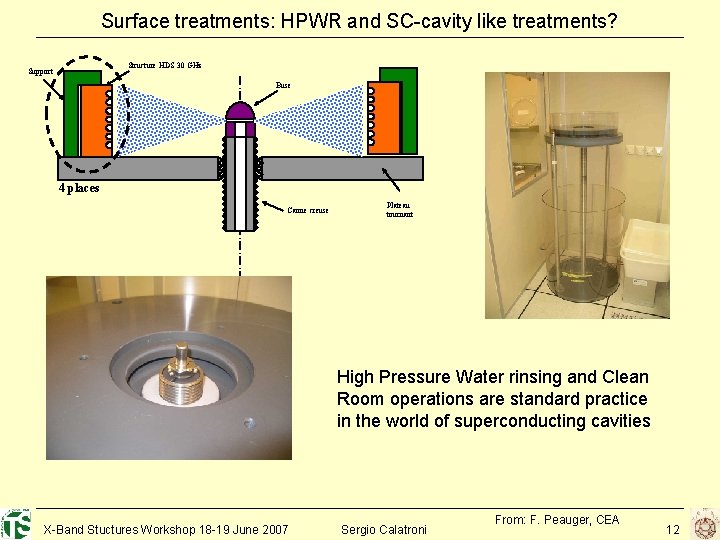
Surface treatments: HPWR and SC-cavity like treatments? Structure HDS 30 GHz Support Buse 4 places Canne creuse Plateau tournant High Pressure Water rinsing and Clean Room operations are standard practice in the world of superconducting cavities X-Band Stuctures Workshop 18 -19 June 2007 Sergio Calatroni From: F. Peauger, CEA 12
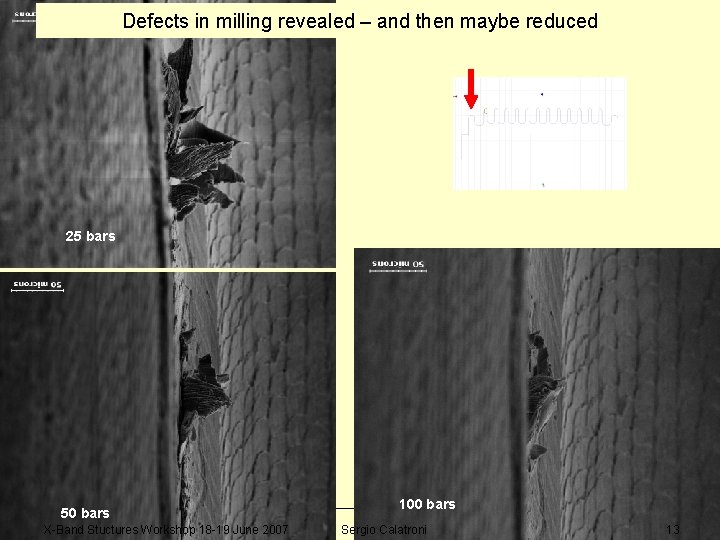
Defects in milling revealed – and then maybe Iris 1 reduced 25 bars 50 bars X-Band Stuctures Workshop 18 -19 June 2007 100 bars Sergio Calatroni 13
Breakdown rate • • We will try to produce statistical breakdown data, by applying DC pulses of HV to test specimens, in our test stand However: – These will be second-long pulses, and we have first to verify that the results are meaningful compared to RF data (as was done for the breakdown limit) – It is also time-consuming, and will probably use or new test system 100% • • • Some theoretical modelling of the breakdown rate phenomenon is under way. A couple of solid hypothesis have been laid, and we have some encouraging quantitative results. Still, the validity must be checked Missing experimental information: is there any influence of the surface treatment? (It is speculated that even the structure assembly technique might play a role) Additional RF data would be greatly helpful X-Band Stuctures Workshop 18 -19 June 2007 Sergio Calatroni 14
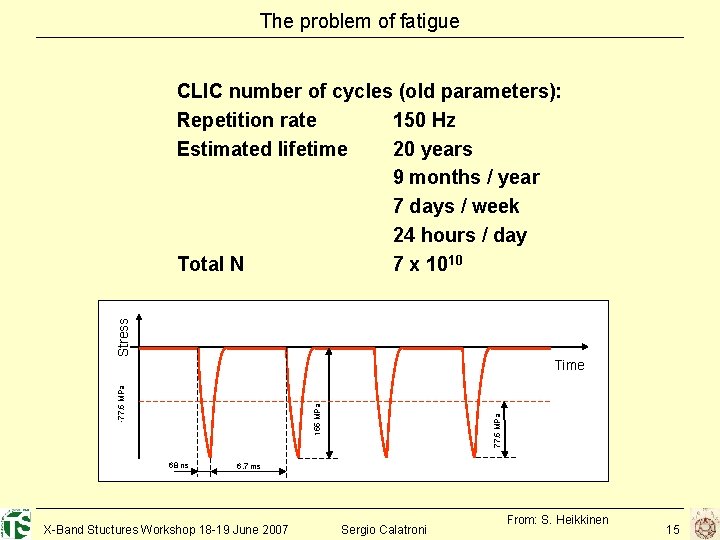
The problem of fatigue Stress CLIC number of cycles (old parameters): Repetition rate 150 Hz Estimated lifetime 20 years 9 months / year 7 days / week 24 hours / day Total N 7 x 10¹⁰ 68 ns 77. 5 MPa 155 MPa -77. 5 MPa Time 6. 7 ms X-Band Stuctures Workshop 18 -19 June 2007 Sergio Calatroni From: S. Heikkinen 15
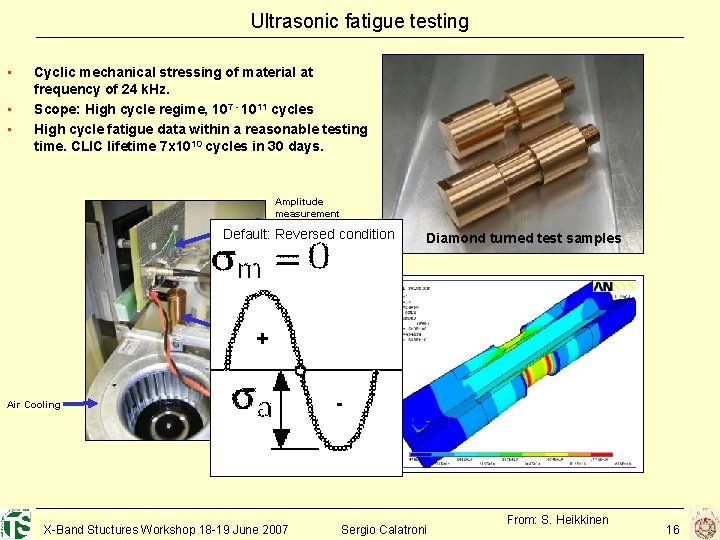
Ultrasonic fatigue testing • • • Cyclic mechanical stressing of material at frequency of 24 k. Hz. Scope: High cycle regime, 107 - 1011 cycles High cycle fatigue data within a reasonable testing time. CLIC lifetime 7 x 10¹⁰ cycles in 30 days. Amplitude measurement system Default: Reversed condition + Diamond turned test samples Fatigue test specimen Air Cooling X-Band Stuctures Workshop 18 -19 June 2007 - Sergio Calatroni From: S. Heikkinen 16
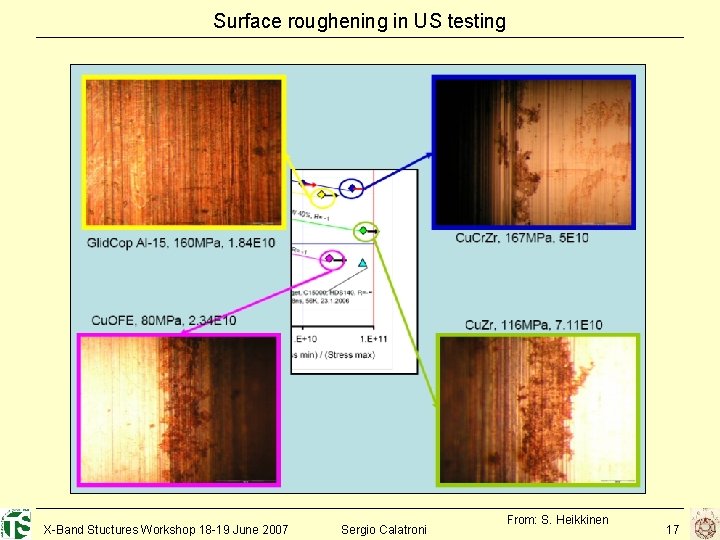
Surface roughening in US testing X-Band Stuctures Workshop 18 -19 June 2007 Sergio Calatroni From: S. Heikkinen 17
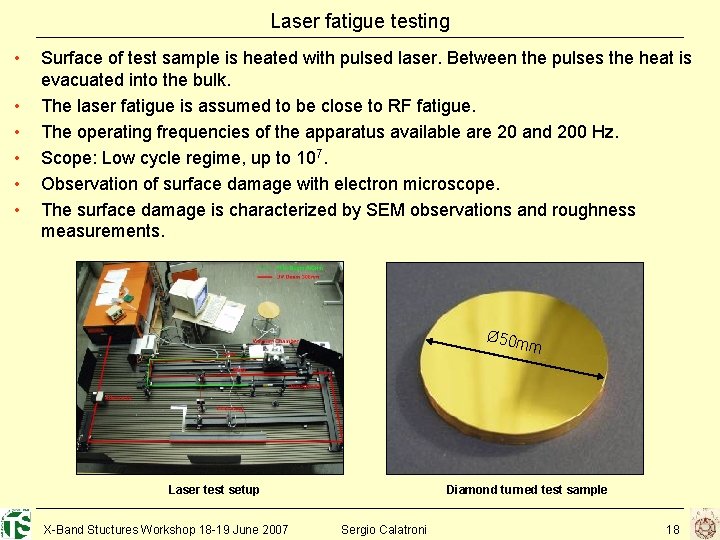
Laser fatigue testing • • • Surface of test sample is heated with pulsed laser. Between the pulses the heat is evacuated into the bulk. The laser fatigue is assumed to be close to RF fatigue. The operating frequencies of the apparatus available are 20 and 200 Hz. Scope: Low cycle regime, up to 107. Observation of surface damage with electron microscope. The surface damage is characterized by SEM observations and roughness measurements. Ø 50 m m Laser test setup X-Band Stuctures Workshop 18 -19 June 2007 Diamond turned test sample Sergio Calatroni 18
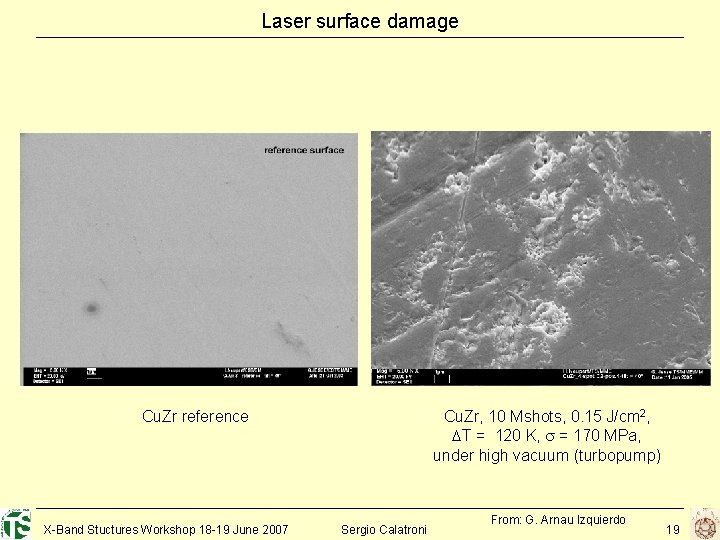
Laser surface damage Cu. Zr reference X-Band Stuctures Workshop 18 -19 June 2007 Cu. Zr, 10 Mshots, 0. 15 J/cm 2, T = 120 K, = 170 MPa, under high vacuum (turbopump) Sergio Calatroni From: G. Arnau Izquierdo 19
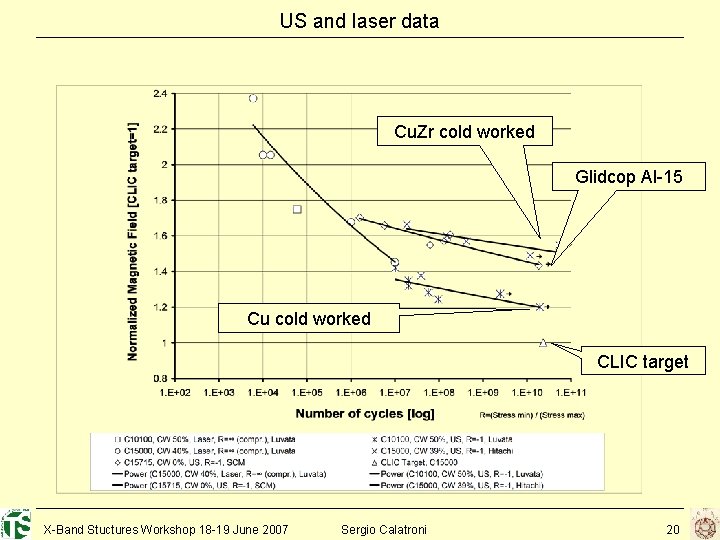
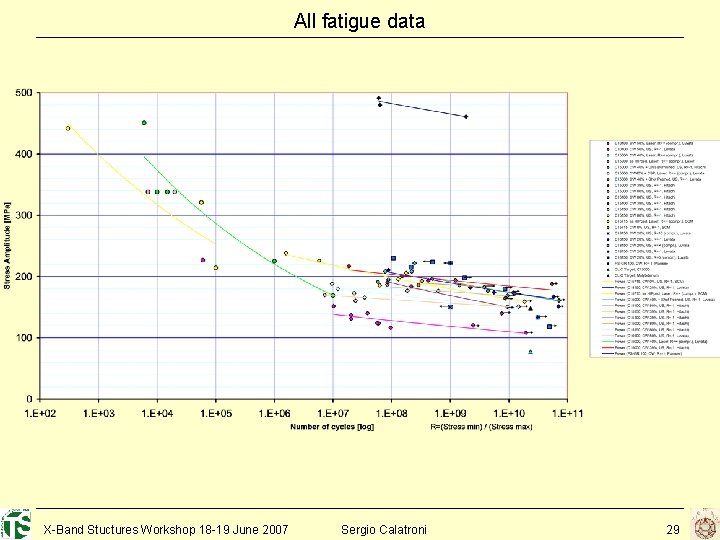
US and laser data Cu. Zr cold worked Glidcop Al-15 Cu cold worked CLIC target X-Band Stuctures Workshop 18 -19 June 2007 Sergio Calatroni 20
More fatigue ? • • Fatigue is a statistical phenomenon. Statistical information is still missing in our study on samples, in particular for the laser data. The technological choice for fabrication has strong influence on fatigue resistance: – A thermal treatments zeroes most of the advantage of Cu. Zr, or the benefits from cold working – Surface finishing has probably strong influence on crack generation (a Ph. D student has just started working on the material science aspect of this topic) • It would be of extreme importance to have a clear RF benchmark of fatigue data. • The old SLAC data (D. P. Pritzkau and R. H. Siemann, PRST-AB 5, 112002 (2002)) are too few, and moreover don‘t give information on the „appearance“ of fatigue damage, which is thought being the most critical issue for RF cavities X-Band Stuctures Workshop 18 -19 June 2007 Sergio Calatroni 21
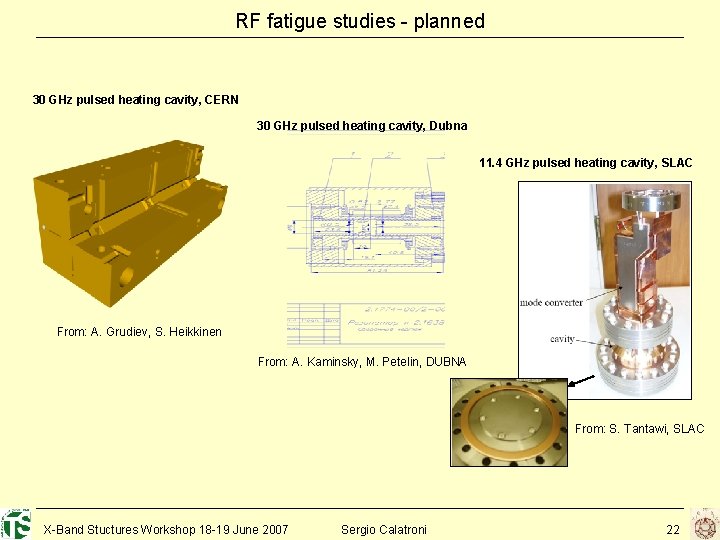
RF fatigue studies - planned 30 GHz pulsed heating cavity, CERN 30 GHz pulsed heating cavity, Dubna 11. 4 GHz pulsed heating cavity, SLAC From: A. Grudiev, S. Heikkinen From: A. Kaminsky, M. Petelin, DUBNA From: S. Tantawi, SLAC X-Band Stuctures Workshop 18 -19 June 2007 Sergio Calatroni 22
The end X-Band Stuctures Workshop 18 -19 June 2007 Sergio Calatroni 23

Beta calculations from SEM observation - Mo DC spark values: around 30 15 X-Band Stuctures Workshop 18 -19 June 2007 Sergio Calatroni 20 24
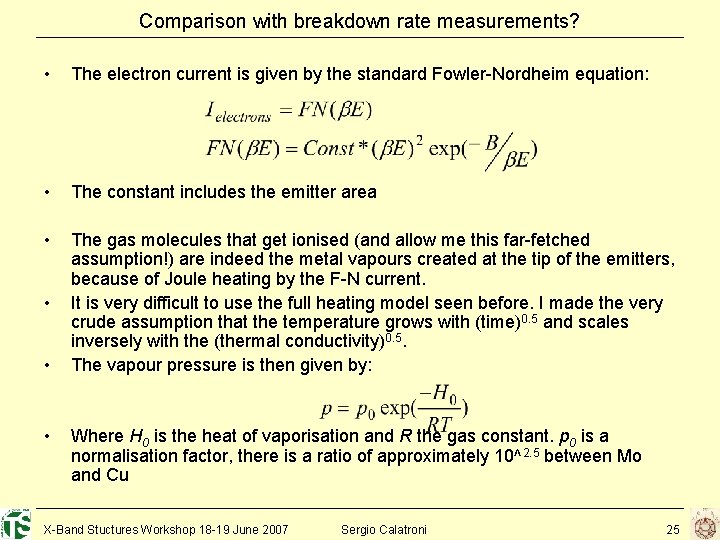
Comparison with breakdown rate measurements? • The electron current is given by the standard Fowler-Nordheim equation: • The constant includes the emitter area • The gas molecules that get ionised (and allow me this far-fetched assumption!) are indeed the metal vapours created at the tip of the emitters, because of Joule heating by the F-N current. It is very difficult to use the full heating model seen before. I made the very crude assumption that the temperature grows with (time)0. 5 and scales inversely with the (thermal conductivity)0. 5. The vapour pressure is then given by: • • • Where H 0 is the heat of vaporisation and R the gas constant. p 0 is a normalisation factor, there is a ratio of approximately 10^2. 5 between Mo and Cu X-Band Stuctures Workshop 18 -19 June 2007 Sergio Calatroni 25
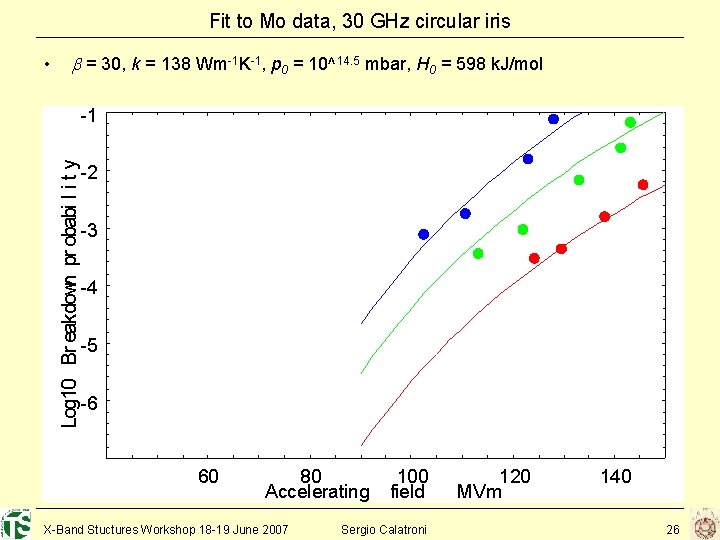
Fit to Mo data, 30 GHz circular iris • = 30, k = 138 Wm-1 K-1, p 0 = 10^14. 5 mbar, H 0 = 598 k. J/mol Log 10 Br eakdown pr obabi l i t y -1 -2 -3 -4 -5 -6 60 80 Accelerating X-Band Stuctures Workshop 18 -19 June 2007 100 field Sergio Calatroni 120 MVm 140 26
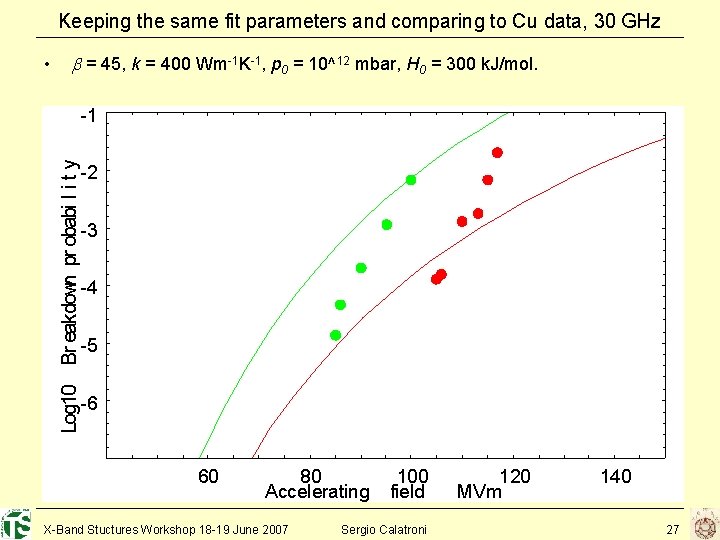
Keeping the same fit parameters and comparing to Cu data, 30 GHz • = 45, k = 400 Wm-1 K-1, p 0 = 10^12 mbar, H 0 = 300 k. J/mol. Log 10 Br eakdown pr obabi l i t y -1 -2 -3 -4 -5 -6 60 80 Accelerating X-Band Stuctures Workshop 18 -19 June 2007 100 field Sergio Calatroni 120 MVm 140 27
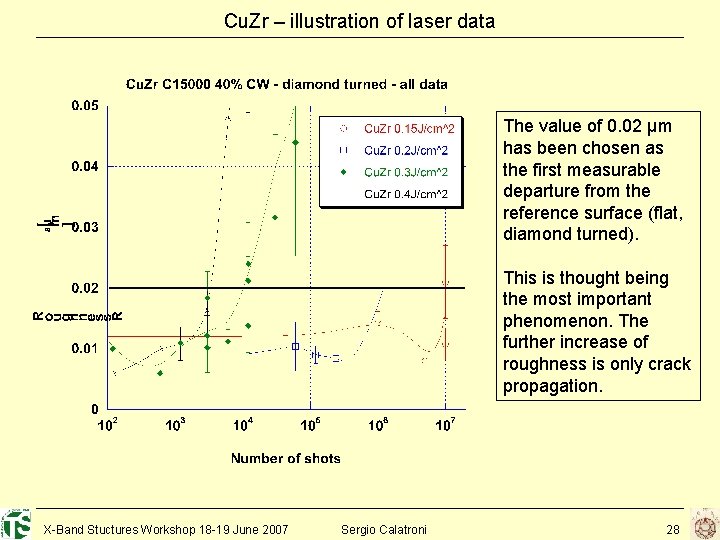
Cu. Zr – illustration of laser data The value of 0. 02 µm has been chosen as the first measurable departure from the reference surface (flat, diamond turned). This is thought being the most important phenomenon. The further increase of roughness is only crack propagation. X-Band Stuctures Workshop 18 -19 June 2007 Sergio Calatroni 28
All fatigue data X-Band Stuctures Workshop 18 -19 June 2007 Sergio Calatroni 29
- Slides: 29