
Structure of the Universe Universe is made up
- Slides: 30
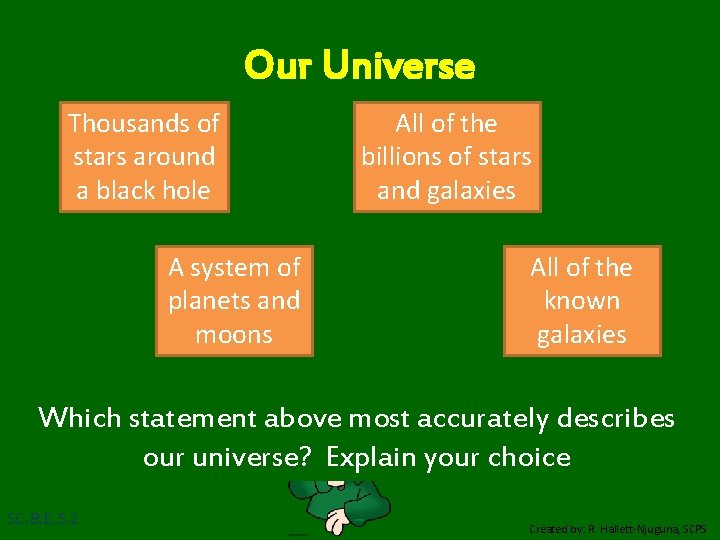
Structure of the Universe • Universe is made up of billions of galaxies – Our galaxy is the Milky Way, a spiral galaxy – At the center of most galaxies is a black hole • Each galaxy is made up of billions of stars – Other objects include planets, asteroids, comets, meteors…. but universe is mostly stars
Size of stars and planets • Stars are much larger than planets • Our sun, which is an average size yellow star could fit approximately 1 million Earth’s inside it
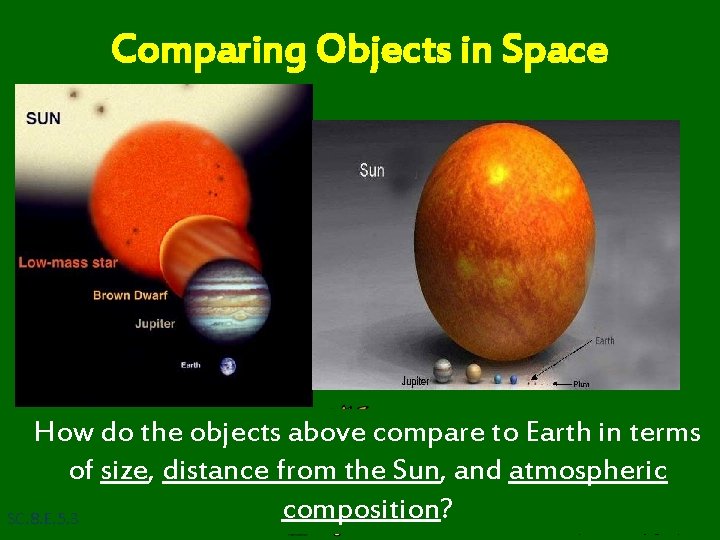
Comparing Objects in Space How do the objects above compare to Earth in terms of size, distance from the Sun, and atmospheric composition? SC. 8. E. 5. 3 Created by: R. Hallett-Njuguna, SCPS
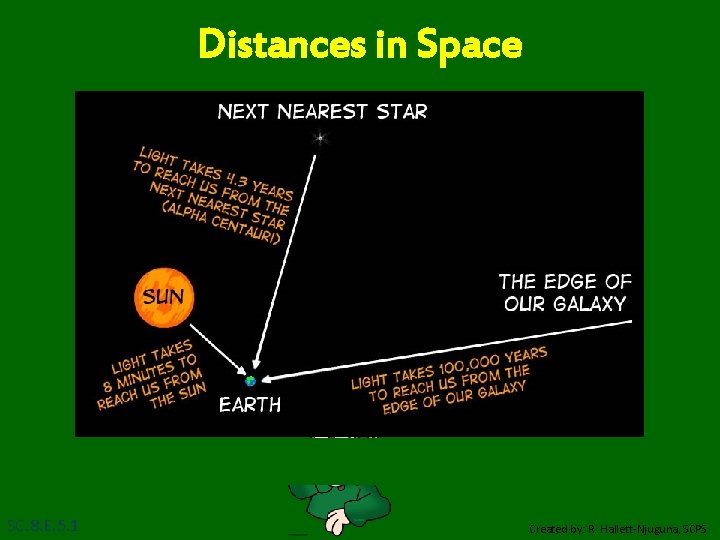
Measurement in Space • 1 light year = the distance light travels in 1 year = 9. 4605284 × 1012 km – Used 1 light to measure to distances outside our solar system • 1 AU (astronomical unit) = distance from Earth to Sun 1 Astronomical = 1. 49 597 x 10 8 kilometers – Used to measure distances. Unit within our 871 solar system Created by: R. Hallett-Njuguna, SCPS
Distances in Space SC. 8. E. 5. 1 Created by: R. Hallett-Njuguna, SCPS
Our Universe Thousands of stars around a black hole A system of planets and moons All of the billions of stars and galaxies All of the known galaxies Which statement above most accurately describes our universe? Explain your choice SC. 8. E. 5. 2 Created by: R. Hallett-Njuguna, SCPS
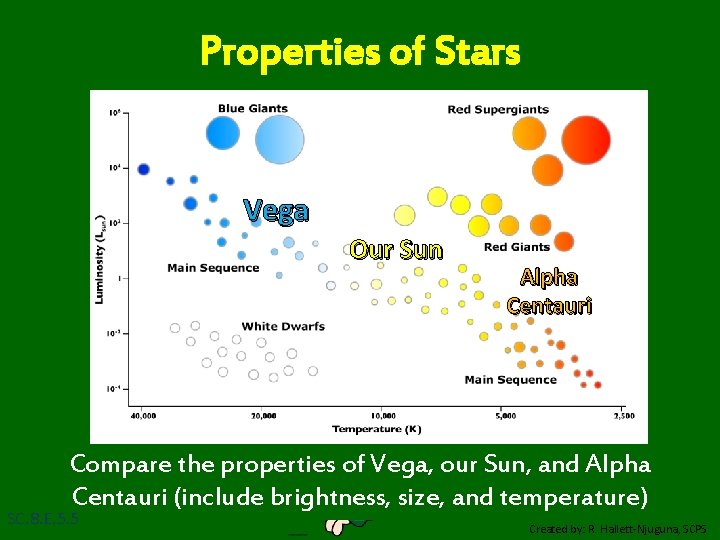
Stars • The mass of a star determines its color, brightness, and temperature • The hottest stars are blue and the coolest stars are red – Opposite of the faucet Created by: R. Hallett-Njuguna, SCPS
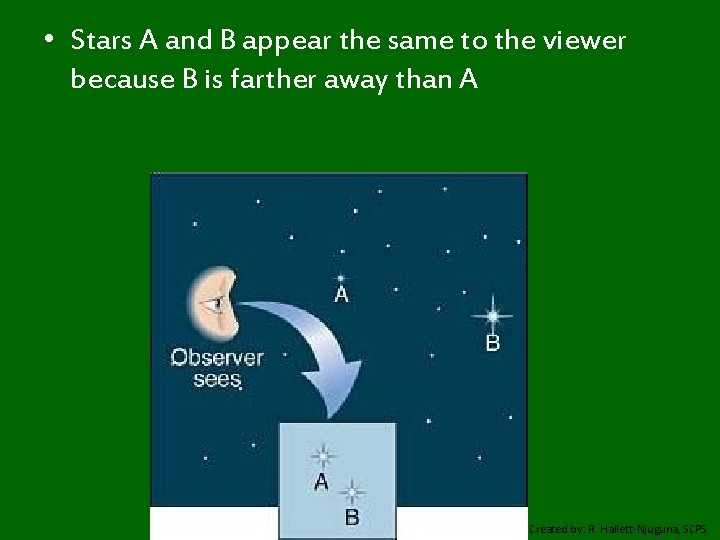
Brightness of Stars • The actual brightness of a star is called the absolute magnitude • The brightness of a star as perceived from Earth is called apparent magnitude – A star that is very bright may be so far away that it appears to be dim Created by: R. Hallett-Njuguna, SCPS
• Stars A and B appear the same to the viewer because B is farther away than A Created by: R. Hallett-Njuguna, SCPS
Color and Temperature of Stars • Stars are “opposite of the faucet” – Red are the coolest stars – Blue are the hottest stars Created by: R. Hallett-Njuguna, SCPS
Properties of Stars Vega Our Sun Alpha Centauri Compare the properties of Vega, our Sun, and Alpha Centauri (include brightness, size, and temperature) SC. 8. E. 5. 5 Created by: R. Hallett-Njuguna, SCPS
Sun is just an average star • The sun is a yellow star with average mass, brightness, and temperature • The sun rotates faster at the equator than at the poles Created by: R. Hallett-Njuguna, SCPS
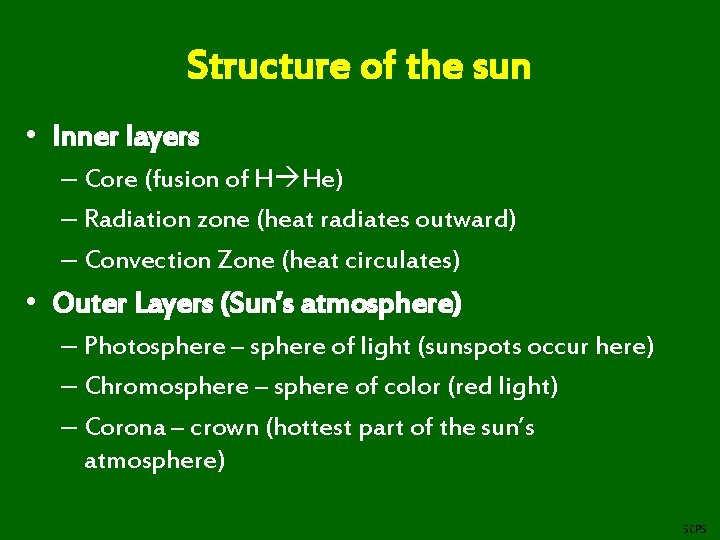
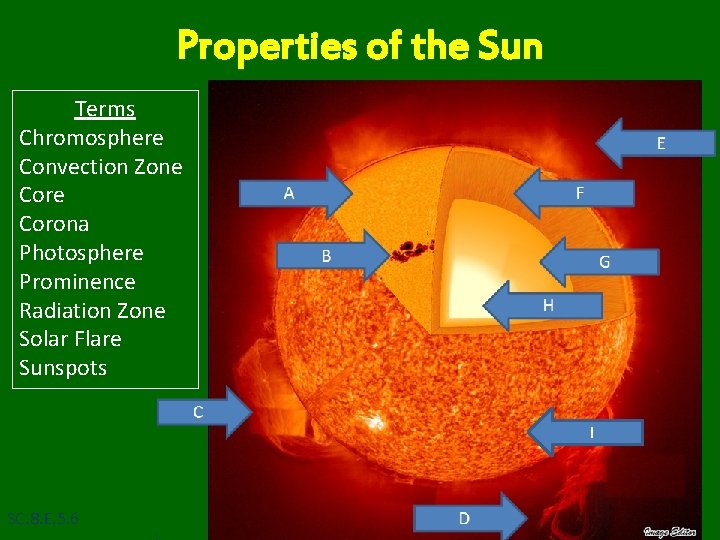
Structure of the sun • Inner layers – Core (fusion of H He) – Radiation zone (heat radiates outward) – Convection Zone (heat circulates) • Outer Layers (Sun’s atmosphere) – Photosphere – sphere of light (sunspots occur here) – Chromosphere – sphere of color (red light) – Corona – crown (hottest part of the sun’s atmosphere) Created by: R. Hallett-Njuguna, SCPS
Properties of the Sun Terms Chromosphere Convection Zone Corona Photosphere Prominence Radiation Zone Solar Flare Sunspots I SC. 8. E. 5. 6 Created by: R. Hallett-Njuguna, SCPS
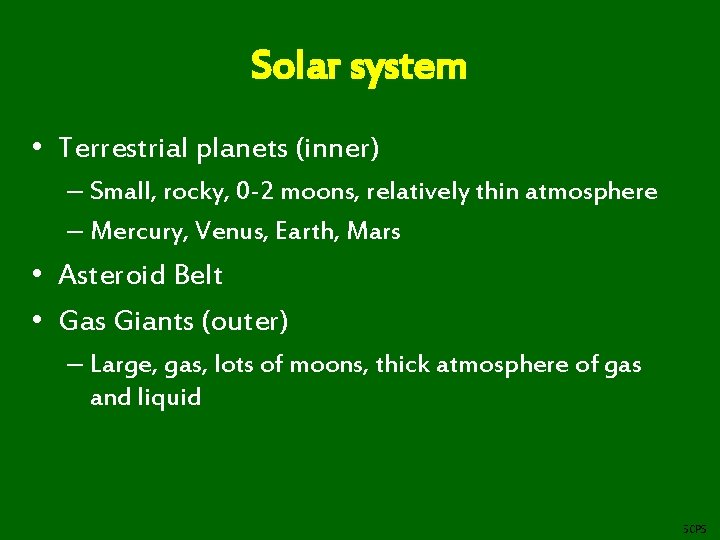
Solar system • Terrestrial planets (inner) – Small, rocky, 0 -2 moons, relatively thin atmosphere – Mercury, Venus, Earth, Mars • Asteroid Belt • Gas Giants (outer) – Large, gas, lots of moons, thick atmosphere of gas and liquid Created by: R. Hallett-Njuguna, SCPS
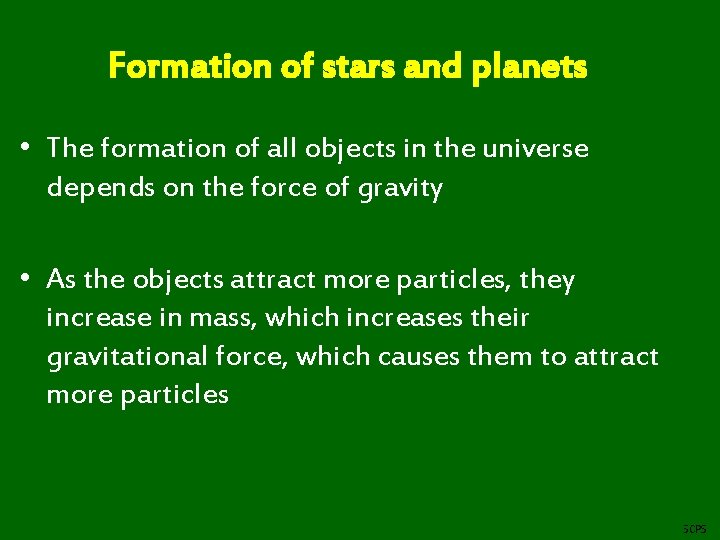
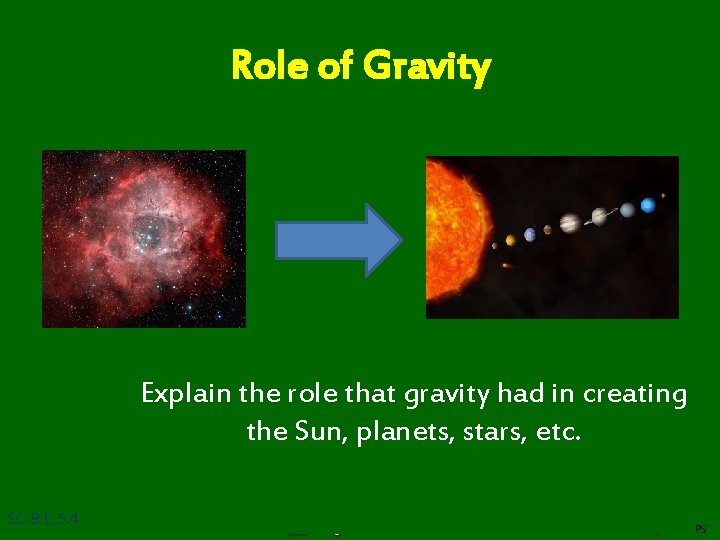
Formation of stars and planets • The formation of all objects in the universe depends on the force of gravity • As the objects attract more particles, they increase in mass, which increases their gravitational force, which causes them to attract more particles Created by: R. Hallett-Njuguna, SCPS
Role of Gravity Explain the role that gravity had in creating the Sun, planets, stars, etc. SC. 8. E. 5. 4 Created by: R. Hallett-Njuguna, SCPS
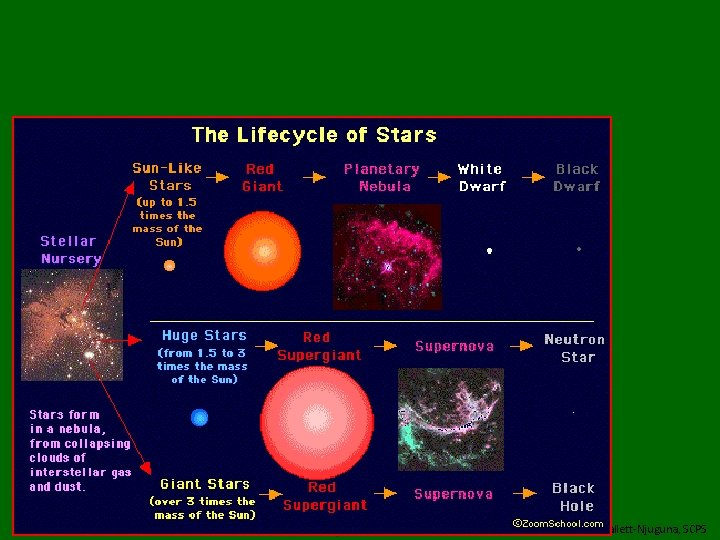
Life Cycle of Stars • The life cycle of a star is determined by the star’s mass – Stars approximately the same size as the sun will cool slowly, turn into a red giant, and eventually become white dwarfs… a quiet “death” – Stars 1. 5 -3 x the size of sun will expand cool rapidly into a red supergiant supernova neutron star – Huge stars more than 3 x the size of sun will expand cool rapidly to a red supergiant supernova black hole Created by: R. Hallett-Njuguna, SCPS
Created by: R. Hallett-Njuguna, SCPS
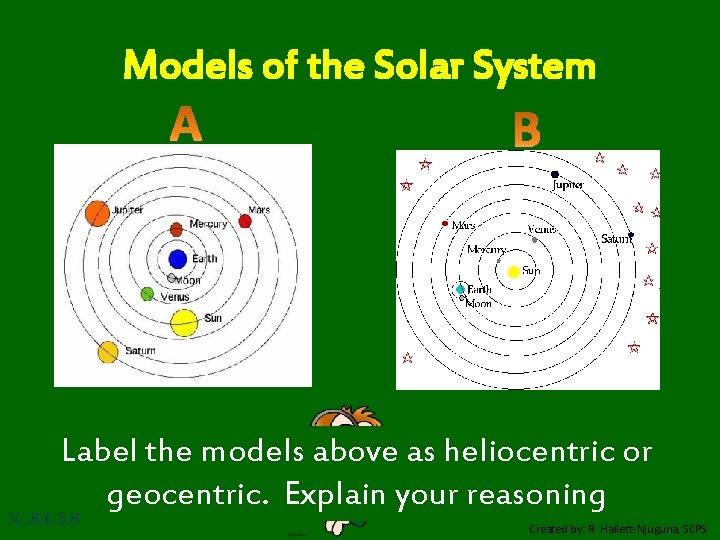
Models of the solar system • Science is durable because it is open to change!!!! – Geocentric model – “Earth centered” – Heliocentric model – “sun centered” Created by: R. Hallett-Njuguna, SCPS
Models of the Solar System Label the models above as heliocentric or geocentric. Explain your reasoning SC. 8. E. 5. 8 Created by: R. Hallett-Njuguna, SCPS
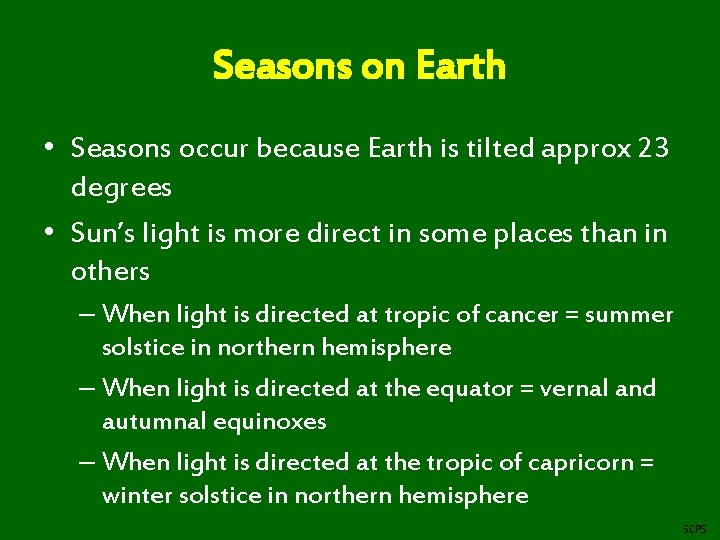
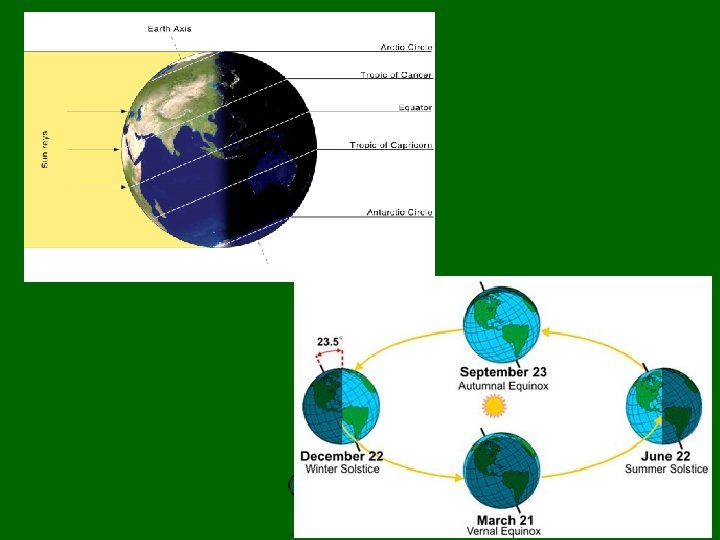
Seasons on Earth • Seasons occur because Earth is tilted approx 23 degrees • Sun’s light is more direct in some places than in others – When light is directed at tropic of cancer = summer solstice in northern hemisphere – When light is directed at the equator = vernal and autumnal equinoxes – When light is directed at the tropic of capricorn = winter solstice in northern hemisphere Created by: R. Hallett-Njuguna, SCPS
Created by: R. Hallett-Njuguna, SCPS
Moon Phases • We see phases of the moon, depending on how much of the lighted half of the moon we can see from our position on earth • As visible light is increasing, the phases are waxing • As visible light is decreasing, the phases are waning Created by: R. Hallett-Njuguna, SCPS
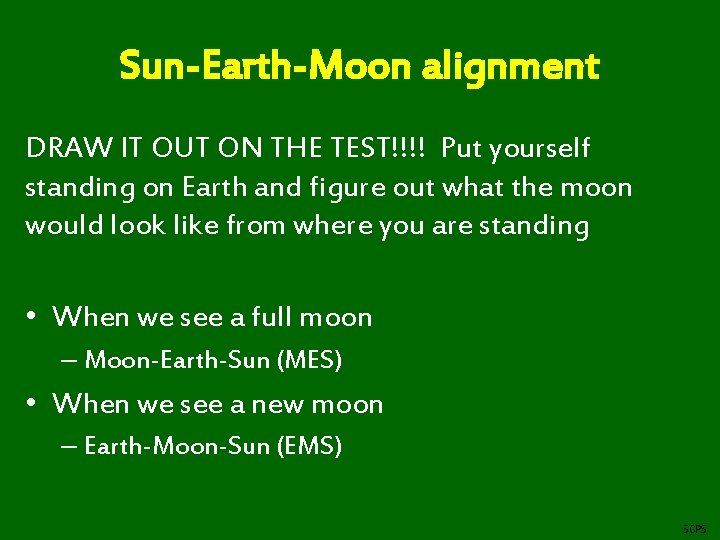
Sun-Earth-Moon alignment DRAW IT OUT ON THE TEST!!!! Put yourself standing on Earth and figure out what the moon would look like from where you are standing • When we see a full moon – Moon-Earth-Sun (MES) • When we see a new moon – Earth-Moon-Sun (EMS) Created by: R. Hallett-Njuguna, SCPS
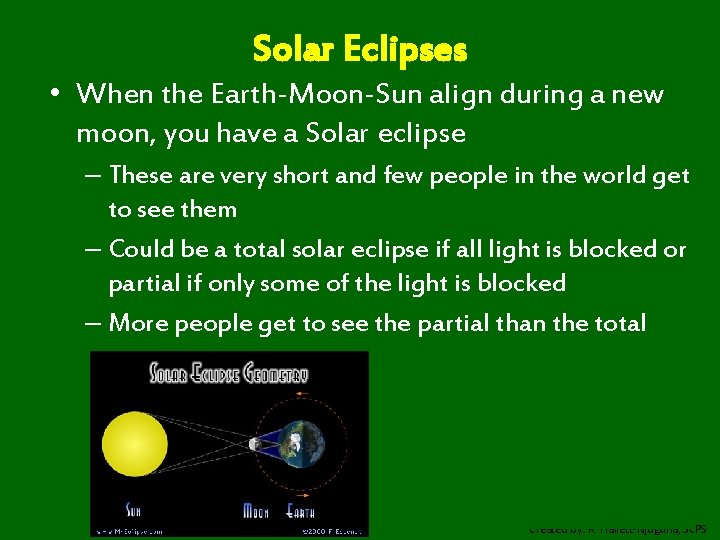
Solar Eclipses • When the Earth-Moon-Sun align during a new moon, you have a Solar eclipse – These are very short and few people in the world get to see them – Could be a total solar eclipse if all light is blocked or partial if only some of the light is blocked – More people get to see the partial than the total Created by: R. Hallett-Njuguna, SCPS
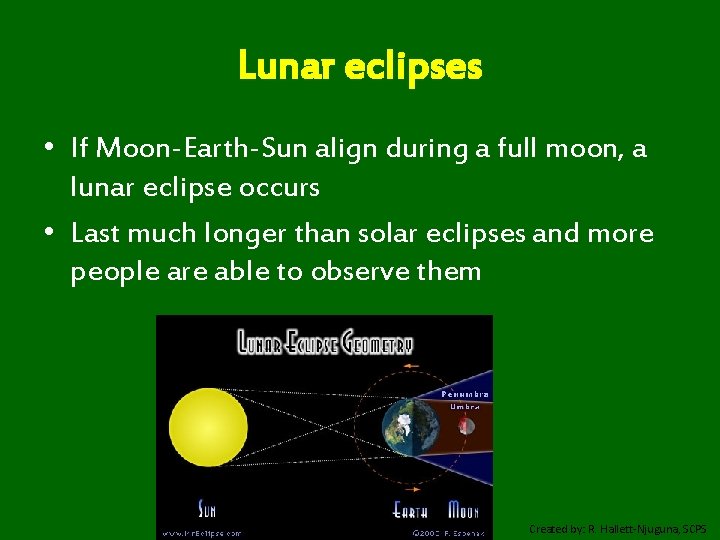
Lunar eclipses • If Moon-Earth-Sun align during a full moon, a lunar eclipse occurs • Last much longer than solar eclipses and more people are able to observe them Created by: R. Hallett-Njuguna, SCPS
Eclipses • Think about: Can more people see a Solar or Lunar eclipse? Explain your answer SC. 8. E. 5. 9 Created by: R. Hallett-Njuguna, SCPS
Tides • The gravitational pull of the sun and moon on Earth affects the oceans • When sun and moon are aligned with Earth during full moon and new moon, we have spring tides (very high tides, and very low tides) • When Moon Sun and Earth are at right angles to each other, during 1 st quarter and 3 rd quarter moon phases we have neap tides (fairly even everywhere) Created by: R. Hallett-Njuguna, SCPS
Tides • Check out this super-cool animation to see tides in action – also on my Earth/Space class website http: //ww 2. valdosta. edu/~cbarnbau/astro_demo s/tides/neap_sp. html SC. 8. E. 5. 9 Created by: R. Hallett-Njuguna, SCPS