
Structure of the Solar System Where and why
- Slides: 35
Structure of the Solar System Where and why it is what it is
Laws of motion Planets move around Sun Not always a given, Anthropic Earth-centered Ptolomaic cosmology Copernicus published his seminal work on his deathbed (1543) A case of publish and perish De revolutionibus orbium celestium Conservation of angular momentum v 1 r 1 = v 2 r 2 = constant (for constant mass) The two body problem
Kepler’s Laws Planets move around the Sun in elliptical orbits, with Sun as one of the foci A radius vector sweeps out equal area in equal time Squares of the periods of the revolutionof the planets are proportional to the cubes of their distance from the Sun
Titius-Bode Law Distances of planets from Sun 0. 4, 0. 7, 1. 0, 1. 6, 2. 8, 5. 2, … Can be formulated R = 0. 4 + 0. 3 k K = 0, 1, 2, 4, 8, 16, 32 0. 4, 0. 7, 1. 0, 1. 6, 2. 8, 5. 2, … Titius 1729 -1776, Bode 1747 -1826
Titius-Bode Law Planet missing between Mars and Jupiter At 2. 8 au Ceres discovered in 1801 at 2. 77 au Pallas, Juno, Vesta by 1804 Exploded planet No common origin point Failed planet
Titius-Bode Law Okay for Uranus, not so good for Neptune (38 predicted vs 30 actual au) No other correlation with planetary properties Secondary effect after formation Related to stable resonances of orbital periods Planets have moved
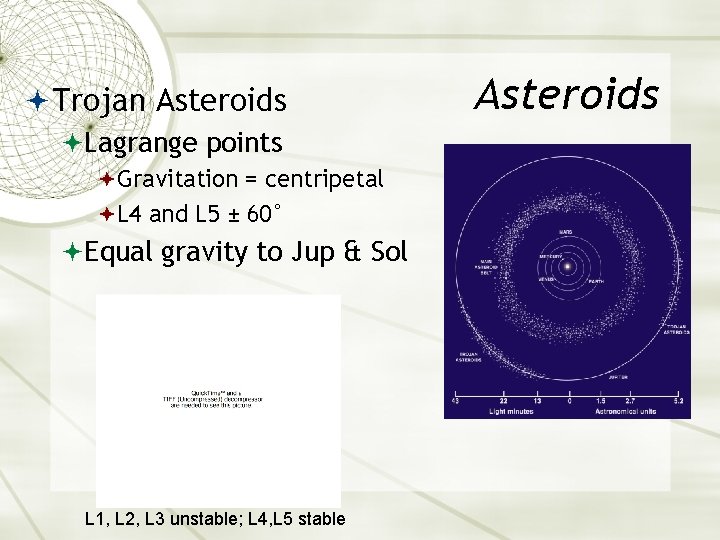
Asteroids Vesta, Ceres, Moon Total mass less than 5% of Moon 1 -2 Million asteroids with size > 1 km Asteroid belt Gaps/concentrations due to resonances with Jupiter (Kirkwood Gaps) Gaps at 2: 1 (3. 28 au) and 3: 1 (2. 50 au) Concs at 1: 1 3: 2 (3. 97 au) 4: 3 (4. 2 au)
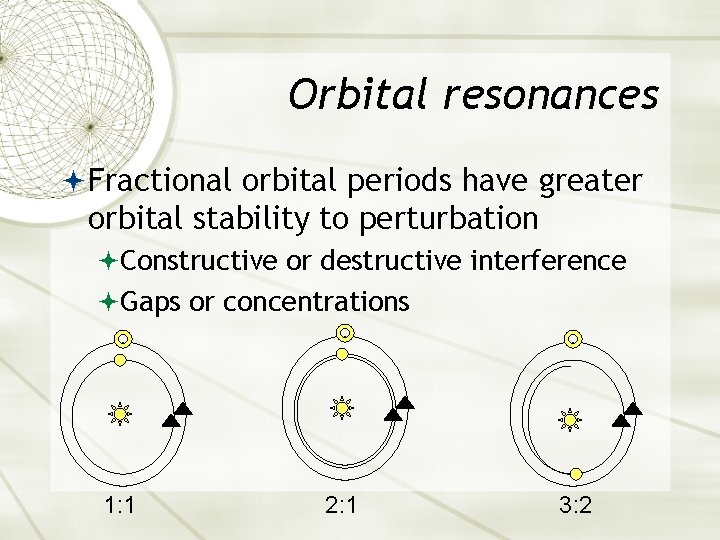
Orbital resonances Fractional orbital periods have greater orbital stability to perturbation Constructive or destructive interference Gaps or concentrations 1: 1 2: 1 3: 2
Asteroids Resonances and gaps
Trojan Asteroids Lagrange points Gravitation = centripetal L 4 and L 5 ± 60° Equal gravity to Jup & Sol L 1, L 2, L 3 unstable; L 4, L 5 stable Asteroids
Asteroids Several hundred thousand discovered 26 > 200 km Solid rock bodies Rubble piles Visits by NEAR, Hayabusa NEAR landed on Eros Hayabusa landed on Itokawa Plus flybys of other missions on way to Jupiter
Asteroid Spectral Classes Definition Based on light reflectance (Albedo) Spectral features Spectral shape Mineralogical features e. g. olivine, pyroxene, water, … Chapman 1975 3 types (C-carbonaceous, S-stony, and U) Tholen 1984 used spectra 0. 31 -1. 06 µm Types A-X (23)
Mathilde Spectral Class C-type (Most abundant 75 %) Low albedo (0. 03 -0. 10) Strong UV absorption below 0. 4 µm Longer wavelengths featureless Reddish Water feature at 3 µm Type 10 -Hygeia 4 th largest asteroid
Spectral Class Ida + Dactyl S Class (17%) Moderately bright Albedo 0. 10 -0. 22 Metallic Fe-Ni + magnesium silicate Spectrum has steep slope < 0. 7µm Absorption features around 1 and 2 µm Largest is 15 Eunomia (330 km diam)
Spectral Class M class (3 rd abundant) Metallic Fe-Ni Moderately bright (0. 10 -0. 18) Spectrum is flat to reddish 16 Psyche Absorption features at 0. 55 and 0. 75 µm 16 Psyche (330 km)
Asteroids Compositional trends? Igneous inside 2. 8 au (S class) Metamorphic around 3. 2 au (M class) Primitive outside 3. 4 au (C class)
Origin of asteroid belt Failed planet Meteorites Iron meteorites from core Pallasites show mantle olivine Igneous achondrites Crustal carbonaceous chondrites But not from single body Oxygen isotopes, chemistry
Origin of asteroid belt Planetoids form in early SS Coalesce to form planets Presence of Jupiter Pumped up the eccentricities Limits growth Many small bodies No planet at 2. 8 au
Near-Earth asteroids Apollos, Atens and Armors Few thousand > 1 km 107 10 -100 m 1036 Ganymed, 433 Eros Source of meteorites? Eros could survive 50 -100 Myr 5% chance of hitting Earth
Spectrophotometric Paradox Most common meteorites are chondrites Parent body apparently absent 3628 Boznemcová 8 km body with Ord-chondrite spectrum Of 35 NEA, 6 have Ord-chondrite spectra Plus 10% of Main Belt asteroids of size ≈1 km Chondrites dominate meteorites, But not asteroids
Asteroids to Meteorites Relative frequency of meteorites depends on efficiency of delivery Meteorites unlikely to be sourced from deep within asteroid belt Asteroids must be close to resonances to supply meteorites into Earth-crossing orbit 6 Hebe near 3: 1(2. 50 au) Source of H-Chondrites + IIE Irons
Missing Olivine Meteorites Iron Meteorites Cores Pallasites Core-mantle Achondrites, Chondrites Crust Where’s the mantle olivine?
Individual asteroids 1 Ceres Largest 933 km diameter 2. 7 g/cm 3 2. 77 au C class 9/13 largest asteroids similar
Individual asteroids 4 Vesta Irregular shape (460 km across) 3. 7 g/cm 3 Intact differentiated crust (basalt) Source of HED meteorites (4. 560 Gyr) 460 km crater, 13 km deep Two more large craters (100 km+)
Individual asteroids 433 Eros S class 2 nd largest NEA 33 x 13 km Density 2. 5 ± 0. 8 km Coherent rather than rubble pile
Individual asteroids NEAR Lands on Eros - 2001 Boulders on surface from 250 m 5 m
Individual asteroids 25143 Itokawa (1998) S class Hayabusa (Muses-C) 500 m long 2. 0 g/cm 3 Rubble pile
Individual asteroids Visits to Mathilde, Gaspra, Ida has satellite (Dactyl) NEAR Mission
Interplanetary dust Sources Asteroids (5 km/s) Comets (20 -60 km/s) Interstellar grains? 10, 000 tons/year to Earth Fluffy grains can survive atmospheric entry Many carbonaceous
Moving Giant Planets Jupiter moved sunwards depleting asteroid belt beyond 4 au Saturn, Uranus, Neptune move out Saturn now in 2: 1 resonance with Jupiter Produced by bombardment of centaurs
Centaurs Between Saturn and Uranus 2060 Chiron - 1977 182 km Dark-grey-black object (albedo 0. 1) Similar in size and colour to Phoebe �(Sat Moon) Orbit 8. 5 - 19 au Fits definition of comet 5145 Pholus - 1992 185 km, red Nessus, Asbolus, Chariklo
Moving Giant Planets Neptune plows into and depletes inner zone of Kuiper Belt (30 -35 au) Pluto swept into a 3: 2 orbital resonance at high eccentricity and inclination
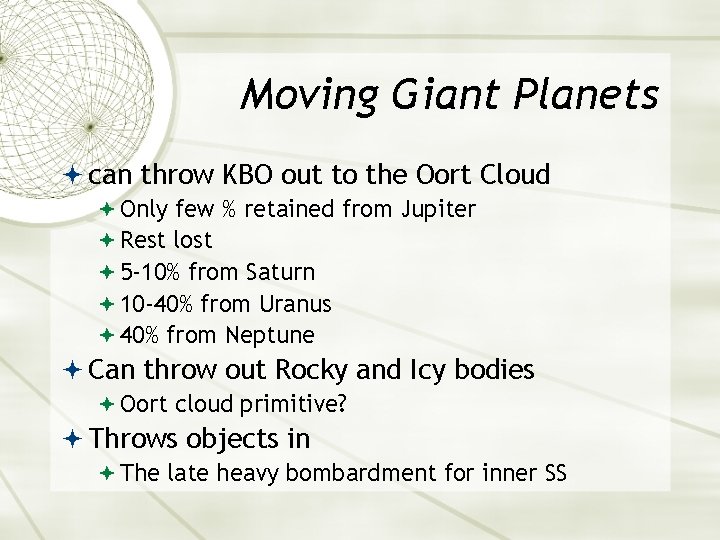
Moving Giant Planets can throw KBO out to the Oort Cloud Only few % retained from Jupiter Rest lost 5 -10% from Saturn 10 -40% from Uranus 40% from Neptune Can throw out Rocky and Icy bodies Oort cloud primitive? Throws objects in The late heavy bombardment for inner SS
Solar System Dynamic Many time scales 4 Vesta has survived 4. 56 Gyr But Exposure ages of HED meteorites 5 -80 Myr Survival time of some asteroids 50, 000 years
Near Earth Asteroid Orbits http: //neo. jpl. nasa. gov/orbits/