
Structure of the first year This session is




- Slides: 25
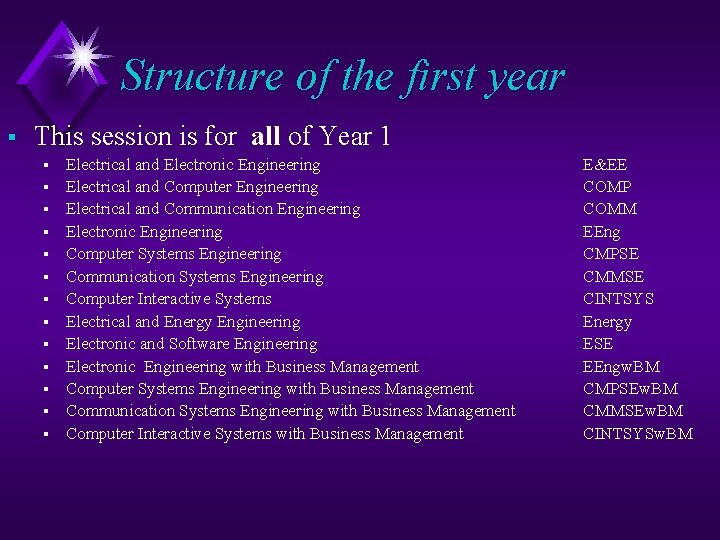
Structure of the first year § This session is for all of Year 1 § § § § Electrical and Electronic Engineering Electrical and Computer Engineering Electrical and Communication Engineering Electronic Engineering Computer Systems Engineering Communication Systems Engineering Computer Interactive Systems Electrical and Energy Engineering Electronic and Software Engineering Electronic Engineering with Business Management Computer Systems Engineering with Business Management Communication Systems Engineering with Business Management Computer Interactive Systems with Business Management E&EE COMP COMM EEng CMPSE CMMSE CINTSYS Energy ESE EEngw. BM CMPSEw. BM CMMSEw. BM CINTSYSw. BM
Welcome!!
u Dr Mike Spann u m. spann@bham. ac. uk u www. eee. bham. . ac. uk/spannm u N 415 u 01214144328
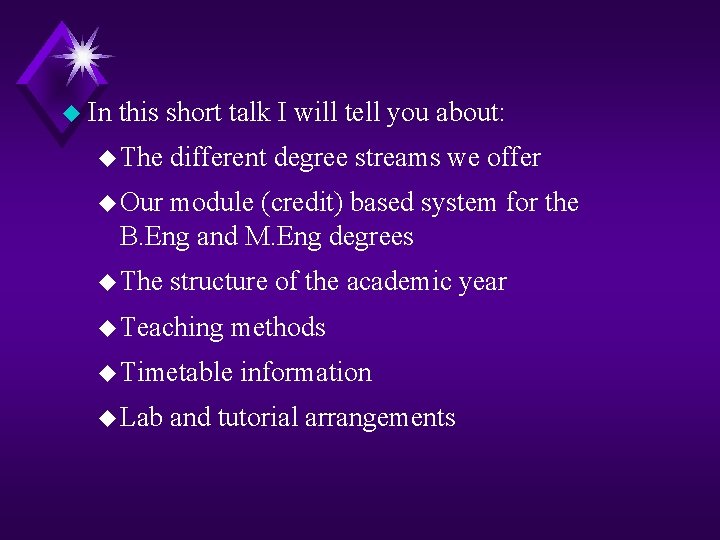
u In this short talk I will tell you about: u The different degree streams we offer u Our module (credit) based system for the B. Eng and M. Eng degrees u The structure of the academic year u Teaching methods u Timetable u Lab information and tutorial arrangements
u u Electronic, Electrical, Computer and Communications Engineering, Communications Systems Engineering u The first semester of the first year is common to all of these programmes u Opportunities to switch at end of semester 1 and at end of year Computer Systems Engineering, Computer Interactive Systems u Common first year u Opportunities to switch at end of semester 1 and at end of year
u Degrees u The with Business Management degrees with Business Management are major/minor degrees taught jointly by the School of EECE and the Birmingham Business School. u In each year, students take 80 credits taught by EECE and 40 credits of material taught by the Business School
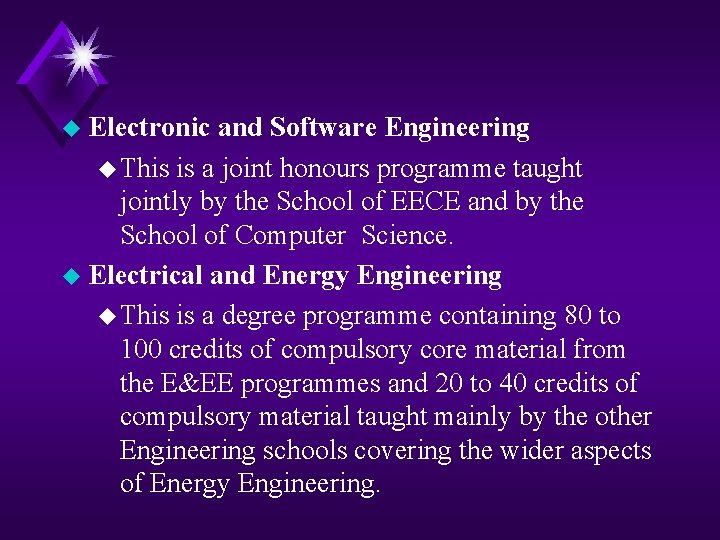
u Electronic and Software Engineering u This is a joint honours programme taught jointly by the School of EECE and by the School of Computer Science. u Electrical and Energy Engineering u This is a degree programme containing 80 to 100 credits of compulsory core material from the E&EE programmes and 20 to 40 credits of compulsory material taught mainly by the other Engineering schools covering the wider aspects of Energy Engineering.
Modules and credits u Each year of study comprises 120 credits u You wil 1 study 1 or 2 semester courses worth 10 or 20 credits each u Some modules are compulsory u Others are optional (including MOMD’s) u Except u Your for degrees with Business Management! timetable will reflect your degree program
What modules am I taking? u Depends on your degree stream and is described in detail in the Student Handbook document u There a small number of optional modules but most are compulsory u It is important you are clear about this by the end of the talk!! u The table in the handbook should be all you need to figure this out
MOMDs u Up to 20 credits of MOMD’s can be chosen provided no timetable clash is generated u Its up to you to check this u You may drop EE 1 F 1 (Intro to Info. Eng. ) in semester 1 and/or EE 1 F 2 (multimedia) in semester 2 and replace them with MOMDs u Also applies to language courses
Languages u You may study a 20 credit language module u Most modern European languages offered plus Japanese u A reasonable pass at GCSE in a language required
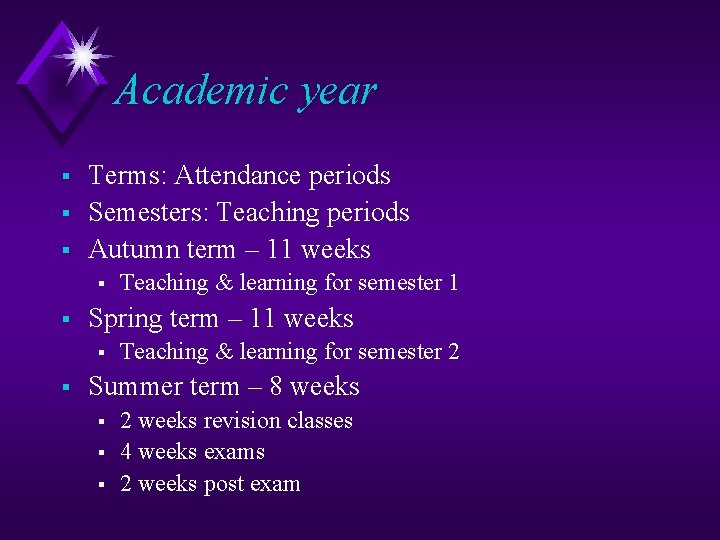
Academic year § § § Terms: Attendance periods Semesters: Teaching periods Autumn term – 11 weeks § § Spring term – 11 weeks § § Teaching & learning for semester 1 Teaching & learning for semester 2 Summer term – 8 weeks § § § 2 weeks revision classes 4 weeks exams 2 weeks post exam
Teaching methods u Your course will mainly be delivered in 3 ways u Formal lecture u Tutorial u Laboratory u There will also be grouped based activities and informal ‘drop in’ clinics
Teaching methods u u u Lectures u Some modules to the whole class, others to smaller class sizes for optional or degree specific courses Laboratories u You will be randomly split up into 2 lab groups (A or B) u You will normally work with a lab partner Tutorials u Small group teaching u Generally none assessed but an opportunity to learn without the added pressure of formal assessment u However, you do get feedback on your work
Assessment methods u Formal exam u Typically 1½ , 2 or 3 hour papers u Coursework u Essay u Computer programming assignment u Formal laboratory report u Design exercise u You must respect the deadlines for submitting coursework as big penalties for late submission apply u More about this another time
Coursework § § Big part of assessment is coursework Coasting and cramming doesn’t work Work steadily and consistently We have a receipt-based system for handing in coursework § All explained in the handbook
Timetable information u Weeks 1 -11 u Note the timetabled slots for personal tutor meetings u Specific issues will be discussed at each one u Important you attend u Main labs for electronics don’t start until week 4 u Computer programming labs start week 2 u However, the IT skills labs starts in week 3 u Introduction to computing facilities lab in week 1 u Tutorials don’t start until week 3
Lab/Tutor groups u You are allocated a lab group (A or B) u Dependant on your degree stream to a certain extent u Otherwise, randomly allocated u Timetable reflects lab group u The tutorial system will be explained to you by the course lecturers before the tutorials start u Tutorials in 1 A 1, 1 F 1 and maths (1 D 1, 1 J 1)
Labs/Tutorials u Main labs are the programming and electronics u IT labs run weeks 1 -3 u Programming labs start week 2 u Electronics labs start week 4 u Also we have maths tutorials (EE 1 D 1 and EE 1 J 1) u Out of hours access
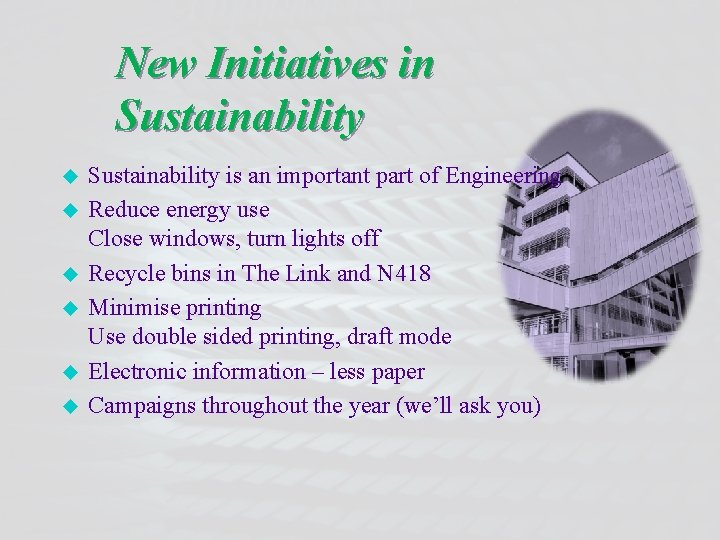
New Initiatives in Sustainability u u u Sustainability is an important part of Engineering Reduce energy use Close windows, turn lights off Recycle bins in The Link and N 418 Minimise printing Use double sided printing, draft mode Electronic information – less paper Campaigns throughout the year (we’ll ask you)
The School Needs to Hear Your Opinions • You can contact your year’s reps with your concerns/ideas/suggestions in person or via Student Information section on Web. CT • Read feedback on progress of issues as they are addressed on Student Information section on Web. CT • Changes are made as a result of student comments
Student Reps • Act as link between Students and University. (See www. youtube. com/guildofstudents) • Have weekly meetings with Prof Russell to deal with problems rapidly. • Sit on Staff Student committee to consider longer term issues • You can identify them from their photos and contact details on student notice-boards
Issues dealt with u u u u u Timetabling issues, Feedback delays, Course work issues, Problems with room facilities, Problems with swipe-card access, Problems with computing facilities, Disk quotas, Remote access to computing facilities, Requests for software.
Elections • There are 2 Rep posts for the first year available • Candidates email Dr Tarte before 5 pm, Friday 7 October with name, photo and statement of why they want to be a rep for public release • Profiles go onto Web. CT by 5 pm Monday October 10 th • Secret Ballot held in week beginning Monday October 17 th