
Structure of the finance organization Typical Finance Organization

- Slides: 62
Structure of the finance organization
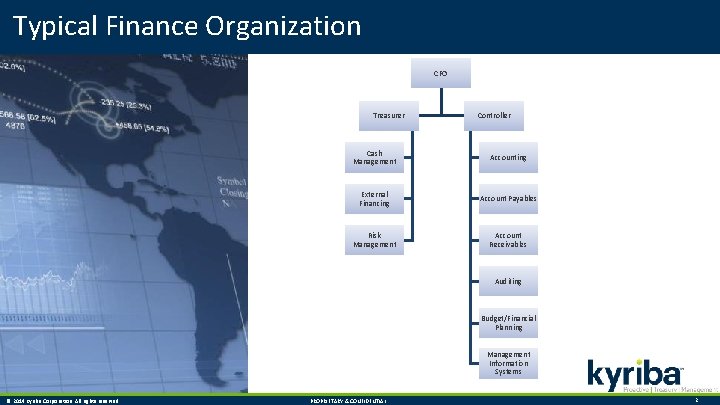
Typical Finance Organization CFO Treasurer Controller Cash Management Accounting External Financing Account Payables Risk Management Account Receivables Auditing Budget/Financial Planning Management Information Systems © 2014 Kyriba Corporation. All rights reserved. PROPRIETARY & CONFIDENTIAL. 2
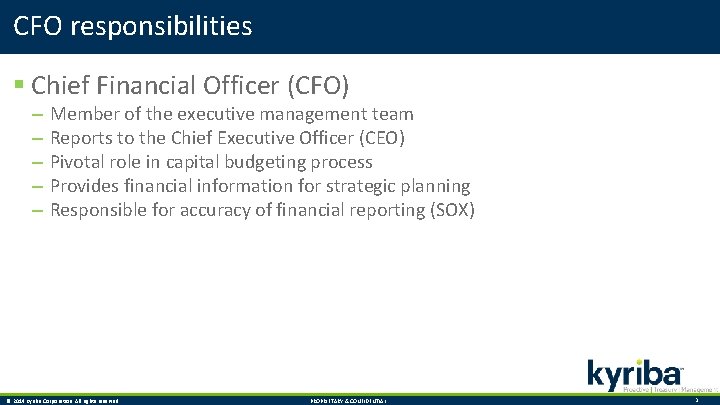
CFO responsibilities § Chief Financial Officer (CFO) – – – Member of the executive management team Reports to the Chief Executive Officer (CEO) Pivotal role in capital budgeting process Provides financial information for strategic planning Responsible for accuracy of financial reporting (SOX) © 2014 Kyriba Corporation. All rights reserved. PROPRIETARY & CONFIDENTIAL. 3
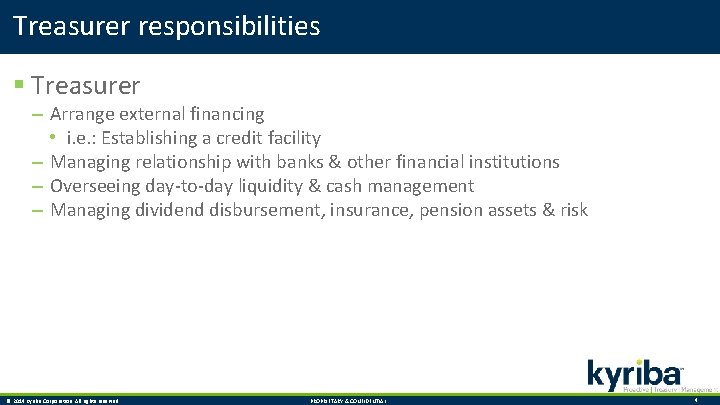
Treasurer responsibilities § Treasurer – Arrange external financing • i. e. : Establishing a credit facility – Managing relationship with banks & other financial institutions – Overseeing day-to-day liquidity & cash management – Managing dividend disbursement, insurance, pension assets & risk © 2014 Kyriba Corporation. All rights reserved. PROPRIETARY & CONFIDENTIAL. 4
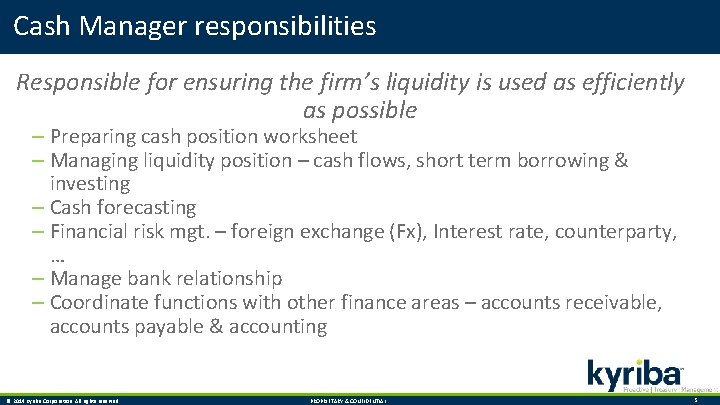
Cash Manager responsibilities Responsible for ensuring the firm’s liquidity is used as efficiently as possible – Preparing cash position worksheet – Managing liquidity position – cash flows, short term borrowing & investing – Cash forecasting – Financial risk mgt. – foreign exchange (Fx), Interest rate, counterparty, … – Manage bank relationship – Coordinate functions with other finance areas – accounts receivable, accounts payable & accounting © 2014 Kyriba Corporation. All rights reserved. PROPRIETARY & CONFIDENTIAL. 5
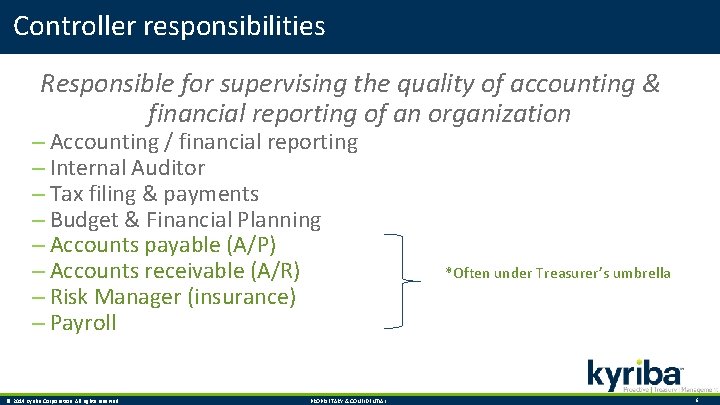
Controller responsibilities Responsible for supervising the quality of accounting & financial reporting of an organization – Accounting / financial reporting – Internal Auditor – Tax filing & payments – Budget & Financial Planning – Accounts payable (A/P) – Accounts receivable (A/R) – Risk Manager (insurance) – Payroll © 2014 Kyriba Corporation. All rights reserved. PROPRIETARY & CONFIDENTIAL. *Often under Treasurer’s umbrella 6
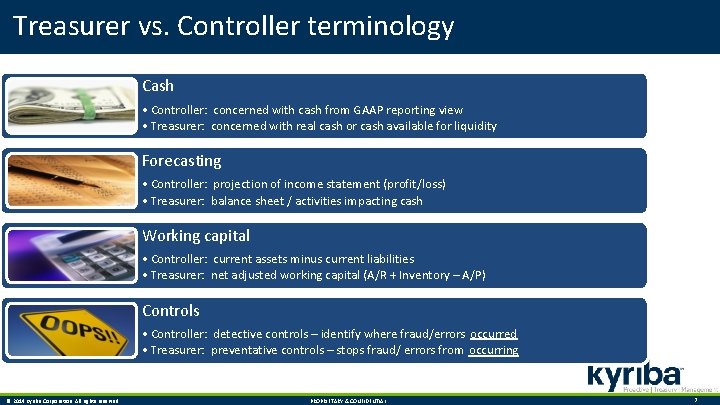
Treasurer vs. Controller terminology Cash • Controller: concerned with cash from GAAP reporting view • Treasurer: concerned with real cash or cash available for liquidity Forecasting • Controller: projection of income statement (profit/loss) • Treasurer: balance sheet / activities impacting cash Working capital • Controller: current assets minus current liabilities • Treasurer: net adjusted working capital (A/R + Inventory – A/P) Controls • Controller: detective controls – identify where fraud/errors occurred • Treasurer: preventative controls – stops fraud/ errors from occurring © 2014 Kyriba Corporation. All rights reserved. PROPRIETARY & CONFIDENTIAL. 7
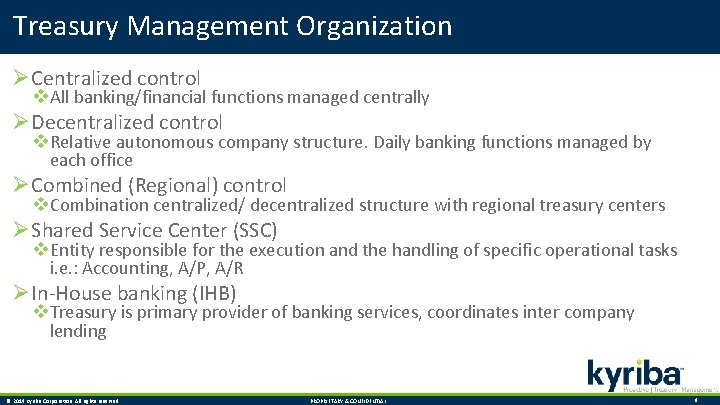
Treasury Management Organization ØCentralized control v. All banking/financial functions managed centrally ØDecentralized control v. Relative autonomous company structure. Daily banking functions managed by each office ØCombined (Regional) control v. Combination centralized/ decentralized structure with regional treasury centers ØShared Service Center (SSC) v. Entity responsible for the execution and the handling of specific operational tasks i. e. : Accounting, A/P, A/R ØIn-House banking (IHB) v. Treasury is primary provider of banking services, coordinates inter company lending © 2014 Kyriba Corporation. All rights reserved. PROPRIETARY & CONFIDENTIAL. 8
The role of Treasury Management
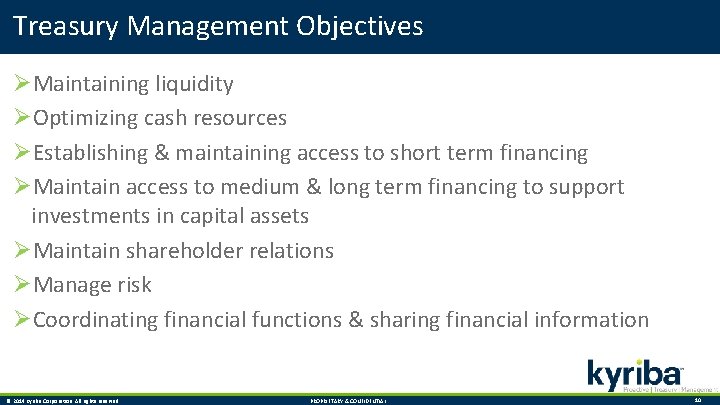
Treasury Management Objectives ØMaintaining liquidity ØOptimizing cash resources ØEstablishing & maintaining access to short term financing ØMaintain access to medium & long term financing to support investments in capital assets ØMaintain shareholder relations ØManage risk ØCoordinating financial functions & sharing financial information © 2014 Kyriba Corporation. All rights reserved. PROPRIETARY & CONFIDENTIAL. 10
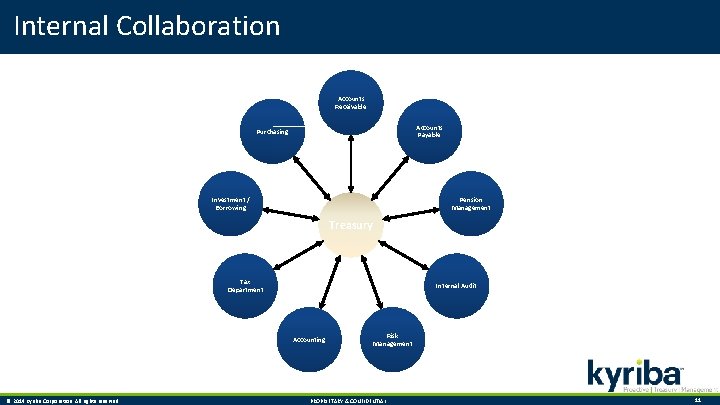
Internal Collaboration Accounts Receivable Accounts Payable Purchasing Investment / Borrowing Pension Management Treasury Tax Department Internal Audit Accounting © 2014 Kyriba Corporation. All rights reserved. Risk Management PROPRIETARY & CONFIDENTIAL. 11
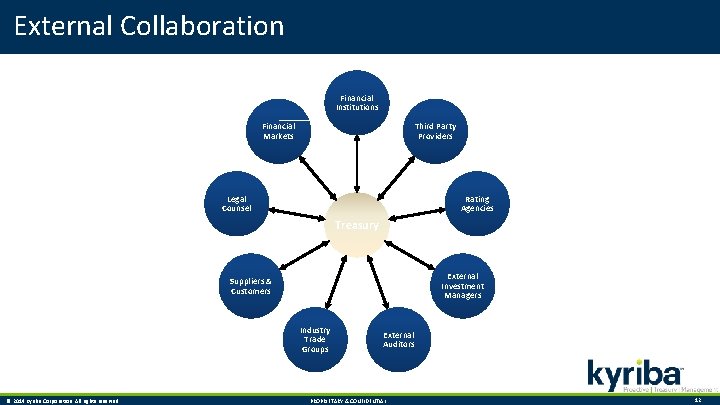
External Collaboration Financial Institutions Financial Markets Third Party Providers Legal Counsel Rating Agencies Treasury External Investment Managers Suppliers & Customers Industry Trade Groups © 2014 Kyriba Corporation. All rights reserved. External Auditors PROPRIETARY & CONFIDENTIAL. 12
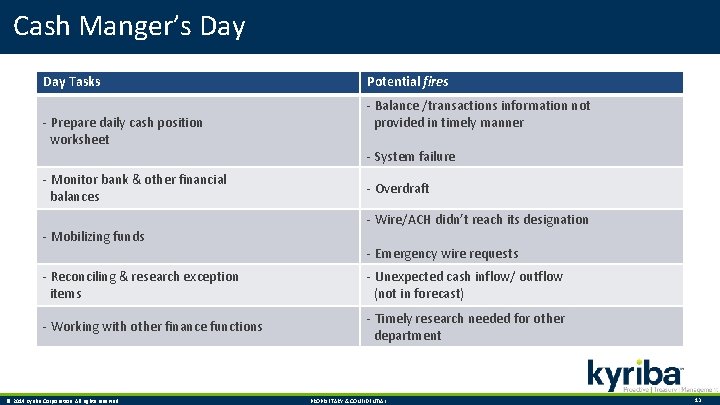
Cash Manger’s Day Tasks - Prepare daily cash position worksheet - Monitor bank & other financial balances - Mobilizing funds Potential fires - Balance /transactions information not provided in timely manner - System failure - Overdraft - Wire/ACH didn’t reach its designation - Emergency wire requests - Reconciling & research exception items - Unexpected cash inflow/ outflow (not in forecast) - Working with other finance functions - Timely research needed for other department © 2014 Kyriba Corporation. All rights reserved. PROPRIETARY & CONFIDENTIAL. 13
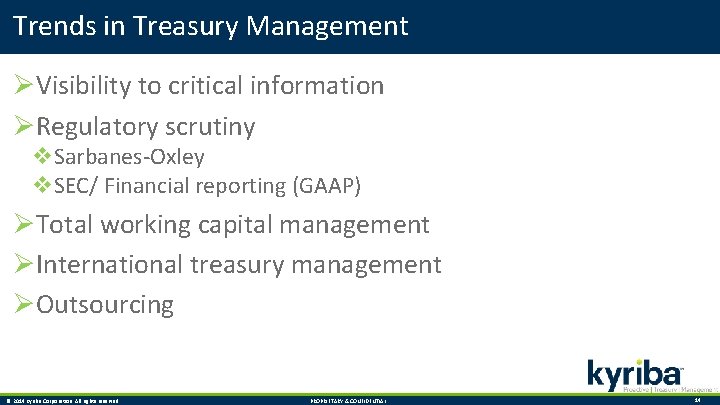
Trends in Treasury Management ØVisibility to critical information ØRegulatory scrutiny v. Sarbanes-Oxley v. SEC/ Financial reporting (GAAP) ØTotal working capital management ØInternational treasury management ØOutsourcing © 2014 Kyriba Corporation. All rights reserved. PROPRIETARY & CONFIDENTIAL. 14
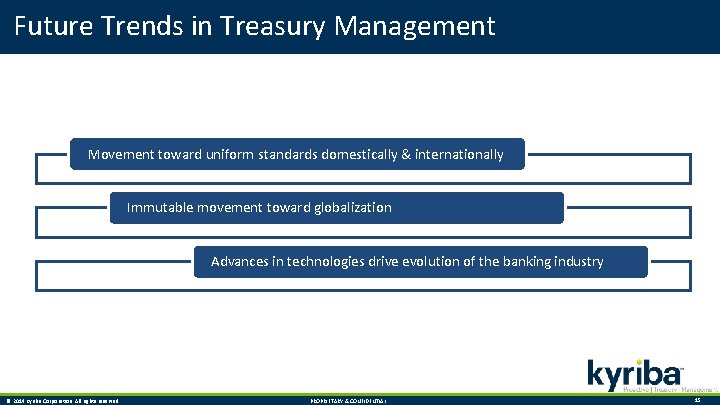
Future Trends in Treasury Management Movement toward uniform standards domestically & internationally Immutable movement toward globalization Advances in technologies drive evolution of the banking industry © 2014 Kyriba Corporation. All rights reserved. PROPRIETARY & CONFIDENTIAL. 15
Overview of Cash Management
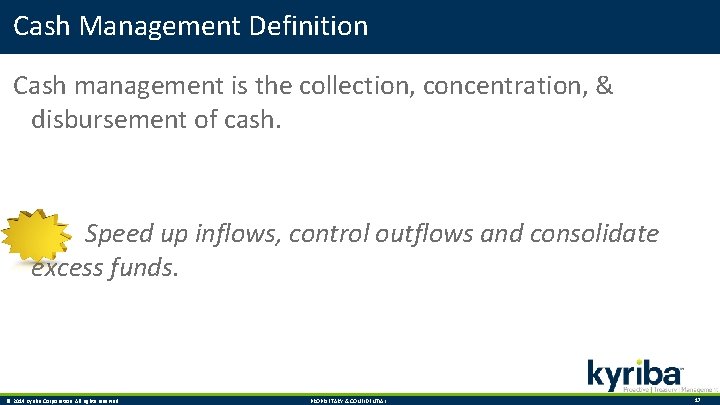
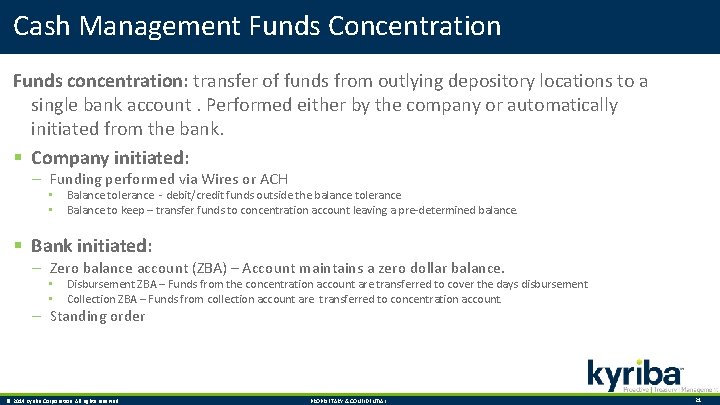
Cash Management Definition Cash management is the collection, concentration, & disbursement of cash. Speed up inflows, control outflows and consolidate excess funds. © 2014 Kyriba Corporation. All rights reserved. PROPRIETARY & CONFIDENTIAL. 17
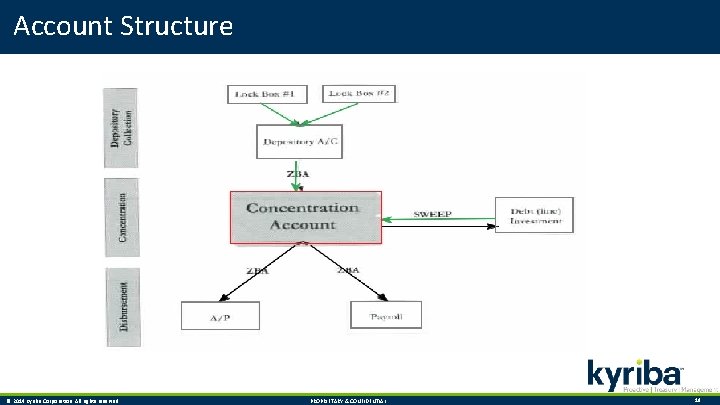
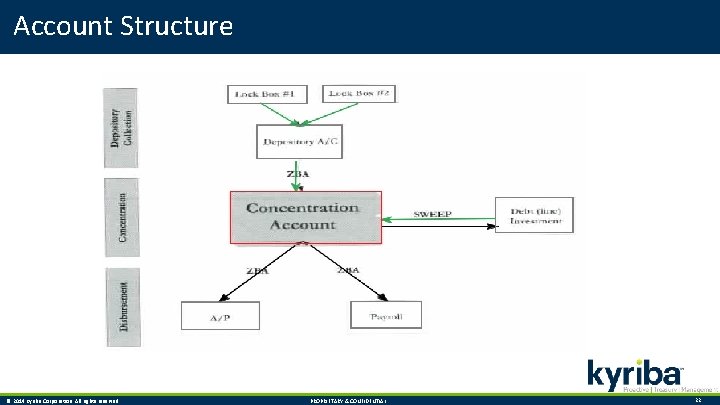
Account Structure © 2014 Kyriba Corporation. All rights reserved. PROPRIETARY & CONFIDENTIAL. 18
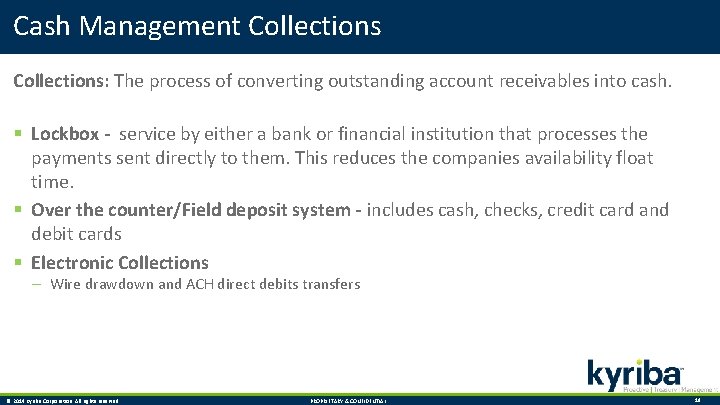
Cash Management Collections: The process of converting outstanding account receivables into cash. § Lockbox - service by either a bank or financial institution that processes the payments sent directly to them. This reduces the companies availability float time. § Over the counter/Field deposit system - includes cash, checks, credit card and debit cards § Electronic Collections – Wire drawdown and ACH direct debits transfers © 2014 Kyriba Corporation. All rights reserved. PROPRIETARY & CONFIDENTIAL. 19
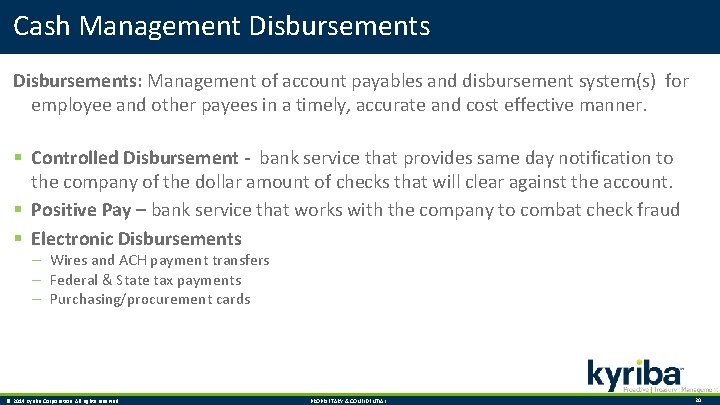
Cash Management Disbursements: Management of account payables and disbursement system(s) for employee and other payees in a timely, accurate and cost effective manner. § Controlled Disbursement - bank service that provides same day notification to the company of the dollar amount of checks that will clear against the account. § Positive Pay – bank service that works with the company to combat check fraud § Electronic Disbursements – Wires and ACH payment transfers – Federal & State tax payments – Purchasing/procurement cards © 2014 Kyriba Corporation. All rights reserved. PROPRIETARY & CONFIDENTIAL. 20
Cash Management Funds Concentration Funds concentration: transfer of funds from outlying depository locations to a single bank account. Performed either by the company or automatically initiated from the bank. § Company initiated: – Funding performed via Wires or ACH • • Balance tolerance - debit/credit funds outside the balance tolerance Balance to keep – transfer funds to concentration account leaving a pre-determined balance. § Bank initiated: – Zero balance account (ZBA) – Account maintains a zero dollar balance. • • Disbursement ZBA – Funds from the concentration account are transferred to cover the days disbursement Collection ZBA – Funds from collection account are transferred to concentration account. – Standing order © 2014 Kyriba Corporation. All rights reserved. PROPRIETARY & CONFIDENTIAL. 21
Account Structure © 2014 Kyriba Corporation. All rights reserved. PROPRIETARY & CONFIDENTIAL. 22
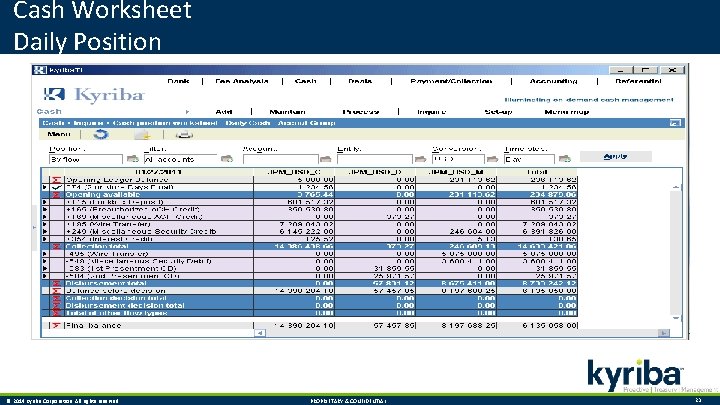
Cash Worksheet Daily Position © 2014 Kyriba Corporation. All rights reserved. PROPRIETARY & CONFIDENTIAL. 23
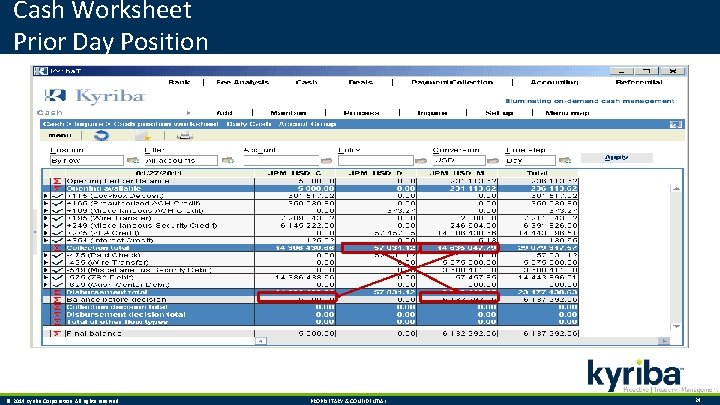
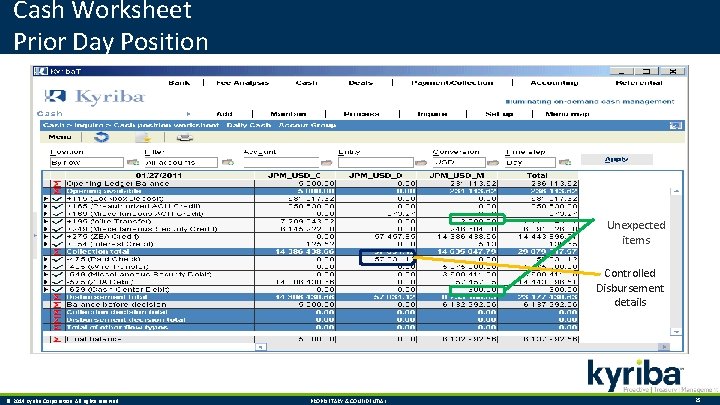
Cash Worksheet Prior Day Position © 2014 Kyriba Corporation. All rights reserved. PROPRIETARY & CONFIDENTIAL. 24
Cash Worksheet Prior Day Position Unexpected items Controlled Disbursement details © 2014 Kyriba Corporation. All rights reserved. PROPRIETARY & CONFIDENTIAL. 25
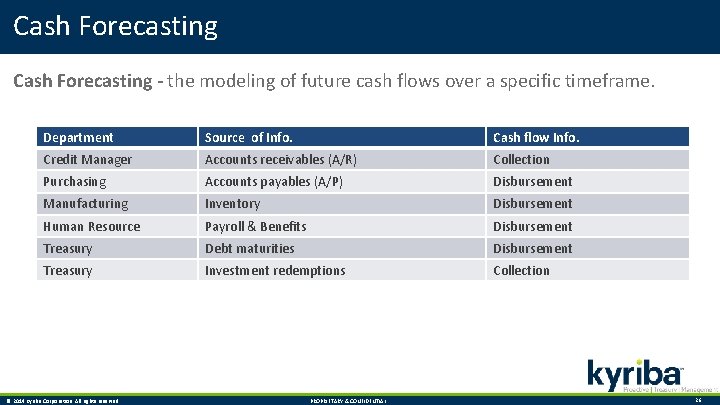
Cash Forecasting - the modeling of future cash flows over a specific timeframe. Department Source of Info. Cash flow Info. Credit Manager Accounts receivables (A/R) Collection Purchasing Accounts payables (A/P) Disbursement Manufacturing Inventory Disbursement Human Resource Payroll & Benefits Disbursement Treasury Debt maturities Disbursement Treasury Investment redemptions Collection © 2014 Kyriba Corporation. All rights reserved. PROPRIETARY & CONFIDENTIAL. 26
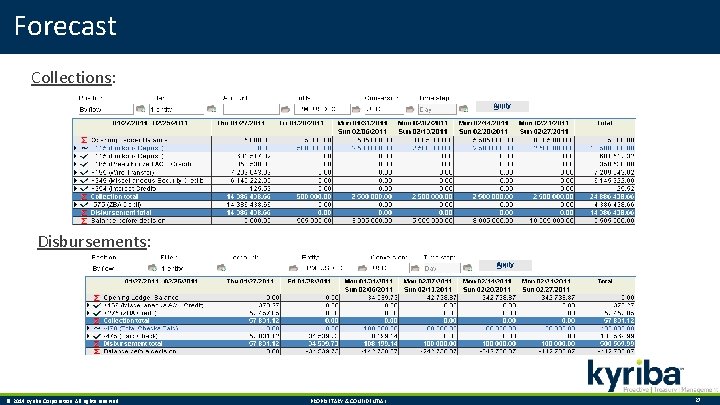
Forecast Collections: Disbursements: © 2014 Kyriba Corporation. All rights reserved. PROPRIETARY & CONFIDENTIAL. 27
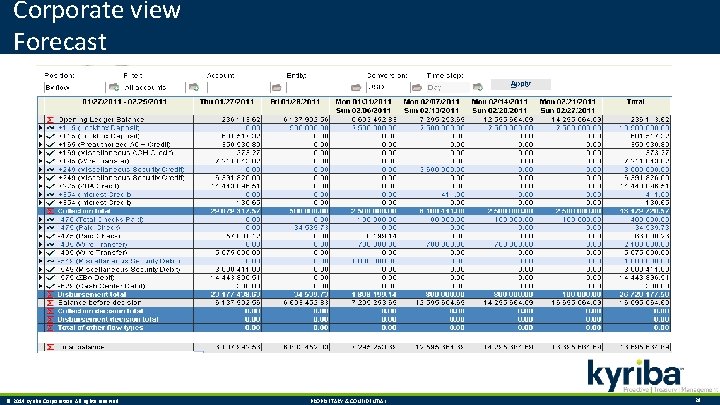
Corporate view Forecast © 2014 Kyriba Corporation. All rights reserved. PROPRIETARY & CONFIDENTIAL. 28
Overview of Payments
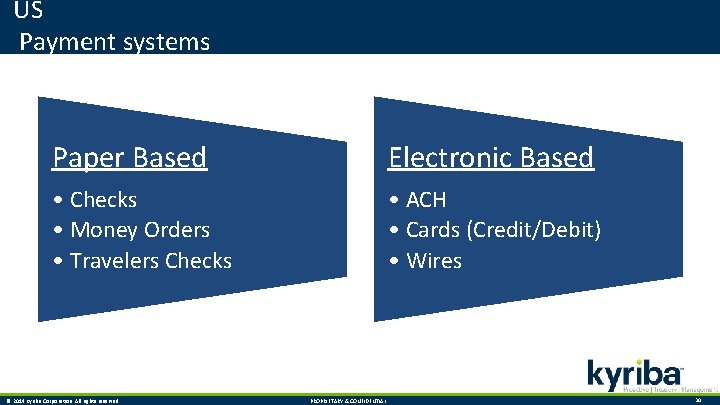
US Payment systems Paper Based Electronic Based • Checks • Money Orders • Travelers Checks • ACH • Cards (Credit/Debit) • Wires © 2014 Kyriba Corporation. All rights reserved. PROPRIETARY & CONFIDENTIAL. 30
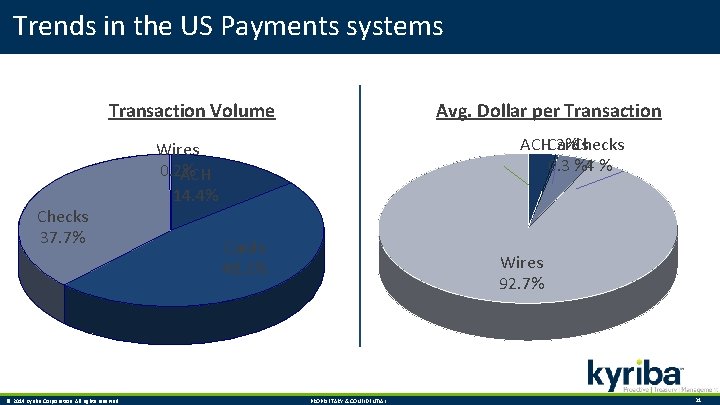
Trends in the US Payments systems Transaction Volume Checks 37. 7% © 2014 Kyriba Corporation. All rights reserved. Avg. Dollar per Transaction ACH 3% Cards Checks 0. 3 %4 % Wires 0. 2% ACH 14. 4% Cards 48. 2% Wires 92. 7% PROPRIETARY & CONFIDENTIAL. 31
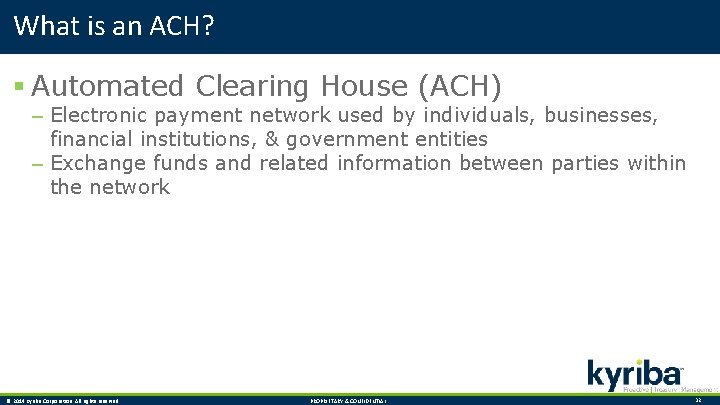
What is an ACH? § Automated Clearing House (ACH) – Electronic payment network used by individuals, businesses, financial institutions, & government entities – Exchange funds and related information between parties within the network © 2014 Kyriba Corporation. All rights reserved. PROPRIETARY & CONFIDENTIAL. 32
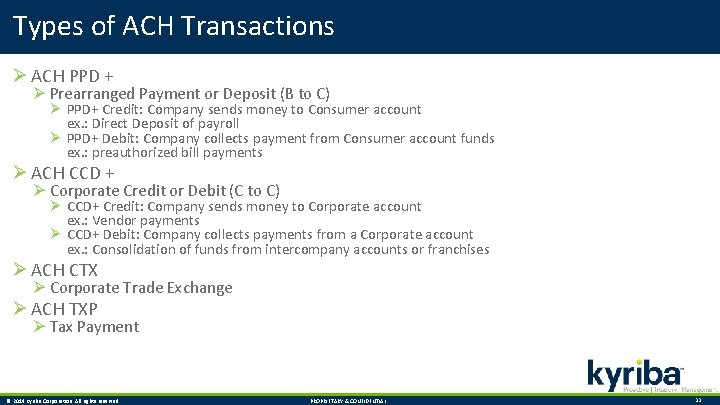
Types of ACH Transactions Ø ACH PPD + Ø Prearranged Payment or Deposit (B to C) Ø PPD+ Credit: Company sends money to Consumer account ex. : Direct Deposit of payroll Ø PPD+ Debit: Company collects payment from Consumer account funds ex. : preauthorized bill payments Ø ACH CCD + Ø Corporate Credit or Debit (C to C) Ø CCD+ Credit: Company sends money to Corporate account ex. : Vendor payments Ø CCD+ Debit: Company collects payments from a Corporate account ex. : Consolidation of funds from intercompany accounts or franchises Ø ACH CTX Ø Corporate Trade Exchange Ø ACH TXP Ø Tax Payment © 2014 Kyriba Corporation. All rights reserved. PROPRIETARY & CONFIDENTIAL. 33
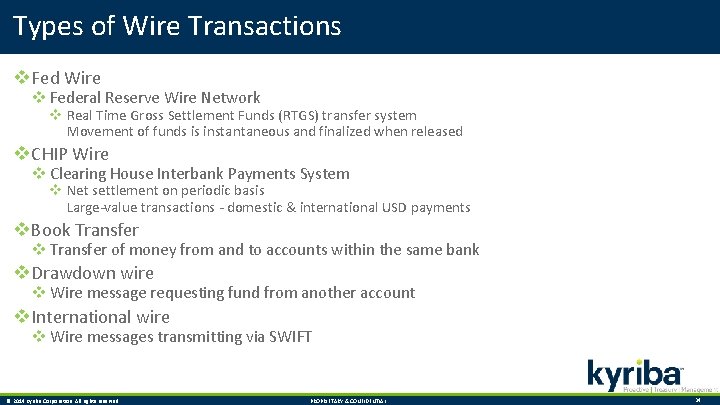
Types of Wire Transactions v Fed Wire v Federal Reserve Wire Network v Real Time Gross Settlement Funds (RTGS) transfer system Movement of funds is instantaneous and finalized when released v CHIP Wire v Clearing House Interbank Payments System v Net settlement on periodic basis Large-value transactions - domestic & international USD payments v Book Transfer v Transfer of money from and to accounts within the same bank v Drawdown wire v Wire message requesting fund from another account v International wire v Wire messages transmitting via SWIFT © 2014 Kyriba Corporation. All rights reserved. PROPRIETARY & CONFIDENTIAL. 34
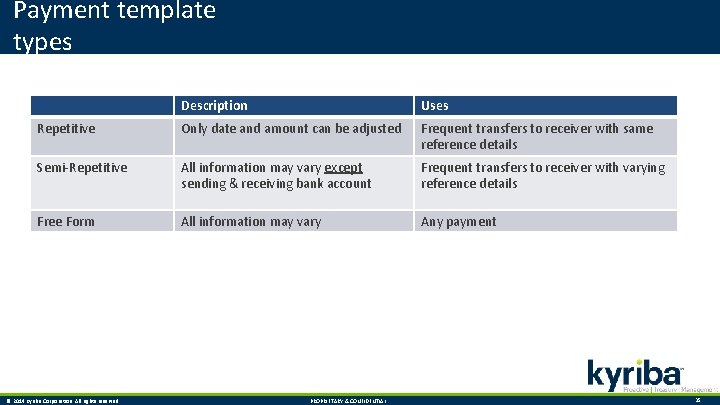
Payment template types Description Uses Repetitive Only date and amount can be adjusted Frequent transfers to receiver with same reference details Semi-Repetitive All information may vary except sending & receiving bank account Frequent transfers to receiver with varying reference details Free Form All information may vary Any payment © 2014 Kyriba Corporation. All rights reserved. PROPRIETARY & CONFIDENTIAL. 35
Overview of Financial Transactions
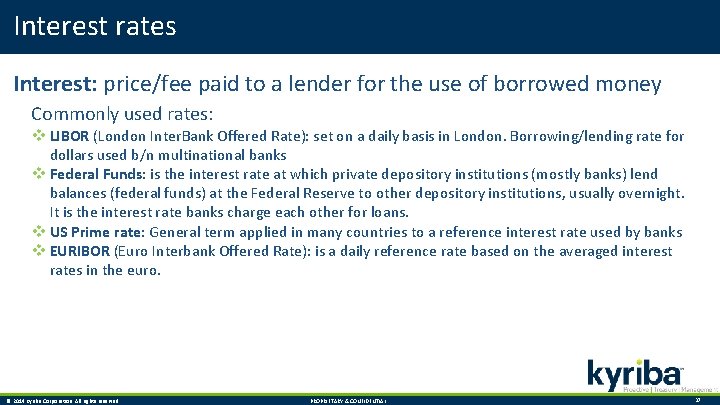
Interest rates Interest: price/fee paid to a lender for the use of borrowed money Commonly used rates: v LIBOR (London Inter. Bank Offered Rate): set on a daily basis in London. Borrowing/lending rate for dollars used b/n multinational banks v Federal Funds: is the interest rate at which private depository institutions (mostly banks) lend balances (federal funds) at the Federal Reserve to other depository institutions, usually overnight. It is the interest rate banks charge each other for loans. v US Prime rate: General term applied in many countries to a reference interest rate used by banks v EURIBOR (Euro Interbank Offered Rate): is a daily reference rate based on the averaged interest rates in the euro. © 2014 Kyriba Corporation. All rights reserved. PROPRIETARY & CONFIDENTIAL. 37
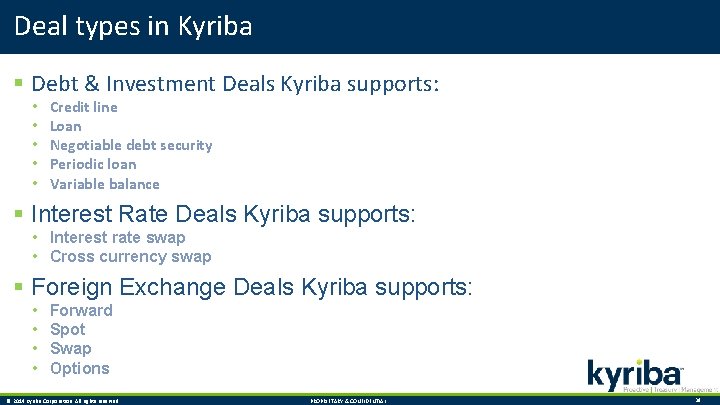
Deal types in Kyriba § Debt & Investment Deals Kyriba supports: • • • Credit line Loan Negotiable debt security Periodic loan Variable balance § Interest Rate Deals Kyriba supports: • Interest rate swap • Cross currency swap § Foreign Exchange Deals Kyriba supports: • • Forward Spot Swap Options © 2014 Kyriba Corporation. All rights reserved. PROPRIETARY & CONFIDENTIAL. 38
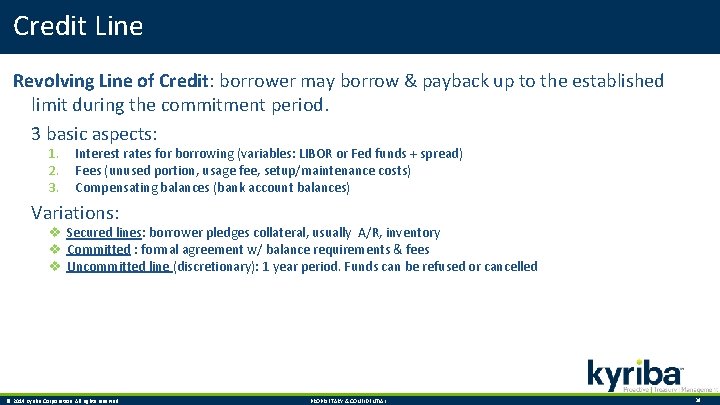
Credit Line Revolving Line of Credit: borrower may borrow & payback up to the established limit during the commitment period. 3 basic aspects: 1. 2. 3. Interest rates for borrowing (variables: LIBOR or Fed funds + spread) Fees (unused portion, usage fee, setup/maintenance costs) Compensating balances (bank account balances) Variations: v Secured lines: borrower pledges collateral, usually A/R, inventory v Committed : formal agreement w/ balance requirements & fees v Uncommitted line (discretionary): 1 year period. Funds can be refused or cancelled © 2014 Kyriba Corporation. All rights reserved. PROPRIETARY & CONFIDENTIAL. 39
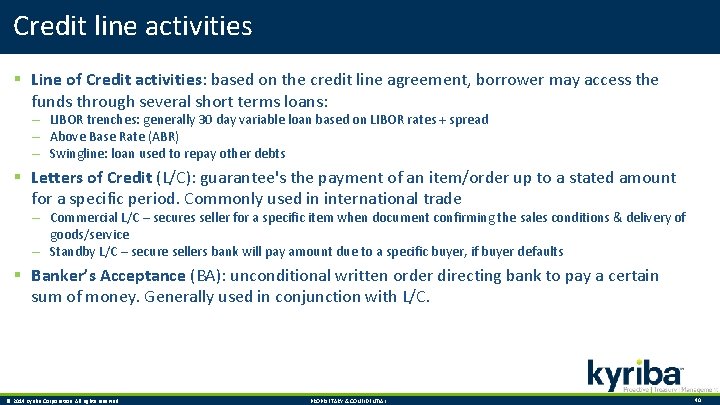
Credit line activities § Line of Credit activities: based on the credit line agreement, borrower may access the funds through several short terms loans: – LIBOR trenches: generally 30 day variable loan based on LIBOR rates + spread – Above Base Rate (ABR) – Swingline: loan used to repay other debts § Letters of Credit (L/C): guarantee's the payment of an item/order up to a stated amount for a specific period. Commonly used in international trade – Commercial L/C – secures seller for a specific item when document confirming the sales conditions & delivery of goods/service – Standby L/C – secure sellers bank will pay amount due to a specific buyer, if buyer defaults § Banker’s Acceptance (BA): unconditional written order directing bank to pay a certain sum of money. Generally used in conjunction with L/C. © 2014 Kyriba Corporation. All rights reserved. PROPRIETARY & CONFIDENTIAL. 40
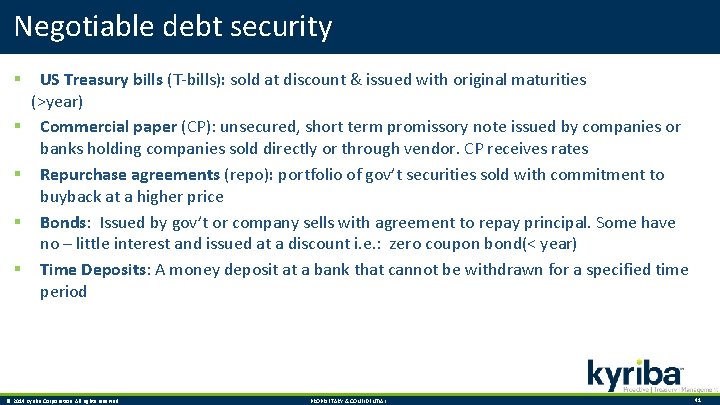
Negotiable debt security § US Treasury bills (T-bills): sold at discount & issued with original maturities (>year) § Commercial paper (CP): unsecured, short term promissory note issued by companies or banks holding companies sold directly or through vendor. CP receives rates § Repurchase agreements (repo): portfolio of gov’t securities sold with commitment to buyback at a higher price § Bonds: Issued by gov’t or company sells with agreement to repay principal. Some have no – little interest and issued at a discount i. e. : zero coupon bond(< year) § Time Deposits: A money deposit at a bank that cannot be withdrawn for a specified time period © 2014 Kyriba Corporation. All rights reserved. PROPRIETARY & CONFIDENTIAL. 41
Periodic § Amortizing note: A loan where the principal is paid down over the life of the loan, according to some amortization schedule, typically through equal payments § Mortgage: A promissory note to repay a specified sum of money plus interest at a specified rate and length of time © 2014 Kyriba Corporation. All rights reserved. PROPRIETARY & CONFIDENTIAL. 42
Variable Balance § Money market: is an open-ended mutual fund* that invests in short-term debt securities * professionally managed type of collective investment scheme that pools money from many investors and invests typically in investment securities © 2014 Kyriba Corporation. All rights reserved. PROPRIETARY & CONFIDENTIAL. 43
Interest Rate & Cross Currency Swap § Interest rate SWAP: one party exchanges a stream of interest payments for another party's stream of cash flows in same currency. Interest rate swaps can be used by hedgers to manage their fixed or floating assets and liabilities. Can be fixed vs. floating or float vs. floating § Cross Currency interest rate SWAP: Same as Interest rate swaps but with two different currencies. Can be fixed vs. floating or float vs. floating or fixed vs. fixed © 2014 Kyriba Corporation. All rights reserved. PROPRIETARY & CONFIDENTIAL. 44
Foreign Exchange § Foreign Exchange (Fx): worldwide financial market for the trading of currencies. § Fx Rates: v Exchange rate: refers to how much one currency is worth in terms of the other v Spot rate: refers to the current exchange rate v Forward rate: refers to an exchange rate that is quoted and traded today but for delivery and payment on a specific future date. v Points: difference between the spot & forward rates § Kyriba supported Fx Types: v Spot: is a 1 or 2 day cash delivery transaction between 2 currencies v Forward: two parties agree on an exchange rate for a future date, and the transaction occurs on that date, regardless of what the market rates are v Swap: two parties exchange currencies for a certain length of time and agree to reverse the transaction at a later date v Option: the owner has the right but not the obligation to exchange money denominated in one currency into another currency at a pre-agreed exchange rate on a specified date. © 2014 Kyriba Corporation. All rights reserved. PROPRIETARY & CONFIDENTIAL. 45
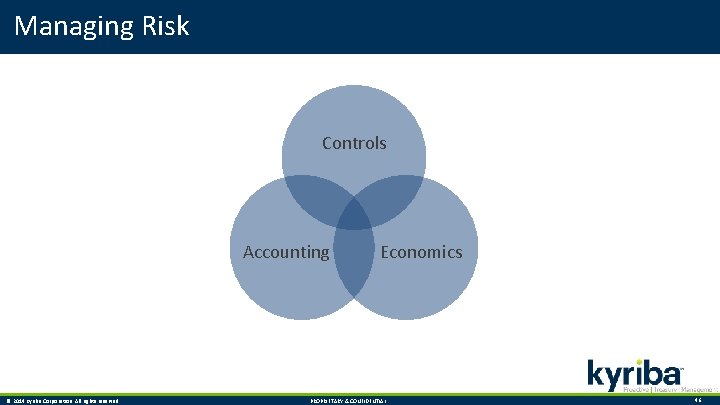
Managing Risk Controls Documentation Accounting Economics FAS 133 Effectiveness © 2014 Kyriba Corporation. All rights reserved. Policy Monitor Risk Impact Risk Preference Hedge Strategy PROPRIETARY & CONFIDENTIAL. 46
Overview of Accounting
What is an ERP? § Enterprise Resource Planning (ERP) – Integrates all data and processes of an organization into a unified system – Designed to bind together a variety of company functions including human resources, inventories and financials while simultaneously linking the company to customers and vendors. SAP, Oracle (JD Edwards/People. Soft), Sage, Microsoft Dynamics, Lawson, Net. Suite © 2014 Kyriba Corporation. All rights reserved. PROPRIETARY & CONFIDENTIAL. 48
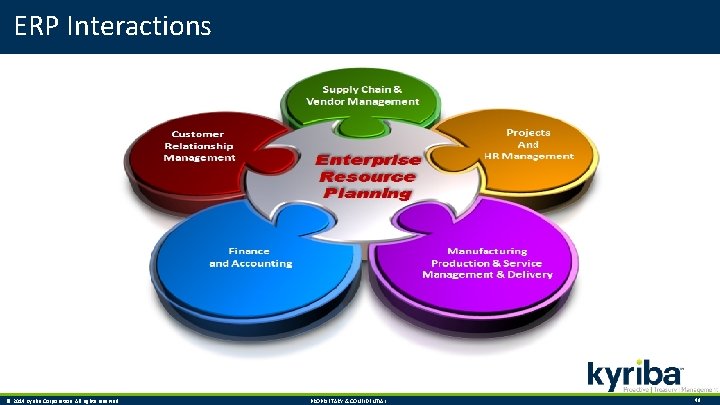
ERP Interactions © 2014 Kyriba Corporation. All rights reserved. PROPRIETARY & CONFIDENTIAL. 49
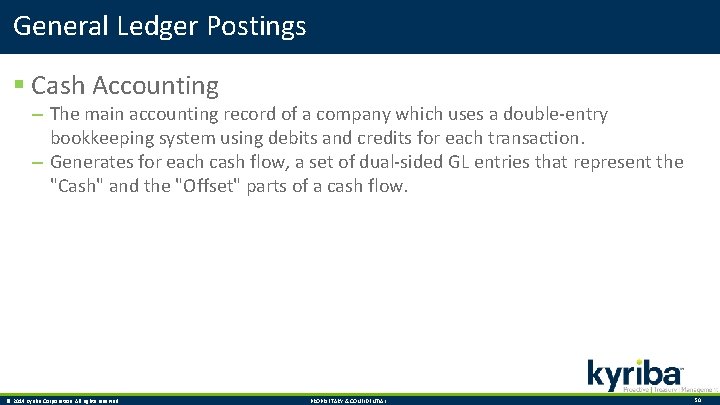
General Ledger Postings § Cash Accounting – The main accounting record of a company which uses a double-entry bookkeeping system using debits and credits for each transaction. – Generates for each cash flow, a set of dual-sided GL entries that represent the "Cash" and the "Offset" parts of a cash flow. © 2014 Kyriba Corporation. All rights reserved. PROPRIETARY & CONFIDENTIAL. 50
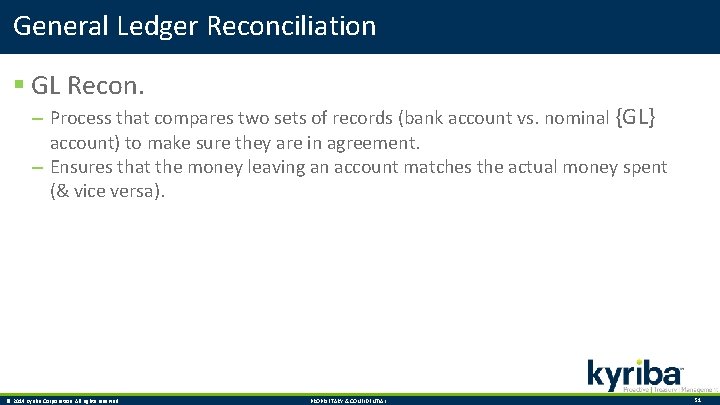
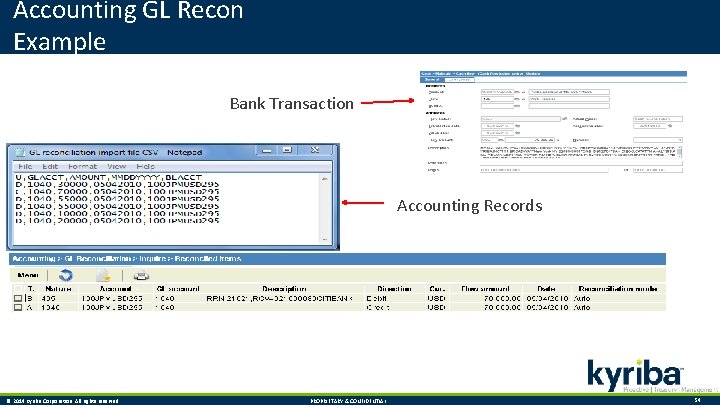
General Ledger Reconciliation § GL Recon. – Process that compares two sets of records (bank account vs. nominal {GL} account) to make sure they are in agreement. – Ensures that the money leaving an account matches the actual money spent (& vice versa). © 2014 Kyriba Corporation. All rights reserved. PROPRIETARY & CONFIDENTIAL. 51
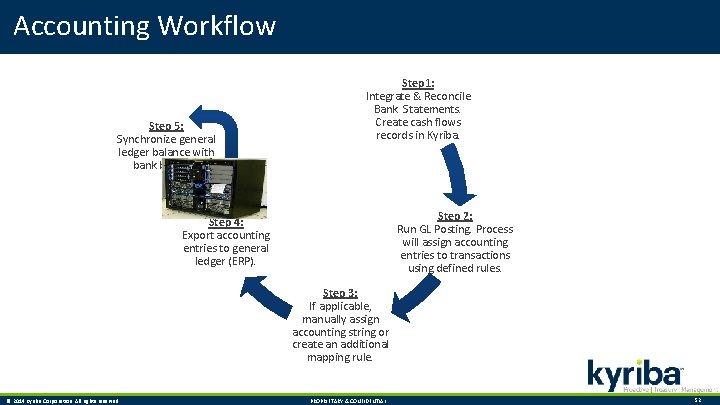
Accounting Workflow Step 5: Synchronize general ledger balance with bank balance. Step 1: Integrate & Reconcile Bank Statements. Create cash flows records in Kyriba. Step 2: Run GL Posting. Process will assign accounting entries to transactions using defined rules. Step 4: Export accounting entries to general ledger (ERP). Step 3: If applicable, manually assign accounting string or create an additional mapping rule. © 2014 Kyriba Corporation. All rights reserved. PROPRIETARY & CONFIDENTIAL. 52
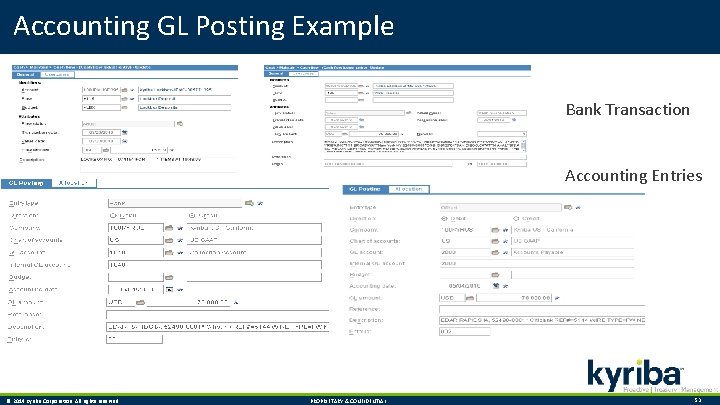
Accounting GL Posting Example Bank Transaction Accounting Entries © 2014 Kyriba Corporation. All rights reserved. PROPRIETARY & CONFIDENTIAL. 53
Accounting GL Recon Example Bank Transaction Accounting Records © 2014 Kyriba Corporation. All rights reserved. PROPRIETARY & CONFIDENTIAL. 54
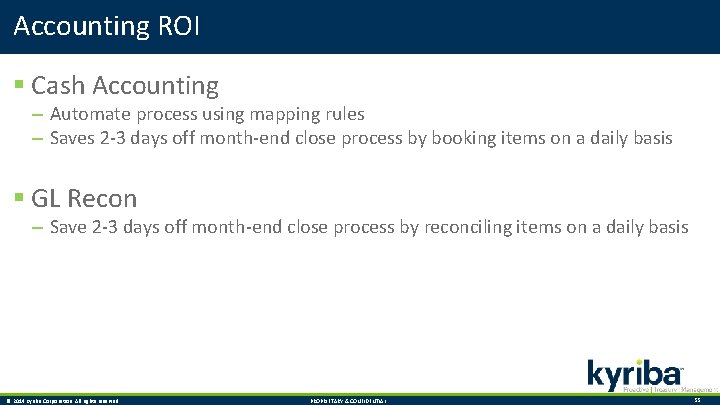
Accounting ROI § Cash Accounting – Automate process using mapping rules – Saves 2 -3 days off month-end close process by booking items on a daily basis § GL Recon – Save 2 -3 days off month-end close process by reconciling items on a daily basis © 2014 Kyriba Corporation. All rights reserved. PROPRIETARY & CONFIDENTIAL. 55
Overview of Bank Administration
Corporate banking relationship § Corporate banking relationship: - Open and frequent two-way communications - Documentation of expectations of both parties - Fair compensation of a bank by a company, as well as fair pricing of services by a bank - Complete & candid disclosure of information by both parties © 2014 Kyriba Corporation. All rights reserved. PROPRIETARY & CONFIDENTIAL. 57
Bank Signatory Overview § What is bank signatories? • A signature of an individual(s) who has authority to perform specific functions at a bank related to the account. This card is kept on file, and it is used by the bank to confirm the identify of the person and their authorization level. © 2014 Kyriba Corporation. All rights reserved. PROPRIETARY & CONFIDENTIAL. 58
Electronic Bank Signatory Management Currently many companies have signatory information stored in filing cabinets Kyriba functionality: -Ability to look up signers/authorities by bank account or individual -Ability to do a find & replace when there is staff turnover -Easy access to data for audit purposes © 2014 Kyriba Corporation. All rights reserved. PROPRIETARY & CONFIDENTIAL. 59
Bank Fee Analysis Overview § What is a Bank Fee Analysis? • Statement detailing banking services, volume, balances, earnings credit, etc for the period. © 2014 Kyriba Corporation. All rights reserved. PROPRIETARY & CONFIDENTIAL. 60
Bank Fee Management Currently many companies do not have time or resources to review their monthly fee statement Kyriba functionality: -Displays and compares fee reports in a consistent format across every company or bank. -Verify that fees match contract rates and reported service use is accurate. © 2014 Kyriba Corporation. All rights reserved. PROPRIETARY & CONFIDENTIAL. 61
Bank Fee Analysis Format § Bank reporting formats Kyriba supports: • EDI (Electronic Data Interchange) 822: Uses AFP & bank service codes to identify each bank service with its associated charge. Standardizes the reporting of this information. • *TWIST: Swift Message for International Bank services with its associated charge. *Not completely standard and only a few banks have been tested to date. © 2014 Kyriba Corporation. All rights reserved. PROPRIETARY & CONFIDENTIAL. 62