
Structure of the Eye Iris The iris is




- Slides: 20
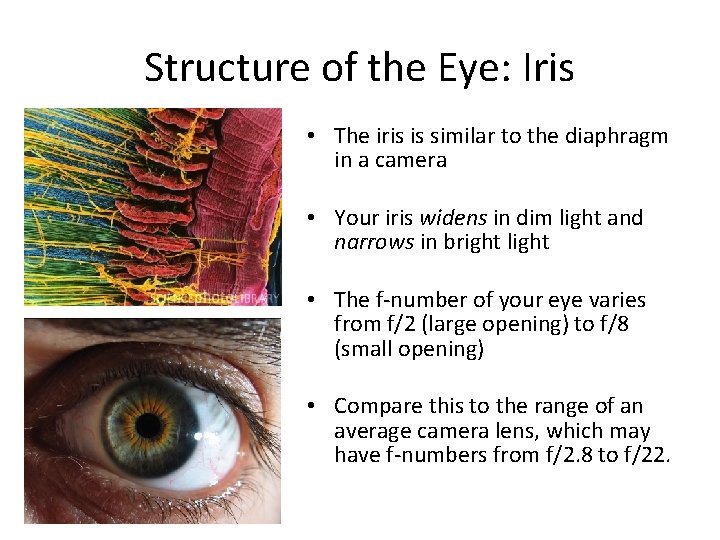
Structure of the Eye: Iris • The iris is similar to the diaphragm in a camera • Your iris widens in dim light and narrows in bright light • The f-number of your eye varies from f/2 (large opening) to f/8 (small opening) • Compare this to the range of an average camera lens, which may have f-numbers from f/2. 8 to f/22.
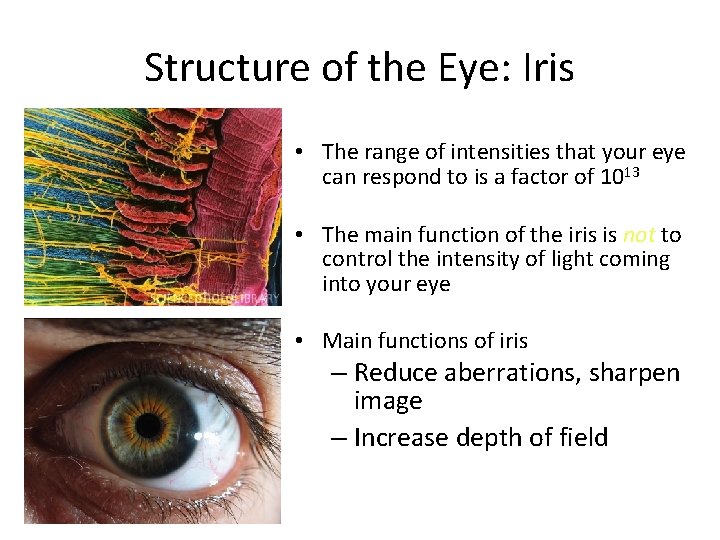
Structure of the Eye: Iris • The range of intensities that your eye can respond to is a factor of 1013 • The main function of the iris is not to control the intensity of light coming into your eye • Main functions of iris – Reduce aberrations, sharpen image – Increase depth of field
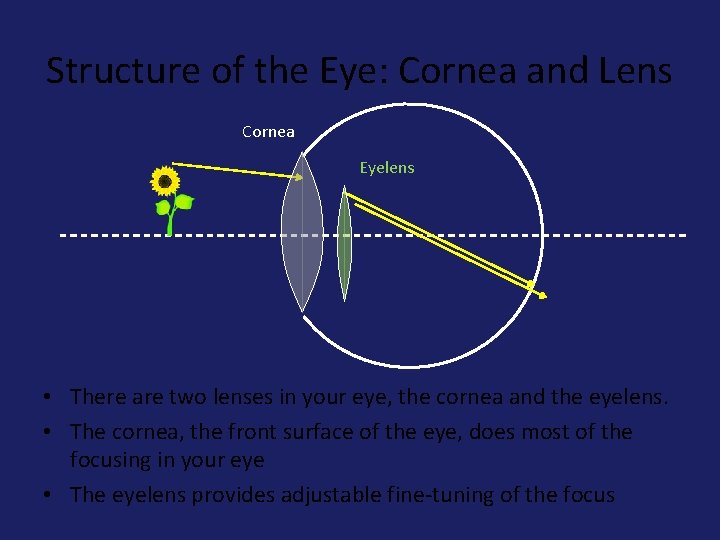
Structure of the Eye: Cornea and Lens Cornea Eyelens • There are two lenses in your eye, the cornea and the eyelens. • The cornea, the front surface of the eye, does most of the focusing in your eye • The eyelens provides adjustable fine-tuning of the focus
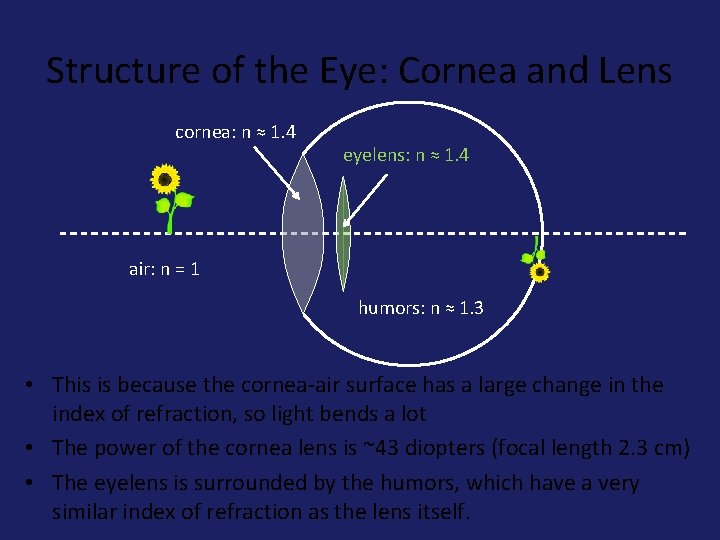
Structure of the Eye: Cornea and Lens cornea: n ≈ 1. 4 eyelens: n ≈ 1. 4 air: n = 1 humors: n ≈ 1. 3 • This is because the cornea-air surface has a large change in the index of refraction, so light bends a lot • The power of the cornea lens is ~43 diopters (focal length 2. 3 cm) • The eyelens is surrounded by the humors, which have a very similar index of refraction as the lens itself.
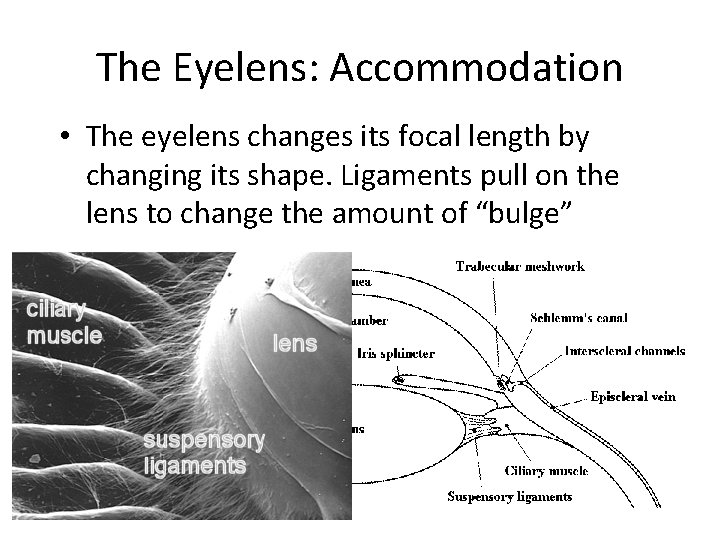
The Eyelens: Accommodation • The eyelens changes its focal length by changing its shape. Ligaments pull on the lens to change the amount of “bulge”
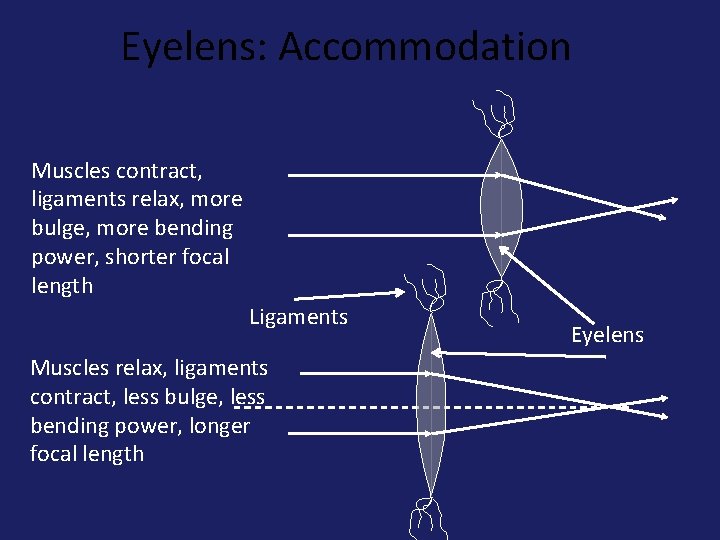
Eyelens: Accommodation Muscles contract, ligaments relax, more bulge, more bending power, shorter focal length Ligaments Muscles relax, ligaments contract, less bulge, less bending power, longer focal length Eyelens
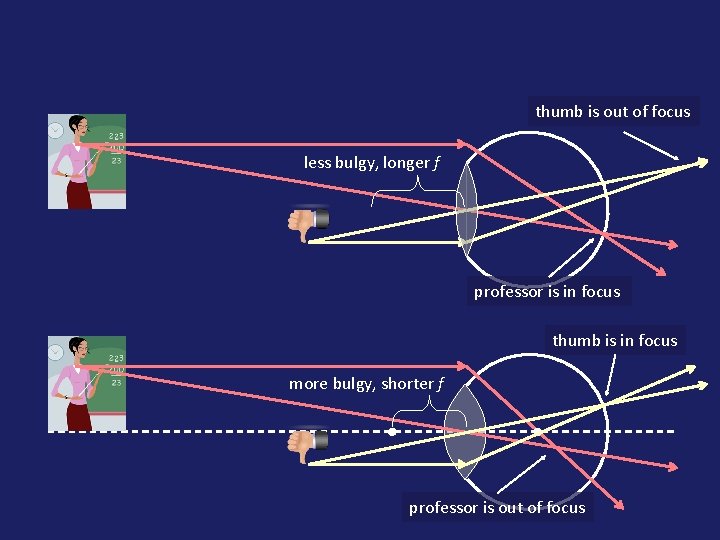
How Your Eyelens Focuses • Your eyelens has a small depth of field – You can't see something close and far with both objects in focus at the same time • Hold out your thumb about a foot away from your eye – Then, alternately focus on thumb and me (right above your thumb) • Note that you cannot see both me and your thumb sharply (in focus) at the same time – You focus on one or the other by changing the bulge of your eyelens
thumb is out of focus less bulgy, longer f professor is in focus thumb is in focus more bulgy, shorter f professor is out of focus
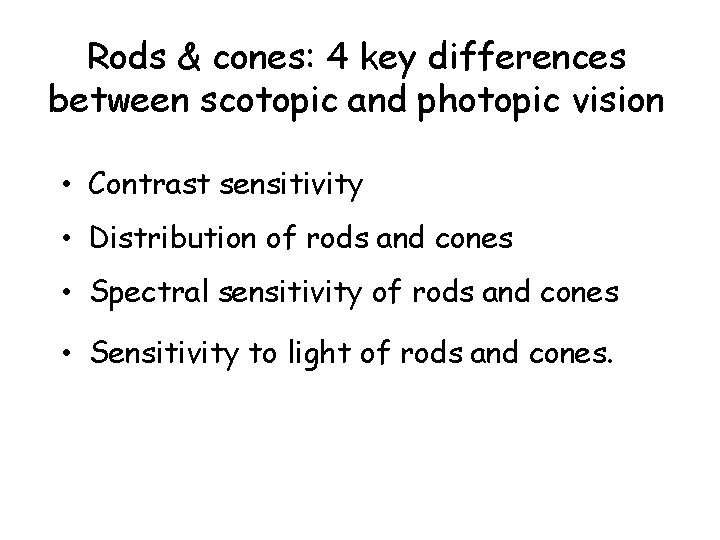
Rods & cones: 4 key differences between scotopic and photopic vision • Contrast sensitivity • Distribution of rods and cones • Spectral sensitivity of rods and cones • Sensitivity to light of rods and cones.
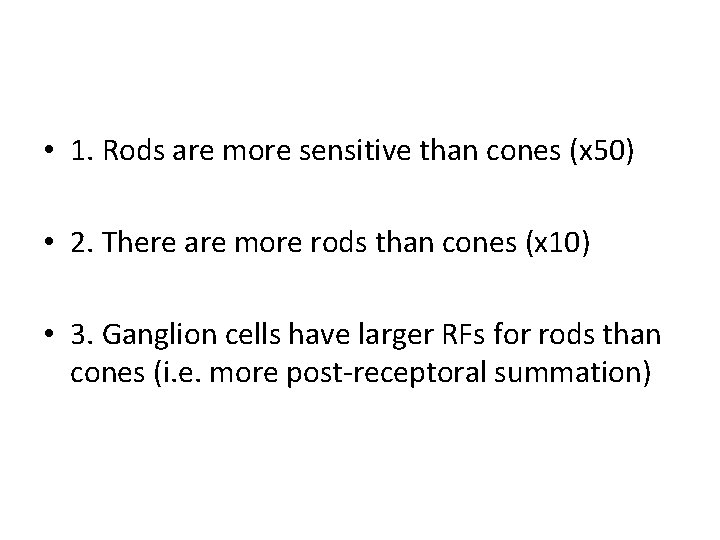
• 1. Rods are more sensitive than cones (x 50) • 2. There are more rods than cones (x 10) • 3. Ganglion cells have larger RFs for rods than cones (i. e. more post-receptoral summation)
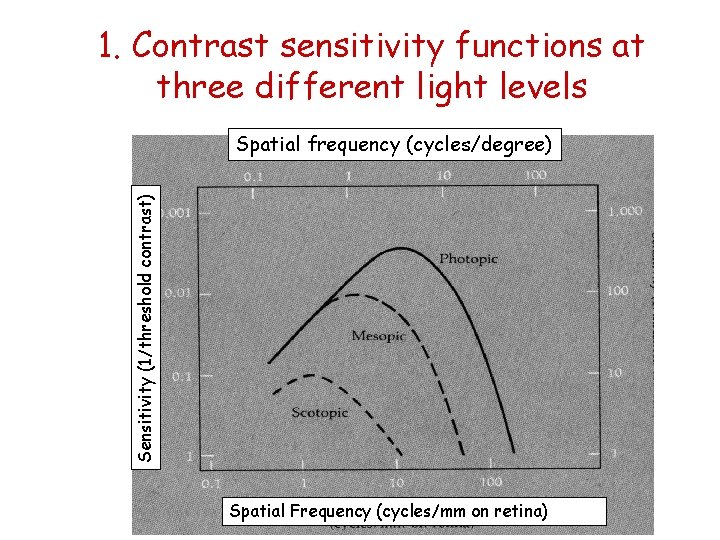
1. Contrast sensitivity functions at three different light levels Sensitivity (1/threshold contrast) Spatial frequency (cycles/degree) Spatial Frequency (cycles/mm on retina)
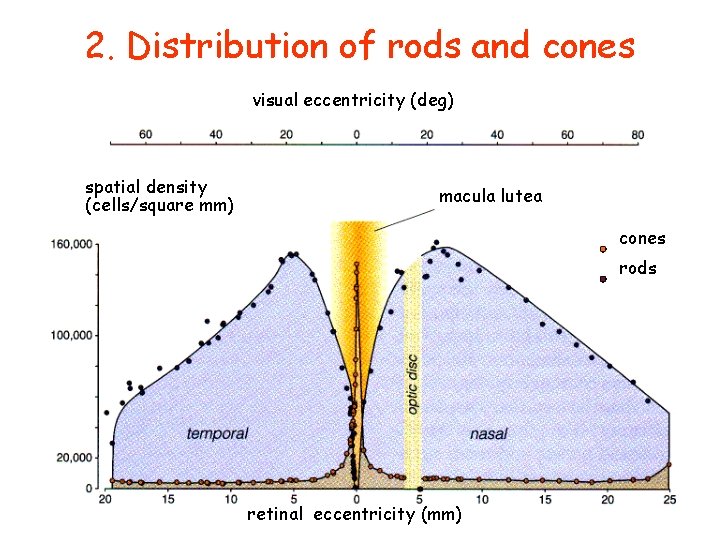
2. Distribution of rods and cones visual eccentricity (deg) spatial density (cells/square mm) macula lutea cones rods retinal eccentricity (mm)
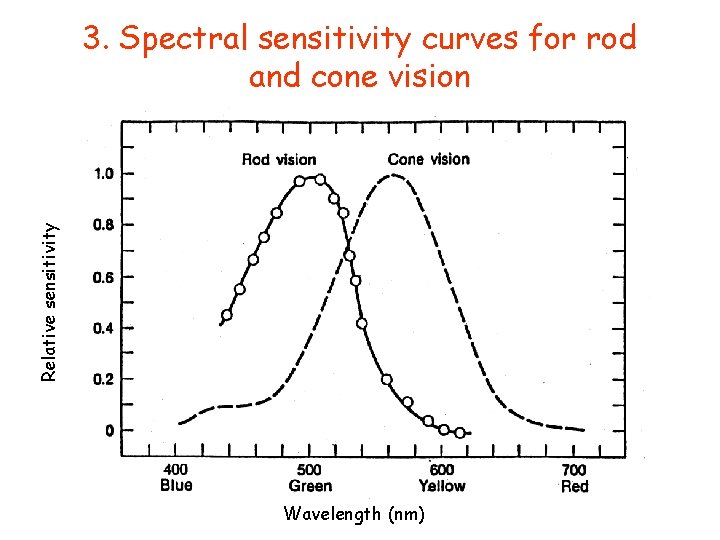
Relative sensitivity 3. Spectral sensitivity curves for rod and cone vision Wavelength (nm)
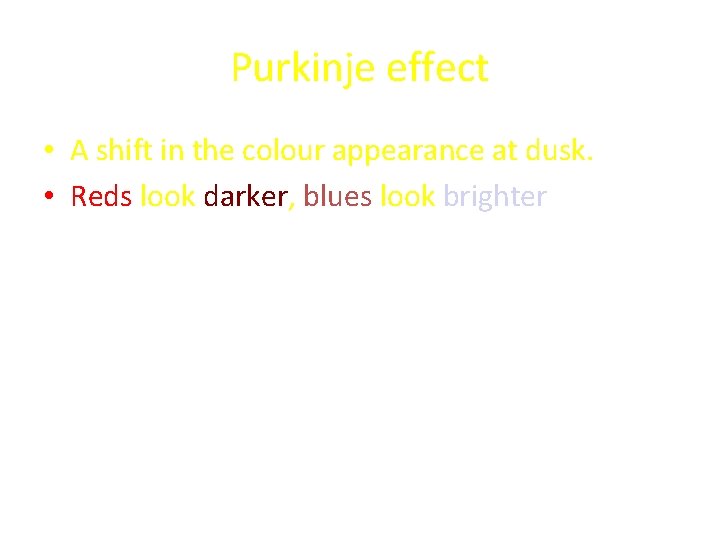
Purkinje effect • A shift in the colour appearance at dusk. • Reds look darker, blues look brighter
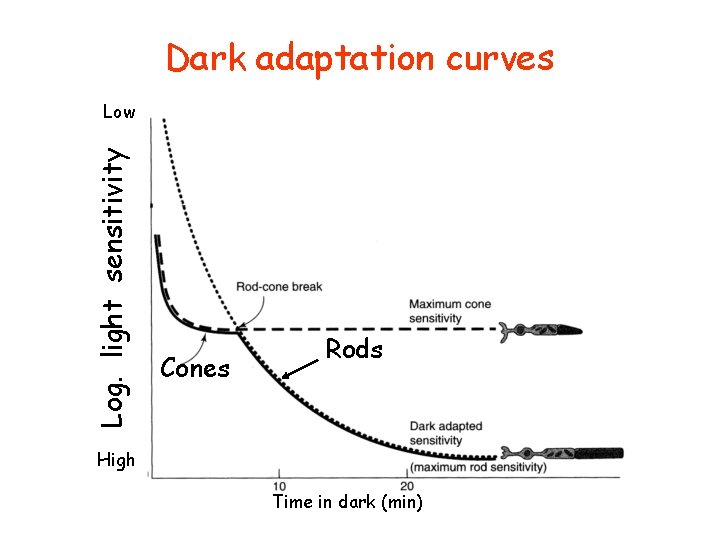
Dark adaptation curves Log. light sensitivity Low Cones Rods High Time in dark (min)
Light and Dark Adaptation • Light adaptation: Dark → light. Faster. • Dark adaptation: Light →dark. Slow.