
Structure of the Communist Party State MarxismLeninism official



- Slides: 17
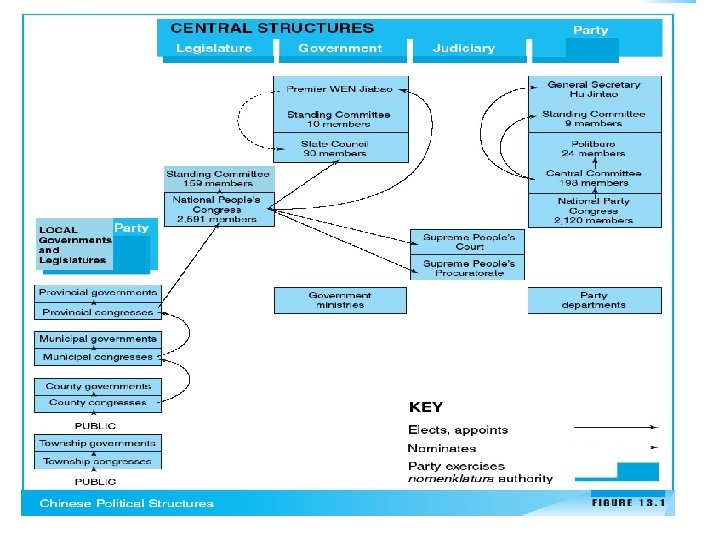
Structure of the Communist Party State § Marxism-Leninism official ideology § Mao and the peasants § Guardianship § Describes the main relationship between the Communist Party and society § Representation of “society’s best interests” § Parallelism between party and government structures § Local governments operate ‘under the unified leadership of the central authorities’
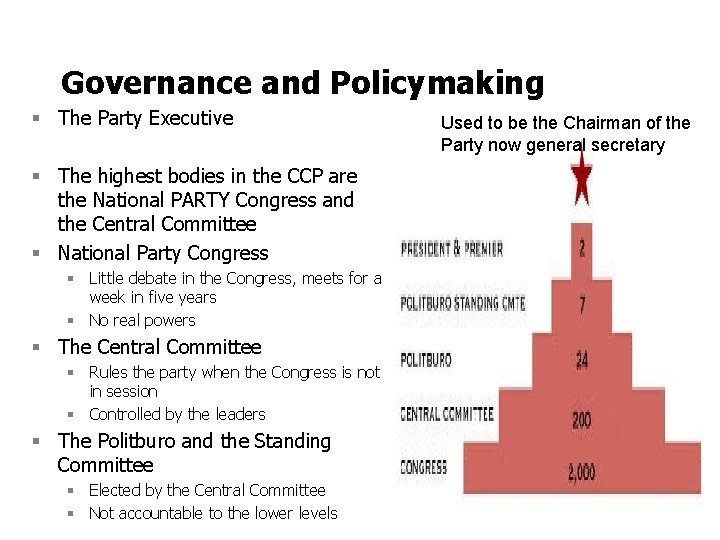
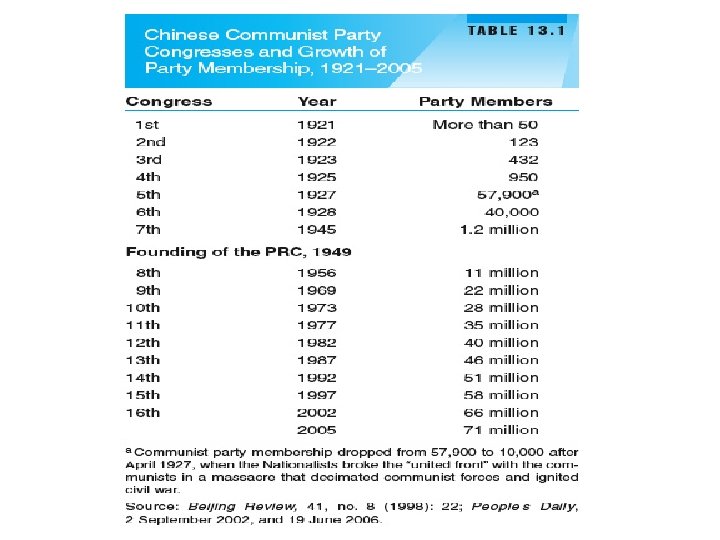
Governance and Policymaking § The Party Executive § The highest bodies in the CCP are the National PARTY Congress and the Central Committee § National Party Congress § Little debate in the Congress, meets for a week in five years § No real powers § The Central Committee § Rules the party when the Congress is not in session § Controlled by the leaders § The Politburo and the Standing Committee § Elected by the Central Committee § Not accountable to the lower levels Used to be the Chairman of the Party now general secretary
Governance and Policymaking § The State Executive § Power formally vested in a system of people’s congresses § The highest one is the National PEOPLE’S Congress § Provincial PCs, City PCs, Township PCs § The executives are more accountable to the party than they are to the congresses
Governance and Policymaking § National People’s Congress (NPC) – legislative § Elected for five-year terms by delegates in provincial-level congresses § Assemble once annually for a plenary session of about two weeks § Formally has extensive powers: § amendment of the constitution, § passage and amendment of legislation, § Electing the President and vice-President of China. § But IN REALITY: § There is one candidate for each office chosen by the Party.
Governance and Policymaking § The President § China’s head of state, meets world leaders § Can serve two five –year terms § The Premier (Prime Minister) § Supervises policy implementation § Appointed formally by the President § But IN REALITY: The Party decides § Can serve two five-year terms § The State Council (Like a cabinet of ministers) § Highest organ of the executive § National People’s Congress elects § But IN REALITY: the Party leadership chooses § Two term limit (Does it matter? )
The Judiciary § The Supreme People’s Court highest court § Supervises lower courts but no powers over the government policies § Criminal justice system with 99% conviction rate. § Death penalty used for murder, rape, embezzlement, corruption, recently mass polluting § The Constitution guarantees judicial independence but IN REALITY the Party controls them § Legal reform: detailed law, legal predictability, property rights protection
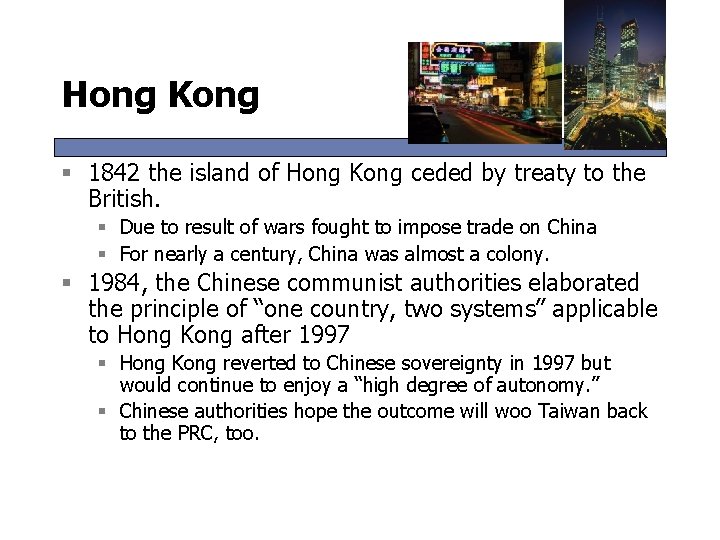
Hong Kong § 1842 the island of Hong Kong ceded by treaty to the British. § Due to result of wars fought to impose trade on China § For nearly a century, China was almost a colony. § 1984, the Chinese communist authorities elaborated the principle of “one country, two systems” applicable to Hong Kong after 1997 § Hong Kong reverted to Chinese sovereignty in 1997 but would continue to enjoy a “high degree of autonomy. ” § Chinese authorities hope the outcome will woo Taiwan back to the PRC, too.
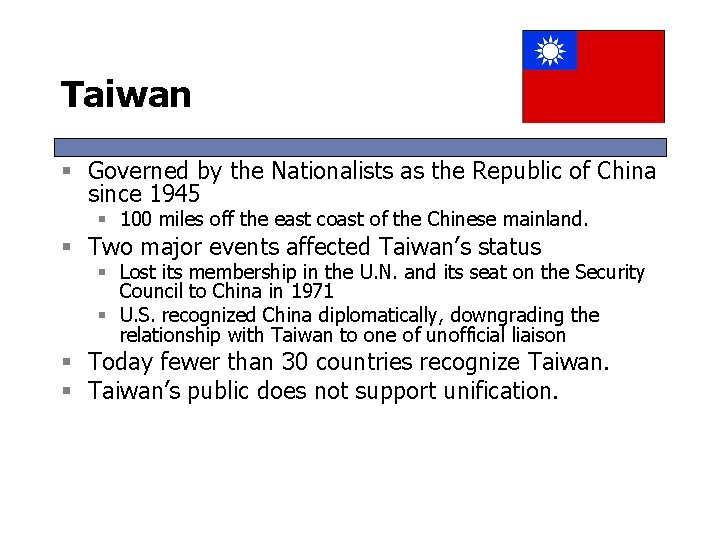
Taiwan § Governed by the Nationalists as the Republic of China since 1945 § 100 miles off the east coast of the Chinese mainland. § Two major events affected Taiwan’s status § Lost its membership in the U. N. and its seat on the Security Council to China in 1971 § U. S. recognized China diplomatically, downgrading the relationship with Taiwan to one of unofficial liaison § Today fewer than 30 countries recognize Taiwan. § Taiwan’s public does not support unification.
Policymaking § Party Dominance § Politburo and the Party wields nearly unchecked political power. § Nomenklatura system § The most important mechanism by which the Communist Party exerts control over officials. § Personal ties are key to getting any work done. § § Corruption http: //news. sky. com/story/1144940/bo-xilai-found-guilty-of-corruptionin-china
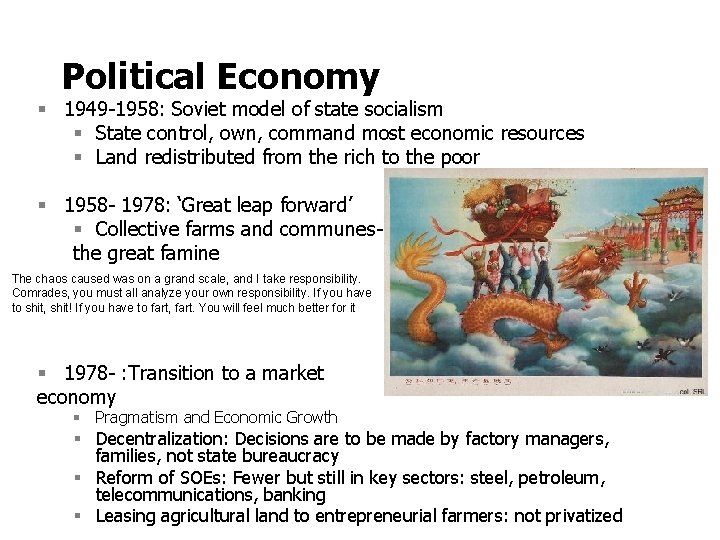
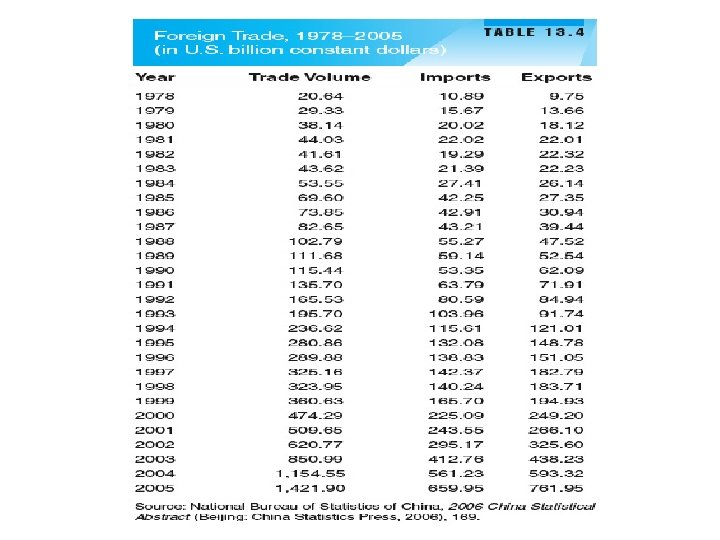
Political Economy § 1949 -1958: Soviet model of state socialism § State control, own, command most economic resources § Land redistributed from the rich to the poor § 1958 - 1978: ‘Great leap forward’ § Collective farms and communesthe great famine The chaos caused was on a grand scale, and I take responsibility. Comrades, you must all analyze your own responsibility. If you have to shit, shit! If you have to fart, fart. You will feel much better for it § 1978 - : Transition to a market economy § Pragmatism and Economic Growth § Decentralization: Decisions are to be made by factory managers, families, not state bureaucracy § Reform of SOEs: Fewer but still in key sectors: steel, petroleum, telecommunications, banking § Leasing agricultural land to entrepreneurial farmers: not privatized
§ http: //www. youtube. com/watch? v=4 Q 2 aznfmc. YU
Political Economy § Maoist ‘iron rice bowl’ is seen to be too costly for the state now § Less comprehensive social benefits § Fewer people with health insurance § Immigration to cities- low-wage, unskilled workers § A socialist market economy? § Sustainable development is the emphasis of the party now. § Environmental degradation should be stopped