
Structure of midlatitude cyclones crossing the California Sierra

- Slides: 16
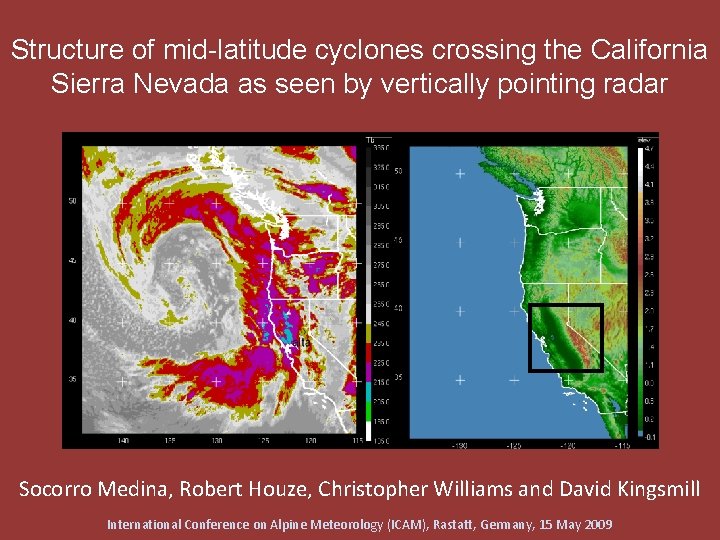
Structure of mid-latitude cyclones crossing the California Sierra Nevada as seen by vertically pointing radar Socorro Medina, Robert Houze, Christopher Williams and David Kingsmill International Conference on Alpine Meteorology (ICAM), Rastatt, Germany, 15 May 2009
Sponsored in part by: NSF Award# ATM-0505739 NSF Award# ATM-0820586 NASA Award# NNX 07 AD 59 G
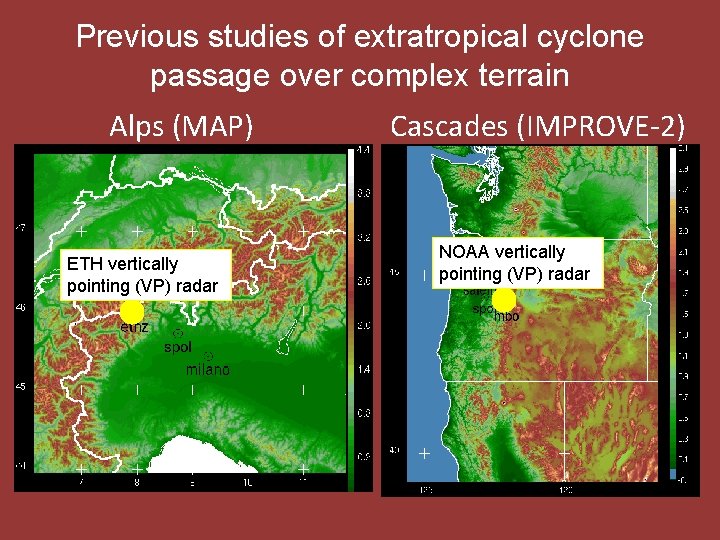
Previous studies of extratropical cyclone passage over complex terrain Alps (MAP) ETH vertically pointing (VP) radar Cascades (IMPROVE-2) NOAA vertically pointing (VP) radar
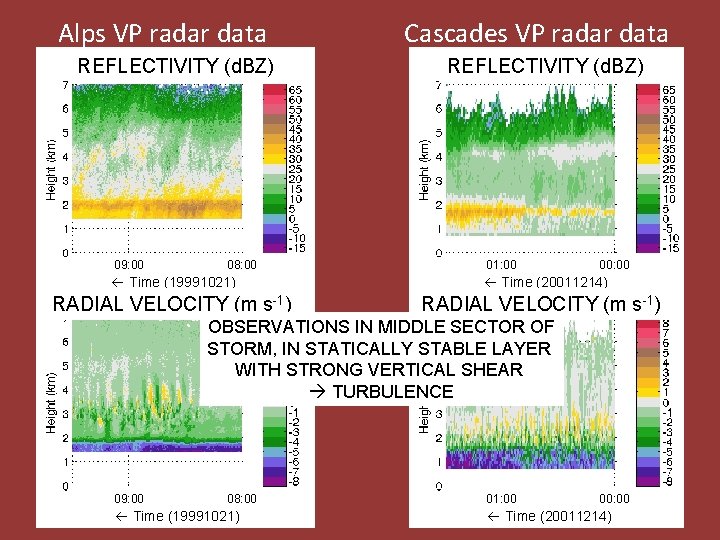
Alps VP radar data REFLECTIVITY (d. BZ) 09: 00 08: 00 Time (19991021) RADIAL VELOCITY (m s-1) Cascades VP radar data REFLECTIVITY (d. BZ) 01: 00 00: 00 Time (20011214) RADIAL VELOCITY (m s-1) OBSERVATIONS IN MIDDLE SECTOR OF STORM, IN STATICALLY STABLE LAYER WITH STRONG VERTICAL SHEAR TURBULENCE 09: 00 08: 00 Time (19991021) 01: 00 00: 00 Time (20011214)
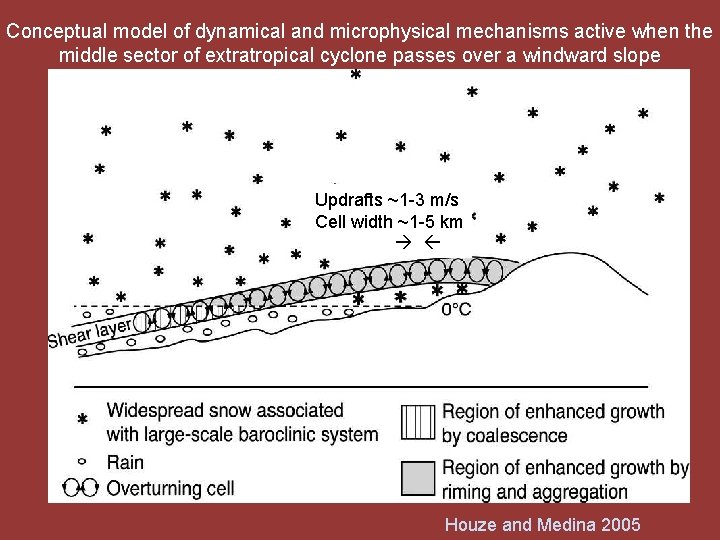
Conceptual model of dynamical and microphysical mechanisms active when the middle sector of extratropical cyclone passes over a windward slope Updrafts ~1 -3 m/s Cell width ~1 -5 km Houze and Medina 2005
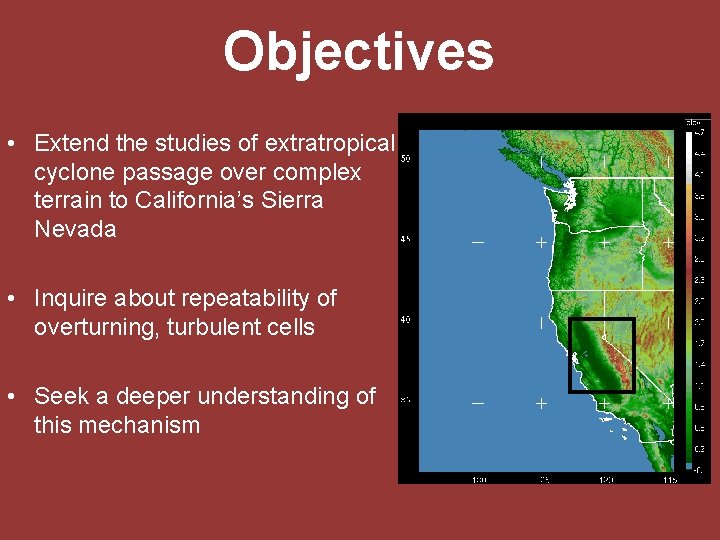
Objectives • Extend the studies of extratropical cyclone passage over complex terrain to California’s Sierra Nevada • Inquire about repeatability of overturning, turbulent cells • Seek a deeper understanding of this mechanism
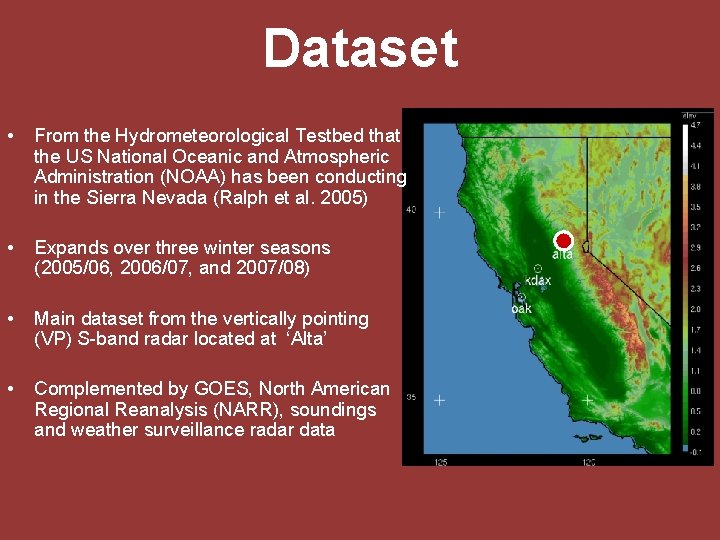
Dataset • From the Hydrometeorological Testbed that the US National Oceanic and Atmospheric Administration (NOAA) has been conducting in the Sierra Nevada (Ralph et al. 2005) • Expands over three winter seasons (2005/06, 2006/07, and 2007/08) • Main dataset from the vertically pointing (VP) S-band radar located at ‘Alta’ • Complemented by GOES, North American Regional Reanalysis (NARR), soundings and weather surveillance radar data
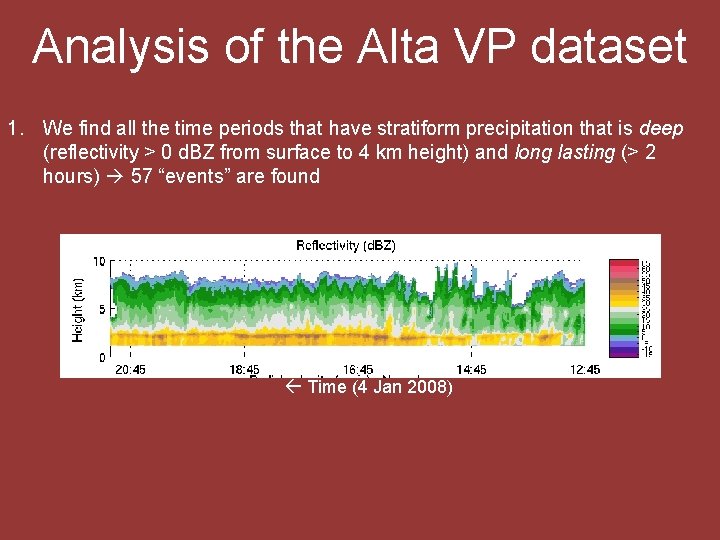
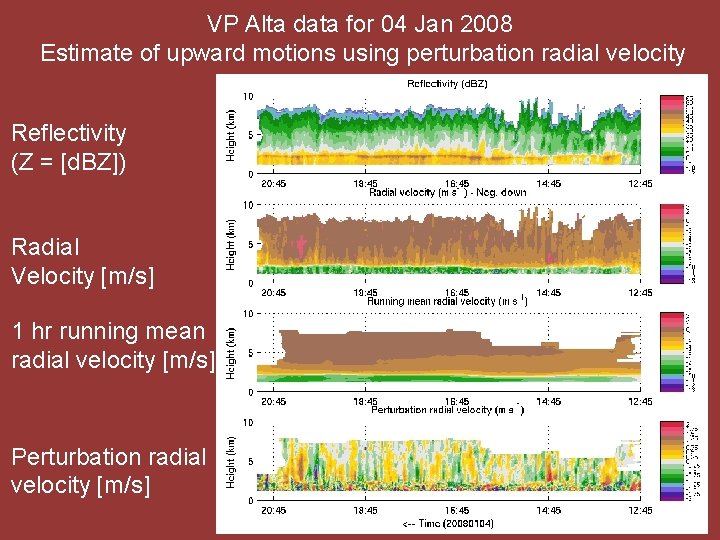
Analysis of the Alta VP dataset 1. We find all the time periods that have stratiform precipitation that is deep (reflectivity > 0 d. BZ from surface to 4 km height) and long lasting (> 2 hours) 57 “events” are found Time (4 Jan 2008)
Analysis of the Alta VP dataset 1. We find all the time periods that have stratiform precipitation that is deep (reflectivity > 0 d. BZ from surface to 4 km height) and long lasting (> 2 hours) 57 “events” are found 2. We investigate the upward motions for these events
VP Alta data for 04 Jan 2008 Estimate of upward motions using perturbation radial velocity Reflectivity (Z = [d. BZ]) Radial Velocity [m/s] 1 hr running mean radial velocity [m/s] Perturbation radial velocity [m/s]
Analysis of the Alta VP dataset 1. We find all the time periods that have stratiform precipitation that is deep (reflectivity > 0 d. BZ from surface to 4 km height) and long lasting (> 2 hours) 57 “events” are found 2. We investigate the upward motions for these events 3. These calculations indicate that ~10 (out of a total of 57 events) have clearly defined, intermittent up and downdrafts, similar to what was seen in the Oregon Cascades and the Alps
Analysis of the Alta VP dataset 1. We find all the time periods that have stratiform precipitation that is deep (reflectivity > 0 d. BZ from surface to 4 km height) and long lasting (> 2 hours) 57 “events” are found 2. We investigate the upward motions for these events 3. These calculations indicate that ~10 (out of a total of 57 events) have clearly defined, intermittent up and downdrafts, similar to what was seen in the Oregon Cascades and the Alps 4. Example of 4 Jan 2008 (case shown before)
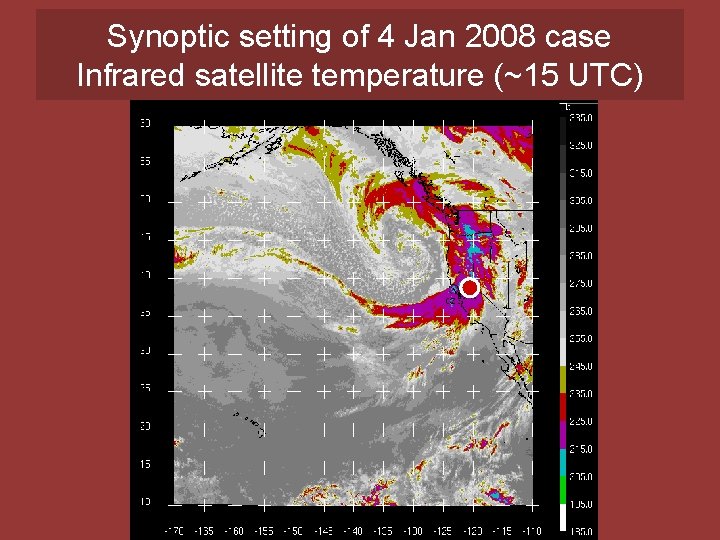
Synoptic setting of 4 Jan 2008 case Infrared satellite temperature (~15 UTC)
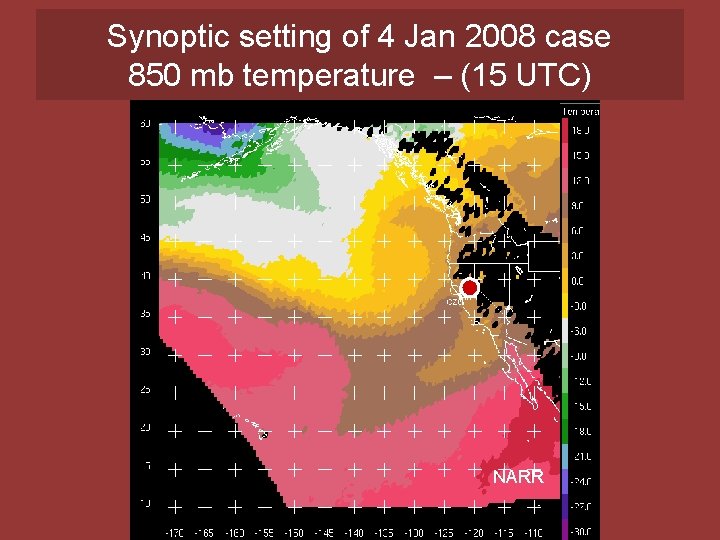
Synoptic setting of 4 Jan 2008 case 850 mb temperature – (15 UTC) NARR
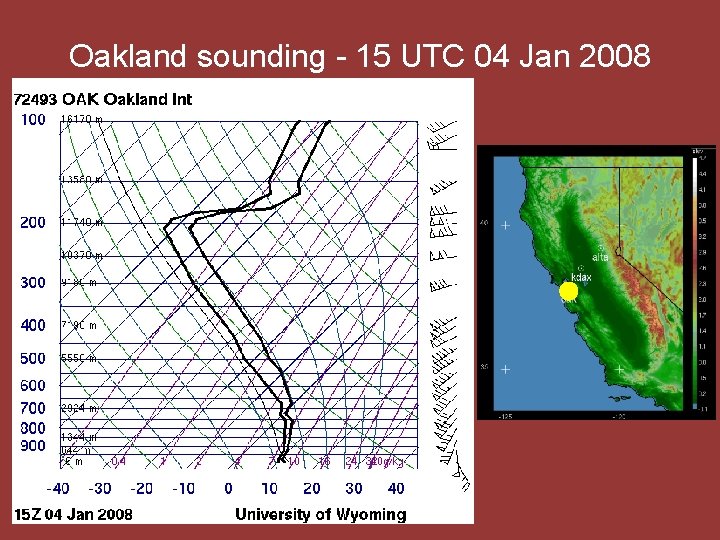
Oakland sounding - 15 UTC 04 Jan 2008
Conclusions • Intermittent cells were clearly defined in at least ~17% of the deep, long lasting stratiform events in the Sierra Nevada • Case study analysis suggest that the updrafts occur as the middle sector of the storm passes over the windward slopes, in a statically stable layer and in a region of strong vertically shear i. e. , similarly to what was observed in other mountain ranges FUTURE STEP: Analyze the distribution of updraft magnitude in relationship to shear, static stability, precipitation, etc