
Structure of Fertilized Egg of Hen The fully
- Slides: 8
Structure of Fertilized Egg of Hen
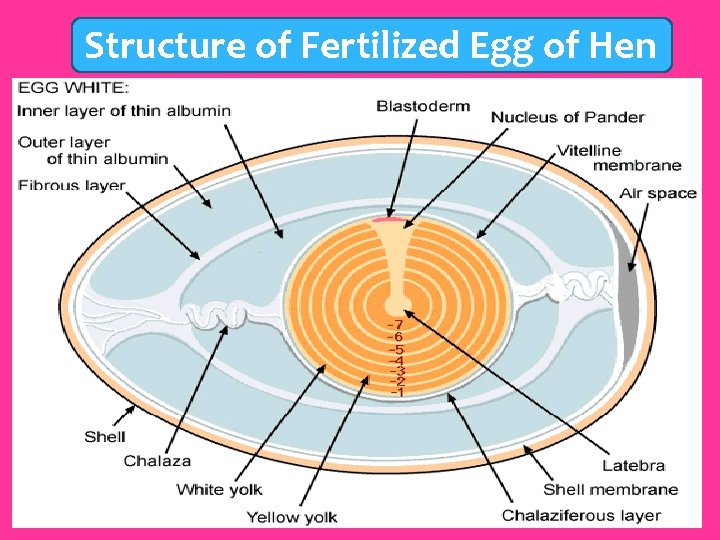
§ The fully formed newly laid egg of hen is a large elliptical structure. § Its one end is broader than the other. § In vertical section it shows following parts… § 1. Egg shell § 2. Shell membranes § 3. Albumen § 4. Ovum
1. Egg Shell § The Egg shell forms the outermost protective covering. Composed of largely calcarious salts (calcite). § The egg shell containing about 7000 pores, enabling the embryo to carry on exchange of gases. § The pores are filled with organic substance related to collagen. § The pores are more numerous at broader end and permit diffusion of O 2 & CO 2.
2. Shell Membranes § Immediately behind the egg shell are two Shell membranes which contain fibers of Keratin. § Outer shell membrane is thick and tough, while inner one is thin. § Two shell membranes remain in contact everywhere except at blunt end of the egg. § These two membranes get separated to form a air chamber. § This space only appears after egg has been laid & cooled up to room temperature. § The air chamber helps the young chicken in breathing before hatching.
3. Albumen § The space of egg between the inner membrane and vitelline membrane is filled with albumen or white of egg. § Albumen is proteinous in nature with 85% water & 15% proteins. § Ovalbumin, Avidin & Lysozyme are three proteins found in albumen. § The outer layer of albumen is more watery k/as thin albumen and inner one is thick, gelatinous semisolid. § Inner to the albumen layer close to the yolk there projects 2 spirally twisted cord-like strands, k/a chalazae at either ends. § Albumen provides nutrition to the embryo.
4. Ovum § It is a spherical body embedded in the albumen occupying central position. § It is surrounded by thin & transparent vitelline membrane. § The inner layer of vitelline membrane is produced in the ovary between oocyte & follicle cells. § An outer layer is formed when egg enters upper portion of fallopian tube. § Inner to the vitelline membrane there lies a plasma membrane of ovum. § Inside ovum occurs abundant yolk. § Yolk is of 2 kinds white yolk & yellow yolk.
§ The principle accumulation of white yolk lies in the central flask- shaped area, latebra, which extends towards the blastoderm k/as nucleus of ponder. § The thin concentric layers of white yolk alternate with the much thicker layers of yellow yolk. § the germinal disc or blastodisc is small, circular whitish area of active cytoplasm which is situated at the top of the yolk. § It represents the living portion of ovum and undergoes embryogenesis.
Functions of Different Parts of Egg: § § § 1. 2. 3. 4. 5. 6. The blastodisc develops into the embryo The yolk functions as nutritive material. The chalazae always keep the blastodisc up whenever the egg is turned. Yolk is nutritive. The albumen has three functions: Storage of water Provides an aqueous environment Protects the embryo from mechanical & chemical injuries. Yolk & album has variety of enzymes, vitamines, pigments. The air space helps in embryonic respiration & facilitates the free movement of the embryo. The shell protect the embryo from mechanical shocks & external environment