
Structure of exotic nuclei basic symmetries Introduction Symmetries
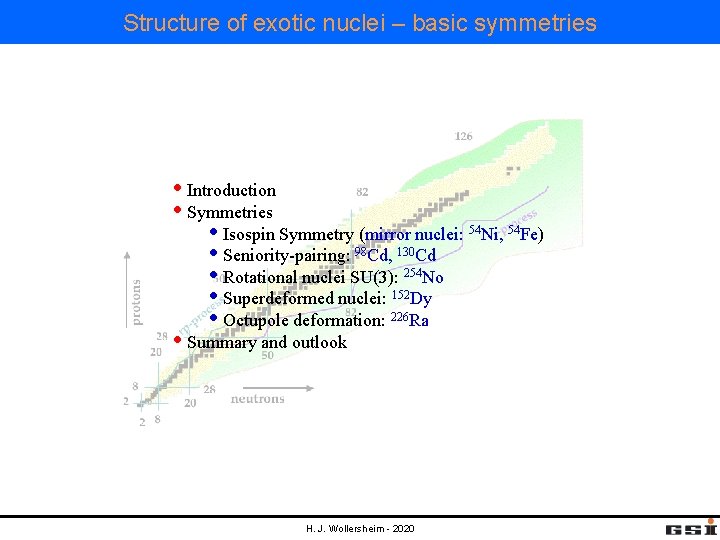
Structure of exotic nuclei – basic symmetries • Introduction • Symmetries • Isospin Symmetry (mirror nuclei: 54 Ni, 54 Fe) • Seniority-pairing: 98 Cd, 130 Cd • Rotational nuclei SU(3): 254 No • Superdeformed nuclei: 152 Dy • Octupole deformation: 226 Ra • Summary and outlook H. J. Wollersheim - 2020
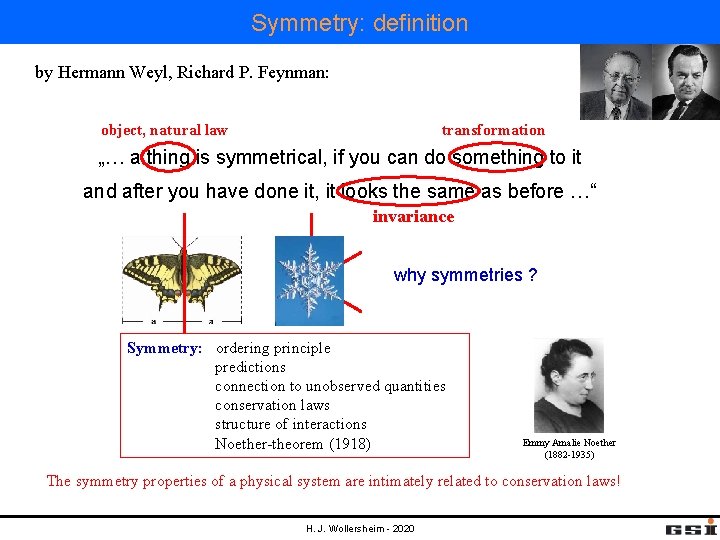
Symmetry: definition by Hermann Weyl, Richard P. Feynman: object, natural law transformation „… a thing is symmetrical, if you can do something to it and after you have done it, it looks the same as before …“ invariance why symmetries ? Symmetry: ordering principle predictions connection to unobserved quantities conservation laws structure of interactions Noether-theorem (1918) Emmy Amalie Noether (1882 -1935) The symmetry properties of a physical system are intimately related to conservation laws! H. J. Wollersheim - 2020
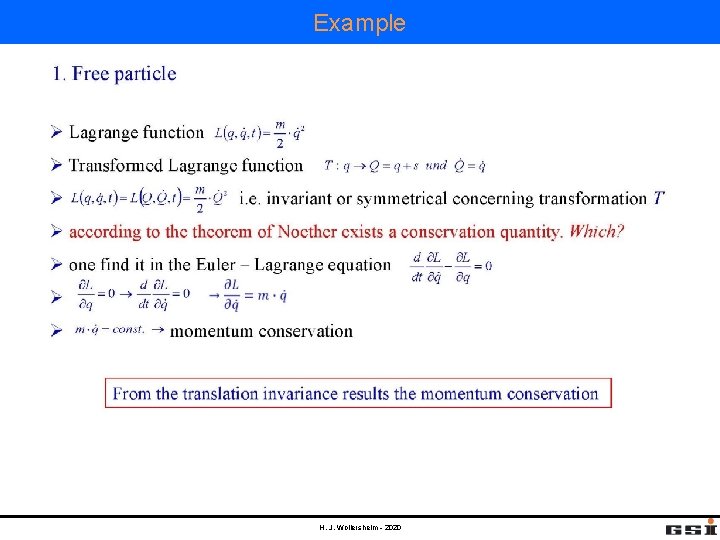
Example H. J. Wollersheim - 2020
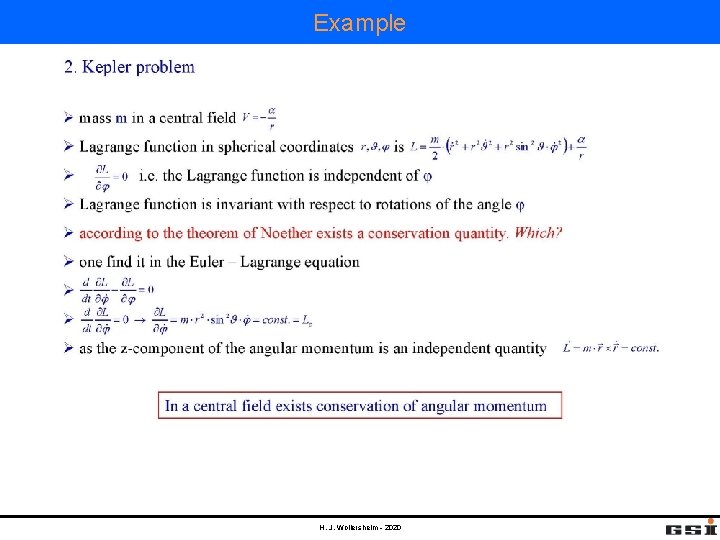
Example H. J. Wollersheim - 2020

Conservation quantities in space-time symmetries Homogeneity of space momentum conservation Isotropy of space angular momentum conservation Homogeneity of time energy conservation solar system energy - and angular momentum conservation H. J. Wollersheim - 2020

Particle physics: particle zoo How can we bring order in the particle zoo ? new symmetry ? new conservation quantities ? new order ! H. J. Wollersheim - 2020
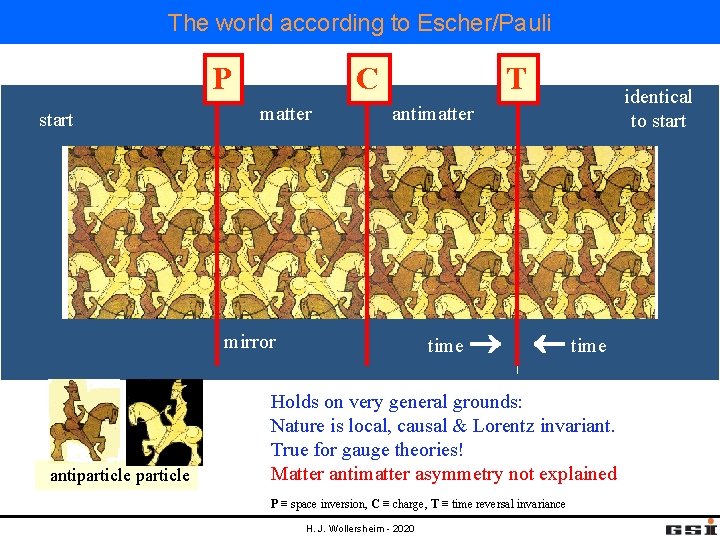
H. W. Wilschut The world according to Escher/Pauli P start C matter T antimatter mirror antiparticle identical to start time Holds on very general grounds: Nature is local, causal & Lorentz invariant. True for gauge theories! Matter antimatter asymmetry not explained P ≡ space inversion, C ≡ charge, T ≡ time reversal invariance H. J. Wollersheim - 2020
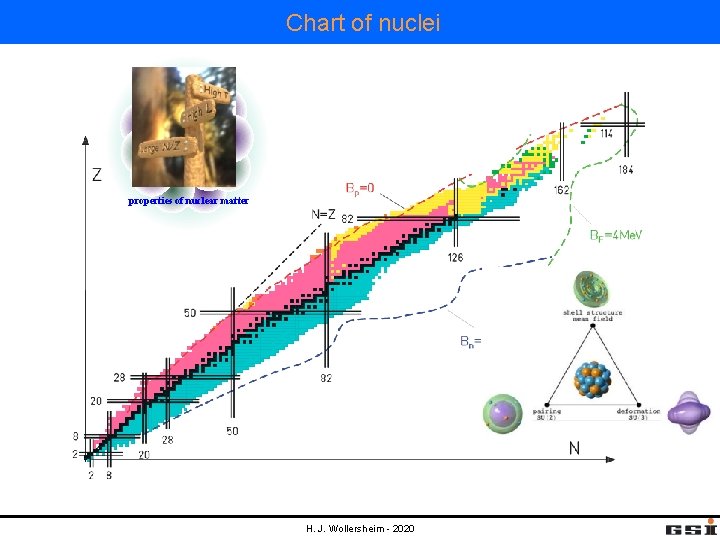
Chart of nuclei properties of nuclear matter H. J. Wollersheim - 2020
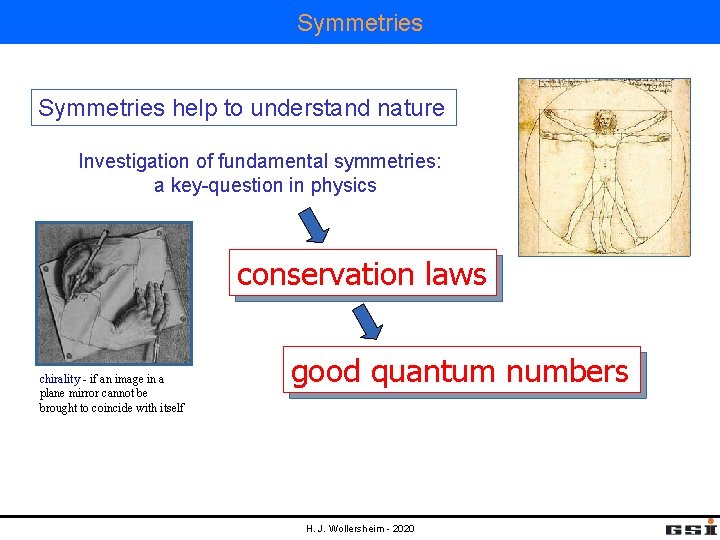
Symmetries help to understand nature Investigation of fundamental symmetries: a key-question in physics conservation laws chirality - if an image in a plane mirror cannot be brought to coincide with itself good quantum numbers In nuclear physics, conserved quantities imply underlying symmetries of the interactions and help to interpret nuclear structure features H. J. Wollersheim - 2020
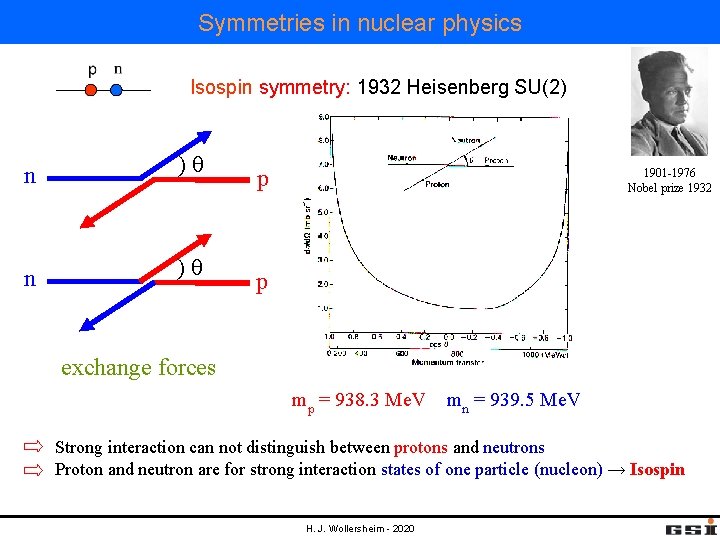
Symmetries in nuclear physics Isospin symmetry: 1932 Heisenberg SU(2) n ) p 1901 -1976 Nobel prize 1932 p exchange forces mp = 938. 3 Me. V mn = 939. 5 Me. V Strong interaction can not distinguish between protons and neutrons Proton and neutron are for strong interaction states of one particle (nucleon) → Isospin H. J. Wollersheim - 2020

Isospin Tz=1/2(Z-N) proton: Tz(p) = +1/2 T=|Tz| neutron: Tz(n) = -1/2 Ø Proton and neutron are 2 states of the same particle. Ø Pauli principle forbids T=0 states for nn und 2 He Ø Deuteron (T=0, S=1) is the only A=2 bound system 2 He H. J. Wollersheim - 2020 nn
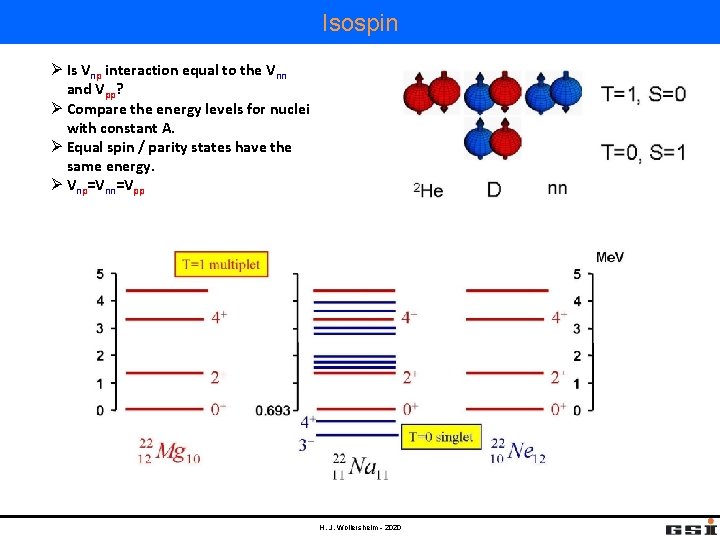
Isospin Ø Is Vnp interaction equal to the Vnn and Vpp? Ø Compare the energy levels for nuclei with constant A. Ø Equal spin / parity states have the same energy. Ø Vnp=Vnn=Vpp H. J. Wollersheim - 2020
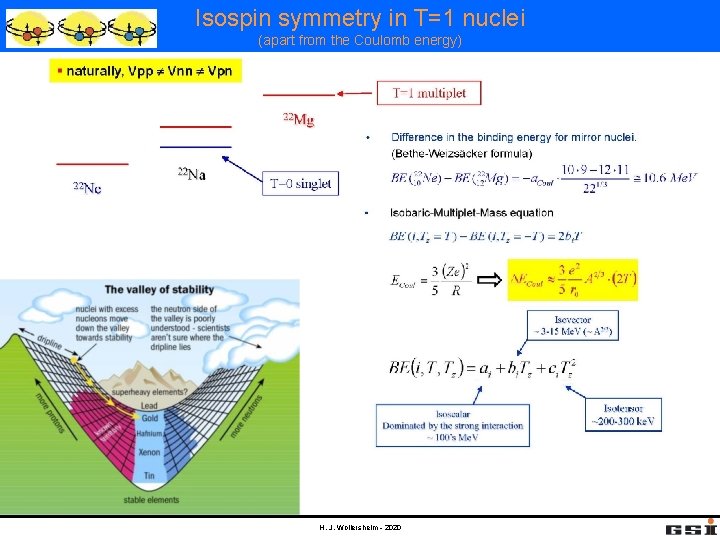
Isospin symmetry in T=1 nuclei (apart from the Coulomb energy) H. J. Wollersheim - 2020
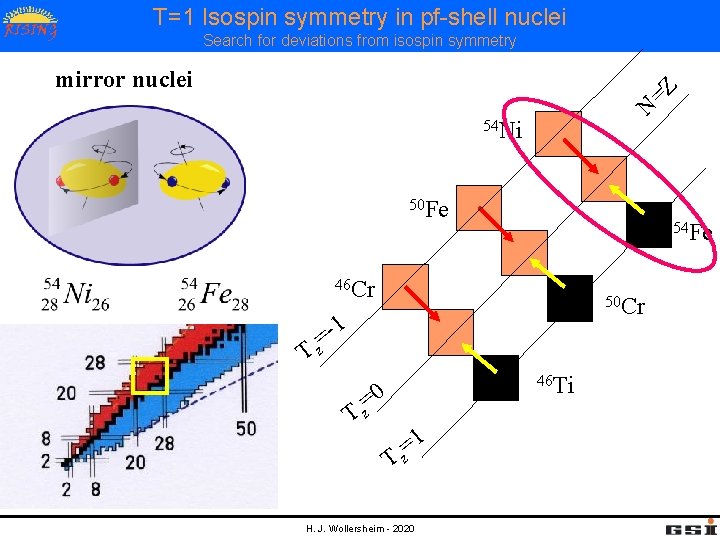
T=1 Isospin symmetry in pf-shell nuclei Search for deviations from isospin symmetry mirror nuclei =Z N 54 Ni 50 Fe 54 Fe 46 Cr 50 Cr 1 T = z T 46 Ti 0 = z T 1 = z H. J. Wollersheim - 2020
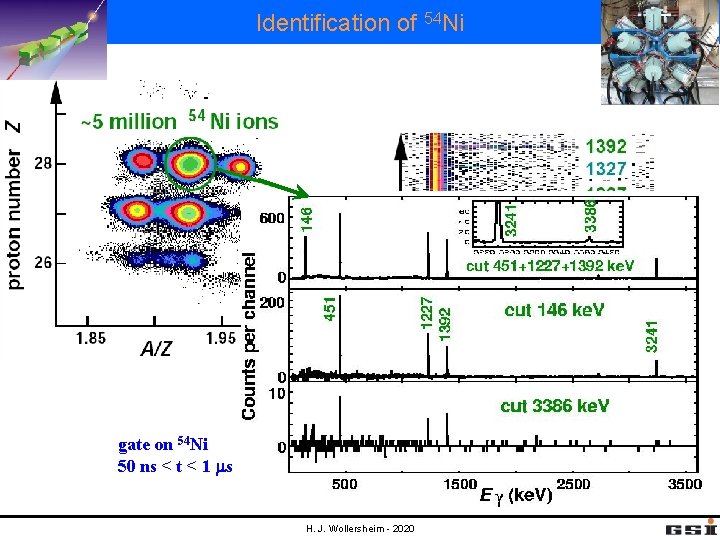
Identification of 54 Ni coincidence spectra gate on 54 Ni 50 ns < t < 1 s H. J. Wollersheim - 2020
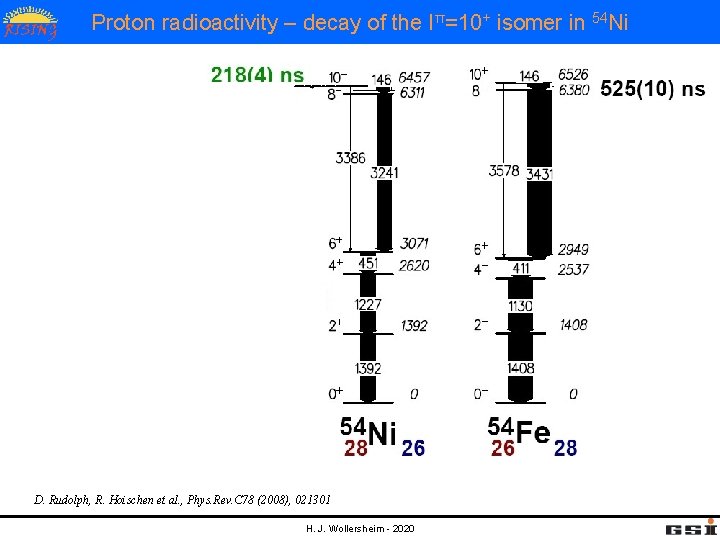
Proton radioactivity – decay of the Iπ=10+ isomer in 54 Ni decay of the excited 10+-state by proton emission and -radiation D. Rudolph, R. Hoischen et al. , Phys. Rev. C 78 (2008), 021301 H. J. Wollersheim - 2020
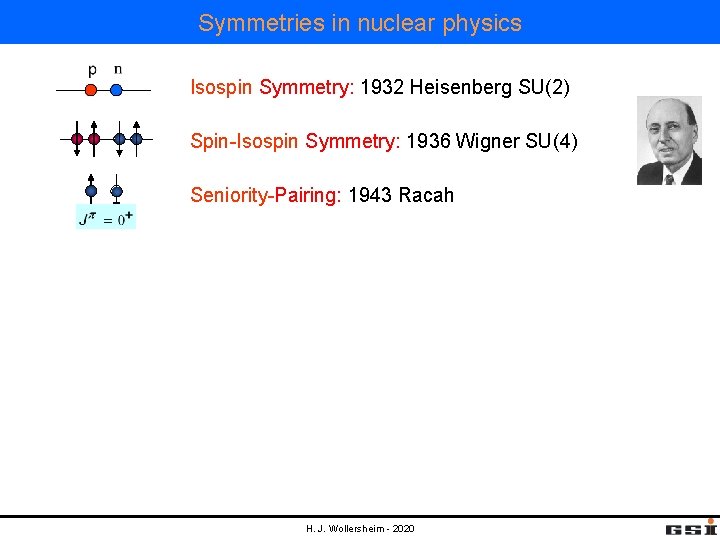
Symmetries in nuclear physics Isospin Symmetry: 1932 Heisenberg SU(2) Spin-Isospin Symmetry: 1936 Wigner SU(4) Seniority-Pairing: 1943 Racah H. J. Wollersheim - 2020
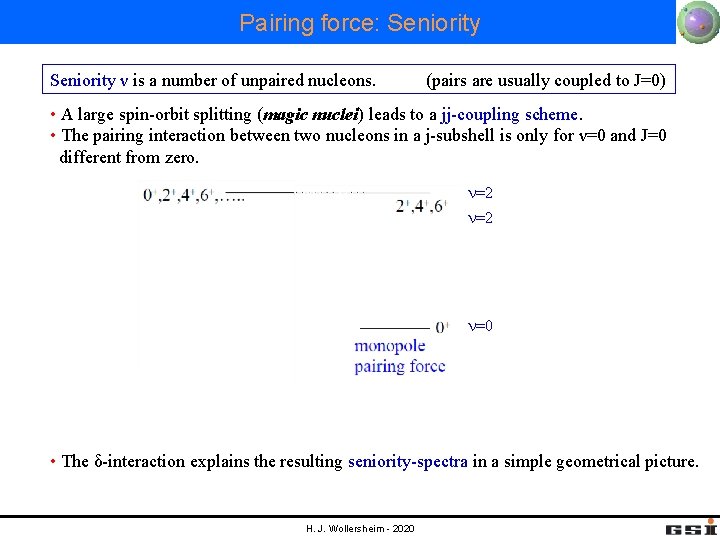
Pairing force: Seniority ν is a number of unpaired nucleons. (pairs are usually coupled to J=0) • A large spin-orbit splitting (magic nuclei) leads to a jj-coupling scheme. • The pairing interaction between two nucleons in a j-subshell is only for ν=0 and J=0 different from zero. =2 =2 =0 • The δ-interaction explains the resulting seniority-spectra in a simple geometrical picture. H. J. Wollersheim - 2020
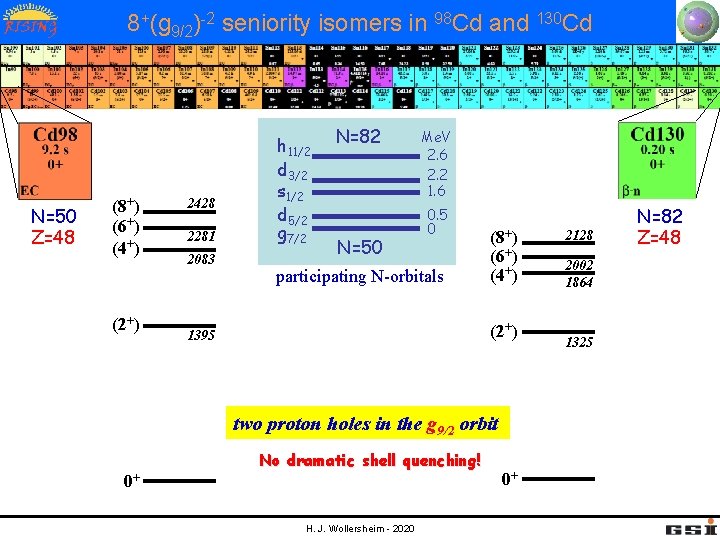
8+(g 9/2)-2 seniority isomers in 98 Cd and 130 Cd N=50 Z=48 (8+) (6+) (4+) (2+) 2428 2281 2083 h 11/2 d 3/2 s 1/2 d 5/2 g 7/2 N=82 N=50 Me. V 2. 6 2. 2 1. 6 0. 5 0 participating N-orbitals (8+) (6+) (4+) (2+) 1395 two proton holes in the g 9/2 orbit 0+ No dramatic shell quenching! H. J. Wollersheim - 2020 0+ 2128 2002 1864 1325 N=82 Z=48
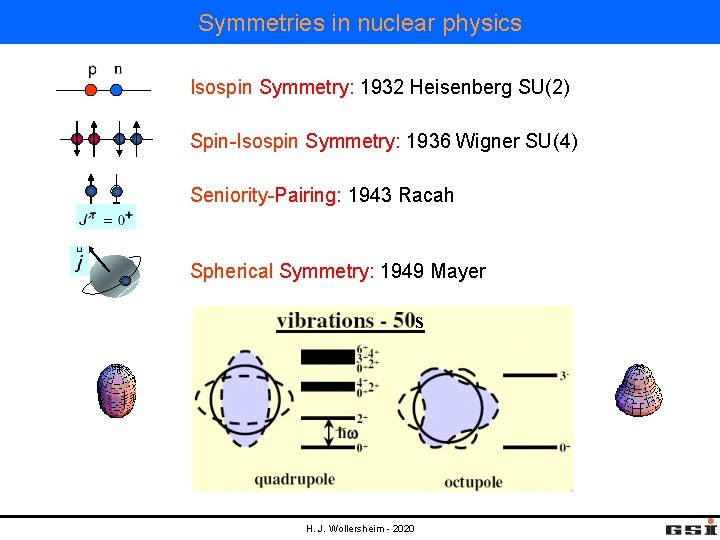
Symmetries in nuclear physics Isospin Symmetry: 1932 Heisenberg SU(2) Spin-Isospin Symmetry: 1936 Wigner SU(4) Seniority-Pairing: 1943 Racah Spherical Symmetry: 1949 Mayer s H. J. Wollersheim - 2020
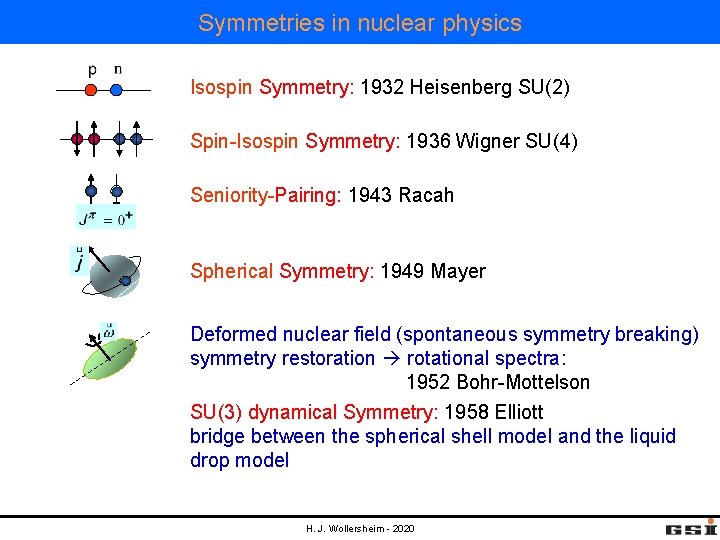
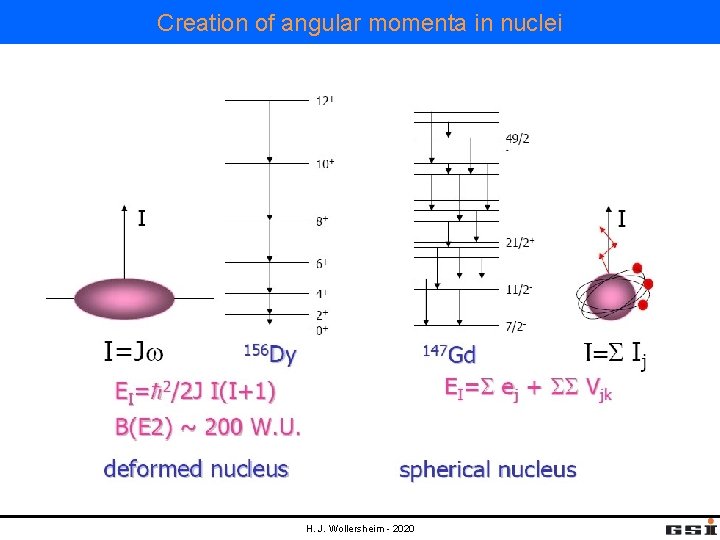
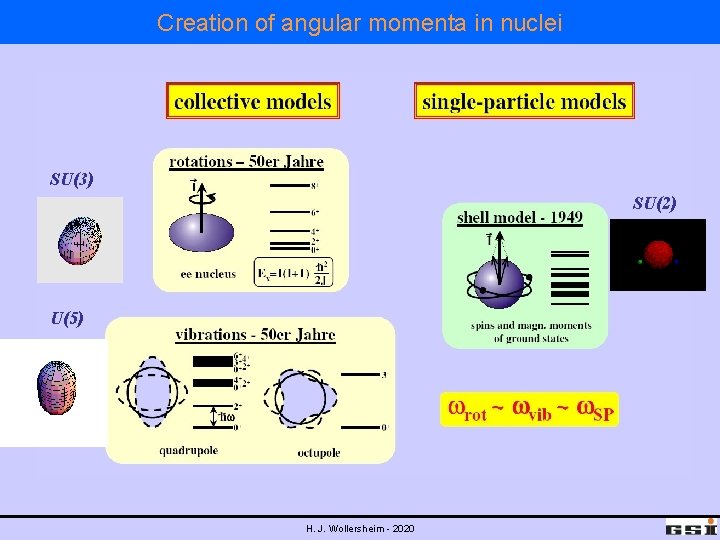
Symmetries in nuclear physics Isospin Symmetry: 1932 Heisenberg SU(2) Spin-Isospin Symmetry: 1936 Wigner SU(4) Seniority-Pairing: 1943 Racah Spherical Symmetry: 1949 Mayer Deformed nuclear field (spontaneous symmetry breaking) symmetry restoration rotational spectra: 1952 Bohr-Mottelson SU(3) dynamical Symmetry: 1958 Elliott bridge between the spherical shell model and the liquid drop model H. J. Wollersheim - 2020
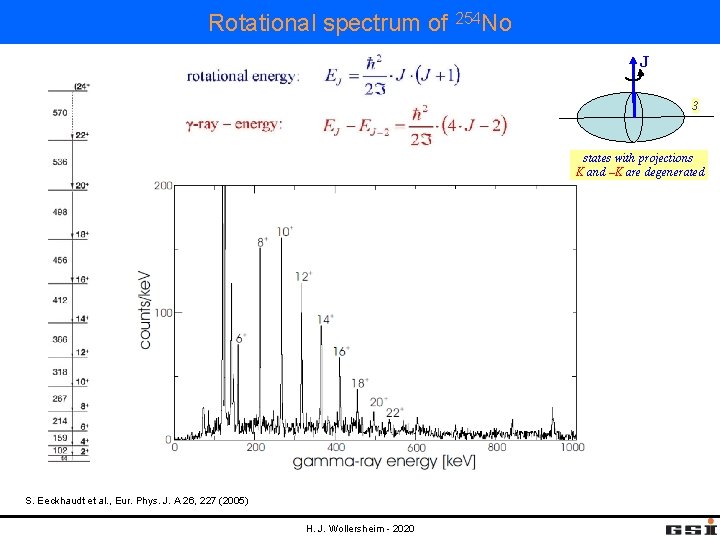
Rotational spectrum of 254 No J 3 states with projections K and –K are degenerated S. Eeckhaudt et al. , Eur. Phys. J. A 26, 227 (2005) H. J. Wollersheim - 2020
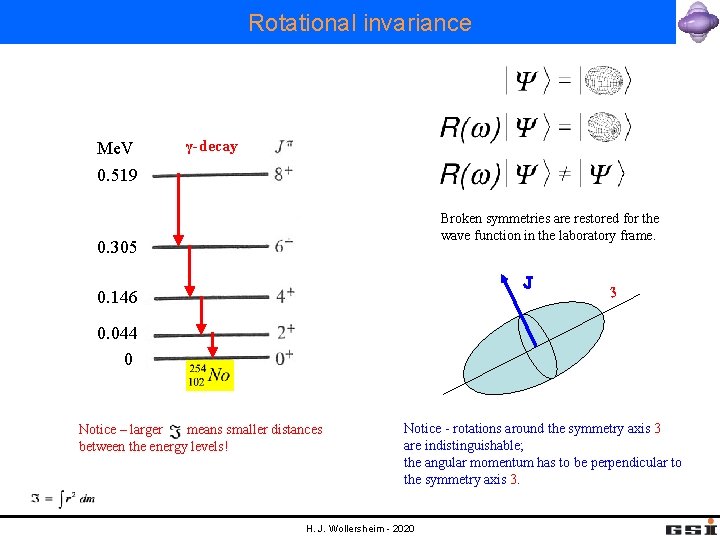
Rotational invariance Me. V 0. 519 γ-decay Broken symmetries are restored for the wave function in the laboratory frame. 0. 305 J 0. 146 3 0. 044 0 Notice – larger means smaller distances between the energy levels! Notice - rotations around the symmetry axis 3 are indistinguishable; the angular momentum has to be perpendicular to the symmetry axis 3. H. J. Wollersheim - 2020
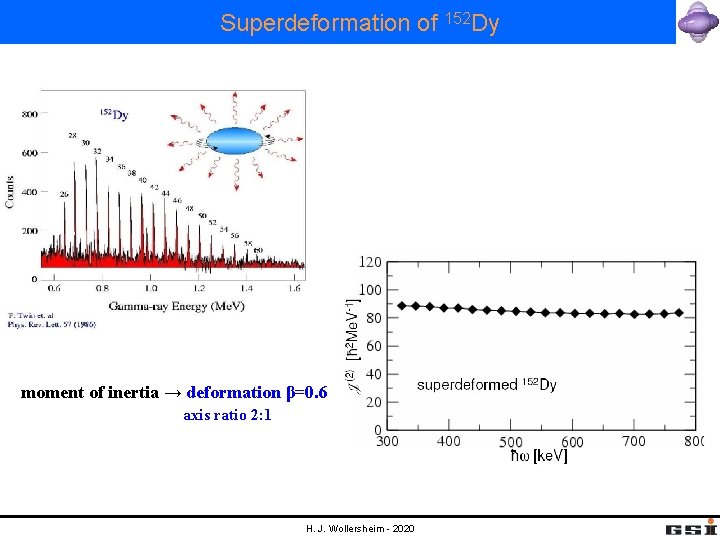
Superdeformation of 152 Dy moment of inertia → deformation β=0. 6 axis ratio 2: 1 H. J. Wollersheim - 2020
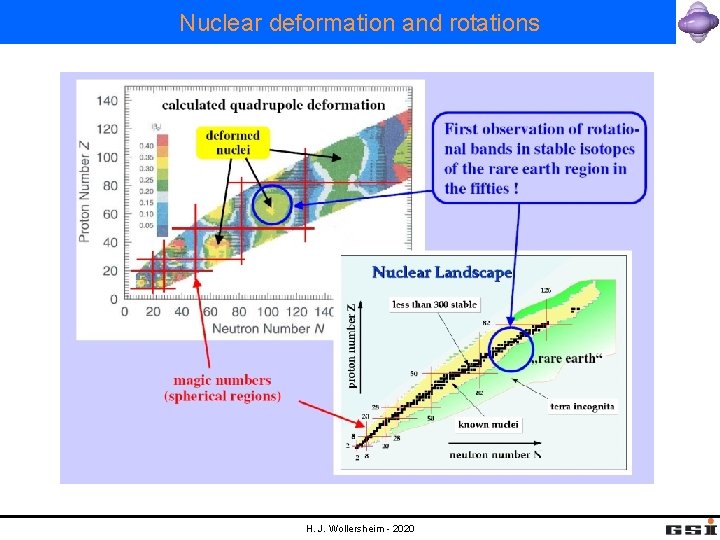
Nuclear deformation and rotations H. J. Wollersheim - 2020
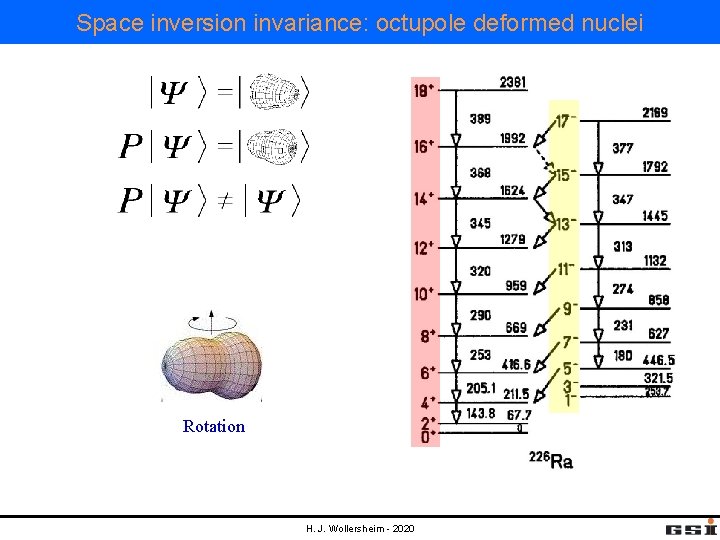
Space inversion invariance: octupole deformed nuclei Rotation H. J. Wollersheim - 2020
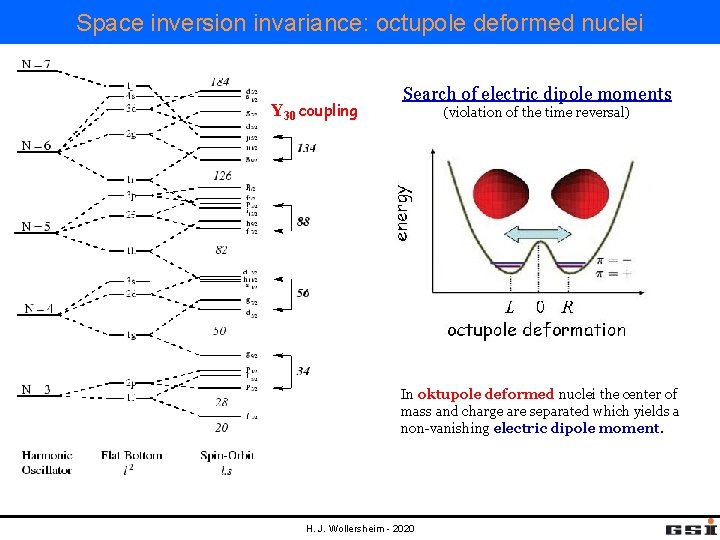
Space inversion invariance: octupole deformed nuclei Y 30 coupling Search of electric dipole moments (violation of the time reversal) static octupole deformation exists only in special regions of the chart of nuclei. + + + 226 Ra + 88 + In oktupole deformed nuclei the center of mass and charge are separated which yields a non-vanishing electric dipole moment. H. J. Wollersheim - 2020
Creation of angular momenta in nuclei H. J. Wollersheim - 2020
Creation of angular momenta in nuclei SU(3) SU(2) U(5) H. J. Wollersheim - 2020
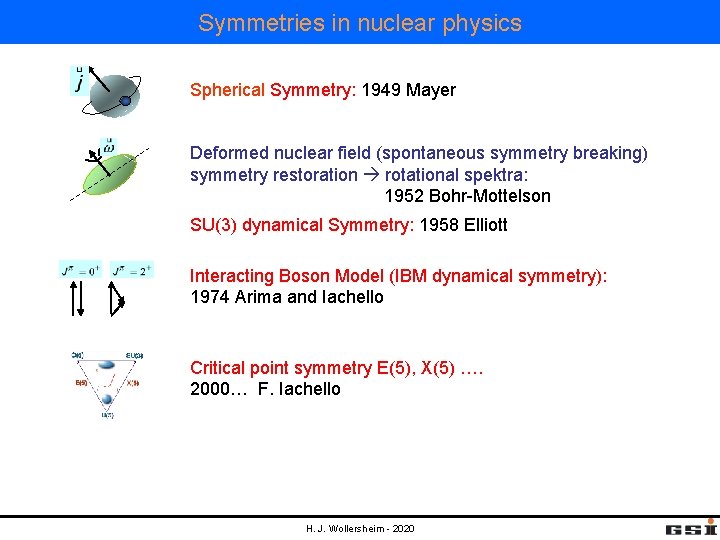
Symmetries in nuclear physics Spherical Symmetry: 1949 Mayer Deformed nuclear field (spontaneous symmetry breaking) symmetry restoration rotational spektra: 1952 Bohr-Mottelson SU(3) dynamical Symmetry: 1958 Elliott Interacting Boson Model (IBM dynamical symmetry): 1974 Arima and Iachello Critical point symmetry E(5), X(5) …. 2000… F. Iachello H. J. Wollersheim - 2020
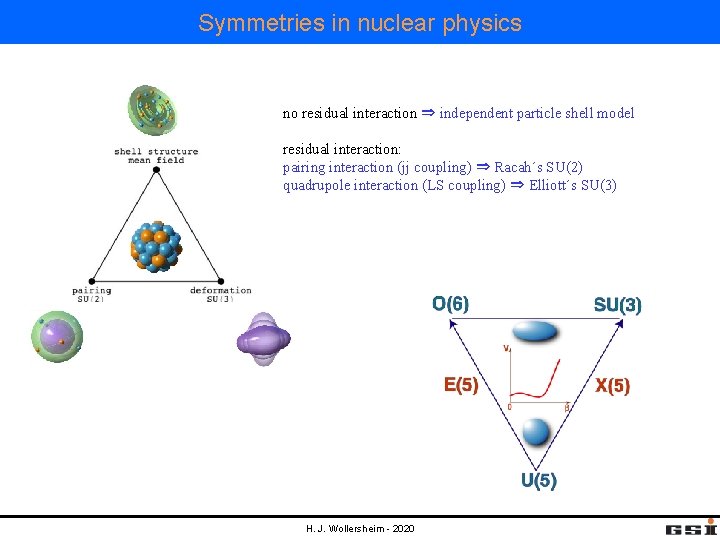
Symmetries in nuclear physics no residual interaction ⇒ independent particle shell model residual interaction: pairing interaction (jj coupling) ⇒ Racah´s SU(2) quadrupole interaction (LS coupling) ⇒ Elliott´s SU(3) H. J. Wollersheim - 2020

Nuclear shapes and symmetries Energy Vibrator Spherical Soft Transitional Rotor nuclei with X(5) symmetry: Deformed p-dripline stable Deformation prolate oblate n-dripline Transitional nuclei R. F. Casten Nature Physics 2 (2006) 811 H. J. Wollersheim - 2020
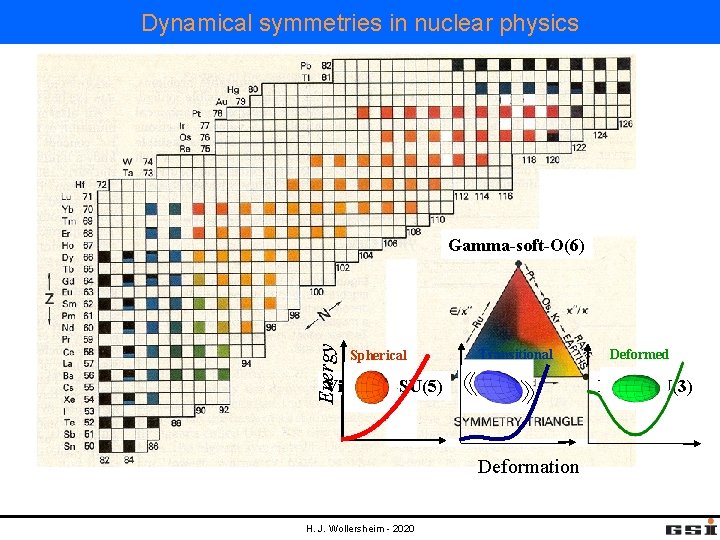
Dynamical symmetries in nuclear physics Energy Gamma-soft-O(6) Spherical Transitional Vibrator-SU(5) Rotor-SU(3) Deformation H. J. Wollersheim - 2020 Deformed

Chart of the Nuclei Mirror nuclei and the nuclear shell model 126 82 s es c o r r-p protons 50 ss e oc r p p- 82 r 70 28 20 50 8 2 20 28 40 neutrons 2 8 H. J. Wollersheim - 2020
- Slides: 34