
Structure of DNA Unit 5 B 1 AP
Structure of DNA Unit 5 B. 1 AP Biology 2007 -2008
§ Genetic information is stored and § passed to subsequent generations through DNA molecules and, in some cases, RNA molecules. Prokaryotes, viruses and eukaryotes contain plasmids, which are small extra chromosomal, double stranded circular DNA molecules AP Biology

§ Proof that DNA is the carrier of genetic information involved a number of important historical experiments AP Biology
Hershey & Chase § Performed an experiment using radioactively labeled viruses that infect bacteria. § Viruses were made of only protein and DNA AP Biology
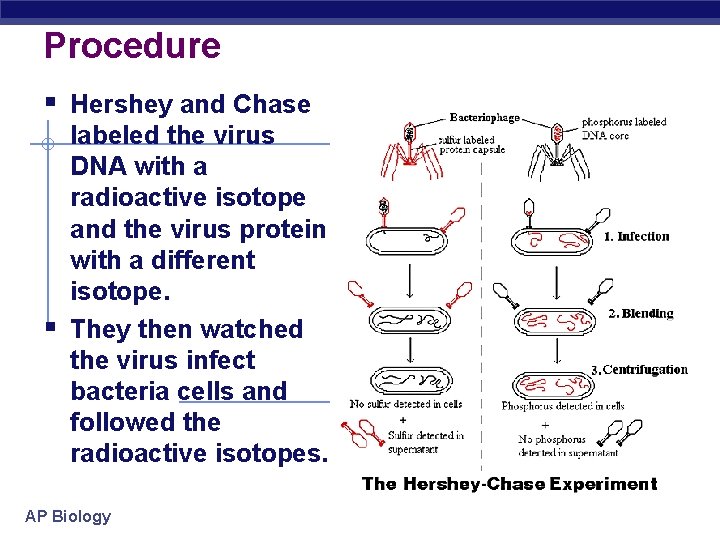
Procedure § Hershey and Chase § labeled the virus DNA with a radioactive isotope and the virus protein with a different isotope. They then watched the virus infect bacteria cells and followed the radioactive isotopes. AP Biology
Results § When the viruses infected bacteria, only the DNA entered the bacteria cell Evidence that DNA is the genetic material of a cell u DNA caused bacteria to produce more viruses. u AP Biology
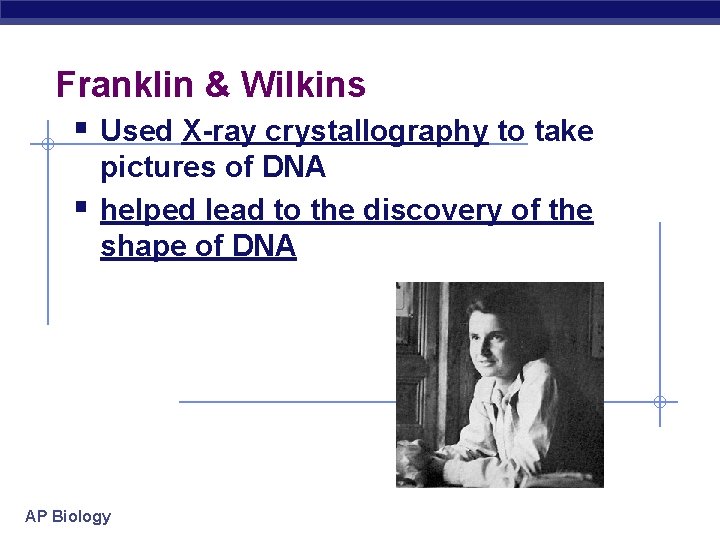
Franklin & Wilkins § Used X-ray crystallography to take § pictures of DNA helped lead to the discovery of the shape of DNA AP Biology
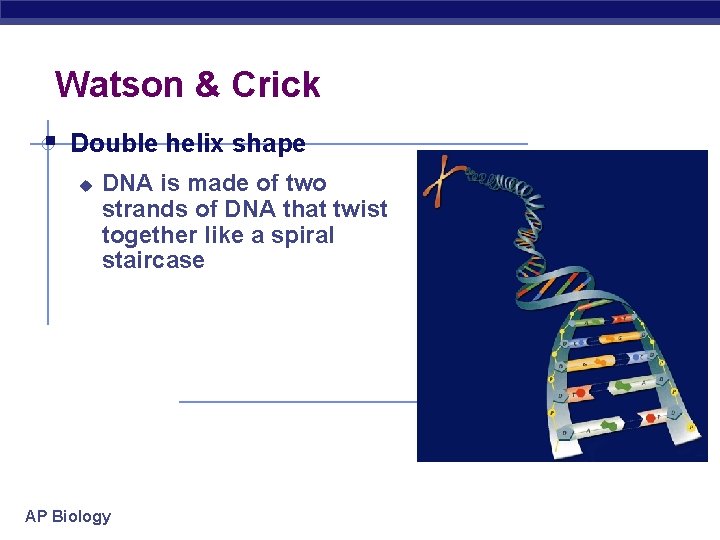
Watson & Crick § Double helix shape u DNA is made of two strands of DNA that twist together like a spiral staircase AP Biology
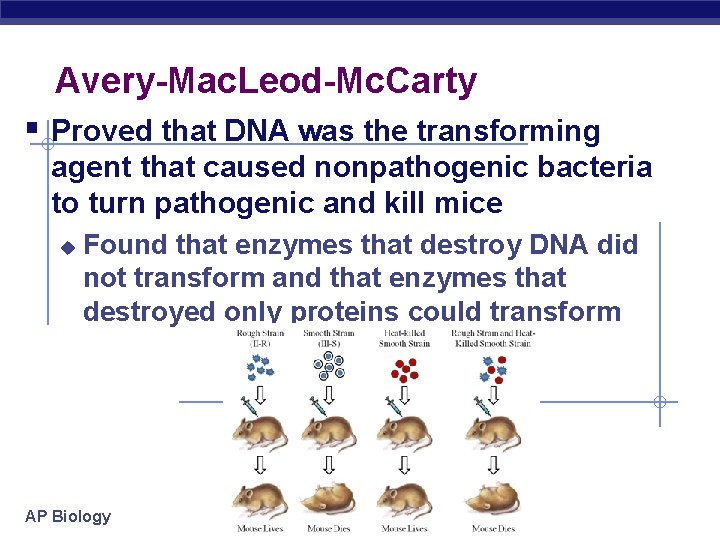
Avery-Mac. Leod-Mc. Carty § Proved that DNA was the transforming agent that caused nonpathogenic bacteria to turn pathogenic and kill mice u Found that enzymes that destroy DNA did not transform and that enzymes that destroyed only proteins could transform AP Biology
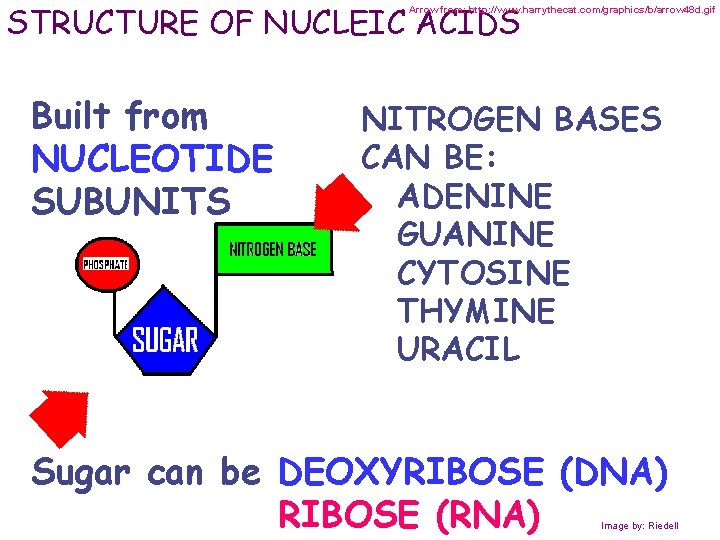
STRUCTURE OF NUCLEIC ACIDS Arrow from: http: //www. harrythecat. com/graphics/b/arrow 48 d. gif Built from NUCLEOTIDE SUBUNITS NITROGEN BASES CAN BE: ADENINE GUANINE CYTOSINE THYMINE URACIL Sugar can be DEOXYRIBOSE (DNA) RIBOSE (RNA) Image by: Riedell
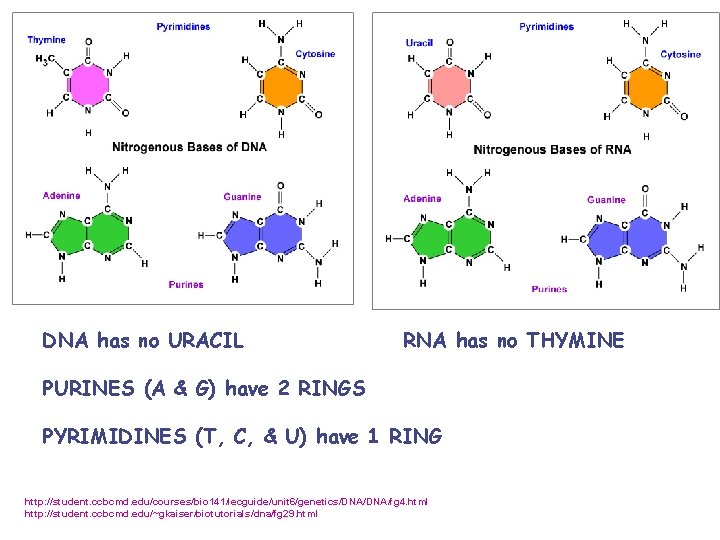
DNA has no URACIL RNA has no THYMINE PURINES (A & G) have 2 RINGS PYRIMIDINES (T, C, & U) have 1 RING http: //student. ccbcmd. edu/courses/bio 141/lecguide/unit 6/genetics/DNA/fg 4. html http: //student. ccbcmd. edu/~gkaiser/biotutorials/dna/fg 29. html
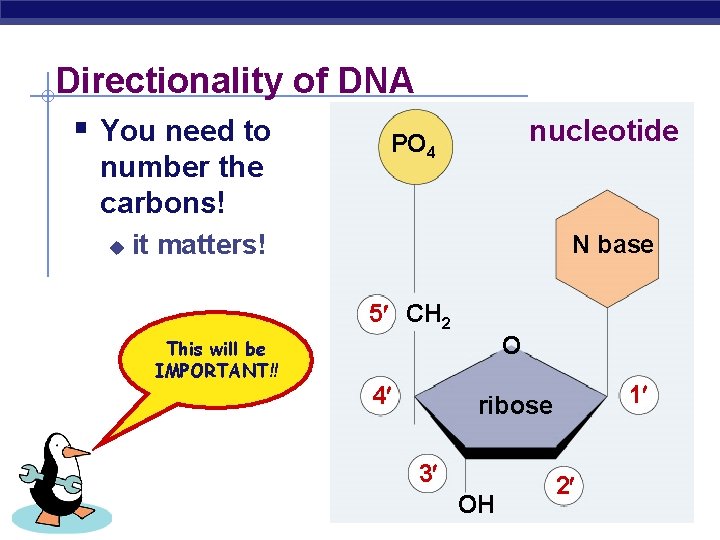
Directionality of DNA § You need to PO 4 nucleotide number the carbons! u it matters! N base 5 CH 2 This will be IMPORTANT!! 4 O 3 AP Biology 1 ribose OH 2
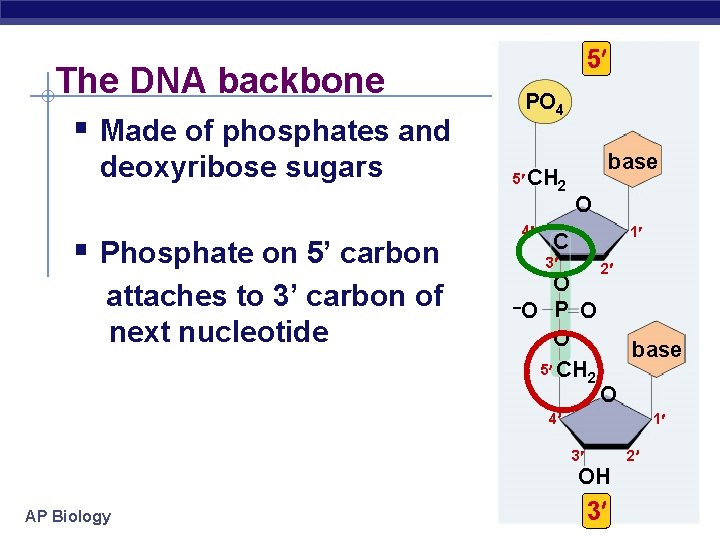
The DNA backbone § Made of phosphates and deoxyribose sugars § Phosphate on 5’ carbon attaches to 3’ carbon of next nucleotide 5 PO 4 5 CH 2 4 base O 1 C 3 O –O P O O 5 CH 2 2 base O 4 1 2 3 OH AP Biology 3
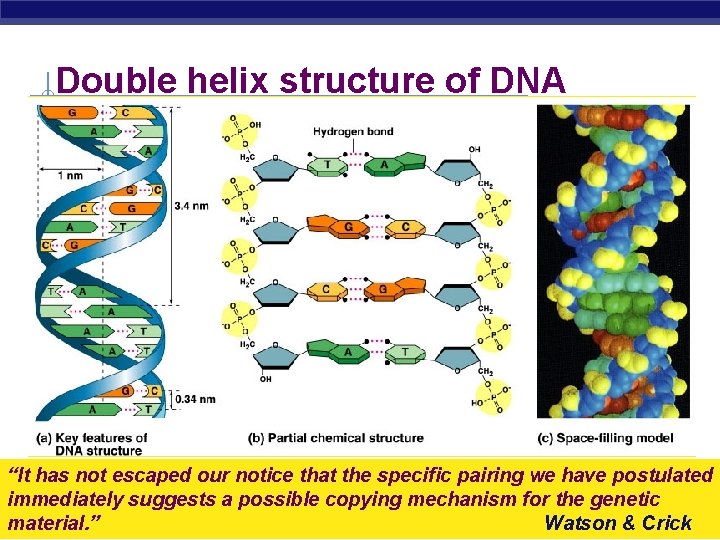
Double helix structure of DNA “It has not escaped our notice that the specific pairing we have postulated immediately suggests a possible copying mechanism for the genetic AP Biology material. ” Watson & Crick
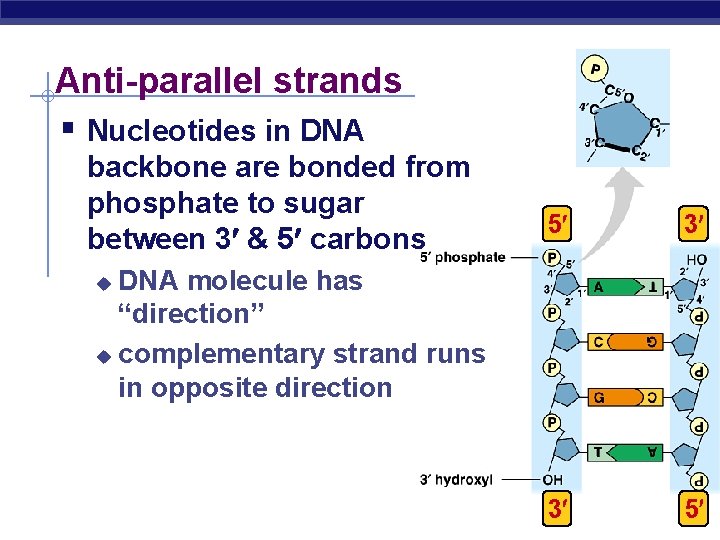
Anti-parallel strands § Nucleotides in DNA backbone are bonded from phosphate to sugar between 3 & 5 carbons 5 3 3 5 DNA molecule has “direction” u complementary strand runs in opposite direction u AP Biology
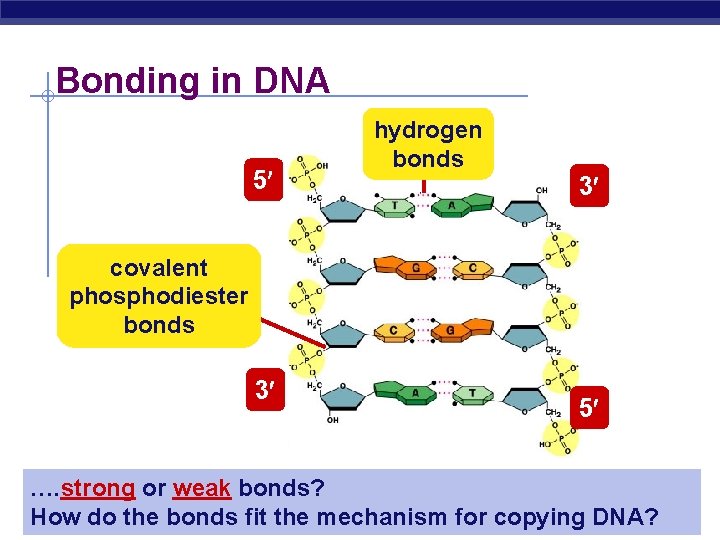
Bonding in DNA 5 hydrogen bonds 3 covalent phosphodiester bonds 3 5 …. strong or weak bonds? AP Biology How do the bonds fit the mechanism for copying DNA?
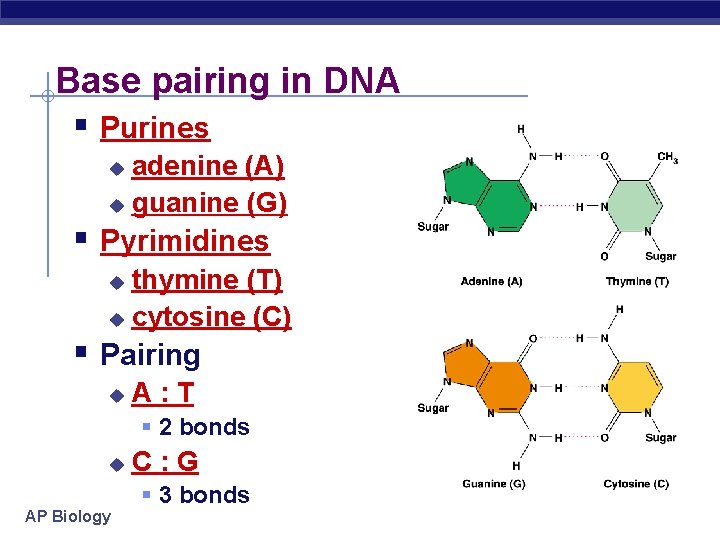
Base pairing in DNA § Purines adenine (A) u guanine (G) u § Pyrimidines thymine (T) u cytosine (C) u § Pairing u A: T § 2 bonds u AP Biology C: G § 3 bonds
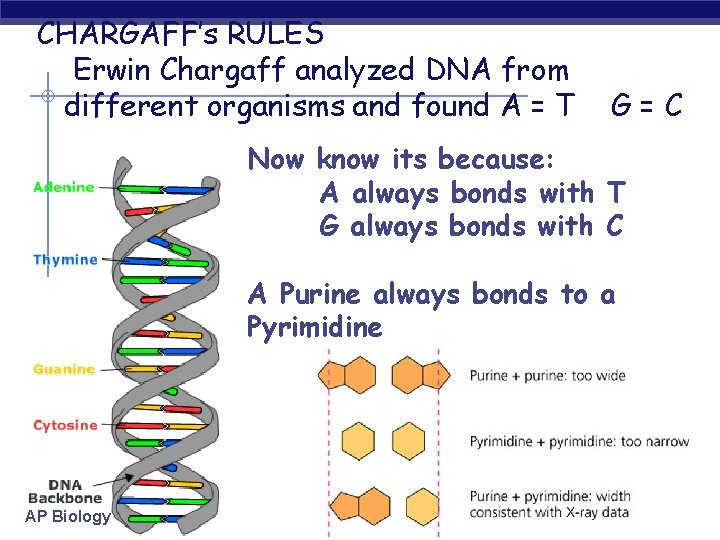
CHARGAFF’s RULES Erwin Chargaff analyzed DNA from different organisms and found A = T G=C Now know its because: A always bonds with T G always bonds with C A Purine always bonds to a Pyrimidine AP Biology
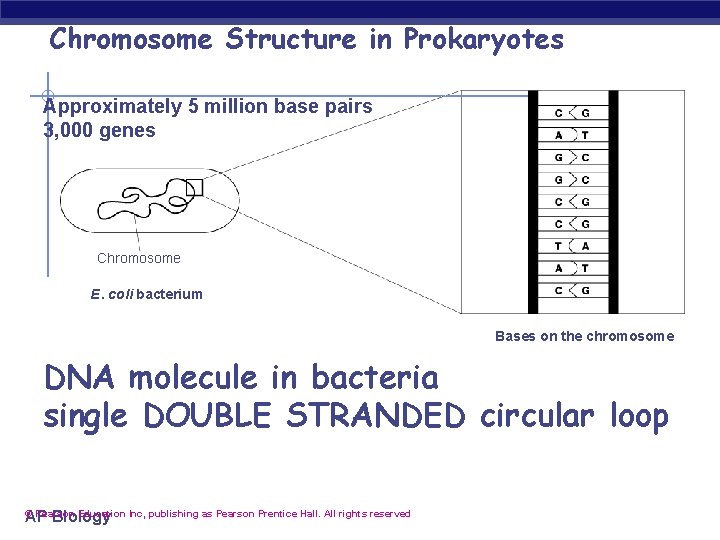
Chromosome Structure in Prokaryotes Approximately 5 million base pairs 3, 000 genes Chromosome E. coli bacterium Bases on the chromosome DNA molecule in bacteria single DOUBLE STRANDED circular loop AP Biology © Pearson Education Inc, publishing as Pearson Prentice Hall. All rights reserved
- Slides: 19