
Structure of Computer Systems Course 2 Computer performance





- Slides: 26
Structure of Computer Systems Course 2 Computer performance and optimality 1
Performance requirements Ø small execution time Ø short reaction time to external events Ø high memory capacity and speed Ø many input/output facilities (interfaces) Ø reach development facilities Ø small dimensions and specific shapes Ø predictability, safety and fault tolerance Ø small costs: absolute and relative 2
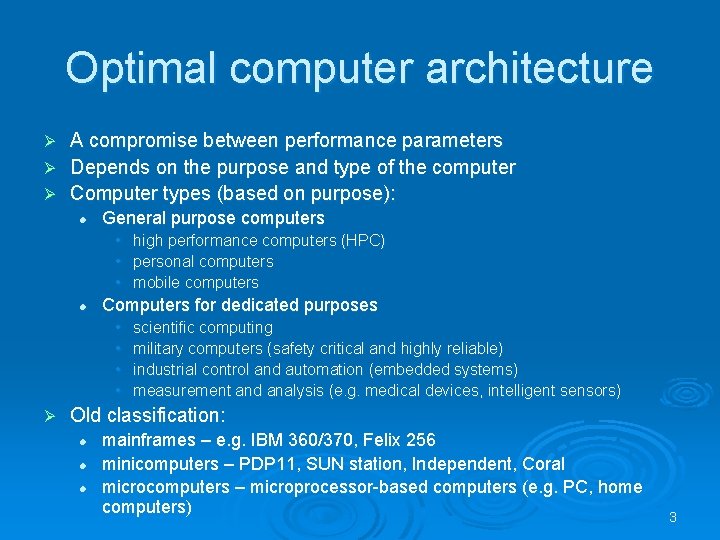
Optimal computer architecture A compromise between performance parameters Ø Depends on the purpose and type of the computer Ø Computer types (based on purpose): Ø l General purpose computers • • • l Computers for dedicated purposes • • Ø high performance computers (HPC) personal computers mobile computers scientific computing military computers (safety critical and highly reliable) industrial control and automation (embedded systems) measurement and analysis (e. g. medical devices, intelligent sensors) Old classification: l l l mainframes – e. g. IBM 360/370, Felix 256 minicomputers – PDP 11, SUN station, Independent, Coral microcomputers – microprocessor-based computers (e. g. PC, home computers) 3
Optimal computer architecture Ø Classification based on architecture: l l single processor computer multiprocessor computers: • parallel systems l l multi-core processors symmetric and asymmetric parallel systems • distributed systems l l l personal computers and network communication for a specific (common) purpose GRIDs Clouds: • computer as a service • storage as a service • platform as a service • software as a service 4
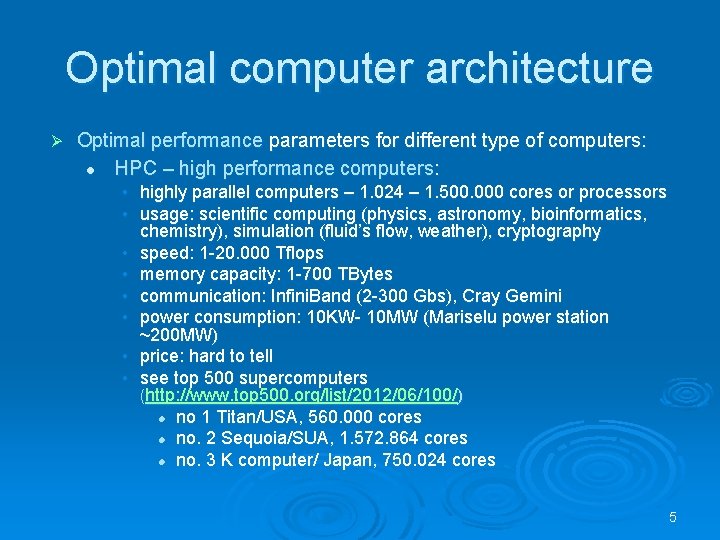
Optimal computer architecture Ø Optimal performance parameters for different type of computers: l HPC – high performance computers: • highly parallel computers – 1. 024 – 1. 500. 000 cores or processors • usage: scientific computing (physics, astronomy, bioinformatics, chemistry), simulation (fluid’s flow, weather), cryptography • speed: 1 -20. 000 Tflops • memory capacity: 1 -700 TBytes • communication: Infini. Band (2 -300 Gbs), Cray Gemini • power consumption: 10 KW- 10 MW (Mariselu power station ~200 MW) • price: hard to tell • see top 500 supercomputers (http: //www. top 500. org/list/2012/06/100/) l no 1 Titan/USA, 560. 000 cores l no. 2 Sequoia/SUA, 1. 572. 864 cores l no. 3 K computer/ Japan, 750. 024 cores 5
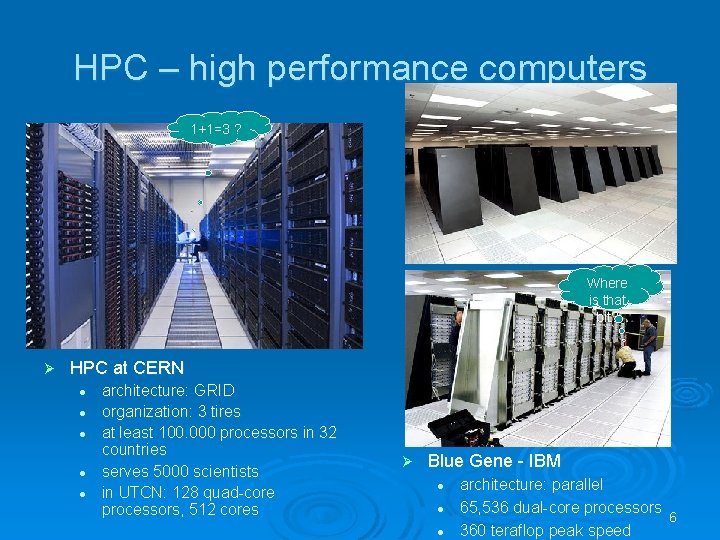
HPC – high performance computers 1+1=3 ? Where is that bit? Ø HPC at CERN l l l architecture: GRID organization: 3 tires at least 100. 000 processors in 32 countries serves 5000 scientists in UTCN: 128 quad-core processors, 512 cores Ø Blue Gene - IBM l l l architecture: parallel 65, 536 dual-core processors 6 360 teraflop peak speed
HPC – high performance computers Ø CG-UTCN – Centrul GRID al UTCN Ø Ø Ø 64 processor boards 128 quad-core processors, 512 cores 1024 virtual processors (hyper-threading) storage: 12 Tbytes price: 2. 000 RON 7
Optimal computer architecture Ø Optimal performance parameters for different type of computers l PC - personal computers: • single or multi-core systems – 1 -8 cores (1 -2 processors) • usage: engineering, accounting, administration, entertainment, document processing, communication • speed: 1 -200 Gflops • memory capacity: 1 -16 GBytes (internal), 0, 5 -1 TBytes (external) • communication: Ethernet (0, 1 -1 Gbs) • power consumption: 400 -800 W • price: 500 -1000 USD • dimensional types: desktop, laptop, tablet, hand-held 8
Optimal computer architecture Ø Optimal performance parameters for different type of computers l Mobile devices: • • single or multi-core systems – 1 -4 cores (1 processors) usage: communication, entertainment, place-holder for PC speed: 20 -600 Mflops memory capacity: 0. 5 -2 GBytes (internal), communication: Wi. Fi, Bluetoth (10 -100 Mbs) power consumption: limited to the accumulator’s capacity price: 1 - 500 USD • dimensional limitations 9
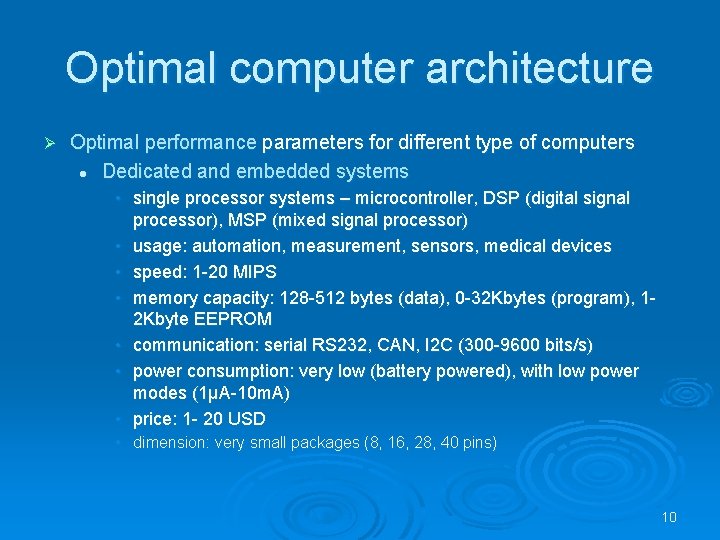
Optimal computer architecture Ø Optimal performance parameters for different type of computers l Dedicated and embedded systems • single processor systems – microcontroller, DSP (digital signal processor), MSP (mixed signal processor) • usage: automation, measurement, sensors, medical devices • speed: 1 -20 MIPS • memory capacity: 128 -512 bytes (data), 0 -32 Kbytes (program), 12 Kbyte EEPROM • communication: serial RS 232, CAN, I 2 C (300 -9600 bits/s) • power consumption: very low (battery powered), with low power modes (1μA-10 m. A) • price: 1 - 20 USD • dimension: very small packages (8, 16, 28, 40 pins) 10
Measuring the performance of a computer – benchmark programs Definition 1 (wikipedia): a benchmark is the act of running a computer program, a set of programs, or other operations, in order to assess the relative performance of an object, normally by running a number of standard tests and trials against it. Ø Definition 2: a method of comparing the performance of various computer systems Ø Measuring and assessing the performance of a system is not a trivial task: Ø l l some computers/CPUs perform better for some tests and worse for others (e. g. good results for image processing but less good for database applications) performance should be a weighted average of a number of specific tests 11
Benchmark programs Ø Real programs l l word processing software user's application software Ø Component Benchmarks/ micro- benchmarks l Ø Micro-benchmarks l Designed to measure the performance of a very small and specific piece of code. Ø Kernel l l contains codes that perform a specific basic operation normally abstracted from actual program popular kernel: Livermore loops (every loop is a mathematical operation) Linpack benchmark (contains basic linear algebra subroutines) results are represented in MFLOPS l programs designed to measure performance of a computer's basic components automatic detection of computer's hardware parameters like number of registers, cache size, memory latency Ø Synthetic Benchmarks l Procedure for programming synthetic benchmark: • take statistics of all types of operations from many application programs • get proportion of each operation • write program based on the proportion above l Types of Synthetic Benchmark are: • Dhrystone – integer arithmetic • Whetstone – integer and floating point arithmetic 12
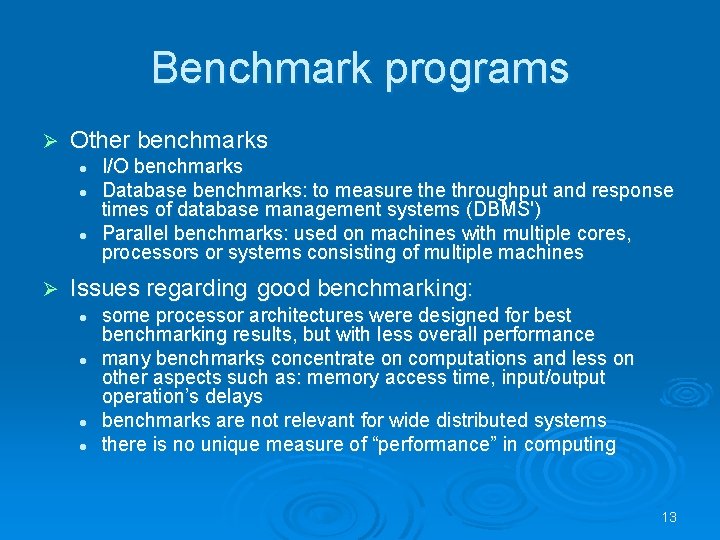
Benchmark programs Ø Other benchmarks l l l Ø I/O benchmarks Database benchmarks: to measure throughput and response times of database management systems (DBMS') Parallel benchmarks: used on machines with multiple cores, processors or systems consisting of multiple machines Issues regarding good benchmarking: l l some processor architectures were designed for best benchmarking results, but with less overall performance many benchmarks concentrate on computations and less on other aspects such as: memory access time, input/output operation’s delays benchmarks are not relevant for wide distributed systems there is no unique measure of “performance” in computing 13
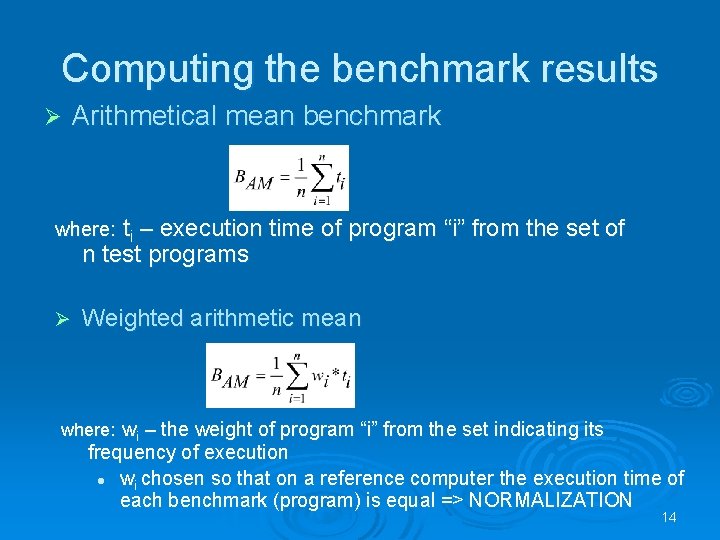
Computing the benchmark results Ø Arithmetical mean benchmark ti – execution time of program “i” from the set of n test programs where: Ø Weighted arithmetic mean where: wi – the weight of program “i” from the set indicating its frequency of execution l wi chosen so that on a reference computer the execution time of each benchmark (program) is equal => NORMALIZATION 14
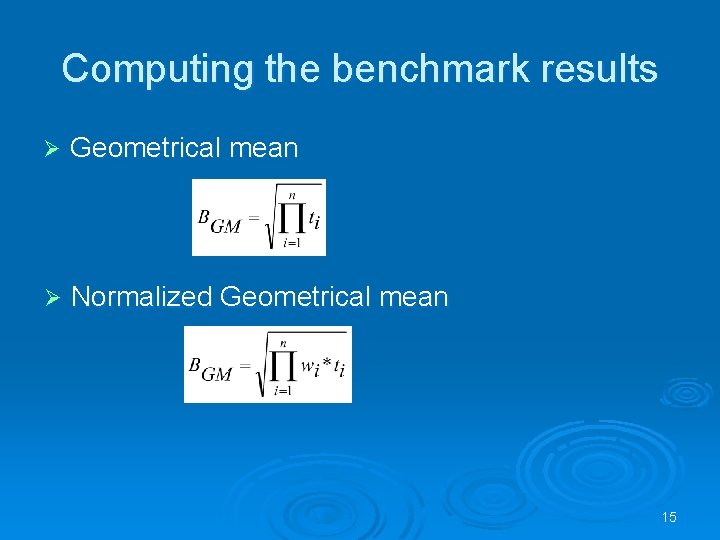
Computing the benchmark results Ø Geometrical mean Ø Normalized Geometrical mean 15
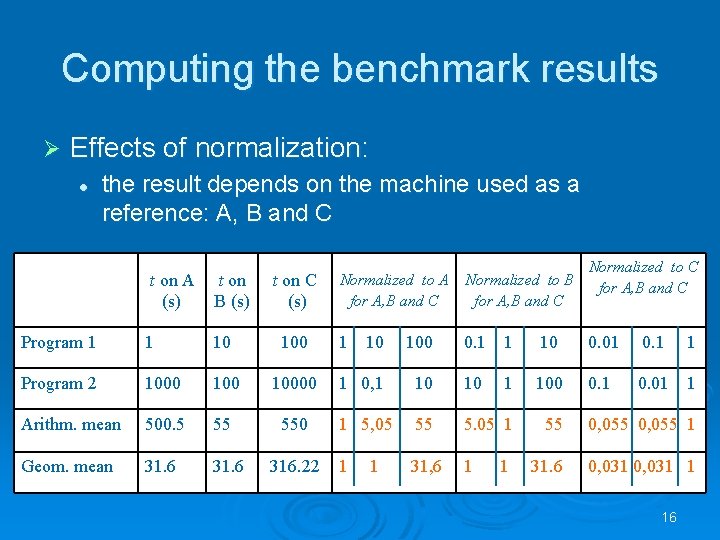
Computing the benchmark results Ø Effects of normalization: l the result depends on the machine used as a reference: A, B and C Normalized to C for A, B and C t on A t on (s) B (s) Program 1 1 10 100 1 10 100 0. 1 1 10 0. 01 0. 1 1 Program 2 10000 1 0, 1 10 1 100 0. 1 0. 01 1 Arithm. mean 500. 5 55 550 1 5, 05 55 5. 05 1 55 0, 055 1 Geom. mean 31. 6 316. 22 1 1 31, 6 1 1 31. 6 0, 031 1 t on C (s) Normalized to A for A, B and C Normalized to B for A, B and C 16
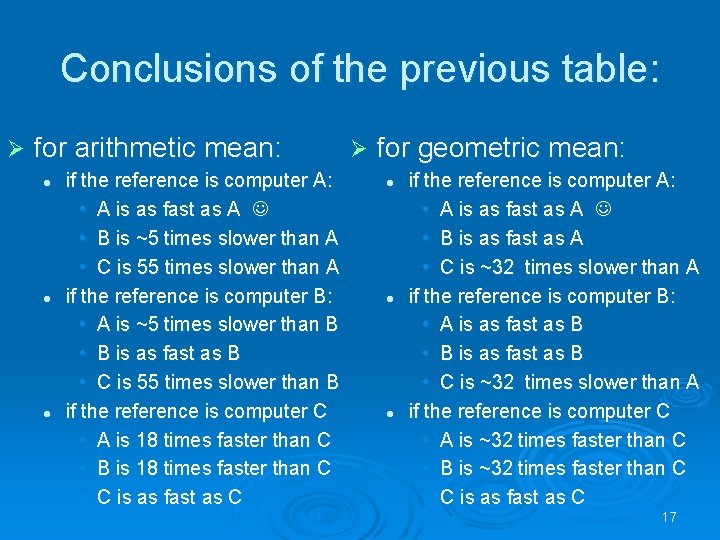
Conclusions of the previous table: Ø for arithmetic mean: l l l if the reference is computer A: • A is as fast as A • B is ~5 times slower than A • C is 55 times slower than A if the reference is computer B: • A is ~5 times slower than B • B is as fast as B • C is 55 times slower than B if the reference is computer C • A is 18 times faster than C • B is 18 times faster than C • C is as fast as C Ø for geometric mean: l l l if the reference is computer A: • A is as fast as A • B is as fast as A • C is ~32 times slower than A if the reference is computer B: • A is as fast as B • B is as fast as B • C is ~32 times slower than A if the reference is computer C • A is ~32 times faster than C • B is ~32 times faster than C • C is as fast as C 17
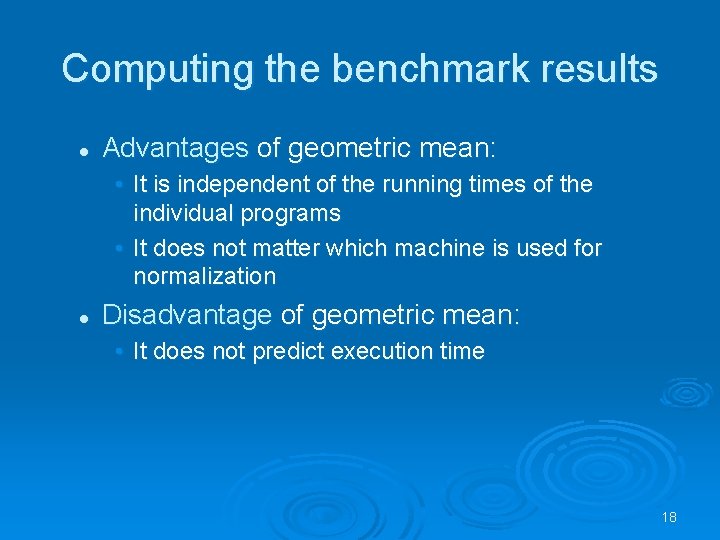
Computing the benchmark results l Advantages of geometric mean: • It is independent of the running times of the individual programs • It does not matter which machine is used for normalization l Disadvantage of geometric mean: • It does not predict execution time 18
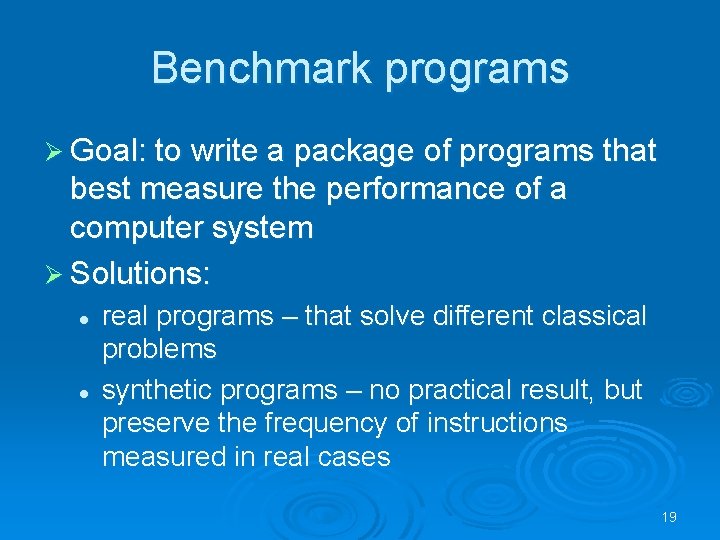
Benchmark programs Ø Goal: to write a package of programs that best measure the performance of a computer system Ø Solutions: l l real programs – that solve different classical problems synthetic programs – no practical result, but preserve the frequency of instructions measured in real cases 19
Examples of benchmark programs Ø Whetstone synthetic program l l l Ø Dhrystone synthetic program l l Ø Published in 1976 by the National Physical Laboratory (NPL), Great Britain preserves the frequency of instructions in scientific and engineering applications written in Algol and later in Fortran and Pascal floating point instructions have an important role Published in 1984 preserves the frequency of instructions in system programming (e. g. operating system components) using Ada and C programming language frequency measurements are published no emphasis on FP operations Issues with synthetic benchmarks: l l does not reflect well the needs of a real application some computer architectures were optimized for best performance regarding synthetic benchmarks, but with less performance on real applications 20
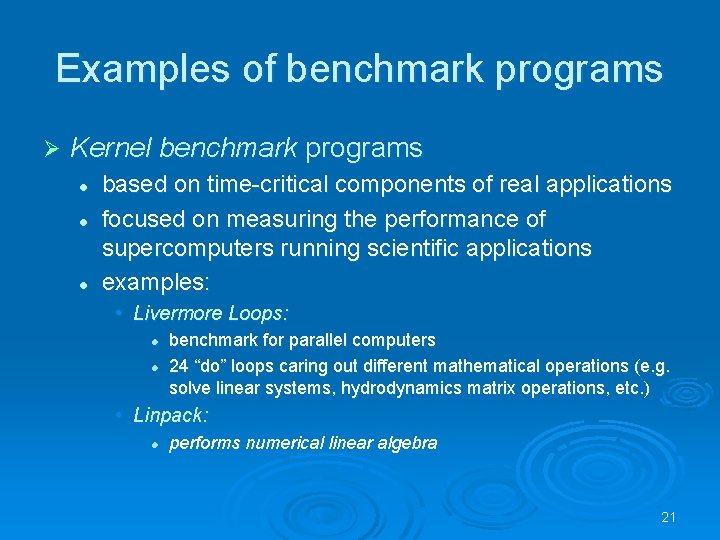
Examples of benchmark programs Ø Kernel benchmark programs l l l based on time-critical components of real applications focused on measuring the performance of supercomputers running scientific applications examples: • Livermore Loops: l l benchmark for parallel computers 24 “do” loops caring out different mathematical operations (e. g. solve linear systems, hydrodynamics matrix operations, etc. ) • Linpack: l performs numerical linear algebra 21
Examples of benchmark programs Ø SPEC - Standard Performance Evaluation Corporation l a non-profit international organization focused on developing standard tools for measuring the performance of computer systems l www. spec. org l develops standard sets of benchmarks based on real applications l benchmark sets contain source codes l there also tools for generating performance reports 22
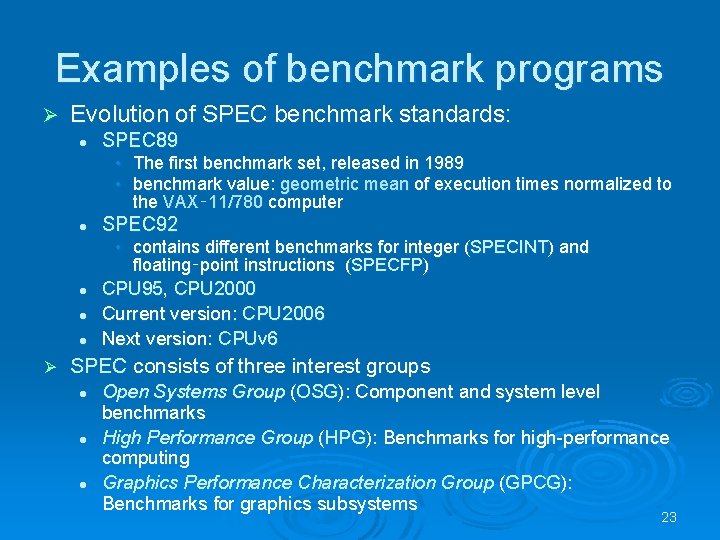
Examples of benchmark programs Ø Evolution of SPEC benchmark standards: l SPEC 89 • The first benchmark set, released in 1989 • benchmark value: geometric mean of execution times normalized to the VAX‑ 11/780 computer l SPEC 92 l • contains different benchmarks for integer (SPECINT) and floating‑point instructions (SPECFP) CPU 95, CPU 2000 Current version: CPU 2006 Next version: CPUv 6 l l Ø SPEC consists of three interest groups l l l Open Systems Group (OSG): Component and system level benchmarks High Performance Group (HPG): Benchmarks for high-performance computing Graphics Performance Characterization Group (GPCG): Benchmarks for graphics subsystems 23
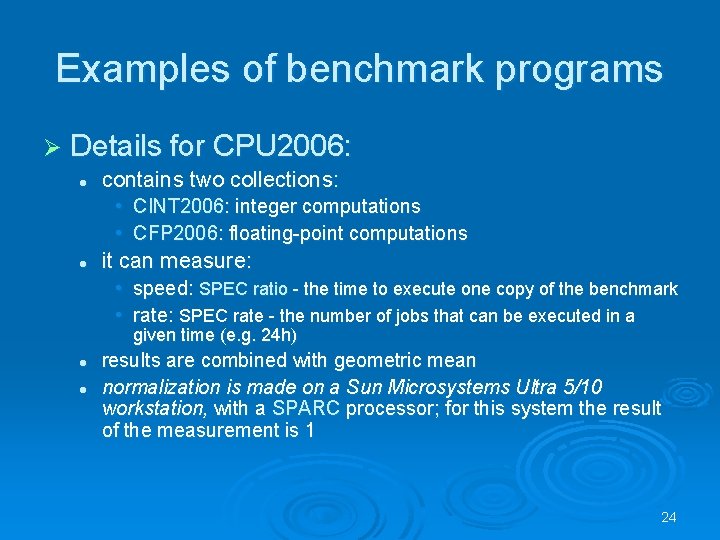
Examples of benchmark programs Ø Details for CPU 2006: l contains two collections: • CINT 2006: integer computations • CFP 2006: floating-point computations l it can measure: • speed: SPEC ratio - the time to execute one copy of the benchmark • rate: SPEC rate - the number of jobs that can be executed in a given time (e. g. 24 h) l l results are combined with geometric mean normalization is made on a Sun Microsystems Ultra 5/10 workstation, with a SPARC processor; for this system the result of the measurement is 1 24
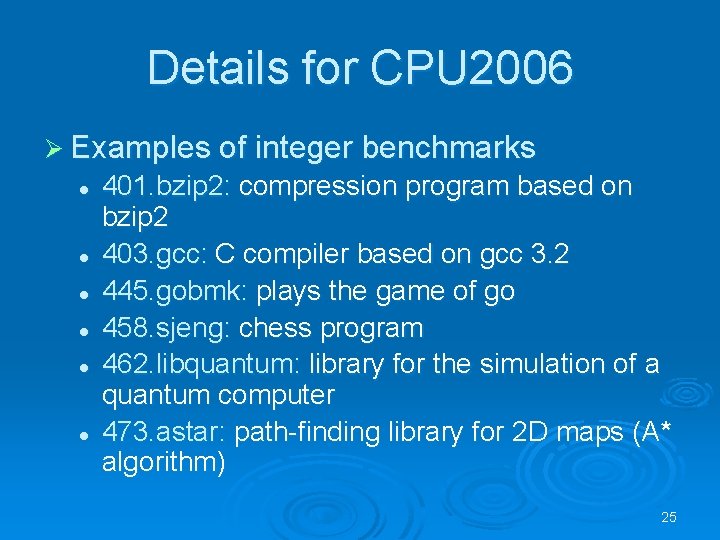
Details for CPU 2006 Ø Examples of integer benchmarks l l l 401. bzip 2: compression program based on bzip 2 403. gcc: C compiler based on gcc 3. 2 445. gobmk: plays the game of go 458. sjeng: chess program 462. libquantum: library for the simulation of a quantum computer 473. astar: path-finding library for 2 D maps (A* algorithm) 25
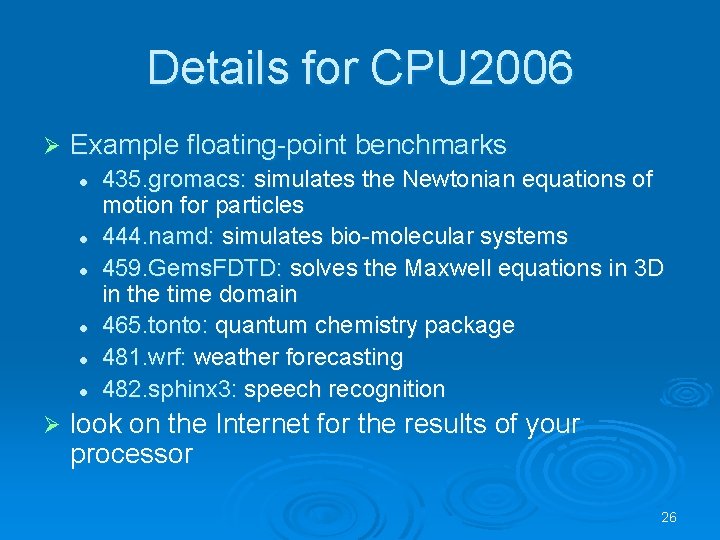
Details for CPU 2006 Ø Example floating-point benchmarks l l l Ø 435. gromacs: simulates the Newtonian equations of motion for particles 444. namd: simulates bio-molecular systems 459. Gems. FDTD: solves the Maxwell equations in 3 D in the time domain 465. tonto: quantum chemistry package 481. wrf: weather forecasting 482. sphinx 3: speech recognition look on the Internet for the results of your processor 26