
Structure of Computer Systems Course 11 Parallel computer
- Slides: 37
Structure of Computer Systems Course 11 Parallel computer architectures
Motivations Ø Why parallel execution? l users want faster-and-faster computers - why? • advanced multimedia processing • scientific computing: physics, info-biology (e. g. DNA analysis), medicine, chemistry, earth sciences) • implementation of heavy-load servers: multimedia provisioning • why not !!!! l performance improvement through clock frequency increase is no longer possible • power dissipation issues limit the clock signal’s frequency to 2 -3 GHz l continue to maintain the Moor’s Law regarding performance increase through parallelization
How ? Ø Parallelization principle: l l l “if one processor cannot make a computation (execute an application) in a reasonable time more processors should be involved in the computation” similar, as in the case of human activities some parts or whole computer systems can work simultaneously: • • multiple ALUs multiple instruction executing units multiple CPU-s multiple computer systems
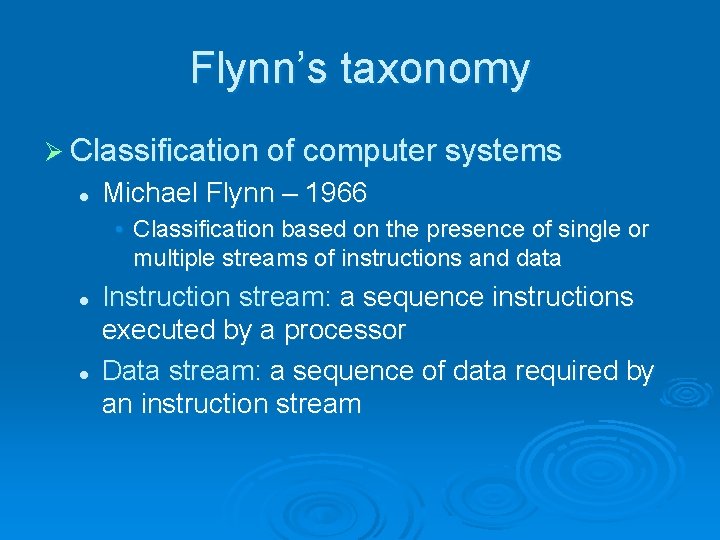
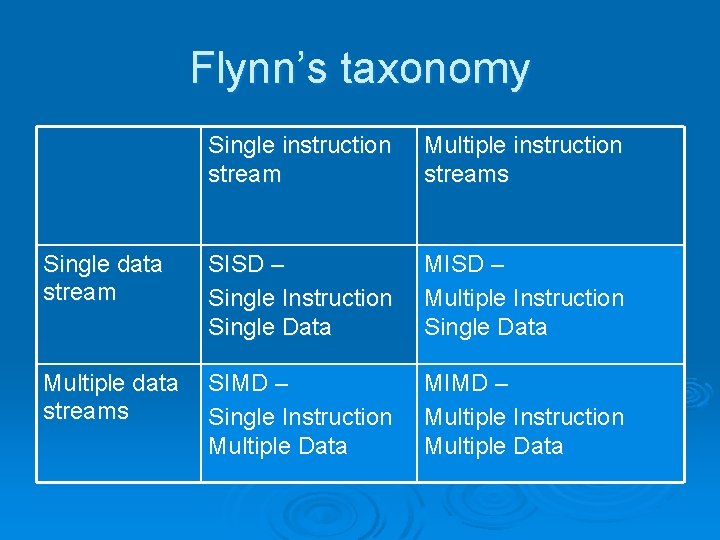
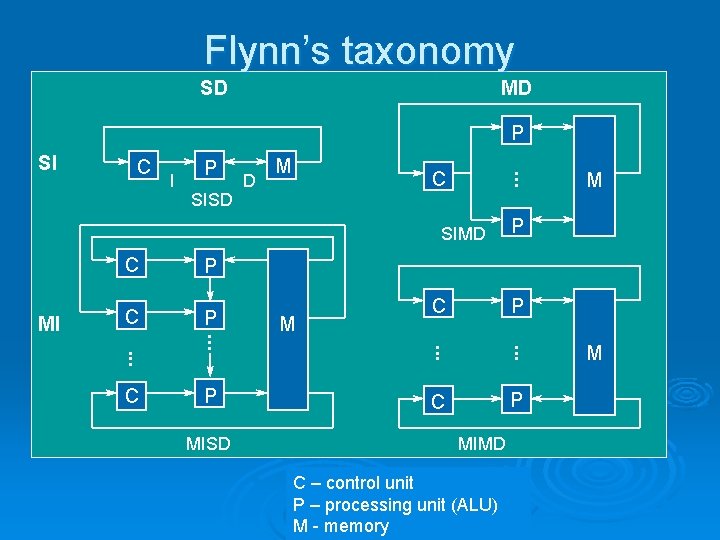
Flynn’s taxonomy Ø Classification of computer systems l Michael Flynn – 1966 • Classification based on the presence of single or multiple streams of instructions and data l l Instruction stream: a sequence instructions executed by a processor Data stream: a sequence of data required by an instruction stream
Flynn’s taxonomy Single instruction stream Multiple instruction streams Single data stream SISD – Single Instruction Single Data MISD – Multiple Instruction Single Data Multiple data streams SIMD – Single Instruction Multiple Data MIMD – Multiple Instruction Multiple Data
Flynn’s taxonomy SD MD P SI C I P SISD D M . . . C SIMD MI C P. . . C P MISD M P C P . . . C P MIMD C – control unit P – processing unit (ALU) M - memory M M
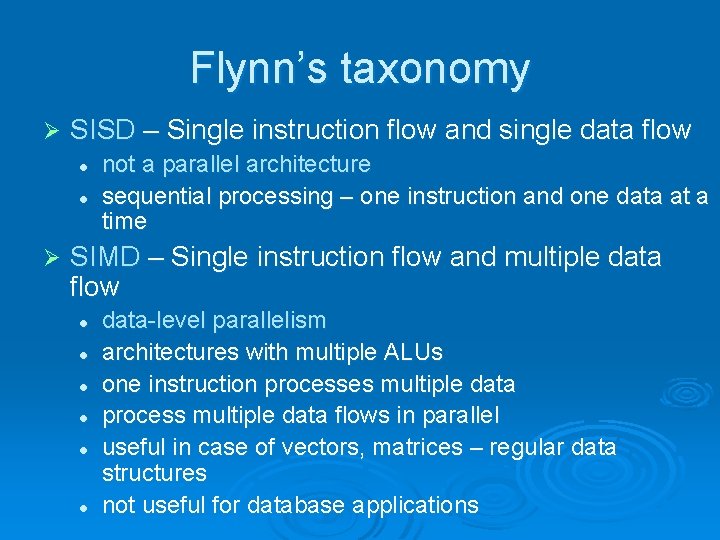
Flynn’s taxonomy Ø SISD – Single instruction flow and single data flow l l Ø not a parallel architecture sequential processing – one instruction and one data at a time SIMD – Single instruction flow and multiple data flow l l l data-level parallelism architectures with multiple ALUs one instruction processes multiple data process multiple data flows in parallel useful in case of vectors, matrices – regular data structures not useful for database applications
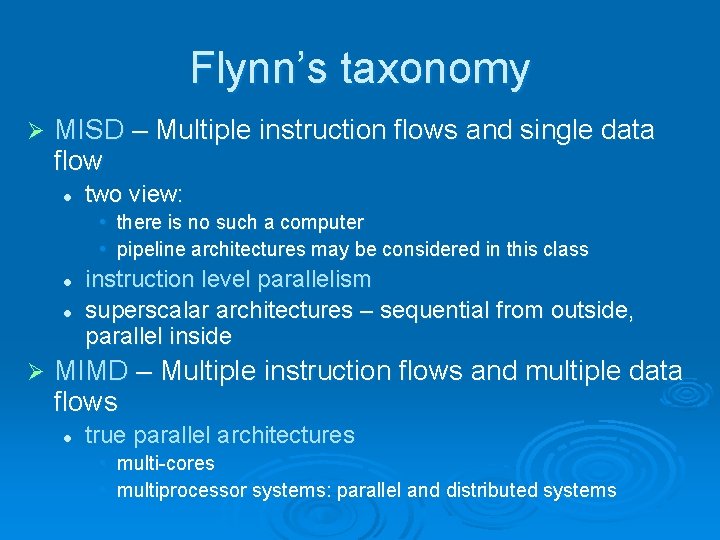
Flynn’s taxonomy Ø MISD – Multiple instruction flows and single data flow l two view: • there is no such a computer • pipeline architectures may be considered in this class l l Ø instruction level parallelism superscalar architectures – sequential from outside, parallel inside MIMD – Multiple instruction flows and multiple data flows l true parallel architectures • multi-cores • multiprocessor systems: parallel and distributed systems
Issues regarding parallel execution Ø subjective issues (which depends on us): l l human thinking is mainly sequential – hard to imagine doing thinks in parallel hard to divide a problem in parts that can be executed simultaneously • multitasking, multi-threading • some problems/applications are inherently parallel (e. g. if data is organized on vectors, if there are loops in the program, etc. ) • how to divide a problem between 100 -1000 parallel units l hard to predict consequences of parallel execution • e. g. concurrent access to shared resources • writing multi-thread-safe applications
Issues regarding parallel execution Ø objective issues l efficient access to shared resources • • • l shared memory shared data paths (buses) shared I/O facilities efficient communication between intelligent parts • interconnection networks, multiple buses, pipes, shared memory zones l synchronization and mutual exclusion • causal dependencies • consecutive start and end of tasks l data-race and I/O-race
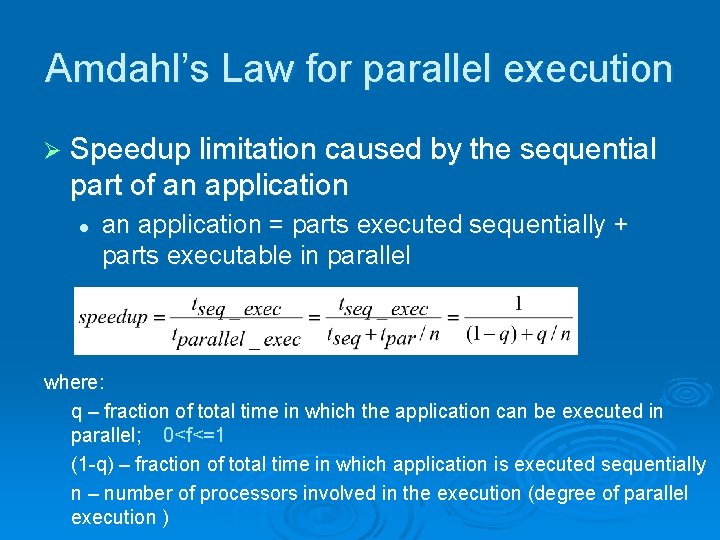
Amdahl’s Law for parallel execution Ø Speedup limitation caused by the sequential part of an application l an application = parts executed sequentially + parts executable in parallel where: q – fraction of total time in which the application can be executed in parallel; 0<f<=1 (1 -q) – fraction of total time in which application is executed sequentially n – number of processors involved in the execution (degree of parallel execution )
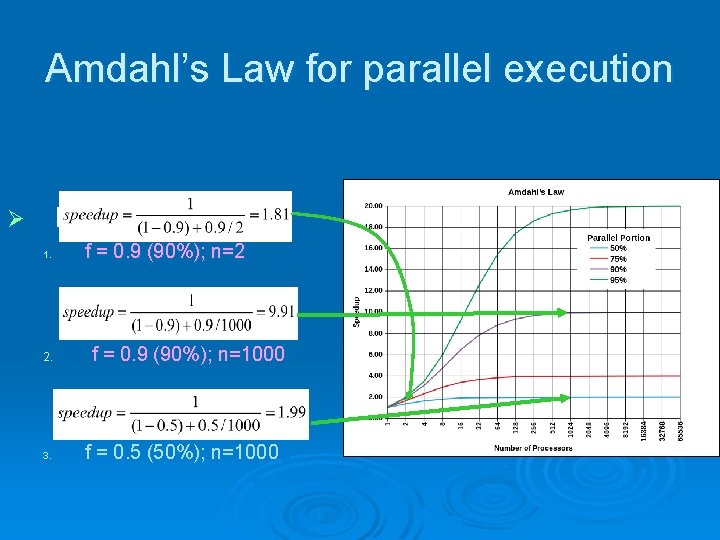
Amdahl’s Law for parallel execution Examples: Ø 1. 2. 3. f = 0. 9 (90%); n=2 f = 0. 9 (90%); n=1000 f = 0. 5 (50%); n=1000
Parallel architectures Data level parallelism (DLP) l l SIMD architectures use of multiple parallel ALUs it is efficient if the same operation must be performed on all the elements of a vector or matrix example of applications that can benefit: • signal processing, image processing • graphical rendering and simulation • scientific computations with vectors and matrices l versions: • • • l vector architectures systolic array neural architectures examples: • Pentium II – MMX and SSE 2
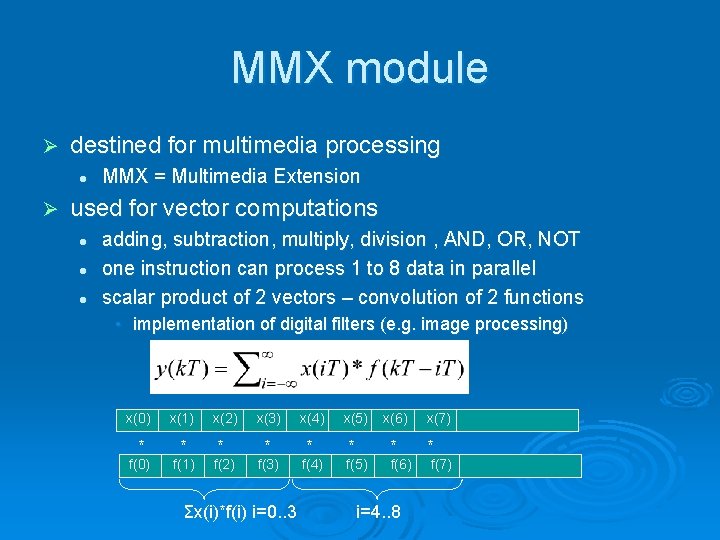
MMX module Ø destined for multimedia processing l Ø MMX = Multimedia Extension used for vector computations l l l adding, subtraction, multiply, division , AND, OR, NOT one instruction can process 1 to 8 data in parallel scalar product of 2 vectors – convolution of 2 functions • implementation of digital filters (e. g. image processing) x(0) x(1) * * f(0) f(1) x(2) * f(2) x(3) x(4) * * f(3) Σx(i)*f(i) i=0. . 3 f(4) x(5) * f(5) x(6) * f(6) i=4. . 8 x(7) * f(7)
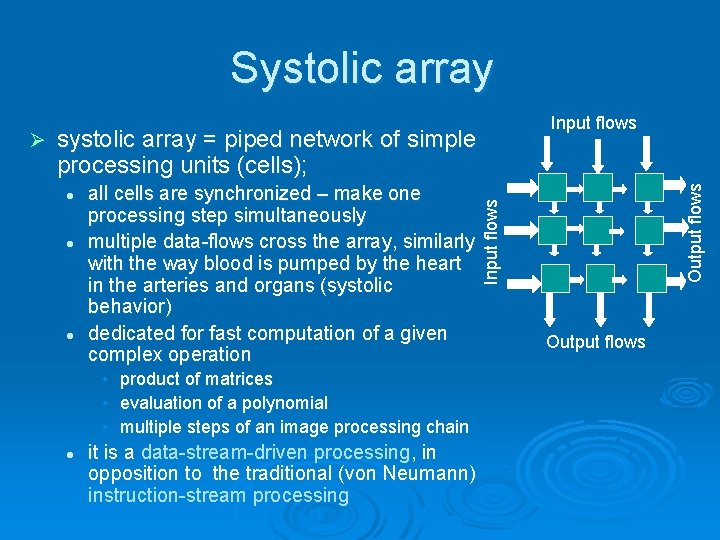
Systolic array l l l all cells are synchronized – make one processing step simultaneously multiple data-flows cross the array, similarly with the way blood is pumped by the heart in the arteries and organs (systolic behavior) dedicated for fast computation of a given complex operation • product of matrices • evaluation of a polynomial • multiple steps of an image processing chain l it is a data-stream-driven processing, in opposition to the traditional (von Neumann) instruction-stream processing Output flows systolic array = piped network of simple processing units (cells); Input flows Ø Input flows Output flows
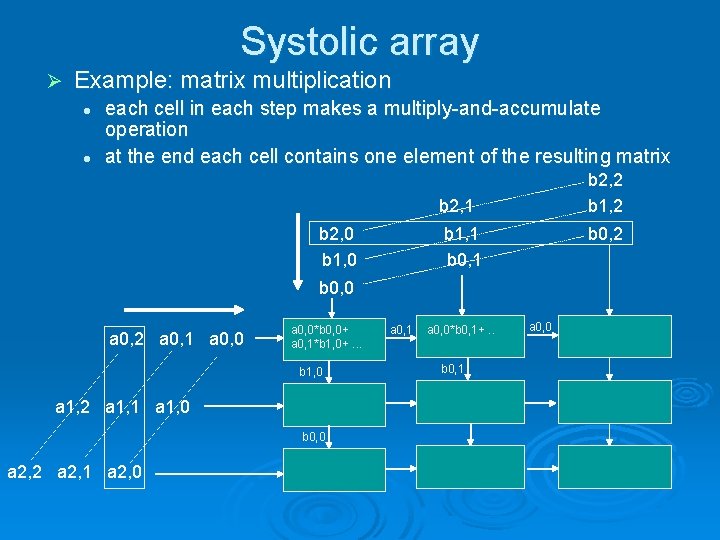
Systolic array Ø Example: matrix multiplication l l each cell in each step makes a multiply-and-accumulate operation at the end each cell contains one element of the resulting matrix b 2, 2 b 1, 2 b 2, 1 b 2, 0 b 1, 1 b 0, 2 b 0, 0 a 0, 2 a 0, 1 a 0, 0*b 0, 0+ a 0, 1*b 1, 0+. . . b 1, 0 a 1, 2 a 1, 1 a 1, 0 b 0, 0 a 2, 2 a 2, 1 a 2, 0 a 0, 1 a 0, 0*b 0, 1+. . b 0, 1 a 0, 0
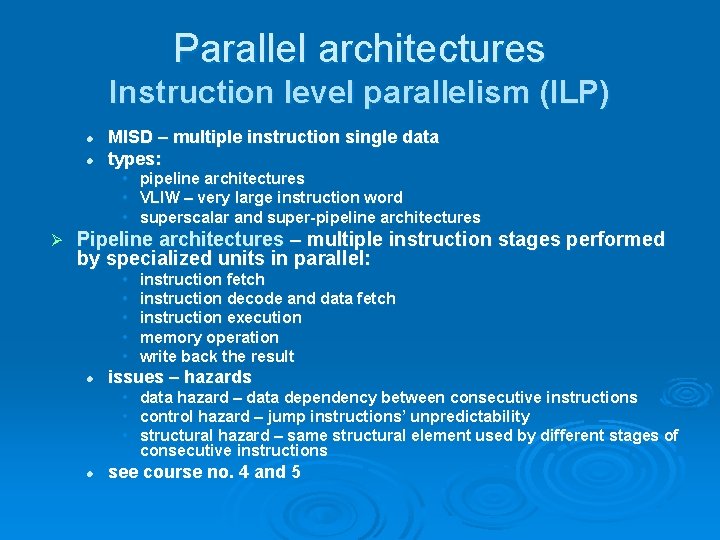
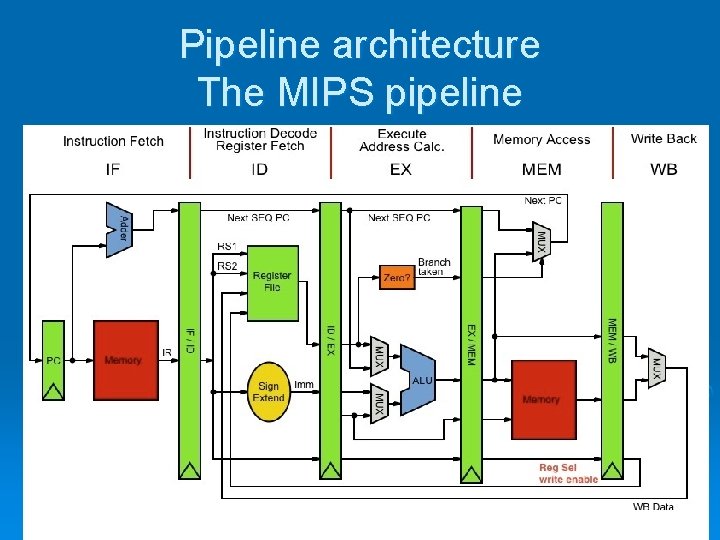
Parallel architectures Instruction level parallelism (ILP) l l MISD – multiple instruction single data types: • pipeline architectures • VLIW – very large instruction word • superscalar and super-pipeline architectures Ø Pipeline architectures – multiple instruction stages performed by specialized units in parallel: • • • l instruction fetch instruction decode and data fetch instruction execution memory operation write back the result issues – hazards • data hazard – data dependency between consecutive instructions • control hazard – jump instructions’ unpredictability • structural hazard – same structural element used by different stages of consecutive instructions l see course no. 4 and 5
Pipeline architecture The MIPS pipeline
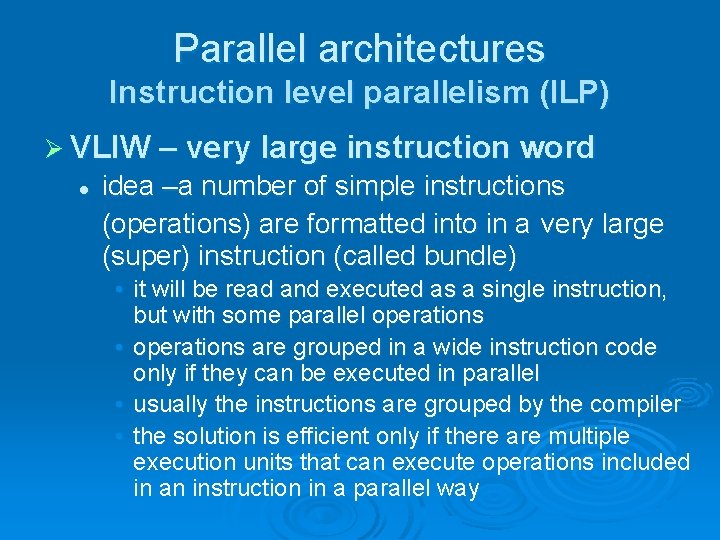
Parallel architectures Instruction level parallelism (ILP) Ø VLIW – very large instruction word l idea –a number of simple instructions (operations) are formatted into in a very large (super) instruction (called bundle) • it will be read and executed as a single instruction, but with some parallel operations • operations are grouped in a wide instruction code only if they can be executed in parallel • usually the instructions are grouped by the compiler • the solution is efficient only if there are multiple execution units that can execute operations included in an instruction in a parallel way
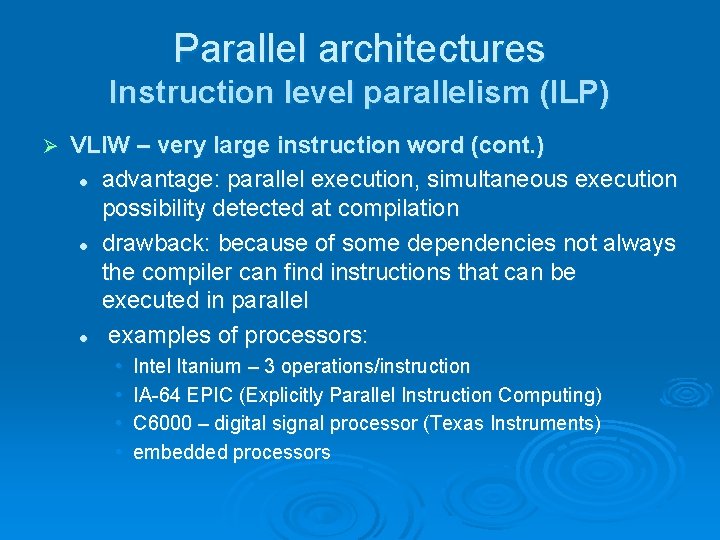
Parallel architectures Instruction level parallelism (ILP) Ø VLIW – very large instruction word (cont. ) l advantage: parallel execution, simultaneous execution possibility detected at compilation l drawback: because of some dependencies not always the compiler can find instructions that can be executed in parallel l examples of processors: • • Intel Itanium – 3 operations/instruction IA-64 EPIC (Explicitly Parallel Instruction Computing) C 6000 – digital signal processor (Texas Instruments) embedded processors
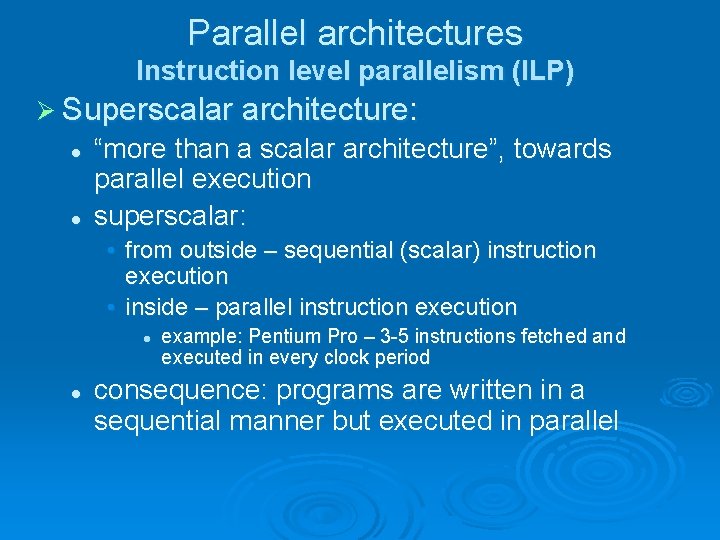
Parallel architectures Instruction level parallelism (ILP) Ø Superscalar architecture: l l “more than a scalar architecture”, towards parallel execution superscalar: • from outside – sequential (scalar) instruction execution • inside – parallel instruction execution l l example: Pentium Pro – 3 -5 instructions fetched and executed in every clock period consequence: programs are written in a sequential manner but executed in parallel
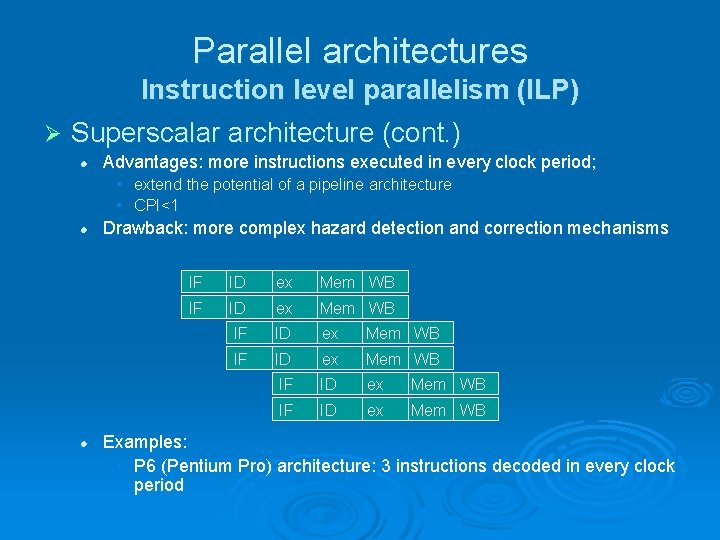
Parallel architectures Instruction level parallelism (ILP) Ø Superscalar architecture (cont. ) l Advantages: more instructions executed in every clock period; • extend the potential of a pipeline architecture • CPI<1 l l Drawback: more complex hazard detection and correction mechanisms IF ID ex Mem WB IF ID ex Mem WB Examples: • P 6 (Pentium Pro) architecture: 3 instructions decoded in every clock period
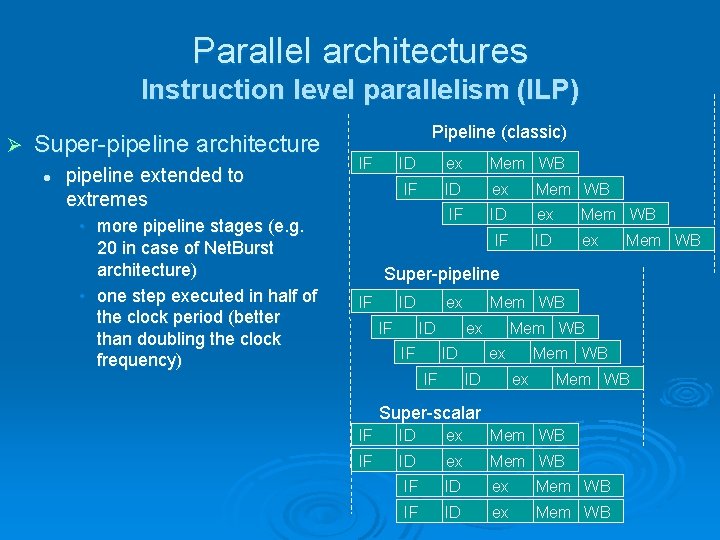
Parallel architectures Instruction level parallelism (ILP) Ø Super-pipeline architecture l pipeline extended to extremes • more pipeline stages (e. g. 20 in case of Net. Burst architecture) • one step executed in half of the clock period (better than doubling the clock frequency) Pipeline (classic) IF ID ex Mem WB Super-pipeline IF ID IF ex ID IF Mem WB ex ID Mem WB ex Mem WB Super-scalar IF ID ex Mem WB
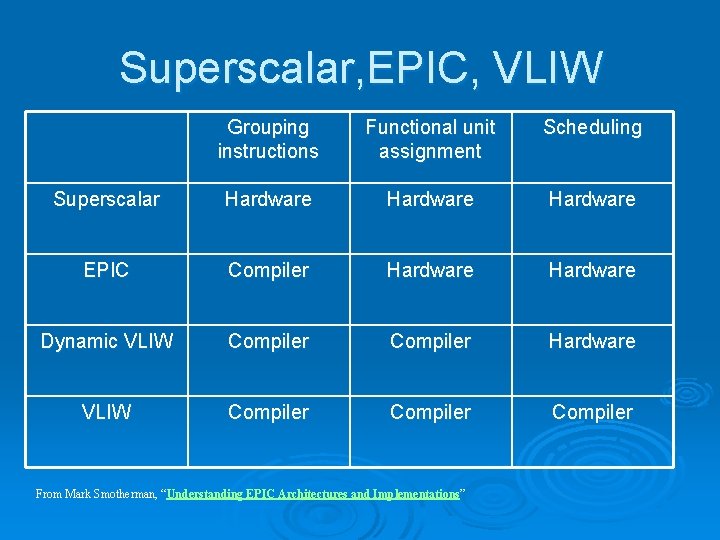
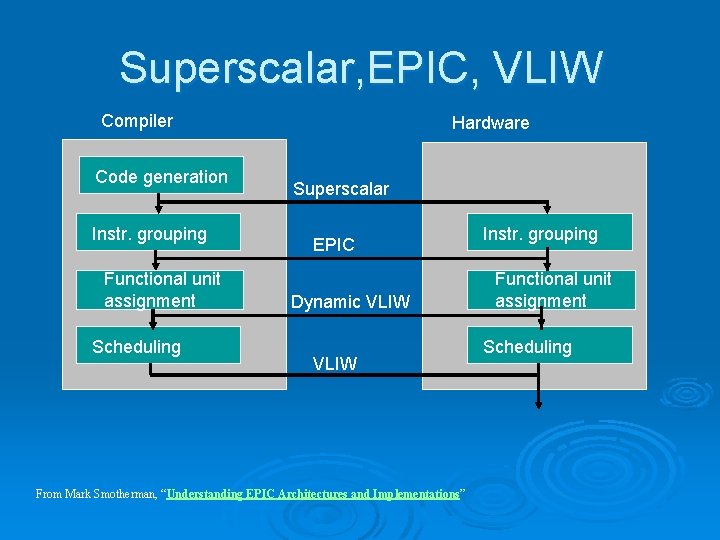
Superscalar, EPIC, VLIW Grouping instructions Functional unit assignment Scheduling Superscalar Hardware EPIC Compiler Hardware Dynamic VLIW Compiler Hardware VLIW Compiler From Mark Smotherman, “Understanding EPIC Architectures and Implementations”
Superscalar, EPIC, VLIW Compiler Code generation Instr. grouping Functional unit assignment Scheduling Hardware Superscalar EPIC Dynamic VLIW From Mark Smotherman, “Understanding EPIC Architectures and Implementations” Instr. grouping Functional unit assignment Scheduling
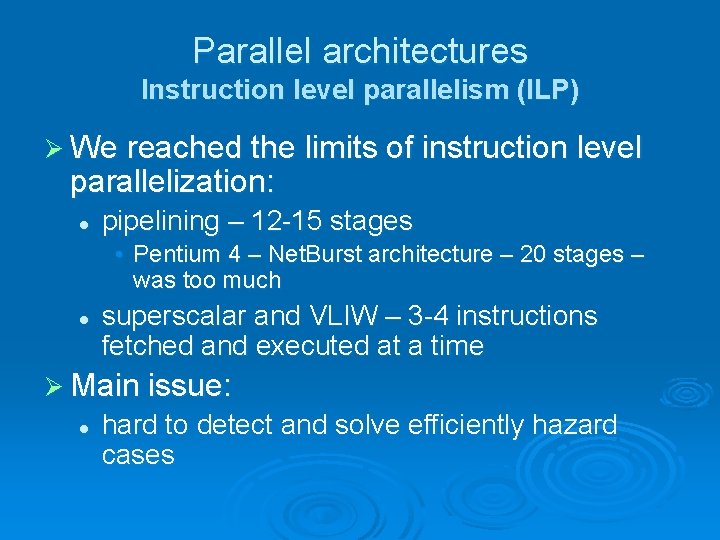
Parallel architectures Instruction level parallelism (ILP) Ø We reached the limits of instruction level parallelization: l pipelining – 12 -15 stages • Pentium 4 – Net. Burst architecture – 20 stages – was too much l superscalar and VLIW – 3 -4 instructions fetched and executed at a time Ø Main issue: l hard to detect and solve efficiently hazard cases
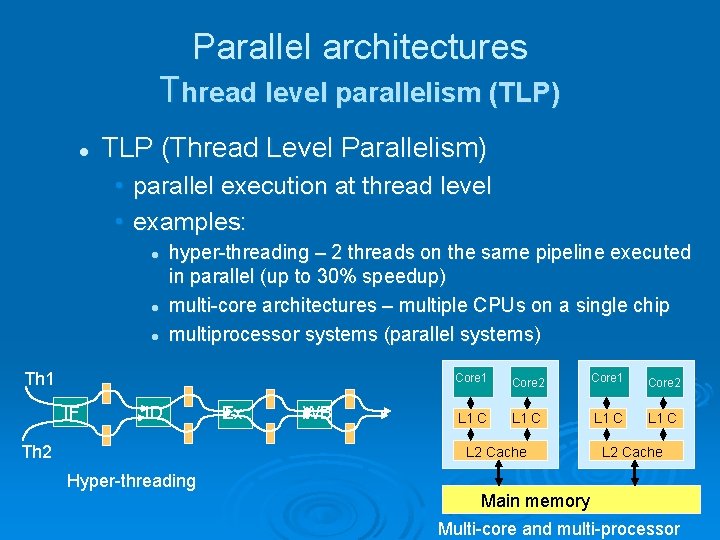
Parallel architectures Thread level parallelism (TLP) l TLP (Thread Level Parallelism) • parallel execution at thread level • examples: l l l hyper-threading – 2 threads on the same pipeline executed in parallel (up to 30% speedup) multi-core architectures – multiple CPUs on a single chip multiprocessor systems (parallel systems) Th 1 IF ID Th 2 Ex WB Core 1 Core 2 L 1 C L 2 Cache Hyper-threading L 2 Cache Main memory Multi-core and multi-processor
Parallel architectures Thread level parallelism (TLP) Ø Issues: • transforming a sequential program into a multithread one: l l procedures transformed into threads loops (for, whiles, do. . . ) transformed into threads • synchronization • concurrent access to common resources • context-switch time => thread-safe programming
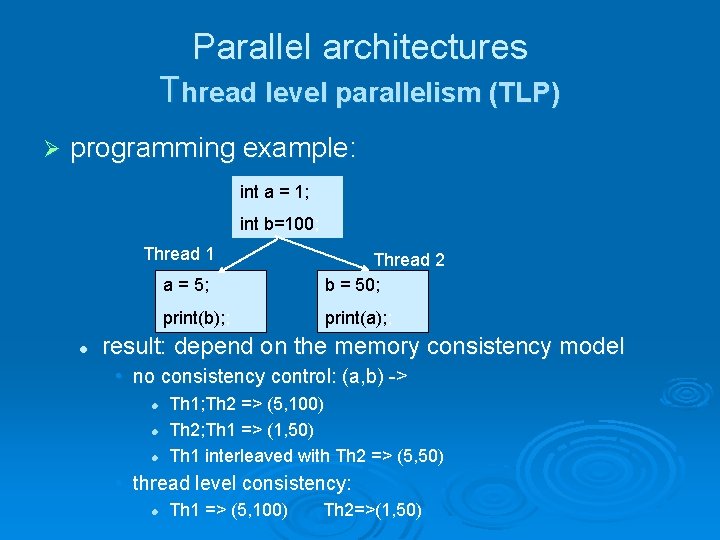
Parallel architectures Thread level parallelism (TLP) Ø programming example: int a = 1; int b=100; Thread 1 l a = 5; Thread 2 b = 50; print(b); ; print(a); ; result: depend on the memory consistency model • no consistency control: (a, b) -> l l l Th 1; Th 2 => (5, 100) Th 2; Th 1 => (1, 50) Th 1 interleaved with Th 2 => (5, 50) • thread level consistency: l Th 1 => (5, 100) Th 2=>(1, 50)
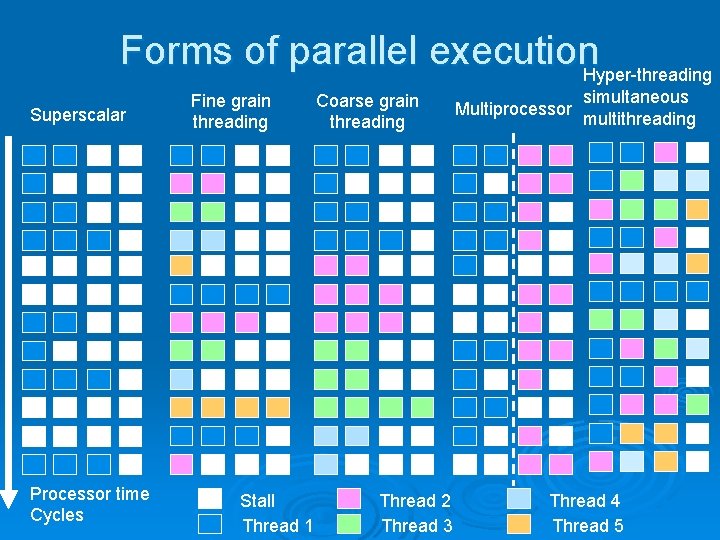
Parallel architectures Thread level parallelism (TLP) Ø when do we switch between threads? l l Fine grain threading – alternate after every instruction Coarse grain – alternate when one thread is stalled (e. g. cache miss)
Forms of parallel execution. Hyper-threading Superscalar Processor time Cycles Fine grain threading Stall Thread 1 Coarse grain threading Thread 2 Thread 3 Multiprocessor simultaneous multithreading Thread 4 Thread 5
Parallel architectures Thread level parallelism (TLP) Ø Fine-Grained Multithreading l l Switches between threads on each instruction, causing the execution of multiple threads to be interleaved Usually done in a round-robin fashion, skipping any stalled threads CPU must be able to switch threads every clock Advantage: it can hide both short and long stalls, • instructions from other threads executed when one thread stalls l l Disadvantage: it slows down execution of individual threads, since a thready to execute without stalls will be delayed by instructions from other threads Used on Sun’s Niagara
Parallel architectures Thread level parallelism (TLP) Ø Coarse-Grained Multithreading l l Switches threads only on costly stalls, such as L 2 cache misses Advantages • Relieves need to have very fast thread-switching • Doesn’t slow down thread, since instructions from other threads issued only when the thread encounters a costly stall l Disadvantage: • hard to overcome throughput losses from shorter stalls, due to pipeline start-up costs • Since CPU issues instructions from 1 thread, when a stall occurs, the pipeline must be emptied or frozen • New thread must fill pipeline before instructions can complete l l Because of this start-up overhead, coarse-grained multithreading is better for reducing penalty of high cost stalls, where pipeline refill << stall time Used in IBM AS/400
Parallel architectures PLP - Process Level Parallelism Ø Process: an execution unit in UNIX l l a secured environment to execute an application or task the operating system allocates resources at process level: • • • Ø protected memory zones I/O interfaces and interrupts file access system Thread – a ”light weight process” l l l a process may contain a number of threads; threads share resources allocated to a process no (or minimal) protection between threads of the same process
Parallel architectures PLP - Process Level Parallelism Ø Architectural support for PLP: l Multiprocessor systems (2 or more processors in one computer system) • processors managed by the operating system l GRID computer systems • many computers interconnected through a network • processors and storage managed by a middleware (Condor, g. Lite, Globus Toolkit) • example - EGI – European Grid Initiative • a special language to describe: l l l processing trees input files output files • advantage - hundreds of thousands of computers available for scientific purposes • drawback – batch processing, very little interaction between the system and the end-user l Cloud computer systems • computing infrastructure as a service • see Amazon: l l EC 2 – computing service – Elastic Computer Cloud S 3 – storage service – Simple Storage Service
Parallel architectures PLP - Process Level Parallelism Ø It’s more a question of software and not of computer architecture l the same computers may be part of a GRID or a Cloud Ø Hardware Requirements: l enough bandwidth between processors
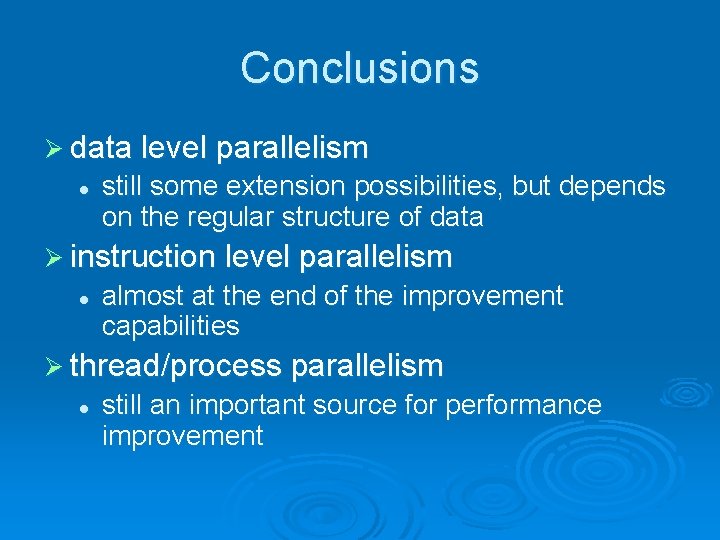
Conclusions Ø data level parallelism l still some extension possibilities, but depends on the regular structure of data Ø instruction level parallelism l almost at the end of the improvement capabilities Ø thread/process parallelism l still an important source for performance improvement