
Structure of Chromosome Dr m meenakshisundaram HEAD DEPT
- Slides: 37
Structure of Chromosome Dr. m. meenakshisundaram HEAD, DEPT OF BOTANY, NMC.
Definition • Chromosomes are self reproducing thread like structures packaged with DNA located inside the nucleus. • They are the vehicles of heredity. • The number of chromosomes varies from species to species. • The lowest number of chromosome 2 (Ascaris megalocephala) • The maximum number of chromosome 1700 (Radiolarian Protozoan). • Generally, chromosomes are arranged in pairs.
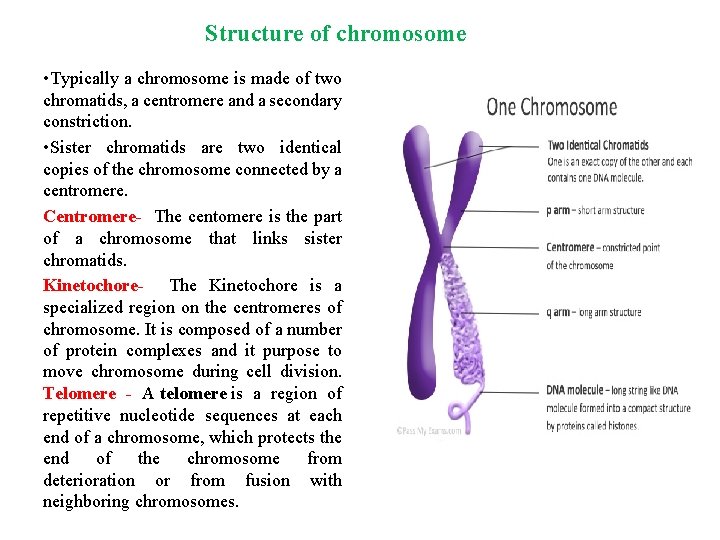
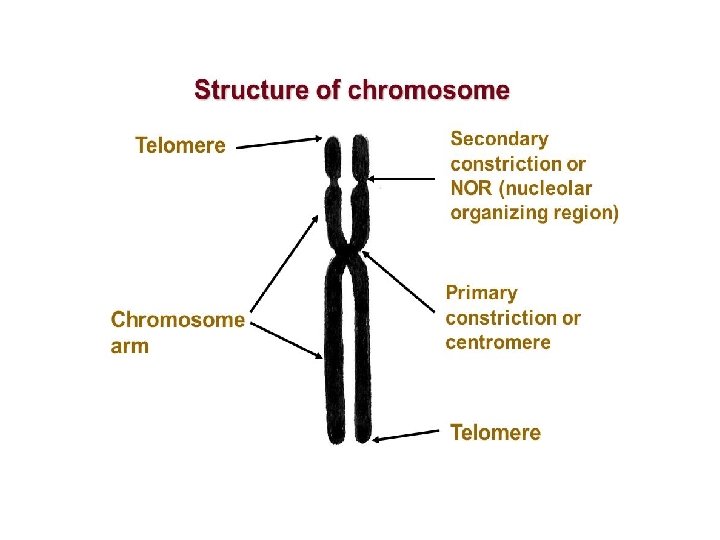
Structure of chromosome • Typically a chromosome is made of two chromatids, a centromere and a secondary constriction. • Sister chromatids are two identical copies of the chromosome connected by a centromere. Centromere- The centomere is the part of a chromosome that links sister chromatids. Kinetochore- The Kinetochore is a specialized region on the centromeres of chromosome. It is composed of a number of protein complexes and it purpose to move chromosome during cell division. Telomere - A telomere is a region of repetitive nucleotide sequences at each end of a chromosome, which protects the end of the chromosome from deterioration or from fusion with neighboring chromosomes.
Primary Constriction • Region at which two chromatids are joined in metaphase chromosomes, and to which spindle microtubules attach. • It appears narrower and more condensed than the arms. • Primary constriction is present in all chromosomes . • Secondary constriction • Actually centromere ( as it plays most important role in chromatid separation during anaphase ) is present within the primary constriction. • Secondary constriction is not present in all chromosomes. • Secondary constriction is also known as nucleolar organizer region as NOR is involved in the formation of nucleolus. • The location of (NOR) nucleolus organizer region or Secondary constriction is species specific as it plays most important role in karyosystematics or karyology and cytotaxonomy.
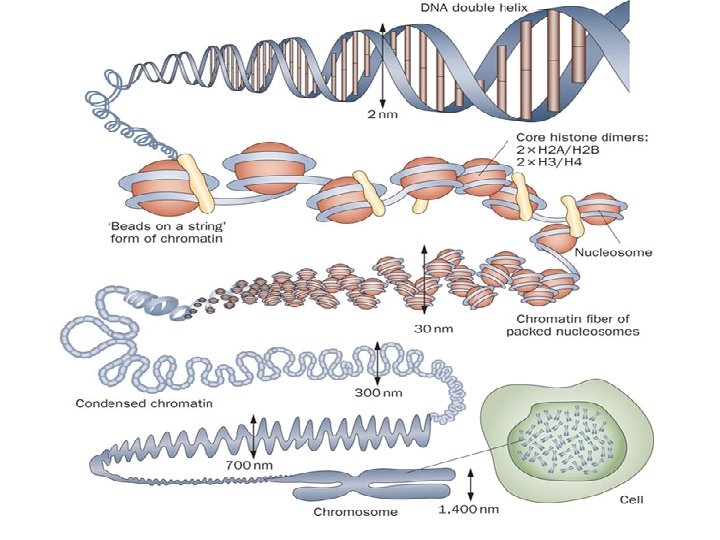
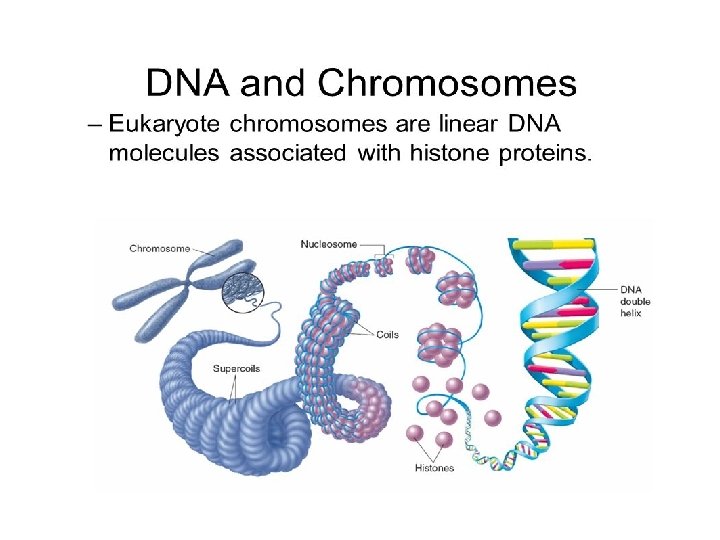
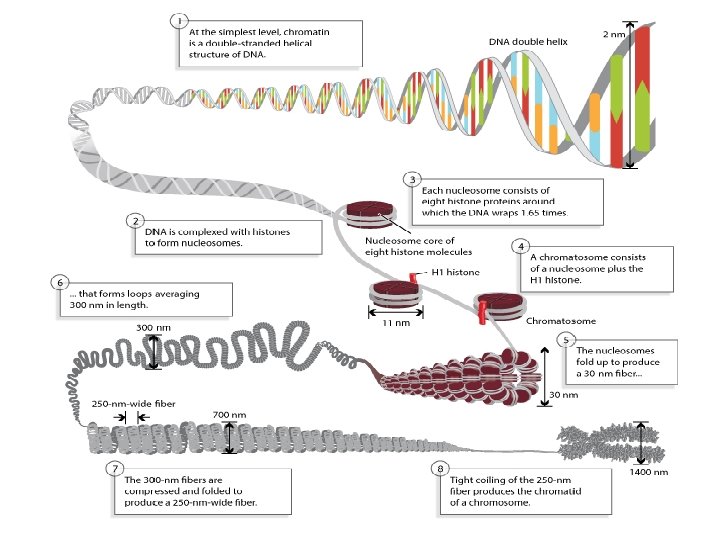
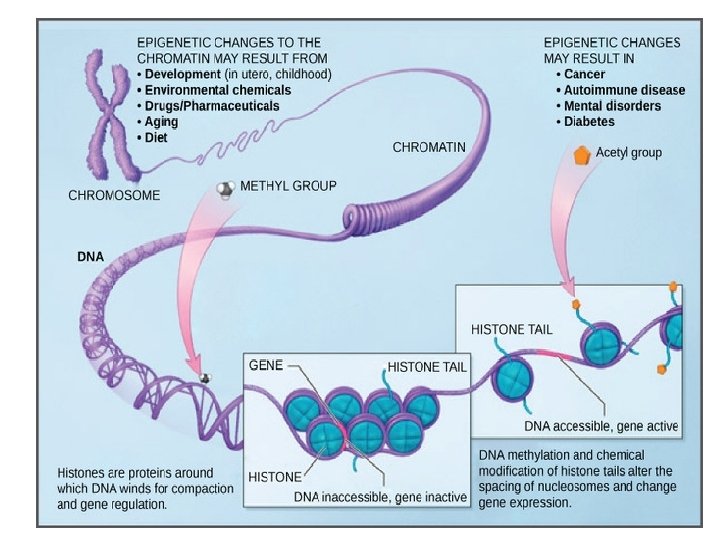
Histones • Histones are a family of basic proteins that associate with DNA in the nucleus and help condense it into chromatin. • Nuclear DNA does not appear in free linear strands. • It is highly condensed and wrapped around histones in order to fit inside of the nucleus and take part in the formation of chromosomes. • Histones are basic proteins, and their positive charges allow them to associate with DNA, which is negatively charged. • Some histones function as spools for the thread like DNA to wrap around.
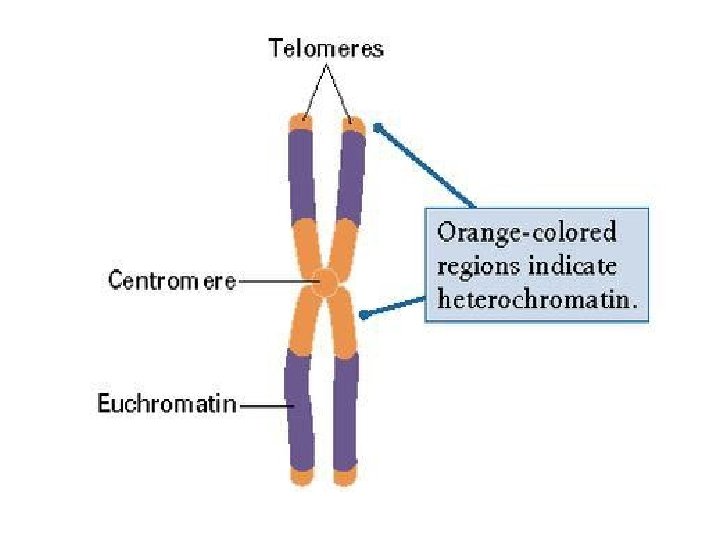
Chromatin • Chromatin is the basic material of chromosome. Chromatin can be of two types depending on staining properties. These are listed below. • Euchromatin • Heterochromatin Euchromatin • Euchromatin is a lightly packed form of chromatin (DNA, RNA and protein) that is enriched in genes. • It is partially condensed and stain lightly. DNA is packed in 3 to 8 nm fibers. • Genes situated on this portion are structural genes, these genes undergo replication and participates in the active transcription. • Most of this chromatin disperse after completion of mitosis. • Euchromatin comprises the genetically most active portion of the genome, have role in phenotypic expression of genes.
Heterochromatin • Heterochromatin is a tightly packed form of DNA, which comes in multiple varieties. • Heterochromatin are the portions of chromosome with tightly packed DNA, always remains in the condensed state and stain dark. DNA is tightly packed in the 30 nm fibers. • Definition by Heitz: those regions of the chromosome that remains condensed during interphase and early prophase and form so called chromo centre. • Late replication • Limited transcription • Have high content of repetitive DNA sequence. • Contain very few structural genes.
Types of Heterochromatin There are two types of heterochromatin viz. Constitutive and facultative heterochromatin. • Constitutive heterochromatin – DNA of this type of chromatin is permanently inactive. It remains in condensed state throughout the cell cycle, never transcribed. Most of the chromatin occurring around centromere, in the telomers, in c bands of chromosome is constitutive heterochromatin. • Facultative heterochromatin – No permanent condensation, follow periodic dispersal. While in dispersed state, it is actively transcribed
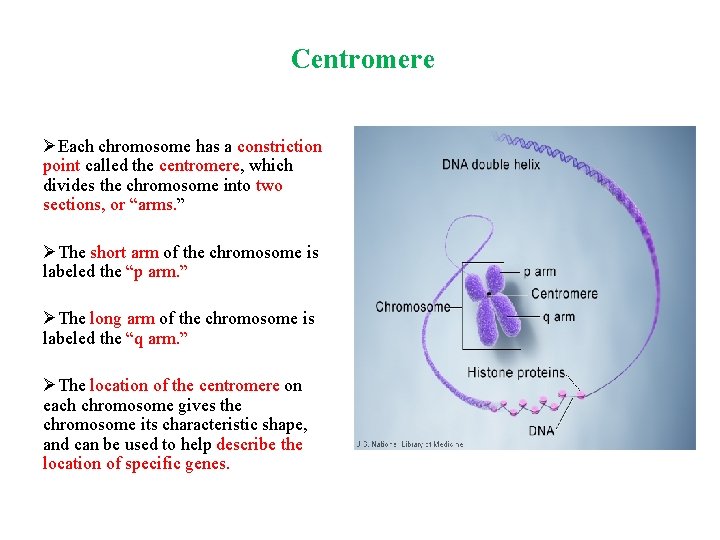
Centromere ØEach chromosome has a constriction point called the centromere, which divides the chromosome into two sections, or “arms. ” ØThe short arm of the chromosome is labeled the “p arm. ” ØThe long arm of the chromosome is labeled the “q arm. ” ØThe location of the centromere on each chromosome gives the chromosome its characteristic shape, and can be used to help describe the location of specific genes.
Types of Chromosome • Based on Centromere Number • Based on the position of centromere • Homologous and Non Homologous chromosome • Special type of chromosomes ü Giant chromosome Polytene and Lampbrush chromosome ü Super Numerary chromosome
1. Based on Centromere Number ØAcentric Chromosome üAcentric chromosomes are those that lack centromeres, i. e. , the centromere is totally absent on the chromosome. üThese chromosomes are observed due to effects of chromosome breaking process like irradiation. ØMonocentric Chromosome üMonocentric chromosomes are those that contain a single centromere. üThis type of chromosome is present in most of the organisms. üThe monocentric chromosomes can be called acrocentric, if the centromere is located at the end of the chromosome.
ØDicentric Chromosome üDicentric chromosomes are those that have two centromeres that are present on its arms. üThese chromosomes are formed after two chromosomal segments with a centromere each, are fused end to end. üThis causes them to lose their acentric fragments, leading to formation of dicentric chromosome. ØPolycentric Chromosome üPolycentric chromosomes are those that contain more than two centromeres. üThese chromosomes are very common in plants, for example, the Adder's tongue fern has 1262 chromosomes.
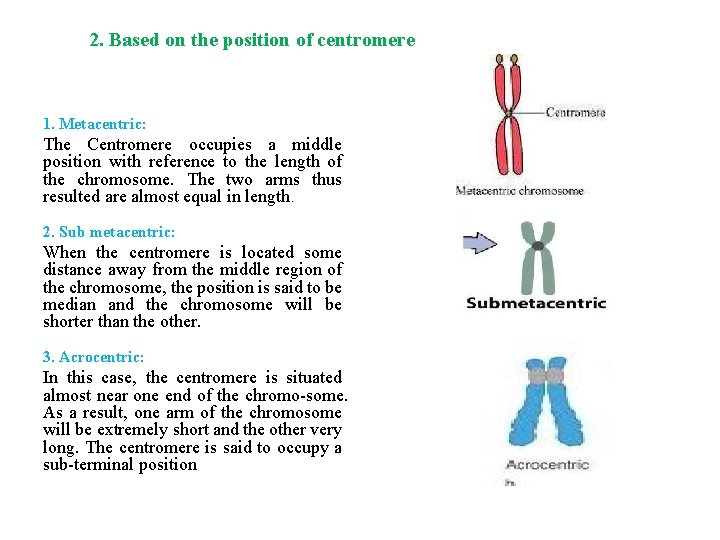
2. Based on the position of centromere 1. Metacentric: The Centromere occupies a middle position with reference to the length of the chromosome. The two arms thus resulted are almost equal in length. 2. Sub metacentric: When the centromere is located some distance away from the middle region of the chromosome, the position is said to be median and the chromosome will be shorter than the other. 3. Acrocentric: In this case, the centromere is situated almost near one end of the chromo some. As a result, one arm of the chromosome will be extremely short and the other very long. The centromere is said to occupy a sub terminal position
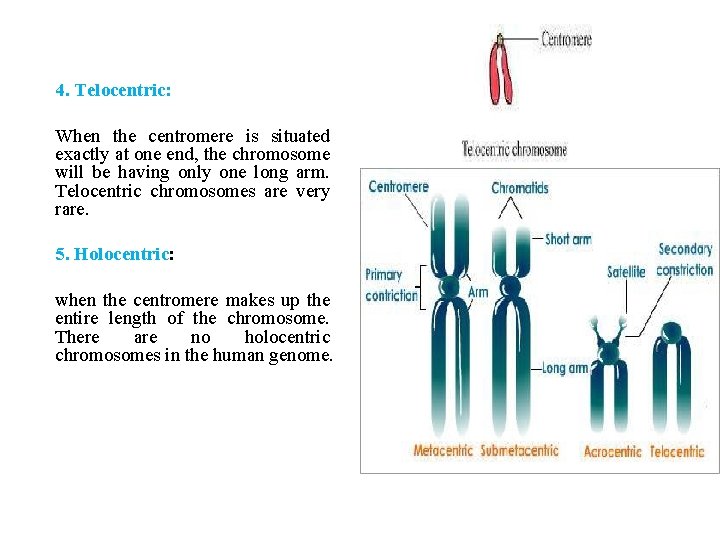
4. Telocentric: When the centromere is situated exactly at one end, the chromosome will be having only one long arm. Telocentric chromosomes are very rare. 5. Holocentric: when the centromere makes up the entire length of the chromosome. There are no holocentric chromosomes in the human genome.
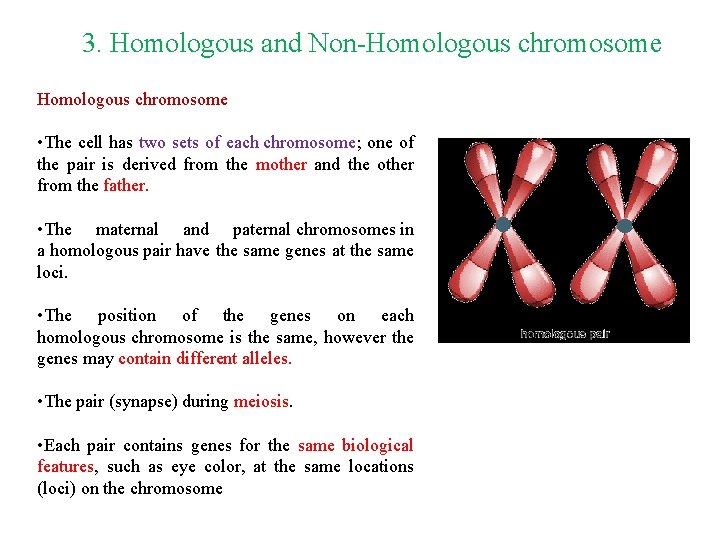
3. Homologous and Non Homologous chromosome • The cell has two sets of each chromosome; one of the pair is derived from the mother and the other from the father. • The maternal and paternal chromosomes in a homologous pair have the same genes at the same loci. • The position of the genes on each homologous chromosome is the same, however the genes may contain different alleles. • The pair (synapse) during meiosis. • Each pair contains genes for the same biological features, such as eye color, at the same locations (loci) on the chromosome
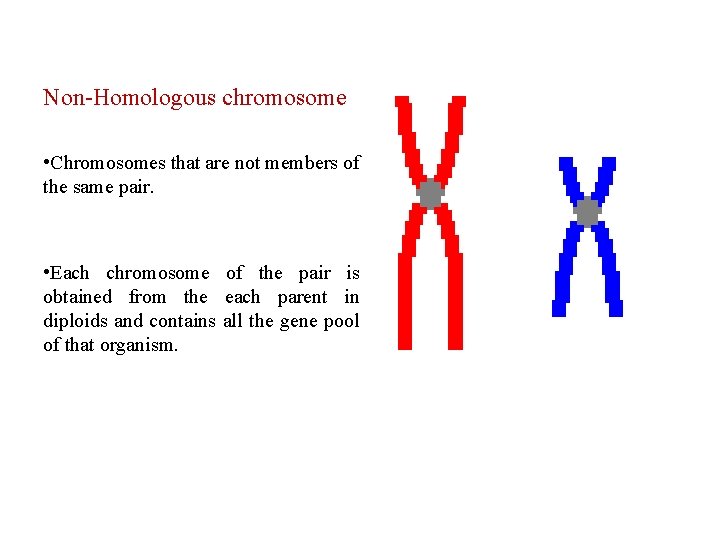
Non Homologous chromosome • Chromosomes that are not members of the same pair. • Each chromosome of the pair is obtained from the each parent in diploids and contains all the gene pool of that organism.
Special/Abnormal type of Chromosomes
Special type of chromosome • Compare to the normal type of chromosome to abnormal type of chromosome are highly differ in structure, size, shape and functions. • It have been found in varied groups of animals and plants. • They are very useful in cytogenetic studies. • Among those most important are Giant chromosome and Super Numerary chromosome.
Giant chromosome • Giant chromosome are exceptionally larger chromosomes. • They are described as unusual chromosomes by A. M. Winchester. • Types üPolytene chromosome üLamp brush chromosome
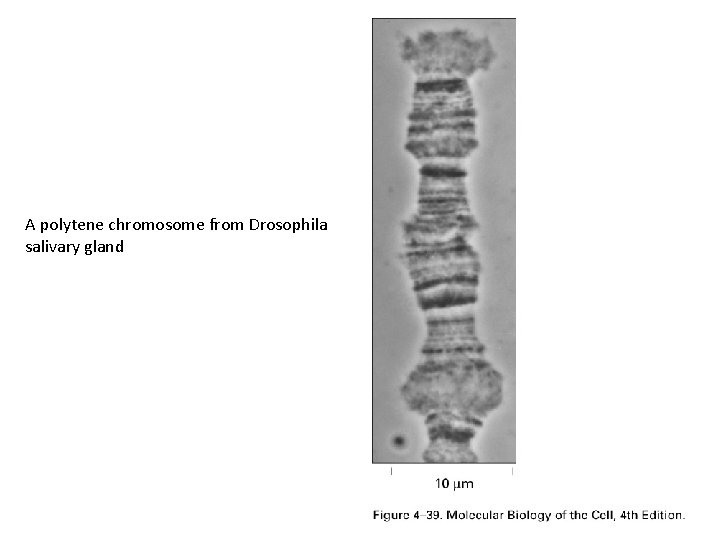
Polytene chromosome • Polytene chromosomes are giant chromosomes common to many dipteran (two winged) flies. • They begin as normal chromosomes, but through repeated rounds of DNA replication without any cell division (called endoreplication), they become large, banded chromosomes (see figure). • For unknown reasons, the centromeric regions of the chromosomes do not endoreplicate very well. • As a result, the centromeres of all the chromosomes bundle together in a mass called the chromocenter. • Polytene chromosomes are usually found in the larvae, where it is believed these many replicated chromosomes allow for much faster larval growth than if the cells remained diploid.
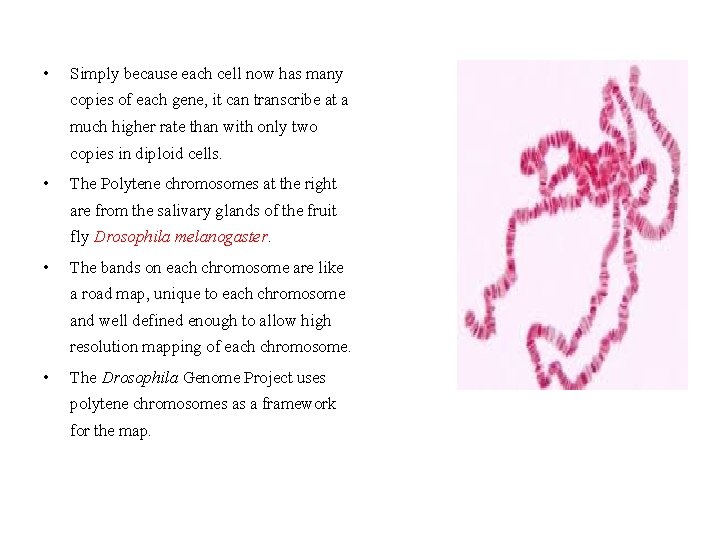
• Simply because each cell now has many copies of each gene, it can transcribe at a much higher rate than with only two copies in diploid cells. • The Polytene chromosomes at the right are from the salivary glands of the fruit fly Drosophila melanogaster. • The bands on each chromosome are like a road map, unique to each chromosome and well defined enough to allow high resolution mapping of each chromosome. • The Drosophila Genome Project uses polytene chromosomes as a framework for the map.
Importance of Polytene chromosome • Polytene chromosomes provided the first evidence that eukaryotic gene activity is regulated at the level of RNA synthesis. • Polytene chromosomes constitute a valuable material for the study of gene regulation because their gene transcription can be visualized directly in the microscope. • Polytene chromosomes have become even more important with the advent of recombinant DNA techniques because they make it possible to map any DNA segment to specific chromosomal loci by in sit hybridization
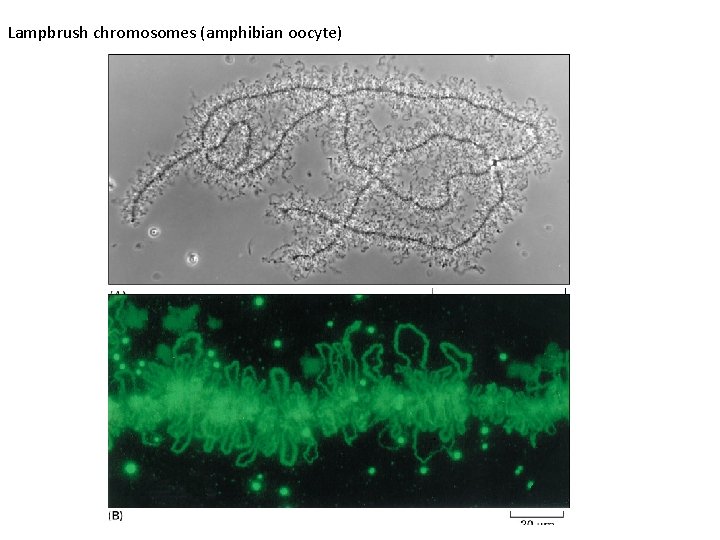
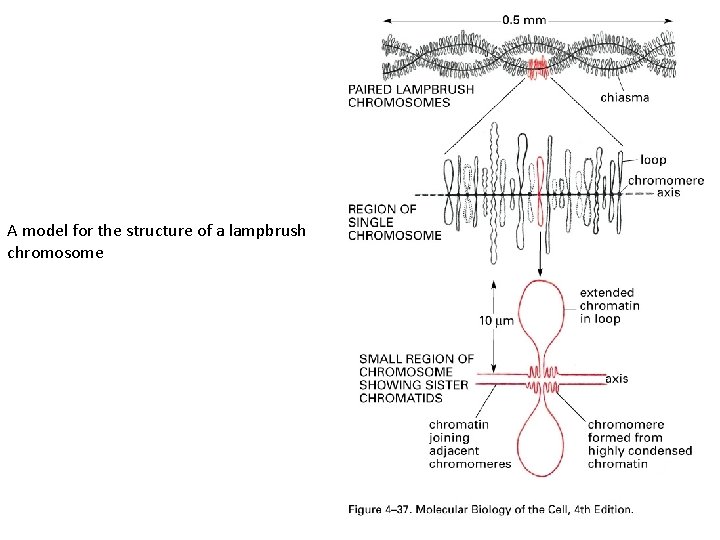
Lamp Brush Chromosome • Lampbrush chromosome occur at the diplotene stage of meiotic prophase in the primary oocyte and spermatocytes of many vertebrates and invertebrates. • Its actually contains two homologous chromosomes. • The two homologous have separated except at several joints chiasmata. • Each homologue at this stage has two chromatids.
• The appearance of the two homologues in a chromosome is the result of the threads that loop out from its two chromatids. • The loop occur in pairs. • The loops are made up of DNA with associated RNA and Ribosomes, and are sites of transcription. • The two chromatids are tightly opposed each other, the chromosome axis is probably by fused pairs of chromomeres. • Experimental evidence show that each loop is single DNA double helices.
Lampbrush chromosomes (amphibian oocyte)
A model for the structure of a lampbrush chromosome
A polytene chromosome from Drosophila salivary gland
Super Numerary chromosome • Some plant and animal nuclei possess one or more extra chromosomes, in addition to normal chromosomes. • They are called super numerary chromosomes. • First discovered by Wilson in 1905(Hemipterian insect, Metapodius terminalis). • They are smaller in size and genetically inert. • They produce little phenotypic effect on the organism in which they are found. • These are relatively unstable and they segregate irregularly at meiosis because of somatic dis junction and elimination. • Their morphology frequently changes through fragmentation. • In plants, the supernumerary chromosomes are unknown origin.
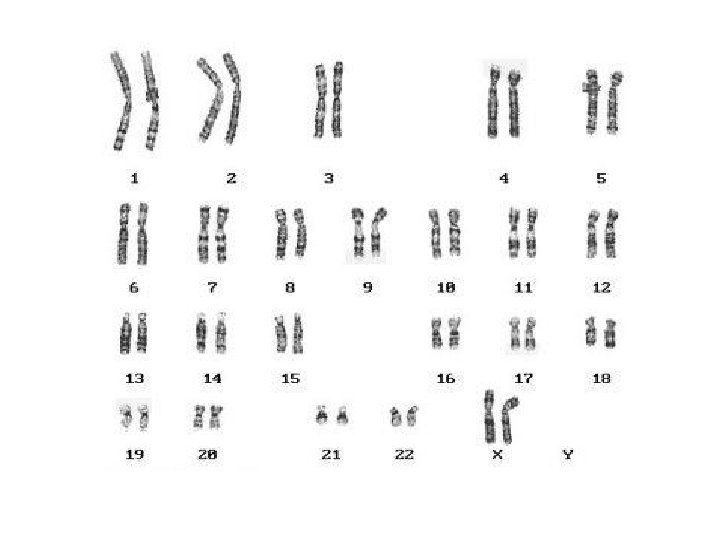
Karyotype • A karyotype is the number and appearance of chromosomes in the nucleus of a eukaryotic cell. • It describes the number of chromosomes, and what they look like under a light microscope. • Attention is paid to their length, the position of the centromeres, banding pattern, any differences between the sex chromosomes, and any other physical characteristics. • The study of whole sets of chromosomes is sometimes known as karyology. • Karyotypes can be used for various purposes; such as, to study chromosomal aberrations, cellular functions, taxonomic relationships, and to gather information about past evolutionary events.
Functions of Chromosomes • • • In charge of all the processes. “Packaging material” that binds DNA and protein together. Protein synthesis steps are the responsibility of genes. Very important roles in the development of an individual. They are the 'vehicles of heredity'. DNA provides the genetic information for various cellular functions essential for survival, growth, development etc. • Chromosomes protect the genetic material (DNA) from being damaged during cell division. • Essential for the process of cell division and are responsible for the replication, division and creation of daughter cells. • Centromeres perform an important function in chromosome movement during cell division.