
Structure of a Flower Petal Stigma Anther Carpel
- Slides: 39
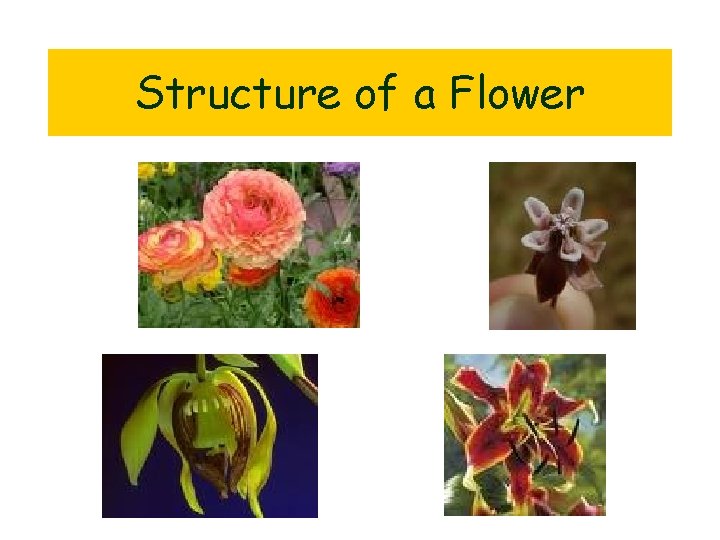
Structure of a Flower
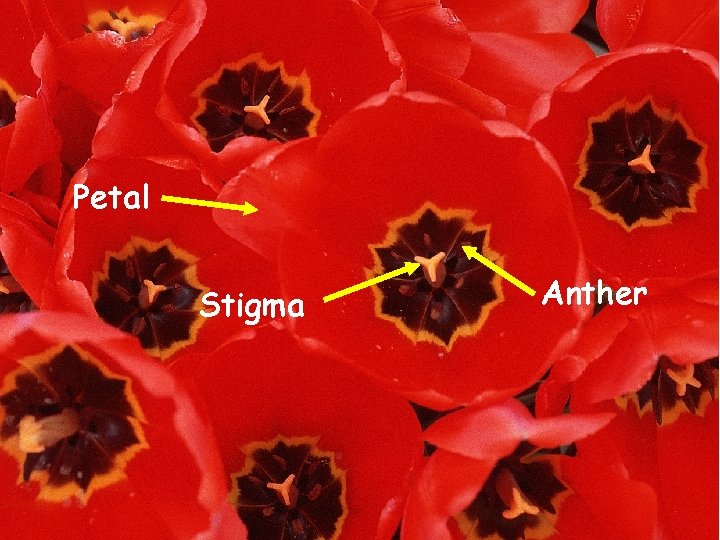
Petal Stigma Anther
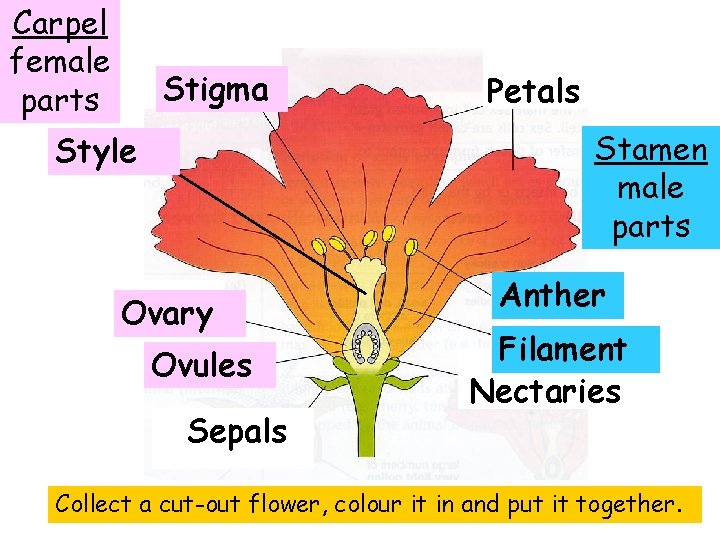
Carpel female parts Stigma Petals Stamen male parts Style Ovary Ovules Sepals Anther Filament Nectaries Collect a cut-out flower, colour it in and put it together.
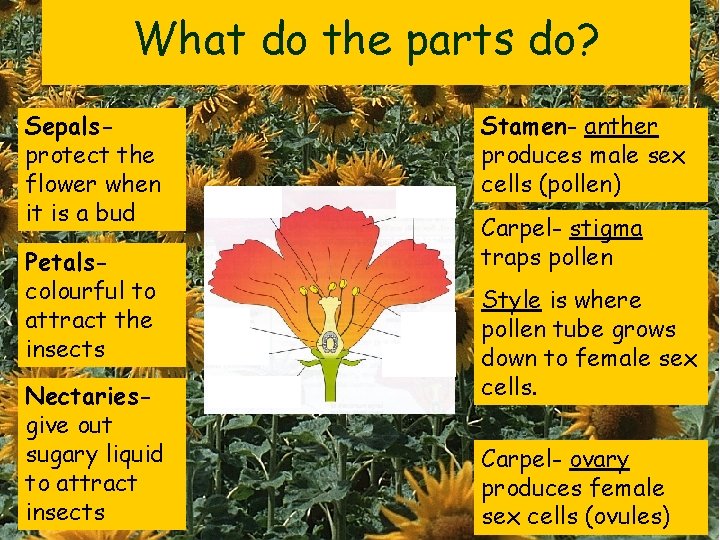
What do the parts do? Sepalsprotect the flower when it is a bud Petalscolourful to attract the insects Nectariesgive out sugary liquid to attract insects Stamen- anther produces male sex cells (pollen) Carpel- stigma traps pollen Style is where pollen tube grows down to female sex cells. Carpel- ovary produces female sex cells (ovules)
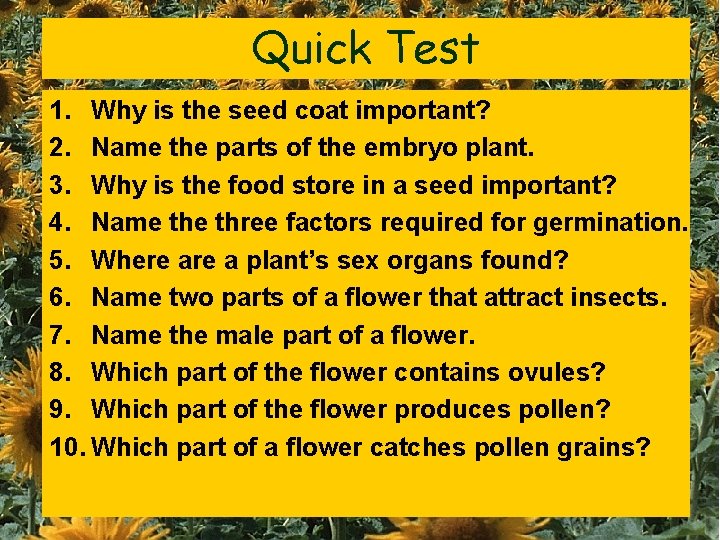
Quick Test 1. Why is the seed coat important? 2. Name the parts of the embryo plant. 3. Why is the food store in a seed important? 4. Name three factors required for germination. 5. Where a plant’s sex organs found? 6. Name two parts of a flower that attract insects. 7. Name the male part of a flower. 8. Which part of the flower contains ovules? 9. Which part of the flower produces pollen? 10. Which part of a flower catches pollen grains?
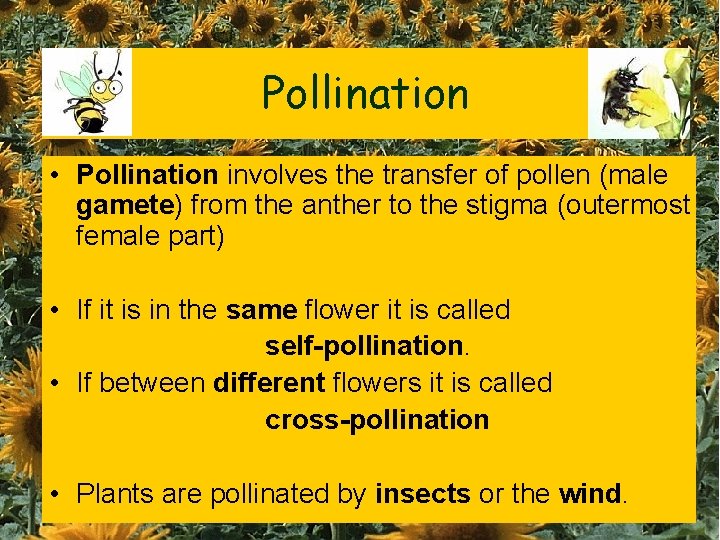
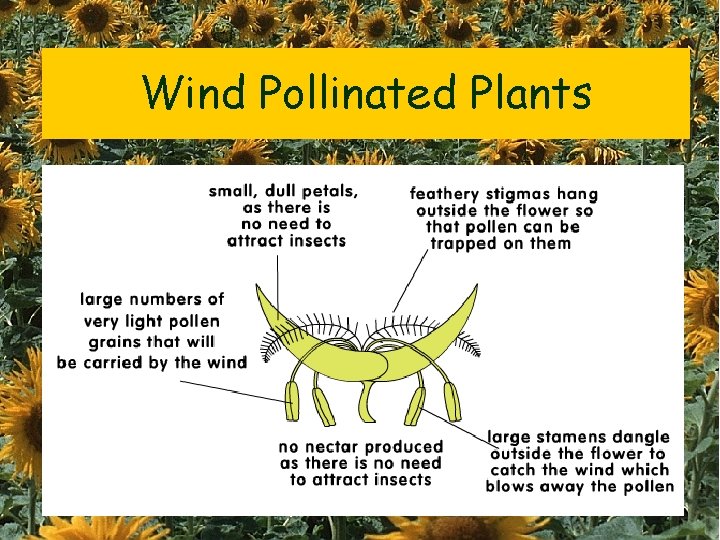
Pollination • Pollination involves the transfer of pollen (male gamete) from the anther to the stigma (outermost female part) • If it is in the same flower it is called self-pollination. • If between different flowers it is called cross-pollination • Plants are pollinated by insects or the wind.
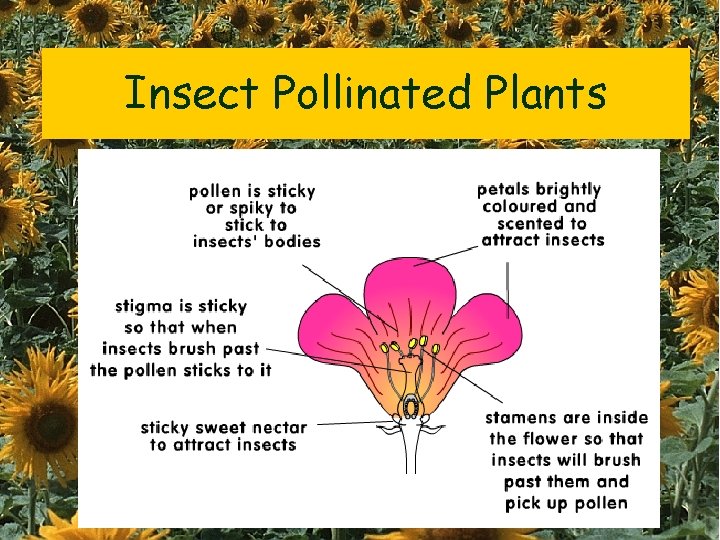
Insect Pollinated Plants
Wind Pollinated Plants
Pollination Activity • Look at the Botanics Posters • Which features are from wind pollinated or insect pollinated plants? • Workbook p 28 – Construct a table to show the differences between insect and wind pollinated plants.
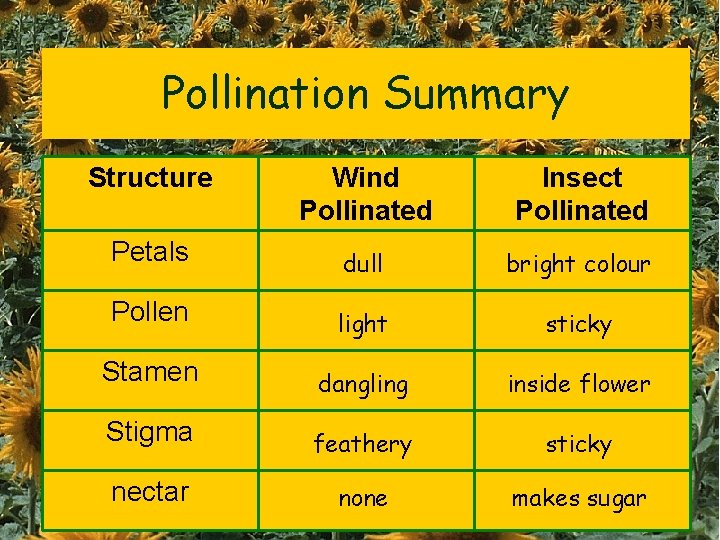
Pollination Summary Structure Wind Pollinated Insect Pollinated Petals dull bright colour Pollen light sticky Stamen dangling inside flower Stigma feathery sticky nectar none makes sugar
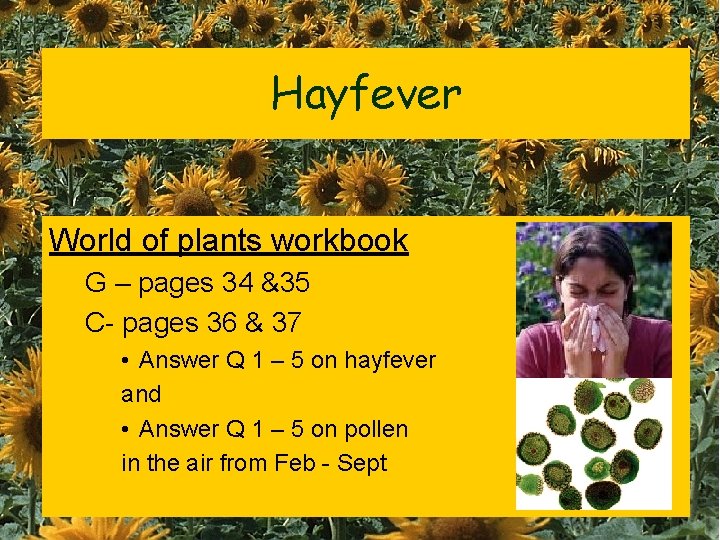
Hayfever World of plants workbook G – pages 34 &35 C- pages 36 & 37 • Answer Q 1 – 5 on hayfever and • Answer Q 1 – 5 on pollen in the air from Feb - Sept
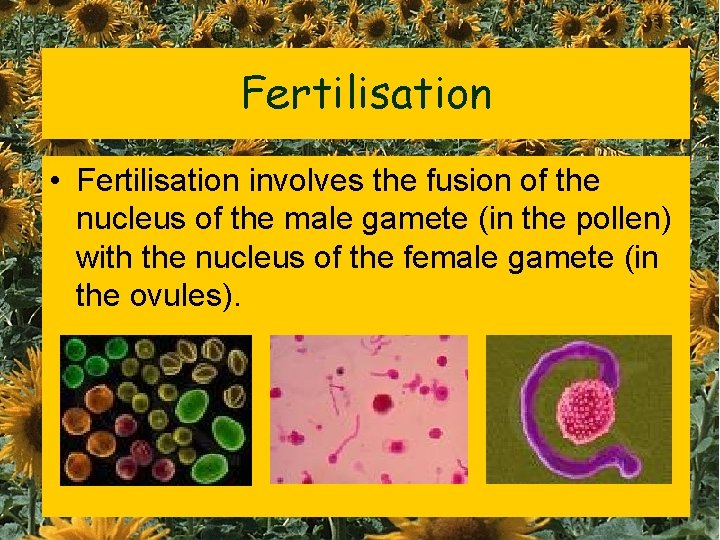
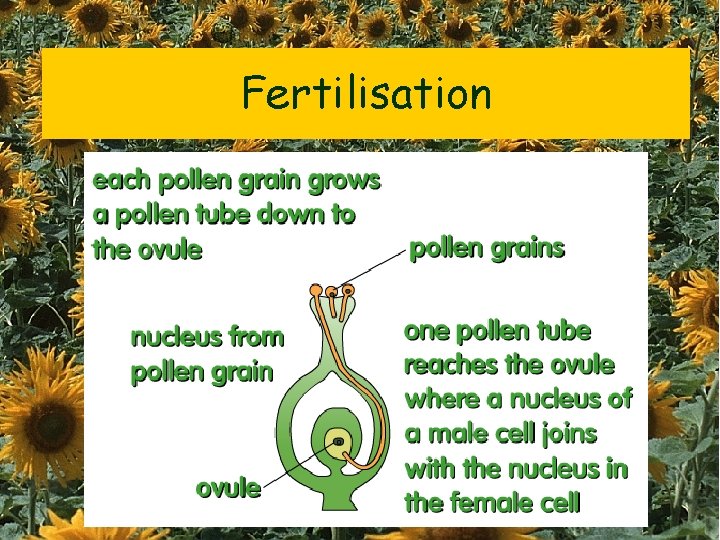
Fertilisation • Fertilisation involves the fusion of the nucleus of the male gamete (in the pollen) with the nucleus of the female gamete (in the ovules).
Fertilisation
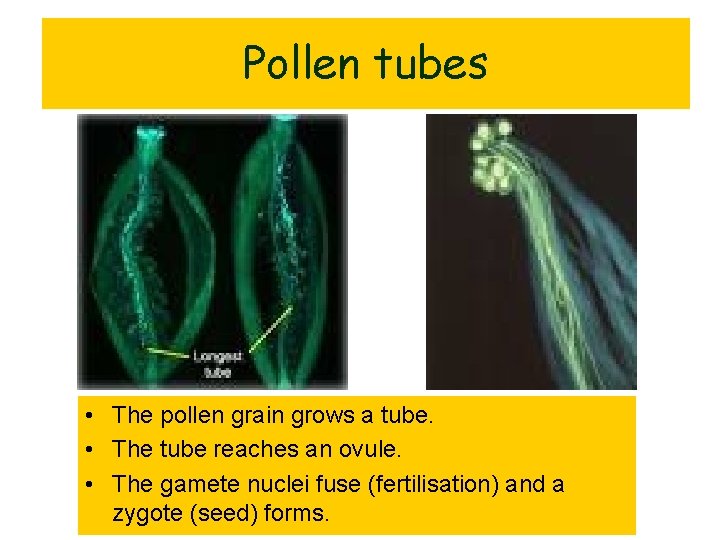
Pollen tubes • The pollen grain grows a tube. • The tube reaches an ovule. • The gamete nuclei fuse (fertilisation) and a zygote (seed) forms.
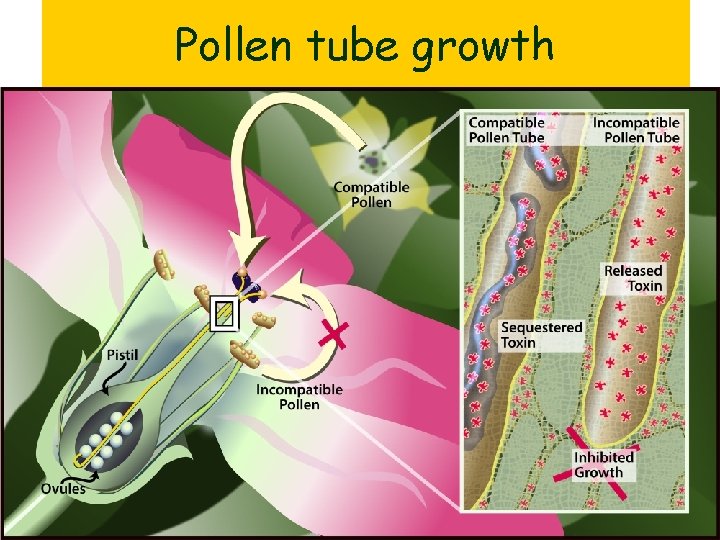
Pollen tube growth
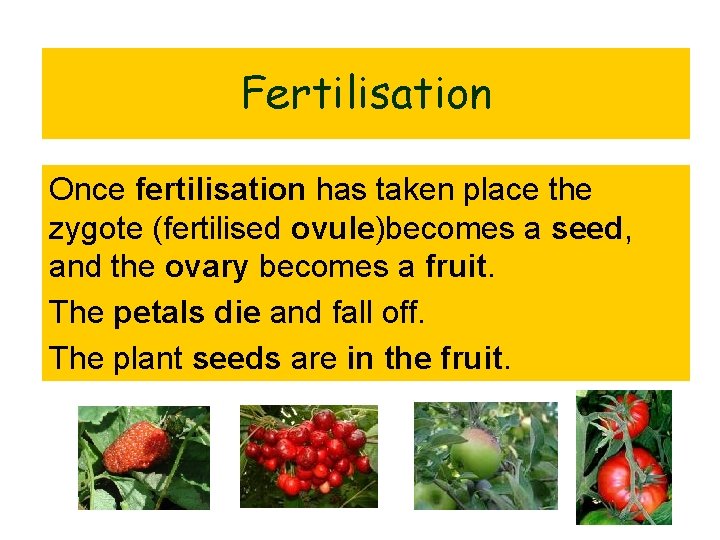
Fertilisation Once fertilisation has taken place the zygote (fertilised ovule)becomes a seed, and the ovary becomes a fruit. The petals die and fall off. The plant seeds are in the fruit.
What are fruits like? The fruits can be: - soft & fleshy - hard & dry • What fruits can you think of? • What are their seeds like? • Draw a table with headings for each type and write some examples for them.
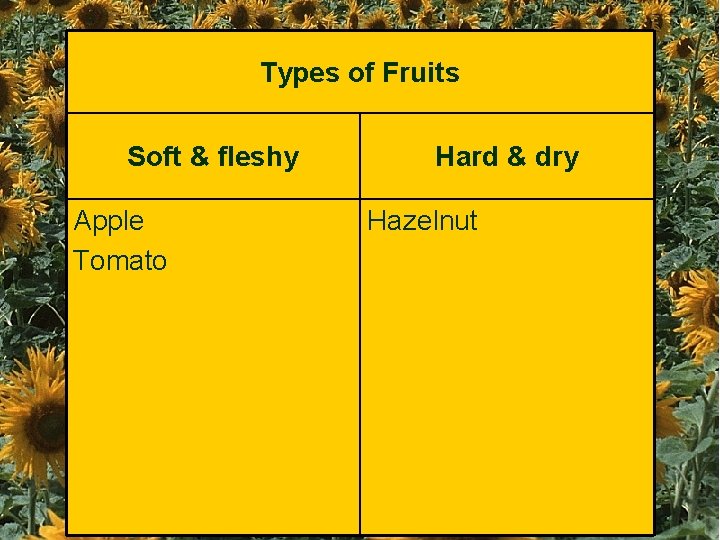
Types of Fruits Soft & fleshy Apple Tomato Hard & dry Hazelnut
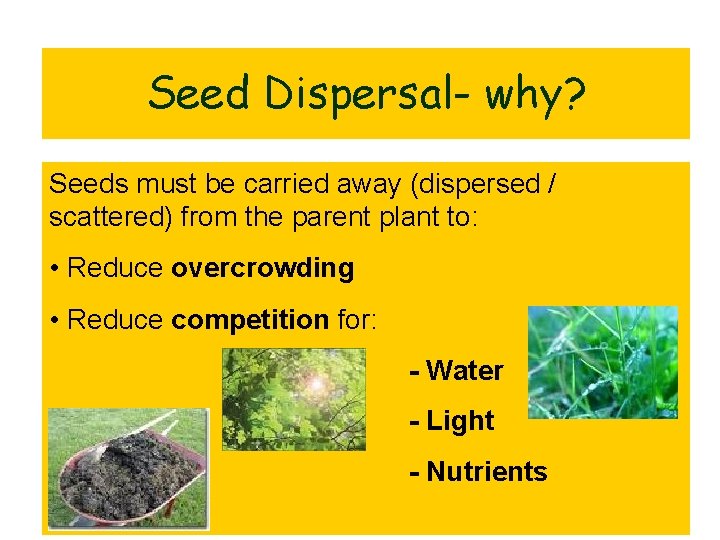
Seed Dispersal- why? Seeds must be carried away (dispersed / scattered) from the parent plant to: • Reduce overcrowding • Reduce competition for: - Water - Light - Nutrients
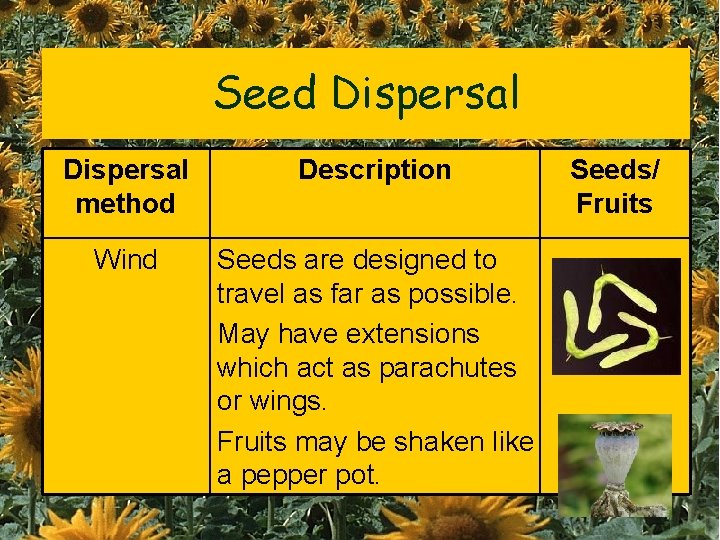
Seed Dispersal method Description Wind Seeds are designed to travel as far as possible. May have extensions which act as parachutes or wings. Fruits may be shaken like a pepper pot. Seeds/ Fruits
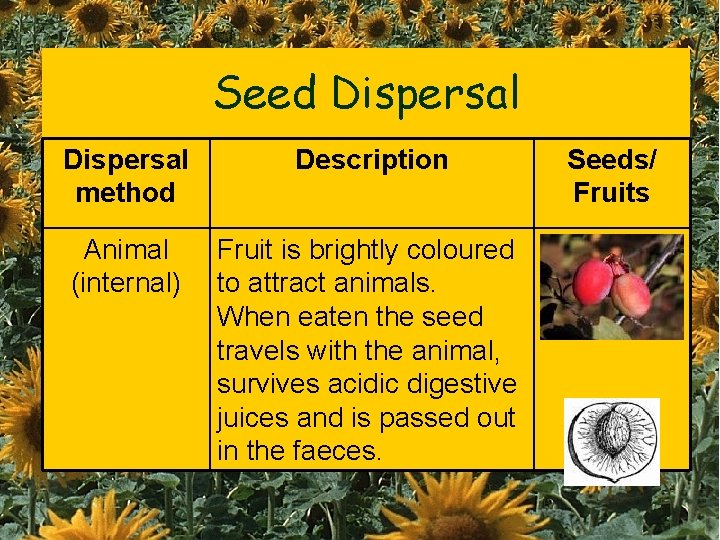
Seed Dispersal method Description Animal (internal) Fruit is brightly coloured to attract animals. When eaten the seed travels with the animal, survives acidic digestive juices and is passed out in the faeces. Seeds/ Fruits
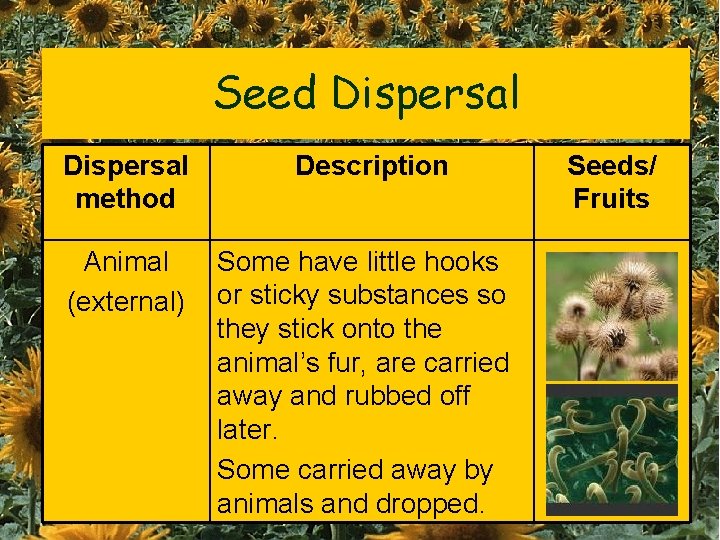
Seed Dispersal method Animal (external) Description Some have little hooks or sticky substances so they stick onto the animal’s fur, are carried away and rubbed off later. Some carried away by animals and dropped. Seeds/ Fruits
Activity • Cut out the seeds, match and stick them into appropriate columns in a table, for: Wind Animal (external) Animal (internal) [There is also mechanical (eg broom, sea cucumber) and water (eg coconut) but you don’t need to know them for Standard grade]
Activity • Listening exercise on seed dispersal – Listen to the tape, – Use the commentary to help you answer questions on your handout. World of Plants Workbook p 41 Comparing Lime and Sycamore seeds. Go through the problem solving activity
Quick Test-A 1. What term is used to describe male and female gametes? 2. What is pollination? 3. Name the two types of pollination. 4. Describe the differences in the pollen between insect and wind pollinated plants. 5. Explain why the stigmas of wind pollinated flowers hang outside the flowers.
Quick test-B 1. Why do wind pollinated flowers not produce nectar? 2. How does the male gamete reach the female gamete? 3. What is a fruit? 4. Name three ways in which fruits and seeds are dispersed. 5. Why is it important that fruits and seeds are carried away from the parent plant?
Types of reproduction Sexual reproduction Involves 2 parents and sex cells ie. pollen and ovule join to make a new individual. Asexual reproduction Involves 1 parent and no sex cells. Ways they naturally reproduce include: - Tubers - ( Bulbs ) - Runners
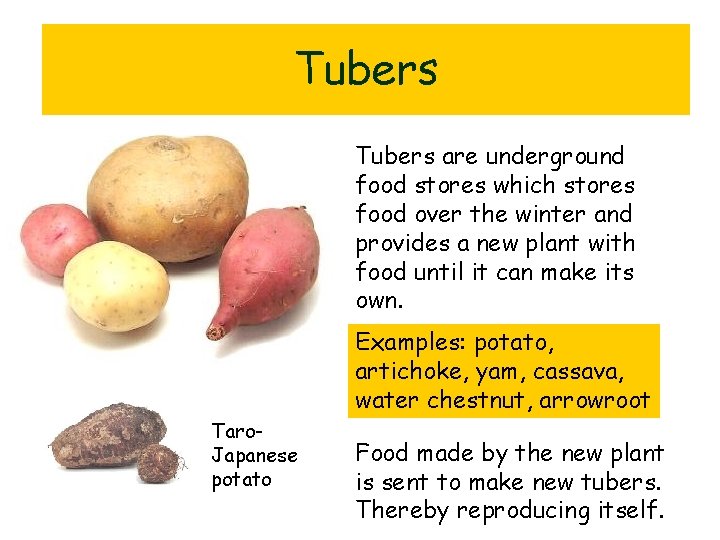
Tubers are underground food stores which stores food over the winter and provides a new plant with food until it can make its own. Examples: potato, artichoke, yam, cassava, water chestnut, arrowroot Taro. Japanese potato Food made by the new plant is sent to make new tubers. Thereby reproducing itself.
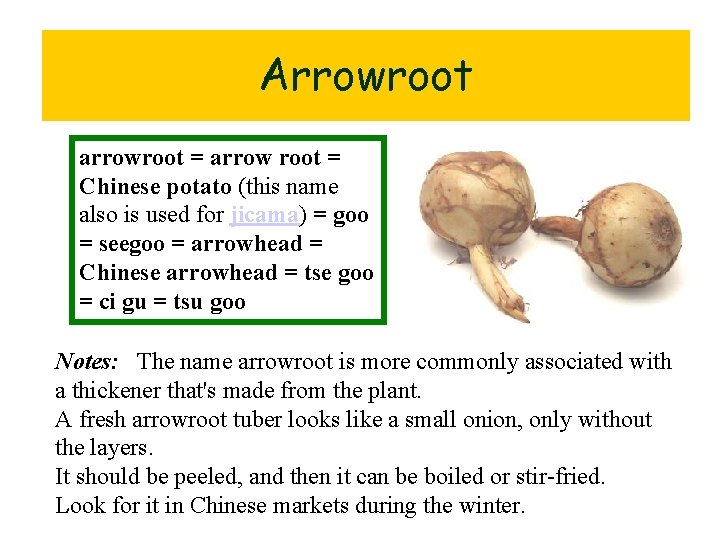
Arrowroot arrowroot = arrow root = Chinese potato (this name also is used for jicama) = goo = seegoo = arrowhead = Chinese arrowhead = tse goo = ci gu = tsu goo Notes: The name arrowroot is more commonly associated with a thickener that's made from the plant. A fresh arrowroot tuber looks like a small onion, only without the layers. It should be peeled, and then it can be boiled or stir-fried. Look for it in Chinese markets during the winter.
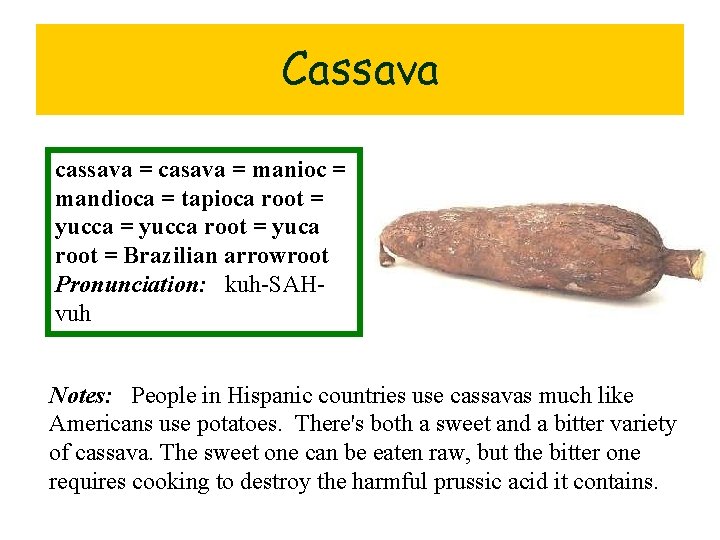
Cassava cassava = casava = manioc = mandioca = tapioca root = yucca root = yuca root = Brazilian arrowroot Pronunciation: kuh-SAHvuh Notes: People in Hispanic countries use cassavas much like Americans use potatoes. There's both a sweet and a bitter variety of cassava. The sweet one can be eaten raw, but the bitter one requires cooking to destroy the harmful prussic acid it contains.
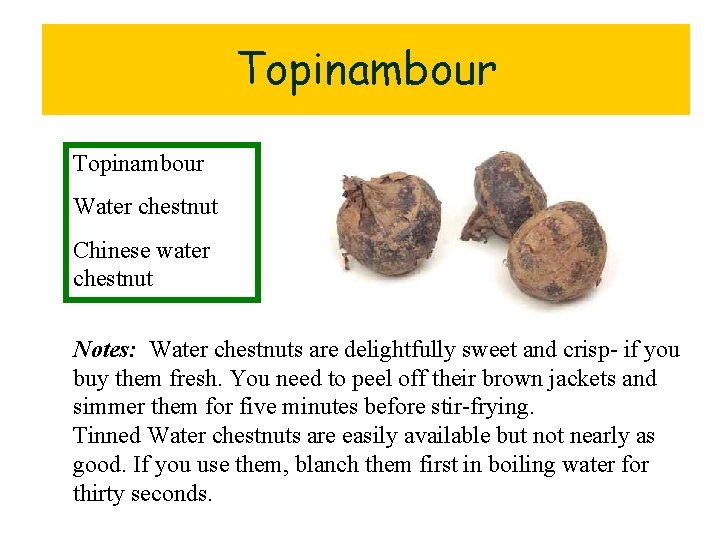
Topinambour Water chestnut Chinese water chestnut Notes: Water chestnuts are delightfully sweet and crisp- if you buy them fresh. You need to peel off their brown jackets and simmer them for five minutes before stir-frying. Tinned Water chestnuts are easily available but not nearly as good. If you use them, blanch them first in boiling water for thirty seconds.
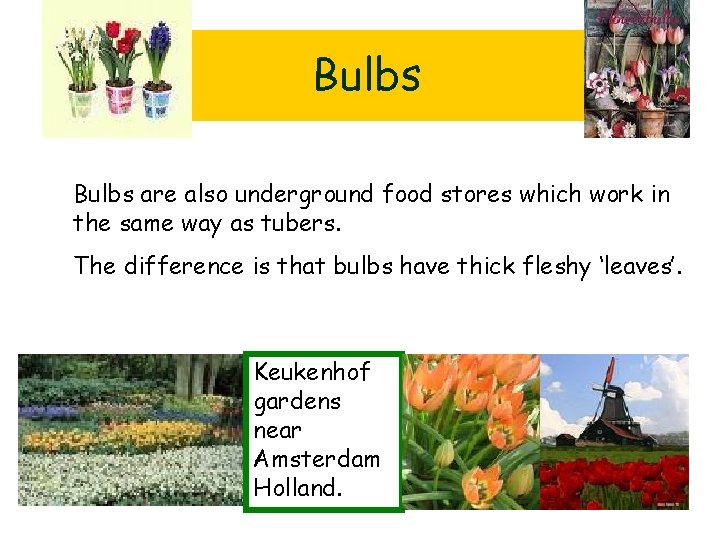
Bulbs are also underground food stores which work in the same way as tubers. The difference is that bulbs have thick fleshy ‘leaves’. Keukenhof gardens near Amsterdam Holland.
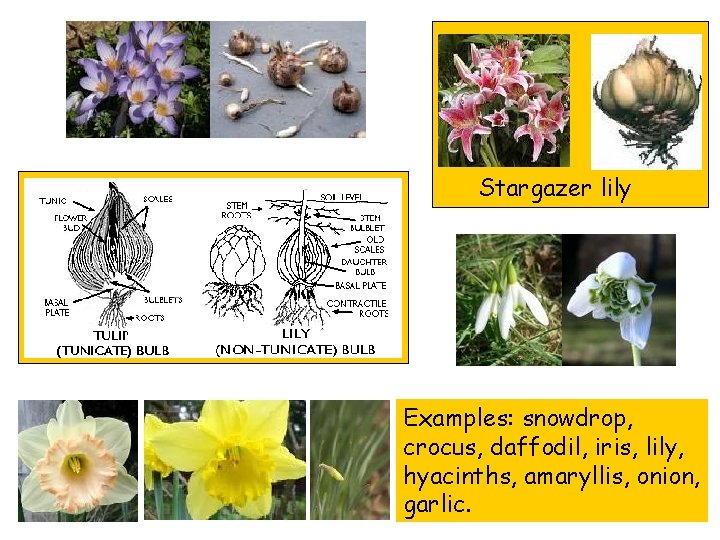
Stargazer lily Examples: snowdrop, crocus, daffodil, iris, lily, hyacinths, amaryllis, onion, garlic.
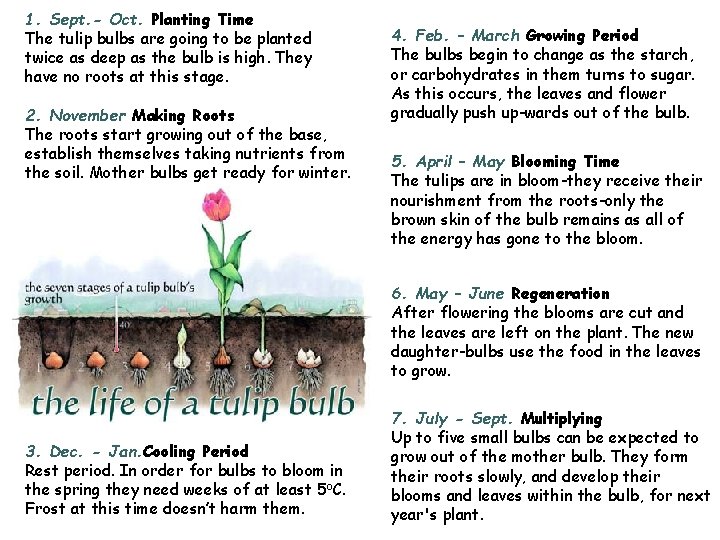
1. Sept. - Oct. Planting Time The tulip bulbs are going to be planted twice as deep as the bulb is high. They have no roots at this stage. 2. November Making Roots The roots start growing out of the base, establish themselves taking nutrients from the soil. Mother bulbs get ready for winter. 4. Feb. – March Growing Period The bulbs begin to change as the starch, or carbohydrates in them turns to sugar. As this occurs, the leaves and flower gradually push up-wards out of the bulb. 5. April – May Blooming Time The tulips are in bloom-they receive their nourishment from the roots-only the brown skin of the bulb remains as all of the energy has gone to the bloom. 6. May – June Regeneration After flowering the blooms are cut and the leaves are left on the plant. The new daughter-bulbs use the food in the leaves to grow. 3. Dec. - Jan. Cooling Period Rest period. In order for bulbs to bloom in the spring they need weeks of at least 5 o. C. Frost at this time doesn’t harm them. 7. July - Sept. Multiplying Up to five small bulbs can be expected to grow out of the mother bulb. They form their roots slowly, and develop their blooms and leaves within the bulb, for next year's plant.
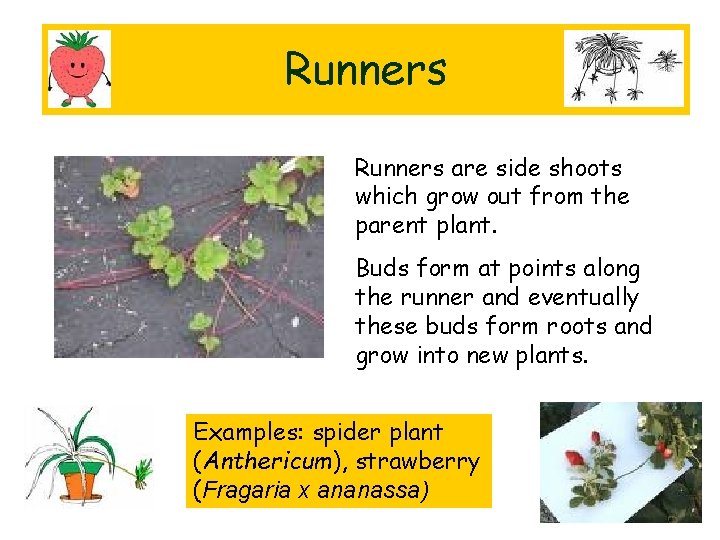
Runners are side shoots which grow out from the parent plant. Buds form at points along the runner and eventually these buds form roots and grow into new plants. Examples: spider plant (Anthericum), strawberry (Fragaria x ananassa)
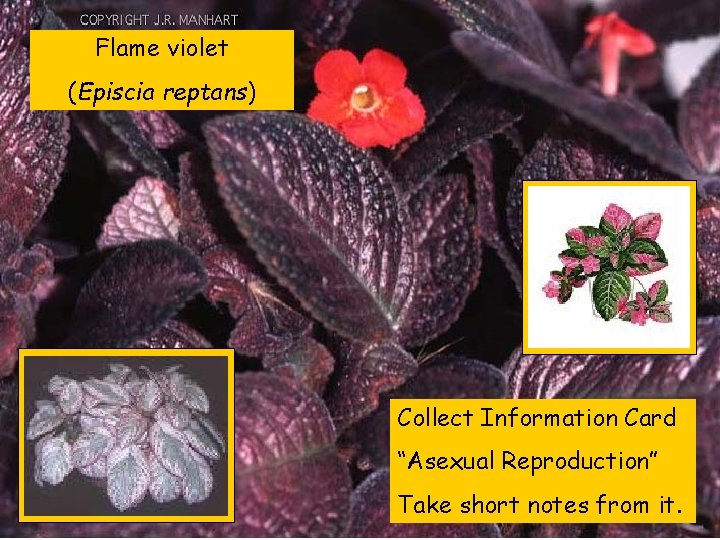
Flame violet (Episcia reptans) Collect Information Card “Asexual Reproduction” Take short notes from it.
Activity World of plants workbook Read p 20 “Advantages of asexual reproduction” Read p 32 & 33. – Copy and complete the table. Summarising advantages & disadvantages of sexual versus asexual reproduction
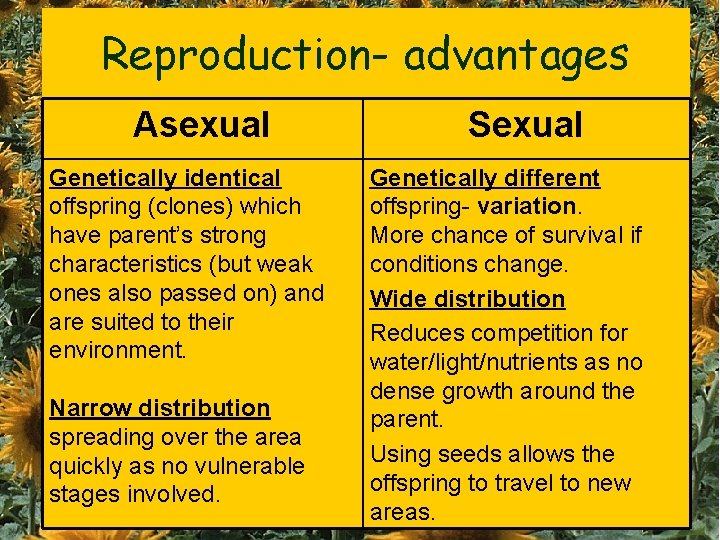
Reproduction- advantages Asexual Genetically identical offspring (clones) which have parent’s strong characteristics (but weak ones also passed on) and are suited to their environment. Narrow distribution spreading over the area quickly as no vulnerable stages involved. Sexual Genetically different offspring- variation. More chance of survival if conditions change. Wide distribution Reduces competition for water/light/nutrients as no dense growth around the parent. Using seeds allows the offspring to travel to new areas.