
Structure materials and dynamics of the lower mantle
- Slides: 23
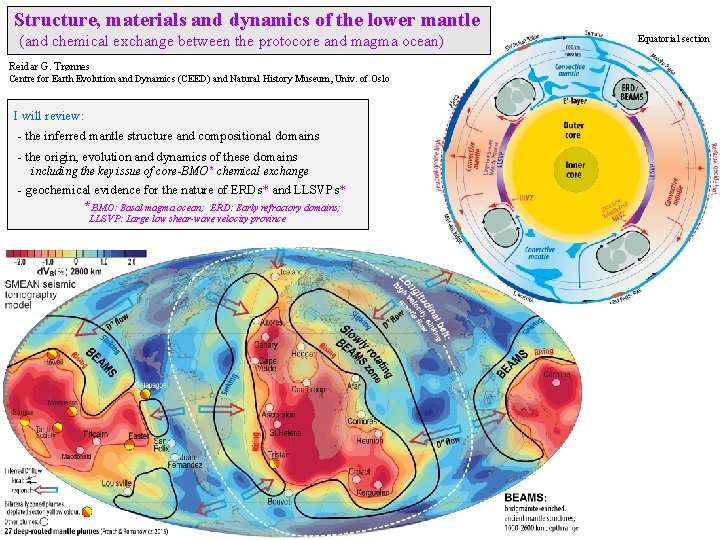
Structure, materials and dynamics of the lower mantle (and chemical exchange between the protocore and magma ocean) Reidar G. Trønnes Centre for Earth Evolution and Dynamics (CEED) and Natural History Museum, Univ. of Oslo I will review: - the inferred mantle structure and compositional domains - the origin, evolution and dynamics of these domains including the key issue of core-BMO* chemical exchange - geochemical evidence for the nature of ERDs* and LLSVPs* *BMO: Basal magma ocean; ERD: Early refractory domains; LLSVP: Large low shear-wave velocity province Equatorial section
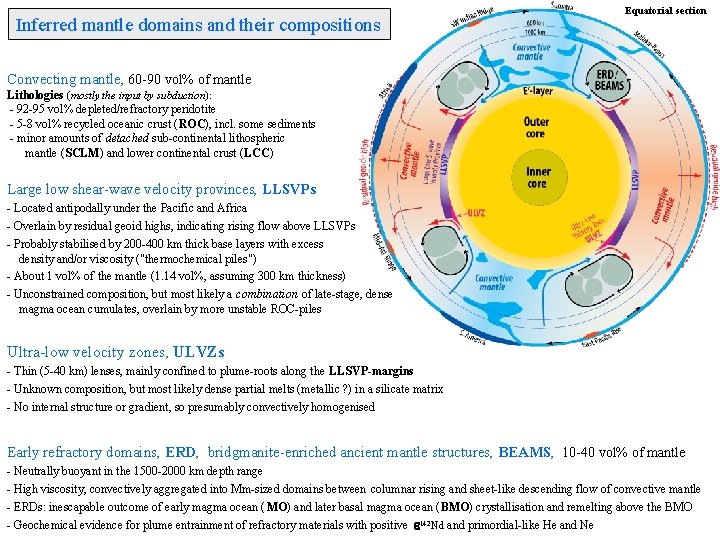
Inferred mantle domains and their compositions Equatorial section Convecting mantle, 60 -90 vol% of mantle Lithologies (mostly the input by subduction): - 92 -95 vol% depleted/refractory peridotite - 5 -8 vol% recycled oceanic crust (ROC), incl. some sediments - minor amounts of detached sub-continental lithospheric mantle (SCLM) and lower continental crust (LCC) Large low shear-wave velocity provinces, LLSVPs - Located antipodally under the Pacific and Africa - Overlain by residual geoid highs, indicating rising flow above LLSVPs - Probably stabilised by 200 -400 km thick base layers with excess density and/or viscosity ("thermochemical piles") - About 1 vol% of the mantle (1. 14 vol%, assuming 300 km thickness) - Unconstrained composition, but most likely a combination of late-stage, dense magma ocean cumulates, overlain by more unstable ROC-piles Ultra-low velocity zones, ULVZs - Thin (5 -40 km) lenses, mainly confined to plume-roots along the LLSVP-margins - Unknown composition, but most likely dense partial melts (metallic ? ) in a silicate matrix - No internal structure or gradient, so presumably convectively homogenised Early refractory domains, ERD, bridgmanite-enriched ancient mantle structures, BEAMS, 10 -40 vol% of mantle - Neutrally buoyant in the 1500 -2000 km depth range - High viscosity, convectively aggregated into Mm-sized domains between columnar rising and sheet-like descending flow of convective mantle - ERDs: inescapable outcome of early magma ocean (MO) and later basal magma ocean (BMO) crystallisation and remelting above the BMO - Geochemical evidence for plume entrainment of refractory materials with positive e 142 Nd and primordial-like He and Ne
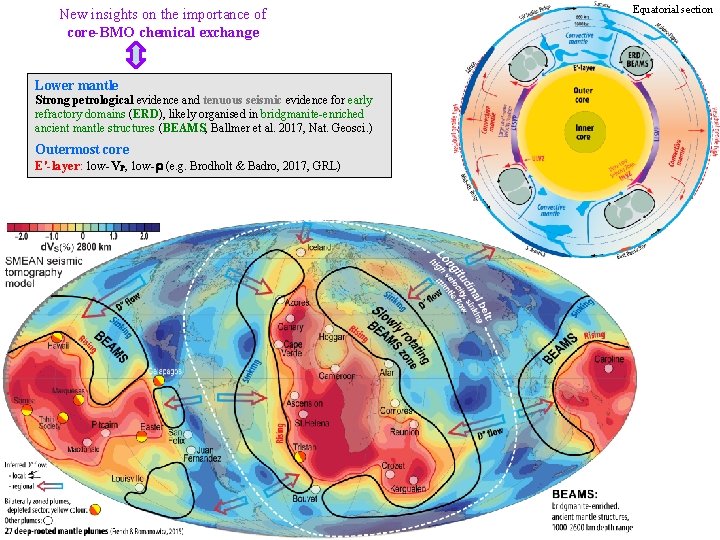
New insights on the importance of core-BMO chemical exchange Lower mantle Strong petrological evidence and tenuous seismic evidence for early refractory domains (ERD), likely organised in bridgmanite-enriched ancient mantle structures (BEAMS, Ballmer et al. 2017, Nat. Geosci. ) Outermost core E'-layer: low-VP, low-r (e. g. Brodholt & Badro, 2017, GRL) Equatorial section
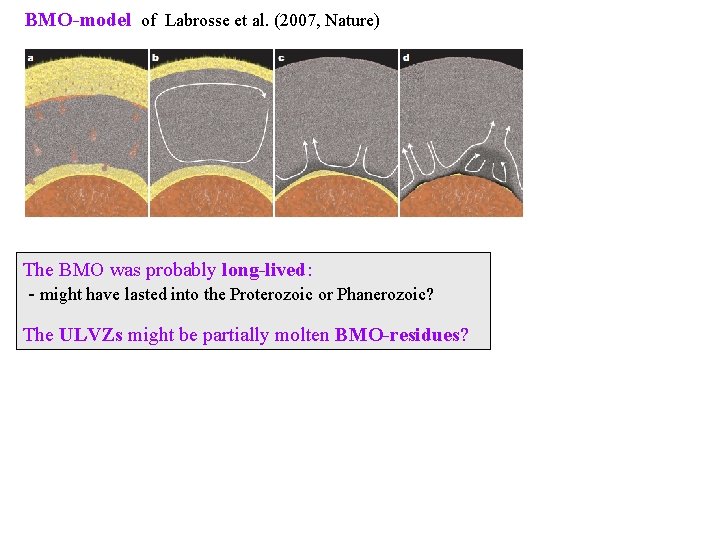
BMO-model of Labrosse et al. (2007, Nature) The BMO was probably long-lived: - might have lasted into the Proterozoic or Phanerozoic? The ULVZs might be partially molten BMO-residues?
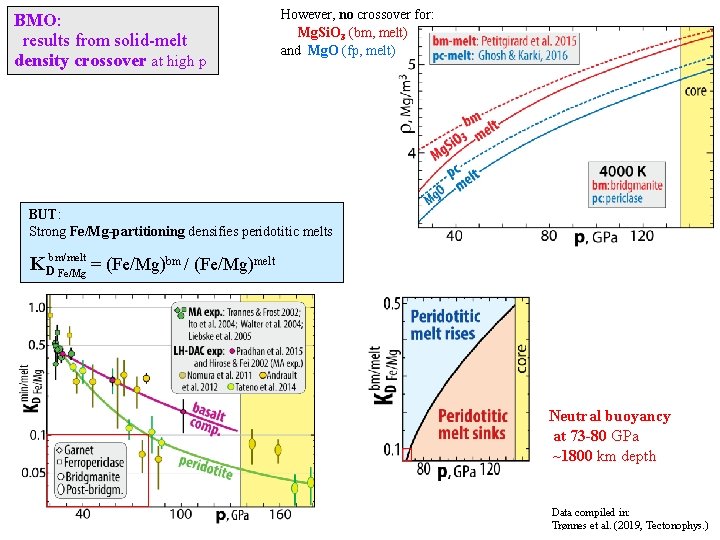
BMO: results from solid-melt density crossover at high p However, no crossover for: Mg. Si. O 3 (bm, melt) and Mg. O (fp, melt) BUT: Strong Fe/Mg-partitioning densifies peridotitic melts KDbm/melt = (Fe/Mg)bm / (Fe/Mg)melt Fe/Mg Neutral buoyancy at 73 -80 GPa ~1800 km depth Data compiled in: Trønnes et al. (2019, Tectonophys. )
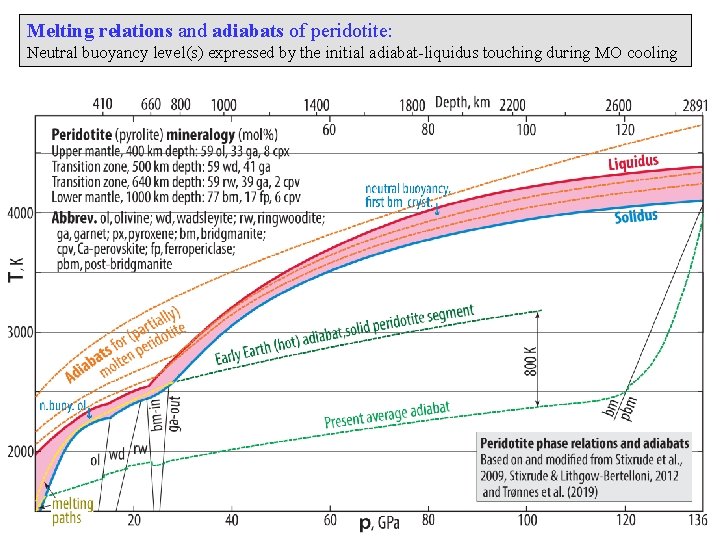
Melting relations and adiabats of peridotite: Neutral buoyancy level(s) expressed by the initial adiabat-liquidus touching during MO cooling
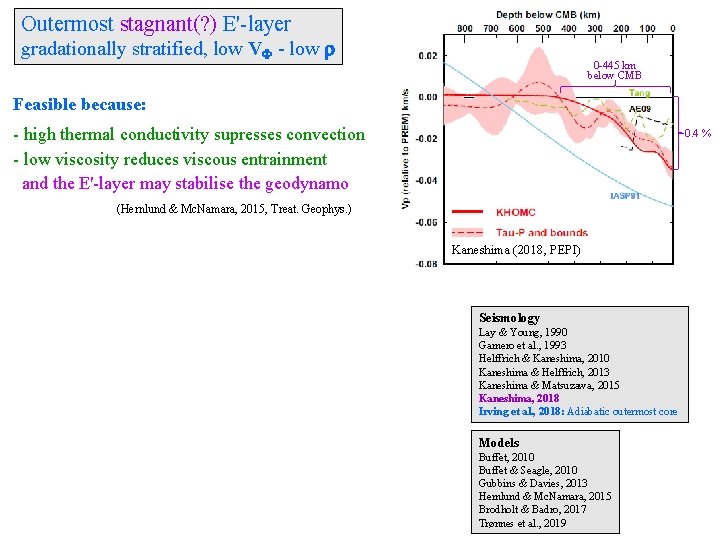
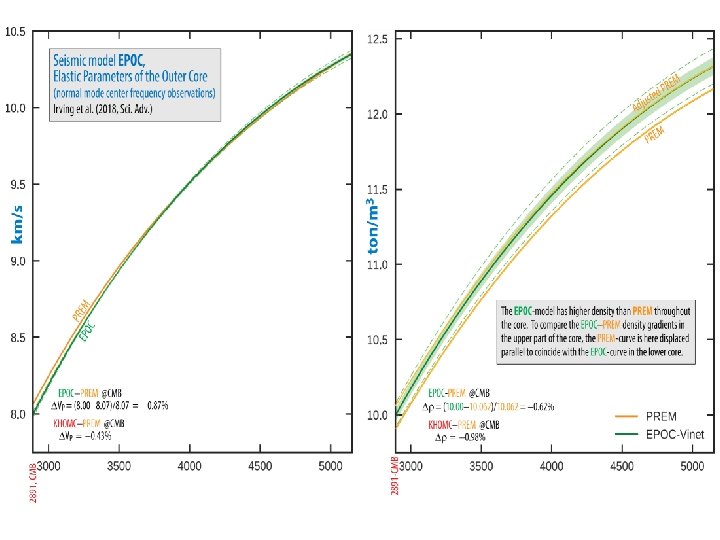
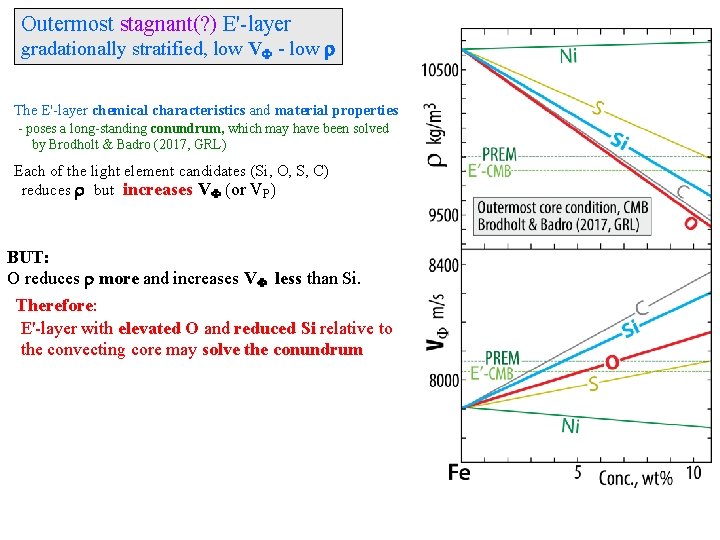
Outermost stagnant(? ) E'-layer gradationally stratified, low VF - low r 0 -445 km below CMB Feasible because: - high thermal conductivity supresses convection - low viscosity reduces viscous entrainment and the E'-layer may stabilise the geodynamo 0. 4 % (Hernlund & Mc. Namara, 2015, Treat. Geophys. ) Kaneshima (2018, PEPI) Seismology Lay & Young, 1990 Garnero et al. , 1993 Helffrich & Kaneshima, 2010 Kaneshima & Helffrich, 2013 Kaneshima & Matsuzawa, 2015 Kaneshima, 2018 Irving et al. , 2018: Adiabatic outermost core Models Buffet, 2010 Buffet & Seagle, 2010 Gubbins & Davies, 2013 Hernlund & Mc. Namara, 2015 Brodholt & Badro, 2017 Trønnes et al. , 2019
Outermost stagnant(? ) E'-layer gradationally stratified, low VF - low r The E'-layer chemical characteristics and material properties - poses a long-standing conundrum, which may have been solved by Brodholt & Badro (2017, GRL) Each of the light element candidates (Si, O, S, C) reduces r but increases VF (or VP) BUT: O reduces r more and increases VF less than Si. Therefore: E'-layer with elevated O and reduced Si relative to the convecting core may solve the conundrum
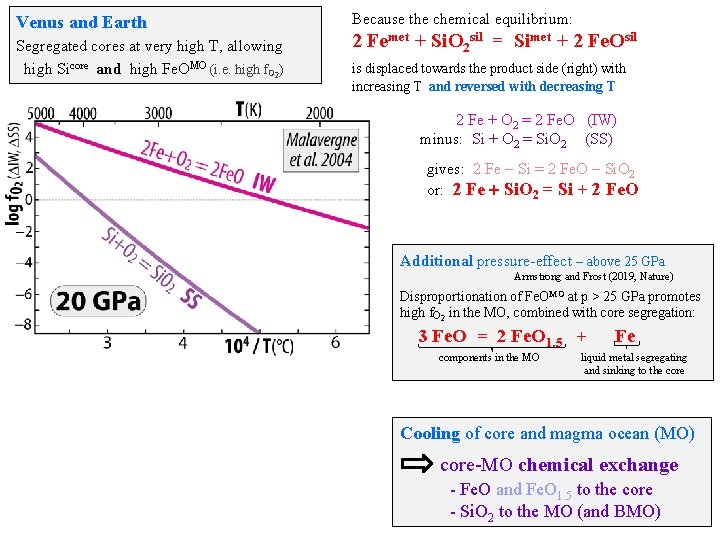
Venus and Earth Segregated cores at very high T, allowing high Sicore and high Fe. OMO (i. e. high f. O 2) Because the chemical equilibrium: 2 Femet + Si. O 2 sil = Simet + 2 Fe. Osil is displaced towards the product side (right) with increasing T and reversed with decreasing T 2 Fe + O 2 = 2 Fe. O (IW) minus: Si + O 2 = Si. O 2 (SS) gives: 2 Fe - Si = 2 Fe. O - Si. O 2 or: 2 Fe + Si. O 2 = Si + 2 Fe. O Additional pressure-effect – above 25 GPa Armstrong and Frost (2019, Nature) Disproportionation of Fe. OMO at p > 25 GPa promotes high f. O 2 in the MO, combined with core segregation: 3 Fe. O = 2 Fe. O 1. 5 + components in the MO Fe liquid metal segregating and sinking to the core Cooling of core and magma ocean (MO) core-MO chemical exchange - Fe. O and Fe. O 1. 5 to the core - Si. O 2 to the MO (and BMO)
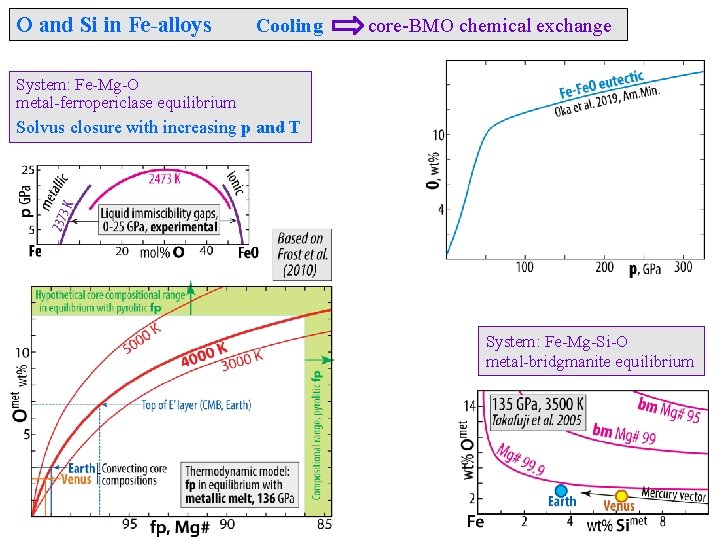
O and Si in Fe-alloys Cooling core-BMO chemical exchange System: Fe-Mg-O metal-ferropericlase equilibrium Solvus closure with increasing p and T System: Fe-Mg-Si-O metal-bridgmanite equilibrium
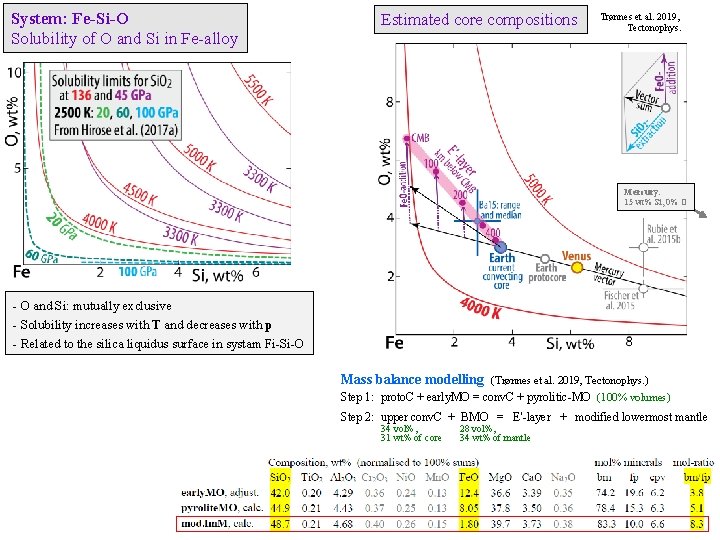
System: Fe-Si-O Solubility of O and Si in Fe-alloy Estimated core compositions Trønnes et al. 2019, Tectonophys. Mercury: 15 wt% Si, 0% O - O and Si: mutually exclusive - Solubility increases with T and decreases with p - Related to the silica liquidus surface in systam Fi-Si-O Mass balance modelling (Trønnes et al. 2019, Tectonophys. ) Step 1: proto. C + early. MO = conv. C + pyrolitic-MO (100% volumes) Step 2: upper conv. C + BMO = E'-layer + modified lowermost mantle 34 vol%, 31 wt% of core 28 vol%, 34 wt% of mantle
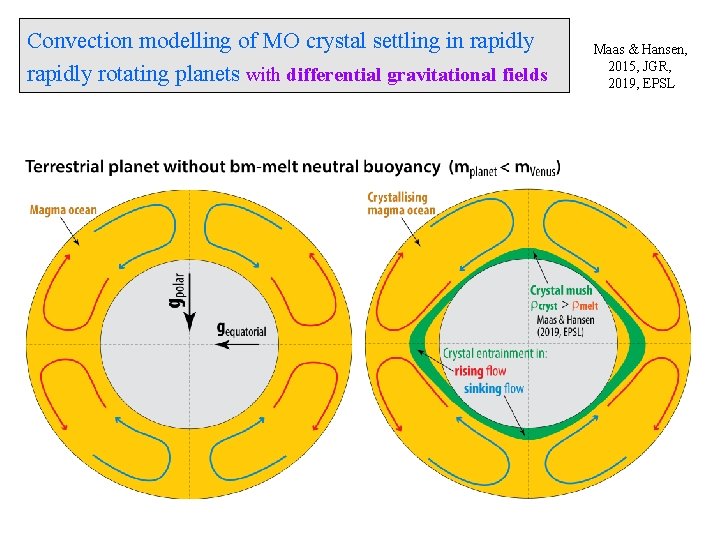
Convection modelling of MO crystal settling in rapidly rotating planets with differential gravitational fields Maas & Hansen, 2015, JGR, 2019, EPSL
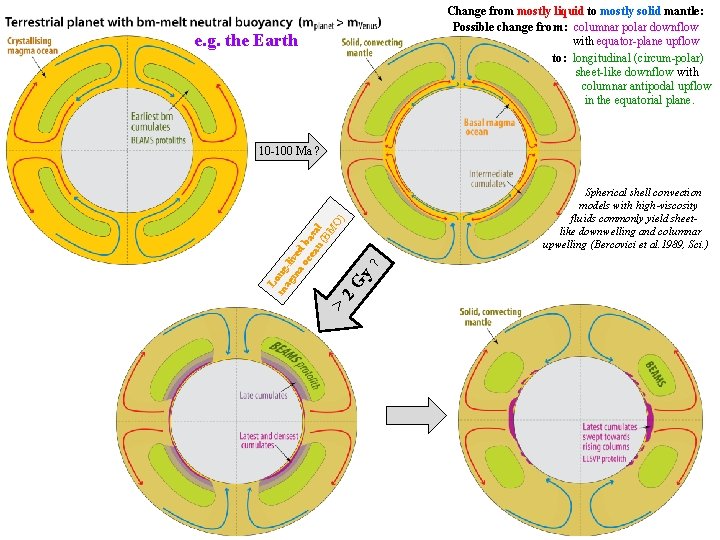
Change from mostly liquid to mostly solid mantle: Possible change from: columnar polar downflow with equator-plane upflow to: longitudinal (circum-polar) sheet-like downflow with columnar antipodal upflow in the equatorial plane. e. g. the Earth 10 -100 Ma ? > y? 2 G L m ong ag -li m ve ao d ce bas an al (B M O) Spherical shell convection models with high-viscosity fluids commonly yield sheetlike downwelling and columnar upwelling (Bercovici et al. 1989, Sci. )
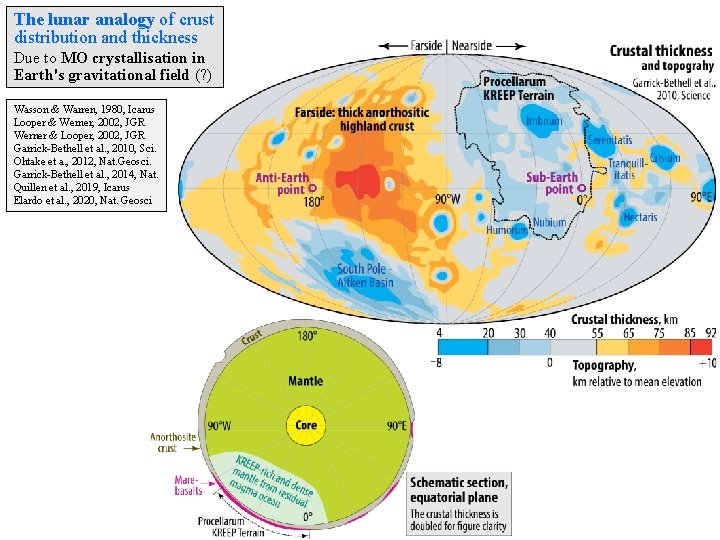
The lunar analogy of crust distribution and thickness Due to MO crystallisation in Earth's gravitational field (? ) Wasson & Warren, 1980, Icarus Looper & Werner, 2002, JGR Werner & Looper, 2002, JGR Garrick-Bethell et al. , 2010, Sci. Ohtake et a. , 2012, Nat. Geosci. Garrick-Bethell et al. , 2014, Nat. Quillen et al. , 2019, Icarus Elardo et al. , 2020, Nat. Geosci
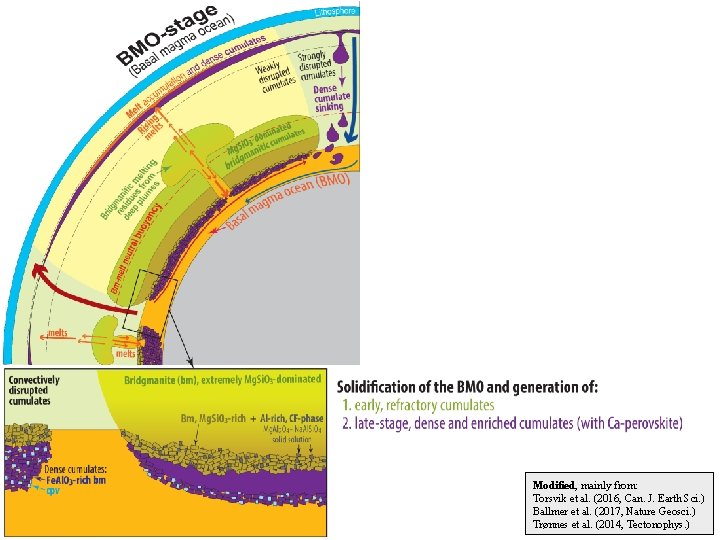
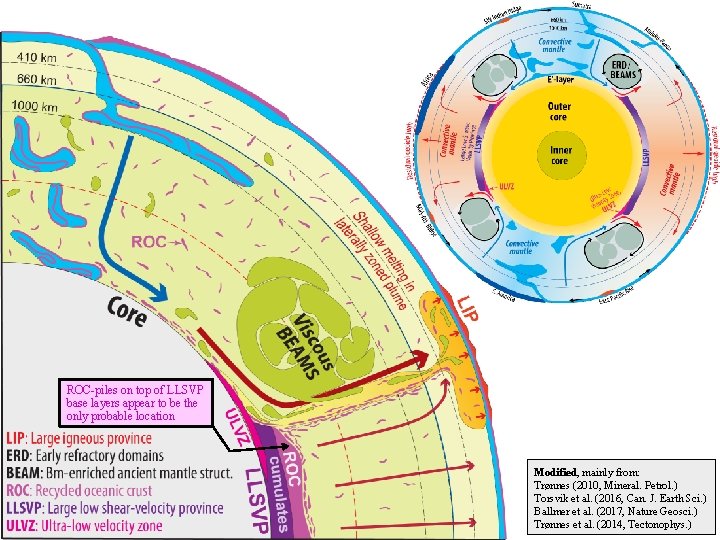
Modified, mainly from: Torsvik et al. (2016, Can. J. Earth Sci. ) Ballmer et al. (2017, Nature Geosci. ) Trønnes et al. (2014, Tectonophys. )
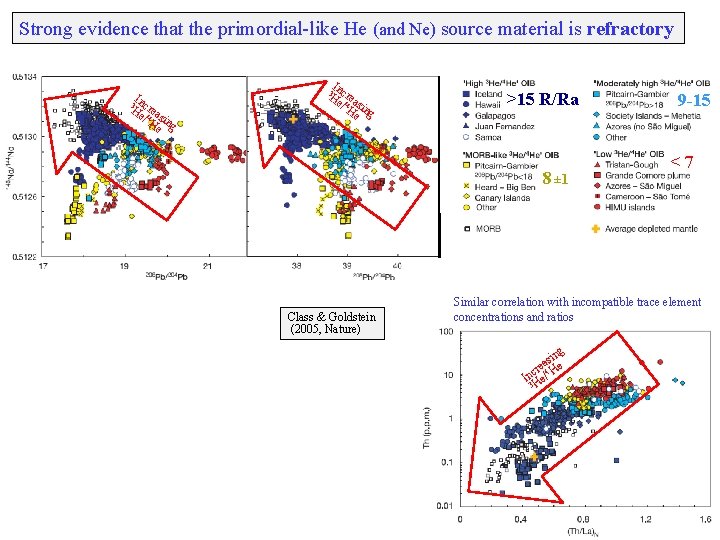
Strong evidence that the primordial-like He (and Ne) source material is refractory I 3 ncr He ea / 4 H sin e g In Hecrea / 4 H sin e g 3 >15 R/Ra 8 ± 1 Class & Goldstein (2005, Nature) 9 -15 <7 Similar correlation with incompatible trace element concentrations and ratios g sin a e cre 4 H In 3 e/ H
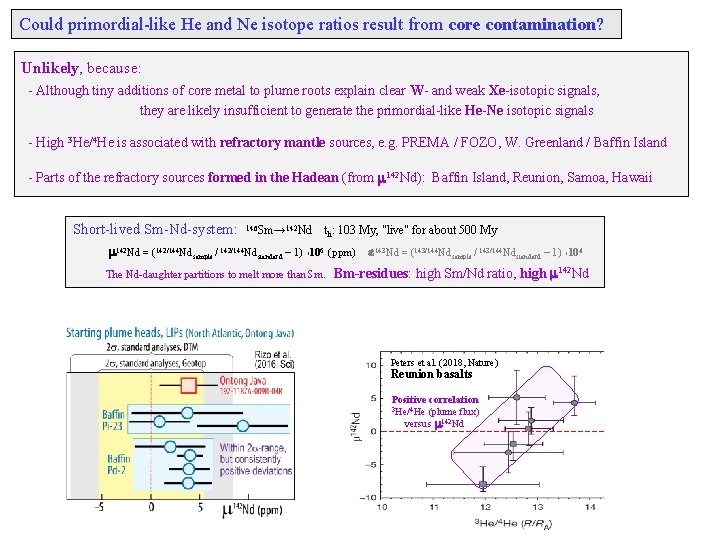
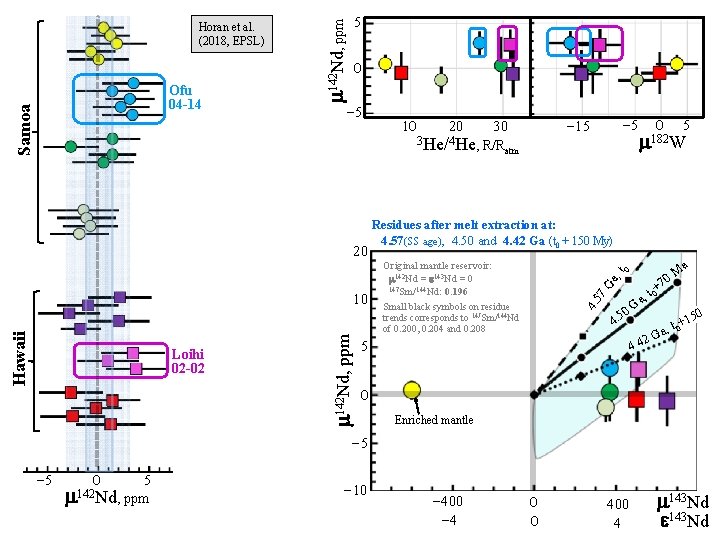
Could primordial-like He and Ne isotope ratios result from core contamination? Unlikely, because: - Although tiny additions of core metal to plume roots explain clear W- and weak Xe-isotopic signals, they are likely insufficient to generate the primordial-like He-Ne isotopic signals - High 3 He/4 He is associated with refractory mantle sources, e. g. PREMA / FOZO, W. Greenland / Baffin Island - Parts of the refractory sources formed in the Hadean (from m 142 Nd): Baffin Island, Reunion, Samoa, Hawaii Short-lived Sm-Nd-system: 146 Sm→ 142 Nd th: 103 My, "live" for about 500 My m 142 Nd = (142/144 Ndsample / 142/144 Ndstandard - 1) *106 (ppm) The Nd-daughter partitions to melt more than Sm. e 143 Nd = (143/144 Ndsample / 143/144 Ndstandard - 1) *104 Bm-residues: high Sm/Nd ratio, high m 142 Nd Peters et al. (2018, Nature) Reunion basalts Positive correlation 3 He/4 He (plume flux) versus m 142 Nd
0 10 20 3 He/4 He, R/R Loihi 02 -02 m 142 Nd, ppm Hawaii 10 atm m 0 5 182 W Residues after melt extraction at: 4. 57 (SS age), 4. 50 and 4. 42 Ga (t 0 + 150 My) a t 0 Original mantle reservoir: m 142 Nd = e 143 Nd = 0 147 Sm/144 Nd: 0. 196 Small black symbols on residue trends corresponds to 147 Sm/144 Nd of 0. 200, 0. 204 and 0. 208 a, 20 -5 -15 30 7 G -5 4. 5 Samoa Ofu 04 -14 5 m 142 Nd, ppm Horan et al. (2018, EPSL) 0 M +7 , t 0 a 0 G 4. 5 4. 4 5 150 + a, t 0 2 G 0 Enriched mantle -5 -5 m 0 5 142 Nd, ppm -10 -400 -4 0 0 400 4 m 143 Nd e 143 Nd
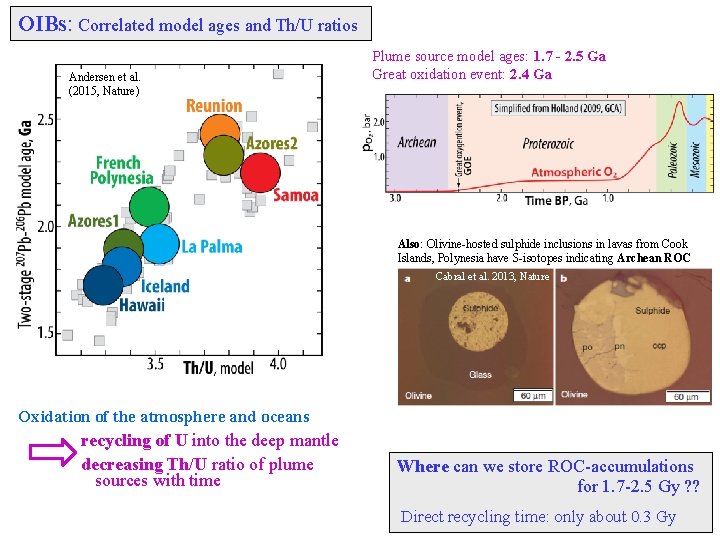
OIBs: Correlated model ages and Th/U ratios Andersen et al. (2015, Nature) Plume source model ages: 1. 7 - 2. 5 Ga Great oxidation event: 2. 4 Ga Also: Olivine-hosted sulphide inclusions in lavas from Cook Islands, Polynesia have S-isotopes indicating Archean ROC Cabral et al. 2013, Nature Oxidation of the atmosphere and oceans recycling of U into the deep mantle decreasing Th/U ratio of plume sources with time Where can we store ROC-accumulations for 1. 7 -2. 5 Gy ? ? Direct recycling time: only about 0. 3 Gy
ROC-piles on top of LLSVP base layers appear to be the only probable location Modified, mainly from: Trønnes (2010, Mineral. Petrol. ) Torsvik et al. (2016, Can. J. Earth Sci. ) Ballmer et al. (2017, Nature Geosci. ) Trønnes et al. (2014, Tectonophys. )
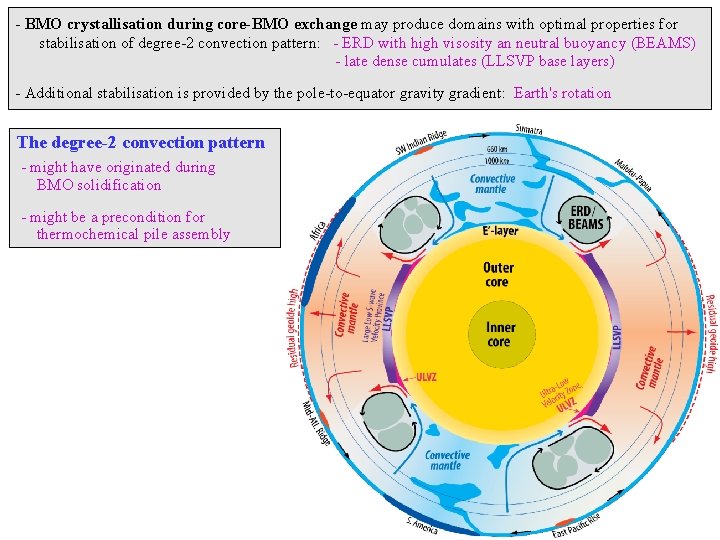
- BMO crystallisation during core-BMO exchange may produce domains with optimal properties for stabilisation of degree-2 convection pattern: - ERD with high visosity an neutral buoyancy (BEAMS) - late dense cumulates (LLSVP base layers) - Additional stabilisation is provided by the pole-to-equator gravity gradient: Earth's rotation The degree-2 convection pattern - might have originated during BMO solidification - might be a precondition for thermochemical pile assembly
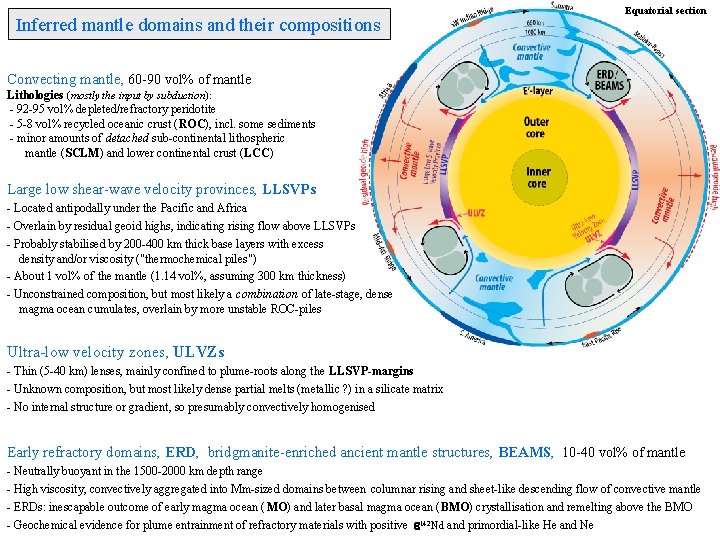
Inferred mantle domains and their compositions Equatorial section Convecting mantle, 60 -90 vol% of mantle Lithologies (mostly the input by subduction): - 92 -95 vol% depleted/refractory peridotite - 5 -8 vol% recycled oceanic crust (ROC), incl. some sediments - minor amounts of detached sub-continental lithospheric mantle (SCLM) and lower continental crust (LCC) Large low shear-wave velocity provinces, LLSVPs - Located antipodally under the Pacific and Africa - Overlain by residual geoid highs, indicating rising flow above LLSVPs - Probably stabilised by 200 -400 km thick base layers with excess density and/or viscosity ("thermochemical piles") - About 1 vol% of the mantle (1. 14 vol%, assuming 300 km thickness) - Unconstrained composition, but most likely a combination of late-stage, dense magma ocean cumulates, overlain by more unstable ROC-piles Ultra-low velocity zones, ULVZs - Thin (5 -40 km) lenses, mainly confined to plume-roots along the LLSVP-margins - Unknown composition, but most likely dense partial melts (metallic ? ) in a silicate matrix - No internal structure or gradient, so presumably convectively homogenised Early refractory domains, ERD, bridgmanite-enriched ancient mantle structures, BEAMS, 10 -40 vol% of mantle - Neutrally buoyant in the 1500 -2000 km depth range - High viscosity, convectively aggregated into Mm-sized domains between columnar rising and sheet-like descending flow of convective mantle - ERDs: inescapable outcome of early magma ocean (MO) and later basal magma ocean (BMO) crystallisation and remelting above the BMO - Geochemical evidence for plume entrainment of refractory materials with positive e 142 Nd and primordial-like He and Ne