
Structure from motion Multipleview geometry questions Scene geometry








- Slides: 42
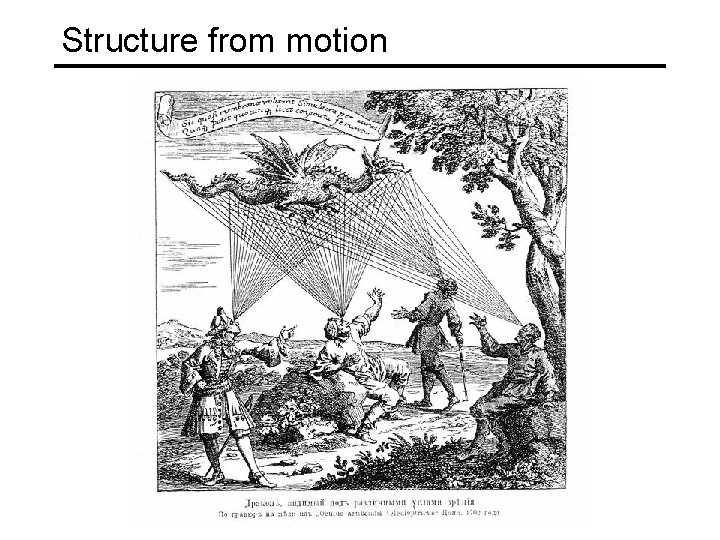
Structure from motion
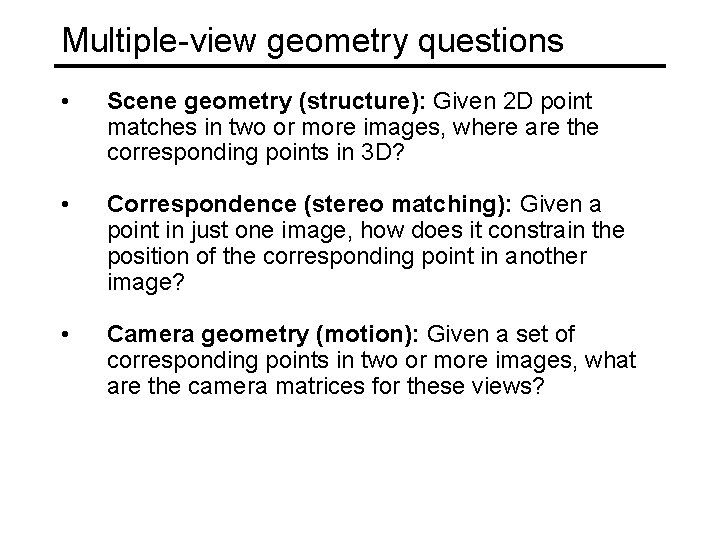
Multiple-view geometry questions • Scene geometry (structure): Given 2 D point matches in two or more images, where are the corresponding points in 3 D? • Correspondence (stereo matching): Given a point in just one image, how does it constrain the position of the corresponding point in another image? • Camera geometry (motion): Given a set of corresponding points in two or more images, what are the camera matrices for these views?
Structure from motion • Given: m images of n fixed 3 D points xij = Pi Xj , i = 1, … , m, j = 1, … , n • Problem: estimate m projection matrices Pi and n 3 D points Xj from the mn correspondences xij Xj x 1 j P 1 x 3 j x 2 j P 2 P 3
Structure from motion ambiguity • If we scale the entire scene by some factor k and, at the same time, scale the camera matrices by the factor of 1/k, the projections of the scene points in the image remain exactly the same: It is impossible to recover the absolute scale of the scene!
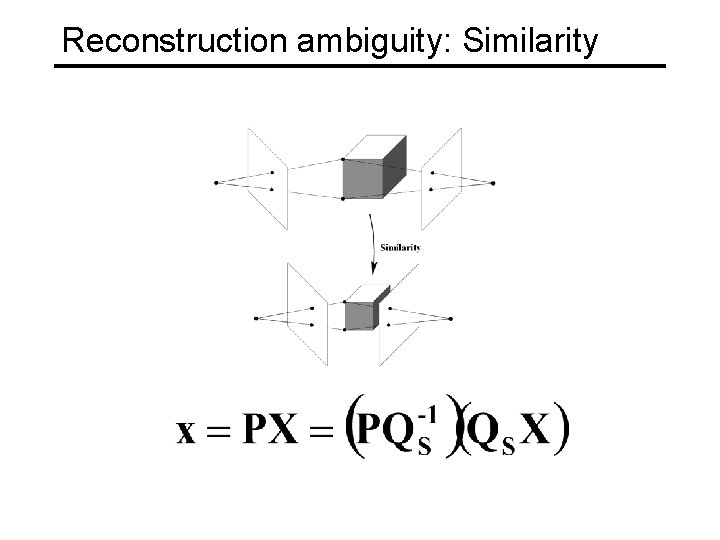
Structure from motion ambiguity • If we scale the entire scene by some factor k and, at the same time, scale the camera matrices by the factor of 1/k, the projections of the scene points in the image remain exactly the same • More generally: if we transform the scene using a transformation Q and apply the inverse transformation to the camera matrices, then the images do not change
Reconstruction ambiguity: Similarity
Reconstruction ambiguity: Affine
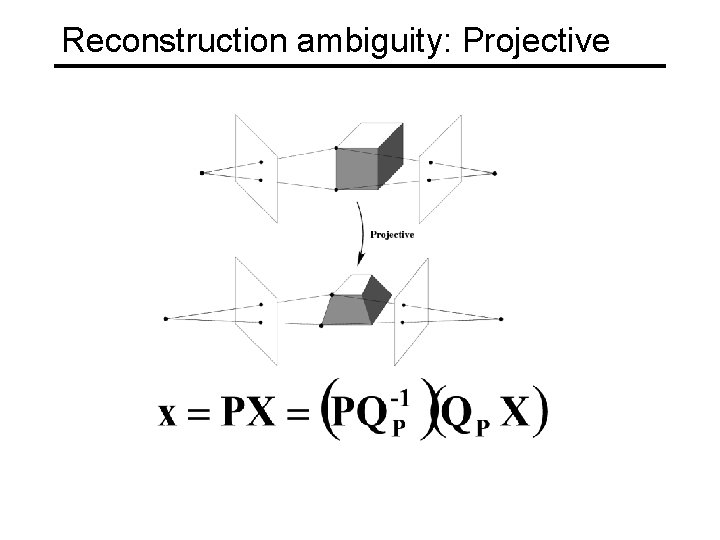
Reconstruction ambiguity: Projective
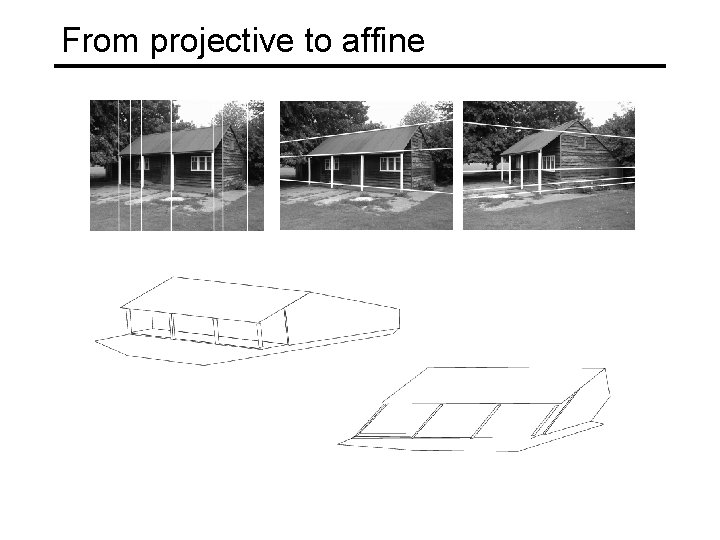
Projective ambiguity
From projective to affine
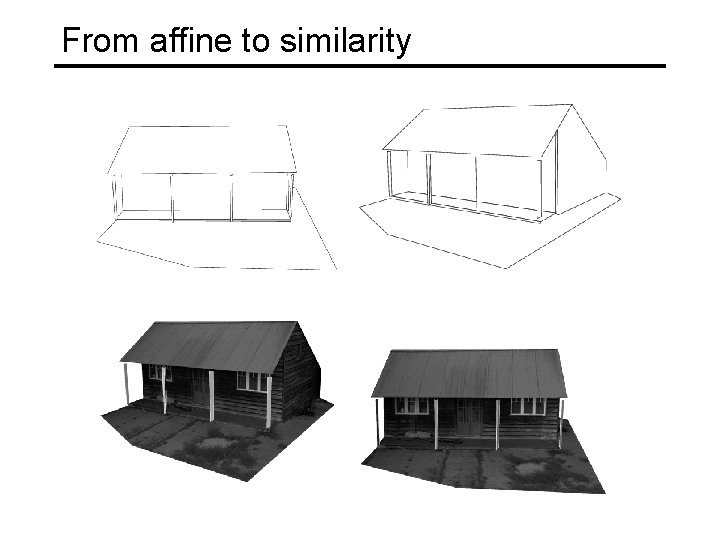
From affine to similarity
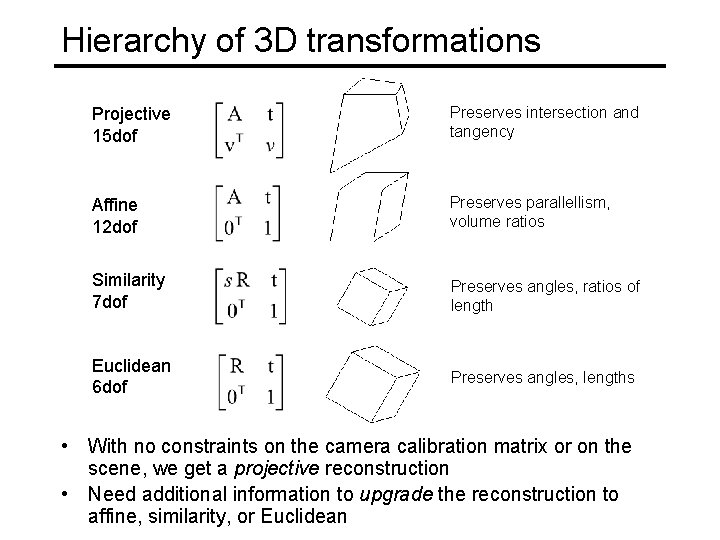
Hierarchy of 3 D transformations Projective 15 dof Preserves intersection and tangency Affine 12 dof Preserves parallellism, volume ratios Similarity 7 dof Preserves angles, ratios of length Euclidean 6 dof Preserves angles, lengths • With no constraints on the camera calibration matrix or on the scene, we get a projective reconstruction • Need additional information to upgrade the reconstruction to affine, similarity, or Euclidean
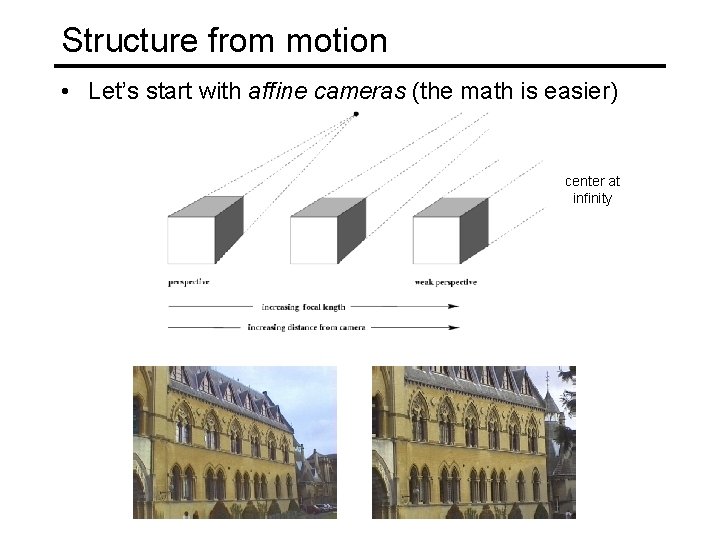
Structure from motion • Let’s start with affine cameras (the math is easier) center at infinity
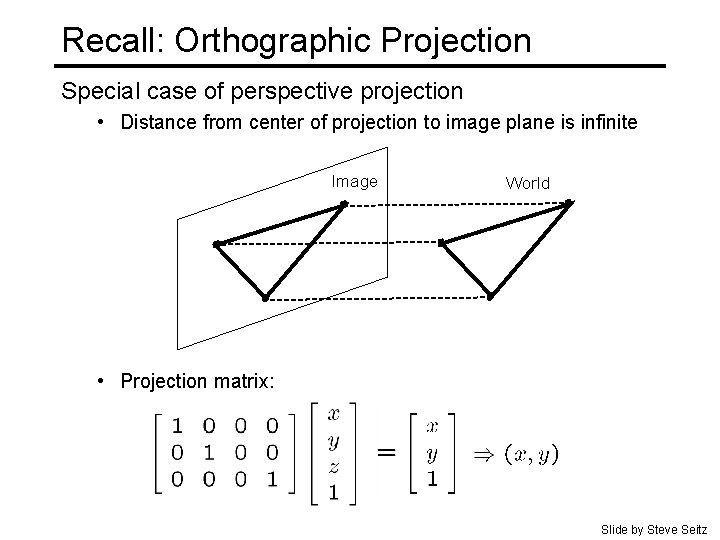
Recall: Orthographic Projection Special case of perspective projection • Distance from center of projection to image plane is infinite Image World • Projection matrix: Slide by Steve Seitz
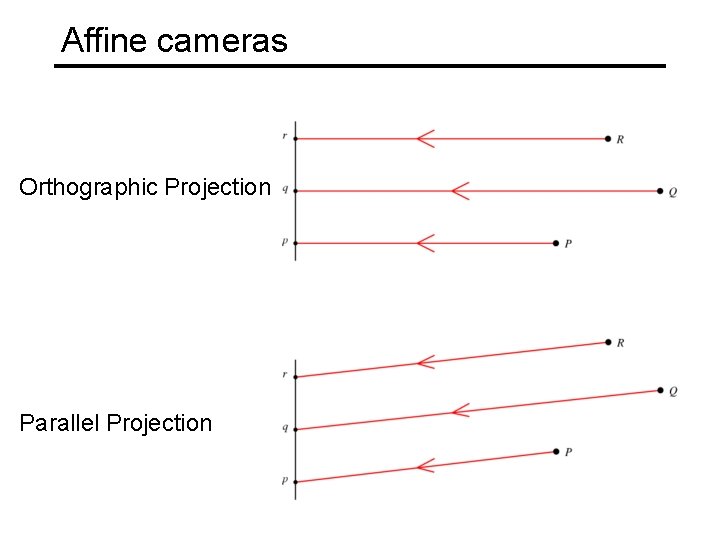
Affine cameras Orthographic Projection Parallel Projection
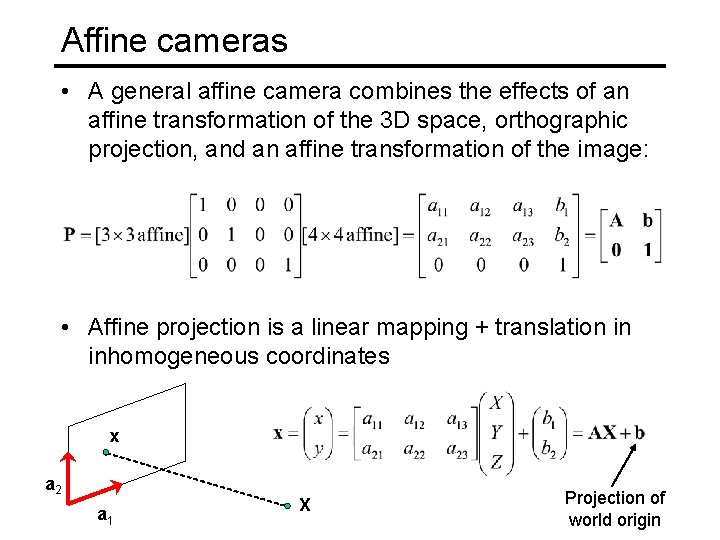
Affine cameras • A general affine camera combines the effects of an affine transformation of the 3 D space, orthographic projection, and an affine transformation of the image: • Affine projection is a linear mapping + translation in inhomogeneous coordinates x a 2 a 1 X Projection of world origin
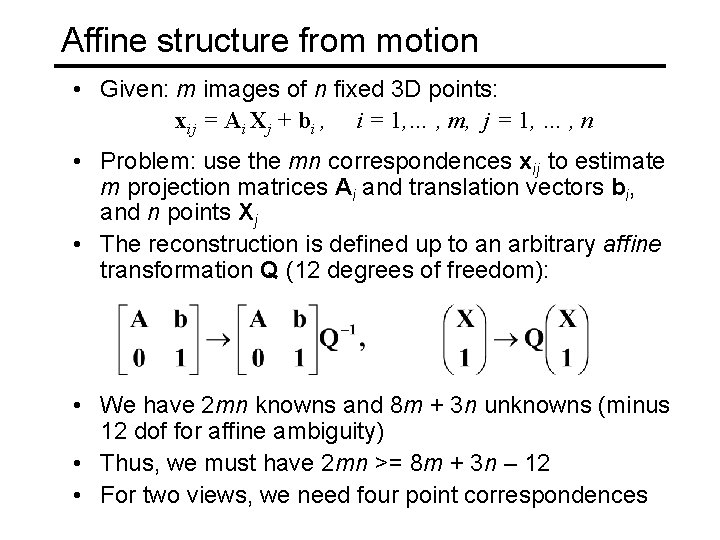
Affine structure from motion • Given: m images of n fixed 3 D points: xij = Ai Xj + bi , i = 1, … , m, j = 1, … , n • Problem: use the mn correspondences xij to estimate m projection matrices Ai and translation vectors bi, and n points Xj • The reconstruction is defined up to an arbitrary affine transformation Q (12 degrees of freedom): • We have 2 mn knowns and 8 m + 3 n unknowns (minus 12 dof for affine ambiguity) • Thus, we must have 2 mn >= 8 m + 3 n – 12 • For two views, we need four point correspondences
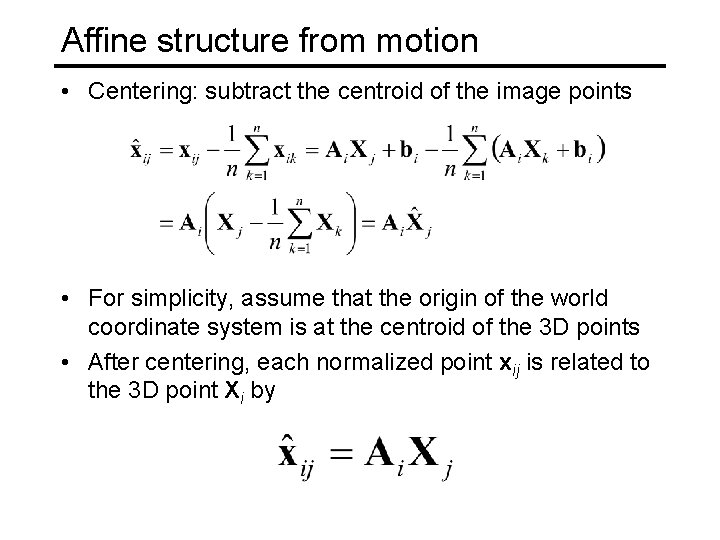
Affine structure from motion • Centering: subtract the centroid of the image points • For simplicity, assume that the origin of the world coordinate system is at the centroid of the 3 D points • After centering, each normalized point xij is related to the 3 D point Xi by
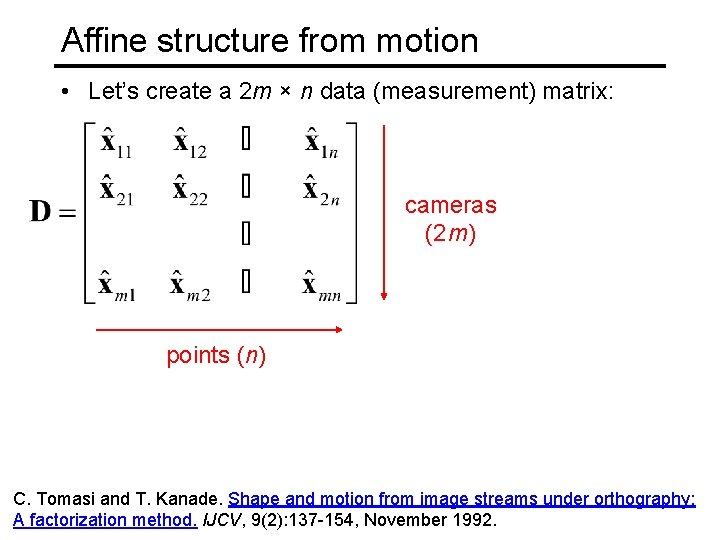
Affine structure from motion • Let’s create a 2 m × n data (measurement) matrix: cameras (2 m) points (n) C. Tomasi and T. Kanade. Shape and motion from image streams under orthography: A factorization method. IJCV, 9(2): 137 -154, November 1992.
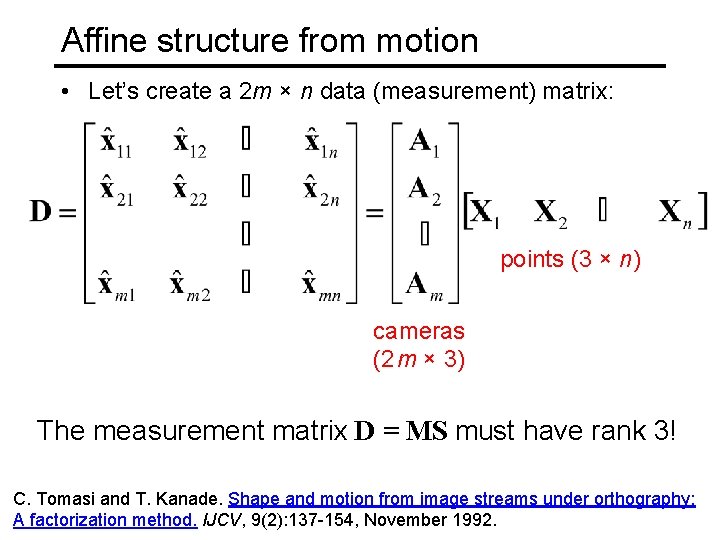
Affine structure from motion • Let’s create a 2 m × n data (measurement) matrix: points (3 × n) cameras (2 m × 3) The measurement matrix D = MS must have rank 3! C. Tomasi and T. Kanade. Shape and motion from image streams under orthography: A factorization method. IJCV, 9(2): 137 -154, November 1992.
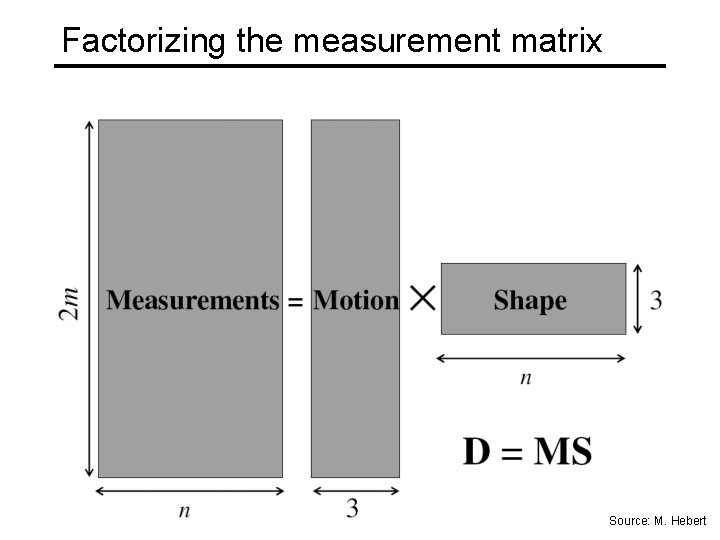
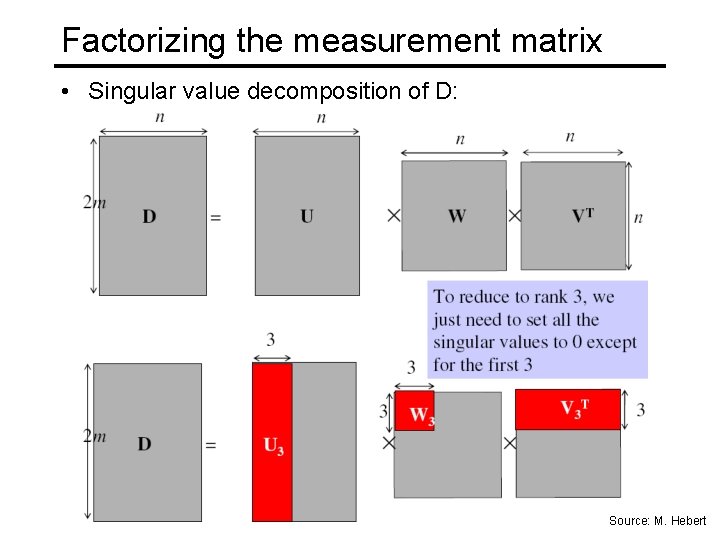
Factorizing the measurement matrix Source: M. Hebert
Factorizing the measurement matrix • Singular value decomposition of D: Source: M. Hebert
Factorizing the measurement matrix • Singular value decomposition of D: Source: M. Hebert
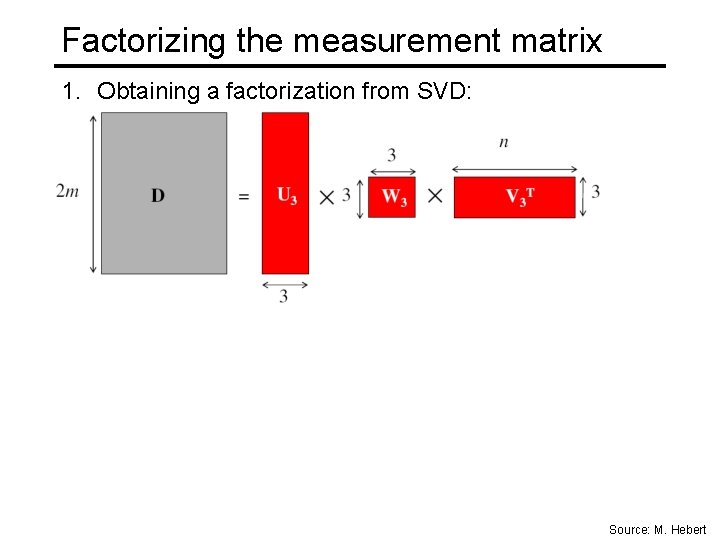
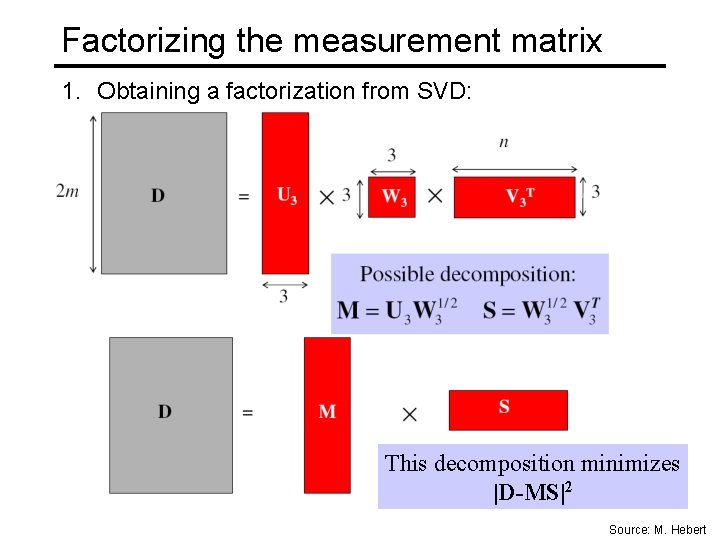
Factorizing the measurement matrix 1. Obtaining a factorization from SVD: Source: M. Hebert
Factorizing the measurement matrix 1. Obtaining a factorization from SVD: This decomposition minimizes |D-MS|2 Source: M. Hebert
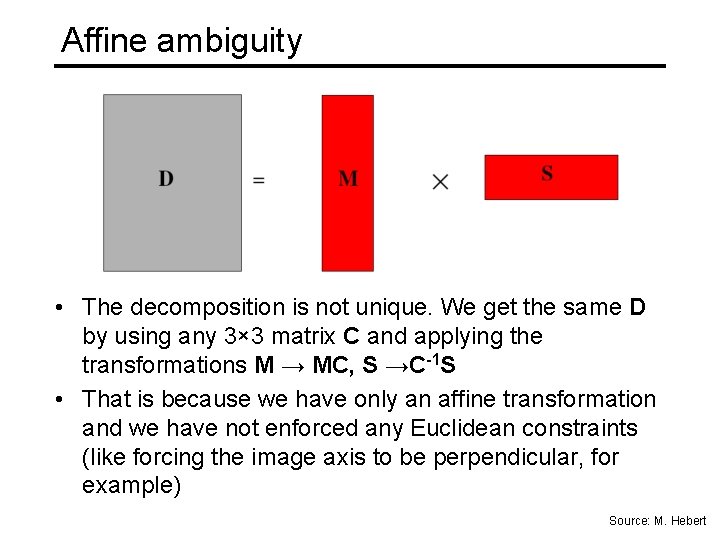
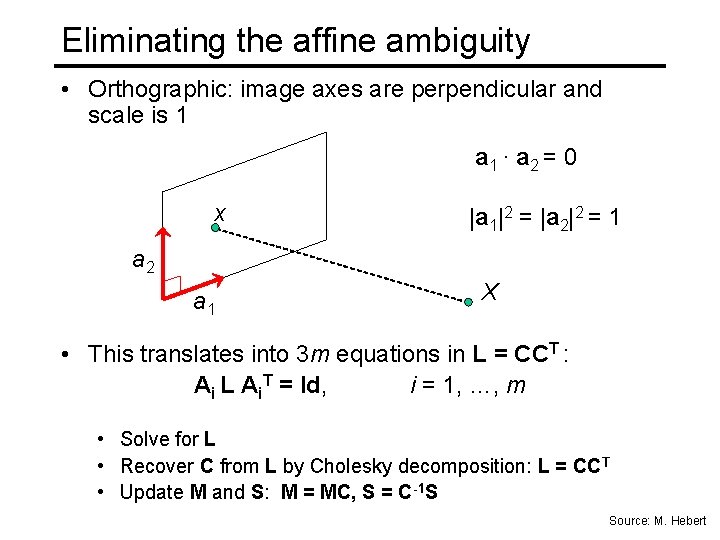
Affine ambiguity • The decomposition is not unique. We get the same D by using any 3× 3 matrix C and applying the transformations M → MC, S →C-1 S • That is because we have only an affine transformation and we have not enforced any Euclidean constraints (like forcing the image axis to be perpendicular, for example) Source: M. Hebert
Eliminating the affine ambiguity • Orthographic: image axes are perpendicular and scale is 1 a 1 · a 2 = 0 x |a 1|2 = |a 2|2 = 1 a 2 a 1 X • This translates into 3 m equations in L = CCT : Ai L Ai. T = Id, i = 1, …, m • Solve for L • Recover C from L by Cholesky decomposition: L = CCT • Update M and S: M = MC, S = C-1 S Source: M. Hebert
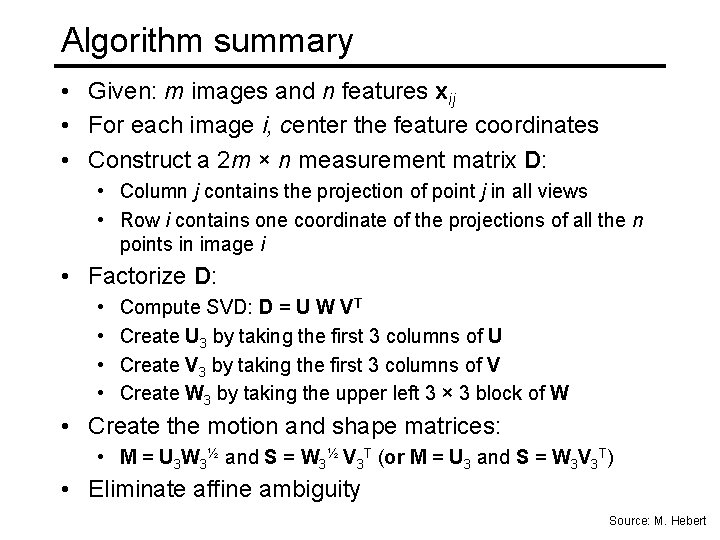
Algorithm summary • Given: m images and n features xij • For each image i, center the feature coordinates • Construct a 2 m × n measurement matrix D: • Column j contains the projection of point j in all views • Row i contains one coordinate of the projections of all the n points in image i • Factorize D: • • Compute SVD: D = U W VT Create U 3 by taking the first 3 columns of U Create V 3 by taking the first 3 columns of V Create W 3 by taking the upper left 3 × 3 block of W • Create the motion and shape matrices: • M = U 3 W 3½ and S = W 3½ V 3 T (or M = U 3 and S = W 3 V 3 T) • Eliminate affine ambiguity Source: M. Hebert
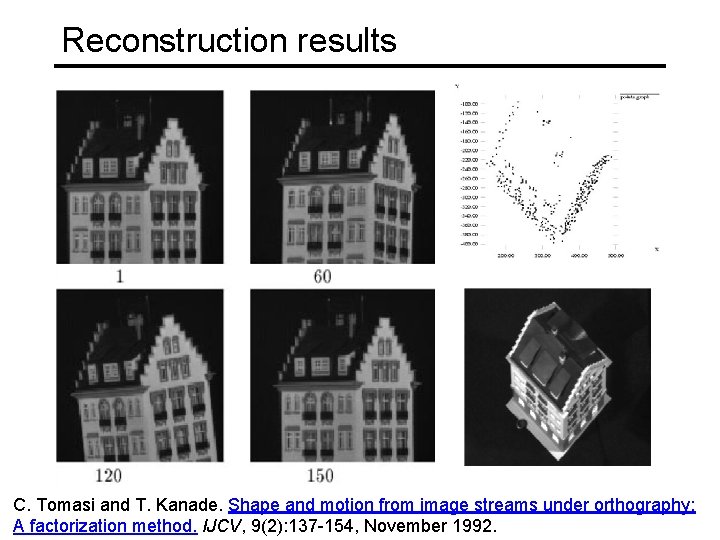
Reconstruction results C. Tomasi and T. Kanade. Shape and motion from image streams under orthography: A factorization method. IJCV, 9(2): 137 -154, November 1992.
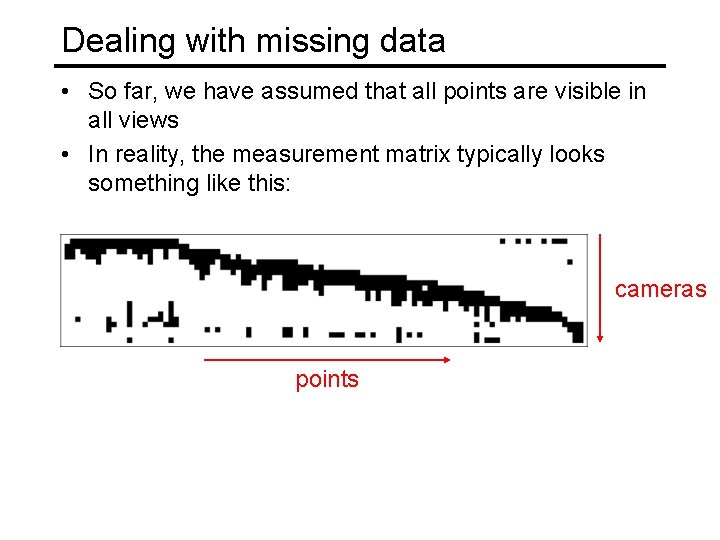
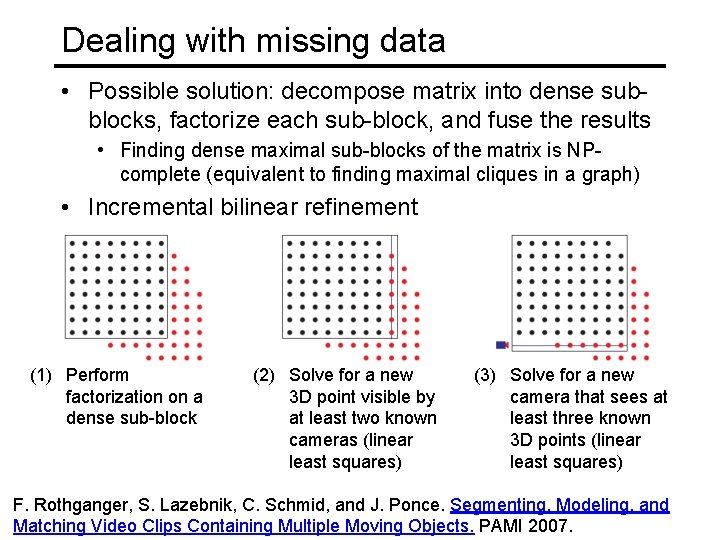
Dealing with missing data • So far, we have assumed that all points are visible in all views • In reality, the measurement matrix typically looks something like this: cameras points
Dealing with missing data • Possible solution: decompose matrix into dense subblocks, factorize each sub-block, and fuse the results • Finding dense maximal sub-blocks of the matrix is NPcomplete (equivalent to finding maximal cliques in a graph) • Incremental bilinear refinement (1) Perform factorization on a dense sub-block (2) Solve for a new 3 D point visible by at least two known cameras (linear least squares) (3) Solve for a new camera that sees at least three known 3 D points (linear least squares) F. Rothganger, S. Lazebnik, C. Schmid, and J. Ponce. Segmenting, Modeling, and Matching Video Clips Containing Multiple Moving Objects. PAMI 2007.
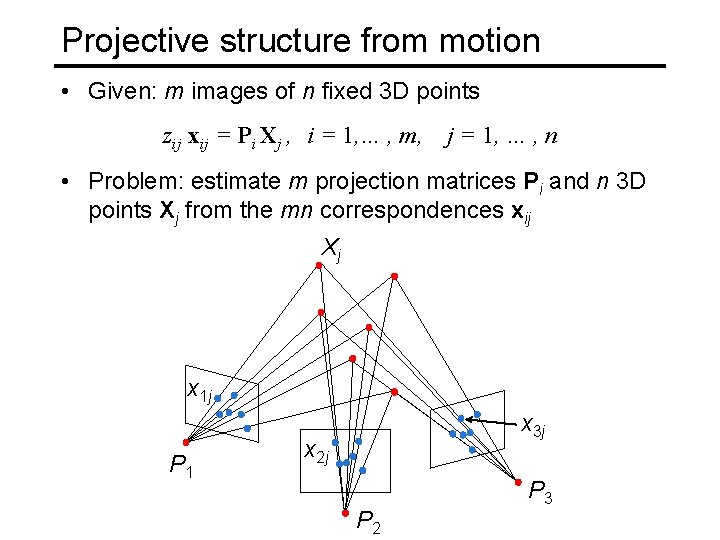
Projective structure from motion • Given: m images of n fixed 3 D points zij xij = Pi Xj , i = 1, … , m, j = 1, … , n • Problem: estimate m projection matrices Pi and n 3 D points Xj from the mn correspondences xij Xj x 1 j P 1 x 3 j x 2 j P 2 P 3
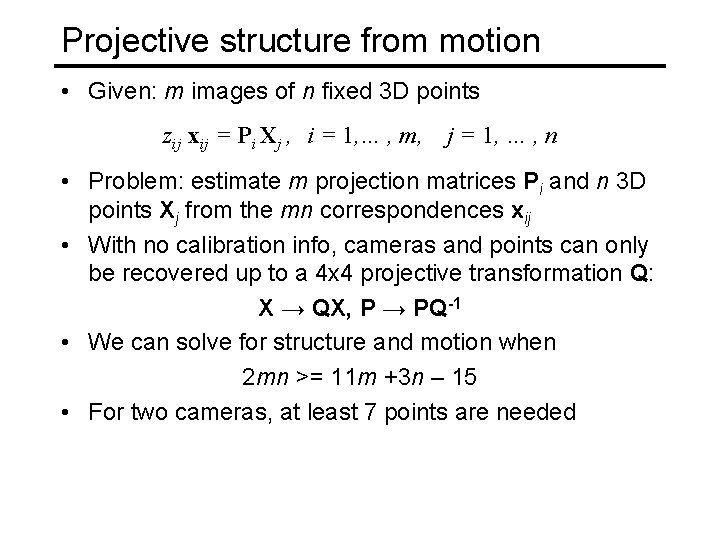
Projective structure from motion • Given: m images of n fixed 3 D points zij xij = Pi Xj , i = 1, … , m, j = 1, … , n • Problem: estimate m projection matrices Pi and n 3 D points Xj from the mn correspondences xij • With no calibration info, cameras and points can only be recovered up to a 4 x 4 projective transformation Q: X → QX, P → PQ-1 • We can solve for structure and motion when 2 mn >= 11 m +3 n – 15 • For two cameras, at least 7 points are needed
Projective SFM: Two-camera case • • • Compute fundamental matrix F between the two views First camera matrix: [I|0]Q-1 Second camera matrix: [A|b]Q-1 Let Then b: epipole (FTb = 0), A = –[b×]F F&P sec. 13. 3. 1
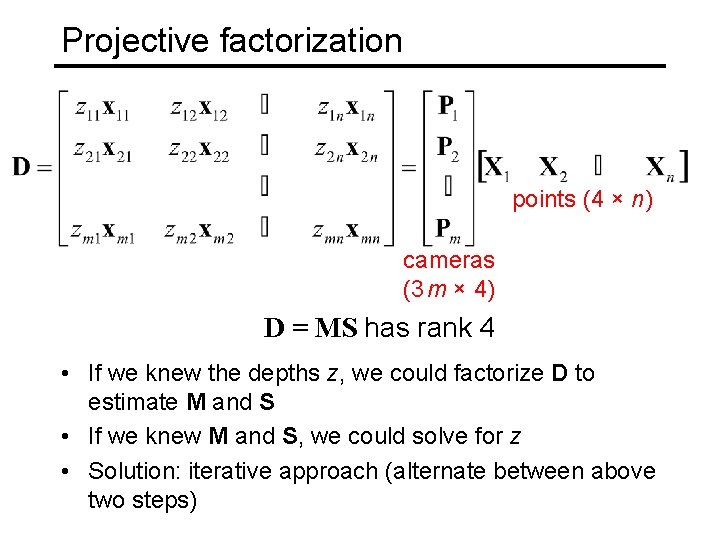
Projective factorization points (4 × n) cameras (3 m × 4) D = MS has rank 4 • If we knew the depths z, we could factorize D to estimate M and S • If we knew M and S, we could solve for z • Solution: iterative approach (alternate between above two steps)
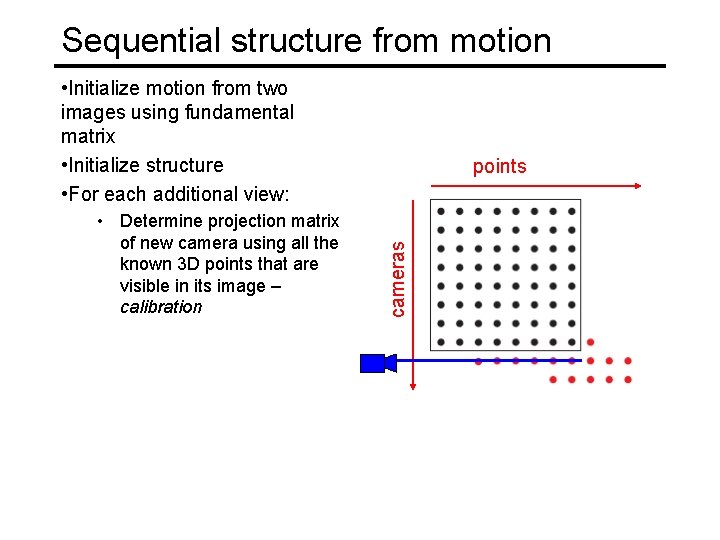
Sequential structure from motion • Initialize motion from two images using fundamental matrix • Initialize structure • For each additional view: cameras • Determine projection matrix of new camera using all the known 3 D points that are visible in its image – calibration points
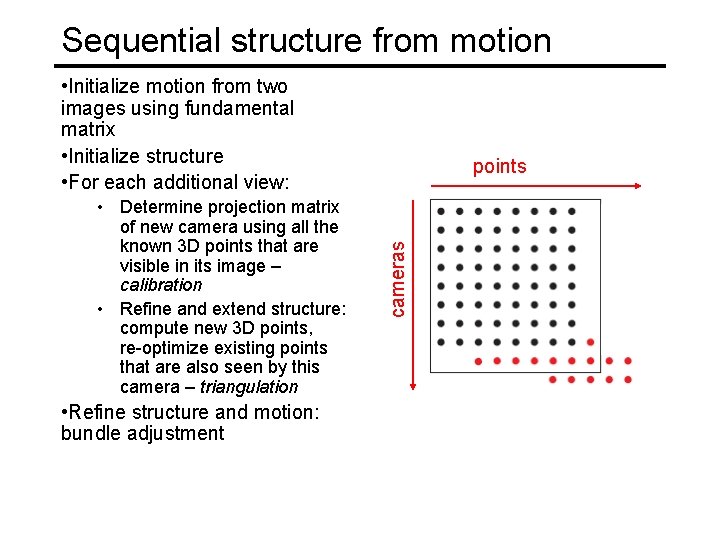
Sequential structure from motion • Initialize motion from two images using fundamental matrix • Initialize structure • For each additional view: cameras • Determine projection matrix of new camera using all the known 3 D points that are visible in its image – calibration • Refine and extend structure: compute new 3 D points, re-optimize existing points that are also seen by this camera – triangulation points
Sequential structure from motion • Initialize motion from two images using fundamental matrix • Initialize structure • For each additional view: • Refine structure and motion: bundle adjustment cameras • Determine projection matrix of new camera using all the known 3 D points that are visible in its image – calibration • Refine and extend structure: compute new 3 D points, re-optimize existing points that are also seen by this camera – triangulation points
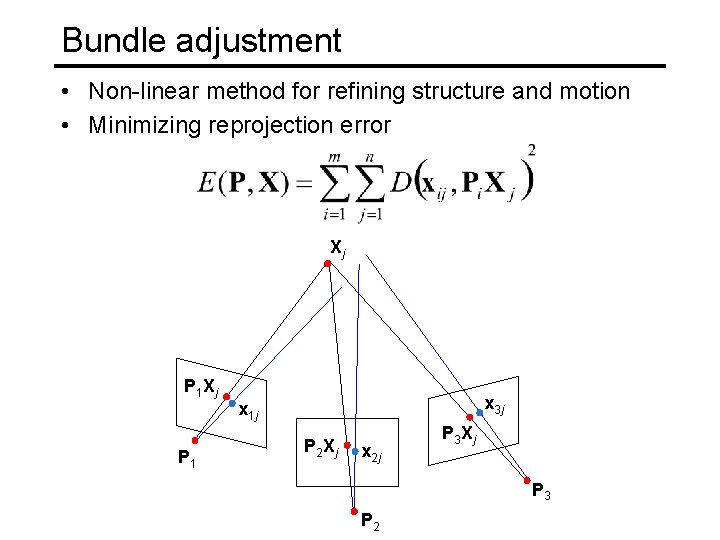
Bundle adjustment • Non-linear method for refining structure and motion • Minimizing reprojection error Xj P 1 x 3 j x 1 j P 2 Xj x 2 j P 3 Xj P 3 P 2
Self-calibration • Self-calibration (auto-calibration) is the process of determining intrinsic camera parameters directly from uncalibrated images • For example, when the images are acquired by a single moving camera, we can use the constraint that the intrinsic parameter matrix remains fixed for all the images • Compute initial projective reconstruction and find 3 D projective transformation matrix Q such that all camera matrices are in the form Pi = K [Ri | ti] • Can use constraints on the form of the calibration matrix: zero skew
Summary: Structure from motion • • Ambiguity Affine structure from motion: factorization Dealing with missing data Projective structure from motion: two views Projective structure from motion: iterative factorization Bundle adjustment Self-calibration
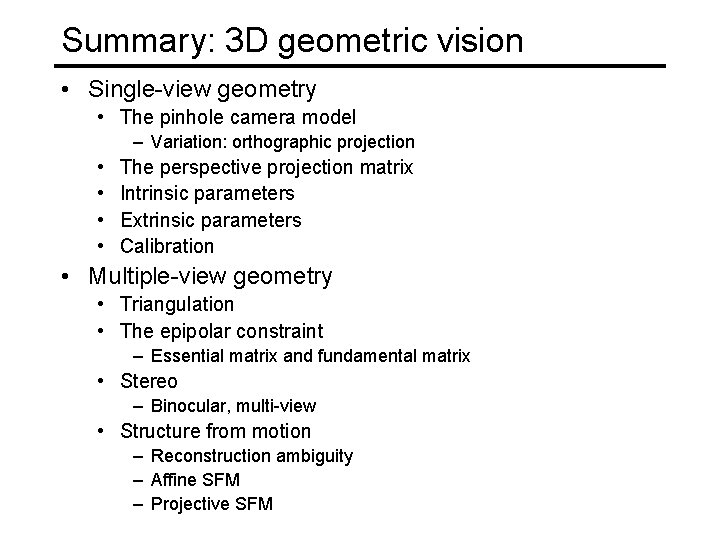
Summary: 3 D geometric vision • Single-view geometry • The pinhole camera model – Variation: orthographic projection • • The perspective projection matrix Intrinsic parameters Extrinsic parameters Calibration • Multiple-view geometry • Triangulation • The epipolar constraint – Essential matrix and fundamental matrix • Stereo – Binocular, multi-view • Structure from motion – Reconstruction ambiguity – Affine SFM – Projective SFM